

The human mind is not a single voice giving clear instructions all day. It is more like a living system that takes in information, gives meaning to it, compares it with past experience, reacts through the body, forms motives, and prepares behavior. That is why a small comment can feel harmless one day and personal the next. The outside event matters, but so does the inner process that turns the event into meaning.
Understanding how the human mind works can help you make sense of ordinary moments: why you overthink before sending a message, why an old memory changes a current reaction, why stress makes small tasks feel harder, why habits run on autopilot, and why insight does not always change behavior right away.
Quick Answer
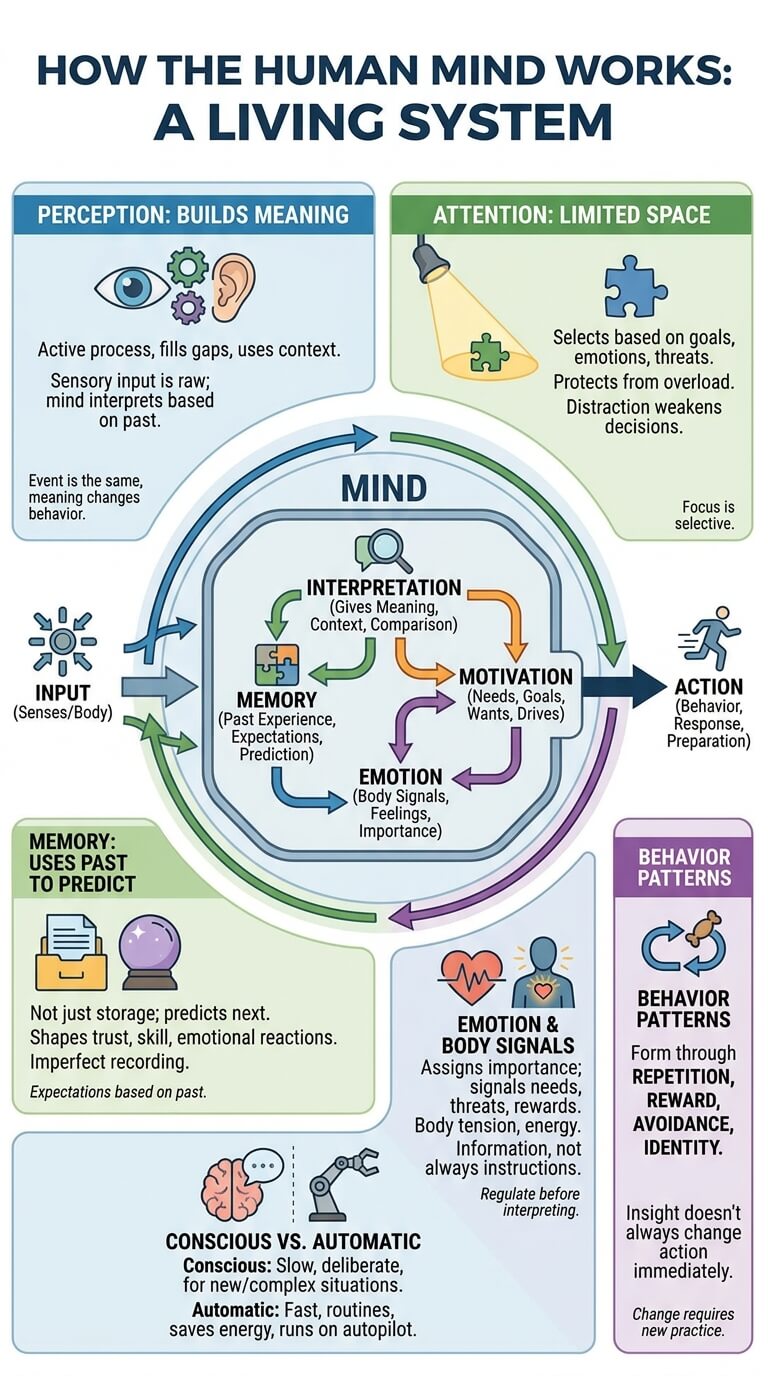
The human mind works by selecting information, interpreting it, connecting it to memory, creating emotional and body responses, weighing needs and motives, then preparing action. Some of this process feels conscious and deliberate. Much of it is fast, automatic, and shaped by past learning, context, stress, and repeated behavior.
A Simple Model of the Mind
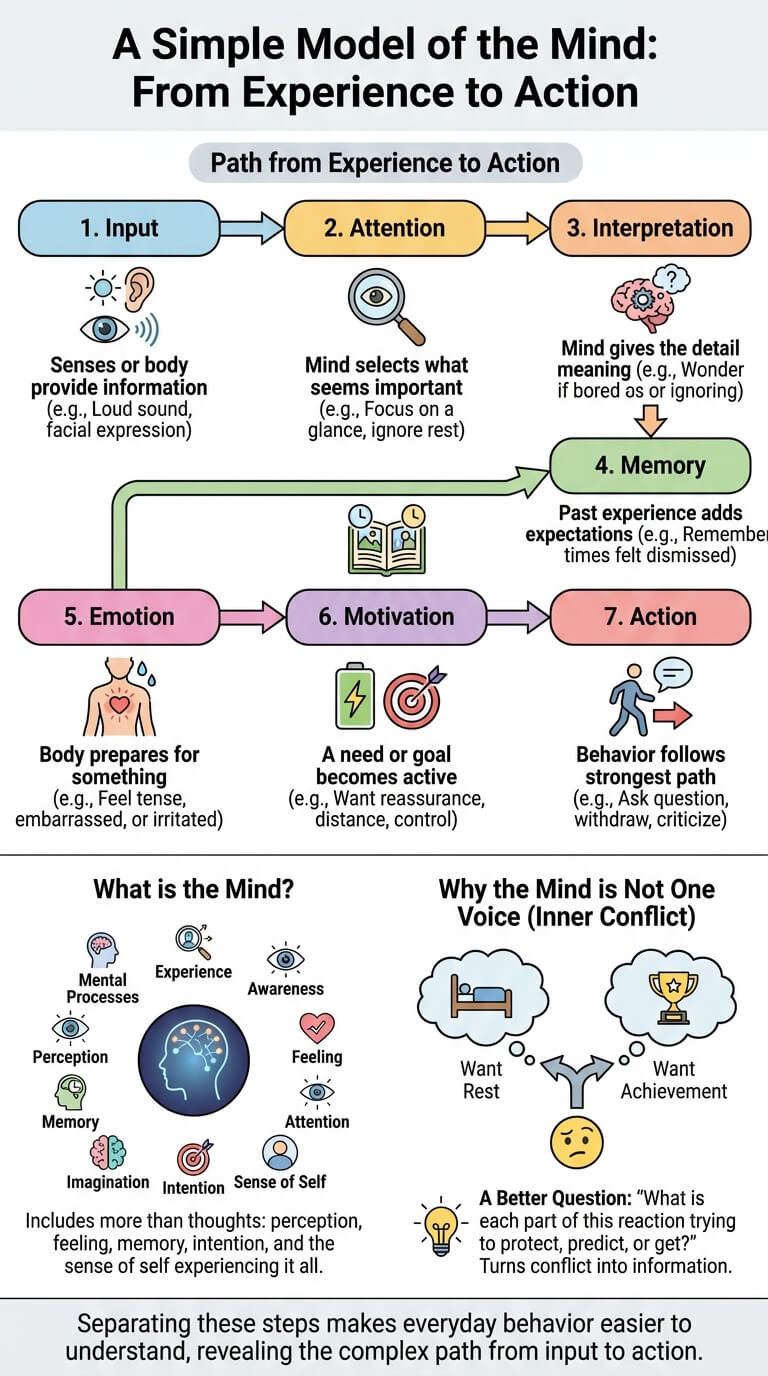
A useful way to understand the mind is to follow the path from experience to action. Something happens, the mind notices part of it, gives it meaning, checks it against memory, creates a body and emotional response, feels a motive, then moves toward a behavior. These steps often overlap, but separating them makes everyday behavior easier to understand. The mind is central to human behavior psychology.
The APA Dictionary of Psychology defines mind in relation to mental processes, experience, and awareness. For general readers, the important point is that the mind includes more than thoughts. It includes perception, feeling, memory, attention, imagination, intention, and the sense of self that experiences all of it. Meaning and expectation show how thoughts influence behavior.
Input, interpretation, emotion, memory, motivation, action
The mind begins with input, but behavior rarely comes from input alone. A loud sound, a facial expression, a deadline, a text message, a physical sensation, or a social situation becomes meaningful only after the mind interprets it. That interpretation then changes what a person feels and what they are ready to do.
| Step | What happens inside | Everyday example |
|---|---|---|
| Input | The senses or body provide information | You see someone glance at their phone while you talk |
| Attention | The mind selects what seems important | You focus on the glance, not the rest of the conversation |
| Interpretation | The mind gives the detail meaning | You wonder if they are bored or ignoring you |
| Memory | Past experience adds expectations | You remember other times you felt dismissed |
| Emotion | The body prepares for something | You feel tense, embarrassed, or irritated |
| Motivation | A need or goal becomes active | You want reassurance, distance, control, or clarity |
| Action | Behavior follows the strongest available path | You ask a question, withdraw, criticize, or move on |
Why the mind is not one single voice
People often talk about the mind as if it should have one clear opinion. In reality, the mind can hold competing signals at the same time. You may want rest and achievement. You may want closeness and privacy. You may know a task matters and still avoid starting it. You may feel angry even while understanding the other person’s perspective.
A practical question is not “Which thought is the real me?” A better question is: “What is each part of this reaction trying to protect, predict, or get?” That question turns inner conflict into information you can work with.
Perception: The Mind Builds Meaning
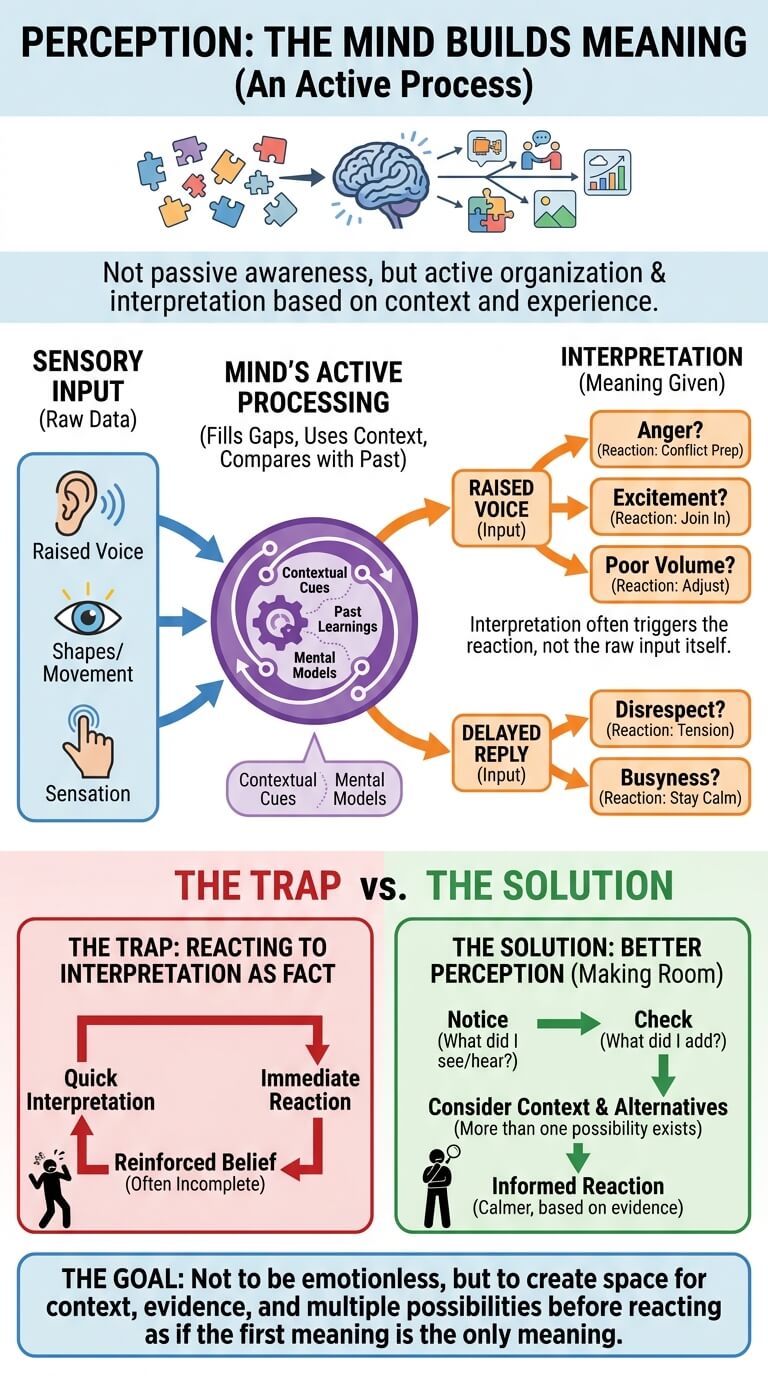
Perception is the process of turning sensory information into a meaningful experience. You do not simply see shapes, hear sounds, and feel sensations. Your mind organizes them into objects, events, risks, opportunities, and social meanings.
The APA Dictionary entry on perception describes it as becoming aware of objects, relationships, and events through the senses. That sounds simple, but perception is active. The mind fills gaps, uses context, and compares the present with what it has learned before.
Sensory input vs interpretation
Sensory input is the raw information. Interpretation is the meaning the mind gives to it. A raised voice is sound. The interpretation might be anger, excitement, urgency, pain, cultural style, or poor volume control. A quiet room is silence. The interpretation might be peace, rejection, tension, boredom, or focus.
This distinction matters because people often react to interpretation as if it were fact. If you interpret a delayed reply as disrespect, your body may prepare for conflict. If you interpret it as busyness, you may stay calm. The event is the same, but the meaning changes the next step.
A perception check can be very simple: “What did I notice, and what did I add?” This does not mean doubting yourself constantly. It means leaving room for more than one explanation when the evidence is incomplete.
How context changes what something means
Context changes the mind’s reading of a situation. A short answer from someone who is rushing to a meeting feels different from a short answer after days of cold behavior. A fast heartbeat after exercise feels different from a fast heartbeat before a presentation. A serious face in a hospital means something different from a serious face during deep concentration.
Better perception is not about becoming emotionless. It is about making room for context, evidence, and possibility before reacting as if the first meaning is the only meaning.
Attention: The Mind Has Limited Space
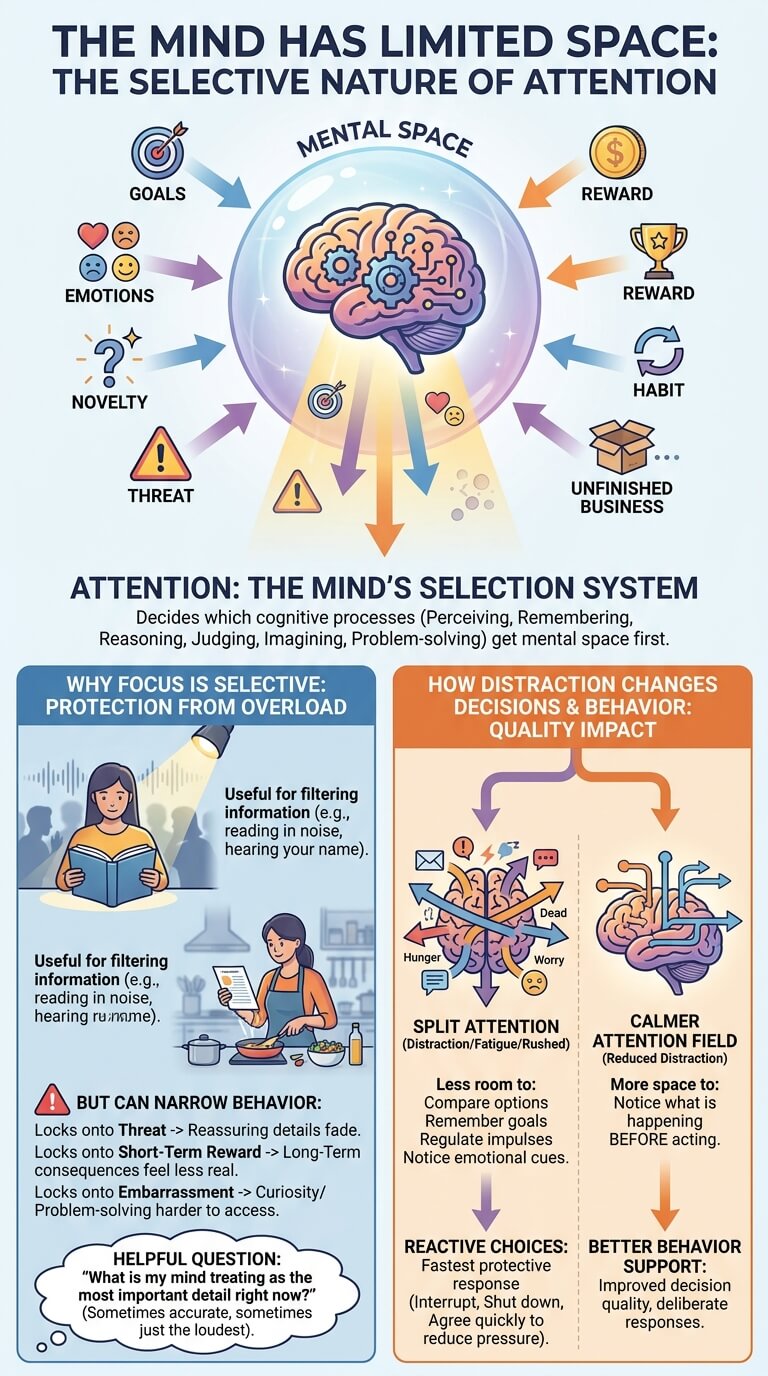
Attention is the mind’s selection system. At any moment, there is more information available than you can fully process. The mind has to choose. It chooses based on goals, emotions, novelty, threat, reward, habit, and what feels unfinished.
APA’s overview of cognition and the brain describes cognition as including forms of knowing and awareness such as perceiving, remembering, reasoning, judging, imagining, and problem-solving. Attention helps decide which of those processes gets mental space first.
Why focus is selective
Selective focus is useful because it protects you from overload. You can read a sentence while ignoring background noise. You can listen for your name in a crowded room. You can focus on a recipe while ignoring most of the visual details in your kitchen.
The same selection can narrow your behavior. If attention locks onto a possible threat, reassuring details may fade into the background. If attention locks onto short-term reward, long-term consequences may feel less real. If attention locks onto embarrassment, curiosity and problem-solving may become harder to access.
A helpful attention question is: “What is my mind treating as the most important detail right now?” Sometimes the answer is accurate. Sometimes the mind has put a spotlight on the loudest detail rather than the most complete picture.
How distraction changes decisions and behavior
Distraction does not only waste time. It changes the quality of decisions. When attention is split, the mind has less room to compare options, remember goals, regulate impulses, or notice emotional cues. This is why small choices can become more reactive when you are tired, rushed, or interrupted.
For example, a person may plan to respond calmly to feedback, but if they are already juggling messages, deadlines, hunger, and worry, their mind may choose the fastest protective response. They may interrupt, shut down, or agree too quickly just to reduce pressure.
Reducing distraction is not just a productivity trick. It can be a behavior support. A calmer attention field gives the mind more space to notice what is happening before it acts.
Memory: The Mind Uses the Past to Predict
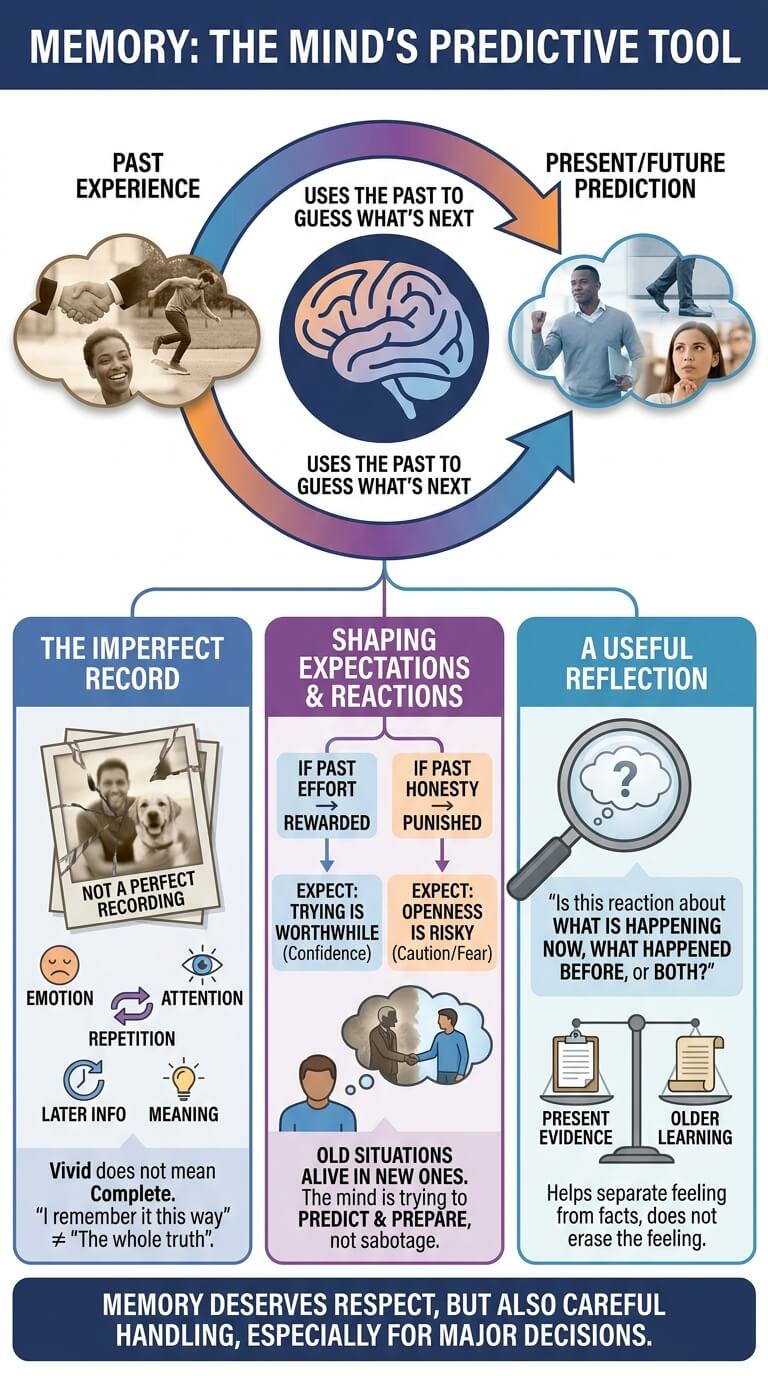
Memory is not only storage. It is also prediction. The mind uses past experience to guess what is happening now and what may happen next. That is why memory affects trust, confidence, fear, skill, habits, preferences, and expectations.
Memory helps you recognize a friend’s voice, drive a familiar route, avoid a painful mistake, and repeat a useful skill. It also shapes emotional reactions before you have time to explain them.
Why memory is useful but imperfect
Memory is imperfect because it is not a perfect recording. It can be influenced by emotion, attention, repetition, later information, and the meaning a person gave to the event. A memory can feel vivid and still be incomplete. A painful memory can become a broad rule, even when the current situation is different.
This is why “I remember it this way” and “this is the whole truth” are not always the same. Memory deserves respect, but it also deserves careful handling, especially when it is guiding major decisions or reactions.
How past experience shapes expectations
Expectations are the mind’s guesses based on what has happened before. If past effort was rewarded, a person may expect trying to be worthwhile. If past honesty led to punishment, a person may expect openness to be risky. If past rejection felt sudden, a person may scan for early signs of being left out.
These expectations can protect people, but they can also keep old situations alive inside new ones. Someone may respond to a current partner, boss, friend, or goal as if the past is happening again. The mind is not trying to sabotage them. It is trying to predict and prepare.
A useful reflection is: “Is this reaction about what is happening now, what happened before, or both?” That question does not erase the feeling. It helps separate present evidence from older learning.
Emotion and Body Signals
Emotion is part of how the mind assigns importance. Feelings help people notice needs, threats, rewards, losses, values, boundaries, and uncertainty. They are not random interruptions to thinking. They are part of the system that prepares action.
The APA Dictionary of Psychology describes emotion as involving experience, behavior, and physiological changes. That is why emotions are felt not only as thoughts, but also as body signals such as tension, warmth, tightness, heaviness, restlessness, or energy.
Feelings as information, not always instructions
Feelings provide information, but they are not always direct instructions. Anxiety may tell you that something feels uncertain, not that disaster is certain. Anger may tell you that something feels unfair or blocked, not that attacking is wise. Sadness may tell you that something matters, not that nothing can improve.
This distinction is important. Ignoring feelings can make people disconnected from their needs. Obeying every feeling immediately can create impulsive behavior. The middle path is to ask what the feeling is pointing toward, then choose a response that fits both the feeling and the situation.
| Feeling or body signal | Possible information | Careful next question |
|---|---|---|
| Tension | Pressure, threat, effort, or overload | What is my body preparing for? |
| Irritation | A blocked need, boundary, or expectation | What feels unfair, repeated, or ignored? |
| Numbness | Fatigue, shutdown, or too much input | Do I need rest, safety, or more time? |
| Excitement | Interest, reward, hope, or momentum | What value or goal is being activated? |
These meanings are possibilities, not diagnoses. The same feeling can have different meanings in different contexts.
Stress, threat, reward, and readiness to act
The mind and body work together to prepare behavior. When something feels threatening, attention may narrow, muscles may tense, and the mind may look for escape, defense, control, or reassurance. When something feels rewarding, attention may move toward it, energy may rise, and the mind may imagine the benefit.
This readiness is helpful when the situation truly requires quick action. It can be less helpful when a modern problem needs patience, conversation, planning, or careful judgment. A body prepared for threat may not be the best state for listening. A mind focused on immediate reward may not be the best state for long-term decisions.
One practical move is to regulate before interpreting. A few slower breaths, a short pause, a walk, water, or stepping away from noise will not solve every problem, but it can give the mind a better state from which to read the situation.
Motivation and Needs
Motivation is the push or pull behind behavior. It includes wants, needs, goals, drives, values, rewards, fears, and identity. People rarely act from one motive only. A single behavior can serve several inner purposes at once.
The APA Dictionary entry on motivation connects motivation with the forces that give behavior energy and direction. In daily life, that means behavior often makes more sense when you ask what need it is trying to meet.
Safety, belonging, competence, control, and reward
Many everyday actions are connected to a few broad motives. People want safety, belonging, competence, control, comfort, meaning, fairness, pleasure, and progress. These motives show up in simple ways. Someone avoids a task because failure feels threatening. Someone checks messages because belonging feels uncertain. Someone takes charge because control feels calming.
For example, avoiding a difficult email may reduce anxiety tonight, but increase pressure tomorrow. Snapping at someone may create a feeling of control for a moment, but damage trust. Working constantly may protect a sense of competence, but weaken rest and relationships.
Why conflicting motives create mixed behavior
Mixed behavior often comes from mixed motives. A person may want change and familiarity. They may want honesty and approval. They may want independence and reassurance. They may want to start a goal and avoid the discomfort of being a beginner.
This is why people sometimes act against their stated goals. They are not always lying to themselves. They may have one motive that sounds wise in reflection and another that feels stronger in the moment. The mind tends to favor what feels urgent, familiar, or emotionally protective.
A practical question is: “What does this behavior give me right now, and what does it cost me later?” That question respects the motive while examining the behavior more honestly.
Conscious and Automatic Processing
Some mental activity feels deliberate. You think through a decision, compare options, choose words carefully, or plan a next step. Other activity feels automatic. You react to a tone, follow a routine, reach for your phone, read a familiar expression, or repeat a habit before you fully think it through. Autopilot is easier to understand through conscious and unconscious behavior.
Both modes matter. A mind that had to deliberate over every action would be exhausted. A mind that runs only on automatic routines would repeat too much without reflection.
Deliberate choices vs fast routines
Deliberate choice is useful when a situation is new, complex, important, or emotionally charged. It allows you to pause, compare, question assumptions, and choose based on values. It is slower, but it can be wiser.
Fast routines are useful when life requires efficiency. You do not need to consciously plan how to brush your teeth, type a familiar password, or take the usual route home. Automatic processing saves energy and keeps daily life moving.
| Mode | Helpful when | Risk when overused |
|---|---|---|
| Deliberate processing | The situation needs reflection, planning, or restraint | Overthinking, delay, and mental fatigue |
| Automatic processing | The situation is familiar and low-risk | Repeating old reactions without checking fit |
| Emotional processing | A need, value, or danger cue deserves attention | Treating intensity as certainty |
| Social processing | Belonging, status, or trust is relevant | Letting approval override judgment |
Why autopilot can help or hurt
Autopilot helps when it runs useful routines. It lets you cook, drive a familiar path, exercise, clean, greet people, and complete repeated tasks without rebuilding the plan each time. A well-trained routine can make good behavior easier.
The goal is not to eliminate automatic behavior. The goal is to notice which routines are helping, which routines are outdated, and which moments need conscious attention again.
How the Mind Creates Behavior Patterns
A behavior pattern forms when a response gets repeated enough that it becomes easier for the mind to choose again. Repetition teaches the mind what is familiar. Reward teaches the mind what feels worth repeating. Avoidance teaches the mind what brings relief. Identity teaches the mind what feels like “the kind of thing I do.” Repeated mental and emotional sequences can become a behavior pattern.
This is why patterns can continue even after a person understands them. Insight is helpful, but it is not always strong enough to rewrite repetition by itself.
Repetition, reward, avoidance, and identity
Patterns often become stronger through a loop. A cue appears, the mind gives it meaning, the body reacts, a behavior follows, and the outcome teaches the mind something. If the outcome brings reward or relief, the behavior becomes more likely next time.
Consider procrastination. A task feels large, the mind predicts discomfort, the body feels tension, avoidance brings relief, and the mind learns that delay works in the short term. The person may still value responsibility, but the relief loop is powerful.
Identity can strengthen the loop. A person who says “I am just bad at this” may stop practicing. A person who says “I am learning this slowly” may stay engaged. The story the mind tells about the self can either narrow or widen behavior.
Why insight may not immediately change action
Many people feel frustrated because they understand a pattern but still repeat it. That frustration is understandable, but it makes more sense when you remember that behavior is not only intellectual. It is emotional, physical, social, habitual, and situational.
Knowing “I should not react that way” may not be enough if the body is flooded, the environment keeps triggering the same cue, the reward for the old behavior is immediate, or the new behavior has not been practiced under pressure.
A more realistic first step is to move change earlier in the sequence. Notice the cue sooner. Reduce the friction around the better response. Practice when stakes are low. Create a pause before the automatic action. The mind learns through repeated experience, not only through explanation.
The Human Mind vs the Brain vs Behavior
People often use mind, brain, and behavior as if they are the same thing. They are connected, but they are not identical. Separating them can help you avoid one-size-fits-all explanations.
Useful distinctions for general readers
The brain is the physical organ and nervous system activity that supports mental life. The mind is the lived experience of thinking, feeling, perceiving, remembering, imagining, wanting, and choosing. Behavior is what a person does that can be observed, including speaking, moving, avoiding, approaching, pausing, choosing, or expressing emotion.
| Term | Simple meaning | Example question |
|---|---|---|
| Brain | The physical system supporting mental activity | What biological processes are involved? |
| Mind | The inner experience and mental processing | What is the person noticing, feeling, remembering, and wanting? |
| Behavior | The visible or measurable action | What did the person actually do? |
These distinctions are not meant to create a hard wall between biology and experience. They simply help you choose the right level of explanation.
Why behavior needs multiple explanations
A single behavior can have several causes. A person may snap during a conversation because they are sleep-deprived, feeling criticized, remembering a past humiliation, trying to protect control, and repeating a learned family pattern. None of those explanations cancels the others.
Multiple explanations do not remove accountability. They make accountability more precise. Instead of blaming the whole person, you can look at the conditions and processes that make a behavior more likely, then choose what can be changed.
Ideas That Become Clearer After This
Once you understand the mind as a system, several everyday questions become easier to answer. You can see why thoughts shape behavior, why conscious intention is not the whole story, and why repeated behavior often needs more than willpower. Attention and memory are explained in more detail through cognitive psychology.
How cognitive processes shape daily life
Cognitive processes include attention, perception, memory, language, reasoning, judgment, and problem-solving. They explain how the mind handles information before action becomes visible. When people misunderstand each other, make quick judgments, forget important details, or struggle to focus, cognitive processes are usually involved.
This is the more detailed layer behind the broad model in this article. If the broad model is the map, cognitive processes are many of the roads.
How conscious and automatic behavior differ
The difference between conscious and automatic behavior becomes clearer when you see how much the mind handles before deliberate thought arrives. Some behavior comes from careful choice. Some comes from learned routines, emotional cues, body states, and familiar expectations.
A helpful question is: “Did I choose this response after reflection, or did I enter a familiar route?” Neither answer automatically means the behavior is good or bad. It simply tells you what kind of awareness may help next.
How behavior patterns and change fit in
Behavior patterns are repeated routes through the mind and body. Behavior change requires building a different route often enough that the mind can access it under real conditions. That may involve changing cues, rewards, environment, self-talk, emotional regulation, practice, and support.
This is why change is usually more practical when it is specific. “Be different” is too vague for the mind to practice. “Pause before replying when I feel criticized” gives the mind a usable action point.
When Your Inner Experience Feels Hard to Manage
Most people experience distraction, mixed motives, emotional reactions, intrusive worries, or automatic habits at times. These experiences do not automatically mean something is wrong. Stress, lack of sleep, grief, major transitions, conflict, loneliness, and overload can all affect how the mind processes daily life.
Support may be worth considering if inner experiences become severe, frightening, persistent, or hard to function with. NIMH says professional help may be important when severe or distressing symptoms last two weeks or more, including difficulty sleeping, concentrating, completing usual tasks, or getting through the day. Its page on caring for your mental health offers general guidance on support and self-care.
Seek urgent help if you are at risk of harming yourself or someone else, if you feel unable to stay safe, or if you are experiencing sudden confusion, hallucinations, extreme distress, or a major change in functioning. An article can help with education, but immediate safety and qualified support matter more than trying to reason through everything alone.
FAQ About How the Human Mind Works
Is the mind the same as the brain?
Not exactly. The brain is the physical organ and nervous system activity that supports mental life. The mind is the experience of thinking, feeling, perceiving, remembering, imagining, wanting, and choosing. They are deeply connected, but the words are used at different levels of explanation.
Why does the mind repeat old patterns?
The mind repeats old patterns because familiar responses require less effort, and past rewards or relief can make a behavior feel useful even when it causes problems later. Repetition also creates expectations. The mind tends to return to routes it has practiced, especially under stress, fatigue, or uncertainty.
Can the unconscious mind control behavior?
Automatic and unconscious processes can strongly influence behavior, but that does not mean a person has no responsibility or no ability to change. Many reactions begin before full awareness, but people can learn to notice cues earlier, slow down familiar routines, change environments, and practice more deliberate responses.
Why do emotions affect decisions?
Emotions affect decisions because they signal importance, threat, reward, loss, uncertainty, or need. They influence attention and body readiness, which changes what feels urgent or safe. Emotions can offer useful information, but they work best when combined with evidence, values, timing, and reflection.
Key Takeaways
- The human mind turns experience into behavior through attention, interpretation, memory, emotion, motivation, and action.
- Perception is active, so people react to the meaning their mind builds, not only to raw information.
- Attention is limited, and what the mind selects can strongly influence what feels important or urgent.
- Memory helps the mind predict, but old experience can make a current situation feel more certain than it is.
- Emotions and body signals are information, but they are not always instructions to act immediately.
- Behavior patterns change more easily when people work with cues, rewards, practice, and context instead of relying only on insight.
Final Thoughts
A simple next step is to choose one recurring reaction and trace it backward. What was the cue? What meaning appeared first? What feeling followed? What did the behavior protect or provide? That small map can turn a confusing reaction into something more understandable, and eventually more workable.

Michael Reed is the Founder and Lead Writer at Psychology Exposed. He writes about human behavior, relationships, emotional patterns, self-awareness, and practical psychology topics using research-informed, easy-to-understand content.
Read More About Michael Reed: https://psychologyexposed.com/michael-reed/