
People do not always choose what helps them most. Someone may avoid a chance they wanted, delay a task that matters, return to a routine that makes life harder, stay quiet when they need support, spend money they meant to save, or choose quick comfort while knowing the long-term cost. From the outside, this can look irrational. From the inside, it often feels like relief, protection, belonging, control, or a way to escape discomfort for a little while.
That does not mean harmful choices are harmless. It means they usually have a short-term logic. A behavior can work in one time frame and hurt in another. It may reduce anxiety now while increasing stress later. It may protect pride now while damaging trust later. It may avoid uncertainty now while keeping a person stuck.
This guide explains why people sometimes act against their own interests without treating them as lazy, broken, or foolish. It focuses on everyday self-defeating choices and goal conflict. It is not a substitute for mental health care, addiction treatment, crisis support, medical advice, or help in unsafe situations.
Quick Answer
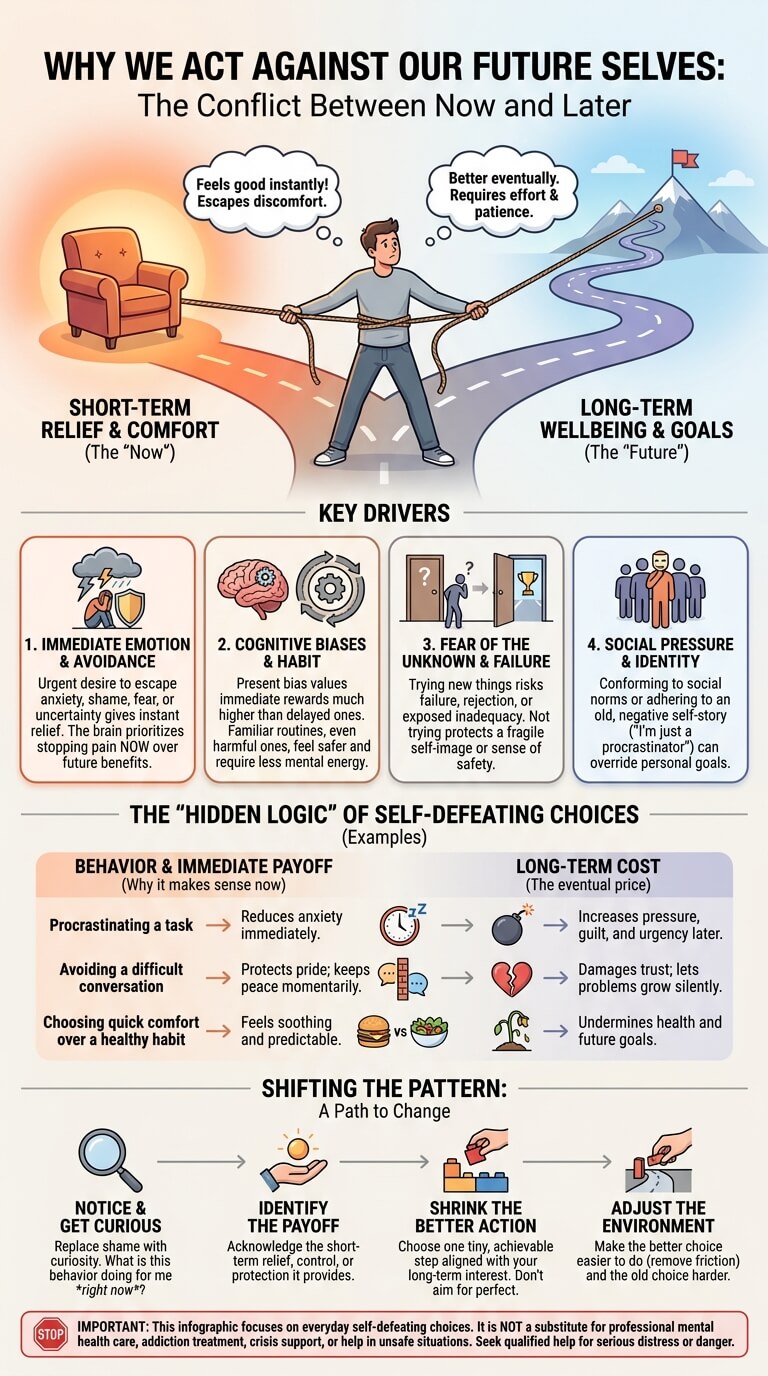
People act against their own interests when short-term relief, fear, habit, social pressure, identity conflict, avoidance, or immediate reward becomes stronger than the distant benefit of a better choice. The behavior may look self-sabotaging, but it often protects against a feeling the person does not want to face, such as shame, fear, uncertainty, loss, rejection, or responsibility.
What It Means to Act Against Your Own Interests
Acting against your own interests means choosing something that conflicts with your goals, values, health, relationships, finances, safety, or future wellbeing. It does not always mean the choice is extreme. It can be quiet and ordinary: not opening the email, not applying for the opportunity, picking a fight before a vulnerable conversation, ignoring a bill, staying in a situation you know is draining, or choosing a quick escape when you wanted to build a better routine. This topic belongs inside human behavior psychology.
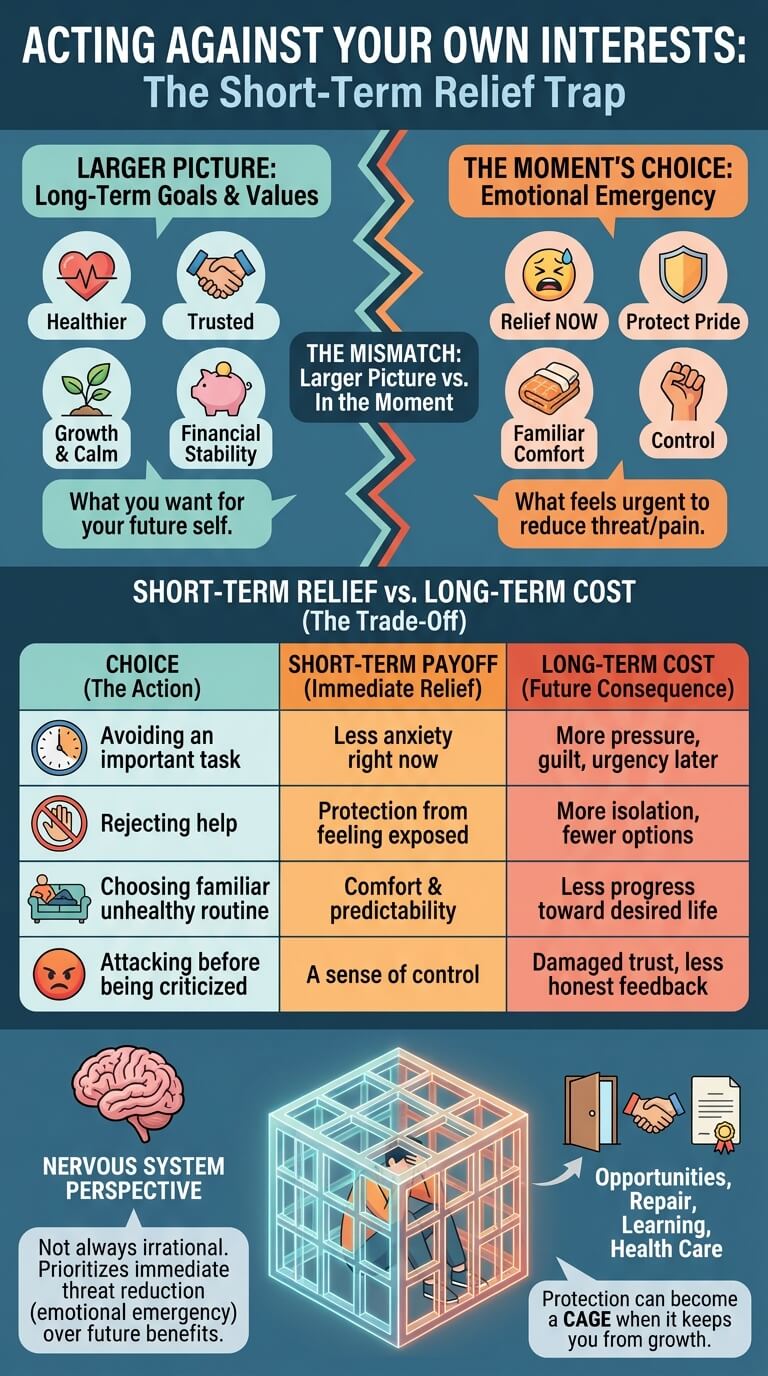
The key feature is a mismatch between what a person wants in the larger picture and what they do in the moment. The larger picture might be “I want to be healthier,” “I want to be trusted,” “I want to stop avoiding,” “I want to save money,” or “I want a calmer life.” The moment says something else: “I need relief now.”
Short-term relief vs long-term cost
Many self-defeating choices make more sense when you separate short-term payoff from long-term cost. Avoiding a difficult call may reduce anxiety for the next hour. The cost arrives later, when the problem grows. Snapping at someone may protect pride in the moment. The cost arrives when distance builds. Staying with a familiar routine may feel safe today. The cost arrives when life remains smaller than you want it to be.
| Choice | Short-term payoff | Long-term cost |
|---|---|---|
| Avoiding an important task | Less anxiety right now | More pressure, guilt, and urgency later |
| Rejecting help | Protection from feeling exposed | More isolation and fewer options |
| Choosing the familiar unhealthy routine | Comfort and predictability | Less progress toward the life you want |
| Attacking before being criticized | A sense of control | Damaged trust and less honest feedback |
The behavior may not serve your whole life, but it may serve the emotional emergency your mind feels in that moment.
Why this is not always irrational from the nervous system perspective
When people hear “acting against your own interests,” they often imagine a person calmly choosing the wrong option despite knowing better. Real life is usually less tidy. The body and mind may be trying to reduce threat, embarrassment, uncertainty, rejection, loneliness, anger, or shame. The nervous system often gives priority to what feels urgent now, not what will be best in six months.
The APA Dictionary of Psychology describes avoidance behavior as actions that help a person avoid unpleasant or painful situations or stimuli. In everyday life, avoidance can feel protective. The problem is that protection can become a cage when it keeps you away from opportunities, repair, learning, health care, responsibility, or honest conversations.
Common Reasons People Choose Against Long-Term Goals

Self-defeating choices rarely have one clean cause. The same behavior can be pulled by emotion, learning history, social context, identity, reward, and environment at the same time. Instead of asking, “Why am I like this?” it is often more useful to ask, “What is this behavior helping me not feel, not face, or not risk?”
Immediate relief is more powerful than distant benefit
A future benefit is often abstract. Relief is immediate. You can feel relief in your body right now when you cancel, hide, buy, scroll, drink, overexplain, lash out, or delay. The future benefit may be real, but it is quiet. It asks you to tolerate discomfort before it pays you back.
Delay discounting research studies the tendency to value immediate outcomes more strongly than delayed outcomes. A PubMed Central review on delay discounting describes steep delay discounting as a preference for smaller immediate outcomes compared with larger delayed outcomes. In daily life, this can look like choosing what soothes today even when tomorrow becomes harder.
This does not mean people are doomed to choose immediate comfort. It means a better plan often needs to make the long-term choice easier, closer, more visible, and less emotionally expensive.
Fear of failure, rejection, loss, or responsibility
Sometimes people avoid success because success brings exposure. Applying for the job may bring rejection. Starting a project may reveal that it is harder than imagined. Having a direct conversation may risk hearing something painful. Getting better may create new responsibilities or change familiar relationships.
A person might tell themselves, “I did not really try,” because that hurts less than “I tried and failed.” Not trying protects an image of possibility. The cost is that the person never gets real feedback, real practice, or real progress.
Familiar pain feels safer than uncertain improvement
People may stay with a costly pattern because it is known. The familiar routine has rules. You know what disappointment feels like. You know how to numb it, explain it, or survive it. Improvement may be better, but it is unfamiliar. It may ask for vulnerability, consistency, patience, or help.
This is one reason self-defeating behavior can feel strangely comforting. It may keep life small, but it also keeps life predictable. The mind sometimes prefers a predictable problem over an uncertain possibility.
Identity conflict and low expectation of success
People often act in ways that match the story they carry about themselves. If someone quietly believes, “I am the person who never follows through,” then starting well may feel uncomfortable. If someone believes, “People like me do not ask for help,” support may feel like weakness. If someone believes, “Good things do not last for me,” they may pull away before disappointment arrives.
The APA Dictionary of Psychology describes self-regulation as control of behavior through processes such as self-monitoring, self-evaluation, and self-reinforcement. That matters because change is not only about wanting a different result. It often requires noticing the old story, evaluating what is happening now, and reinforcing behavior that fits the person you are trying to become.
Social pressure and environment
Some choices are not purely personal. A person may keep spending because their social circle treats spending as belonging. They may stay quiet because their workplace punishes honesty. They may keep unhealthy routines because home, stress, access, or time make better routines hard to sustain.
Environment does not remove responsibility, but it changes difficulty. If the better choice is hidden, expensive, socially costly, inconvenient, or emotionally punished, acting in your long-term interest requires more energy. A realistic plan changes the surroundings, not only the intention.
Self-Sabotage or Self-Protection?
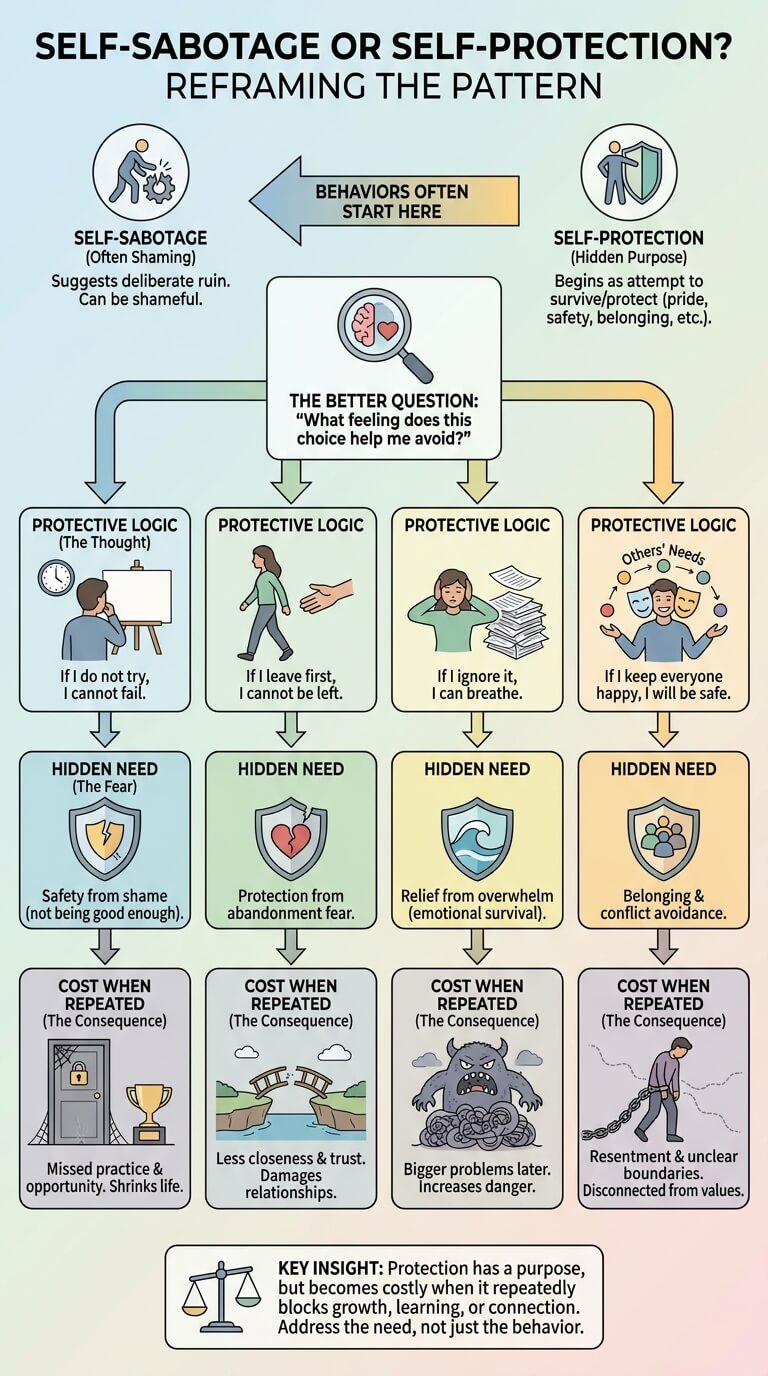
The phrase self-sabotage can be useful when it helps someone notice a pattern. It can also become shaming when it suggests a person is deliberately ruining their life. Many behaviors called self-sabotage began as attempts to protect something: pride, safety, belonging, control, certainty, or emotional survival.
When the behavior protects against a feared feeling
A person who procrastinates may be protecting against the fear of not being good enough. A person who pushes others away may be protecting against the fear of being left first. A person who refuses feedback may be protecting against shame. A person who stays overbusy may be protecting against loneliness or difficult memories.
Protection is not always wise, but it has a purpose. If you only attack the behavior, you may miss the need underneath it. A better question is: “What feeling does this choice help me avoid?” The answer may reveal the real work.
When protection becomes costly
A protective behavior becomes costly when it repeatedly shrinks your life, damages trust, blocks learning, increases danger, or keeps you disconnected from values. Avoiding one event to rest may be reasonable. Avoiding every opportunity that matters can become a problem. Taking a pause during conflict may help. Disappearing whenever accountability appears can damage relationships.
| Protective logic | Possible hidden need | Cost when repeated |
|---|---|---|
| “If I do not try, I cannot fail.” | Safety from shame | Missed practice and opportunity |
| “If I leave first, I cannot be left.” | Protection from abandonment fear | Less closeness and trust |
| “If I ignore it, I can breathe.” | Relief from overwhelm | Bigger problems later |
| “If I keep everyone happy, I will be safe.” | Belonging and conflict avoidance | Resentment and unclear boundaries |
The Role of Cognitive Biases
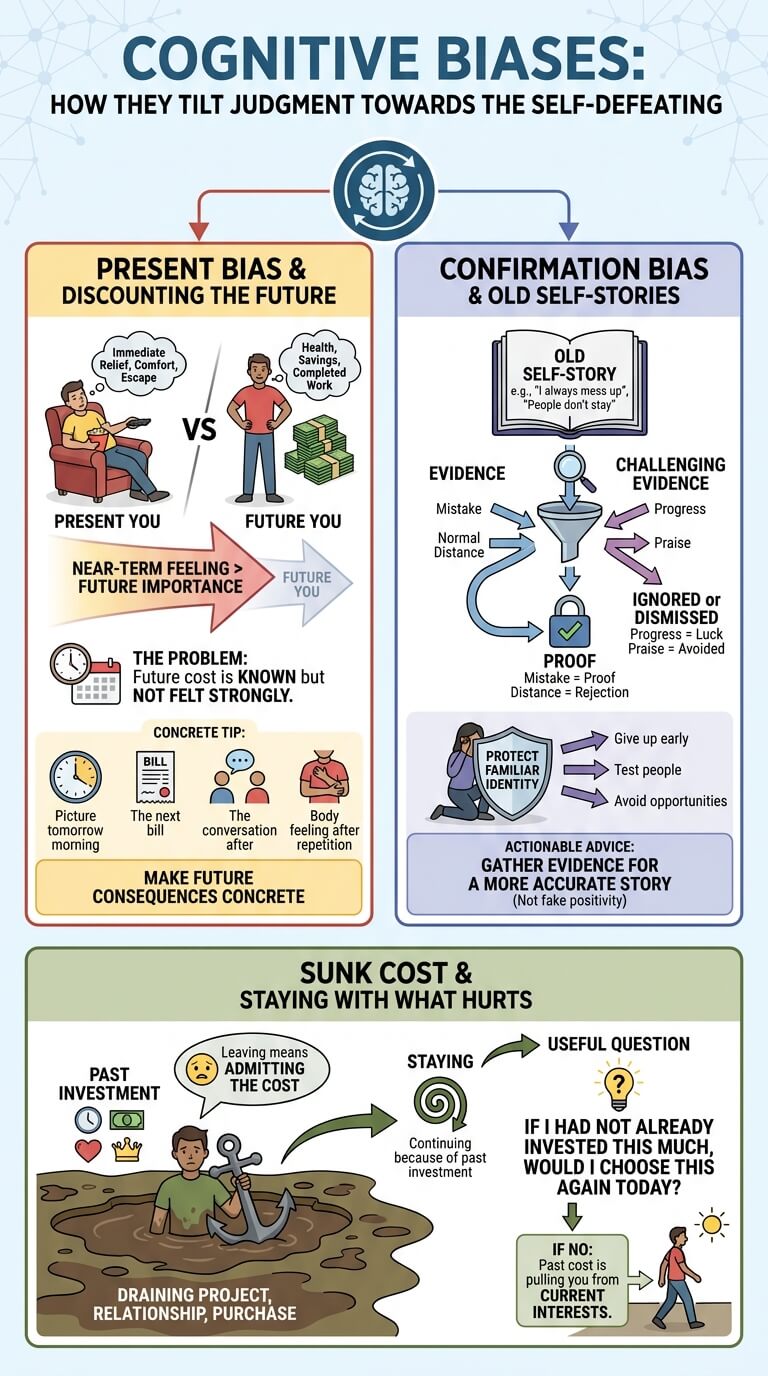
Cognitive biases can make a self-defeating choice feel reasonable. They do not explain everything, but they can tilt judgment in the direction of what is familiar, immediate, or consistent with old beliefs. A person may choose against long-term interest when cognitive biases make relief feel reasonable.
Present bias and discounting the future
Present bias makes the near-term outcome feel more important than the future one. The future version of you may want money saved, trust repaired, health protected, or work completed. The present version wants relief, comfort, status, escape, or certainty.
The practical issue is not that people forget the future completely. They often know the future cost. They simply do not feel it as strongly as the immediate discomfort. Making future consequences concrete can help: picture tomorrow morning, the next bill, the conversation after the silence, or the way your body feels after the choice repeats.
Confirmation bias and old self-stories
When people hold a painful story about themselves, they may notice evidence that confirms it and ignore evidence that challenges it. If you believe “I always mess things up,” a mistake may feel like proof, while progress feels like luck. If you believe “People do not stay,” normal distance may look like rejection.
This can create choices that protect the old story. A person may give up early, test people, reject praise, or avoid opportunities because success would challenge a familiar identity. Changing behavior may require gathering evidence for a more accurate story, not forcing fake positivity.
Sunk cost and staying with what hurts
Sunk cost thinking appears when people continue something partly because they have already invested time, money, emotion, or reputation. They may stay in a draining project, relationship pattern, purchase, argument, or plan because leaving would mean admitting the cost.
The useful question is: “If I had not already invested this much, would I choose this again today?” If the honest answer is no, the past cost may be pulling you away from your current interests.
The Role of Emotion and Avoidance
Many choices that work against long-term interest are avoidance choices. The person is not always chasing pleasure. Often, they are trying to get away from an internal state that feels too sharp, too humiliating, too uncertain, or too overwhelming. Fear or shame can turn into avoidance through how thoughts influence behavior.
Anxiety, shame, guilt, anger, and numbness
Anxiety can push people toward escape. Shame can push people toward hiding. Guilt can push people toward overcompensating or avoiding the person they harmed. Anger can push people toward actions that feel powerful now and costly later. Numbness can make future consequences feel unreal.
A recent PubMed Central review of experiential avoidance discusses avoidance of unwanted internal experiences as a process connected to emotion regulation. For a general reader, the plain version is this: sometimes people are not avoiding the task, person, or choice itself. They are avoiding the feeling that comes with it.
Why avoidance can feel like solving the problem
Avoidance is powerful because it often works immediately. If opening the message makes your stomach tighten, not opening it brings relief. If being honest might disappoint someone, staying vague brings relief. If starting the project brings doubt, cleaning your room instead brings relief and still feels productive.
The trap is that relief can teach the mind to repeat the avoidance. The problem returns, but the memory of relief becomes stronger. Over time, the person may feel less capable because they have had fewer chances to practice facing the discomfort.
Acting Against Your Interests vs Repeating Mistakes
These two patterns overlap, but they are not the same. Repeating mistakes is about returning to a choice after feedback shows that it did not work. Acting against your interests is about choosing against a known long-term good, often because another emotional or short-term need is louder. If the same outcome keeps happening, it may overlap with why people repeat the same mistakes.
Goal conflict vs feedback loop
Goal conflict sounds like: “Part of me wants to do the responsible thing, but another part wants relief, safety, comfort, or escape.” A feedback loop sounds like: “This keeps happening, I see the result, and I still repeat the sequence.”
| Question | Acting against interests | Repeating mistakes |
|---|---|---|
| Main focus | Conflict between short-term payoff and long-term good | Failure to convert feedback into a different next move |
| Common feeling | Relief, fear, shame, or inner conflict | Frustration, regret, confusion, or disbelief |
| Useful question | What payoff is this choice giving me now? | Where does the repeated sequence begin? |
When the two overlap
The patterns overlap when a person repeatedly chooses short-term relief despite knowing the cost. For example, someone may avoid a difficult conversation, feel temporary relief, experience more distance later, regret it, and then avoid the next difficult conversation too. In that case, the self-defeating choice becomes a repeated mistake.
The overlap is useful because it gives two places to intervene. You can look at the emotional payoff in the moment and the repeated sequence over time.
What to Do When You Notice the Pattern
Change usually begins by removing shame from the investigation. Shame says, “What is wrong with me?” Curiosity asks, “What is this choice doing for me right now, and what is it costing me later?” Curiosity gives you more useful information. Once the payoff is clear, behavior change becomes more practical.
Identify the short-term payoff
Do not start with the long-term cost. You probably already know it. Start with the payoff. What did the behavior give you immediately? Relief? Control? Belonging? Distraction? A sense of being right? A way to delay shame? A way to avoid asking for help?
Write one sentence: “When I choose this, I get _____ right away, but I pay for it later by _____.” This sentence makes the tradeoff visible without turning it into a character attack.
Name the fear or need underneath
Next, look underneath the payoff. If the payoff is relief, relief from what? If the payoff is control, what feels out of control? If the payoff is belonging, whose approval feels necessary? If the payoff is distraction, what feeling becomes loud when you stop moving?
This step matters because a behavior often returns when the underlying need has no better place to go. If procrastination protects against shame, a calendar alone may not fix it. You may need a way to start imperfectly. If spending protects against sadness, a budget alone may not fix it. You may need other ways to soothe and connect.
Choose a smaller action aligned with long-term interest
When a better choice feels too large, shrink it. Do not demand a complete identity change in one move. Choose a smaller action that points in the right direction: open the document, write the first sentence, send a brief reply, put the item back for ten minutes, ask one honest question, walk for five minutes, or schedule the appointment.
The smaller action matters because it gives your mind new evidence. You are not trying to win a dramatic battle with yourself. You are building a path where the long-term interest becomes easier to act on.
Add support or reduce friction
If a behavior keeps winning, change the conditions around it. Remove saved payment details. Put the phone in another room. Ask a friend to sit with you while you start. Use a short appointment instead of an open-ended promise. Make the better option visible. Make the costly option less automatic.
Self-discipline is easier when the environment supports the long-term goal instead of testing self-control at every turn.
Where to Look Next If This Pattern Keeps Showing Up
If self-defeating choices keep returning, it can help to separate three questions: How am I deciding, what keeps repeating, and what would make change easier? Each question points to a slightly different kind of understanding. The same pattern can show up through everyday decisions.
Everyday decisions
If the issue appears in many small daily choices, focus on decision conditions. Look at time pressure, default options, mood, social pressure, and the amount of mental energy available when the choice happens. Sometimes the problem is not one dramatic flaw. It is a daily setup that keeps making the short-term option easier.
Repeating mistakes
If the same sequence happens again and again, focus on the first moment of the loop. What happens before the choice? What warning sign appears? What do you tell yourself? What small step could interrupt the sequence before the cost arrives?
Behavior change
If you understand the pattern but still cannot shift it, focus on behavior change. The next step may involve reducing friction, adding support, practicing smaller actions, tracking what triggers the choice, and rewarding the behavior that fits your long-term values.
When to Get Support
Some choices need more than self-reflection. Consider professional or crisis support if the behavior involves self-harm, suicidal thoughts, dangerous impulsivity, substance misuse, eating behaviors that feel unsafe, abuse, coercion, threats, stalking, severe avoidance, or major impairment in work, school, health, parenting, money, or relationships.
Self-harm, addiction, abuse, severe avoidance, dangerous choices, or major life impairment
If you might hurt yourself or you feel unable to stay safe, seek immediate help in your area. In the United States, you can call or text 988 for the Suicide and Crisis Lifeline. The NIMH lists warning signs of suicide, including talking about wanting to die, feeling trapped, unbearable pain, extreme anxiety, agitation, rage, or withdrawing from friends and family.
If substance use is part of the pattern, it can help to speak with a qualified health professional. NIMH notes that substance use and mental health concerns can be interconnected, and appropriate care can address both. If your choices are being shaped by coercion, threats, humiliation, or fear of retaliation, prioritize safety planning and support over communication tips.
FAQ About Acting Against Your Own Interests
Is acting against my interests the same as self-sabotage?
Sometimes, but not always. Self-sabotage is a common phrase for behavior that blocks your own goals, but it can sound as if you are deliberately trying to harm your life. Many self-defeating choices are better understood as short-term protection with long-term costs. The useful question is not only “Am I sabotaging myself?” but “What is this behavior protecting me from feeling or facing?”
Why do I choose short-term relief when I know the cost?
Knowing the cost does not always make the cost feel real in the moment. Immediate relief is concrete, physical, and available now. The long-term cost may feel distant until it arrives. This is especially true when you are anxious, ashamed, tired, angry, lonely, overwhelmed, or socially pressured. A better plan makes the long-term choice smaller, easier, and closer.
Can fear of success cause self-defeating behavior?
It can. Success may bring visibility, responsibility, higher expectations, jealousy from others, identity change, or the fear that you will not be able to keep the result. A person may delay, underprepare, withdraw, or create conflict because staying near possibility feels safer than being tested by reality. This is not a reason to give up. It is a reason to make the next step safer and more specific.
What is the first step to stop undermining myself?
Start by identifying the immediate payoff. Ask, “What does this choice give me right now?” Then ask, “What does it cost me later?” After that, choose one smaller action that supports the long-term interest without demanding a full transformation. If the behavior feels dangerous, compulsive, or tied to severe distress, support from a qualified professional may be the safer first step.
Key Takeaways
- People often act against their interests because short-term relief feels stronger than distant benefit.
- Self-defeating behavior is not always random or irrational. It may protect against fear, shame, uncertainty, rejection, or responsibility.
- Cognitive biases, avoidance, emotion, social pressure, identity stories, and environment can all pull behavior away from long-term goals.
- The most useful first question is often, “What payoff does this behavior give me right away?”
- Smaller actions, better conditions, and support can make long-term interests easier to act on.
- When behavior involves self-harm, substance misuse, danger, coercion, or severe impairment, safety and professional support matter more than self-help reflection.
Final Thoughts
Acting against your own interests does not mean you lack intelligence or character. It often means one part of you is trying to protect you quickly while another part wants a better future. The work is to understand the short-term protection, name the cost, and create a smaller path toward the life you actually want.
For the next choice that feels self-defeating, do not begin with punishment. Begin with one honest sentence: “This gives me _____ now, but it costs me _____ later.” That sentence can turn confusion into a map, and a map gives you a better next step.

Michael Reed is the Founder and Lead Writer at Psychology Exposed. He writes about human behavior, relationships, emotional patterns, self-awareness, and practical psychology topics using research-informed, easy-to-understand content.
Read More About Michael Reed: https://psychologyexposed.com/michael-reed/