
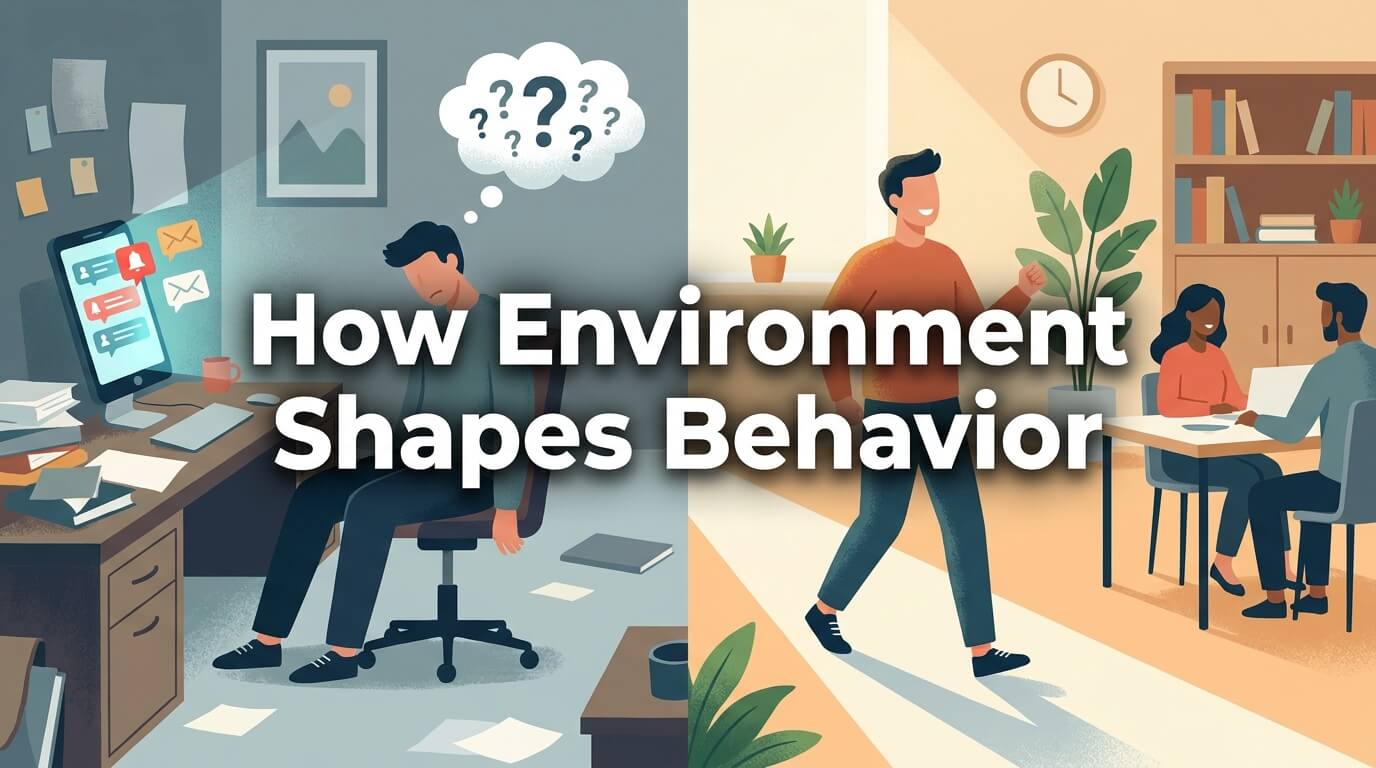
People often explain behavior as a matter of motivation, discipline, or personality. Sometimes that is part of the story, but it is rarely the whole story. The room you are in, the people around you, the apps on your phone, the rules of your workplace, the layout of your kitchen, and the amount of friction between you and an action can all shape what you do before you have time to think about it.
Understanding how environment shapes behavior can reduce a lot of unnecessary shame. If you keep checking your phone, it may not mean you are weak. If you act more confident in one setting and more guarded in another, it may not mean you are fake. If you make better choices when your space is organized, your surroundings may be supporting attention, energy, and follow-through.
This does not mean environment explains everything. Biology, memory, learning, emotions, values, and personal history still matter. The useful point is more practical: behavior becomes easier or harder depending on the world around you. When you learn to notice those influences, you can stop relying only on willpower and start shaping conditions that make your preferred behavior more likely.
Quick Answer

Environment shapes behavior by providing cues, rewards, barriers, defaults, social expectations, and emotional signals. A setting can make one action feel obvious and another feel difficult. Changing the environment does not erase personal choice, but it can make better choices easier to start, repeat, and maintain.
What Environment Means in Behavior Psychology
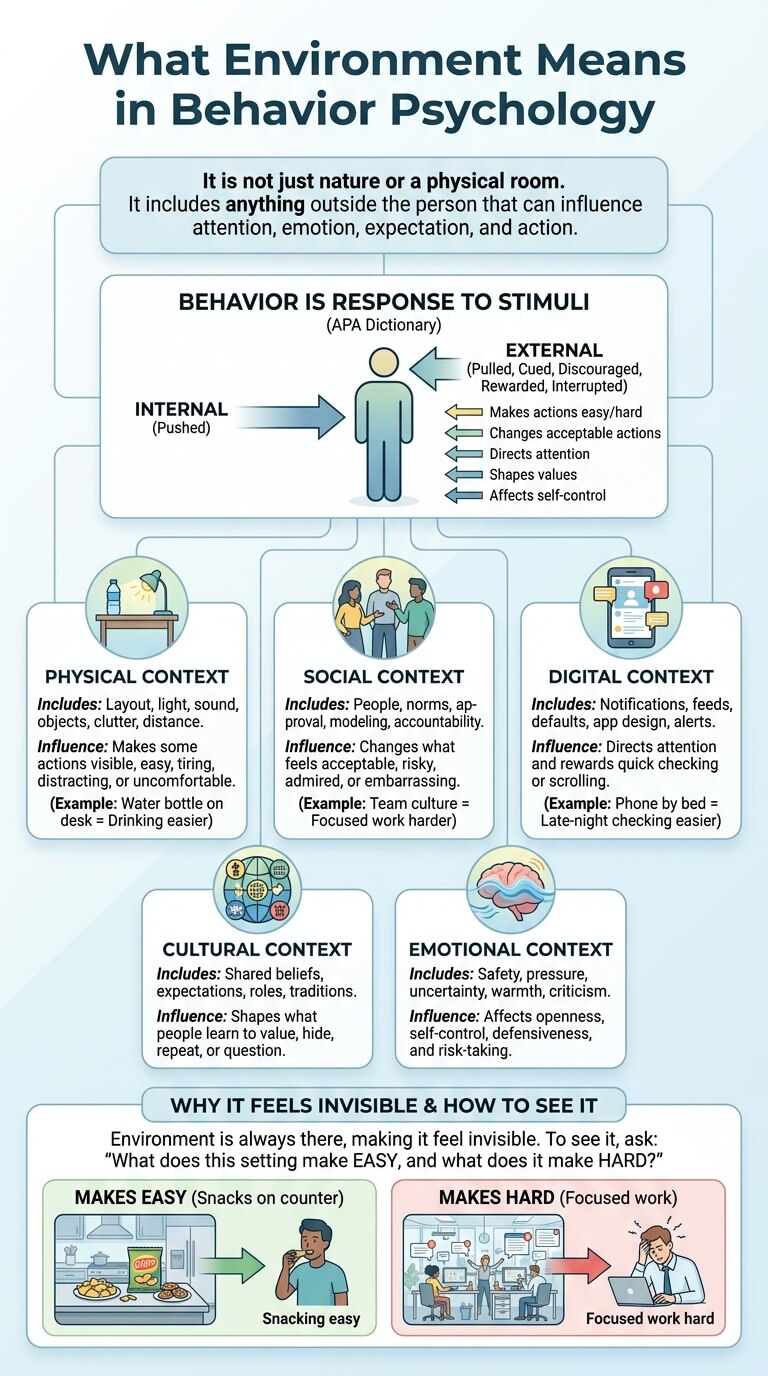
In behavior psychology, environment does not only mean nature, weather, or the physical room around you. It includes anything outside the person that can influence attention, emotion, expectation, and action. A desk, a smell, a message notification, a family norm, a workplace rule, a noisy street, a grocery layout, and a social media feed can all become part of the environment. Environment is a major part of human behavior psychology.
The APA Dictionary of Psychology describes behavior as activity in response to internal or external stimuli. That matters because behavior is not only pushed from the inside. It is also pulled, cued, discouraged, rewarded, or interrupted by the world around a person.
Physical, social, digital, cultural, and emotional context
Physical context includes layout, light, sound, temperature, clutter, distance, signs, objects, and accessibility. A water bottle on the desk makes drinking water easier. A television facing the couch makes watching feel like the default. A crowded room can make some people more alert and others more withdrawn.
| Environment type | What it includes | How it may shape behavior |
|---|---|---|
| Physical | Objects, layout, light, noise, distance, clutter | Makes some actions visible, easy, tiring, distracting, or uncomfortable |
| Social | People, norms, approval, modeling, accountability | Changes what feels acceptable, risky, admired, or embarrassing |
| Digital | Notifications, feeds, defaults, app design, alerts | Directs attention and rewards quick checking or scrolling |
| Cultural | Shared beliefs, expectations, roles, traditions | Shapes what people learn to value, hide, repeat, or question |
| Emotional | Safety, pressure, uncertainty, warmth, criticism | Affects openness, self-control, defensiveness, and risk-taking |
Why environment is not just background
Environment can feel invisible because it is always there. You notice a bad decision, but you may not notice the cue that made it more likely. You notice procrastination, but not the missing next step, the noisy room, the constant interruptions, or the easy escape sitting one tap away.
A helpful way to see environment is to ask, “What does this setting make easy, and what does it make hard?” A kitchen counter covered with snacks makes snacking easy. A phone beside the bed makes late-night checking easy. A team culture that rewards instant replies makes focused work hard.
Cues: What the Environment Reminds You to Do
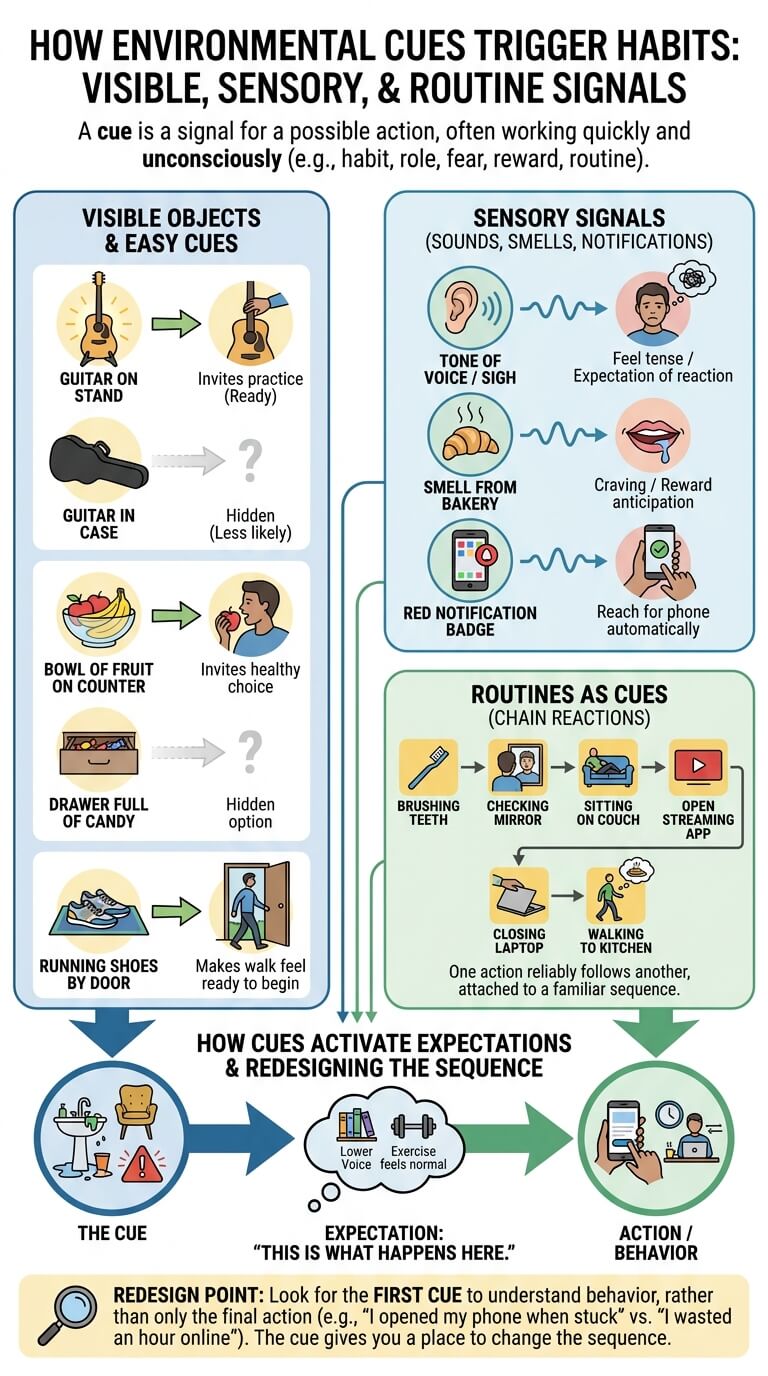
A cue is something that signals a possible action. It may remind you of a habit, a role, a fear, a reward, or a routine. Cues are powerful because they often work quickly. You may reach for your phone before you consciously decide to check it. You may feel tense when you hear a certain tone of voice before you can explain why. Cues are especially important in habit formation.
The APA Dictionary entry on stimulus defines it as an event or object that can produce a response. In daily life, the stimulus may be simple: a smell from a bakery, a red notification badge, a messy sink, a familiar chair, a deadline reminder, or the sound of someone sighing.
Visible objects, sounds, smells, notifications, and routines
Visible objects are some of the easiest cues to understand. A guitar on a stand invites practice more than a guitar hidden in a case. A bowl of fruit on the counter invites a different choice than a drawer full of candy. Running shoes by the door make a walk feel more ready to begin.
Routines become cues when one action reliably follows another. Brushing your teeth may cue checking the mirror. Sitting on the couch may cue opening a streaming app. Closing a laptop may cue walking to the kitchen. The behavior is not random. It is attached to a familiar sequence.
How cues activate habits and expectations
A cue often carries an expectation: “This is what happens here.” At a library, you may lower your voice automatically. At a gym, exercise feels more normal. In bed, your body may expect sleep, unless the bed has become a place for emails, scrolling, and arguments.
To understand your own behavior, look for the first cue rather than only the final action. “I wasted an hour online” is less useful than “I opened my phone when I felt stuck, saw one alert, then followed the next suggestion.” The cue gives you a place to redesign the sequence.
Friction and Convenience

Friction is anything that makes a behavior harder to start or continue. Convenience is anything that makes it easier. A behavior does not need to be deeply meaningful to win. Sometimes it wins because it is the closest, fastest, most visible, least awkward, or least mentally demanding option.
Why easy behaviors happen more often
Easy behaviors happen more often because they require less effort at the moment of choice. The effort may be physical, mental, social, emotional, or financial. A behavior that is simple, visible, accepted, and immediately rewarding has a strong environmental advantage.
| Desired behavior | Convenience helper | Why it works |
|---|---|---|
| Drinking more water | Keep a filled bottle where you work | The reminder is visible and the action is ready |
| Reading before bed | Put the book on the pillow and charge the phone elsewhere | The desired choice becomes closer than the distraction |
| Starting a task | Write the first tiny step on a note | The brain does not have to solve the whole task before beginning |
| Taking a walk | Place shoes near the door | The transition from intention to action becomes shorter |
Why small barriers can stop intended action
Small barriers often matter more than people expect. A login step, a missing charger, a cold room, a messy desk, an unclear instruction, or a long walk to the printer can interrupt follow-through. When energy is low, small barriers feel larger.
This can explain why a behavior disappears even when the person still values it. You may stop stretching because the mat is buried in a closet. You may stop budgeting because the spreadsheet is confusing. You may avoid a health appointment because the scheduling process is hard to navigate.
Friction is not always bad. You can use it on purpose. If you want to reduce late-night scrolling, logging out, moving the app, turning the screen grayscale, or charging the phone outside the bedroom can create a pause. The goal is not to punish yourself. It is to make the automatic path less automatic.
Defaults and Choice Architecture
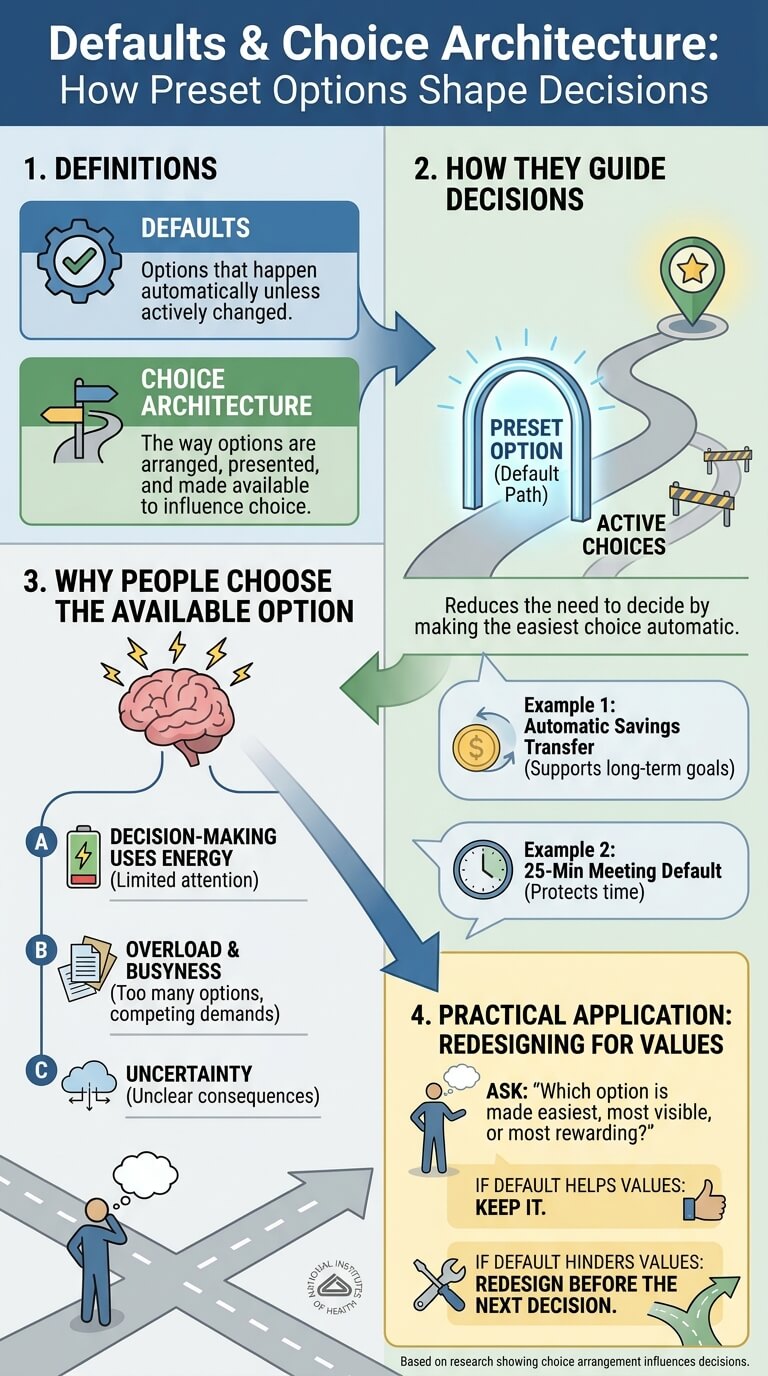
Defaults are the options that happen unless someone actively changes them. Choice architecture is the way options are arranged, presented, labeled, or made available. These details can shape behavior because many people choose what is easiest to accept, especially when they are busy, tired, uncertain, or overloaded. Defaults and friction quietly shape everyday decisions.
How preset options guide decisions
Preset options guide decisions by reducing the need to decide. That can be helpful when the default serves the person’s real goals. For example, an automatic transfer to savings may support a person who wants to save but often forgets. A default meeting length of twenty-five minutes may protect time better than a default of one hour.
One practical question is: “What is the default path in this setting?” If the default path helps your values, keep it. If it keeps pulling you away from your values, redesign the default before the next moment of decision.
Why people often choose what is already available
People often choose what is already available because decision-making uses energy. When there are too many options, unclear consequences, or competing demands, the available choice becomes more attractive. This is not laziness. It is a normal response to limited attention.
The National Institutes of Health archive includes research on choice architecture showing how the arrangement of choices can influence health-related decisions. The broader lesson applies beyond health: the way choices are presented can change what people notice, compare, avoid, or select.
To use this responsibly in your own life, avoid asking, “Why do I keep choosing the wrong thing?” too quickly. Also ask, “Which option has been made easiest, most visible, most socially normal, or most immediately rewarding?”
Social Environment
People are strongly influenced by other people. Social environment includes the behavior you see, the behavior that gets rewarded, the behavior that gets mocked, and the behavior that feels safe in a group. A person may act louder, quieter, kinder, harsher, braver, or more guarded depending on who is present. Context also helps explain why people behave differently in the same situation.
Norms, modeling, approval, and accountability
Norms tell people what is normal here. If a workplace praises constant availability, employees may answer messages late at night even if nobody directly orders them to. If a family avoids conflict, a child may learn to hide anger. If a friend group values honesty, direct conversation may feel less risky.
Approval and accountability can support behavior when used carefully. A walking partner, study group, or shared budget check-in can make follow-through easier. Pressure, humiliation, or control can create compliance in the short term, but they do not create a healthy environment for honest change.
Why behavior changes around different people
You may be patient with one person and defensive with another. You may be funny with close friends and quiet with coworkers. You may make healthy choices around one group and impulsive choices around another. This does not automatically mean you are inconsistent in a bad way. It often means different environments cue different roles, expectations, and levels of safety.
Ask what each setting invites. Does this person invite honesty or performance? Does this group reward calm thinking or quick reactions? Does this space make you feel respected, watched, rushed, ignored, or understood?
Digital Environment
Digital environments are not neutral containers. They are designed spaces with cues, rewards, defaults, interruptions, and social comparisons. A phone is not only a tool you pick up. It is a portable environment that can follow you into bed, work, meals, conversations, and quiet moments.
Notifications, infinite feeds, urgency, and comparison
Notifications are cues. They create a small question: “What is this?” Even when the alert is unimportant, the interruption can pull your mind away from what you were doing. Over time, frequent alerts can train a checking rhythm.
Infinite feeds reduce stopping points. When there is no natural end, the environment does not ask you to decide whether to continue. Autoplay works similarly. The next action begins before reflection has a chance to catch up.
How apps shape attention and reward
Many apps offer fast rewards: a message, a like, a new video, a sale, a headline, a match, a comment, or a tiny sign that something changed. These rewards can be inconsistent, which often makes checking more compelling. You do not know whether the next check will matter, so the urge repeats.
The American Psychological Association has discussed how constant digital checking can relate to stress in everyday life, especially when people feel pressure to stay connected. The APA report on technology and stress is a useful reminder that digital habits happen in a larger emotional and social context, not only inside individual willpower.
A practical digital redesign starts with one question: “Which apps are allowed to cue me, and when?” Turning off nonessential alerts, removing apps from the home screen, setting device-free rooms, or using app limits can reduce the number of times the environment asks for your attention.
Stressful and Supportive Environments
Stress changes behavior because it changes what the mind and body prioritize. In a stressful environment, people may become more reactive, avoidant, controlling, forgetful, impulsive, or exhausted. In a supportive environment, people often have more room for patience, curiosity, planning, and self-control.
How threat, clutter, noise, and uncertainty affect self-control
Threat narrows attention. When a person feels unsafe, judged, or at risk, the mind may focus on protection rather than reflection. In that state, it can be harder to listen, plan, delay gratification, or choose a thoughtful response.
Uncertainty adds another burden. When rules are unclear, consequences are unpredictable, or expectations keep changing, people may become cautious, anxious, avoidant, or overly focused on avoiding mistakes. The National Institute of Mental Health explains common stress responses, which can include changes in mood, attention, sleep, and behavior.
Why supportive environments make good behavior easier
A supportive environment reduces unnecessary strain. It makes important behavior visible, respected, and possible. This may mean a quiet work period, a clear routine, a respectful manager, a safe home atmosphere, a clean counter, a realistic budget system, or friends who support the version of you that you are trying to practice.
Environment vs Nature vs Nurture
Environment overlaps with nature and nurture, but the terms are not identical. Nature usually points to biological influences, including genetics and temperament. Nurture often points to learning, development, parenting, culture, education, and early experience. Environment in this article focuses especially on the present conditions that make behavior easier or harder right now. This connects with nature vs nurture psychology.
Present context vs long-term development
Present context includes what is happening now: the room, the people, the tools, the cues, the available options, the pressure, and the consequences. Long-term development includes what a person has learned over years about safety, trust, effort, reward, punishment, and belonging.
A current environment can activate old learning. A critical manager may feel bigger than the present moment because criticism has a history for that person. A supportive mentor may make a new behavior possible because the present setting feels safer than past settings.
Why both can matter at once
People are not blank slates, and they are not fixed machines. A person can have tendencies and still be shaped by context. They can be naturally cautious and still become more confident in a predictable environment. They can be outgoing and still become quiet in a group where speaking up is punished.
When you ask why a behavior happens, try using “and” instead of “or.” It may be temperament and stress. Habit and phone design. Motivation and friction. Personal values and social pressure. Early learning and present cues.
How to Redesign an Environment for Better Behavior
Redesigning an environment means changing the conditions around a behavior before the difficult moment arrives. It is not about creating a perfect life. It is about making the desired action easier to notice, easier to start, and easier to repeat, while making the unwanted action less automatic. Many goals become easier when behavior change includes the setup around the person.
Make desired behavior visible and easy
Make the preferred action obvious. Put the object where you will see it. Prepare the first step. Reduce the number of decisions. Attach the behavior to a routine that already happens.
- Put a notebook on your desk before leaving work so tomorrow’s first task is visible.
- Place workout clothes near the bathroom if you want a morning walk.
- Keep healthy ingredients together so cooking does not begin with searching.
- Open the document you need before a focus block starts.
- Set a calm reminder for a difficult but important conversation.
Add friction to unwanted behavior
Adding friction means making the unwanted behavior less immediate. This works best when it creates a pause without creating shame. The pause gives your conscious intention a chance to catch up.
| Unwanted behavior | Friction you can add | Why it helps |
|---|---|---|
| Checking phone in bed | Charge the phone across the room or outside the bedroom | The behavior is no longer within arm’s reach |
| Impulse buying | Remove saved cards from shopping apps | The extra step gives time to reconsider |
| Late-night work messages | Turn off work app alerts after a set time | The environment stops cueing work during recovery time |
| Snacking while distracted | Keep snacks out of sight and eat from a plate | The action becomes more deliberate |
Friction should not make your life harder everywhere. Use it selectively on behaviors that keep happening too quickly for reflection.
Use social support without pressure
Social support works best when it increases clarity and encouragement, not fear. A study partner, walking friend, shared calendar, or check-in routine can make a behavior easier because the environment now includes connection and structure.
Pressure is different. If support becomes criticism, surveillance, or humiliation, the person may comply briefly but feel less safe, less honest, or more resentful. Good support helps you return to your chosen behavior without making you feel trapped.
When Your Environment Feels Unsafe
Some environments are not just inconvenient or distracting. They may involve fear, threats, coercion, humiliation, stalking, retaliation, or control. In those situations, the priority is safety, not productivity, habit design, or better communication.
If your behavior changes because you are afraid of someone’s reaction, afraid to say no, afraid to leave, or afraid to be honest, do not treat that as a simple motivation problem. A safer plan may require trusted support, local resources, legal guidance, or professional help depending on the situation.
If there is immediate danger, contact local emergency services. If a relationship includes intimidation, coercion, isolation, threats, or retaliation, the National Domestic Violence Hotline offers confidential support and safety planning in the United States. Use resources appropriate to your country and situation if you are outside the U.S.
What to Understand Next
Habit formation
If a behavior repeats in a stable context with little thought, habit formation is the next useful lens. Look for the cue, routine, reward, and environment that keep the action available. This is especially useful for routines around sleep, screens, movement, studying, eating, and tidying.
Behavior change
If you already understand the environment but still need a plan, behavior change strategies can help you choose a smaller action, prepare for obstacles, measure progress, and recover after setbacks. Environment design is one part of change, but behavior change also includes motivation, identity, emotion, practice, and support.
Different behavior in the same situation
If two people behave differently in the same setting, the environment is still only part of the answer. People bring different histories, expectations, bodies, stress levels, skills, and meanings into the same room. The same cue can feel inviting to one person and threatening to another.
FAQ About Environment and Behavior
Can environment change personality?
Environment can change how personality is expressed, but that is not the same as instantly changing personality. A person who is naturally quiet may speak more in a respectful group. A person who is usually organized may become scattered in a chaotic setting. Over time, repeated environments can shape skills, habits, confidence, and expectations, but personality is influenced by more than the current room.
Why do I act differently at home and at work?
Home and work usually contain different roles, rules, cues, pressures, and rewards. At work, you may monitor your tone, manage deadlines, and follow group norms. At home, you may feel safer, more tired, less structured, or more emotionally exposed. Acting differently does not automatically mean you are being fake. It often means different settings bring out different learned responses.
Do phone notifications really affect behavior?
Yes, they can. A notification is a cue that asks for attention. Even if you do not open it, it can interrupt your focus or create a checking urge. The effect depends on the person, the app, the timing, and the emotional meaning of the alert. Turning off nonessential notifications is a simple way to reduce how often your digital environment directs your behavior.
Is changing the environment better than using willpower?
Changing the environment is not always better, but it is often more reliable than willpower alone. Willpower is easier when the environment supports the desired action. If the old cue is visible, convenient, rewarding, and socially normal, willpower has to fight the same battle repeatedly. A better approach is to use intention and environment together.
Key Takeaways
- Environment shapes behavior through cues, friction, convenience, defaults, social norms, digital design, and emotional safety.
- A setting can make one behavior feel automatic and another behavior feel difficult, even when your values have not changed.
- Small environmental changes, such as moving objects, changing defaults, or reducing notifications, can create more room for deliberate choice.
- Social environments influence behavior through modeling, approval, accountability, pressure, and the sense of safety people feel around others.
- Environment is not the only cause of behavior, but it is often one of the most practical places to start when you want change.
- If an environment includes fear, coercion, threats, or retaliation, prioritize safety and support rather than treating the issue as a simple habit problem.
Final Thoughts
The next time you judge a behavior, pause long enough to look at the setting around it. What was visible? What was easy? What was rewarded? What felt risky? What was the default path? These questions turn behavior from a personal mystery into a practical map.

Michael Reed is the Founder and Lead Writer at Psychology Exposed. He writes about human behavior, relationships, emotional patterns, self-awareness, and practical psychology topics using research-informed, easy-to-understand content.
Read More About Michael Reed: https://psychologyexposed.com/michael-reed/