
- Instead of avoiding the email, open it and only identify the next action.
- Instead of asking for reassurance three times, write the fear down once and choose one grounded step.
- Instead of sending an emotional reply immediately, save it, move your body, then rewrite it more clearly.
- Instead of shopping for relief, wait twenty minutes and choose a comfort action that does not create a later problem.
- Instead of going silent in conflict, say, “I need a pause, and I can come back to this at 7.”
- A behavior pattern is a repeated sequence, not one isolated action or a fixed identity.
- Most patterns include a cue, interpretation, feeling, behavior, consequence, and short-term payoff.
- Short-term relief can keep a pattern alive even when the long-term cost is clear.
- Patterns are easier to change when you name the loop neutrally instead of attacking your character.
- The first useful change is often small: one cue, one pause, one replacement response, or one changed consequence.
- Support matters when a pattern involves safety risk, self-harm, compulsion, addiction, coercion, or severe distress.
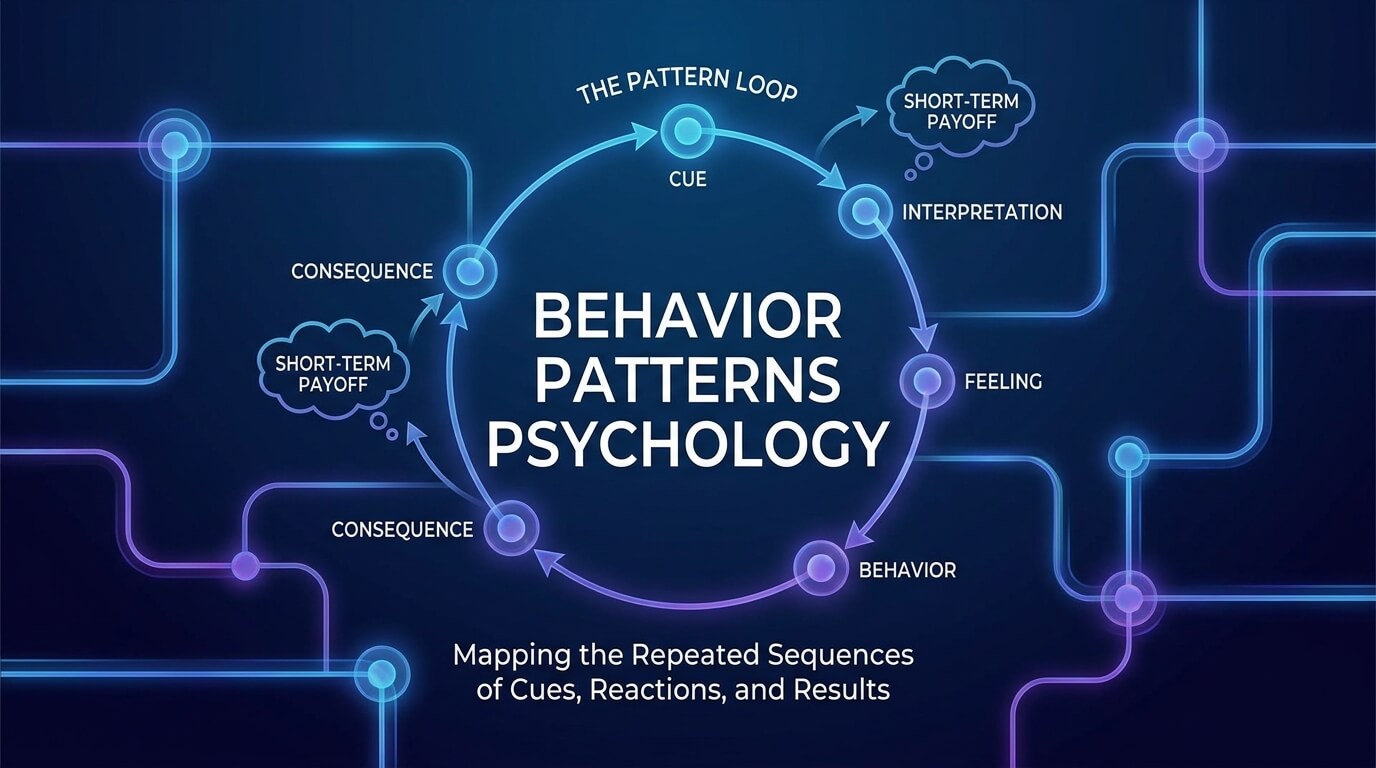
You may not think of your life as a set of patterns, but many repeated problems have a sequence. You avoid a message, feel brief relief, then feel more pressure later. You ask for reassurance, calm down for a while, then need the same reassurance again. You stay quiet during tension, the moment passes, but the unresolved issue returns in a different form.
Behavior patterns psychology looks at these repeated sequences without turning them into character flaws. A behavior pattern is not just “what you do.” It includes what happens before the behavior, what you feel while doing it, what the behavior gives you in the short term, and what it costs later. This makes the pattern easier to understand, because the behavior often makes sense inside its loop even when the long-term result is frustrating.
This page is not meant to diagnose you, label your personality, or solve every repeated behavior in one sitting. It is a practical way to map recurring actions and reactions so you can see the structure more clearly. Once you can see the loop, the next step becomes smaller and less shame-based.
Quick Answer

Behavior patterns are repeated sequences of cues, interpretations, feelings, actions, and consequences. They keep repeating because the behavior often gives a short-term payoff, such as relief, control, comfort, approval, or escape. The first step is not to judge the behavior, but to map what happens before, during, and after it.
What a Behavior Pattern Is
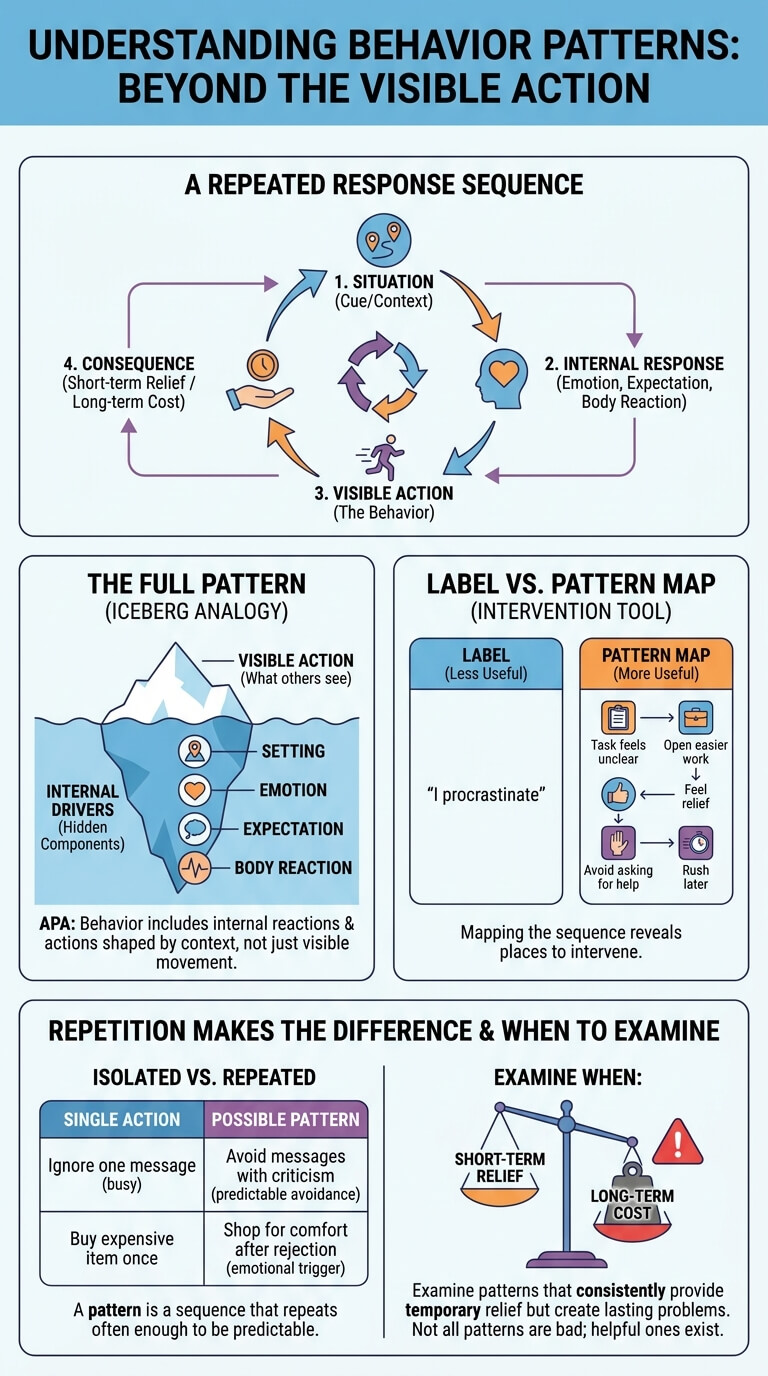
A behavior pattern is a repeated way of responding to certain situations. It may show up in work, relationships, money, food, conflict, stress, screen use, self-care, or decision-making. The visible action matters, but the full pattern includes the setting, emotion, expectation, body reaction, and consequence around the action. Behavior patterns are one part of human behavior psychology.
The APA Dictionary of Psychology describes behavior as activity in response to internal or external stimuli. That definition is useful because it reminds us that behavior is not only what other people can see. It can include internal responses, automatic reactions, and actions shaped by context.
For example, “I procrastinate” is a label. A pattern map is more useful: “When a task feels unclear, I open easier work, feel relief, avoid asking for help, then rush later.” The second version gives you places to intervene.
Repeated sequence, not one isolated action
One late reply is not automatically a pattern. One awkward conversation is not proof that you always avoid conflict. A pattern means the sequence repeats often enough that you can start predicting it.
The repetition can be obvious, such as overspending after stressful workdays. It can also be subtle, such as becoming overly agreeable around certain people, then feeling resentful afterward.
| Single action | Possible pattern | What makes the difference |
|---|---|---|
| You ignore one message because you are busy | You avoid messages that may contain criticism | The same type of cue leads to the same delay |
| You buy something expensive once | You shop for comfort after feeling rejected | The purchase follows an emotional trigger |
| You get quiet during one hard talk | You shut down whenever tension rises | The same emotional pressure produces the same response |
| You ask one clarifying question | You repeatedly seek reassurance before acting | The question temporarily reduces uncertainty but does not build trust in your own judgment |
Patterns can be helpful, neutral, or harmful
Not every pattern is a problem. Brushing your teeth before bed, checking your calendar in the morning, taking a walk after lunch, and calling a friend when you feel isolated are all behavior patterns. A pattern becomes worth examining when it repeatedly gives short-term relief but creates long-term cost.
The Pattern Loop
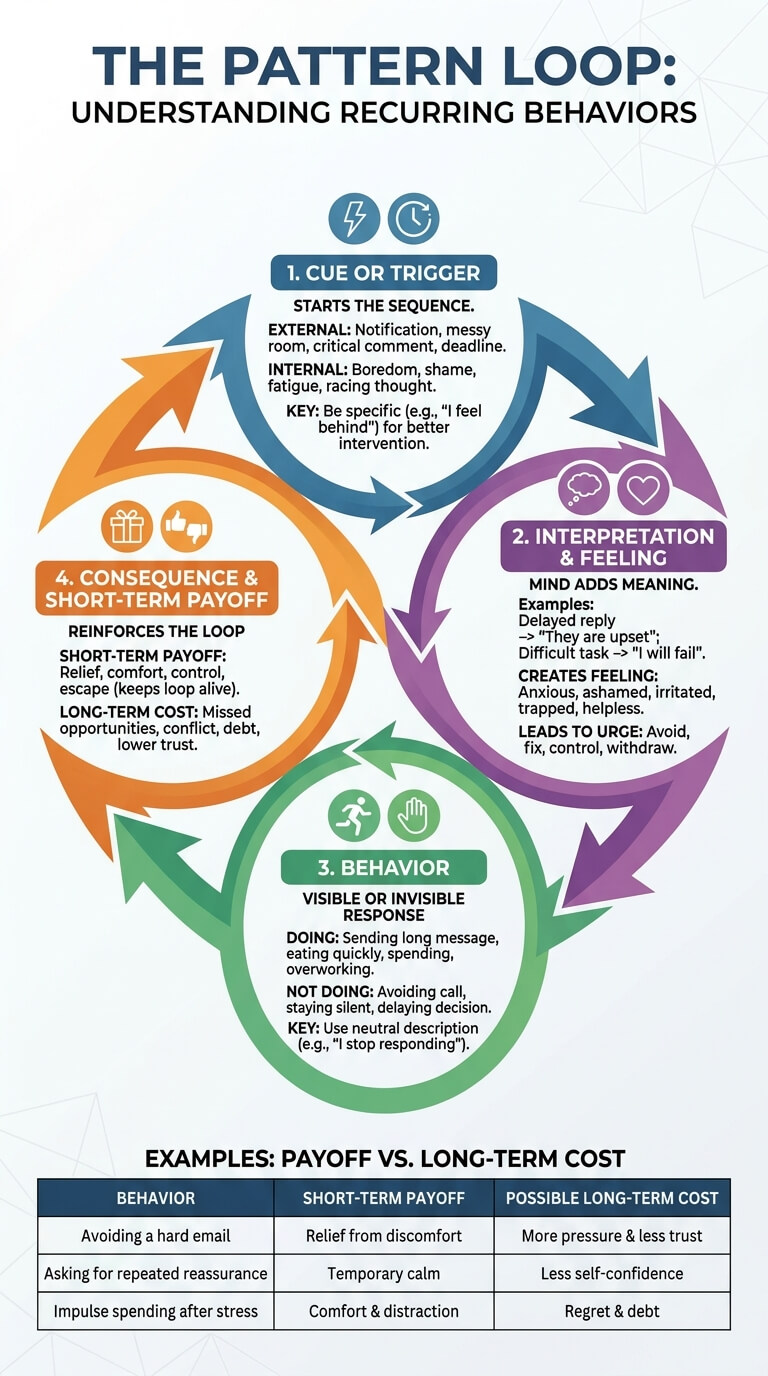
Most recurring behavior patterns can be understood as a loop. Something starts the sequence, your mind gives the situation meaning, your body and emotions respond, you act, and the consequence teaches the loop whether to repeat. The loop may happen in seconds, hours, or days. Many loops move quickly because they involve automatic behavior.
Cue or trigger
The cue is what starts the pattern. It may be external, such as a notification, a messy room, a critical comment, a deadline, a familiar person, a tone of voice, or money in your account. It may also be internal, such as boredom, shame, fatigue, loneliness, uncertainty, hunger, or a racing thought.
A cue does not force a behavior. It makes a familiar response more available. The APA Dictionary definition of automaticity is helpful here because many repeated responses can happen quickly and with little explicit intention, especially after practice.
When you map a pattern, write down the cue as specifically as you can. “Stress” is a start, but “I feel behind and do not know the next step” is more useful. A clear cue gives you a clearer intervention point.
Interpretation and feeling
After the cue, your mind often adds meaning. A delayed reply may become “They are upset with me.” A difficult task may become “I am going to fail.” A partner’s quiet mood may become “I did something wrong.” These interpretations can be fast, emotional, and partly automatic.
The interpretation creates feeling. You may feel anxious, ashamed, irritated, trapped, rejected, bored, pressured, or helpless. The feeling then creates an urge. You may want to avoid, explain, fix, check, control, withdraw, seek comfort, or prove yourself.
Behavior
The behavior is the visible or invisible response. It may be something you do, such as sending a long message, eating quickly, spending money, checking for updates, overworking, cleaning, criticizing, apologizing, or asking for reassurance. It may also be something you do not do, such as avoiding a call, staying silent, delaying a decision, or not asking for support.
Describe the behavior without insult. Instead of “I sabotage everything,” try “I stop responding when I feel exposed.” A neutral description makes the pattern less foggy.
Consequence and short-term payoff
The consequence is what happens after the behavior. Some consequences are long-term, such as missed opportunities, conflict, debt, disconnection, or lower trust. But the short-term payoff is often what keeps the loop alive.
In behavioral psychology, reinforcement refers to a process that increases the likelihood of a response in the future. The APA Dictionary entry on reinforcement explains that a response becomes more likely when it is followed by a dependent stimulus or circumstance. In daily life, the payoff may be relief, praise, control, escape, comfort, stimulation, or a sense of certainty.
| Behavior | Short-term payoff | Possible long-term cost |
|---|---|---|
| Avoiding a hard email | Relief from discomfort | More pressure and less trust later |
| Asking for repeated reassurance | Temporary calm | Less confidence in your own judgment |
| Overexplaining after criticism | Protection from blame | The other person may feel unheard |
| Impulse spending after stress | Comfort and distraction | Regret, debt, or more stress |
| Withdrawing during conflict | Less intensity in the moment | Unresolved issues return later |
Common Types of Behavior Patterns

People repeat patterns for different reasons. Some patterns protect against discomfort. Some create a sense of control. Some seek connection. Some chase reward. Some reduce emotional intensity. The categories below are not diagnoses. They are practical ways to recognize the kind of loop you may be dealing with.
Avoidance patterns
Avoidance patterns happen when you move away from something uncomfortable. The thing avoided may be a task, feeling, person, decision, memory, bill, conversation, or uncertainty. Avoidance can be adaptive when it protects you from real danger or gives you time to prepare. It becomes costly when it repeatedly shrinks your life or delays necessary action.
The APA Dictionary describes an avoidance response as an attempt to prevent contact with an aversive stimulus. In everyday terms, avoidance often says, “I cannot handle this right now,” and then gives relief by moving you away from the discomfort.
A common example is delaying a difficult conversation. The short-term payoff is less anxiety tonight. The longer-term cost is that the topic becomes heavier, the other person becomes more confused, or the decision becomes harder.
Reassurance-seeking patterns
Reassurance-seeking patterns often begin with uncertainty. You may ask, check, reread, compare, or search until you feel temporarily calm. This can be understandable, especially when something matters to you. The problem is that repeated reassurance may train the mind to distrust its own ability to tolerate uncertainty.
For example, someone may repeatedly ask whether a friend is upset. Each answer helps for a short time, but the next ambiguous tone brings the fear back. The behavior is not random. It is trying to reduce uncertainty quickly.
A helpful self-check is: “After reassurance, do I become more able to act, or do I need the same reassurance again soon?” If the same reassurance has to be repeated often, the loop may need a different response.
Overcontrol and perfection patterns
Overcontrol patterns try to prevent mistakes, embarrassment, rejection, or chaos by tightening everything. You may overprepare, rewrite small details, avoid delegating, check your work many times, micromanage plans, or delay sharing anything until it feels perfect.
This pattern often softens when the goal changes from “make it flawless” to “make it safe enough, useful enough, or clear enough for the next step.” That does not mean lowering standards carelessly. It means matching effort to the real risk.
Conflict and withdrawal patterns
Some behavior patterns show up most clearly in conflict. One person may pursue more conversation when anxious, while another becomes quiet to reduce intensity. Someone may apologize too quickly to end tension, then feel unseen later. Someone else may argue details because the emotional part feels too exposed.
Withdrawal can be a pause, a protection strategy, or a way to avoid accountability. The difference depends on what happens next. A useful pause includes a return plan. A costly withdrawal leaves the other person guessing and keeps the issue unresolved.
Reward and impulse patterns
Reward and impulse patterns are loops where a behavior gives quick stimulation, pleasure, comfort, or escape. This may include scrolling, snacking, shopping, gaming, gambling-like checking, risky messaging, or constantly switching tasks. The behavior may not start as a serious problem, but repetition can make it easier to choose again.
Research on habits often emphasizes the role of cues and learned associations. A review in PubMed Central on habit in health psychology describes habit as behavior prompted automatically by situational cues through learned cue-behavior associations. Reward patterns can become especially sticky when the cue is common and the payoff arrives quickly.
The practical question is not only “How do I stop?” It is also “What state am I trying to change with this behavior?” Boredom, loneliness, pressure, and emotional fatigue often need a response, not just restriction.
Why Patterns Keep Repeating

If a pattern keeps repeating, there is usually a reason. That reason may not be wise, fair, or healthy, but it often has internal logic. The pattern may reduce discomfort, protect against shame, keep a familiar role in place, or make the environment easier to predict.
Short-term relief teaches the loop
Short-term relief is one of the strongest teachers. If avoiding a task lowers anxiety, the mind remembers avoidance as useful. If overexplaining lowers the fear of being blamed, the mind remembers overexplaining as protection. If scrolling lowers boredom, the mind remembers scrolling as a quick state change.
The difficulty is that the body often learns from immediate relief faster than it learns from delayed regret. Later consequences may be serious, but they arrive after the short-term payoff has already done its teaching.
This is why shame rarely fixes a repeated pattern. Shame may increase discomfort, which can make the old relief behavior more tempting. Curiosity gives you more information than self-attack.
Familiarity can feel safer than change
People sometimes repeat patterns that do not make them happy because the pattern is familiar. Familiar behavior requires less uncertainty than new behavior. Even a painful loop may feel predictable compared with a new response that has unknown results.
For example, staying silent may feel safer than speaking honestly, even if silence leaves resentment. Perfectionism may feel safer than sharing imperfect work, even when it delays progress.
Environment keeps the pattern available
Patterns live in environments. Your phone is beside the bed. The snacks are visible. The person who criticizes you uses the same tone. The calendar is overloaded. The group rewards overworking. The room, routine, people, and tools around you make some responses easier than others.
If the environment stays the same, the pattern has many reminders. Willpower feels weak when the old cue appears in the same place at the same time.
Behavior Pattern vs Habit vs Mistake
These words overlap, but they do not mean the same thing. A behavior pattern is the larger sequence. A habit is a repeated routine that often runs automatically in a stable context. A mistake is an outcome or choice you regret. Separating them helps you choose the right response. When a loop produces the same unwanted outcome, it may help to look at why people repeat the same mistakes.
| Term | Best use | Example |
|---|---|---|
| Behavior pattern | The full repeated loop around a response | When I feel criticized, I explain too much, then the conversation becomes about my intention |
| Habit | A repeated routine tied to cues and automaticity | I check my phone after sitting on the couch |
| Mistake | A result you regret or a choice that missed the mark | I sent a message too quickly and wish I had waited |
Pattern as the larger sequence
A pattern includes several moving parts. It may contain habits, thoughts, emotions, interpersonal roles, and environmental cues. This is why a pattern can show up in different situations even when the surface details change. A habit is one type of repeated behavior, but habit formation focuses more specifically on cues and rewards.
For example, a person may avoid work feedback, money conversations, and medical appointments. Those look like different topics, but the larger sequence may be the same: uncertainty, body tension, avoidance, relief, delayed consequence.
Habit as repeated automatic routine
A habit is usually narrower. It often repeats in a specific context, such as checking messages after waking up, eating dessert after dinner, or opening a certain app during breaks. Habits matter, but not every pattern is only a habit.
If the main issue is a stable cue and a repeated routine, habit strategies may help. If the loop includes shame, conflict, fear, reassurance, or avoidance, you may need to understand the emotional and social parts too.
Mistake as an outcome you regret
A mistake is the part you wish had gone differently. Mistakes deserve attention, especially when they affect other people. But if you only focus on the mistake, you may miss the repeated sequence that produced it.
Instead of stopping at “I messed up again,” ask, “What was the first cue in the sequence?” and “What did the behavior help me avoid or get in the moment?” Those questions turn regret into usable information.
How to Identify Your Own Pattern
Identifying a pattern is not the same as blaming yourself. The purpose is to make the sequence visible. You are looking for the first few steps in the loop, the emotional payoff, and the place where a smaller choice could interrupt the repetition.
Use a recent example, not a lifetime summary. A specific Tuesday afternoon will teach you more than a broad statement like “I always ruin things.” Specific examples reduce shame and increase accuracy.
Track what happens before, during, and after
Choose one repeated behavior and write three short columns: before, during, and after. Keep the language plain. Do not analyze everything at once. Record the facts, feelings, and consequences.
| Stage | Questions to ask | Example answer |
|---|---|---|
| Before | What happened right before the urge? | I saw the unread email and thought it might be criticism |
| During | What did I feel and do? | I felt tight in my chest and opened easier work instead |
| After | What did I get right away, and what cost came later? | I felt relieved for an hour, then the email felt even bigger |
Look for the payoff, not just the problem
The payoff is often the most important part. If a behavior repeats, it is usually doing something for you in the short term. It may create relief, certainty, comfort, approval, stimulation, escape, control, or emotional distance.
Ask yourself: “What became easier right after I did this?” The answer may be uncomfortable, but it is useful. Avoidance may make fear quieter. People-pleasing may reduce the risk of conflict. Overworking may protect against feeling inadequate. Spending may create a quick sense of reward after a hard day.
Name the pattern without naming yourself as the problem
Name the loop rather than labeling your identity. “The criticism loop” is more workable than “I am defensive.” “The relief-shopping loop” is more workable than “I have no control.”
This does not remove responsibility. It gives responsibility a shape. You can work with a loop. You cannot do much with a global insult.
What to Do After You Spot a Pattern
Once you spot a pattern, resist the urge to redesign your entire life in one day. Big promises often fail because they do not match the actual loop. Start with one cue, one pause, one replacement behavior, or one changed consequence. Once a loop is visible, behavior change becomes more practical.
Change one cue, one pause, or one consequence
Pick one small point in the loop. If the cue is too available, change the environment. If the feeling escalates too quickly, add a pause. If the payoff keeps teaching the old loop, change the consequence.
| Loop point | Small change | Example |
|---|---|---|
| Cue | Make the trigger less automatic | Move the phone charger outside the bedroom |
| Pause | Create a brief moment before the old response | Write the reply in notes and wait ten minutes before sending |
| Consequence | Reward the replacement response | After opening the hard email, take a short walk instead of avoiding the inbox |
| Support | Add accountability or structure | Schedule a body-doubling work session for the task you avoid |
Small changes are not small because they are weak. They are small because they are close enough to the real loop to be repeated.
Build a replacement response
A pattern usually needs a replacement, not only a stop sign. If the old behavior reduces anxiety, the new response needs to help you tolerate anxiety. If the old behavior creates comfort, the new response needs to offer comfort in a less costly way. If the old behavior avoids conflict, the new response needs to create a safer path into the conversation.
Here are simple replacement examples:
The replacement should be realistic on a bad day. A perfect replacement that only works when you feel calm will not help much when the pattern is active.
Where to Look Next
Once you can map a recurring loop, different next questions become clearer. Some loops are mostly habits. Some are repeated mistakes with a decision point you keep missing. Some need a broader behavior-change plan. Knowing which question you are asking prevents you from using the wrong tool.
Habit formation
If the behavior is tied to a stable cue, repeated often, and carried out with little thought, habit science may be the most useful next lens. Look at the cue, the routine, the reward, and the environment that keeps the routine easy.
This is especially helpful for patterns around screen use, sleep routines, snacking, exercise, studying, tidying, and morning or evening routines. The more stable the context, the more habit-focused tools may help.
Repeating the same mistakes
If the repeated problem is less about a routine and more about regret, decision points, or ignored lessons, the better question may be why the same mistake keeps happening. That lens looks at emotion, memory, pressure, self-justification, and the gap between insight and action.
For example, a person may know a choice usually ends badly, but the moment still feels different each time. The pattern map can show the sequence. A mistake-focused lens can show why the lesson is not translating into a different choice.
Behavior change psychology
If you already understand the loop and want a practical change plan, behavior change becomes the next step. That usually means choosing a target behavior, reducing friction, making the replacement easier, tracking progress, and preparing for relapse moments without giving up.
When to Get Support
Many behavior patterns can be explored with reflection, journaling, coaching, education, or everyday support. Some patterns deserve more care. If a pattern involves self-harm urges, substance misuse, compulsive behavior, intense fear, threats, coercion, stalking, violence, humiliation, or feeling unsafe, prioritize support and safety over self-improvement.
NIMH offers education on warning signs that someone may be thinking about suicide, including changes in behavior and talk about wanting to die, feeling trapped, or being a burden. If this is relevant to you or someone near you, use local emergency services or crisis support now, and consider reviewing NIMH guidance on suicide warning signs for general awareness.
Professional support may also help if the pattern feels compulsive, if you cannot stop despite serious harm, if anxiety or distress is shrinking your life, or if the pattern is tied to trauma, addiction, disordered eating, or an unsafe relationship. Getting help is not a failure to understand yourself. It is a way to bring more support to a loop that may be too heavy to handle alone.
FAQ About Behavior Patterns
Is a behavior pattern the same as a habit?
No. A habit is usually a repeated routine that becomes more automatic in a stable context. A behavior pattern is broader. It can include habits, emotions, thoughts, relationship dynamics, avoidance, reassurance, impulses, and consequences.
Why do I notice the pattern only after it happens?
Many patterns run quickly because they have been practiced. At first, awareness often arrives after the behavior and after the consequence. That does not mean change is impossible. A realistic early goal is to notice the pattern sooner: first afterward, then during it, then at the cue stage. Earlier noticing creates more choice.
Can one trigger start several patterns?
Yes. One cue can start different loops depending on your state, environment, and history. Feeling criticized might lead to defending, withdrawing, overexplaining, people-pleasing, or working harder to prove yourself. That is why it helps to track real examples instead of assuming one trigger always has one meaning.
How long does it take to change a pattern?
There is no exact timeline because patterns vary in strength, age, payoff, context, and emotional intensity. A narrow routine may shift faster than a pattern tied to fear, identity, relationships, or coping. A better measure is whether you are noticing the cue earlier, choosing a replacement more often, and recovering faster when the old loop happens again.
Key Takeaways
Final Thoughts
The most useful way to approach a repeated behavior is to get specific. Choose one recent example and map the cue, feeling, action, payoff, and cost. Then choose one small place to interrupt the sequence next time.
You do not need to understand your entire life at once. You need one clear loop, one honest observation, and one replacement response that is realistic enough to repeat.

Michael Reed is the Founder and Lead Writer at Psychology Exposed. He writes about human behavior, relationships, emotional patterns, self-awareness, and practical psychology topics using research-informed, easy-to-understand content.
Read More About Michael Reed: https://psychologyexposed.com/michael-reed/