
- Am I trying to avoid embarrassment, rejection, conflict, or looking difficult?
- Am I copying the group because I agree, or because standing apart feels costly?
- Who seems to have status or authority in this setting?
- What behavior gets rewarded here: honesty, speed, silence, loyalty, humor, toughness, agreement, or performance?
- What would I choose if I had one calm minute to think privately?
- Social psychology explains how other people, groups, norms, roles, status, and social settings shape thoughts, feelings, and behavior.
- Social influence can happen through conformity, compliance, obedience, persuasion, approval, silence, authority, or imagined judgment.
- Groups can create belonging and cooperation, but they can also intensify loyalty, risk-taking, comparison, and responsibility shifting.
- Attribution matters because people often judge others by personality while overlooking context and pressure.
- Social norms and roles act like invisible scripts, guiding behavior in workplaces, families, classrooms, friendships, and online spaces.
- A practical self-check is to ask what the setting rewards, what role you are playing, and whether group pressure is moving you away from your values.
Social psychology basics explain why people often act differently when other people are watching, expecting, judging, helping, pressuring, rewarding, ignoring, or modeling behavior. A person may feel confident alone but quiet in a meeting. Someone may disagree with a group privately but still follow along. A stranger may want to help, yet freeze because everyone else seems calm.
This part of psychology looks at the social side of human behavior. It does not say people have no personality, values, or free choice. It simply shows that behavior is shaped by more than what is inside one person. Groups, roles, norms, status, belonging, and first impressions can quietly change what feels possible, safe, polite, embarrassing, or expected.
Understanding social psychology helps you read everyday situations with more nuance. Instead of assuming someone is rude, weak, selfish, brave, confident, or careless, you can ask a better question: what social forces may be shaping what this person is doing right now?
Quick Answer
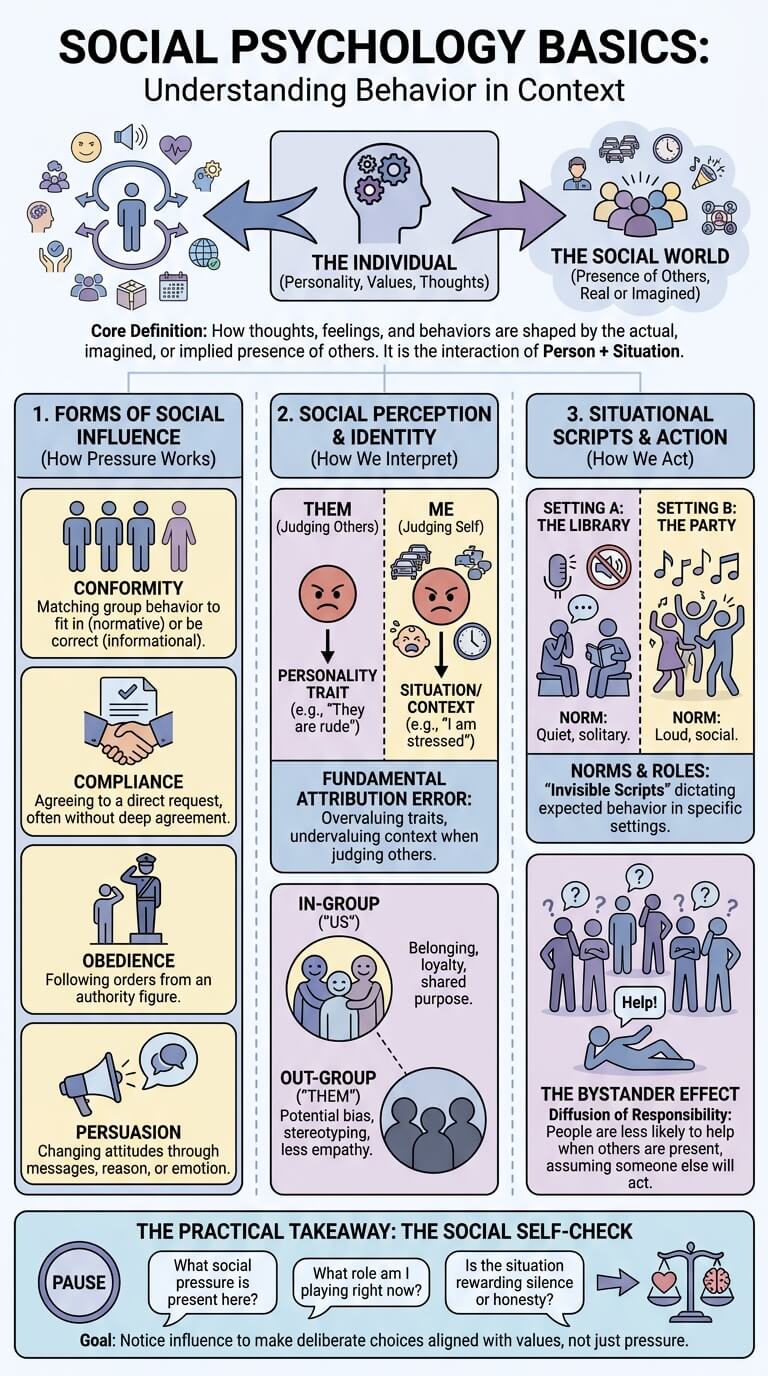
Social psychology studies how people’s thoughts, feelings, and behavior are influenced by other people, groups, norms, roles, and social settings. It helps explain conformity, persuasion, first impressions, group loyalty, helping behavior, comparison, conflict, and why the same person may act differently depending on who is present and what the situation seems to demand.
What Social Psychology Studies
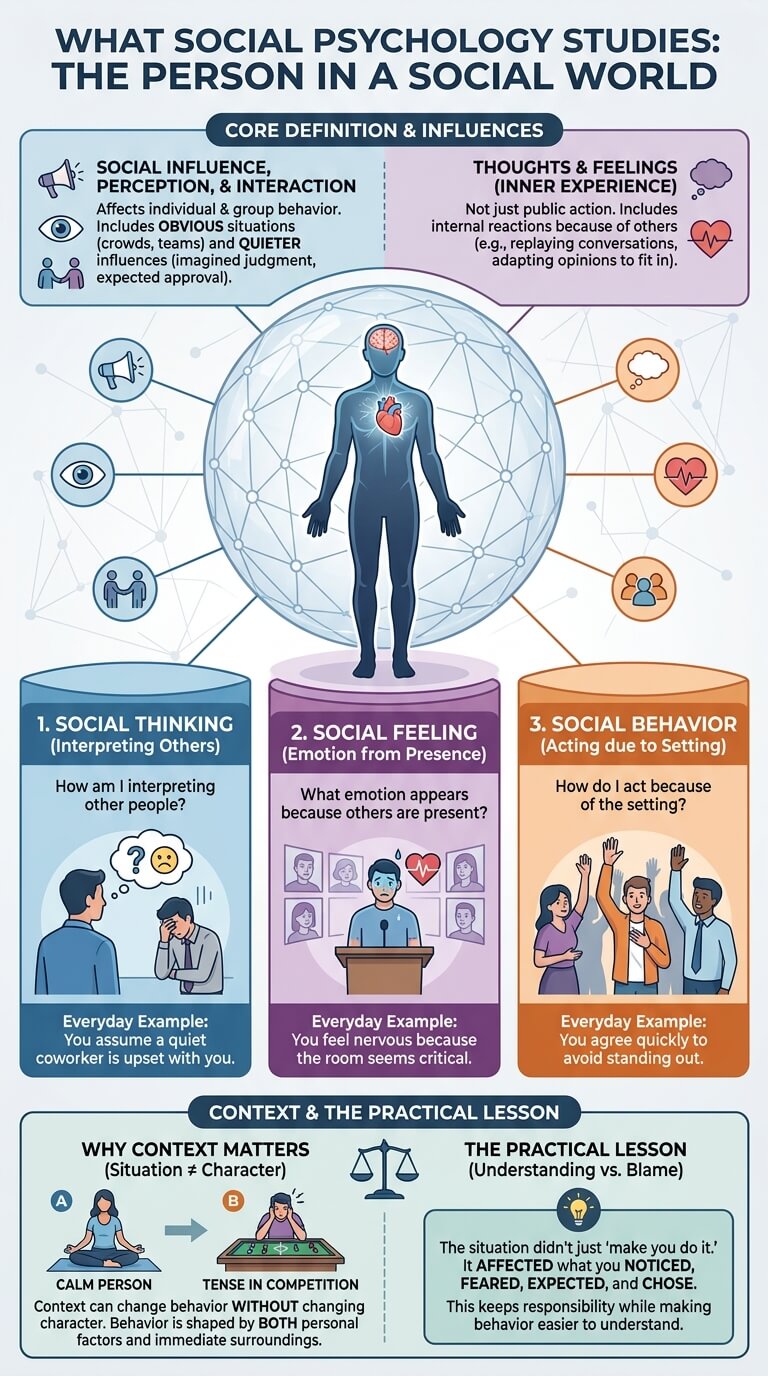
Social psychology studies the person in a social world. It asks how people interpret others, adjust to groups, respond to pressure, judge intentions, cooperate, compete, help, withdraw, or change behavior when a social setting shifts. Social psychology is one branch of the psychology of human behavior.
The American Psychological Association describes social psychology as the study of how social influence, social perception, and social interaction affect individual and group behavior. That definition is useful because it includes both obvious situations, such as a crowd or team, and quieter influences, such as imagined judgment or expected approval.
How people think, feel, and behave around others
Social psychology is not only about what people do in public. It also includes the thoughts and feelings people have because of other people. You might replay a conversation because you wonder how you came across. You might choose clothes based on the setting, not only personal taste. You might soften an opinion around one group and speak more directly around another.
These shifts are not always fake or dishonest. People naturally adapt to social cues. The question is whether the adaptation helps the person act with awareness, respect, and values, or whether the person is being pushed into behavior they do not actually support.
A useful starting point is to separate three layers:
| Layer | Question | Everyday example |
|---|---|---|
| Social thinking | How am I interpreting other people? | You assume a quiet coworker is upset with you |
| Social feeling | What emotion appears because others are present? | You feel nervous because the room seems critical |
| Social behavior | How do I act because of the setting? | You agree quickly to avoid standing out |
Why the social context matters
Context can change behavior without changing a person’s character. A calm person may become tense in a competitive room. A thoughtful person may become quiet when a group rewards fast answers. A generous person may hesitate to help if everyone else is standing still and the situation seems unclear.
OpenStax explains social psychology through the relationship between the person and the situation, noting that behavior can be shaped by both personal factors and immediate surroundings. Its overview of what social psychology studies is helpful for seeing why situation and personality should not be treated as enemies.
The practical lesson is not, “The situation made me do it.” It is, “The situation affected what I noticed, feared, expected, and chose.” That difference keeps responsibility in the picture while also making behavior easier to understand.
Social Influence in Everyday Life
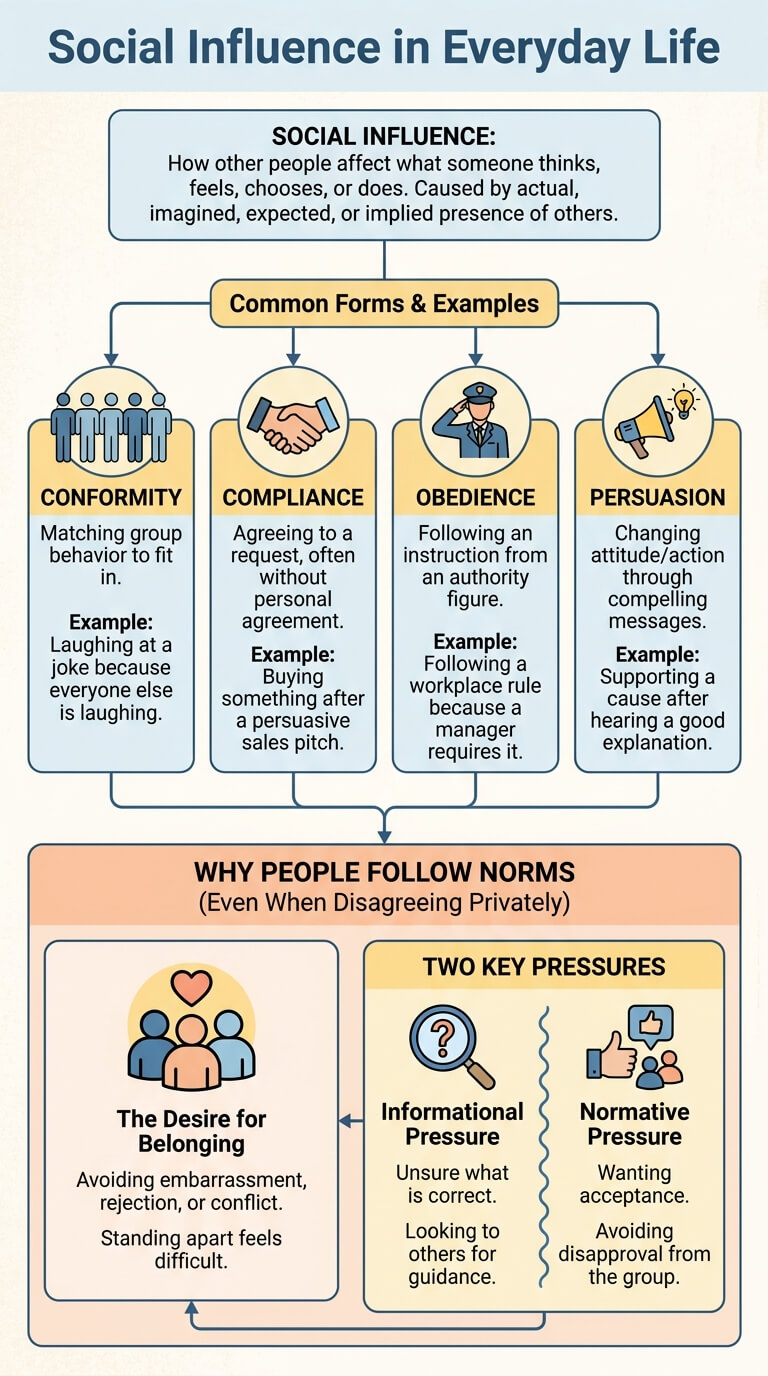
Social influence happens when other people affect what someone thinks, feels, chooses, or does. The other people do not always have to speak directly. Their presence, imagined reaction, status, approval, silence, or group behavior may be enough. Its ideas are easy to see in social behavior in everyday life.
The APA Dictionary of Psychology defines social influence as changes in thoughts, feelings, or behavior caused by other people, whether they are actually present, imagined, expected, or implied. This explains why people can feel pressure even when no one has given an order.
Conformity, compliance, obedience, and persuasion
Several common forms of social influence are easy to confuse, but they are not identical.
| Type of influence | What it means | Everyday example |
|---|---|---|
| Conformity | Changing behavior to match a group | You laugh at a joke because everyone else laughs |
| Compliance | Agreeing to a request, often without deep personal agreement | You buy something after a persuasive sales pitch |
| Obedience | Following an instruction from an authority figure | You follow a workplace rule because a manager requires it |
| Persuasion | Changing an attitude or action through messages, reasons, emotion, or credibility | You support a cause after hearing a compelling explanation |
OpenStax separates conformity, compliance, and obedience in its psychology text, which is useful because each one carries a different kind of pressure. A person who conforms to a group may not feel ordered. A person who obeys may not personally agree. A person who complies may simply want the interaction to end.
Why people follow norms even when they disagree privately
People often follow group norms because belonging matters. Standing apart can create embarrassment, rejection, conflict, or unwanted attention. In small moments, the easiest choice may be to match the group first and think about it later.
This happens in harmless ways, such as dressing for a formal event or lowering your voice in a library. It can also happen in more troubling ways, such as staying silent when a group mocks someone, exaggerating enthusiasm for an idea you doubt, or joining behavior that feels wrong because no one else speaks up.
Two pressures are especially common. Informational pressure happens when people look to others because they are unsure what is correct. Normative pressure happens when people want acceptance or want to avoid disapproval. Both can shape behavior, and both can happen at the same time.
Groups and Identity
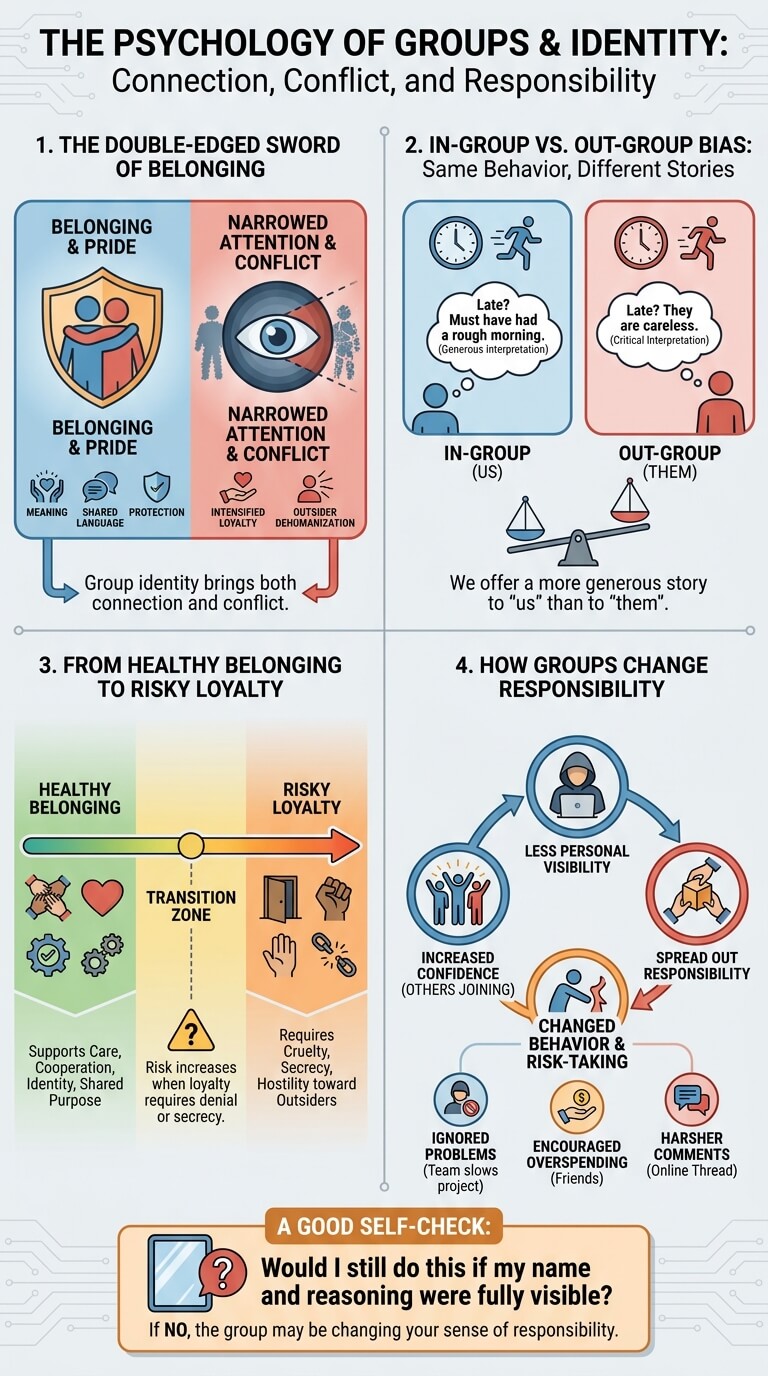
Groups give people belonging, meaning, protection, pride, and shared language. They can also narrow attention, intensify loyalty, and make outsiders seem less real or less fair to consider. This is why group identity can bring both connection and conflict.
In-groups, out-groups, belonging, and loyalty
An in-group is a group a person identifies with. The APA Dictionary entry on ingroup describes it as a group to which a person belongs or with which they identify, often in contrast to out-groups. That contrast matters because people often interpret behavior differently depending on who is doing it.
For example, if someone from your own team is late, you may think, “They must have had a rough morning.” If someone from a rival team is late, you may think, “They are careless.” The same behavior receives a more generous story when it comes from “us” than when it comes from “them.”
Belonging can be healthy when it supports care, cooperation, identity, and shared purpose. It becomes risky when loyalty requires denial, cruelty, secrecy, or hostility toward people outside the group.
How groups can change risk-taking and responsibility
People sometimes take risks in groups that they would avoid alone. A group can make behavior feel less personally visible. Responsibility may feel spread out. Confidence can rise because others are joining in. Fear of rejection can make it hard to object.
This is not only about extreme behavior. It can show up when a team ignores a problem because no one wants to slow the project, when friends encourage overspending, when a comment thread becomes harsher than any single person would be face to face, or when a crowd treats a person as a symbol rather than a human being.
A good self-check is: “Would I still do this if my name and reasoning were fully visible?” If the answer is no, the group may be changing the sense of responsibility.
Attribution and First Impressions
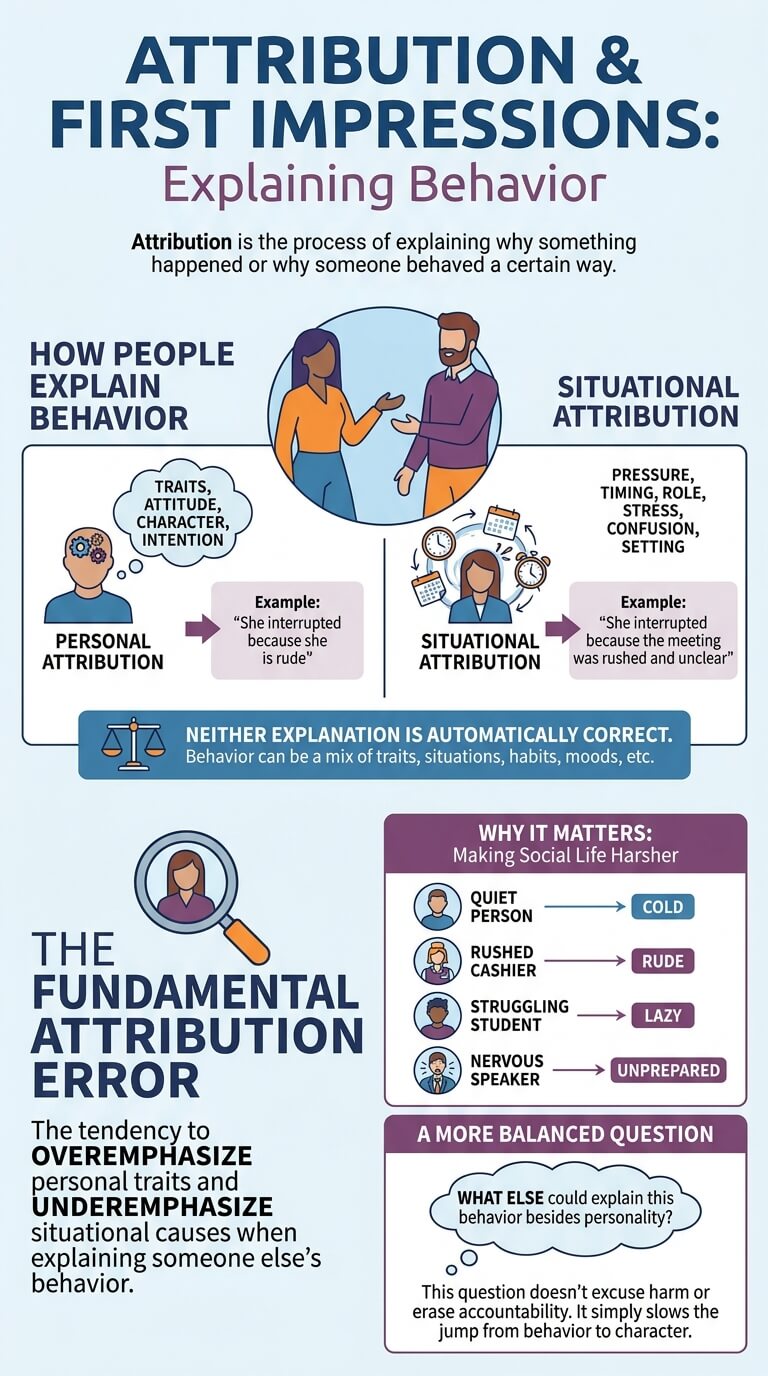
Attribution is the process of explaining why something happened or why someone behaved a certain way. People make attributions quickly because social life requires constant interpretation. The problem is that quick explanations are not always accurate. Quick social judgments are often shaped by cognitive biases and examples.
How people explain behavior
When someone cuts you off in traffic, you may explain it as personality: “They are selfish.” When you cut someone off, you may explain it as context: “I could not see them, and I was trying to change lanes safely.” This difference is common because people have more access to their own pressures than to someone else’s situation.
Attributions usually lean in one of two directions:
| Attribution type | Meaning | Example |
|---|---|---|
| Personal attribution | The behavior is explained by traits, attitude, character, or intention | “She interrupted because she is rude” |
| Situational attribution | The behavior is explained by pressure, timing, role, stress, confusion, or setting | “She interrupted because the meeting was rushed and unclear” |
Neither explanation is automatically correct. A person can be acting from a trait, a situation, a habit, a mood, a misunderstanding, or a mix of several things.
Why we overfocus on personality and underfocus on context
The fundamental attribution error is the tendency to overemphasize personal traits and underemphasize situational causes when explaining someone else’s behavior. The APA Dictionary definition of fundamental attribution error is useful because it names a mistake people make in ordinary judgment, not just formal research.
This error can make social life harsher. A quiet person becomes “cold.” A rushed cashier becomes “rude.” A struggling student becomes “lazy.” A nervous speaker becomes “unprepared.” Sometimes those labels may contain part of the truth, but they often skip the context too quickly.
A more balanced question is: “What else could explain this behavior besides personality?” That question does not excuse harm or erase accountability. It simply slows the jump from behavior to character.
Social Norms and Roles
Social norms are shared expectations about how people usually behave in a setting. Roles are expected patterns of behavior linked to a position, relationship, or situation. Together, they create invisible scripts for social life. Norms are part of the surroundings that influence behavior.
Scripts for how to act in different settings
The APA Dictionary definition of social norm explains that social norms apply across groups and settings, while group norms are specific to a particular group. In real life, this means you may follow one set of expectations at a wedding, another at work, another with close friends, and another online.
Most people learn these scripts through observation. They notice where to stand, how loudly to speak, when to joke, how much emotion to show, what counts as polite, and what behavior gets approval or disapproval.
Norms are not automatically good or bad. Some help people cooperate smoothly. Others keep people silent, unequal, ashamed, or afraid to challenge unfair behavior.
Why roles can change behavior quickly
Roles can shift behavior because they come with expectations. A person may speak differently as a customer than as an employee. Someone may be relaxed as a friend but careful as a team leader. A teenager may act one way with peers and another way with grandparents.
Roles can clarify responsibility, but they can also hide the person behind the role. “I was just doing my job,” “everyone here talks like that,” or “that is how leaders act” can become ways of avoiding reflection. A useful role check is: “What does this role ask from me, and what do my values still require from me?”
Helping, Cooperation, and Bystander Behavior
Social psychology is not only about pressure and conformity. It also helps explain kindness, cooperation, generosity, and why people sometimes fail to help even when they care.
Why people help
People may help because they feel empathy, notice a clear need, identify with the person, feel responsible, have the skills to act, see others helping, or believe helping fits their role. Helping is easier when the situation is clear and the person knows what action to take.
Small social cues matter. A person who says, “Are you okay? I can call someone,” gives others a model for action. A teacher who invites questions makes it easier for a quiet student to ask. A workplace that rewards cooperation makes helping feel normal rather than risky.
Why people sometimes freeze or wait for others
The bystander effect describes situations where people are less likely to help when others are present. A meta-analysis indexed in PubMed found that bystander effects can vary based on perceived danger, the presence of perpetrators, and costs of intervention, which shows that helping is shaped by context rather than simple indifference.
In everyday life, freezing may happen because people are unsure whether the situation is serious, assume someone else will act, fear embarrassment, or do not know the safest next step. The practical lesson is to make helping specific. “You in the blue shirt, please call emergency services” is clearer than “Somebody help.”
If a social situation involves threats, harassment, stalking, coercion, retaliation, or physical danger, the safest response may not be direct confrontation. It may be getting support, documenting what happened, leaving the area, contacting appropriate services, or asking a trained person to intervene.
Conflict, Comparison, and Status
People are social learners, but they are also social comparers. They notice who gets attention, who has influence, who is respected, who is ignored, and where they seem to stand. Those comparisons can affect confidence, choices, resentment, shame, and ambition. Social cues also affect everyday decisions.
Competition, approval, shame, and social ranking
Not all comparison is harmful. Seeing someone do well can inspire learning. Noticing a skill gap can guide practice. Competition can motivate effort when it is fair and values-based.
Comparison becomes heavier when a person’s worth feels attached to rank. A student may stop asking questions because they do not want to look behind. An employee may hide mistakes because status matters more than learning. A friend may feel small when every conversation turns into achievement updates.
A social psychology lens asks: “What is being rewarded here?” If the setting rewards image over honesty, people may hide. If it rewards dominance over listening, people may interrupt. If it rewards belonging through criticism of outsiders, people may become harsher than they want to be.
How online spaces intensify comparison
Online spaces can increase comparison because people see edited moments, public reactions, visible numbers, group opinions, and rapid feedback. A person may not only compare their life to someone else’s highlight, but also compare how much approval each post receives.
Online behavior can also feel less accountable. Distance, speed, anonymity, and group reinforcement can make comments sharper. People may join a pile-on because the group has already defined someone as wrong, embarrassing, or deserving of judgment.
A practical online self-check is: “Would I say this to one person in a calm room?” Another is: “Am I responding to what happened, or am I responding to the crowd’s emotional momentum?”
Social Psychology vs General Human Behavior Psychology
Social psychology is one lens within the broader study of behavior. It focuses on how other people and social settings shape action. General human behavior psychology may also include biology, learning, habits, cognition, emotion, development, personality, and environment. Roles and status help explain different reactions in the same social setting.
Social causes vs cognitive, habit, and environment causes
Different lenses can explain different parts of the same behavior. Imagine someone avoids speaking in a meeting. A cognitive lens may focus on thoughts such as, “My idea is not good enough.” A habit lens may notice a long pattern of staying quiet. An environment lens may focus on meeting structure. A social psychology lens asks about status, group norms, authority, belonging, and fear of judgment.
| Lens | Main question | Meeting example |
|---|---|---|
| Social | What pressure, norm, role, or status issue is present? | Junior staff rarely challenge senior staff |
| Cognitive | What thought or interpretation is shaping action? | “If I speak, I will sound foolish” |
| Habit | What repeated routine has become automatic? | The person always waits until others speak first |
| Environment | What part of the setting makes behavior easier or harder? | The meeting has no structured turn-taking |
These lenses can work together. Social pressure can create anxious thoughts. Repeated group experiences can become habits. An environment can make one role louder and another role quieter.
How social psychology connects to different behavior in the same situation
Two people can face the same social setting and respond differently because they have different histories, roles, confidence, group memberships, interpretations, and perceived risks. One person may see a room as welcoming. Another may see it as a place where one mistake will be remembered.
This is why social psychology is most useful when it avoids simple labels. It does not ask only, “What kind of person are they?” It also asks, “What did this setting make visible, risky, rewarded, punished, or expected?”
Practical Self-Check
You can use social psychology basics without turning every interaction into an analysis. The goal is to notice social pressure early enough to make a more deliberate choice.
What social pressure is present here?
Ask yourself these questions in a situation where your behavior feels different from your values:
These questions are not meant to shame you for being influenced. Everyone is influenced. The point is to notice the influence before it quietly makes the decision for you.
What role am I playing in this setting?
Roles can be useful, but they can also narrow identity. You may be playing the helper, expert, outsider, peacekeeper, performer, rebel, student, leader, parent, newcomer, or loyal friend. Each role can make some behaviors feel natural and others feel risky.
A simple role reset is: “What would a responsible version of this role do?” A leader might listen before deciding. A friend might be loyal without joining cruelty. A newcomer might observe without erasing their own judgment. A helper might care without taking over.
If social pressure includes threats, humiliation, harassment, coercion, or control, reflection alone may not be enough. In those cases, consider support from trusted people, workplace or school reporting channels, local services, or emergency help if there is immediate danger.
FAQ About Social Psychology Basics
What is an example of social psychology?
An example of social psychology is a person staying silent in a meeting because everyone else seems to agree, even though they privately have concerns. The behavior is not explained only by personality. It may also involve group norms, fear of standing out, perceived authority, status differences, and uncertainty about whether disagreement is welcome.
Why do people conform?
People conform for several reasons. They may believe the group knows something they do not, want approval, fear rejection, avoid embarrassment, respect authority, or simply follow a familiar script. Conformity can help groups coordinate, but it becomes a problem when it pushes people to ignore evidence, violate values, or mistreat others.
Is social psychology only about groups?
No. Groups are important, but social psychology also studies one-on-one interaction, first impressions, persuasion, helping, prejudice, social comparison, attraction, conflict, roles, and how imagined judgment affects behavior. Even when you are alone, your choices may be shaped by what you expect other people to think or do.
How does social media affect behavior?
Social media can affect behavior by making approval, comparison, group opinion, status signals, and feedback more visible. Likes, comments, shares, trends, and public reactions can shape what people post, what they avoid saying, how they judge themselves, and how quickly they join group reactions. It does not affect everyone the same way, but it can intensify social influence because feedback is fast and public.
Key Takeaways
Final Thoughts
The first step in using social psychology is not to distrust everyone or analyze every conversation. It is to pause before turning behavior into a character judgment. Ask what the room, group, role, norm, status difference, or audience may be doing to the person in that moment.
Then turn the same question back toward yourself. When you notice social pressure, you gain a small space to choose. You may still follow the group, but you can do it because it fits your values, not only because it feels easier than standing apart.

Michael Reed is the Founder and Lead Writer at Psychology Exposed. He writes about human behavior, relationships, emotional patterns, self-awareness, and practical psychology topics using research-informed, easy-to-understand content.
Read More About Michael Reed: https://psychologyexposed.com/michael-reed/