
False memory psychology explains one of the most unsettling truths about remembering: a memory can feel clear, emotional, and familiar while still being partly inaccurate. This does not mean the person is pretending. It means memory is not a perfect recording of the past. It is a mental reconstruction that can be influenced by attention, later information, imagination, emotion, repetition, and social context.
This matters because memory disagreements can become personal very quickly. One person may say, “I know exactly what happened,” while another remembers the same event differently. In everyday life, that may lead to confusion, embarrassment, family tension, or relationship conflict. In high-stakes situations, such as trauma, abuse concerns, or legal conflict, the topic becomes far more sensitive and should not be handled casually.
The careful middle ground is this: memory deserves respect, but confidence alone does not prove accuracy. This article explains how false memories can happen, why they can feel convincing, how they differ from lying and ordinary forgetting, and how to approach memory disagreements without turning them into blame.
Quick Answer
False memories can feel real
A false memory is a remembered event or detail that is inaccurate or did not happen as remembered. The APA Dictionary of Psychology defines false memory as a recollection that does not correspond to what actually occurred, even though the person may experience it as genuine.
Confidence is not the same as accuracy
People often assume that a confident memory is a correct memory. Confidence can matter in some circumstances, but it is not a guarantee. A person may feel certain because the memory has been repeated, imagined, emotionally charged, or supported by later stories. That feeling of certainty can make the memory more persuasive, even when some details have shifted.
What a False Memory Means in Psychology

In psychology, false memory does not simply mean “bad memory.” It refers to a mismatch between what is remembered and what happened. The mismatch may be small, such as remembering the wrong person saying a sentence. It may also be larger, such as remembering a detail that came from a story, photo, question, or repeated imagination rather than from direct experience.
The word “false” can sound harsh, so it helps to separate the memory from the person’s character. A false memory is not automatically a lie, a manipulation, or a sign that someone is unreliable in every area of life. It is one example of how human memory can be constructive, flexible, and vulnerable to influence.
False memory vs ordinary forgetting
Forgetting usually means a detail is missing, weak, inaccessible, or hard to retrieve. You may forget where you put your keys, the name of a person you met last week, or the exact words used in a conversation. The memory is incomplete.
A false memory is different because the mind may provide a detail that feels like a memory. Instead of saying, “I do not remember,” the person may feel, “I remember that it happened this way.” The issue is not only absence. It is replacement, blending, or construction.
| Memory issue | What it often feels like | Simple example |
|---|---|---|
| Forgetting | A gap or blank spot | You cannot remember where you parked. |
| False memory | A detail that feels remembered | You remember parking near the entrance, but the car was actually on another level. |
| Uncertainty | A partial memory with doubt | You think you parked near a pillar, but you are not sure. |
False memory vs lying
Lying involves knowingly saying something untrue. A false memory can involve sincere belief. Someone may repeat an inaccurate memory with real emotion because it feels available, familiar, and personally meaningful.
This distinction is important in ordinary conversations. If two people remember a dinner conversation differently, the fastest way to make the disagreement worse is to say, “You are lying.” A more accurate starting point may be, “We may be remembering this differently.” That does not mean every claim is equally accurate. It means the first step is curiosity before accusation.
False memory vs changing interpretation
Sometimes the remembered facts are mostly stable, but the meaning changes. For example, you may remember that a friend did not reply to your message. Years later, you may interpret that as rejection. The event may be real, while the meaning attached to it has changed.
False memory is more about the remembered details themselves. Did the friend promise to call, or did you later infer that they should have? Did someone say “I will be there,” or did they say “I will try”? Changing interpretation can happen around accurate memories, false memories, or uncertain memories.
Why False Memories Can Happen
The risk of reconstruction becomes clearer when looking at how memory works through encoding, storage, retrieval, and updating.
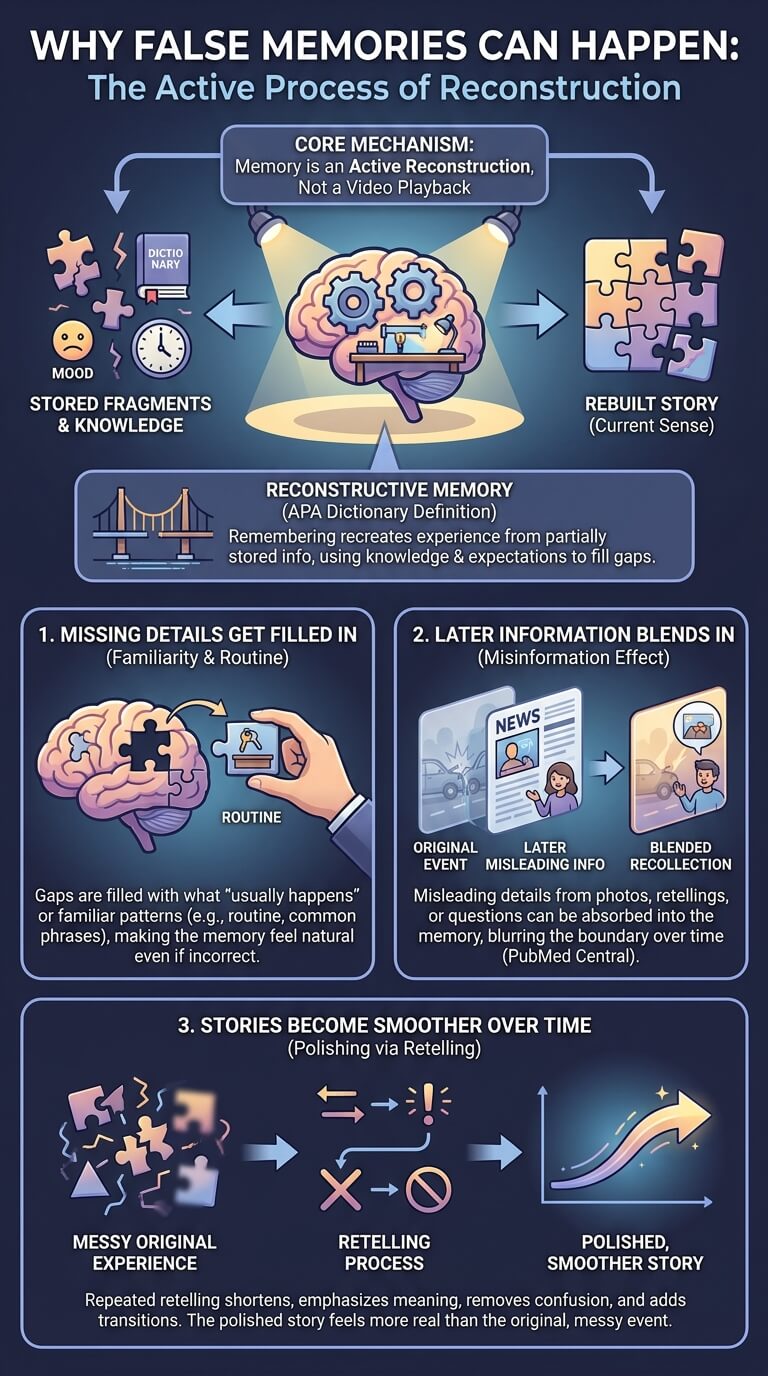
False memories are possible because remembering is active. When you recall an event, the mind brings together stored fragments, general knowledge, emotional tone, and current context. The APA Dictionary describes reconstructive memory as remembering that recreates an experience from partially stored information, often using knowledge and expectations to fill gaps.
Memory is reconstructed during recall
A memory is not pulled from the mind like a video file. It is rebuilt. You may retrieve the setting, a few words, the emotion, and the rough sequence. Then your mind organizes those pieces into a story that makes sense now.
This rebuilding is usually useful. It helps you understand your life without needing to store every tiny detail. The cost is that the rebuilt version can become smoother, simpler, or more coherent than the original experience.
Missing details get filled in
When a memory has gaps, the mind may fill them with what usually happens. If you often leave your wallet on the kitchen counter, you may remember putting it there even on a day when you left it in the car. The memory feels natural because it matches your routine.
This gap-filling can also happen in conversations. You may remember someone using a phrase they often use, even if they did not use it that day. The brain leans on familiarity when exact detail is unavailable.
Later information can blend with earlier experience
One of the best-known routes to false memory is later information blending with the original event. Research on the misinformation effect shows that misleading information after an event can become incorporated into a person’s later account. A review in PubMed Central describes the misinformation effect as cases where misleading details are absorbed into recollection of a past event.
Everyday life is full of later information: someone else’s retelling, a photo caption, a family joke, a news report, a group chat, or a question that assumes a detail. Over time, the boundary between what you saw and what you later heard can become less clear.
Stories become smoother over time
When people retell a memory, they usually do not repeat it word for word. They shorten it, emphasize the most meaningful parts, remove confusing pieces, and add transitions. After many retellings, the polished story may feel more real than the messy original.
This is one reason old stories can feel certain. The person may not be remembering the event fresh. They may be remembering the story they have told about the event for years.
Common Sources of False Memories
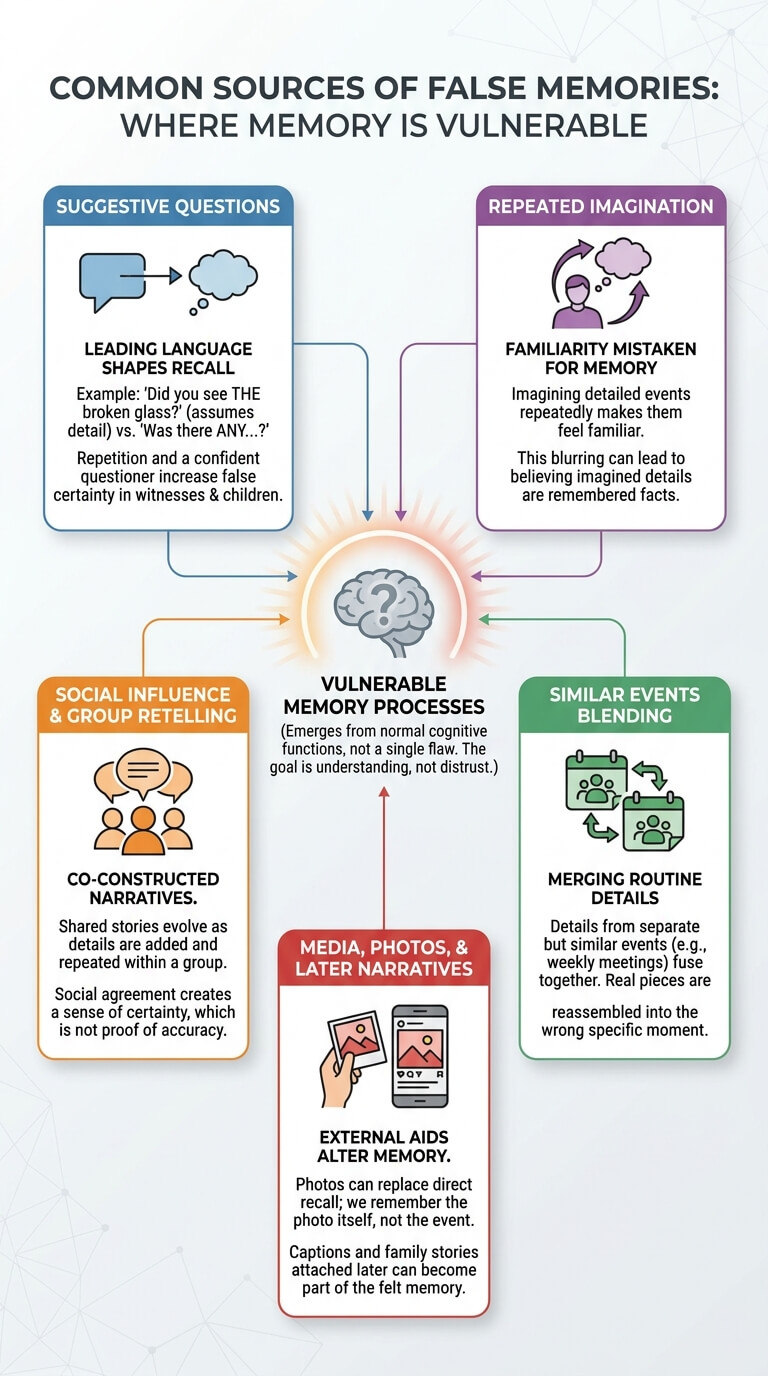
False memories do not come from one single cause. They can emerge from normal memory processes, social pressure, repeated imagination, emotional meaning, or later evidence that becomes mixed with the original experience. The point is not to distrust every memory. The point is to understand where memory becomes vulnerable.
Suggestive questions
A question can quietly shape a memory. “Did you see the broken glass?” is different from “Was there any broken glass?” The first question assumes a detail. Even if the person is trying to be honest, the assumption can guide what they search for in memory.
Suggestive questions matter in families, workplaces, relationships, and investigations. A child, witness, or stressed adult may become more certain after repeated questions, especially when the questioner appears confident.
Repeated imagination
Imagining an event many times can make it feel more familiar. Familiarity can then be mistaken for memory. This does not mean imagination always creates false memories, but it can blur the line when the imagined scene becomes detailed and repeated.
For example, if you repeatedly picture how a conversation probably happened, the imagined version may later feel closer to a remembered version. You may remember the tone, the room, or the wording with more confidence than the original evidence supports.
Social influence and group retelling
Memory often becomes social. Families, friend groups, and teams retell shared events. One person adds a detail, another laughs, a third person repeats it later, and the detail becomes part of the group version.
This can be harmless, such as a family vacation story that gets exaggerated. It can also become painful if a group version pressures one person to accept a memory they do not share. Social agreement can create certainty, but agreement is not the same as proof.
Similar events blending together
When events repeat, details can merge. You may confuse two birthdays, two arguments, two meetings, or two trips to the same place. The memory is not invented from nothing. It is built from real pieces that belong to different events.
This is especially common with routine experiences. If every Monday meeting feels similar, it can be hard to know which person made which comment on which date. The mind remembers the pattern, then may attach the wrong detail to a specific moment.
Media, photos, and later narratives
Photos can support memory, but they can also change it. A photo may make you believe you remember the whole day, when you may mostly remember the photo itself. Captions, videos, messages, and social media posts can all become part of the later story.
A childhood photo can create a feeling of memory even when the person was too young to remember the event clearly. A family story attached to the photo may become so familiar that it feels personally remembered.
Why False Memories Feel So Convincing
A memory can feel clear and detailed without being fully accurate, which is why vivid memories need to be treated with both respect and curiosity.
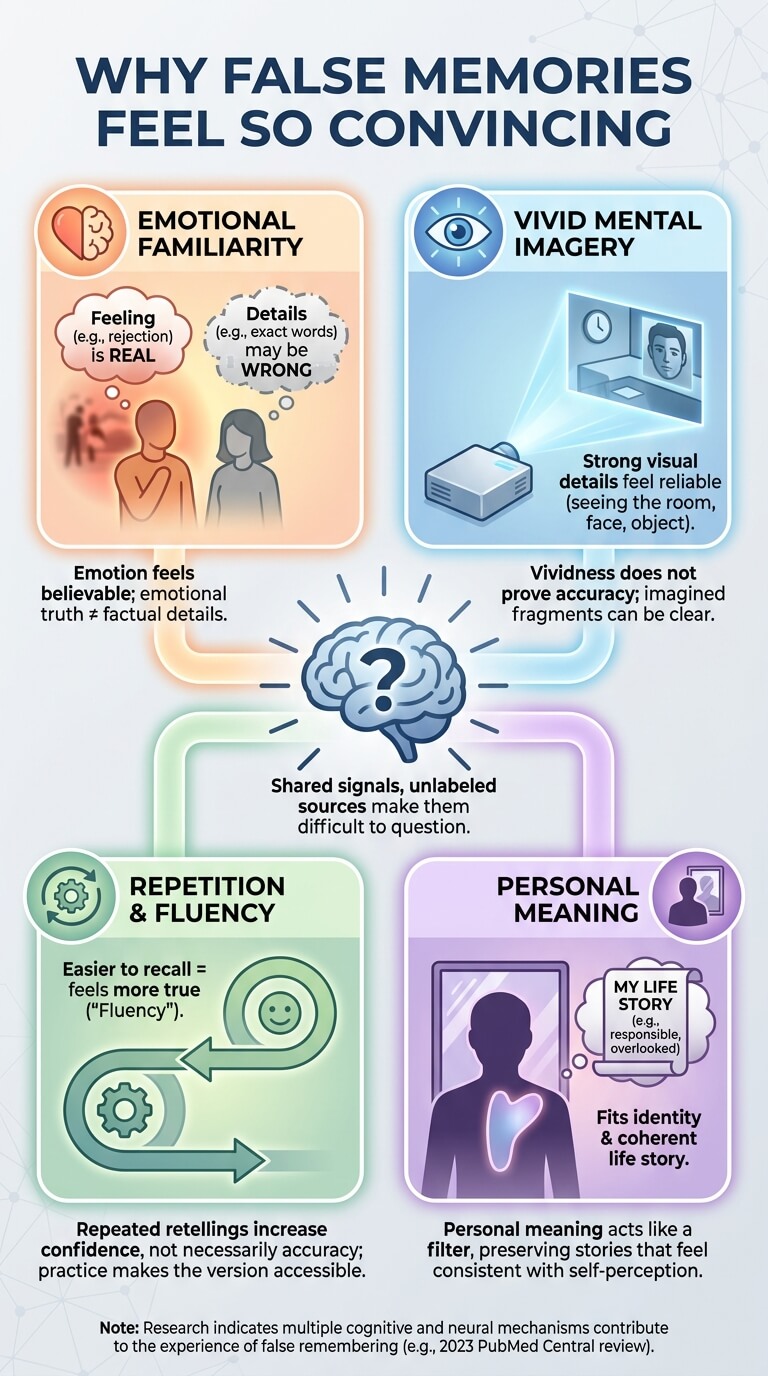
False memories are difficult to question because they can carry many of the same signals as accurate memories. They may have images, emotion, sensory fragments, and a feeling of familiarity. The mind does not always label where a detail came from.
Emotional familiarity
Emotion can make a memory feel important. If a remembered event fits an old feeling, such as embarrassment, fear, pride, or rejection, it may feel more believable. The emotion may be real even if some details are not exact.
For example, someone may accurately remember feeling left out in a friend group, but misremember the exact sentence that created that feeling. The emotional truth and factual details are related, but they are not identical.
Vivid mental imagery
A memory with strong imagery can feel more reliable than a vague one. You may “see” the room, the face, the weather, or the object in someone’s hand. Vividness, however, does not always prove accuracy.
Research reviews continue to examine why false memories can involve sensory and emotional detail. A 2023 review in PubMed Central on cognitive and neural mechanisms of false memories describes false remembering as involving distorted memories or memories of events that did not occur, with multiple mechanisms contributing to the experience.
Repetition and fluency
The more easily a story comes to mind, the more true it may feel. Psychologists sometimes call this fluency: the mental ease of processing something. A repeated story can become fluent, and fluency can be mistaken for accuracy.
This is why repeated retellings can strengthen confidence. The person is not necessarily becoming more accurate. They may be becoming more practiced at accessing the same version.
Personal meaning
A memory that fits your identity or life story can feel especially convincing. If you see yourself as someone who was always overlooked, you may be more likely to remember ambiguous moments as dismissive. If you see yourself as responsible and careful, you may remember yourself handling a situation better than you did.
This does not mean identity always distorts memory. It means personal meaning acts like a filter. The mind tends to preserve stories that feel coherent with who we think we are and what we believe happened to us.
False Memory vs Memory Bias
False memory and memory bias are closely related, but they are not the same. Understanding the difference helps prevent two articles, two conversations, or two personal reflections from turning into the same issue.
False details vs biased emphasis
False memory focuses on remembered details or events that are inaccurate. Memory bias focuses on how memory is selected, emphasized, interpreted, or organized. A biased memory may still contain real details, but the emphasis may be shaped by mood, beliefs, expectations, or identity.
| Question | False memory | Memory bias |
|---|---|---|
| Main issue | Did this detail or event happen as remembered? | Why is this detail emphasized or interpreted this way? |
| Common example | Remembering someone said a phrase they did not say | Remembering mostly the negative parts of a mixed experience |
| Best next question | What evidence separates direct experience from later information? | What mood, belief, or expectation may be shaping the memory? |
How the two can overlap
The two can work together. A person may falsely remember a detail because it fits a biased interpretation. For example, if someone already feels disliked by a coworker, they may misremember the coworker’s neutral comment as sharper than it was.
The bias gives the memory a direction. The false detail gives it a concrete form. That combination can be powerful because it feels both meaningful and specific.
When to read the memory bias guide next
If your main question is “How can I remember something that did not happen?” false memory is the better frame. If your main question is “Why do I keep remembering only one side of what happened?” memory bias is the better frame.
Many people need both ideas. False memory explains how details can be added or altered. Memory bias explains why certain details become more noticeable, more available, or more emotionally important.
Everyday Examples of False Memory
False memories are not limited to dramatic cases. They can show up in ordinary life, especially when events are emotional, repetitive, or retold often. The examples below are not proof that a specific memory is false. They are practical ways to see how memory can shift.
Misremembering who said something
You remember a helpful suggestion, but you attach it to the wrong person. Maybe your sister said it, but you remember your friend saying it because you spoke with both of them that week.
What you remember may still contain a real idea. The mistake is the source. This kind of error can matter if credit, blame, or trust depends on who said what.
Remembering a childhood detail from family stories
You may feel as if you remember falling asleep at a family wedding, even though the memory may come mostly from hearing the story for years. A photograph and repeated family retelling can create a strong sense of personal memory.
This does not make the family story meaningless. It simply means your direct memory, the photo, and the repeated story may be woven together.
Confusing two similar conversations
You and a partner may have had several conversations about money, chores, or plans. Later, you remember a sentence from one conversation as if it happened during another. The feeling is real because the topic and emotional tone are familiar.
This can lead to conflict if each person argues from certainty. A better question is: “Are we talking about the same conversation, or are two moments getting blended?”
Recalling a detail added later
After an event, someone says, “He looked angry when he walked out.” Later, you may remember seeing anger yourself, even if you originally noticed only that he left quickly.
The later interpretation becomes attached to the original scene. This is one reason witness memory and group retelling require care. The National Institute of Justice collects research on eyewitness testimony, a field where memory confidence, identification procedures, and later information can have serious consequences.
How to Think About Memory Disagreements Carefully
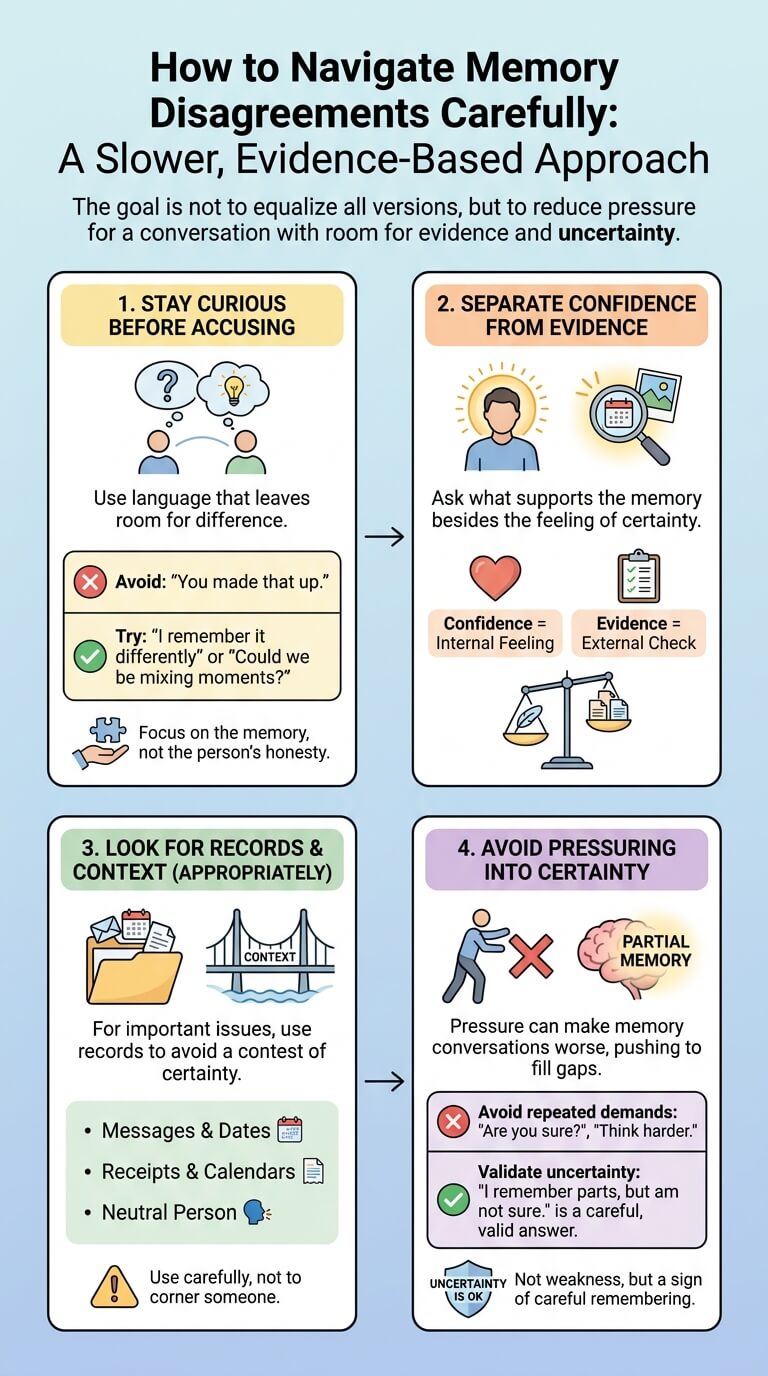
Memory disagreements need a slower approach than ordinary factual disagreements. When someone feels certain, direct contradiction can feel like an attack. When someone feels accused, they may defend the memory even harder. The aim is not to pretend all versions are equally accurate. The aim is to reduce pressure so the conversation has room for evidence and uncertainty.
Stay curious before accusing
Start with language that leaves room for difference. Instead of “You made that up,” try “I remember it differently” or “I wonder if we are mixing two moments.” This keeps the focus on the memory, not the person’s honesty.
Curiosity does not mean passivity. If the memory involves harm, responsibility, or a pattern that affects you, you can still take it seriously. Careful wording simply prevents the first sentence from becoming a character attack.
Separate confidence from evidence
Ask what supports the memory besides the feeling of certainty. Is there a message, calendar entry, photo, third person, location detail, or repeated pattern? Is the detail from direct experience, or from something someone later said?
This is especially useful when both people feel sure. Confidence tells you how the memory feels from inside. Evidence helps you understand what can be checked from outside.
Look for records, context, and multiple perspectives when appropriate
For low-stakes issues, you may not need to investigate. If two friends disagree about which restaurant they visited first, it may not matter. For important issues, records and context can prevent the conversation from becoming a contest of certainty.
Useful checks might include messages, dates, receipts, shared calendars, earlier notes, or asking a neutral person who was present. This should be done carefully, not as a way to corner someone.
Avoid pressuring someone into certainty
Pressure can make memory conversations worse. Repeated demands like “Are you sure?” or “Think harder” may push someone to fill gaps instead of tolerate uncertainty. This is especially important with children, distressed adults, witnesses, and anyone discussing painful experiences.
Sometimes the most accurate answer is, “I remember parts of it, but I am not sure about that detail.” That answer deserves room. Uncertainty is not weakness. It can be a sign of careful remembering.
When False Memory Topics Become Sensitive
False memory can be discussed lightly when the issue is a mistaken detail about a trip or a family story. It becomes much more serious when the memory involves trauma, abuse, safety, legal responsibility, or someone’s reputation. In those situations, internet explanations are not enough to settle what happened.
Trauma, abuse, legal conflict, and high-stakes claims
Be careful with any claim that tries to prove or disprove a traumatic memory based only on a general article. Trauma can affect attention, emotion, and later recall, but that does not mean a painful memory is automatically false. It also does not mean every vivid or emotional memory is automatically exact.
If there is fear, coercion, threats, stalking, humiliation, violence, self-harm risk, or retaliation, prioritize safety and professional support over debate. The National Institute of Mental Health offers information on coping with traumatic events and signs that additional help may be needed after distressing experiences.
Why professional support may be needed
A trained professional cannot magically replay the past, but they can help someone handle distress, uncertainty, and safety decisions more carefully. This is especially important if memory questions are connected to panic, nightmares, intrusive images, family pressure, legal conflict, or fear of another person.
Support is not only about proving whether a memory is true. It may be about stabilizing the present, reducing pressure, documenting concerns, and making decisions that protect well-being.
FAQ About False Memory Psychology
Can a false memory feel emotional?
Yes. A false memory can feel emotional because the feeling attached to it may be real, even if some details are inaccurate. Emotion can come from a related experience, a repeated story, an old fear, or the meaning the memory has taken on over time. This is why emotional intensity should be respected, but not treated as the only proof of accuracy.
Does a false memory mean someone is lying?
No. Lying means someone knowingly says something false. A false memory can be sincerely believed. That distinction matters because accusing someone of lying too quickly can damage trust and make the conversation more defensive. It is better to separate honesty, confidence, and accuracy as three different questions.
Can photos create or change memories?
Photos can strengthen memory, but they can also shape it. A person may remember the photo, the caption, and the family story around it more clearly than the original event. Over time, those pieces may feel like direct memory. This does not make photos useless. It means they are evidence of a moment, not always evidence of everything a person later remembers about that moment.
Why do people remember the same event differently?
People notice different details, care about different meanings, and retell events through different personal histories. One person may remember the words. Another may remember the tone. A third may remember how the room felt. Differences do not automatically mean anyone is dishonest. They show that memory is selective and reconstructed.
Can you prove whether a memory is false?
Sometimes a detail can be checked with records, messages, photos, dates, or multiple perspectives. Other times, the evidence is limited and the honest answer is uncertainty. In high-stakes situations involving trauma, abuse, safety, or legal conflict, it is wise to seek qualified support instead of trying to settle the issue through pressure, online research, or repeated arguments.
Key Takeaways
- False memory psychology explains how people can sincerely remember inaccurate details or events.
- A memory can feel vivid, emotional, and familiar without being fully accurate.
- False memory is different from ordinary forgetting, lying, and changing interpretation.
- Suggestive questions, repeated imagination, social retelling, similar events, and later information can all influence recall.
- Memory confidence should be considered, but it should not be treated as the same thing as evidence.
- When memory questions involve trauma, abuse, safety, or legal issues, careful professional support may be more appropriate than debate.

Michael Reed is the Founder and Lead Writer at Psychology Exposed. He writes about human behavior, relationships, emotional patterns, self-awareness, and practical psychology topics using research-informed, easy-to-understand content.
Read More About Michael Reed: https://psychologyexposed.com/michael-reed/