

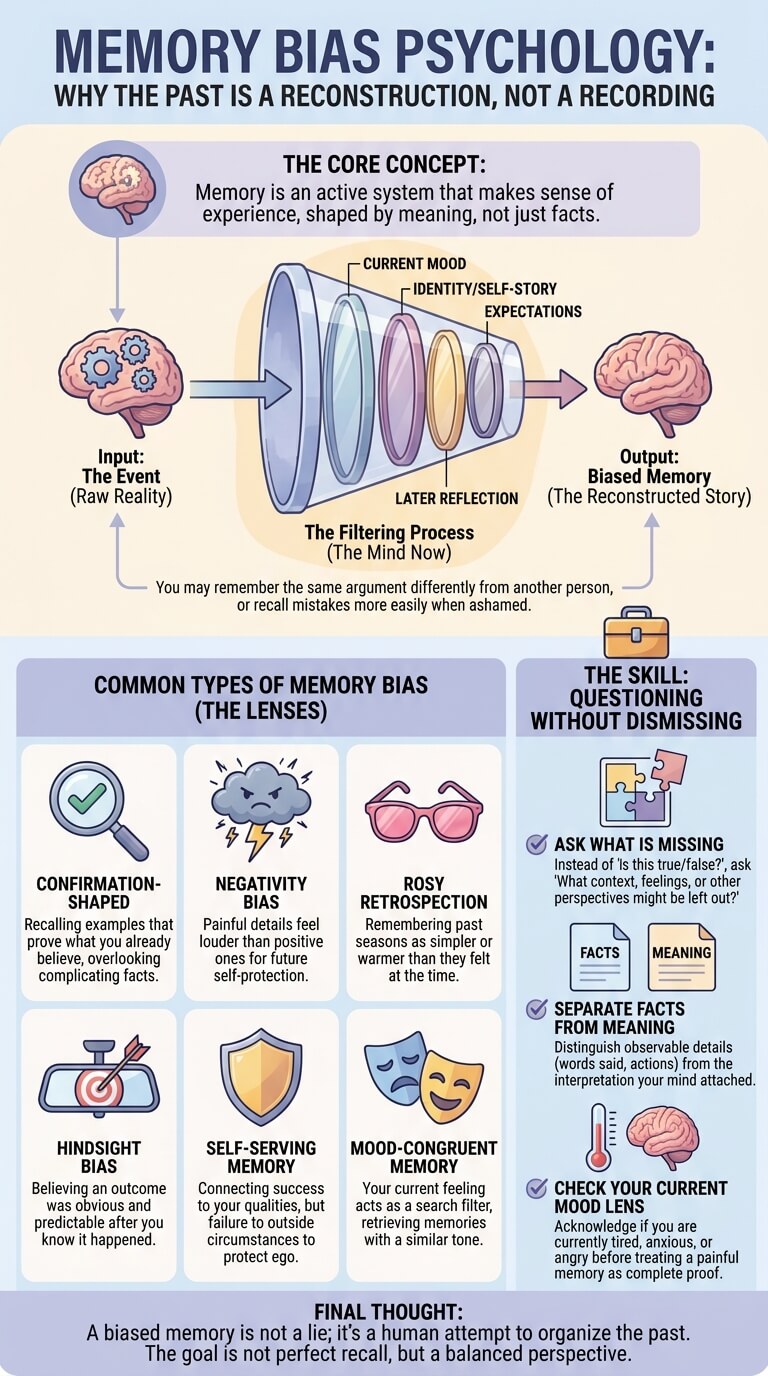
Memory bias psychology explains why the past can feel clear, convincing, and personal, while still being shaped by mood, meaning, identity, expectation, and later reflection. You may remember the same argument differently from another person. You may recall old mistakes more easily when you feel ashamed. You may look back on a difficult year and remember only the struggle, or look back on a past season and remember it as better than it really felt at the time.
That does not mean memory is useless. It means memory is not a perfect recording device. It is an active system that helps you make sense of experience. The trouble starts when a biased memory feels like complete proof: proof that you always fail, proof that someone never cared, proof that the outcome was obvious, or proof that the past was simpler than the present.
This topic is especially useful when you want to question a memory without dismissing yourself. A memory can contain real facts, real feelings, and real gaps at the same time. The skill is not to accuse yourself of remembering badly. The skill is to ask what your mind may be emphasizing, protecting, simplifying, or leaving out.
Quick Answer
Memory bias is one part of memory psychology, because recall is shaped not only by stored details but also by mood, meaning, identity, and later interpretation.
Memory is shaped by meaning, not just facts
Memory bias is the tendency for recall to lean toward certain details, emotions, explanations, or self-protective interpretations. Psychology treats memory as an active process, not a fixed replay of the past. The American Psychological Association describes memory as involving learning, retention, and retrieval, which means what you remember is influenced by how information was encoded and later brought back to mind.
Bias affects what we notice, store, and retrieve
A biased memory does not always invent an event. Often, it changes the balance of the story. Your mind may highlight the criticism and fade the compliment, remember the outcome but forget how uncertain you felt beforehand, or recall the version that supports your current mood. This is why two sincere people can remember the same moment differently.
What Memory Bias Means
Bias is not always intentional
Memory bias is not the same as lying. Lying involves deliberate misrepresentation. Memory bias can happen without conscious intent. A person may truly believe the version they remember because that version fits their current understanding, emotional state, or self-image.
This matters because accusing someone of lying often shuts down curiosity. A better starting question is: what part of the event became most meaningful to each person? One person may remember the exact words. Another may remember the tone. Another may remember the feeling of being embarrassed. Each memory may be incomplete in a different way.
Memory bias vs false memory
A false memory involves remembering something inaccurately or remembering something as if it happened when it did not happen in that form. Memory bias is broader and often subtler. It may involve a real event, but the event is filtered through expectation, emotion, identity, or later knowledge.
| Issue | Main question | Everyday example |
|---|---|---|
| Memory bias | What is being emphasized, minimized, or interpreted? | You remember a meeting mostly as humiliating because one critical comment stands out. |
| False memory | Was a detail added, changed, or remembered as real when it may not have happened that way? | You recall someone using a phrase they never actually said. |
| Ordinary disagreement | Did two people attend to different parts of the same event? | One person remembers the plan, while another remembers the stress in the room. |
Memory bias vs ordinary forgetting
Forgetting is often about loss of access. Memory bias is about selective access. You may not simply forget half the story. You may retrieve the half that fits the emotional meaning your mind is already using.
For example, after a breakup, someone may remember every sign that the relationship was doomed but struggle to remember the moments that felt safe. After getting a promotion, the same person may remember their past effort as steady and intentional, even if they were unsure and inconsistent along the way. In both cases, memory is organizing the past around a current conclusion.
Why Memory Becomes Biased
When bias becomes part of the story someone tells about themselves, it overlaps with autobiographical memory and the way personal memories shape identity.
Current mood can pull up emotionally similar memories, which makes emotional memory especially relevant when recall feels intense.
The brain looks for patterns and meaning
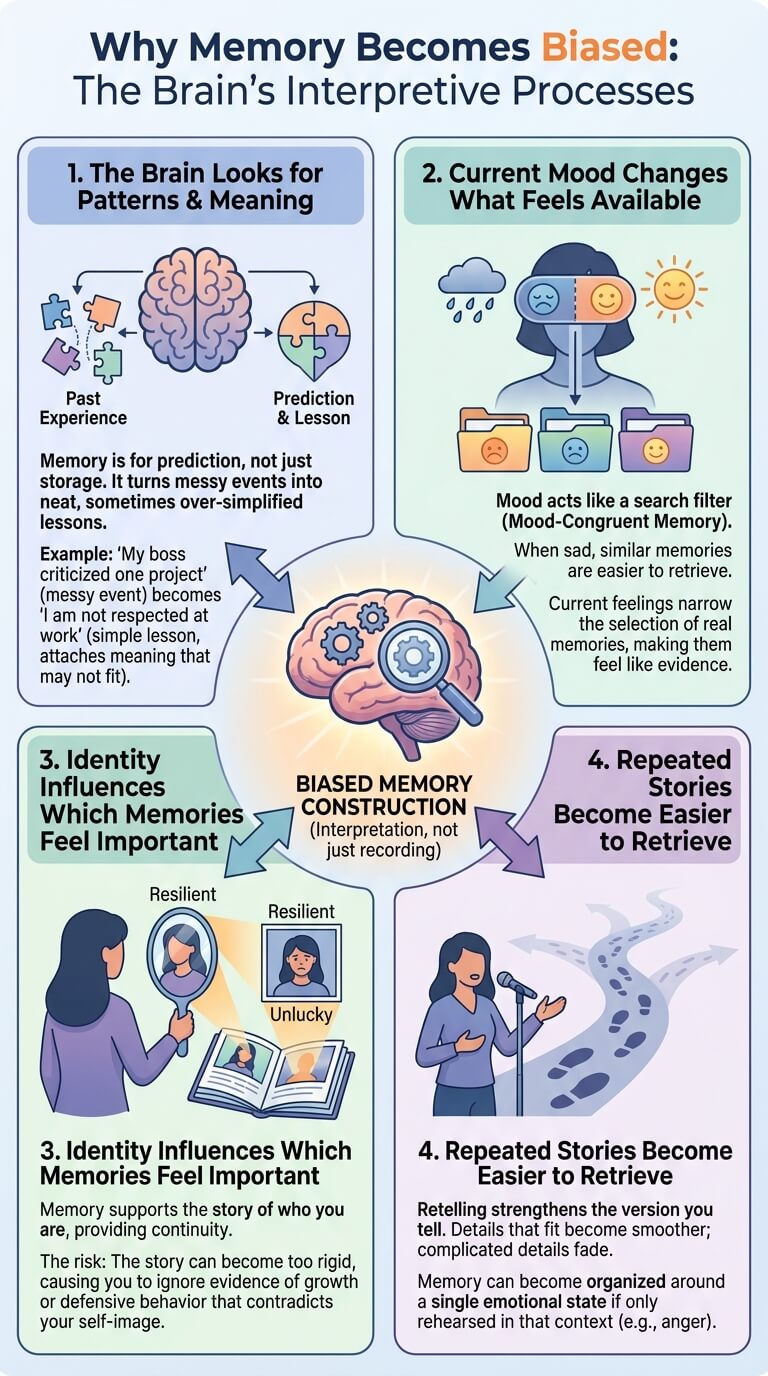
Human memory is not only about storage. It is also about prediction. Your mind uses past experience to answer questions such as, “What kind of situation is this?” “What should I expect?” and “How should I protect myself next time?” A biased memory can form when the mind turns a messy event into a neat lesson.
That lesson may be useful, but it may also become too simple. “My boss criticized one project” can become “I am not respected at work.” “My friend was distracted at dinner” can become “People always lose interest in me.” The memory has not only stored what happened. It has attached a meaning that may or may not fit the whole situation.
Current mood changes what feels available
What you feel now can affect what comes to mind. When you are sad, lonely, angry, or anxious, memories with a similar emotional tone may feel easier to retrieve. A review in PubMed Central explains mood-congruent memory as a pattern in which emotional memory leans toward content that matches a current or past mood.
This does not mean your current feeling is fake. It means your feeling may be acting like a search filter. If you feel rejected today, your mind may quickly offer old examples of rejection. If you feel proud today, it may offer examples of competence. The filter can feel like evidence because the memories are real, but the selection may be narrow.
Identity influences which memories feel important
Memory often supports the story you tell about who you are. If you see yourself as resilient, you may remember moments when you pushed through. If you see yourself as unlucky, you may remember moments when things went wrong despite effort. If you see yourself as the responsible one, you may remember your sacrifices more easily than your mistakes.
Identity-shaped memory can be stabilizing. It helps you maintain continuity. The risk is that the story can become too rigid. A person who sees themselves as “always the one who messes up” may ignore evidence of growth. A person who sees themselves as “always right in conflict” may miss moments when they were defensive, dismissive, or incomplete in their account.
Repeated stories become easier to retrieve
Every time you retell a memory, you may strengthen the version you tell. Details that fit the story become smoother. Details that complicate the story may fade. This is why repeated family stories, workplace stories, and relationship stories can become more confident over time even when the original experience was messier.
Retelling is not bad. It can help people process experience, connect with others, and build meaning. But if a story is repeated only in one emotional state, such as anger or shame, the memory may become organized around that emotion. The question becomes: have I only rehearsed one version?
Common Types of Memory Bias
Repeated retelling and personal meaning help explain why some memories feel so vivid, even when clarity is not proof of accuracy.
Confirmation-shaped remembering
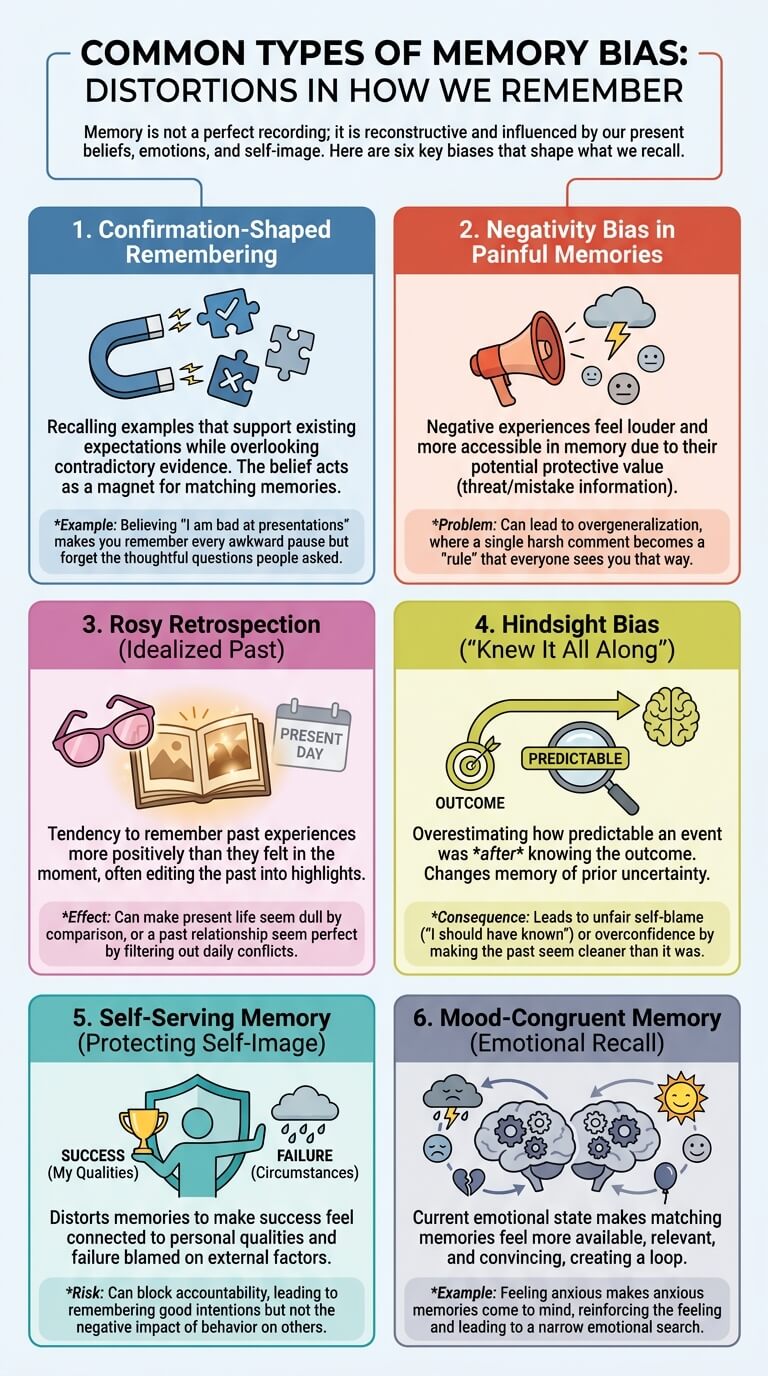
Confirmation-shaped remembering happens when memory supports what you already expect. The APA Dictionary of Psychology defines confirmation bias as a tendency to gather or emphasize evidence that confirms existing expectations. In memory, this can show up as recalling examples that prove what you already believe while overlooking examples that complicate it.
If you believe “I am bad at presentations,” you may remember every awkward pause and forget the parts where people nodded, asked thoughtful questions, or used your ideas later. If you believe “my partner never listens,” you may remember the missed moments and forget the times they adjusted after you spoke. The belief becomes a magnet for matching memories.
Negativity bias in painful memories
Negative experiences often demand attention because they may carry information about threat, loss, rejection, or mistakes. That can make painful details feel louder in memory. A single harsh comment may stay more accessible than five neutral or kind comments because your mind treats the painful detail as important for future protection.
This bias is not weakness. It can be protective. The problem is that protection can become overgeneralization. “That comment hurt” may turn into “everyone sees me that way.” “That rejection was painful” may turn into “trying again is unsafe.” The memory begins as warning, then becomes a rule.
Rosy retrospection and idealized past memories
Rosy retrospection is the tendency to remember a past experience more positively than it felt in the moment. It can make an old job, old friendship, old relationship, or earlier life stage seem simpler, warmer, or more meaningful than it actually was day to day.
This bias can be comforting. It may help people preserve gratitude and personal meaning. But it can also create unfair comparisons. The present may seem dull because the past has been edited into highlights. A former relationship may seem perfect because the loneliness after it makes the good parts easier to retrieve than the actual conflicts.
Hindsight bias and the illusion that you knew it all along
Hindsight bias makes an outcome feel more predictable after you already know what happened. The APA Dictionary describes hindsight bias as the tendency to overestimate how foreseeable an outcome was after the event occurs. In memory, it can change how you remember your own uncertainty.
After a bad decision, you may think, “I should have known.” After someone disappoints you, you may remember only the warning signs. After a project succeeds, you may remember your confidence more clearly than your doubts. Hindsight bias can make the past feel cleaner than it was, which can lead to unfair self-blame or overconfidence.
Self-serving memory and protecting the self-image
Self-serving memory protects the self-image by making success feel more connected to your qualities and failure feel more connected to circumstances. Research in PubMed Central has examined self-serving bias in memories, including how people remember the connection between positive or negative information and the self.
This kind of bias is not always harmful. A small amount of self-protection can help people recover from setbacks. But when it becomes too strong, it blocks accountability. You may remember how unfair others were but not how you contributed. You may remember your good intention but not the impact of your behavior.
Mood-congruent memory and emotional recall
Mood-congruent memory is one reason a bad mood can make the past look worse and a hopeful mood can make the past look more workable. When the emotional tone of a memory matches your current state, it may feel more available, more relevant, and more convincing.
This can create a loop. You feel anxious, so anxious memories come to mind. Those memories make the anxiety feel justified. The anxiety then searches for more matching memories. The loop may feel like careful analysis, but it can become a narrow emotional search.
How Memory Bias Shows Up in Daily Life
Arguments and relationship history
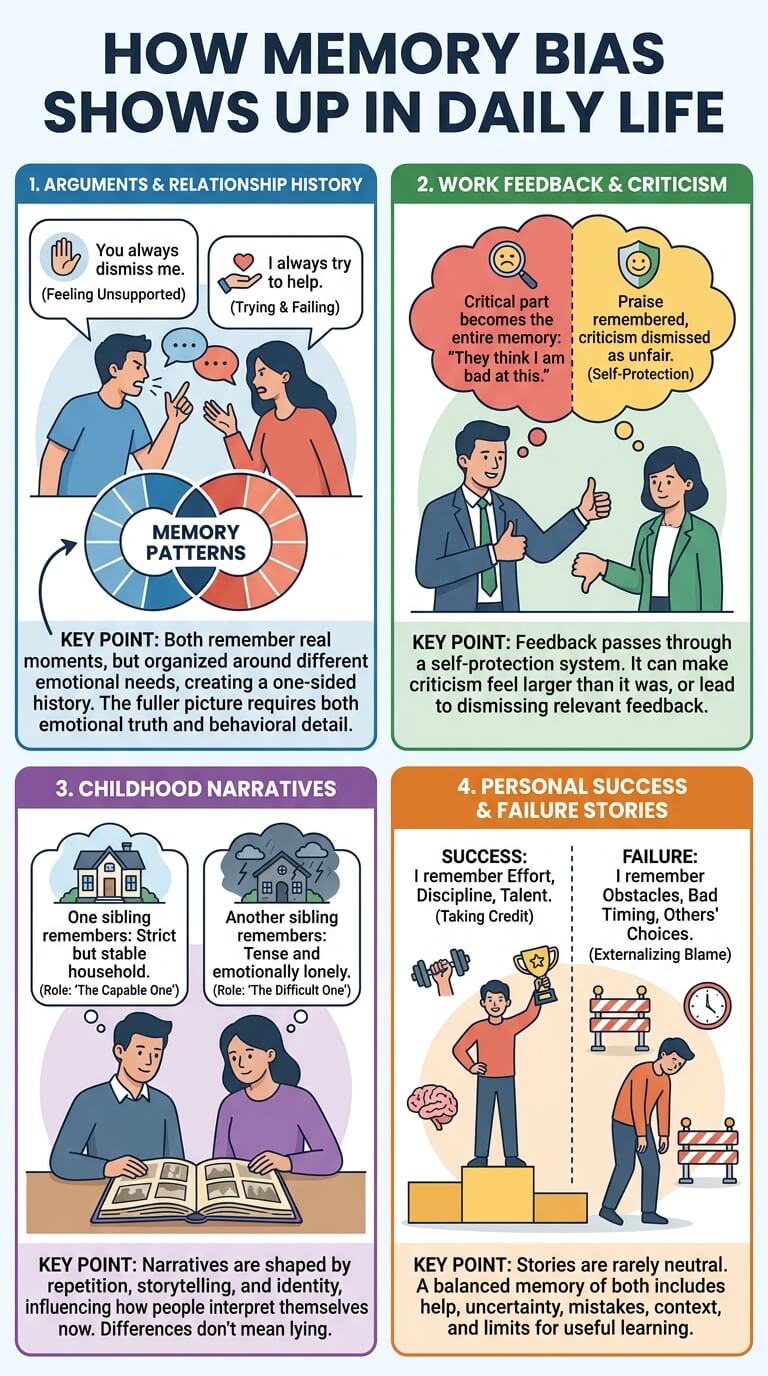
In arguments, memory bias often shows up as a one-sided history. One person says, “You always dismiss me.” The other says, “I always try to help.” Both may be remembering real moments, but each memory set is organized around a different emotional need.
A more useful question is not, “Whose memory wins?” It is, “Which parts of the pattern are each of us remembering most strongly?” One person may remember feeling unsupported. The other may remember trying and failing to get it right. The fuller picture may require both emotional truth and behavioral detail.
Work feedback and criticism
At work, memory bias can make feedback feel larger than it was. If one manager gives mixed feedback, the critical part may become the entire memory. Later, you may tell yourself, “They think I am bad at this,” even if the actual message was more balanced.
The opposite can also happen. If you strongly identify as competent, you may remember praise clearly but dismiss criticism as unfair, personal, or irrelevant. Neither reaction means you are dishonest. It means feedback has passed through a self-protection system.
Childhood narratives
Childhood memories are often shaped by repetition, family storytelling, later understanding, and identity. One sibling may remember a household as strict but stable. Another may remember the same household as tense and emotionally lonely. These differences do not automatically mean one person is lying.
Childhood narratives matter because they influence how people interpret themselves now. Someone who remembers being “the difficult one” may continue to expect blame. Someone who remembers being “the capable one” may struggle to admit need. The memory becomes part of a role.
Personal success and failure stories
Success and failure stories are rarely neutral. If you succeed, you may remember effort, discipline, and talent. If you fail, you may remember obstacles, bad timing, or other people’s choices. Sometimes that is fair. Sometimes it protects you from useful learning.
A balanced memory of success includes help, timing, uncertainty, and mistakes along the way. A balanced memory of failure includes context, choices, limits, and what was knowable at the time. That kind of memory is less dramatic, but more useful.
Memory Bias vs Cognitive Bias
How they overlap
Cognitive bias is a broader term for patterns in thinking that can skew judgment. Memory bias is one way those patterns show up when the mind handles the past. A belief can guide attention during an event, shape how the event is stored, and later guide what is retrieved.
For example, confirmation bias can affect what you notice now and what you remember later. Hindsight bias can affect how you judge a decision after the outcome is known. Self-serving bias can affect how you explain both past success and past failure.
Why memory bias is one part of biased thinking
Memory gives biased thinking a sense of proof. A thought such as “I never get chosen” becomes more powerful when your mind quickly retrieves five examples. The examples may be real, but the sample may be incomplete. The mind may not retrieve the times you were included, appreciated, or selected because they do not match the current conclusion.
This is why memory bias can feel so persuasive. It does not only say, “I think this.” It says, “Look, here is evidence.” The helpful move is not to argue with every memory. It is to ask whether the memory sample is complete enough to support the conclusion.
When to read a broader cognitive bias guide
A broader cognitive bias explanation is useful when the main issue is decision-making, judgment, persuasion, problem-solving, or interpreting current information. Memory bias is the better lens when the main issue is how you remember past events, why certain memories feel more available, or why different people recall the same experience differently.
In real life, they often work together. You may interpret today through old memories, then store today in a way that supports the same interpretation. That is how a belief becomes stronger with time even when the evidence is mixed.
How to Question a Biased Memory Without Dismissing Yourself
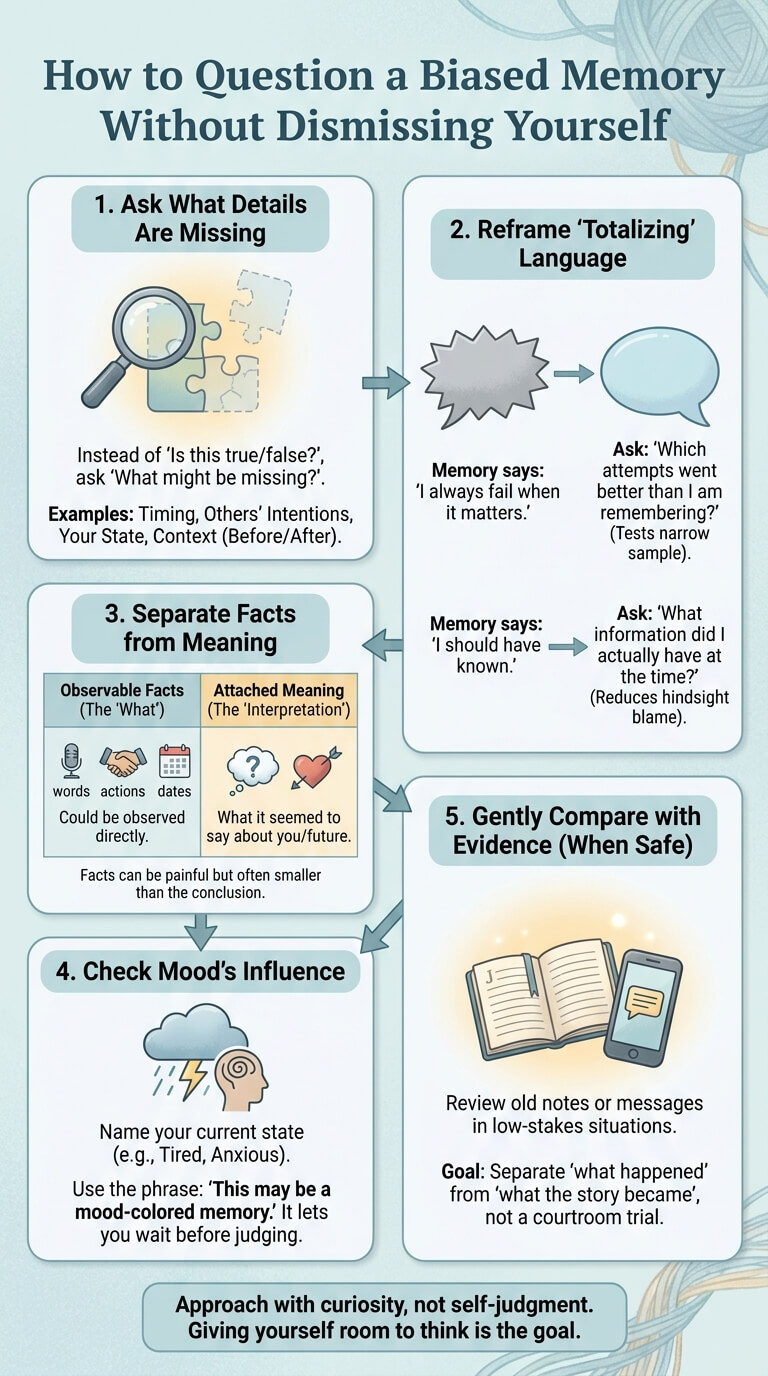
Ask what details are missing
Instead of asking, “Is this memory true or false?” ask, “What might be missing from this memory?” Missing details may include timing, other people’s intentions, your own state, what happened before, what happened after, or examples that do not fit the current emotional story.
| When the memory says | Ask | Why it helps |
|---|---|---|
| “I always fail when it matters.” | “Which attempts went better than I am remembering right now?” | It tests whether the memory sample is too narrow. |
| “They never cared.” | “Were there caring actions that did not fix the bigger issue?” | It separates pain from totalizing language. |
| “I should have known.” | “What information did I actually have at the time?” | It reduces hindsight-based self-blame. |
| “Everything was better then.” | “What parts of that time were hard while I was living it?” | It balances nostalgia with reality. |
Separate facts from meaning
A fact is what could be observed: words said, actions taken, dates, decisions, messages, or outcomes. Meaning is what the event seemed to say about you, another person, or the future. Memory bias often blends the two.
Try writing two short columns. In one column, put the observable details. In the other, put the meanings your mind attached. You might find that the facts are painful but smaller than the conclusion. Or you might find that the conclusion is reasonable because the pattern is repeated. Either way, separating facts from meaning gives you more room to think.
Check whether your current mood is coloring recall
Before trusting a painful memory as complete, name your current state. Are you tired, ashamed, lonely, anxious, angry, rejected, or under pressure? If so, your mind may be retrieving memories that match that state.
A simple phrase can help: “This may be a mood-colored memory.” That phrase does not mean the memory is wrong. It means you are allowed to wait before building a whole life conclusion around it.
Compare repeated story with original evidence when possible
When the situation is low stakes and safe to review, compare your repeated story with available evidence. Look at old notes, messages, timelines, journal entries, or project records. The goal is not to shame yourself for remembering imperfectly. The goal is to separate what happened from what the story became.
Sometimes the evidence confirms your memory. Sometimes it softens it. Sometimes it reveals that the event was real, but the meaning has grown heavier over time. This kind of checking is most useful when done gently, not as a courtroom trial against yourself.
When Memory Bias Can Become Harmful
Rumination and repeated negative recall
Memory bias becomes more harmful when it feeds repetitive negative thinking. Rumination often replays painful memories without leading to new action, clearer boundaries, or realistic problem-solving. The American Psychiatric Association explains that rumination involves repetitive focus on negative feelings and distress, and that this repetition can contribute to anxiety or depression symptoms.
If you keep replaying the same event and feel worse each time, the issue may not be the memory alone. The issue may be the loop around the memory. In that case, asking for support can be more helpful than trying to think harder by yourself.
Self-blame and shame-based memory
Shame can make memory feel like a list of evidence against the self. You may remember mistakes sharply and forget context, growth, apology, repair, or the limits of what you knew at the time. This can make the past feel like a fixed verdict rather than a record of human learning.
A useful question is: “Am I remembering this to learn, or am I remembering this to punish myself?” Learning tends to include specifics and next steps. Punishment tends to include global labels such as “I am terrible,” “I ruin everything,” or “I never change.”
Relationship conflict loops
In relationships, memory bias can turn conflict into a courtroom. Each person arrives with a file of remembered examples. Each example may be real, but the conversation becomes a contest of evidence rather than an attempt to understand the present pattern.
This is especially important when there is fear, coercion, threats, humiliation, stalking, intimidation, or retaliation. In those situations, communication tips may not be enough and may even increase risk. If a memory pattern is connected to feeling unsafe or controlled, prioritize safety, trusted support, and professional guidance over trying to prove the memory perfectly.
FAQ About Memory Bias Psychology
Does memory bias mean my memory is wrong?
No. Memory bias means your memory may be selective, emotionally weighted, or shaped by meaning. A biased memory can contain accurate details and still leave out context. It is better to ask what the memory is emphasizing than to assume it is either completely true or completely false.
Why do I remember negative things more easily?
Negative memories may feel easier to access because painful, threatening, embarrassing, or disappointing experiences often carry strong emotional importance. Your mind may treat them as lessons for future protection. That can be useful, but it can also make the past feel darker than the full record supports.
Can my current mood change old memories?
Your current mood can influence which old memories feel most available and convincing. When you feel rejected, rejected memories may come forward. When you feel confident, memories of competence may come forward. The memories may be real, but the selection can be mood-shaped.
Why do people remember arguments differently?
People attend to different parts of an argument. One person may remember the words, another may remember the tone, another may remember the feeling of being ignored, and another may remember trying to explain. Each person may be sincere, but their memory is filtered through what felt most important in the moment.
Can I reduce memory bias?
You probably cannot remove bias completely, and that is not the goal. You can reduce its impact by checking for missing details, separating facts from meaning, noticing your current mood, comparing your story with evidence when appropriate, and asking whether the memory is helping you learn or only making you feel trapped.
Key Takeaways
- Memory bias psychology explains why recall often leans toward certain emotions, meanings, details, or self-protective interpretations.
- A biased memory is not the same as a lie, and it is not always the same as a false memory.
- Current mood, identity, repeated storytelling, and later knowledge can all shape what feels easiest to remember.
- Common forms include confirmation-shaped remembering, negativity bias, rosy retrospection, hindsight bias, self-serving memory, and mood-congruent recall.
- The most useful question is often not “Is this memory real?” but “What is this memory emphasizing, and what might be missing?”
- If memory loops are tied to severe distress, trauma, shame, or unsafe relationships, support matters more than trying to analyze everything alone.
Final Thoughts
Memory bias does not make you unreliable as a person. It makes you human. Your mind is trying to create meaning from incomplete information, strong feelings, past lessons, and present needs. Sometimes that meaning helps you. Sometimes it narrows the story too much.
The next time a memory feels like complete proof, pause before turning it into a final conclusion. Ask what the memory includes, what it leaves out, what mood you are in now, and whether the story helps you act wisely. A more balanced memory does not erase your feelings. It gives them a fuller frame.

Michael Reed is the Founder and Lead Writer at Psychology Exposed. He writes about human behavior, relationships, emotional patterns, self-awareness, and practical psychology topics using research-informed, easy-to-understand content.
Read More About Michael Reed: https://psychologyexposed.com/michael-reed/