

Some memories do not arrive as quiet facts. They come back with color, sound, body feeling, facial expressions, weather, music, embarrassment, fear, pride, or the exact look of a room. A moment from years ago can feel closer than something that happened last week. That vividness can be comforting, painful, confusing, or strangely convincing.
The easy assumption is that a vivid memory must be perfectly accurate. If you can see it clearly and feel it strongly, it may seem obvious that your mind is replaying the past exactly as it happened. Psychology is more careful than that. Vividness is real, but it is not the same thing as a recording.
Vivid memories often form when an event was emotional, surprising, repeated, identity-shaping, or tied to sensory cues such as smell, music, or place. These features can make a memory feel alive and can make confidence grow faster than accuracy. The useful question is: “What makes this memory feel so clear, and what should I be careful not to assume?”
Quick Answer
Vivid memory is one part of memory psychology, but it is important because a strong feeling of clarity can make recall feel more certain than it really is.
Vividness is a feeling of clarity, not proof of accuracy
Some memories feel vivid because the mind attaches extra importance to certain experiences. Emotion, surprise, meaning, repeated recall, and sensory cues can make a memory feel sharp and immediate. The APA Dictionary of Psychology defines memory as the ability to retain and retrieve information, but retrieval is not a perfect replay. A vivid memory can contain accurate parts, missing parts, and later interpretation.
Emotion, surprise, repetition, and meaning can all increase vividness
A memory may feel real because it was emotionally charged, interrupted your normal routine, has been retold many times, or became part of how you understand yourself. Strong imagery and confidence can make recall feel convincing. Still, the feeling of certainty should be held with curiosity, especially when the memory affects conflict, shame, blame, or major decisions.
What Makes a Memory Feel Vivid

Strong imagery
Vivid memories often feel visual. You may picture the room, the angle of light, a person’s face, the color of a shirt, or the exact place where you were standing. This image-like quality gives the memory a movie scene feeling. The mind may treat that image as evidence that the whole memory is complete.
Imagery can be useful, but it is selective. You may remember one sharp frame while losing the sequence around it. You may recall a face but not the exact words, a location but not the timing, or a gesture but not what happened before. A clear image is one piece of memory, not the whole event.
Emotional charge
Emotion tells the brain that an experience matters. Joy, shock, shame, fear, grief, anger, pride, relief, and love can all make an event more memorable. The APA Dictionary describes emotional memory as memory that involves re-experiencing emotions linked with an event, and that is one reason a past moment can feel present again.
Emotional charge can make central details stand out. It can also narrow attention. You may remember the insult but not the whole conversation, the panic but not the safe ending, or the applause but not the mistakes that came before it. Emotion does not ruin memory. It marks memory, and that mark can pull some details forward while leaving others behind.
Sensory detail
A smell, song, hallway, season, texture, or taste can bring back a memory with unusual force. Sensory cues often work quickly because they are tied to context. A certain soap may bring back a grandmother’s bathroom. A song may return you to a first apartment. The smell of rain on a particular street may make an old season feel nearby.
These cues can make memory feel bodily, not only mental. You may notice your chest tighten, your face warm, or your mood shift before you can name the memory.
Familiar retelling
A memory becomes easier to recall when you have replayed it often. Repetition creates a smooth path. If you tell the same story at family gatherings, revisit the same embarrassing moment at night, or explain the same turning point to new people, the memory can become fluent. Fluent recall often feels like reliable recall.
Retelling can strengthen the main shape of a memory, but it can also edit the memory. Details that make the story easier to tell may become stronger. Awkward details may drop out. A later interpretation may blend with the original event. Over time, you may remember the story you have practiced as much as the event itself.
Personal meaning
Memories feel vivid when they seem to say something about who you are. A small moment may become powerful because it came to mean “I am not safe,” “I am lovable,” “I should not trust people,” “I can handle hard things,” or “I do not belong.” The event may have been brief, but the meaning became large.
This is why two people can remember the same event differently. One person remembers a casual comment. Another remembers the moment as proof that they were dismissed, admired, rejected, chosen, or misunderstood. Vividness often grows where personal meaning is high.
| Feature | How it makes a memory feel vivid | What to remember |
|---|---|---|
| Imagery | The memory feels like a scene or picture | A clear image can still be incomplete |
| Emotion | The body reacts as if the event matters now | Strong feeling does not prove every detail |
| Sensory cues | Smell, music, place, or texture brings it back quickly | Cues can revive mood as well as facts |
| Repetition | The memory is easy to retell | Retelling can strengthen and reshape details |
| Meaning | The memory connects to identity or a life lesson | Meaning can grow beyond the original moment |
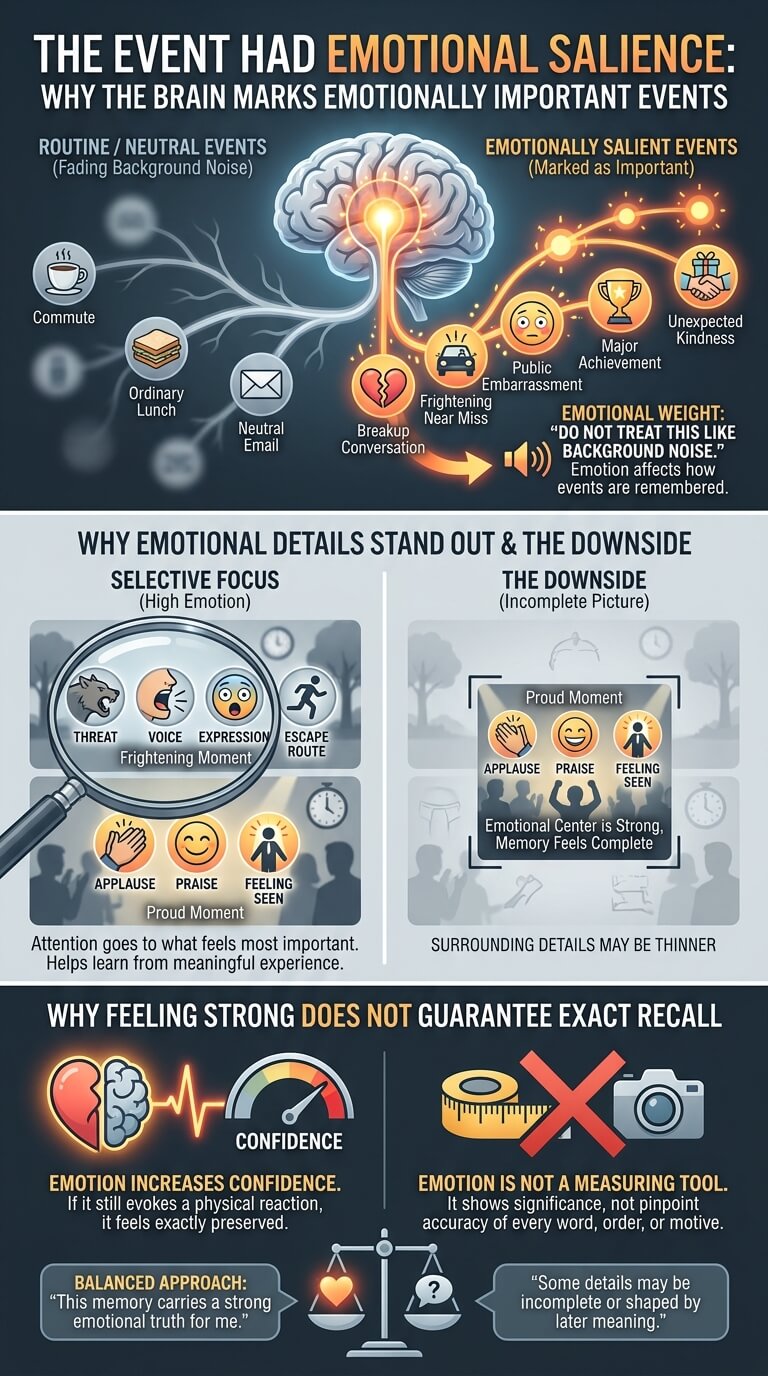
Reason 1: The Event Had Emotional Salience
Many vivid memories are vivid because they are also emotional memories, shaped by fear, joy, shame, grief, pride, or belonging.

Why the brain marks emotionally important events
Emotional salience means the event stood out because it mattered. The brain does not treat every moment equally. A routine commute, ordinary lunch, or neutral email may fade because there is little reason to mark it as important. A breakup conversation, a frightening near miss, a public embarrassment, a major achievement, or an unexpected kindness may receive more attention because it carries emotional weight.
Research on emotion and autobiographical memory has described how personal memories are influenced by emotional significance. One open-access review on emotion and autobiographical memory explains that emotion affects how personal events are remembered and later described. In everyday terms, emotional salience tells the mind, “Do not treat this like background noise.”
Why emotional details may stand out more than neutral details
When emotion is high, attention often goes to what feels most important. During a frightening moment, you may remember the threat, the voice, the expression, or the escape route more than peripheral details. During a proud moment, you may remember the praise, the applause, or the feeling of being seen more than what happened ten minutes earlier.
This selective focus can be useful. It helps you learn from meaningful experience. The downside is that the memory may feel complete because the emotional center is strong. The surrounding details may be thinner than you realize.
Why feeling strong does not guarantee exact recall
Emotion can increase confidence. If a memory still makes your stomach drop or your face warm, it can feel as if the mind must be preserving the event exactly. But emotion is not a measuring tool. It shows that something mattered to you, not that every word, order, motive, or facial expression is beyond question.
A balanced approach respects the feeling without overstating the facts. You can say, “This memory carries a strong emotional truth for me,” while also saying, “Some details may be incomplete or shaped by later meaning.”
Reason 2: The Event Was Surprising or Unusual
Novelty and attention
Surprising events break the pattern of ordinary life. When something unexpected happens, attention sharpens because your mind is trying to understand what changed. A sudden announcement, strange coincidence, near miss, unexpected compliment, or first-time experience can stand out because it interrupts autopilot.
Novelty does not have to be dramatic. It can be as simple as seeing a parent act differently, hearing a sentence you never expected, entering a new place, or realizing that a relationship has shifted. The mind often remembers the moment when ordinary expectations were disrupted.
First-time experiences
Firsts are vivid because they come with extra attention and uncertainty. The first day at a new school, first serious job, first kiss, first public failure, first solo trip, or first time standing up for yourself may feel brighter than similar events later. You had less routine to lean on, so the mind paid attention.
First-time experiences can also become anchors. They help divide a life story into before and after, which is why the first version can feel brighter than later versions.
Why unusual moments interrupt autopilot
Much of daily life runs on habit. You do not remember every time you locked the door, brushed your teeth, or drove the same route because your mind does not need to store each repetition as a separate scene. Unusual moments break that pattern. They create a “wait, what is happening?” response.
That interruption can become a memory marker. You may remember where you were standing when you heard surprising news because the normal flow of the day stopped. You may remember a stranger’s kindness because it did not fit your expectations. Surprise makes the moment feel less blended with everything around it.
Reason 3: You Have Replayed the Memory Often
Repeated retelling and personal meaning can also create memory bias, where certain details become easier to recall than others.
Repetition makes recall smoother
A memory that is revisited often becomes easier to access. You may replay a mistake because you wish you had handled it differently. You may retell a funny story because people enjoy it. You may revisit a meaningful moment because it comforts you. Each return can make the path to that memory feel smoother.
Smooth recall can be mistaken for exact recall. If a memory comes easily, the mind may treat it as stable. But ease can come from practice. A song lyric is easy to recall because you have heard it many times, not because you are remembering the first time you heard it perfectly.
Retelling can strengthen confidence
When a memory has a clear beginning, middle, and ending, it becomes more convincing to both the listener and the person remembering. Retelling can make the memory feel organized. It can also increase certainty because the story has become familiar.
That does not mean retold memories are false. Many retold memories are broadly accurate. The caution is more specific: confidence grows from fluency, emotion, and social reinforcement, not only from accuracy. A memory can be easy to tell and still contain edited details.
Repetition can also change details
Each time you remember something, you may bring the current self into the memory. Your current beliefs, mood, relationship with the people involved, and later information can influence what stands out. Over time, some details may become sharper while others soften or disappear.
A useful question is, “Have I remembered this event many times in the same way, or have I checked what I actually know?” This is especially helpful when a vivid memory is being used to settle an argument or judge someone’s motive.
Reason 4: The Memory Connects to Your Identity
Turning points
Some memories feel vivid because they explain change. They are the moments you use to say, “That is when I stopped trusting easily,” “That is when I realized I was capable,” “That is when I felt left behind,” or “That is when I chose a different life.” These memories often become turning points in the story of the self.
Turning points do not need to be public or dramatic. A private decision in a bedroom, a sentence in a hallway, or a quiet moment of clarity can become vivid because it changed how you saw yourself. The event became meaningful because it shaped direction.
Shame, pride, grief, and belonging
Identity-linked memories often gather around powerful social emotions. Shame can make a memory feel painfully clear because it seems to expose the self. Pride can make a memory glow because it confirms competence or worth. Grief can freeze small details because they are tied to someone important. Belonging can make a moment vivid because it says, “I was accepted there.”
These emotions are not all negative. A memory of being welcomed can stay vivid for decades. A memory of finally being believed can feel bright because it repaired something. The mind remembers not only danger and pain. It also remembers moments that gave the self a place to stand.
Why meaning makes details feel important
When a memory carries meaning, even small details can feel loaded. A doorway, coat, song, or phrase may seem important because it belongs to a moment that changed how you understood yourself. This is one reason vivid memories can feel symbolic. The details do not just describe the scene. They carry the weight of the meaning attached to it.
Still, meaning can grow after the event. A moment that seemed ordinary at the time may become vivid later because you now see it as the beginning of something. That later meaning is real as meaning, but it should not be confused with perfect recall of the original moment.
Reason 5: Sensory Cues Bring It Back Strongly
Smells, songs, places, and body states
Sensory cues can return a memory before you have chosen to think about it. A smell may bring back a childhood kitchen. A song may pull up an old relationship. A hotel hallway may remind you of a trip. A body state, such as fatigue, excitement, or tension, may make an old situation feel familiar.
Smell is especially well known for its connection with personal memory. A review on odor-evoked memory explains that odors can call up autobiographical memories with emotional force. This helps explain why a scent can make the past feel unusually close.
Why cues can make old memories feel present
A cue does not simply remind you of a fact. It can recreate part of the context. The memory may bring back the mood, body feeling, and atmosphere of the earlier moment. That is why a song can make you feel like your younger self for a few seconds.
This present-like feeling can be powerful. It can bring nostalgia, tenderness, embarrassment, grief, longing, or dread. If the memory is mild, you may simply pause and notice it. If it is distressing, grounding in the present can help: look around, name where you are, feel your feet, and remind yourself that a cue has activated a memory, not moved you back in time.
Vivid Memory vs Accurate Memory

Why detail can be reconstructed
Memory often reconstructs. The mind may rebuild an event from stored fragments, current knowledge, repeated stories, emotion, and assumptions about what probably happened. This is why a memory can feel detailed even when some details were filled in later.
Reconstruction is not the same as lying. Most people are not trying to distort the past. The mind is trying to make sense of incomplete information. The result can feel whole because the story is coherent, not because every part has been preserved exactly.
Why confidence can mislead
Confidence is one of the main reasons vivid memories feel persuasive. If you feel sure, other people may believe you more easily, and you may believe yourself more strongly. But confidence is not the same as consistency or independent accuracy.
A well-known study on flashbulb memory confidence and consistency found that flashbulb memories were marked more by perceived accuracy than by special accuracy. In plain language, people may continue to feel vividness and belief even as consistency changes over time.
How to hold vivid memories with curiosity
Curiosity is a middle path between dismissing yourself and treating vividness as proof. You can respect the memory and still ask careful questions. What details are clear? What details are assumed? What did you feel then? What do you feel now? What later information may have changed the story?
This approach is especially useful when the memory affects a relationship or a decision. Instead of saying, “I remember it clearly, so there is nothing to discuss,” try, “This is how I remember it, and it had a strong impact on me.” That wording protects both emotional truth and humility about details.
| Experience | What it may indicate | What it does not prove by itself |
|---|---|---|
| The memory feels like a movie | Strong imagery or repeated recall | That every detail is exact |
| You feel certain | High confidence or personal meaning | That the memory is independently verified |
| Your body reacts | Emotional charge or sensory cue activation | That the whole scene is complete |
| You have told it many times | The memory is well practiced | That retelling has not shaped it |
| The memory changed your self-view | Strong identity meaning | That the meaning was obvious at the time |
Vivid Memory vs Flashbulb Memory vs False Memory
Clear memory for a shocking event
A flashbulb memory is a vivid memory for the circumstances around learning about a shocking or important public event. The APA Dictionary defines flashbulb memory as a clear, long-lasting memory of the circumstances in which a person learned of a significant event. These memories often include where you were, who told you, and how you reacted.
Flashbulb memories are vivid, but that does not make them immune to change. A review on flashbulb memories notes that the term is used for memories of the circumstances in which someone learned of a public event, not necessarily a perfect recording of the event itself.
Vivid but distorted memory
A vivid memory can be distorted when details, order, emphasis, or meaning have shifted. It may still contain a real emotional core. For example, you may accurately remember feeling humiliated, but misremember the exact wording. You may accurately remember a frightening moment, but later add details from stories, photos, or other people’s descriptions.
A false memory is a broader issue: a person remembers something that did not happen in the way remembered, or sometimes did not happen at all. Not every vivid but imperfect memory is a false memory. The distinction matters because ordinary memory errors are common and do not require dramatic explanations.
When to explore memory distortion more carefully
It may help to look more carefully at memory distortion when a vivid memory is being used to make a serious accusation, define someone’s motive, explain an entire relationship, or decide what is true in a situation with major consequences. In those cases, vividness should not be the only evidence.
You can ask: Is there a record? Did anyone else notice the same thing? Have I heard this story from others many times? Did my interpretation change after later events? These questions are not meant to erase your experience. They are meant to keep certainty from outrunning what the memory can safely support.
| Type | Main feature | Careful interpretation |
|---|---|---|
| Vivid memory | Feels clear, detailed, sensory, or emotionally alive | May be meaningful, but still check assumptions |
| Flashbulb memory | Clear memory of learning about a major public event | Often high confidence, not necessarily perfect detail |
| False memory | Memory does not match what happened or includes invented details | Needs careful handling, especially in high-stakes contexts |
What to Do When a Vivid Memory Keeps Returning

Notice the trigger
When a memory returns strongly, first notice what brought it up. Was it a smell, song, place, date, body state, conversation, conflict, or feeling of rejection? Naming the trigger can make the memory feel less random. It also helps you understand whether the memory is about the past alone or a present cue that resembles the past.
A simple sentence can help: “This memory came up after I heard that tone,” or “This came up when I smelled that perfume.” The trigger does not explain everything, but it gives you a starting point.
Separate sensory detail from interpretation
Try writing two columns. In one column, list sensory or observable details: where you were, what you saw, what you heard, what happened next. In the other, list interpretations: what you believe it meant, what you think the other person intended, what you decided it said about you.
This separation can reduce confusion. You may discover that the sensory part is vivid, but the meaning part is where most of the pain lives. Or you may realize that the meaning still feels accurate, but some details are uncertain.
Ground yourself in the present
If a memory feels present, use present-time cues. Name the date, the room, the objects around you, and what is different now. Slow your breathing if that helps. Touch something steady, such as a chair, table, or mug. The aim is not to push the memory away. It is to remind the body that remembering is happening now, not then.
For mild memories, grounding may be enough. For intense memories, grounding can be the first step before talking with someone safe, journaling briefly, or choosing not to analyze the memory when your body is activated.
Seek support if it feels intrusive or unsafe
A vivid memory deserves extra care if it keeps intruding, disrupts sleep, causes panic, brings self-harm thoughts, or is connected to fear, threats, humiliation, coercion, violence, or ongoing danger. The National Institute of Mental Health explains PTSD symptoms such as flashbacks, recurring memories or dreams, distressing thoughts, and physical signs of stress after trauma.
You do not need to diagnose yourself before getting help. If a memory feels too strong to handle alone, or returning to it makes you feel unsafe, consider contacting a qualified mental health professional or local crisis and safety support.
FAQ About Vivid Memories
Why do some memories feel like they happened yesterday?
Some memories feel recent because they are emotionally charged, frequently replayed, linked to sensory cues, or connected to a turning point in your life. The feeling of “yesterday” often means the memory is easy to access and still meaningful. It does not automatically mean every detail has stayed unchanged.
Does vivid memory mean accurate memory?
No. Vividness can include accurate detail, but it is not proof of total accuracy. A memory may feel clear because of emotion, repetition, confidence, imagery, or personal meaning. It is safer to treat vividness as a sign that the event mattered, then check details separately when accuracy is important.
Why do smells bring back strong memories?
Smells can act as powerful context cues. A scent may be tied to a place, person, season, or emotional period, so encountering it again can bring back a memory quickly. Smell-triggered memories often feel immersive because they revive mood and atmosphere, not only facts.
Can retelling a memory change it?
Yes. Retelling can strengthen a memory, but it can also shape which parts become central. The story may become smoother, shorter, more dramatic, or more certain over time. This does not mean the memory is useless. It means repeated recall should be handled with some humility.
Why do embarrassing memories stay so clear?
Embarrassing memories can stay vivid because shame increases attention and personal meaning. The mind may keep replaying the moment to understand how to avoid the same feeling again. If the memory keeps returning harshly, it can help to separate what happened from the larger self-judgment attached to it.
Key Takeaways
- Vivid memories feel clear because of emotion, surprise, sensory detail, repetition, and personal meaning.
- A memory can be meaningful and partly accurate without being a perfect replay of the past.
- Confidence often grows when a memory is emotional or easy to retell, but confidence is not the same as accuracy.
- Flashbulb memories are vivid memories around shocking public events, and they can still change over time.
- Sensory cues such as smells, songs, and places can make old memories feel present again.
- If vivid memories feel intrusive, trauma-linked, unsafe, or connected to self-harm thoughts, professional or urgent support may be needed.

Michael Reed is the Founder and Lead Writer at Psychology Exposed. He writes about human behavior, relationships, emotional patterns, self-awareness, and practical psychology topics using research-informed, easy-to-understand content.
Read More About Michael Reed: https://psychologyexposed.com/michael-reed/