

Learning psychology is the study of how experience changes what people know, expect, feel prepared to do, and actually do. It is not only about classrooms, exams, or memorizing facts. It includes the way a child learns that a hot pan is dangerous, the way an employee learns a new workflow, the way a musician corrects a small timing error, and the way a person starts expecting certain outcomes after repeated experiences.
That makes learning easy to underestimate. A person may say, “I did not learn anything from that,” while their future choices quietly change. They may avoid a situation, repeat a habit, trust a method, copy someone’s behavior, or expect a result because past experience shaped their mind. Learning can be deliberate, but it can also happen in the background.
This overview gives you a plain-English map of learning psychology. It explains what learning means, how experience becomes knowledge or behavior, why people learn different lessons from similar events, and how attention, practice, feedback, memory, and application work together. It stays broad on purpose, so you can understand the whole picture before going deeper into specific topics such as feedback, reinforcement, social learning, skill development, or transfer.
Quick Answer
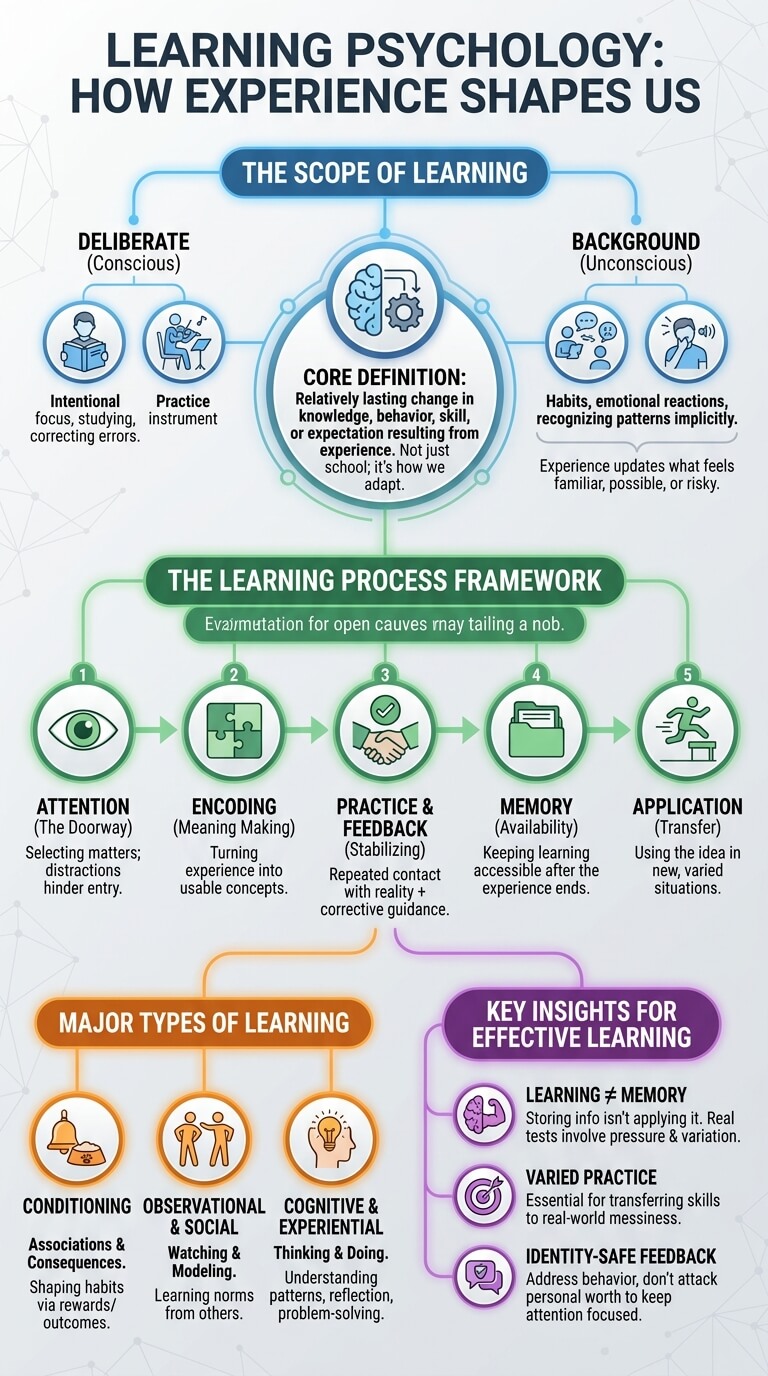
Learning as a change caused by experience
Learning in psychology means a relatively lasting change in knowledge, behavior, skill, expectation, or understanding that comes from experience. The APA Dictionary of Psychology describes learning as the acquisition of new information, behaviors, or abilities after practice, observation, or other experiences. The change does not always show up immediately, and it is not always conscious.
Knowledge, behavior, skill, and expectation as learning outcomes
People often think learning means “knowing more,” but knowledge is only one possible result. Learning can also mean acting differently, recognizing a cue faster, making fewer errors, feeling more confident in a task, or expecting a situation to unfold in a certain way. A person can learn a fact, a movement, a social rule, a risk, a shortcut, a routine, or a belief about what usually happens next.
What Learning Psychology Means

Learning vs instinct, reflex, habit, and maturity
Learning is easiest to understand when you separate it from changes that do not depend on experience in the same way. An instinct is a built-in tendency, such as a newborn’s basic sucking response. A reflex is an automatic reaction, such as blinking when something comes close to the eye. Maturity is change that comes with biological development, such as a child gaining greater motor control as the nervous system develops.
Learning can interact with all of these, but it is not the same thing. A reflex can become linked to a new cue through repeated experience. A habit can form when a learned behavior becomes automatic. Maturity can make new learning possible because the brain and body are ready for more complex skills. Still, the central idea is experience. Something happened, the person processed it, and later they were not quite the same learner.
For example, one person may flinch around dogs after a bite, while another stays calm after many safe interactions. The same kind of situation can teach very different expectations.
Conscious and unconscious forms of learning
Some learning is intentional. You decide to learn a language, practice driving, or study a new software tool. You focus, make mistakes, correct yourself, and improve. Other learning is less obvious. You may learn which coworker gives clear answers, which route feels safer, which tone usually means someone is upset, or which foods leave you feeling energized.
This is why people sometimes confuse learning with studying. Studying is one way to learn, but it is not the whole field. Learning also happens through observation, consequences, repeated exposure, emotional meaning, trial and error, cultural patterns, and social feedback. The mind is constantly using experience to update what seems familiar, possible, rewarding, risky, or worth repeating.
Why Learning Matters in Everyday Life
School, work, relationships, health, and identity examples
Learning psychology matters because learning sits underneath many ordinary choices. In school, it affects whether information is understood, remembered, and used. At work, it shapes how people adapt to feedback, workflows, mistakes, team expectations, and new responsibilities. In relationships, it affects how people interpret tone, trust promises, repair conflict, or protect themselves after disappointment.
Learning also shapes health behavior. Someone may learn that a short walk improves their mood, that skipping sleep makes concentration harder, or that stress leads them to snack late at night. These lessons are not only intellectual. They become tied to cues, feelings, routines, and expectations.
Over time, repeated learning can influence identity. A person who experiences steady progress may start thinking, “I can improve at difficult things.” A person who is repeatedly shamed for mistakes may start thinking, “I am bad at learning.” Neither belief appears from nowhere. Both are built from interpreted experience, and both can influence what the person attempts next.
Why the same experience teaches different people different lessons
Two people can go through the same class, the same feedback session, or the same failure and learn different lessons. One person may learn, “I need a better strategy.” Another may learn, “I should avoid this.” A third may learn, “People judge me when I try.” The event matters, but so does the meaning attached to the event.
Prior knowledge plays a major role. When you already understand part of a topic, new information has somewhere to attach. When everything is unfamiliar, the same information can feel like noise. The National Academies report How People Learn II emphasizes that learners bring prior knowledge, experiences, culture, motivation, and context into new learning situations. People are not blank pages waiting for information to be printed on them.
Emotional state also matters. A calm learner may notice details, ask questions, and correct errors. A threatened learner may focus on self-protection. A bored learner may miss what matters. A curious learner may explore patterns beyond the assignment. The learning environment does not replace personal effort, but it strongly affects what effort is available.
A Simple Framework for How People Learn

Attention gives experience a starting point
Attention is the doorway into learning. If the mind does not notice something, it has little chance to organize it, practice it, or use it later. This is why distractions make learning harder even when a person is physically present. A student may sit through a lecture, an employee may attend training, or a friend may hear advice, but attention determines what actually enters the learning process.
Attention does not mean staring harder. It means selecting what matters from everything happening at once. Good learning often starts when the learner knows what to look for: the main concept, the common mistake, the important cue, the next step, or the difference between two similar options.
Encoding turns experience into usable meaning
Encoding is the process of turning experience into a form the mind can use. When you hear an explanation, watch a demonstration, or try a new action, your brain is not storing a perfect video. It is organizing meaning. You connect the new experience to things you already know, label patterns, notice differences, and decide what seems important.
This is why examples help. A definition may sound clear, but an example shows how the idea works. “Feedback should be specific” becomes more useful when someone can see what specific feedback sounds like.
Practice and feedback stabilize learning
Practice gives learning repeated contact with reality. It shows whether the learner can use the idea, not just recognize it. But practice without feedback can stabilize mistakes. A person may repeat a piano movement, a lifting technique, or a communication habit many times and become very fluent at doing it the wrong way.
Feedback helps the learner compare intention with result. Corrective feedback can support learning when it is clear, timely, and usable. A review in PubMed Central on corrective feedback and learning describes feedback as a powerful tool, while also showing that its effect depends on how learners receive and use it.
Memory keeps learning available
Memory matters because learning needs to remain available after the original experience is gone. If you understand something only while the teacher is explaining it, the learning is fragile. If you can return to it later, recognize when it applies, and use it without the original support, the learning has become more durable.
Still, memory and learning are not identical. You can remember a rule and fail to use it under pressure. Memory stores and retrieves information; learning changes what you can do with experience.
Application tests whether learning can transfer
Application is where learning proves itself. It is one thing to solve a practice problem that looks exactly like the example. It is harder to use the same idea in a new setting. A person may understand a communication tip in theory but forget it during a tense conversation. They may perform well in training but struggle when the real workplace is noisy, rushed, or emotionally loaded.
Good learning prepares the person for variation. It asks not only, “Can you repeat this?” but also, “Can you use it when the situation changes?”
| Part of learning | What it does | Everyday example |
|---|---|---|
| Attention | Selects what the mind will work with | Noticing the exact step where a recipe usually goes wrong |
| Encoding | Turns experience into meaning | Understanding why the dough failed, not only that it failed |
| Practice | Repeats the skill or idea | Trying the recipe again with better timing |
| Feedback | Shows the gap between intention and result | Learning that the pan was too hot, not that you are bad at cooking |
| Memory | Keeps learning available later | Remembering the heat cue next time |
| Application | Tests learning in a real situation | Adjusting the method on a different stove |
The Main Types of Learning in Psychology
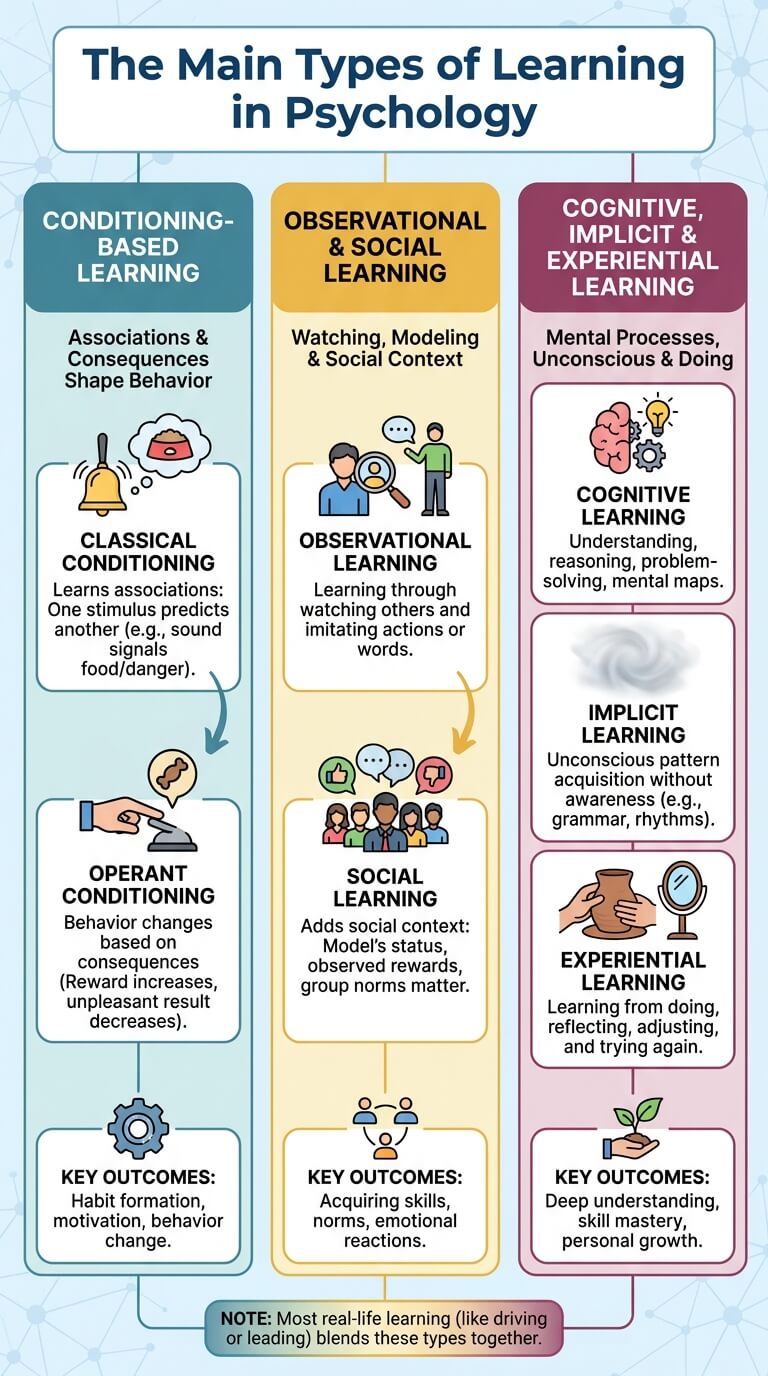
Conditioning-based learning in brief
Conditioning-based learning focuses on how associations and consequences shape behavior. In classical conditioning, a person or animal learns that one stimulus predicts another. A sound may start to signal food, danger, attention, or another meaningful outcome. In operant conditioning, behavior changes because of what follows it. A behavior may increase when it is rewarded or decrease when it leads to an unpleasant result.
The OpenStax Psychology 2e chapter on what learning is introduces classical conditioning, operant conditioning, and observational learning as basic forms of learning. These ideas help explain why cues, rewards, consequences, and repeated outcomes matter. They do not explain every kind of learning, but they remain useful for understanding habit formation, avoidance, motivation, and behavior change.
Observational and social learning in brief
People also learn by watching others. A child may learn how to greet guests by watching parents. A new employee may learn team norms by watching who speaks, who gets ignored, and what behavior receives approval. A teenager may learn emotional reactions from peers, influencers, or admired role models.
Observational learning focuses on learning through watching and modeling. Social learning adds the larger social context: who the model is, whether the behavior appears rewarded, whether the learner identifies with the person, and whether the environment makes imitation seem useful. OpenStax explains observational learning and modeling as learning by watching others and then imitating what they do or say. In real life, this kind of learning is often subtle. People absorb not only actions, but also norms about what is admired, punished, copied, or ignored.
Cognitive, implicit, and experiential learning in brief
Not all learning is built around obvious rewards or imitation. Cognitive learning involves understanding, reasoning, problem-solving, and mental organization. You learn a concept, see a pattern, build a map of how something works, or revise an explanation after new evidence.
Implicit learning happens without much conscious awareness. You may pick up grammar patterns in a language, social rhythms in a group, or visual patterns in a game before you can clearly explain what you learned. Experiential learning comes from doing, reflecting, adjusting, and trying again. It is common in work, parenting, relationships, sports, creative projects, and personal growth.
Most real learning blends several types. Driving, communicating, cooking, leading, and creating all combine feedback, practice, observation, memory, emotion, and real-world judgment.
What to Learn Next
If you want the process, focus on how learning works
If your main question is “What happens between first exposure and real understanding?” look more closely at attention, encoding, practice, feedback, memory, and application.
If you want categories, focus on types of learning
If you want a clearer map of the field, learn the major types side by side. Conditioning, observation, social learning, cognitive learning, implicit learning, and experiential learning each explain a different part of how people adapt. The category map helps prevent a common mistake: using one theory to explain every kind of change.
If you learn from people, focus on modeling and social context
If your learning is strongly shaped by parents, teachers, coworkers, friends, creators, leaders, or social groups, observational and social learning are especially relevant. The useful question is not only “What did I experience?” It is also “Who did I watch, what did their behavior seem to produce, and what did my environment make seem normal?”
If rewards and consequences matter, focus on reinforcement
If a behavior keeps repeating, ask what follows it. A habit may continue because it brings relief, attention, status, pleasure, convenience, or a sense of control. Reinforcement is not only about obvious rewards. Sometimes the reward is that discomfort stops for a moment, which can make avoidance more likely next time.
If improvement is the goal, focus on feedback and practice
If you are trying to improve at a skill, practice quality matters. Repetition builds fluency, but feedback shows what to adjust before the mistake becomes automatic.
If learning feels difficult, focus on load, frustration, and meaning
Learning often feels hard when the mind is overloaded, the goal is unclear, mistakes feel personal, or progress is hard to see. Difficulty does not automatically mean low ability.
If application is the problem, focus on transfer
Many people understand an idea in one setting but fail to use it elsewhere. That is a transfer problem, and it often calls for varied practice, realistic examples, and better cues for when the idea applies.
Learning vs Memory in Plain English
Why learning needs memory but is not the same thing
Learning and memory are closely connected, but they answer different questions. Learning asks, “What changed because of experience?” Memory asks, “What can be stored and retrieved?” You usually need memory for learning to last, but remembering does not automatically mean learning is complete.
For example, a person may remember the steps of active listening: pause, reflect, ask, clarify. But in a real argument, they may interrupt quickly because their body feels threatened. The information is stored, but the response has not yet become usable under pressure. Learning would mean the person can recognize the live moment, slow down, and use the skill when it matters.
When remembering information does not mean you can use it
This difference explains why people can pass a quiz and still struggle in real life. They may remember terms, definitions, or instructions, but they have not practiced enough variations to apply the idea flexibly. A learner might know what “boundary” means but freeze when setting one. A manager might remember a feedback model but sound harsh when stressed. A student might remember a formula but fail to recognize which problem calls for it.
Useful learning moves beyond storage. It gives the person cues, practice, feedback, and enough real-world variation to use what they know without needing the original situation to look exactly the same.
Common Misunderstandings About Learning
Learning is not only school or studying
School makes learning visible, but it is not the only place learning happens. People learn in kitchens, offices, gyms, families, friendships, online communities, and quiet private moments. Every time experience changes future expectation or action, learning may be involved.
This matters because adults sometimes stop seeing themselves as learners after formal education ends. In reality, adult life is full of learning demands: handling conflict differently, using new tools, recovering from mistakes, building health routines, changing habits, understanding emotions, and adapting to new responsibilities.
Reward is not the only reason people learn
Rewards can shape learning, but they are not the only force. People also learn from curiosity, fear, belonging, identity, observation, meaning, confusion, embarrassment, pride, care for others, and repeated exposure. A person may learn because something matters deeply, not because someone handed them a prize.
Overfocusing on reward can make learning look mechanical. Human learning often includes interpretation. The same reward may motivate one person and pressure another. The same criticism may help one learner and shut another down. The psychological meaning of the experience affects what gets learned.
Struggle does not always mean failure
Struggle during learning can mean the task is challenging, the learner is reaching beyond automatic habits, or the mind is trying to reorganize old knowledge. That kind of effort can be useful. But struggle is not automatically good. Confusion without support can become discouragement. Feedback without clarity can feel like judgment. Repetition without correction can build the wrong habit.
A better question is not “Is this hard?” but “Is this difficulty helping the learner notice, adjust, and improve?” Productive struggle has direction. Unproductive struggle feels like repeated effort without information.
| Misunderstanding | More accurate view | Why it matters |
|---|---|---|
| Learning means studying | Learning can happen through practice, observation, consequences, reflection, and experience | People notice more opportunities to grow |
| Knowing means you learned it | Knowing is only part of learning | Application and behavior may still need practice |
| More repetition always helps | Repetition helps most when paired with feedback and adjustment | It prevents fluent mistakes |
| Difficulty means low ability | Difficulty can reflect load, unclear goals, weak feedback, or lack of prior knowledge | It reduces unnecessary self-blame |
| Rewards explain everything | Meaning, identity, emotion, and social context also shape learning | It creates a fuller picture of human behavior |
What Helps Learning Stick

Clear goals and attention
Learning sticks better when the learner knows what they are trying to change. “Get better at writing” is vague. “Make each paragraph easier to follow” gives attention a target. “Improve communication” is vague. “Pause before responding when I feel accused” gives the learner a moment to practice.
A clear goal also helps the learner filter feedback. Without a goal, every suggestion can feel equally important or equally overwhelming. With a goal, the learner can ask, “Does this help me improve the specific thing I am working on right now?”
Feedback without identity threat
Feedback works best when the learner can hear it as information rather than a verdict on their worth. That does not mean feedback must be soft or vague. It means it should point to a changeable part of performance. “You are careless” attacks identity. “This answer skipped the evidence step” points to behavior that can be corrected.
This distinction matters in classrooms, workplaces, parenting, coaching, and relationships. When feedback threatens identity, attention often moves away from learning and toward defense. When feedback is specific and usable, the learner has a clearer path back into action.
Varied practice and real-world use
Learning sticks when practice includes variation. If every practice example looks the same, the learner may memorize the surface pattern without understanding the deeper principle. Varied practice teaches the person what changes and what stays the same.
For example, someone learning a language may recognize a phrase in an app but still need conversation practice with different speakers. Someone learning leadership may understand a model in training but still need to use it with real personalities and time pressure.
When Learning Problems Need Extra Support
Ongoing distress, severe anxiety, attention problems, or learning difficulties
Learning struggles are common. Everyone has moments where a task feels confusing, progress feels slow, or motivation drops. That does not mean something is wrong with the person. Sometimes the method, environment, pacing, or feedback needs to change.
Extra support may be worth considering when learning problems create ongoing distress, interfere with daily responsibilities, or come with severe anxiety, persistent attention problems, avoidance that is hard to control, or a long history of academic or work difficulty. These situations are not a reason for shame. They are a reason to look for better support.
When to consider professional, educational, or clinical support
If learning struggles are affecting school, work, relationships, sleep, mood, or self-worth, a qualified professional can help clarify what may be contributing. That might mean an educator, tutor, coach, counselor, physician, psychologist, or another licensed professional depending on the situation. This is especially important if distress is intense, persistent, or connected to panic, depression, trauma, or thoughts of self-harm.
Educational information can help you understand learning, but it cannot diagnose attention disorders, learning disabilities, anxiety disorders, or other clinical concerns. Getting support is not the opposite of learning. It is often the structure that makes learning possible again.
FAQ About Learning Psychology
What is learning in psychology?
Learning in psychology is a change in knowledge, behavior, skill, expectation, or understanding that happens because of experience. The experience may involve practice, observation, feedback, consequences, instruction, trial and error, or repeated exposure. The change does not always show up immediately, and it may be conscious or unconscious.
Is learning always conscious?
No. Some learning is deliberate, such as studying for an exam or practicing a skill. Other learning happens with little awareness. You may learn the emotional tone of a workplace, the usual rhythm of a friend group, or the easiest path through an app without being able to explain exactly when you learned it.
How is learning different from behavior change?
Behavior change can be one sign that learning happened, but learning is broader. A person may learn something internally before behavior changes, such as recognizing a risk, understanding a concept, or forming a new expectation. At the same time, a behavior may change temporarily because of pressure or fatigue without becoming lasting learning.
Why do people learn bad habits?
Bad habits often form because they solve an immediate problem, even if they create a larger problem later. Avoiding a hard conversation may reduce anxiety in the moment. Checking a phone during boredom may provide quick stimulation. Snapping when stressed may create distance. The short-term result teaches the behavior to repeat, unless the person learns a different response that works better.
What is the most important factor in learning?
There is no single factor that explains all learning. Attention, prior knowledge, emotion, practice, feedback, memory, motivation, and context all matter. For practical purposes, one of the strongest starting points is clear feedback paired with repeated, focused practice. That combination helps people notice what to change and gives them chances to make the change real.
Key Takeaways
- Learning psychology studies how experience changes knowledge, behavior, skills, expectations, and future choices.
- Learning is not limited to school. It happens through practice, observation, consequences, emotion, reflection, and repeated exposure.
- A useful learning process often includes attention, encoding, practice, feedback, memory, and application.
- Remembering information is not the same as being able to use it in real situations.
- Feedback helps most when it is specific, timely, and focused on changeable behavior rather than personal worth.
- Learning struggles deserve support when they create ongoing distress or interfere with daily life.
Final Thoughts
The simplest way to understand learning psychology is to ask: what did experience change? Sometimes it changes what you know. Sometimes it changes what you expect, avoid, repeat, practice, trust, or believe is possible.
A good next step is to choose one real learning situation in your life and map it through the basic sequence: what you notice, how you interpret it, how you practice, what feedback you receive, what you remember, and whether you can use it when the situation changes. That map can show where learning is working and where it needs support.

Michael Reed is the Founder and Lead Writer at Psychology Exposed. He writes about human behavior, relationships, emotional patterns, self-awareness, and practical psychology topics using research-informed, easy-to-understand content.
Read More About Michael Reed: https://psychologyexposed.com/michael-reed/