

Feedback can feel like a gift, a warning, a grade, a threat, or a confusing pile of comments you do not know how to use. That emotional reaction is part of why feedback psychology matters. The same correction that helps one learner improve can make another learner freeze, argue, avoid the task, or feel suddenly less capable.
When feedback arrives during a difficult learning moment, the learner may not only hear information. They may also feel exposed, judged, overloaded, or unsure whether they are improving at all.
This is one part of a larger question in learning psychology: how experience changes what people notice, remember, expect, and do next.
At its best, feedback gives the mind better information. It shows the difference between what you meant to do and what actually happened. It helps you adjust the next attempt instead of repeating the same mistake with more effort. At its worst, feedback becomes vague, humiliating, overwhelming, or too personal. Then the learner may spend more energy protecting their self-image than improving the skill.
When learning does not stick, it often helps to look at the full chain: attention, meaning, practice, feedback, memory, and application.
Quick Answer

Feedback works when it gives usable information
In psychology, feedback is most helpful when it gives clear information about a result, a strategy, or the next adjustment. A learner needs to know what happened, how it compares with the goal, and what to try differently next time. The APA Dictionary describes knowledge of results as information about an outcome in relation to a goal, which is one reason feedback is so central to learning.
Feedback fails when it threatens identity more than it guides action
Feedback becomes harder to use when it sounds like a verdict on intelligence, worth, talent, or character. A comment such as “this paragraph is unclear because the idea jumps too fast” gives a learner something to revise. A comment such as “you are bad at writing” gives the learner an identity problem. Once the mind feels judged, it may defend, withdraw, or overfocus on the emotional sting.
What Feedback Means in Psychology
Feedback as information about performance, strategy, or direction
Feedback is information returned to a learner after an action. It may come from another person, a test result, a coach, a teacher, a mirror, a recording, a score, a failed attempt, or the learner’s own observation. The important point is that the information says something about the relationship between an attempt and a goal.
For example, a language learner may say a sentence and notice the listener looks confused. A basketball player may release a shot and see it hit the front rim. A student may submit an essay and receive notes about unclear reasoning. Each case tells the learner something about the gap between intention and outcome.
Why feedback is not the same as praise, judgment, or reinforcement
Praise can feel good, but it is not always useful feedback. “Great job” may encourage someone to keep going, yet it may not tell them what worked. Judgment can feel strong, but it is often too broad to guide improvement. “That was terrible” may signal a problem, but it rarely shows the learner where to place attention.
Reinforcement is also different. In learning theory, reinforcement refers to a consequence that increases the chance of a response happening again; the APA Dictionary defines reinforcement in relation to the increased frequency or probability of a response. Feedback can support reinforcement, but feedback is mainly informational. It tells you what happened and what may need to change.
Corrective feedback vs evaluative feedback
Corrective feedback points toward adjustment. It says, in effect, “Here is what missed the mark, and here is how to move closer.” Evaluative feedback gives a rating, score, approval, or disapproval. Both can matter, but they do different jobs.
| Type of feedback | Main message | What the learner can do with it |
|---|---|---|
| Corrective feedback | Something needs to be changed | Revise the action, strategy, or understanding |
| Evaluative feedback | The attempt met, exceeded, or missed a standard | Understand standing, score, or general quality |
| Process feedback | The method used may need adjustment | Change how the task is approached |
| Self-regulation feedback | The learner may need a better monitoring habit | Plan, check, pause, or review more effectively |
Why Feedback Matters for Learning
It shows the gap between intention and result
People often judge their attempts from the inside. You know what you meant to say, the movement you meant to make, or the answer you thought you understood. Feedback brings in the outside result. It shows whether the attempt landed the way you believed it did.
This gap can be uncomfortable, but it is also where learning begins. Without feedback, a learner may keep practicing the version that feels familiar rather than the version that works. A singer may repeat the same pitch error. A student may keep using a weak study method. A beginner driver may think they are checking mirrors often enough until an instructor points out the missed moments.
It helps learners notice errors they cannot see alone
Beginners often lack the mental map needed to notice their own mistakes. They may feel that something is wrong without knowing what it is. A coach, teacher, peer, or well-designed task can point attention to details the learner does not yet know how to see.
The National Academies report How People Learn II describes learning as shaped by learners, contexts, and cultures, not only by information delivered once. Feedback fits that broader view because it helps the learner compare attempts, revise understanding, and respond to the context in which the skill is used.
It turns practice into correction instead of repetition
Practice by itself is not always improvement. A person can repeat the same error until it becomes automatic. Feedback is one of the main ways practice becomes adaptive. It interrupts the loop of “try harder in the same way” and replaces it with “try differently with better information.”
This is why a learner can spend many hours on a skill and still plateau. Effort matters, but effort without usable feedback may strengthen the wrong pattern. The more complex the skill, the more important it becomes to know which part of the attempt needs attention.
The Feedback Loop

Try the task
Feedback begins with an attempt. The learner writes the paragraph, solves the problem, plays the chord, gives the presentation, speaks the sentence, or tries the movement. Without an attempt, feedback becomes abstract advice. It may sound useful but has nothing concrete to attach to.
Notice the result
The next step is noticing what happened. Did the paragraph make sense to another reader? Did the movement produce the intended result? Did the learner remember the concept two days later? Did the recipe taste balanced, or did it fall flat?
Some feedback is built into the task. A math answer is right or wrong. A tennis serve lands in or out. Other feedback is more interpretive. A conversation may feel awkward, but the learner has to figure out whether the issue was timing, tone, wording, confidence, or context.
Receive or generate feedback
Feedback can come from outside or inside. Outside feedback includes comments from teachers, coaches, peers, clients, mentors, or test systems. Self-generated feedback happens when the learner compares the attempt with a model, watches a recording, uses a checklist, or asks, “What changed after I tried this?”
Adjust the next attempt
The most important part of feedback is not receiving it. It is using it. After feedback, the learner chooses one adjustment. This might mean slowing down, changing the order, checking the criteria, using a different strategy, practicing one smaller part, or asking a clarifying question.
Too many adjustments at once can make the next attempt chaotic. One targeted change is often more useful than trying to fix everything immediately.
Repeat with better information
The loop continues when the learner tries again. This is where feedback becomes learning rather than commentary. The second attempt gives new information, which leads to another adjustment. Over time, the learner builds a clearer sense of what works, what fails, and what still needs attention.
| Loop step | Useful question | Common mistake |
|---|---|---|
| Try | What did I attempt? | Waiting to be ready before trying |
| Notice | What actually happened? | Relying only on how it felt |
| Receive | What information do I have? | Treating every comment as equally important |
| Adjust | What is one next change? | Trying to fix everything at once |
| Repeat | What changed after the adjustment? | Practicing without checking the result |
What Makes Feedback Helpful

Specific enough to act on
Helpful feedback names something the learner can actually change. “Your argument is hard to follow after the second paragraph” is more useful than “this is weak.” “Keep your elbow closer to your body during the movement” is more useful than “your form is bad.” Specificity turns feedback into a next step.
Timed close enough to the task
Timing affects how easy feedback is to use. If feedback comes too late, the learner may not remember the attempt clearly enough to connect correction with action. If feedback comes too soon during a fragile attempt, it may interrupt concentration. The best timing depends on the skill, the learner’s level, and the emotional load of the task.
For many learning tasks, feedback works best when it arrives while the attempt is still fresh and before the mistake becomes overpracticed. Indiana University’s teaching guidance describes targeted feedback as useful when it is ongoing, timely, and tied to expectations the learner can understand.
Focused on behavior or strategy
Feedback is easier to use when it focuses on what the learner did, not who the learner is. “Your notes copied the chapter instead of organizing the ideas” points to a study strategy. “You are lazy” attacks identity and rarely teaches.
Strategy-focused feedback also protects motivation. It sends the message that improvement is connected to actions that can change. That does not mean every learner will like the feedback, but it gives the mind a workable path.
Balanced between challenge and support
Good feedback does not have to avoid difficulty. In fact, feedback that is too soft may hide the real issue. The key is whether the challenge comes with enough clarity and dignity for the learner to stay engaged.
A useful correction may sound like this: “The main idea is strong, but the examples do not yet prove it. Choose one example and explain it more carefully.” This kind of feedback challenges the work while protecting the learner’s ability to keep trying.
What Makes Feedback Harmful

Vague praise that gives no direction
Praise can encourage effort, but vague praise can leave the learner stuck. “Amazing work” may feel good, yet the learner may not know what to repeat. Was the structure strong? Was the timing better? Did the strategy improve? Did the result meet the goal?
Useful praise points to what worked. Instead of “you are talented,” a better learning-focused comment is, “Your opening example made the idea easier to understand.” That tells the learner what to keep doing.
Harsh criticism that creates threat
Harsh feedback may look honest on the surface, but it often creates a threat response. The learner starts thinking about embarrassment, rejection, or self-protection instead of the task. The information gets buried under the emotional impact.
Research on feedback interventions has long warned that feedback can sometimes reduce performance, especially when it pulls attention away from the task and toward the self. A review available through Psychological Bulletin found that feedback interventions do not always help, which is a useful reminder that delivery and focus matter.
Too much feedback at once
Too much feedback can overload working attention. A learner who receives fifteen corrections may not know which one matters first. Instead of improving, they may become scattered, discouraged, or dependent on someone else to tell them what to do.
Overloaded feedback often sounds thorough but functions poorly. It gives more information than the learner can organize. A better approach is to name the highest-impact issue first, let the learner revise, and then add the next layer.
Feedback that attacks identity instead of action
Identity attacks make feedback sticky in the wrong way. A learner may remember the shame but not the correction. “You are careless,” “you are not a math person,” or “you always mess this up” turns a fixable behavior into a personal label.
This is especially damaging for beginners because they are still forming a sense of what the skill means. A person who hears “you are not creative” may avoid writing or design long before they have had enough guided practice to know what they can do.
Why Feedback Can Feel So Personal
Identity threat and ego protection
Feedback can feel personal because people often attach ability to identity. If you care about being smart, capable, kind, disciplined, creative, or competent, feedback may seem to question more than the task. It may feel like evidence about who you are.
When identity feels threatened, ego protection can take over. A learner may argue with the feedback, dismiss the person giving it, attack themselves, shut down, or avoid the task completely. These reactions are not always conscious. They are often quick attempts to reduce discomfort.
Shame, defensiveness, and fear of being seen as incapable
Shame says, “Something is wrong with me.” Defensiveness says, “I need to protect myself from that conclusion.” Fear says, “If people see this mistake, they may think less of me.” Once these feelings show up, the learner may not be able to hear the useful part clearly.
One way to slow this reaction is to separate three questions: What was the actual feedback? What did I feel when I heard it? What story did my mind add about what it means? This does not make unfair feedback acceptable. It simply helps the learner recover the usable information when there is some.
Why tone changes what the brain does with information
Tone changes whether feedback feels like guidance or attack. The same correction can land differently depending on whether it is delivered with contempt, impatience, curiosity, warmth, or calm directness. Tone tells the learner whether the relationship feels safe enough for correction.
Feedback vs Reinforcement
Feedback tells you what happened
Feedback answers questions such as: What was the result? What matched the goal? What missed the goal? What should change next? It is about information. A learner can receive feedback even when there is no reward or punishment attached.
For example, a piano teacher saying “your left hand is rushing in the second measure” gives feedback. A language app showing which words were missed gives feedback. A tennis ball landing beyond the line gives feedback from the environment.
Reinforcement changes what you are likely to repeat
Reinforcement affects the likelihood that a behavior will happen again. A learner who receives encouragement, a point, a reward, social approval, or a satisfying result may be more likely to repeat the behavior. This is related to learning, but it is not identical to feedback.
How both can support learning when used carefully
Feedback and reinforcement can work together. A coach may say, “That version was stronger because your timing was steadier,” which gives both encouragement and information. A teacher may praise effort while also naming the next correction. A learner may feel motivated by progress and guided by specific detail.
How to Receive Feedback Without Losing Yourself
Separate data from delivery
Sometimes the delivery is poor, but some data is still useful. Other times the delivery is so shaming or controlling that it is hard to use safely. Start by separating the two. Ask, “Is there any accurate information here, and is the way it was delivered acceptable?”
This helps you avoid two extremes. You do not have to reject every correction because it felt uncomfortable. You also do not have to accept every harsh comment as truth because someone sounded confident.
Ask what one thing to adjust first
When feedback feels big, narrow it. Ask, “What is the first thing I should change?” or “Which part matters most right now?” This turns a large judgment into a manageable action.
Look for patterns across feedback
One comment may be wrong, incomplete, or shaped by someone’s preference. Repeated feedback from different moments can reveal a pattern. If several readers say your examples are interesting but your structure is confusing, structure may be the real learning target.
Pattern spotting prevents overreacting to every opinion. It also helps you notice the difference between taste and recurring evidence. Not every piece of feedback deserves equal weight.
Decide what is useful without accepting unfair blame
Useful feedback does not require self-attack. You can say, “This correction helps me improve,” without saying, “I am incompetent.” You can also say, “This comment was unfairly delivered,” without ignoring the part that may help you grow.
If feedback is repeatedly used to shame, threaten, control, humiliate, or make you afraid to try, the issue is no longer only learning. In that case, getting support from a trusted person, supervisor, educator, counselor, or appropriate safety resource may matter more than trying to become a better receiver of criticism.
How to Give Feedback That Actually Teaches
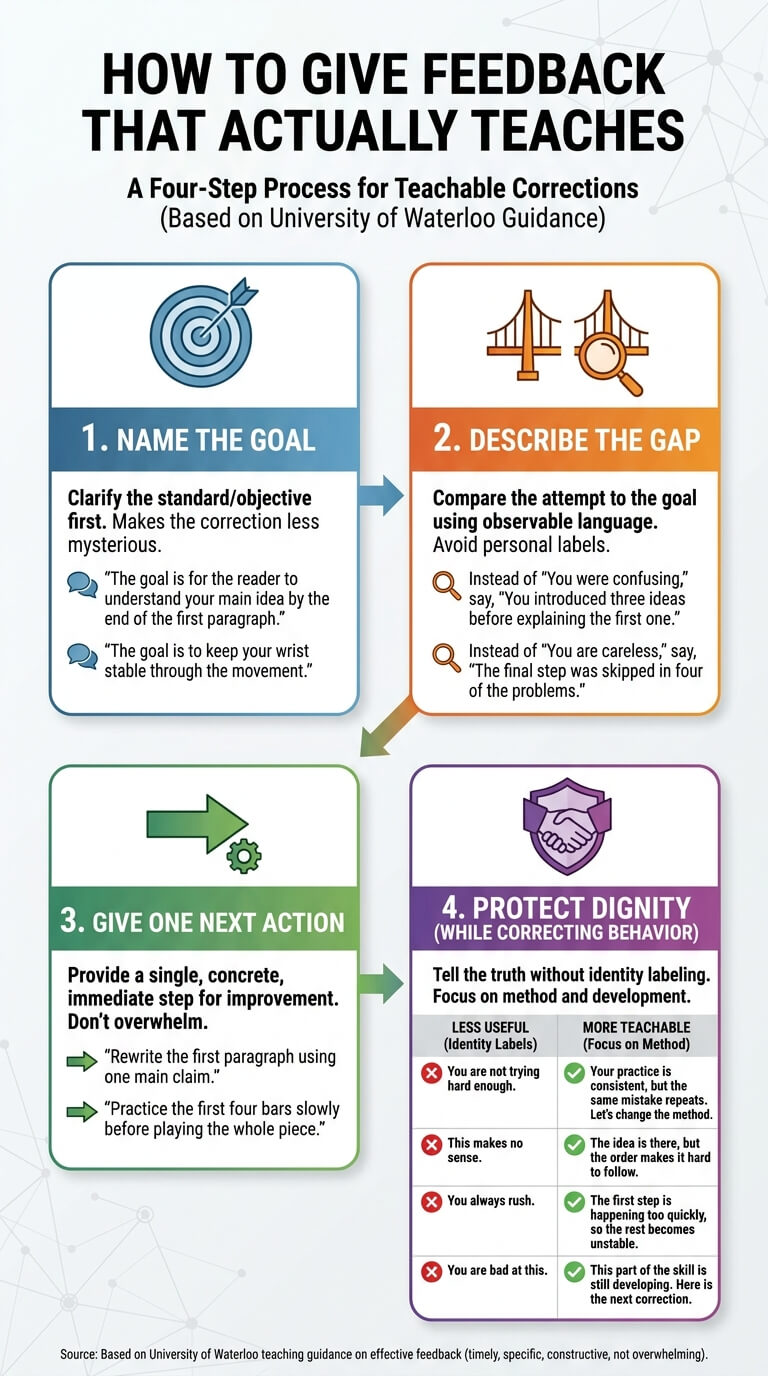
Name the goal
Start with the goal so the learner understands the standard. “The goal is for the reader to understand your main idea by the end of the first paragraph.” “The goal is to keep your wrist stable through the movement.” “The goal is to explain your reasoning, not just give the answer.”
Without a clear goal, feedback can feel like personal preference. Naming the goal makes the correction less mysterious and more teachable.
Describe the gap
Next, describe the gap between the attempt and the goal. Keep the language observable when possible. Instead of “you were confusing,” say, “You introduced three ideas before explaining the first one.” Instead of “you are careless,” say, “The final step was skipped in four of the problems.”
This kind of feedback is not always easy to hear, but it gives the learner something concrete to work with.
Give one next action
A correction should lead somewhere. Give one next action the learner can attempt soon. “Rewrite the first paragraph using one main claim.” “Practice the first four bars slowly before playing the whole piece.” “Check your answer by explaining each step out loud.”
The University of Waterloo’s teaching guidance on receiving and giving effective feedback emphasizes timely, specific, and constructive feedback, including the need to avoid overwhelming the receiver with too much at one time.
Protect dignity while correcting the behavior
Protecting dignity does not mean avoiding the truth. It means telling the truth in a way that keeps the learner able to learn. The person should leave with a clearer next step, not a heavier identity label.
| Less useful | More teachable |
|---|---|
| You are not trying hard enough. | Your practice is consistent, but the same mistake is repeating. Let us change the method. |
| This makes no sense. | The idea is there, but the order makes it hard to follow. |
| You always rush. | The first step is happening too quickly, so the rest becomes unstable. |
| You are bad at this. | This part of the skill is still developing. Here is the next correction. |
How Feedback Fits With the Rest of Learning
How attention shapes what feedback can reach
Feedback only helps if the learner can pay attention to the right part of it. If attention is overloaded, the learner may miss the useful detail. If attention is locked onto shame, the correction may not be processed. This is why short, focused feedback often works better than long, emotionally charged feedback.
Why consequences still matter
Consequences can shape what people repeat, but they do not always explain what people understand. A student may repeat an answer because it received praise without knowing why it worked. A learner may avoid a task because criticism felt painful without knowing what needs correction. Feedback fills the information gap that consequences alone may leave behind.
Why practice needs correction
Practice builds skill when it includes attention, adjustment, and repetition. Feedback provides the adjustment signal. Without it, practice can become automatic repetition. With it, practice becomes a series of experiments that gradually become more accurate.
Why hard learning needs emotional steadiness
New learning often feels awkward. Mistakes are visible before skill is stable. Feedback can either help the learner stay oriented or make the difficulty feel like proof of failure. The emotional side matters because learners need enough steadiness to keep using information after discomfort appears.
FAQ About Feedback Psychology
Why does feedback make me defensive?
Feedback can make you defensive when it feels like a judgment about your intelligence, effort, worth, or identity. Defensiveness is often an attempt to protect yourself from shame or unfair blame. It may help to pause and separate the correction from the story your mind adds. Ask what part is useful, what part is unclear, and whether the delivery was respectful.
What is the best timing for feedback?
The best timing depends on the task. Feedback usually helps when it comes close enough to the attempt that the learner remembers what happened, but not so constantly that it interrupts thinking. For complex skills, it can help to let the learner finish a small attempt, then correct one or two high-impact points before the next round.
Is praise a type of feedback?
Praise can be feedback if it tells the learner what worked. “Good job” is encouraging, but it is not very informative. “Your example made the concept easier to understand” gives useful information. Praise becomes more helpful when it names a repeatable behavior, strategy, or improvement.
How much feedback is too much?
Feedback becomes too much when the learner cannot tell what to do next. A long list of corrections may be accurate but still unusable. If someone feels overwhelmed, it helps to prioritize one next action, one recurring pattern, or one part of the skill that will make the biggest difference.
What should I do with feedback I disagree with?
Do not accept feedback automatically, but do not reject it only because it felt uncomfortable. Ask whether the comment contains evidence, whether it matches other patterns, and whether the person understands the goal. You can ask for an example, test the suggestion once, or decide that the feedback reflects a preference rather than a useful correction.
Key Takeaways
- Feedback helps learning when it gives clear information about the gap between an attempt and a goal.
- Corrective feedback is usually more useful than broad praise or personal judgment because it points toward a next action.
- Feedback can backfire when it creates shame, identity threat, overload, or fear instead of task-focused attention.
- Feedback is not the same as reinforcement. Feedback informs adjustment, while reinforcement affects what behavior is likely to repeat.
- The most useful feedback loop is: try, notice the result, receive or generate information, adjust, and try again.
- Good feedback protects dignity while correcting behavior, which helps learners stay engaged long enough to improve.
Feedback is not valuable because it is positive or negative. It is valuable when it helps a learner see more clearly and act more effectively. The next time you receive feedback, try asking one practical question: “What is the smallest useful adjustment I can make on the next attempt?” The next time you give feedback, try answering that question for the learner before you speak.
Educational note: Michael Reed writes for Psychology Exposed as a psychology-focused writer who explains human behavior, emotional patterns, learning, and everyday decisions in a simple, research-aware way. This content is educational and is not a substitute for professional mental health, medical, legal, or crisis support.

Michael Reed is the Founder and Lead Writer at Psychology Exposed. He writes about human behavior, relationships, emotional patterns, self-awareness, and practical psychology topics using research-informed, easy-to-understand content.
Read More About Michael Reed: https://psychologyexposed.com/michael-reed/