
Learning can feel surprisingly personal. You sit down to study, train for a new skill, or understand a new system at work, and the first few attempts feel slow, clumsy, and mentally heavy. A task that looked simple when someone else did it suddenly feels full of hidden steps. You may know you are capable, but the experience still brings up thoughts like, “Why is this so hard for me?” or “I should understand this by now.”
This is one part of a larger question in learning psychology: how experience changes what people notice, remember, expect, and do next.
That reaction is common because learning is not just taking in information. It asks your attention, memory, emotions, confidence, and habits to work together before they are ready. The APA Dictionary describes learning as a process that involves attending to information, organizing it, connecting it with prior knowledge, and retaining it for later use. That is a lot of mental work before a skill starts to feel smooth.
The aim here is to separate normal learning struggle from signs that the method, pace, or emotional pressure may need adjusting. Difficulty does not automatically mean you are bad at learning. It often means the mind is dealing with too many unfamiliar demands at once.
Quick Answer
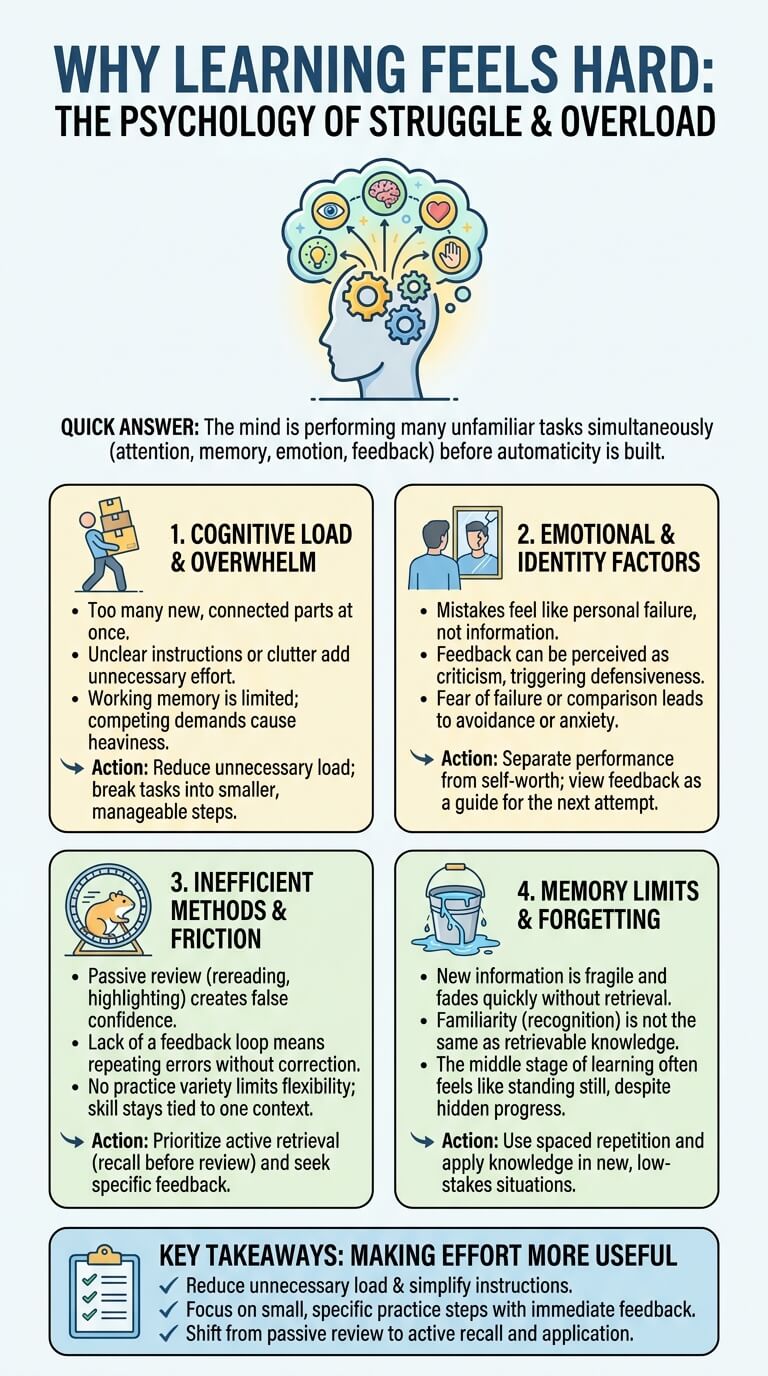
Learning feels hard because the mind is doing many unfamiliar tasks at once
Learning feels hard because attention, working memory, prior knowledge, feedback, and emotion are all active at the same time. You are trying to understand what matters, hold new details in mind, notice mistakes, connect ideas, and keep going while the result is still uncertain. The heaviness often comes from mental load, not from a lack of intelligence.
Difficulty is not always evidence that you are bad at learning
Struggle can mean several different things. The task may be genuinely complex. The instructions may be unclear. You may be practicing too much at once. You may be comparing your beginning to someone else’s fluency. Or your mind may be reacting to mistakes as if they say something about your worth. These causes feel similar in the moment, but they need different responses.
The Hidden Work Behind Learning
Paying attention to new information
Attention is the first bottleneck. When something is unfamiliar, almost everything seems important. A beginner in a new software tool notices buttons, menus, warnings, terms, and examples all at once. A new language learner listens for meaning, pronunciation, grammar, and speed at the same time. The mind has not yet learned what to ignore.
Holding details in working memory
Working memory is the short-term mental space used to hold and work with information right now. It is limited. When you are learning algebra, driving, editing a video, or following a recipe, you may have to keep several steps active at once. If too many pieces compete for space, the whole task feels heavier.
This is why you can understand each step separately but lose the sequence when you try to do the whole thing. It does not mean you learned nothing. It means the task has not yet been chunked into easier units. Until that happens, your mind must carry every piece by hand.
Connecting new ideas to old knowledge
New information is easier to learn when it can attach to something you already understand. If you know basic cooking, learning a new sauce technique is easier because you already understand heat, timing, texture, and ingredients. If every word in the explanation is new, the mind has fewer hooks to hold the idea.
The National Academies report How People Learn II emphasizes that learning involves attention, memory, prior knowledge, motivation, and context working together. In everyday terms, your background knowledge shapes what you notice and how quickly new information becomes meaningful.
Practicing before skill feels smooth
Understanding often comes before fluency. You may understand what a teacher, coach, or tutorial is asking for, but your performance still feels awkward. That gap can be frustrating because it creates the feeling of “I know this, so why can’t I do it?”
Skill takes time because the mind and body need repeated attempts, correction, and smoother access. A new driver may understand mirror checks but still forget them while turning. A public speaker may know the opening line but still rush when nervous. The knowledge exists, but the skill has not become stable under real conditions yet.
Cognitive Load: When the Mind Has Too Much to Hold

Intrinsic difficulty of the task
Some learning feels hard because the task itself has many connected parts. Learning a musical instrument includes rhythm, finger placement, listening, timing, posture, and correction. Learning statistics includes formulas, concepts, symbols, interpretation, and problem selection. The difficulty is built into the task.
That kind of challenge is not always a problem. Complex skills require time because the learner must understand how the parts relate. A task with high intrinsic difficulty needs smaller steps, slower pacing, and repeated examples before it becomes manageable.
Extra confusion from unclear instructions or clutter
Some difficulty is unnecessary. A lesson can be harder than it needs to be because the instructions are vague, the examples are crowded, the order is confusing, or the learner is given too many details too soon. This creates mental effort that does not directly help understanding.
Cognitive load theory is often used to explain why learning design matters. A PubMed summary of cognitive load theory in health professional education describes the idea as being based on limited working memory and the building of long-term knowledge structures. When instruction adds unnecessary clutter, limited mental space gets spent on confusion instead of learning.
Useful effort that builds understanding
Not all effort should be removed. Some effort is useful because it forces the mind to organize, retrieve, compare, and apply information. For example, explaining an idea from memory may feel harder than rereading notes, but it can reveal what you actually understand. Solving a slightly different problem may feel slower, but it can build flexible knowledge.
| Type of effort | What it feels like | What may help |
|---|---|---|
| Task difficulty | The material has many connected parts. | Break the skill into smaller pieces. |
| Instruction clutter | You cannot tell what matters. | Find a clearer example or simpler starting point. |
| Useful effort | You are challenged but learning from the attempt. | Repeat with feedback and retrieval. |
| Emotional overload | The mistake feels like a personal failure. | Pause, reduce pressure, and separate performance from identity. |
Why New Skills Feel Awkward

You have not built automaticity yet
Automaticity is what makes practiced actions feel less mentally expensive. A skilled typist does not think about every key. A fluent reader does not sound out every familiar word. A practiced cook can chop, stir, taste, and adjust without treating each movement as a separate decision.
Beginners do not have that ease yet. They must consciously manage each step, which makes the task feel slow and exposed. The awkwardness is often the cost of doing manually what later may become more automatic.
Your attention is split across too many steps
Early learning often splits attention. A person learning to drive may think about speed, mirrors, lane position, distance, signs, and other drivers at the same time. A person learning video editing may think about timeline cuts, sound levels, keyboard shortcuts, pacing, and export settings. Each step competes for awareness.
Mistakes are more visible in the early stage
Early mistakes are obvious because the learner has fewer backup habits. A skilled person can recover smoothly from small errors. A beginner may pause, blush, restart, or feel exposed. The mistake feels larger because there is not yet a reliable way to correct it.
This is one reason private, low-stakes practice can help. It gives the learner room to make errors without turning every attempt into a social test. Over time, mistakes become information rather than proof that the learner does not belong.
Why Feedback Can Make Learning Feel Harder
Correction can feel like criticism
Feedback is supposed to help, but correction can still sting. When someone points out an error, the learner may hear more than the information. They may hear, “You are behind,” “You should have known this,” or “You are not good at this.” The emotional meaning can drown out the useful part.
That reaction is especially likely when the learner cares about the skill. A casual correction on something unimportant may pass quickly. A correction on writing, speaking, art, parenting, work performance, or intelligence can feel more personal because the skill is tied to identity.
Identity threat can trigger defensiveness or shutdown
Feedback becomes harder to use when it threatens the learner’s sense of self. A person may argue, avoid practice, overexplain, quit, or pretend not to care. These reactions are not always laziness. Sometimes they are attempts to escape the feeling of being judged.
The APA Dictionary defines frustration as a blocked or thwarted state that prevents a person from reaching an expected outcome. In learning, frustration can appear when effort does not produce progress as quickly as expected. If that frustration turns into shame, the learner may protect the ego instead of studying the correction.
Useful feedback still needs emotional safety
Helpful feedback is specific, limited, and connected to the next attempt. “Your explanation skips the middle step” is easier to use than “You are bad at explaining.” “Your timing is early on the second beat” gives the learner a place to work. “Try again” without direction may only increase pressure.
Emotional safety does not mean avoiding all correction. It means the learner can receive correction without feeling humiliated or hopeless. When feedback feels safer, the mind has more room to ask, “What is the next adjustment?” instead of “What does this mistake say about me?”
Memory Limits and Forgetting

Why new information disappears quickly
Forgetting new information can feel discouraging, but it is not unusual. New material is fragile before it has been used, retrieved, and connected to other knowledge. If you only read something once, it may feel clear in the moment but fade when you try to explain it later.
Forgetting often tells you that the information has not been practiced in a retrievable form yet. The solution is not always more rereading. Often, it is active recall: closing the notes, explaining the idea, solving a problem, or using the information in a small example.
Why familiarity creates false confidence
Rereading can create a feeling of familiarity. The page looks familiar, the words sound familiar, and the explanation seems clear. But recognition is not the same as retrieval. You may recognize the answer when you see it and still struggle to produce it alone.
This is why tests, flashcards, teaching someone else, and practice problems can feel harder than review. They remove the cue and ask the mind to rebuild the idea. That difficulty can feel like failure, but it often gives a more honest picture of learning.
Why retrieval feels harder than rereading
Retrieval is effortful because the mind must search for the idea and organize it without the full answer in front of you. That effort is often the point. It shows what is accessible and what is still weak. A blank moment during recall can be uncomfortable, but it reveals where the next practice session should focus.
A useful approach is to retrieve first, then review. Try to write or say what you remember before checking the material. Then use the notes to correct the missing or confused parts. This turns forgetting into guidance.
Uncertainty and the Beginner Mind
Not knowing what matters yet
Beginners often suffer from not knowing what is important. Every detail seems equally urgent. A new programmer may not know whether the error comes from syntax, logic, file structure, or the tool setup. A new student may not know whether a textbook paragraph is central or background detail.
Uncertainty makes learning feel harder because it removes confidence about where to place effort. Clear examples, worked problems, demonstrations, and simple success criteria can reduce this burden. They teach the learner what to notice first.
Comparing your beginning to someone else’s fluency
Comparison can make normal struggle feel like personal failure. You see someone do the skill smoothly and assume they understand faster, think better, or have something you lack. What you do not see is the messy stage they passed through earlier.
Fluency hides labor. A confident speaker has likely repeated stories, lost attention, adjusted pacing, and learned from awkward moments. A skilled designer has likely made many weak drafts. A good cook has likely ruined food. When you compare your early attempts to someone else’s polished performance, learning feels harder than it needs to feel.
Why progress feels invisible in the middle
The middle stage of learning is often the most emotionally difficult. You know enough to see your mistakes but not enough to avoid them consistently. You are no longer completely new, but you are not yet fluent. This stage can feel like standing still.
Progress may be happening in smaller ways: you notice errors faster, recover sooner, ask better questions, recognize patterns, or need fewer reminders. These are real changes even if the final performance is not smooth yet.
When Learning Feels Hard Because the Method Is Wrong
Too much passive review
Passive review feels productive because it keeps you close to the material. Highlighting, rereading, watching tutorials, and copying notes can help at the start, but they may not create enough retrieval or application. You may feel busy without finding out whether you can use the information.
A better test is simple: can you explain it without looking, solve a fresh example, perform the movement, or apply the idea in a new situation? If not, the method may need more active practice.
No feedback loop
Learning stalls when you repeat without information. If you do not know what is improving, what is missing, or what to adjust next, practice becomes guessing. Feedback does not have to come from a formal teacher. It can come from a rubric, answer key, recording, checklist, coach, peer, user response, or real-world result.
The key is to turn each attempt into information for the next attempt. Without that loop, you may repeat the same weakness while feeling like you are working hard.
No practice variety
If you practice only one version of the task, the skill may stay tied to that version. A student can solve problems in the same order as the lesson but freeze when the order changes. A language learner can answer familiar app prompts but struggle in conversation. A worker can follow a checklist but struggle when the situation is slightly different.
Once the basic skill is stable, variation matters. Change the examples, order, setting, timing, or level of help. Variation prepares learning for real use instead of only familiar practice.
Goals that are too vague or too large
“Get better at math,” “learn marketing,” “become fluent,” or “understand psychology” are too large to guide today’s effort. Vague goals make learning feel endless because there is no clear next step and no clear sign of progress.
Smaller goals reduce pressure. Try “solve five problems using this formula,” “explain this concept in 100 words,” “practice this chord change for ten minutes,” or “use this new word in three sentences.” Specific goals make the next action visible.
| When the method creates friction | What to change |
|---|---|
| You reread but cannot explain. | Use recall before review. |
| You repeat but do not improve. | Add feedback after each attempt. |
| You know it in one setting only. | Practice with varied examples. |
| You feel lost every session. | Set one narrow skill target. |
Learning Struggle vs Anxiety, Burnout, or Shame
Normal challenge vs severe distress
Normal learning challenge includes effort, confusion, mistakes, and temporary frustration. Severe distress is different. If learning regularly brings panic, dread, self-hatred, avoidance, sleep disruption, or thoughts of harming yourself, the issue deserves more care than study tips.
Stress and anxiety can affect focus, memory, sleep, and daily functioning. Cleveland Clinic notes that stress can involve emotional, physical, and behavioral symptoms, and that professional help may be useful when stress feels overwhelming or hard to manage. If learning is tied to intense distress, a healthcare provider, counselor, therapist, or trusted support person may help you sort out what is happening.
When fear of failure takes over the learning process
Fear of failure can make learning feel dangerous even when the task itself is safe. The learner may avoid starting, hide mistakes, overprepare, quit early, or only practice privately. The problem is no longer just the material. The problem is the meaning attached to not getting it right.
A helpful first step is to lower the stakes of the next attempt. Make one private draft. Solve one easy problem. Practice one awkward sentence. Ask one clarifying question. The aim is to give the nervous system evidence that mistakes can be survived and used.
When rest, support, or professional help may be needed
Sometimes learning feels hard because your system is depleted. Lack of sleep, chronic stress, grief, illness, heavy responsibilities, or a harsh environment can make normal learning demands feel impossible. In that case, pushing harder may not be the best first move.
Rest, clearer structure, tutoring, disability support, medical guidance, or mental health support may be appropriate when struggles are persistent, sudden, impairing, or tied to intense shame. Seeking help does not mean you failed at learning. It may mean the conditions around learning need attention.
What to Do When Learning Feels Hard

Reduce unnecessary load
Start by removing friction that does not teach you anything. Clear the workspace, choose one resource, close extra tabs, simplify the example, or ask for the steps in order. If the explanation is too dense, find a beginner version before returning to the advanced one.
Reducing load is not cheating. It gives your mind more room for the part that actually needs learning.
Practice one smaller step
Choose the smallest useful action. If writing feels hard, write only the topic sentence. If coding feels hard, run one simple example. If studying feels hard, explain one concept out loud. If speaking a new language feels hard, practice one everyday sentence until it feels less foreign.
Small steps matter because they create contact with the task without overwhelming the whole system. They also give feedback faster.
Use feedback as information
After an attempt, ask what the result tells you. Did you misunderstand the concept? Skip a step? Rush? Need a model? Need more examples? Feedback becomes less painful when it points to a behavior you can adjust.
When feedback feels personal, pause before responding. Write down the useful part in plain language: “The answer needs one more step,” “The timing is too fast,” or “The example does not match the idea.” The simpler the correction, the easier it is to use.
Repeat with retrieval, not only review
Before rereading, try to recall. Write what you remember, explain the idea, solve the problem, or perform the step. Then check what was missing. This method may feel harder than reviewing, but it gives clearer evidence of what is available in memory.
Use the gap as a map. The part you could not retrieve becomes the part to practice next.
Apply the idea in a low-stakes situation
Learning becomes more flexible when you use it outside the original example. Try a small, low-pressure application. Use the new word in a message. Apply the concept to a familiar story. Practice the work skill on a test project. Teach the idea to someone patient.
How This Connects With Practice, Feedback, and Memory
The process behind learning
When learning feels hard, it can help to look at the whole process instead of blaming one moment. Attention brings information in. Encoding organizes it. Practice tests it. Feedback corrects it. Memory holds and retrieves it. Application shows whether it works in real life.
If one part of that chain is weak, the whole experience may feel harder. For example, you may not need more motivation. You may need clearer steps, better feedback, or more retrieval practice.
Why feedback changes the emotional experience
Feedback can either make learning safer or more threatening. Specific feedback gives the learner a next move. Vague or shaming feedback often creates defensiveness, avoidance, or discouragement. The difference matters because emotion affects whether the learner stays engaged long enough to improve.
Why practice turns effort into skill
Practice matters because learning rarely becomes usable from explanation alone. Repeated attempts help the learner correct errors, build automaticity, and become less dependent on perfect conditions. When practice is narrow, varied, and connected to feedback, the same hard task can start to feel more manageable.
Why memory can make learning feel better or worse
FAQ About Why Learning Feels Hard
Why do I feel stupid when learning something new?
You may feel stupid because early learning makes mistakes visible before skill is stable. Your mind is managing attention, memory, uncertainty, and emotion at the same time. That can create a heavy feeling even when you are capable. Try separating the task from your identity: “This step is hard right now” is more accurate than “I am bad at this.”
Does struggle mean I am learning?
Struggle can be part of learning, but not every struggle is useful. Helpful struggle gives you feedback, clearer understanding, or a better next attempt. Unhelpful struggle leaves you confused, exhausted, or ashamed without showing what to change. If the effort is not teaching you anything, simplify the task, find a clearer example, or ask for feedback.
Why do I forget what I just studied?
New information fades quickly when it has not been retrieved, organized, or connected to prior knowledge. Rereading may make the material feel familiar, but recall shows whether you can access it. Try closing the notes and explaining the idea first, then review what you missed.
Why does feedback make me want to quit?
Feedback can feel like a threat when it seems to judge your intelligence, talent, or worth. The useful part of feedback is the information about the next adjustment. If the feedback is too vague or harsh, translate it into a specific behavior if possible. If the environment is humiliating or consistently unsafe, getting support or changing the learning conditions may matter more than pushing through.
When should I get help for learning problems?
Consider help if the struggle is persistent, sudden, strongly impairing, or tied to panic, intense shame, avoidance, sleep problems, or thoughts of self-harm. Depending on the situation, useful help may come from a teacher, tutor, academic support office, manager, doctor, counselor, therapist, or trusted person. Asking for help is not a diagnosis. It is a way to improve the conditions around learning.
Key Takeaways
- Learning feels hard because attention, memory, feedback, emotion, and practice demands often collide before skill becomes smooth.
- Cognitive load increases when a task has many connected parts or when instructions add unnecessary confusion.
- Early mistakes feel more personal because the learner has not built automaticity or reliable recovery habits yet.
- Feedback is easier to use when it is specific, respectful, and connected to the next attempt.
- Forgetting does not always mean learning failed; it often means the material needs retrieval, spacing, and application.
- If learning brings severe distress, panic, intense shame, or thoughts of self-harm, support matters more than forcing another study session.
Final Thoughts
When learning feels hard, the most useful next step is usually not to judge yourself harder. It is to make the task smaller, remove unnecessary load, practice one part, and use feedback as information for the next attempt. A difficult learning moment may be showing you where the system is overloaded, not where your ability ends.
The first useful question is not only whether you are trying hard enough. It is whether the difficulty is coming from attention, memory, unclear feedback, awkward practice, or a method that does not match the skill.
Choose one small piece of the skill and try again under better conditions. The goal is not to make learning effortless. The goal is to make the effort clearer, safer, and more useful.

Michael Reed is the Founder and Lead Writer at Psychology Exposed. He writes about human behavior, relationships, emotional patterns, self-awareness, and practical psychology topics using research-informed, easy-to-understand content.
Read More About Michael Reed: https://psychologyexposed.com/michael-reed/