
You can remember a sentence from a book and still not know how to use the idea. You can also learn how to ride a bike, read a room, or solve a problem without being able to explain every step out loud. That is the basic tension behind learning vs memory.
This is one part of a larger question in learning psychology: how experience changes what people notice, remember, expect, and do next.
In everyday language, people often treat learning and remembering as the same thing. If you remember the notes, you assume you learned the lesson. If you remember the advice, you assume it changed you. If you remember what happened before, you assume you will act differently next time. Sometimes that is true. Other times, memory is only one part of learning.
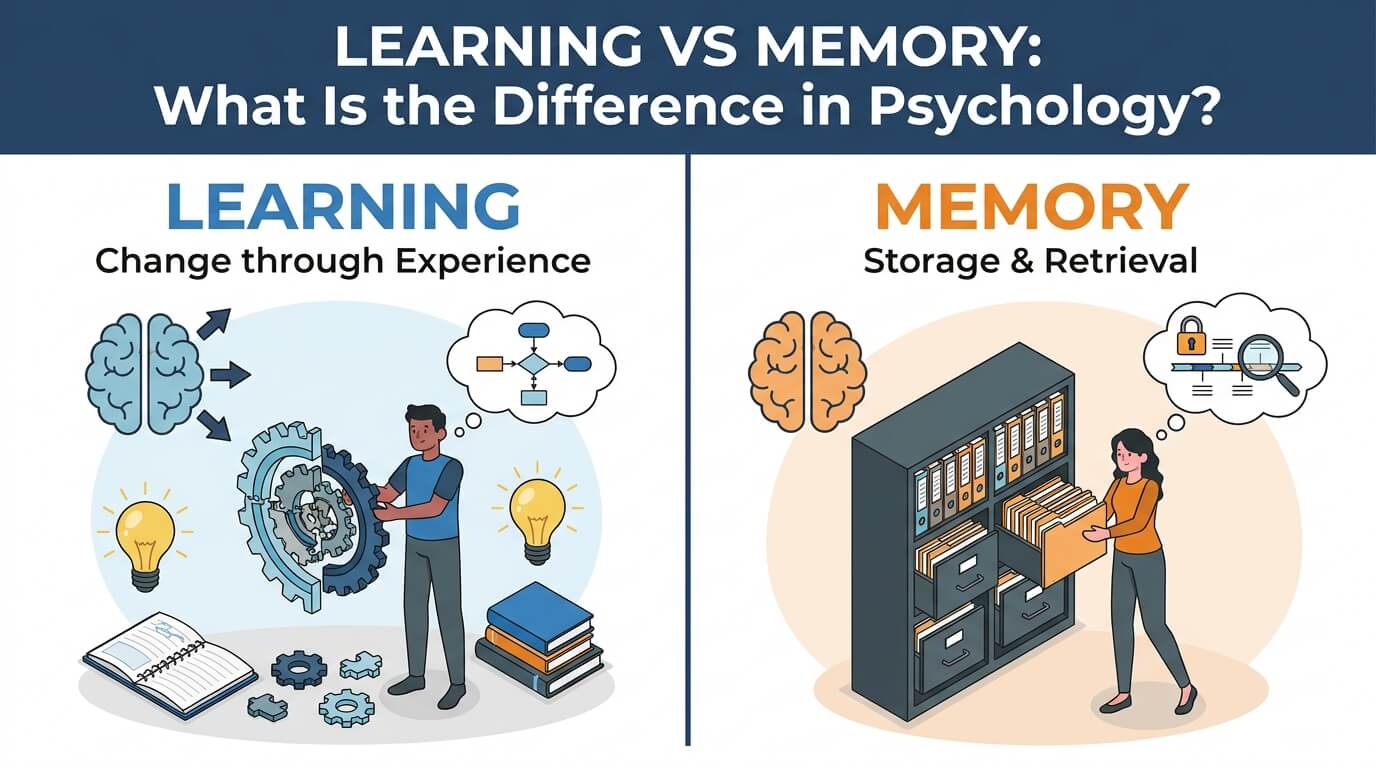
Psychologically, learning is about change through experience. Memory is about keeping and retrieving information from experience. They work together, but they are not identical. The difference matters because it explains why a person can pass a quiz but freeze in real life, recall advice but repeat the same behavior, or improve at a skill while struggling to describe how they do it.
Quick Answer

Learning is a change in knowledge, behavior, skill, expectation, or understanding that comes from experience. Memory is the ability to retain and retrieve information or experiences. Memory can support learning, but remembering something does not always mean you have learned how to apply it.
Learning changes what you can do, expect, or understand
The APA Dictionary of Psychology defines learning as acquiring new information, behavior, or abilities through practice, observation, or other experience. That definition includes facts, but it also includes skills, habits, emotional expectations, social understanding, and changes in behavior.
Learning answers questions like: What changed after the experience? Can you do something you could not do before? Do you understand the situation differently? Are you more likely to respond in a new way? Do you notice patterns you used to miss?
Memory stores and retrieves information from experience
The APA Dictionary of Psychology describes memory as the ability to retain information or representations of past experience through learning or encoding, retention, and retrieval. In simpler terms, memory helps you keep access to what happened, what you studied, what you noticed, or what something means.
Memory answers different questions: Can you bring the information back? Can you recognize it? Can you recall the example? Can you reconnect with the experience? Can you retrieve the right detail at the right moment?
Why Learning and Memory Are Easy to Confuse
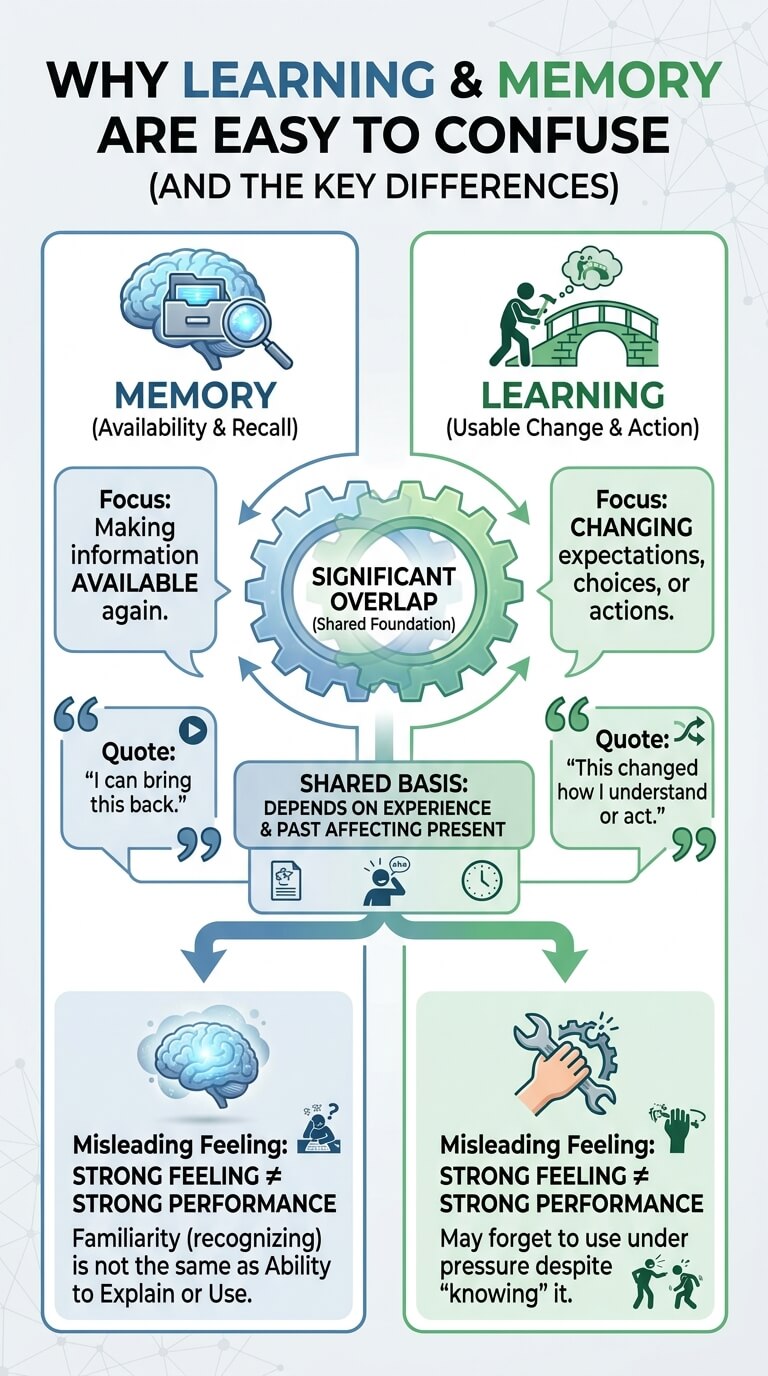
Learning and memory overlap so much that the confusion is understandable. Most learning needs memory, and many memories come from learning. The problem starts when we assume that a strong memory automatically creates usable change.
Both depend on experience
You do not form memories or learn much from nothing. Experience gives the mind material to work with. A lesson, mistake, conversation, repeated action, emotional event, or observed example can become something you remember and something that changes you.
But the experience must be processed in different ways. Remembering a cooking video is not the same as learning to cook the dish. Remembering a difficult conversation is not the same as learning how to respond differently during the next one.
Both involve the past affecting the present
Memory brings the past into the present by making information available again. Learning brings the past into the present by changing what you expect, notice, choose, or perform. In both cases, the past matters.
The difference is the kind of influence. Memory says, “I can bring this back.” Learning says, “This experience changed how I understand or act.”
Both can feel strong even when performance is weak
A memory can feel clear, familiar, or emotionally strong, yet still fail to guide performance. You may recognize a concept while reading it, then struggle to explain it without looking. You may remember exactly what your coach said, then forget to use it under pressure.
This is why familiarity can be misleading. Something can feel known because you have seen it many times, while your ability to use it remains fragile.
What Learning Means
Learning is not only collecting information. It is a change that comes from experience. Sometimes that change is obvious, such as speaking a new phrase, driving more smoothly, or solving a type of math problem. Sometimes it is quiet, such as expecting a certain reaction, noticing a social cue, or becoming less surprised by a pattern.
Learning as change in knowledge, behavior, skill, or expectation
Learning can change what you know. It can also change what you do. A person learns a rule when they understand it, a skill when they can perform it, a habit when repetition starts to guide behavior, and an expectation when experience teaches them what usually happens next.
That is why learning is broader than studying. A child can learn that crying brings comfort. A worker can learn that asking questions is safe on one team and risky on another. A musician can learn timing through repeated practice. A friend can learn that someone needs space before they are ready to talk.
Why learning can be visible or invisible
Visible learning shows up in performance. You answer correctly, act differently, move better, choose better, or make fewer mistakes. Invisible learning may show up later. It can appear as readiness, recognition, expectation, confidence, caution, or a new way of interpreting what is happening.
For example, you may not look different after reading about negotiation. But later, in a real conversation, you may pause before accepting the first offer. That pause can be learning, even if nobody else notices it.
Examples of learning without perfect recall
You might learn how to make a better decision without remembering the exact article that changed your thinking. You might become kinder in a tense moment without recalling the exact sentence from a book. You might improve your tennis serve while forgetting the name of the technique.
Learning does not always require perfect verbal recall. Sometimes experience changes timing, judgment, attention, or action more than it creates a clear explanation.
What Memory Means
Memory is the mind’s way of retaining and returning to information. It helps you recognize faces, recall instructions, remember events, use language, keep personal history, and connect one moment to another. Without memory, learning would have nothing to build on.
Memory as encoding, storage, and retrieval
Many introductions to memory describe three broad processes: encoding, storage, and retrieval. OpenStax explains memory through questions about how information is processed, stored, and brought back for use in its overview of memory in Psychology 2e.
Encoding is how information first enters a usable form. Storage is how it is maintained over time. Retrieval is how it comes back when needed. If any part is weak, memory can feel unreliable.
Why recall can be accurate, partial, or reconstructed
Memory is not always a perfect recording. Some details may be accurate, some may be missing, and some may be rebuilt from meaning, emotion, expectation, or later information. This does not mean memory is useless. It means memory is a living mental process, not a video file.
This matters for learning because a person may strongly remember an experience but misunderstand what it taught them. A painful mistake may teach caution, but it may also teach an overly broad rule like “I should never try that again.”
Examples of memory without usable learning
You may remember a grammar rule and still make the same error while speaking. You may remember a productivity tip and still avoid the hard task. You may remember someone’s advice to stay calm and still react quickly when embarrassed.
In these cases, the memory exists. What is missing is usable change at the moment of action.
Side-by-Side Comparison

The cleanest way to separate learning and memory is to compare what each one is trying to do. Memory keeps access to information. Learning changes ability, expectation, understanding, or behavior through experience.
Main purpose
Memory helps preserve and retrieve. Learning helps adapt and change. Memory is useful because it lets information return. Learning is useful because it helps the person respond differently after experience.
What changes
In memory, what changes is access to stored information. You may remember more, remember less, recognize faster, or retrieve with better cues. In learning, what changes may be behavior, skill, interpretation, confidence, caution, strategy, or expectation.
How it is tested
Memory is often tested by recall, recognition, or explanation. Can you remember the term? Can you choose the right answer? Can you repeat the steps? Learning is better tested by transfer and performance. Can you use the idea? Can you adjust when the situation changes? Can you act differently when it counts?
Everyday examples
| Situation | Memory | Learning |
|---|---|---|
| Studying a concept | You recall the definition. | You use the concept to explain a new example. |
| Receiving advice | You remember what someone told you. | You behave differently when the situation returns. |
| Practicing a skill | You remember the steps. | Your timing, accuracy, or confidence improves. |
| Having a difficult experience | You remember what happened. | You form a wiser expectation or response. |
Common failure points
Memory can fail when information was not encoded well, was not maintained, or cannot be retrieved under pressure. Learning can fail when practice is too passive, feedback is missing, the context changes, or the person never uses the information beyond recognition.
The failure point tells you what to fix. If you cannot recall, you may need better retrieval practice. If you can recall but cannot apply, you may need examples, feedback, and practice in varied situations.
When You Remember but Have Not Learned
This is one of the most common frustrations in school, work, relationships, and personal growth. You remember the information, but it has not changed what you can do with it.
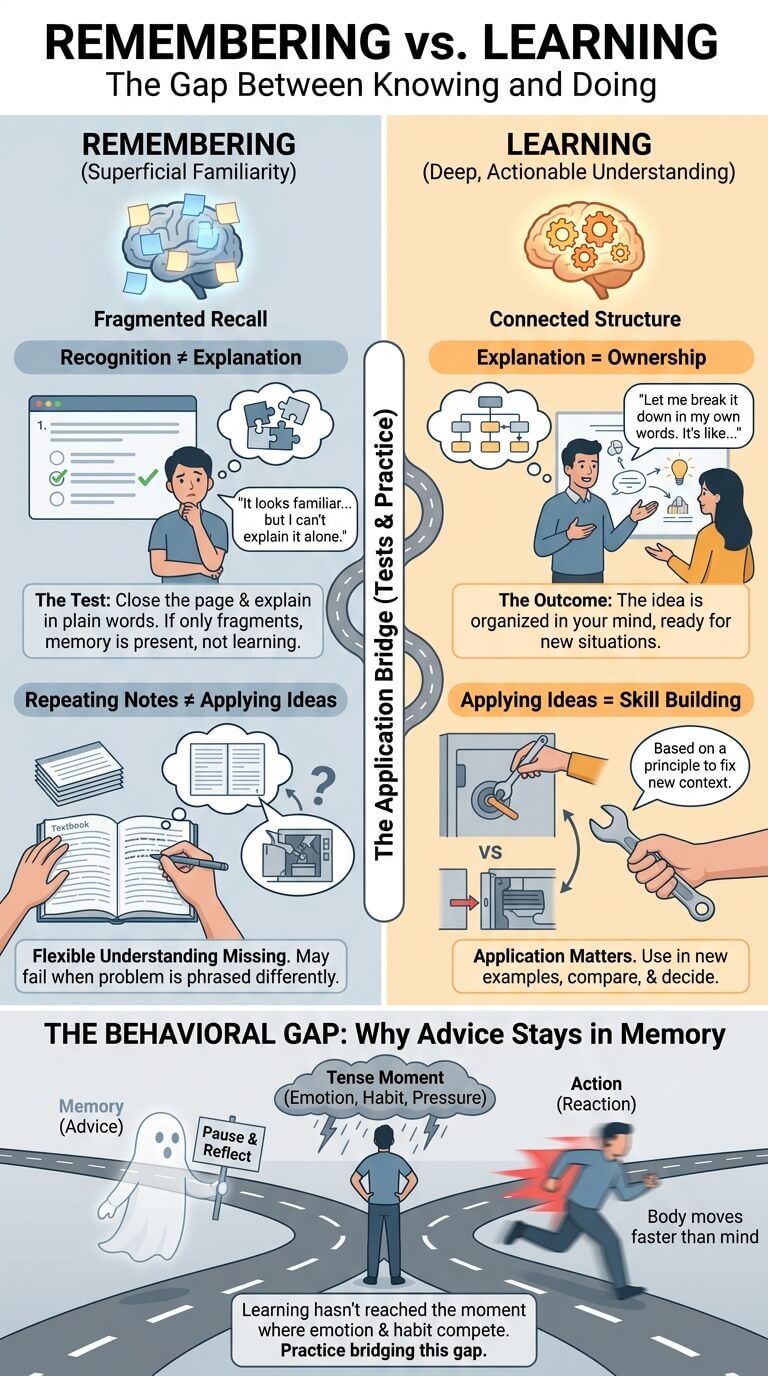
Recognizing the answer but failing to explain it
Recognition feels easier than recall. When you see the answer, it looks familiar. But when you must explain it alone, the structure is not there. Familiarity creates confidence, while explanation reveals whether the idea is organized in your own mind.
A simple test is to close the page and explain the idea in plain words. If you can only repeat fragments, memory is present, but learning may still be shallow.
Repeating notes without applying ideas
Copying notes can strengthen exposure. It does not automatically create flexible understanding. You may remember the layout, wording, and examples, yet fail when the problem is phrased differently.
This is why application matters. A concept becomes more useful when you use it in a new example, compare it with a similar concept, make a decision with it, or explain what would change in a different situation.
Remembering advice but acting the same way
Advice often lives in memory before it lives in behavior. You may remember “pause before reacting,” but in a tense moment your body moves faster than your reflective mind. You may remember “ask for clarification,” but embarrassment pushes you into defense.
This does not mean the advice was fake. It means the learning has not yet reached the moment where emotion, habit, timing, and social pressure all compete.
When You Learn Without Being Able to Explain Everything
The opposite also happens. You may have learned something even though your verbal explanation is incomplete. This is common in skill, judgment, social perception, and repeated exposure.
Skill learning and automaticity
Skills often become smoother with practice before they become easy to describe. A fluent typist does not consciously name every key. A driver does not explain every micro-adjustment. A dancer may feel timing before they can describe the mechanics.
Automaticity is not mindless. It is the result of repeated adjustment until some parts of performance require less conscious control.
Intuition from repeated exposure
Intuition can be a form of learning when it comes from repeated, meaningful exposure. A nurse may notice a small change in a patient’s appearance. A teacher may sense when a class is confused. A designer may feel that a layout is off before naming the rule.
Intuition is not always correct, but it can reflect patterns the mind has learned faster than language can explain.
Implicit learning in social and practical situations
Implicit learning happens when people pick up patterns without fully realizing what they have learned. The National Academies report How People Learn II discusses learning as a process shaped by knowledge, experience, context, and development across life.
In everyday life, implicit learning may help you understand tone, rhythm, timing, grammar, social norms, or practical routines. You may not be able to give a formal rule, but your behavior shows that something changed.
Why Studying Can Improve Memory Without Improving Learning
Studying often improves memory first. That is not a problem. The problem is stopping there and assuming memory is the final goal.
Familiarity vs understanding
Familiarity says, “I have seen this before.” Understanding says, “I can explain how it works, why it matters, and how it changes in a new situation.” Familiarity is useful, but it can create a false sense of mastery.
One sign of shallow familiarity is confidence during review and confusion during application. The material feels easy while the answer is visible, then becomes slippery when you must generate it yourself.
Review vs retrieval
Review puts information in front of you again. Retrieval asks you to pull it back from memory. The APA Dictionary of Psychology defines retrieval as recovering or locating stored information. In learning, retrieval is useful because it tests access and reveals gaps.
Reading the same page five times may make it familiar. Closing the page and explaining the idea forces the mind to rebuild it. That effort is often where learning becomes stronger.
Memorization vs transfer
Memorization can help you keep facts available. Transfer means using what you learned in a different situation. A person who memorizes a formula may still struggle when the problem changes. A person who understands the principle can adapt.
Transfer is often the difference between remembering information and having usable knowledge.
How to Turn Memory Into Learning

If you can remember something but cannot use it, the next step is not always more review. Often, the next step is to make the memory work harder.
Explain the idea in your own words
Do not only repeat the original wording. Translate the idea into simple language. Then explain it to an imaginary beginner, a friend, or your past self. If you cannot explain it without copying, you may remember the sentence more than the meaning.
Use the idea in a new situation
Choose a fresh example. Ask how the idea would apply at work, in a relationship, while learning a skill, or during a real decision. This moves the information from recognition toward flexible use.
Get feedback on mistakes
Feedback helps separate what you think you know from what your performance shows. A mistake is not proof that you failed to learn. It can be information about where learning is incomplete, especially when the feedback is specific and usable.
Practice retrieval and application together
Research reviews on retrieval practice often distinguish passive review from active recall and use. A 2025 PubMed Central review describes retrieval practice as active recall that supports memory and comprehension, especially when learners must bring information back rather than only reread it.
For everyday learning, this means combining recall with use. Remember the concept, apply it to a case, notice the gap, correct it, and try again.
What to Read Next If This Feels Familiar
If this comparison explains a problem you have noticed in yourself, there are a few useful directions to explore next. Each one answers a different question.
How learning works from attention to application
If you want the full process, look at how attention, encoding, practice, feedback, memory, and application work together. This helps when you are not sure where learning is breaking down.
How memory shapes confidence and recall
If your main question is why some information feels easy to remember while other information disappears under pressure, memory is the better focus. That includes encoding, retrieval cues, forgetting, reconstruction, and confidence.
Why transfer is harder than remembering
If you can remember a lesson but struggle to apply it in real life, the missing piece may be transfer. The issue is not only whether you know the idea, but whether you practiced it across enough situations.
How practice turns knowledge into skill
If your goal is performance, practice matters more than recognition. Skill grows when repetition, feedback, correction, and timing slowly change what you can do.
When Memory Problems Need More Support
Normal forgetfulness is common, especially with distraction, stress, poor sleep, overload, or too many similar tasks. But sudden, severe, worsening, or daily-life-disrupting memory changes deserve more careful attention.
Learning often feels harder at the beginning because the mind is managing too many new details before the task starts to feel familiar.
Consider professional evaluation if memory problems appear suddenly, affect safety, interfere with work or daily responsibilities, come with confusion, or feel very different from your normal functioning. This kind of concern is not something to solve with study tips alone.
FAQ About Learning vs Memory
Can you learn without remembering?
You usually need some form of memory for learning to last, but you may not remember every detail consciously. Skill learning, social learning, and implicit learning can change behavior even when you cannot explain exactly what changed. The memory may be stored in performance, expectation, or pattern recognition rather than a clear verbal statement.
Can you remember without learning?
Yes. You can remember a fact, quote, example, or piece of advice without gaining usable understanding or changed behavior. This often happens when information is repeated but not applied, tested, compared, or connected to real situations.
Is memorization bad for learning?
No. Memorization can be useful when facts, terms, formulas, vocabulary, or steps need to be available quickly. The problem is treating memorization as the whole process. Strong learning usually also needs meaning, practice, feedback, and application.
Why do I remember examples but fail the test?
You may remember the surface example without understanding the underlying principle. Tests often change wording, context, or problem structure. To prepare better, practice explaining the principle, then apply it to examples that look different from the original notes.
Is skill memory different from fact memory?
Yes, in everyday terms, skill memory often shows up as performance, timing, and automatic action, while fact memory shows up as recall or recognition. They can support each other, but being able to describe a skill is not the same as being able to perform it smoothly.
Key Takeaways
- Learning is a change from experience; memory is the retention and retrieval of information or experience.
- Remembering a concept does not always mean you can explain it, use it, or act differently because of it.
- You can learn through skill, intuition, and repeated exposure even when your verbal explanation is incomplete.
- Familiarity often feels like mastery, but application reveals whether learning is usable.
- To turn memory into learning, explain ideas in your own words, apply them in new situations, get feedback, and practice recall with use.
- Sudden or worsening memory changes that disrupt daily life should be discussed with a qualified professional.
Final Thoughts
The practical difference between learning and memory is simple: memory helps you bring something back, while learning changes what you can do with experience. Both matter. Memory gives learning material to work with, and learning gives memory a purpose beyond storage.
If you are trying to learn something important, do not stop at “I recognize this.” Ask a stronger question: Can I explain it, use it, adjust with feedback, and apply it when the situation looks different? That is where remembered information starts becoming real learning.

Michael Reed is the Founder and Lead Writer at Psychology Exposed. He writes about human behavior, relationships, emotional patterns, self-awareness, and practical psychology topics using research-informed, easy-to-understand content.
Read More About Michael Reed: https://psychologyexposed.com/michael-reed/