
Learning can look simple from the outside. You read a chapter, watch a lesson, repeat a move, hear advice, or make a mistake. Then, somehow, the experience is supposed to turn into understanding or skill. But many people know the frustrating gap between being exposed to information and actually being able to use it.
You can sit through a lecture and remember almost nothing later. You can understand a concept during practice, then freeze when the task changes. You can repeat the same mistake many times because no part of the experience showed you what to adjust. These are not always signs of laziness or low ability. Often, one part of the learning chain is weak.
This is one part of a larger question in learning psychology: how experience changes what people notice, remember, expect, and do next.
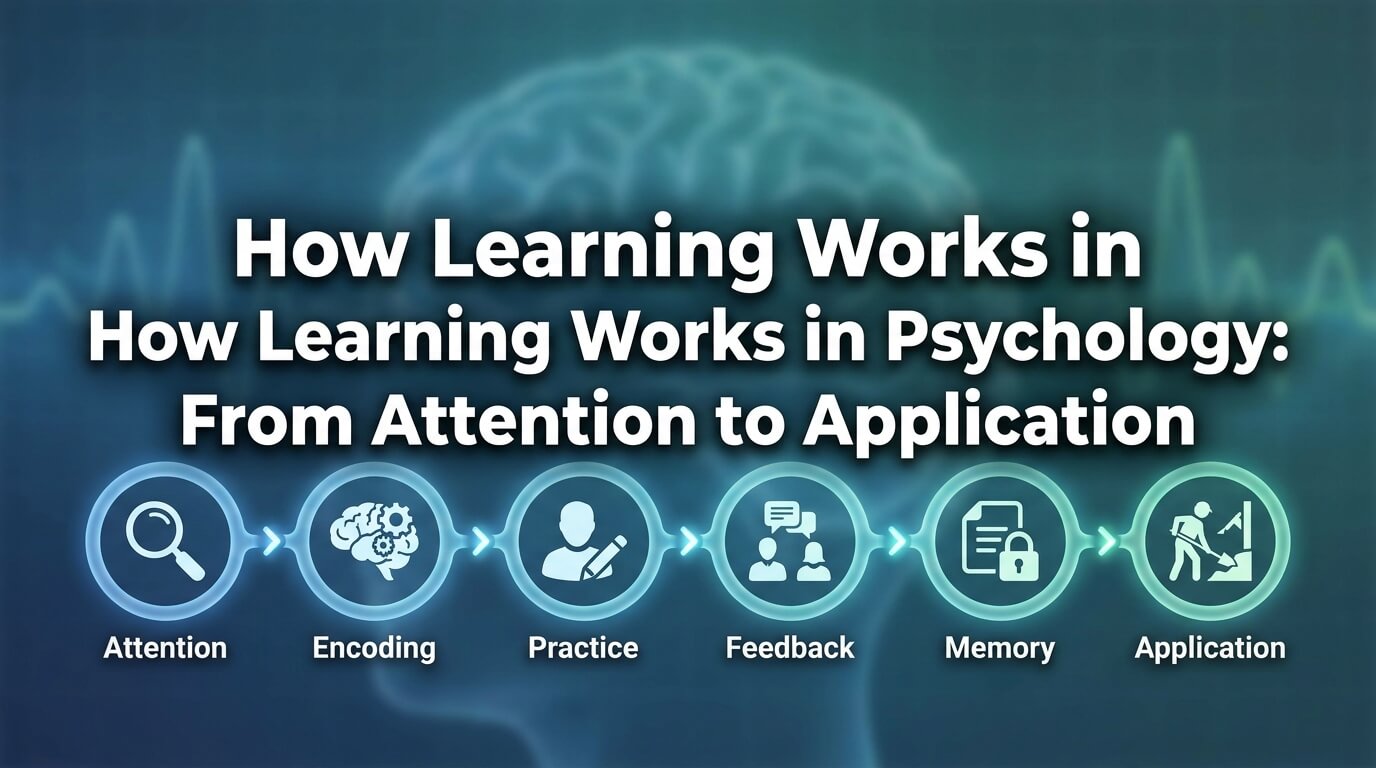
How learning works in psychology is best understood as a sequence: attention selects the experience, encoding gives it meaning, practice tests it, feedback corrects it, memory keeps it available, and application shows whether it can be used in real life. When learning is not sticking, the useful question is not only “Did I try hard enough?” It is also “Where did the chain break?”
Quick Answer

Learning begins before practice starts
Learning begins when attention selects something from experience and the mind starts organizing it into meaning. Practice matters, but practice is not the first step. If the learner does not notice the right cue, understand what the task requires, or connect the new information to something meaningful, later repetition may only repeat confusion.
The short version of the learning chain
The learning chain moves from attention to encoding, practice, feedback, memory, and application. Attention decides what enters awareness. Encoding organizes it. Practice creates repeated contact. Feedback shows what needs correction. Memory keeps the learning available later. Application reveals whether the learning works outside the original example.
The Learning Chain: Attention to Application

Attention selects what the mind can work with
Attention is the first filter. The mind receives far more information than it can process deeply, so it has to select. The APA Dictionary of Psychology defines attention as focused cognitive resources and readiness to respond to selected parts of the environment. In learning, that selection matters because the learner cannot organize, practice, or remember what they never properly noticed.
Two people can attend the same lesson and leave with different takeaways. One notices the main principle, another notices a small detail, and another misses both because the task feels overwhelming.
Good attention is not just intensity. It is direction. A learner benefits from knowing what to watch for: the pattern, the cue, the error, the next decision, or the difference between two options that look similar at first.
Meaning and encoding organize the experience
Once something is noticed, it still has to be organized. Encoding is the process of turning experience into a form that can be stored and used later. OpenStax explains memory through the linked processes of encoding, storage, and retrieval. For learning, encoding is where raw exposure becomes meaning.
If “use active recall” stays vague, it may not change much. When you connect it to a behavior, such as closing the book and explaining the idea from memory, the concept becomes usable.
Weak encoding often feels like, “I understood it at the time.” The lesson felt clear, but it was not organized enough to survive a new question, a delay, or a real task.
Practice gives the brain repeated contact with the problem
Practice gives learning repeated contact with reality. It lets the learner find out whether the idea can be used, not just recognized. Reading about public speaking is different from speaking aloud. Watching a cooking technique is different from controlling heat in your own pan. Knowing a grammar rule is different from choosing the right sentence under time pressure.
Practice is where friction appears. The explanation falls apart, the hand moves too slowly, or the habit returns under stress. This friction is often the first moment when learning becomes measurable.
Still, practice can strengthen the wrong thing if it is disconnected from correction. Repeating a mistake can make the mistake smoother. That is why practice and feedback belong together.
Feedback corrects the direction of learning
Feedback tells the learner what happened compared with what was intended. It can come from a teacher, coach, friend, test result, body sensation, task outcome, or the environment itself. A musician hears the wrong note. A writer sees that a paragraph is unclear. A person trying a new communication habit notices that their tone still sounded defensive.
Research on corrective feedback shows that feedback is not one simple ingredient. A review in PubMed Central on corrective feedback discusses how feedback can support learning, while also depending on factors such as timing, task difficulty, and learner characteristics. In daily life, that means feedback works best when it tells you what to adjust, not merely whether you are good or bad.
Useful feedback narrows the gap. “Try again” is vague. “Your answer has the right idea, but you skipped the reason why it works” gives the next attempt a direction.
Memory makes learning available later
Learning needs memory because the original lesson will not always be present. A person has learned more deeply when they can return to the idea later, retrieve it, and use it without the exact same prompt. Memory makes learning portable.
Retrieval is especially important. Trying to bring information back from memory can strengthen later retention. A review in PubMed on retrieval practice and long-term retention describes retrieval practice as a powerful way to improve long-term memory compared with only restudying. This is one reason active recall often beats passive review.
Memory also shows where learning is fragile. If you can recognize an answer when you see it but cannot produce it yourself, the learning may still depend heavily on cues. If you can explain it tomorrow in a different room, with no notes, it is more available.
Application proves whether learning can be used
Application is the final test of the chain. You do not only know the idea in the learning setting; you can use it when the setting changes. A student can solve a new problem. A manager can use a feedback principle in a tense conversation. A driver can respond to unusual traffic, not only repeat a calm practice route.
Application often exposes a gap between understanding and use. You may understand a concept calmly but fail to apply it when rushed, embarrassed, distracted, or under pressure. The learning may need more variation.
| Step | What it does | What can go wrong |
|---|---|---|
| Attention | Selects the cue or information | The learner notices the wrong thing or too much at once |
| Encoding | Turns experience into meaning | The lesson feels familiar but stays poorly organized |
| Practice | Tests the idea through action | The learner repeats without noticing errors |
| Feedback | Shows what needs correction | The feedback is too vague, late, harsh, or ignored |
| Memory | Keeps learning available later | The learner recognizes the idea but cannot retrieve it |
| Application | Uses learning in real situations | The skill works only in the original context |
Why Exposure Is Not the Same as Learning
Seeing information without processing it
Exposure means the information was present. Learning means the person changed in some relatively lasting way because of the experience. Those are not the same. You can scroll past advice, watch a tutorial, highlight a page, or hear a lecture without building a usable mental structure.
Processing requires more than contact. The learner has to select, connect, compare, test, and revise. Five videos may create recognition, but not organization.
Confusing familiarity with understanding
Familiarity is one of the easiest learning traps. When you reread something, the words feel smoother. When you watch the same demonstration again, the steps feel less surprising. That fluency can feel like understanding, even when you have not yet tried to use the information yourself.
A simple test is to remove the support. Can you explain it without looking? Can you solve a slightly different problem? Can you notice the mistake in a new example? If not, the feeling of familiarity may be stronger than the actual learning.
Why passive review feels easier than active use
Passive review is comfortable because it lowers the chance of failure. Active use is harder because it reveals gaps. Trying to retrieve, explain, write, solve, speak, perform, or teach forces the learner to discover what is missing.
This difficulty is not a reason to avoid active use. It is one of the reasons active use teaches. When you struggle to recall a step, choose between options, or correct an error, the mind has to work with the material instead of only receiving it.
The Role of Prior Knowledge

New information attaches to what you already know
Prior knowledge acts like a landing place for new learning. If you already know basic cooking, a new sauce technique makes sense faster. If you already understand simple statistics, a new research method has familiar parts. If you know nothing about a field, even basic terms may compete for attention.
The National Academies report How People Learn II notes that prior knowledge can support new learning, but it can also create bias when old assumptions guide attention too strongly. This is why “start with what you already know” is helpful, but “trust what you already assume” is not always safe.
Why beginners and experts notice different things
Beginners often notice surface features because they do not yet know which details matter. Experts notice structure. A beginner chess player may focus on a piece being threatened; an expert sees a position developing. A beginner writer may focus on grammar; an experienced editor may see unclear logic underneath correct sentences.
This difference is not magic. It comes from organized knowledge. Experts have mental categories that help them separate signal from noise. Beginners are not worse learners because they miss those patterns; they are still building the categories that make those patterns visible.
When old assumptions block new learning
Prior knowledge can also get in the way. If someone learned that being fast means being skilled, they may resist slowing down to practice correctly. If a learner believes mistakes mean they are not talented, feedback may feel like personal evidence rather than task information. If an employee learned an old workflow for years, a better system may feel wrong at first simply because it is unfamiliar.
Unlearning does not usually mean deleting the old lesson. It means noticing when an old rule no longer fits. A useful question is: “What am I assuming here that may have been useful before but is limiting now?”
Practice, Retrieval, and Error Correction

Why trying to recall changes learning
Trying to recall information forces the learner to rebuild access. That effort matters. It shows whether the information is actually available and strengthens the path back to it. This is different from looking at the answer and feeling that you know it.
For example, after reading a lesson, pause and write three points from memory. Then compare your answer with the original. The comparison will show what was clear, what was missing, and what was distorted. That small cycle is more revealing than simply reading the same paragraph again.
Why mistakes are information, not proof of failure
Mistakes can feel personal, especially when the learner cares about the outcome. But in the learning process, mistakes are data. They show where attention, encoding, practice, memory, or application needs adjustment.
A math mistake might show a weak concept, a rushed step, or poor recall of a formula. A communication mistake might show that the person understood the sentence but could not use it while emotionally activated. A sports mistake might show timing, balance, or decision-making under pressure. The same visible error can have different causes.
How correction turns weak understanding into stronger skill
Correction strengthens learning when it is specific enough to guide the next attempt. The learner needs to know what to keep, what to change, and what to test next. Without that, correction can become discouragement or guesswork.
A strong correction sounds more like “Your example is good, but it does not prove your main point yet” than “This is confusing.” In skill practice, it may sound like “Keep your wrist steady during this part” rather than “Do better.” The correction gives attention a new target.
Feedback Loops in Learning
Fast feedback vs delayed feedback
Fast feedback helps when the learner needs to connect an action with an immediate result. If your pronunciation is wrong, your form is unsafe, or your calculation has a repeated error, quick correction can prevent the wrong version from becoming practiced.
Delayed feedback can help when the learner needs to think independently first. A teacher, coach, or mentor may wait so the learner can attempt the problem, explain their reasoning, and notice a gap. The best timing depends on the task, the learner, and the kind of error.
Specific feedback vs vague praise
Vague praise feels pleasant, but it often teaches little. “Great job” may encourage effort, but it does not tell the learner which part worked. Specific feedback points to the behavior, strategy, or decision that mattered.
| Less helpful feedback | More useful feedback |
|---|---|
| You are smart. | Your example made the abstract idea easier to understand. |
| Try harder. | Slow down on the second step because that is where the error starts. |
| This is wrong. | The conclusion does not follow from the evidence yet. |
| Good work. | Your first attempt was rough, but your revision fixed the main gap. |
When feedback threatens identity and shuts learning down
Feedback becomes harder to use when it feels like a judgment of the self. A learner who hears “this answer is incomplete” may translate it into “I am not smart.” A person learning a new habit may hear “that did not work” as “I never change.” Once identity feels threatened, attention moves toward self-protection.
This is why the tone and framing of feedback matter. The learner still needs honest information, but honest information is easier to use when it points to the task, the strategy, or the next attempt. A useful internal sentence is: “This result is telling me what to adjust, not deciding who I am.”
From Understanding to Use
Why you can understand something but fail to apply it
Understanding often happens in a calm, supported setting. Application happens in a messier one. You may understand a negotiation principle while reading, then forget it when your heart rate rises. You may understand a language rule during a lesson, then miss it in a real conversation. You may understand time management, then lose the plan when the day becomes unpredictable.
This gap appears because use requires more than knowledge. It requires retrieval, timing, emotional regulation, context recognition, and often motor or social coordination. The lesson must be available when the situation asks for it.
The role of context and real examples
Context gives learning cues. If all practice happens in one format, room, app, or example type, the learner may depend on that context without realizing it.
Real examples add variation. Instead of asking only, “Can I repeat this?” ask, “Where else would this apply, and what would look different there?”
How varied practice prepares transfer
Varied practice means practicing across different examples, conditions, or problem types. It may feel less smooth at first because the learner has to keep adjusting. But that adjustment is part of the learning. It teaches the mind what stays the same and what changes.
For example, learning feedback by reading one script is narrow. Practicing how to give feedback to a friend, a coworker, a child, and yourself builds a wider pattern. Learning a math formula through one example is narrow. Using it across word problems, diagrams, and real measurements makes the idea more flexible.
Common Breakpoints in the Learning Process

Attention breaks before encoding
The first breakpoint is attention. The learner is present, but the mind is split, overloaded, bored, anxious, or unsure what matters. The lesson never becomes clear enough to organize.
Signs of this breakpoint include rereading without remembering, watching a demonstration but missing the key move, or feeling that everything seems equally important. The first fix is not more repetition. It is a clearer target for attention.
Memory breaks before retrieval
Sometimes the lesson made sense and was practiced, but it cannot be retrieved later. The learner recognizes it when shown the answer, yet cannot produce it independently. This suggests the memory is still cue-dependent.
A practical fix is to practice retrieval before looking. Try to explain, solve, write, or perform first, then check. This makes the missing parts visible and gives memory a reason to strengthen access.
Practice breaks before feedback
Another breakpoint happens when practice continues without correction. The learner is active, but the loop is open. They do not know whether the attempt is improving, drifting, or repeating the same error.
This can happen when someone studies alone, trains without a coach, repeats a habit without tracking outcomes, or receives only vague reactions. The fix is to add a feedback signal: a rubric, example answer, recording, test, mentor comment, measurement, or clear outcome.
Application breaks when the context changes
The final breakpoint appears when learning works only in the original setting. The person can do the textbook problem but not the real problem. They can explain the idea but not use it under pressure. They can perform well during practice but not when the audience, time limit, or stakes change.
The fix is not always more of the same practice. It is practice with variation. Change the example, the setting, the order, the time pressure, or the emotional conditions in a manageable way.
What to Do First When Learning Is Not Sticking
Identify the weakest link in the chain
Before adding more hours, diagnose the step that is failing. Ask one question at a time:
- Did I know what to pay attention to?
- Can I explain the idea in my own words?
- Have I practiced using it, not just reviewing it?
- Did I get feedback that tells me what to change?
- Can I retrieve it without looking?
- Can I apply it when the situation changes?
The answer points to the next action. If attention is weak, narrow the focus. If encoding is weak, create examples. If practice is weak, attempt the task. If feedback is missing, compare your attempt with a standard. If retrieval is weak, test yourself. If application is weak, vary the context.
Turn the next practice session into a feedback loop
A feedback loop has four parts: attempt, result, correction, next attempt. Keep it small enough to repeat. Instead of “learn Spanish for two hours,” try “describe one picture aloud, record it, notice three errors, correct them, and describe another picture.” Instead of “get better at writing,” try “write one introduction, compare it with a strong example, revise the opening sentence, and test whether the main point is clearer.”
The loop makes learning visible. It changes practice from time spent into information gained.
Use one real-world application as a test
Choose one low-risk situation where the learning should apply. Use the new concept in a meeting note, a conversation, a recipe, a workout, a study session, or a small decision. Then ask: “What worked here, what did not transfer, and what needs another round of practice?”
This prevents learning from staying trapped in preparation mode. The goal is not to perform perfectly. The goal is to discover how the lesson behaves when life adds friction.
Where to Go Deeper After You Understand the Process
Learning and memory
Learning and memory are closely connected, but they are not identical. Learning changes what you know or can do because of experience. Memory helps preserve and retrieve that change later. This distinction matters when someone remembers information but cannot use it, or when a lesson changes behavior even before the person can explain it clearly.
Feedback in everyday learning
Feedback deserves deeper attention because it can either sharpen learning or make the learner defensive, discouraged, or confused. Timing, specificity, tone, and trust all shape whether feedback becomes useful information or emotional noise.
Practice and skill building
Skill learning needs more than repetition. It involves deliberate attention, error correction, increasingly refined movement or judgment, and a shift from effortful control toward more automatic performance. The psychology of practice explains why some repeated effort leads to improvement while other effort only preserves old habits.
Transfer into real life
Transfer asks whether learning can move beyond the original lesson. This is where many people struggle. They understand something in one situation but cannot apply it in another. Transfer improves when practice includes variation, examples, and real conditions instead of only identical drills.
FAQ About How Learning Works
Why do I forget something I just learned?
You may have forgotten it because the information was never encoded deeply, because it was not retrieved soon enough, or because the original learning depended too much on cues that are no longer present. Forgetting does not always mean you learned nothing. It often means the memory is weak, poorly organized, or hard to access without support.
Is repetition enough to learn?
Repetition helps when it gives the learner useful contact with the material. But repetition alone can repeat confusion, strengthen a bad habit, or create familiarity without understanding. Repetition becomes more powerful when it includes attention, retrieval, feedback, and correction.
Why do I understand a lesson but fail the task?
You may understand the explanation but lack practice applying it under task conditions. The task may require timing, retrieval, decision-making, or emotional steadiness that the lesson did not fully train. This is common when learning moves from a clear example to a real situation.
What is the role of feedback in learning?
Feedback shows the gap between the intended result and the actual result. It helps the learner decide what to keep, change, or practice next. Feedback is most useful when it is specific, understandable, and connected to another attempt.
How long does learning take?
Learning time depends on the skill, the learner’s prior knowledge, the quality of practice, the feedback available, and the level of application required. A simple fact may be learned quickly. A flexible skill may require many rounds of practice across different situations.
Key Takeaways
- Learning is a chain, not a single moment of exposure.
- Attention decides what the mind can process, while encoding turns experience into usable meaning.
- Practice is most effective when it includes feedback and correction.
- Retrieval helps reveal whether learning is available without the original support.
- Application shows whether learning can survive real-world variation.
- When learning is not sticking, identify the weakest step before adding more effort.
Final Thoughts
When learning feels slow, it is tempting to blame motivation or intelligence first. Sometimes effort does need to increase, but often the better move is to inspect the process. Maybe attention is scattered. Maybe the idea was never encoded clearly. Maybe practice is active but feedback is missing. Maybe memory has not been tested. Maybe the skill works only in one context.
Choose one thing you are trying to learn and run it through the chain: attention, encoding, practice, feedback, memory, and application. The weakest link gives you your next step. If learning difficulties are persistent, intense, or interfering with school, work, or daily life, it may also be worth seeking educational or professional support. That support does not mean you failed. It may help you find the part of the process that needs a better strategy.

Michael Reed is the Founder and Lead Writer at Psychology Exposed. He writes about human behavior, relationships, emotional patterns, self-awareness, and practical psychology topics using research-informed, easy-to-understand content.
Read More About Michael Reed: https://psychologyexposed.com/michael-reed/