
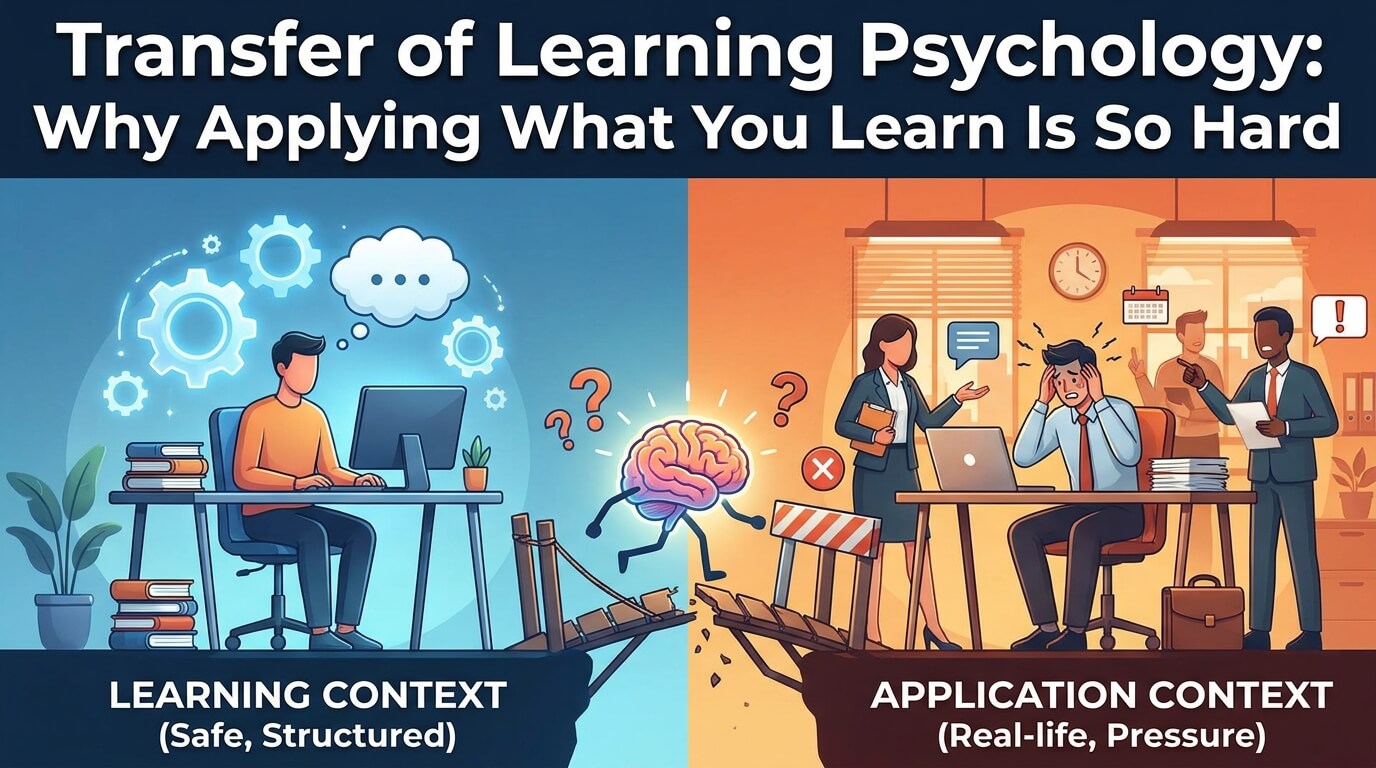
You can understand something clearly in one place and still lose it when life changes the setting. A student may know the material at home but freeze during the test. A new manager may practice a feedback conversation in training but avoid it with a real employee. A person may rehearse a calm response alone, then forget every word during conflict. The problem is not always memory. It is often transfer.
This is one part of a larger question in learning psychology: how experience changes what people notice, remember, expect, and do next.
Transfer of learning is the ability to use knowledge, skills, or strategies beyond the original situation where they were learned. The APA Dictionary describes learning as the acquisition of new information, behaviors, or abilities after practice, observation, or other experiences. Transfer asks a harder question: can that learning still work when the cues, pressure, people, timing, or task demands change?
Quick Answer

Transfer means using learning beyond the original practice setting
Transfer of learning means applying something you learned in one context to another context. It may be easy when the new situation is similar to the practice situation, and much harder when the surface details change. Good transfer depends on understanding the principle behind the skill, practicing under varied conditions, noticing useful cues, and getting feedback after real attempts.
When learning does not stick, it often helps to look at the full chain: attention, meaning, practice, feedback, memory, and application.
Why understanding something does not guarantee application
Understanding can remain tied to the place, format, mood, or example where it first made sense. You may recognize an idea when it appears in a lesson but miss it when it appears in a meeting, conflict, exam, or daily routine. Application requires flexible access, not just recognition. The mind has to notice that the new situation is asking for the old learning.
What Transfer of Learning Means
Learning in one context
Learning usually begins inside a setting. You read a chapter at a desk, watch a tutorial on your phone, practice a speech in an empty room, or role-play a work conversation in a workshop. That setting provides cues. The page layout, teacher, examples, mood, order of steps, and immediate reminders all help the learning feel available.
Applying in another context
Application asks the learner to recognize the same useful idea under different surface details. A math problem may use different numbers. A job task may involve a difficult customer instead of a clean training example. A health habit may need to happen in a busy week, not during a quiet planning session.
The National Academies chapter on learning and transfer notes that context can affect whether people use what they learned in another setting. In plain language, the mind may not automatically carry learning from “there” to “here.” Transfer has to be supported.
Why transfer is the test of usable learning
A person can pass a short review, repeat a definition, or follow a step-by-step example without being ready to use the idea flexibly. Transfer reveals whether the learning is connected to a deeper principle, or only to the original format.
Near Transfer and Far Transfer

Near transfer: similar situations and familiar cues
Near transfer happens when the new situation is close to the original practice setting. If you practice a specific spreadsheet formula and then use it on a similar spreadsheet, that is near transfer. If you learn a customer support script and use it with a similar customer question, that is near transfer. The surface cues are familiar, so the mind can see the connection more easily.
Far transfer: different situations with deeper similarities
Far transfer happens when the new situation looks different from the practice setting, but the underlying principle is related. A person who learns to give clear feedback at work may use the same principle to talk to a roommate. A student who learns how evidence supports a claim in history may apply the same reasoning to a science article. A person who learns to pause before reacting in one relationship may use that pause in another stressful conversation.
Far transfer is harder because the similarity is deeper, not obvious. The new situation may not announce which skill is relevant. The learner has to detect the pattern beneath the surface. Research on transfer often treats far transfer carefully because broad claims can be overstated. For example, a Frontiers review of music training and cognitive abilities explains that transfer effects can be debated and depend on how near or far the new task is from the trained one.
Why far transfer usually needs more deliberate support
| Type of transfer | What changes | Everyday example | What helps |
|---|---|---|---|
| Near transfer | The new situation is very similar. | Using a practiced formula on a similar problem. | Repeated practice with small variations. |
| Far transfer | The new situation looks different but has a shared principle. | Using conflict-pausing skills from coaching during a real argument. | Principle naming, varied examples, and reflection. |
| Weak transfer | The learner remembers the lesson but misses when to use it. | Knowing a study strategy but not using it before an exam. | Cues, planning, and realistic rehearsal. |
| Negative transfer | Old learning interferes with the new task. | Using habits from one software tool that do not work in another. | Spot the mismatch and practice the changed rule. |
Why Learning Often Does Not Transfer

Practice was too narrow
Transfer becomes harder when practice repeats one clean version of the task. A student may solve ten nearly identical examples and feel confident, then struggle when the problem wording changes. A speaker may rehearse only from the top of the script, then freeze when interrupted. A person may practice a boundary sentence alone, then forget it when another person reacts emotionally.
Narrow practice can build familiarity without flexibility. The learner gets better at the practice format, not necessarily at the real-world skill. This is why variation matters. Changing one part of the task at a time teaches the mind which parts are essential and which parts are surface details.
Cues were tied to the original context
Sometimes learning depends too much on cues that will not be present later. You may remember a concept because it was on the left side of a page, next to a certain diagram, or explained by a certain teacher. You may perform well in practice because someone tells you which step comes next. When those cues disappear, the skill feels less available.
Transfer-friendly learning builds cues that travel with you. Instead of depending only on the worksheet, the learner may use a short question: “What is the underlying principle?” Instead of depending on a coach’s prompt, they may use a body cue: “When my voice gets tight, slow down before responding.” Portable cues help learning survive outside the original setting.
The learner memorized steps without understanding principles
Step memory can be useful, but it is fragile when the situation changes. If you only remember the exact script, a different response may throw you off. If you only remember the procedure, a new version of the task may feel like a different problem. Principles make transfer easier because they tell you why the step matters.
For example, the deeper principle behind a communication script may be “name the impact without attacking the person.” The exact words can change. The deeper principle behind a study method may be “practice retrieving the idea without looking.” The format can change. The deeper principle gives the learner a stable center.
Stress or pressure changed the task demands
Many skills are easier in quiet practice than under pressure. A student may recall material in a calm room but struggle during a timed exam. A person may plan a calm sentence but become flooded when the other person raises their voice. An employee may know the process but hesitate when a supervisor is watching.
Context Matters More Than People Expect
Same skill, different setting
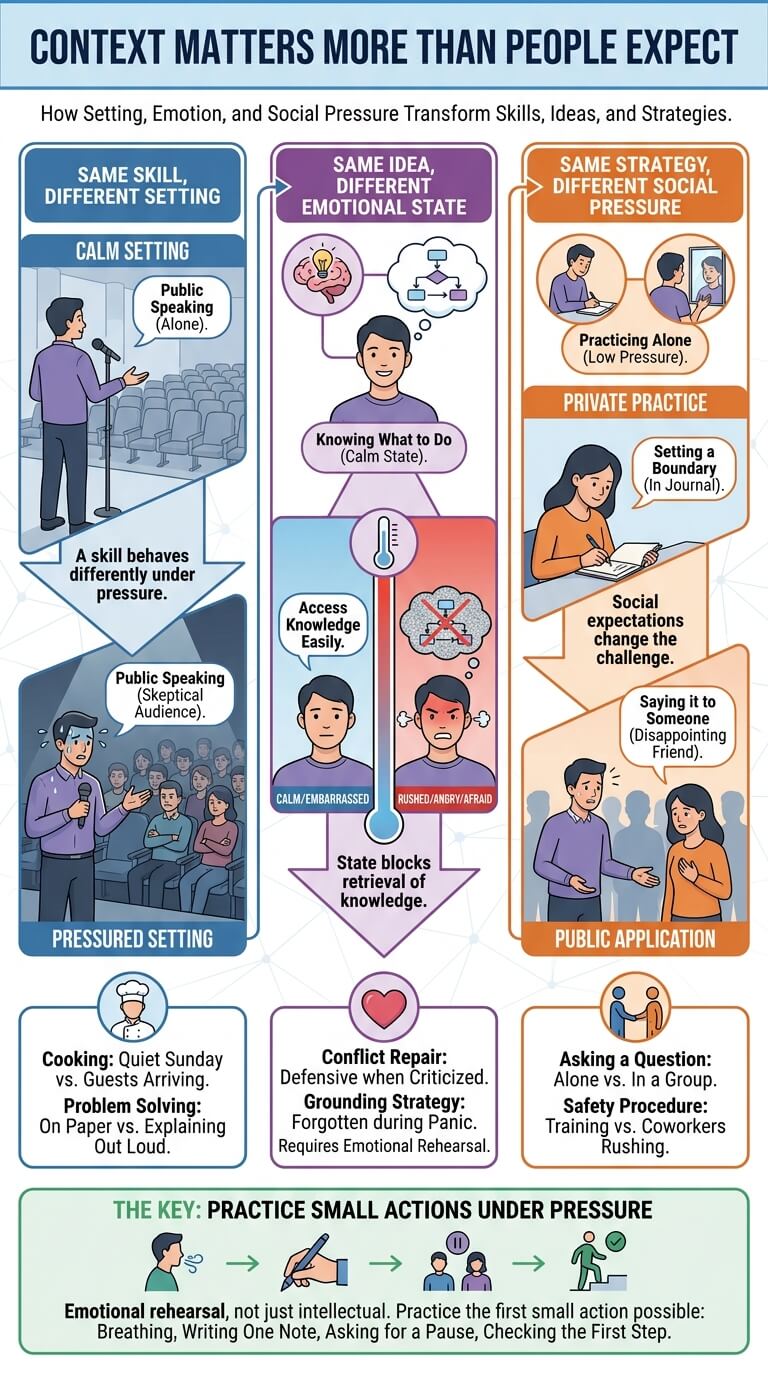
A skill can behave differently when the setting changes. Public speaking in an empty room is not the same as speaking to a skeptical audience. Cooking a recipe on a quiet Sunday is not the same as cooking it while guests arrive. Solving a problem on paper is not the same as explaining your reasoning out loud.
Same idea, different emotional state
Emotional state can act like a context. You may know what to do when calm but lose access when embarrassed, rushed, angry, or afraid. A person who understands conflict repair may still become defensive when criticized. A person who knows a grounding strategy may forget it during panic-like pressure. The knowledge exists, but the state makes retrieval harder.
This is why transfer often needs emotional rehearsal, not only intellectual rehearsal. A learner may need to practice the first small action that is possible under pressure: breathing before answering, writing one note before a test, asking for a pause, or checking the first step instead of trying to remember everything.
Same strategy, different social pressure
Social pressure changes learning too. It is one thing to practice asking a question alone. It is another to ask it in front of a group. It is one thing to set a boundary in a journal. It is another to say it to someone who may feel disappointed. It is one thing to learn a safety procedure in training. It is another to use it when coworkers are rushing.
Examples of Transfer Problems
Remembering material at home but freezing on the test
At home, the learner may have notes, quiet, familiar examples, and no clock. During the test, the cues change. The question wording may be unfamiliar. Time pressure may increase self-monitoring. The learner may remember recognizing the material but struggle to retrieve it without the original cues.
What helps is practicing retrieval under conditions closer to the test: closed notes, mixed questions, timed attempts, and brief review after errors. The goal is not to create panic. It is to make the practice environment less different from the performance environment.
Practicing communication alone but forgetting in conflict
Communication skills often fail to transfer because conflict adds emotional pressure. A sentence that seemed clear in a notebook may feel impossible when someone interrupts, dismisses the issue, or responds with hurt. The person may fall back into old habits: overexplaining, withdrawing, attacking, apologizing too quickly, or going silent.
Transfer improves when the practice includes the first ten seconds of the real situation. Instead of rehearsing a perfect conversation, practice the opening line, the pause after a reaction, and the repair if the first attempt comes out clumsy. Real transfer often begins with a small recoverable move, not a flawless script.
Learning a work process in training but failing on the job
Training often teaches clean steps. Real work adds interruptions, unclear requests, shifting priorities, and imperfect tools. A person may know the process but miss when to use it, skip a step under pressure, or rely on a shortcut that worked in another system.
Knowing health advice but not using it in daily routines
Health learning often fails at the point of routine. A person may understand nutrition, sleep, movement, or stress advice but not use it when tired, busy, traveling, or emotionally drained. The knowledge is not the problem. The transfer setting is different from the learning setting.
What helps is building the behavior into real cues: placing walking shoes near the door, preparing a simple food option, setting a specific wind-down time, or choosing a smaller version of the habit for difficult days. Transfer improves when the desired action has a place to land.
What Helps Learning Transfer
Practice in varied contexts
Varied practice teaches the mind what changes and what stays the same. If you are studying, mix problem types instead of doing only one type at a time. If you are learning a skill, practice it in slightly different settings. If you are learning a communication habit, rehearse it with different wording and different possible responses.
Variation should be controlled at first. Change one variable, not everything. Practice the same idea with a new example, a new order, a new person, or a small amount of time pressure. The learner needs enough difference to build flexibility, but not so much difference that the task becomes overwhelming.
Explain the principle behind the step
Before transfer can happen, the learner has to know what is meant to travel. A step may be tied to one example, but a principle can move. After practicing, ask: “What is the rule here?” “What problem does this step solve?” “When would I use this again?” “What would look different but still need the same idea?”
This turns practice into understanding. The learner is no longer only copying a sequence. They are building a reason for the sequence.
Use retrieval in realistic conditions
Retrieval means bringing learning back without the answer in front of you. For transfer, retrieval should become more realistic over time. A student can move from flashcards to mixed problems. A musician can move from slow practice to performance tempo. A person practicing a difficult conversation can move from reading a sentence to saying it out loud while feeling mild discomfort.
A study in PubMed Central on deliberate errors found that correcting errors can support concept learning and far transfer in certain learning conditions. The broader practical lesson is careful: mistakes can become useful when learners receive correction and understand why the first answer did not work.
Get feedback after real attempts
Feedback after real application is different from feedback during practice. It shows what broke when the situation changed. Did you miss the cue? Did the old habit take over? Did the wording work in practice but not with a real person? Did the task require a principle you had not fully understood?
The most useful feedback is not only “right” or “wrong.” It identifies the transfer problem. Was the issue recognition, recall, timing, confidence, context, emotion, or missing background knowledge? Each problem needs a different adjustment.
Build cues that travel with you
A portable cue is a short reminder that can work in more than one setting. For studying, it may be “close the notes and explain.” For conflict, it may be “slow down before defending.” For work, it may be “check the exception before submitting.” For health behavior, it may be “make the next step visible.”
Transfer vs Memory
Remembering is access
Memory helps you access information, examples, steps, and experiences. If you cannot remember a concept at all, transfer becomes difficult. But memory by itself is not the same as transfer. You can remember a definition and still not see how it applies to a new problem.
Memory says, “Can I bring it back?” Transfer asks, “Can I use it here?” Both matter, but they are not identical.
A person can remember information without being ready to use it, which is why the difference between learning and memory matters.
Transfer is flexible use
Transfer requires flexibility. The learner has to adjust the learning to the current situation without losing the core idea. A memorized script may fail if the other person responds differently. A memorized formula may fail if the problem is disguised. A memorized safety step may fail if the environment is messy.
Flexible use grows when learners compare examples, explain principles, practice variations, and review real attempts. It is less about holding the old lesson perfectly and more about recognizing what part of the old lesson matters now.
Why recall can be strong but application weak
Recall can be strong when cues are familiar. Application can still be weak when cues change. This is why someone can ace a review quiz and struggle on a problem that looks different. It is also why people can give wise advice when calm but forget it when personally triggered.
If this happens, do not only ask, “Do I know it?” Ask, “Where does it need to work?” Then practice closer to that place.
Transfer vs Practice and Skill Acquisition
Practice builds the skill
Practice makes a skill more stable. Repetition, correction, and gradual difficulty help the learner move from clumsy effort to smoother performance. Without practice, transfer usually has little to work with.
But practice can be narrow or broad. If practice only prepares you for one exact version of the task, the skill may look strong in practice but weak in life.
Transfer tests the skill in a new situation
Transfer shows whether the skill can survive change. Can you use the idea with different examples? Can you use the skill when someone interrupts? Can you remember the step when the layout is different? Can you act on the habit when tired?
Why varied practice sits between them
Varied practice is the bridge between skill-building and transfer. It keeps the learner close enough to the skill to improve, but different enough to build flexibility. That may mean changing examples, timing, emotional conditions, people, setting, or order of steps.
| Learning goal | Practice question | Transfer question |
|---|---|---|
| Understand a concept | Can I explain it in my own words? | Can I recognize it in a new example? |
| Build a skill | Can I perform the step correctly? | Can I adjust the step when conditions change? |
| Use a strategy | Can I follow the strategy during practice? | Can I remember when to use it in real life? |
| Change a habit | Can I do the behavior when planned? | Can I do a smaller version when the day is messy? |
How to Design a Transfer-Friendly Practice Session
Start with one real context
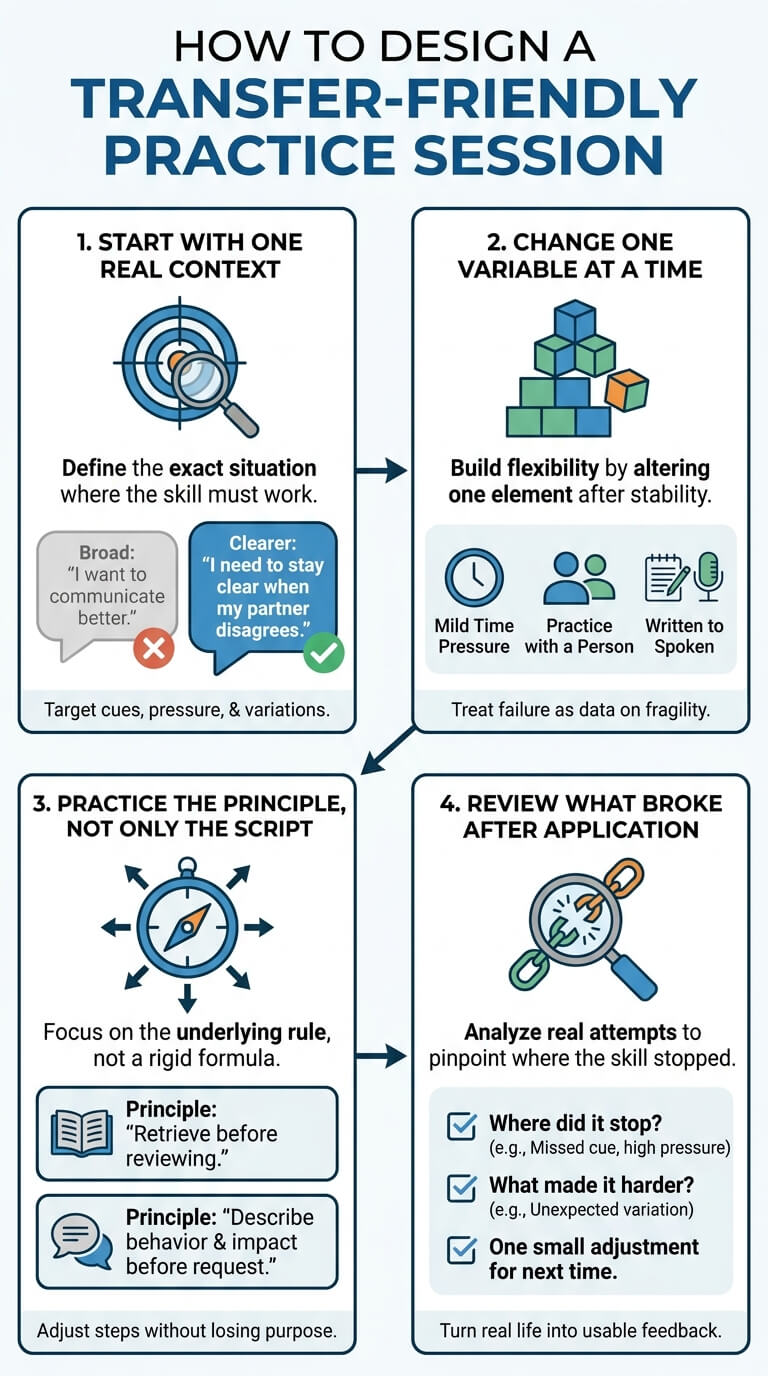
Begin by naming where the learning actually needs to work. “I want to understand this chapter” is useful, but “I need to solve mixed exam questions without notes” is clearer. “I want to communicate better” is broad, but “I need to stay clear when my partner disagrees” is more transferable.
The real context gives practice a target. It tells you what cues, pressure, and variations to include later.
Change one variable at a time
After the basic version is stable, change one part of the practice. Use a different example. Add mild time pressure. Change the order. Practice with a person instead of alone. Move from written notes to spoken explanation. The point is to teach flexibility without creating chaos.
If the practice falls apart, do not treat that as proof of failure. Treat it as data. The variable you changed revealed where the learning is still too fragile.
Practice the principle, not only the script
Scripts, formulas, and steps are useful, but they should not become cages. After each practice attempt, name the principle. For a feedback conversation, the principle may be “describe the behavior and impact before making a request.” For studying, it may be “retrieve before reviewing.” For performance, it may be “return attention to the next cue after a mistake.”
When you know the principle, you can adjust the words or steps without losing the purpose.
Review what broke after application
The most important transfer question after a real attempt is not “Did I succeed perfectly?” It is “Where did the skill stop traveling?” Maybe you did not notice the cue. Maybe you remembered too late. Maybe the emotional pressure was higher than expected. Maybe the real task required a variation you had not practiced.
A short review turns real life into usable feedback. Write one sentence about what happened, one sentence about what made it harder, and one small adjustment for next time. This keeps transfer practical.
When Application Breaks Down Under Pressure
Normal pressure can reduce flexibility
Pressure can make people fall back on familiar habits. This is common in exams, performance settings, conflict, public speaking, and high-stakes work. The mind may choose the fastest known response, even if a newer skill would be better.
When this happens, start smaller. Practice the first recoverable action. Open the notes and write one remembered idea. In conflict, say, “I need a minute so I can answer better.” At work, check the next required step instead of trying to remember the whole process. Small actions can reopen access to learning.
Severe distress may need more than practice
If you repeatedly cannot use skills because of panic, trauma reminders, intense shame, dissociation-like numbness, or fear of another person’s reaction, the issue may not be only learning design. It may be worth getting support from a qualified mental health, educational, or medical professional. If a relationship includes threats, coercion, stalking, humiliation, or retaliation, safety matters more than practicing better communication.
Learning advice should not be used to pressure someone to stay in an unsafe situation or blame themselves for freezing. Sometimes the healthiest next step is support, protection, or a safer environment.
FAQ About Transfer of Learning
What is transfer of learning in psychology?
Transfer of learning is the use of knowledge, skills, or strategies from one situation in another situation. It is why a lesson learned in class may help with a work task, why a practiced communication skill may help in a real conversation, or why a training exercise may improve performance outside training. Transfer is strongest when the learner understands the principle and practices in more than one context.
What is the difference between near and far transfer?
Near transfer happens when the new situation is similar to the practice situation. Far transfer happens when the new situation looks different but shares a deeper principle. Near transfer is usually easier because the cues are familiar. Far transfer often requires more support, such as comparing examples, naming the principle, and practicing under varied conditions.
Why can I remember something but not use it?
Remembering means you can access information. Using it means you can recognize when and how it applies. You may remember a rule, script, or strategy but miss the cue in real life, especially when the situation looks different or feels stressful. To improve application, practice retrieving the idea in conditions closer to where you need it.
How do I practice for real-life application?
Start by naming the real setting where the learning needs to work. Then practice the skill with small variations: different examples, mixed questions, time limits, social pressure, or realistic interruptions. After each attempt, review what broke. Did you forget the cue, misunderstand the principle, feel too much pressure, or need a smaller first step?
Can emotional pressure block transfer?
Yes. Emotional pressure can make newer learning harder to access and older habits more likely to appear. This can happen during exams, conflict, performance, public speaking, or high-stakes work. Gentle exposure to realistic conditions can help, but severe distress, panic, trauma reminders, or unsafe relationship dynamics may need additional support.
Key Takeaways
- Transfer of learning means using knowledge or skill outside the original learning setting.
- Near transfer is easier because the new situation is similar; far transfer is harder because the similarity is deeper and less obvious.
- Learning often fails to transfer when practice is too narrow, cues are tied to one setting, or the learner memorizes steps without understanding principles.
- Real-life pressure can make useful learning harder to access, so practice should gradually include realistic conditions.
- Varied practice, retrieval, feedback after real attempts, and portable cues make learning more flexible.
- If pressure, fear, panic, or unsafe dynamics block application, support and safety matter more than forcing more practice.
Final Thoughts
If you know something but cannot use it when the situation changes, do not assume the learning was useless. Ask a more precise question: where does this need to work, and what changes when I get there? Then practice one step closer to that real setting. Transfer grows when learning is given room to travel.

Michael Reed is the Founder and Lead Writer at Psychology Exposed. He writes about human behavior, relationships, emotional patterns, self-awareness, and practical psychology topics using research-informed, easy-to-understand content.
Read More About Michael Reed: https://psychologyexposed.com/michael-reed/