

People often talk about learning as if it means studying, memorizing, or being taught. In psychology, learning is broader than that. You can learn from a repeated sound, a consequence, a person you admire, a mistake, a pattern you never consciously noticed, or an experience that finally makes an idea feel real.
Different types of learning in psychology help answer, “How did this change happen?” Did two things become associated? Did an action lead to a result? Did you watch someone else? Did you build a mental model? Did repeated experience quietly train your expectations?
This is one part of a larger question in learning psychology: how experience changes what people notice, remember, expect, and do next.
This guide gives you a practical map of the major learning types without turning every example into reward and punishment. Behavior matters, but learning also includes attention, meaning, memory, emotion, social context, practice, and reflection.
When learning does not stick, it often helps to look at the full chain: attention, meaning, practice, feedback, memory, and application.
Quick Answer

The main types of learning in psychology include classical conditioning, operant conditioning, observational learning, social learning, cognitive learning, implicit learning, and experiential learning. They overlap in real life. One person may learn an emotional association, repeat a behavior because of consequences, copy a model, build a mental shortcut, and improve through experience in the same situation.
The main types in one simple map
| Learning type | Simple meaning | Everyday example |
|---|---|---|
| Classical conditioning | Learning through association | A notification sound starts to create tension because it has often arrived before stressful messages. |
| Operant conditioning | Learning through consequences | You check an app more often because it sometimes gives you a rewarding update. |
| Observational learning | Learning by watching a model | You learn how to use a tool by watching someone demonstrate it. |
| Social learning | Learning shaped by models, norms, status, and social reward | A team member copies the speaking style that gets approval in meetings. |
| Cognitive learning | Learning through thinking, interpretation, and mental structure | You understand a problem after seeing the pattern behind it. |
| Implicit learning | Learning patterns without fully knowing what you learned | You sense when a sentence sounds wrong in your first language, even if you cannot explain the grammar rule. |
| Experiential learning | Learning from doing, reflecting, and adjusting | You become better at cooking because you notice what happened, change your method, and try again. |
Why one experience can involve more than one type of learning
Real life is rarely clean enough to fit one category. Imagine learning to drive. You associate a warning beep with danger, which is classical conditioning. You stop speeding after receiving a ticket, which is consequence-based learning. You copy how an experienced driver checks mirrors, which is observational learning. You build a mental map of traffic flow, which is cognitive learning. You start sensing road rhythm without naming every cue, which is implicit learning.
The categories are useful because they show different mechanisms. They are not boxes life must obey.
What Counts as a Type of Learning?
The APA Dictionary of Psychology describes learning as the acquisition of new information, behavior, or abilities after practice, observation, or other experience. That definition matters because it does not limit learning to school or memorization. A person can learn a fact, a fear, a habit, a skill, a social rule, or an expectation.
Learning by association
Association means the mind connects one thing with another. A smell reminds you of a childhood kitchen. A tone of voice makes your body tense because you heard it before criticism. A place feels safe because good experiences happened there. The learning is not always deliberate. The mind notices patterns and prepares for what usually comes next.
This kind of learning is especially important for emotional and bodily responses.
Learning by consequence
Consequences shape what people are more or less likely to do again. If speaking up brings respect, a person may speak up more. If asking questions leads to embarrassment, they may stop asking. If procrastination brings temporary relief, the behavior can become stronger even when it creates later stress.
Consequences are not only formal rewards or punishments. Relief, attention, approval, avoidance, comfort, embarrassment, and social belonging can all teach behavior.
Learning by observation
Observation teaches without direct trial and error. People watch what others do, what happens afterward, and whether the behavior seems useful, admired, safe, or punished. This is one reason children, employees, athletes, creators, and peers learn so much from examples.
Watching does not guarantee copying. A person must notice the behavior, remember it, be able to reproduce it, and have some reason to use it.
Learning by thinking, meaning, and experience
Some learning happens when people make sense of information. They compare, categorize, test assumptions, reflect, and form mental models. A person may not change visible behavior immediately, yet their understanding has changed.
Experience also matters, but not all experience automatically becomes learning. Repeating the same mistake without reflection can strengthen the wrong habit. Experience becomes more useful when the person notices what happened, receives feedback, and adjusts.
Classical Conditioning

Classical conditioning is learning by association. It explains how a once-neutral cue can start to trigger a response after being paired with something meaningful. In the classic learning chapter from OpenStax, classical conditioning is explained through associations between stimuli, where one cue comes to signal another.
How association creates expectation
At first, a cue may mean nothing. Then it repeatedly appears before something important. Over time, the cue starts to carry expectation. Your body may respond before the actual event happens because it has learned what usually follows.
This is not the same as choosing to believe something. Classical conditioning can be quick, bodily, and emotional. The nervous system learns patterns that help it prepare.
Everyday examples of emotional and bodily learning
| Situation | Learned association | Possible response |
|---|---|---|
| A dentist drill sound repeatedly appears before discomfort. | The sound predicts pain or tension. | The body tightens before treatment begins. |
| A song played during a joyful season. | The song connects with warmth and belonging. | The person feels nostalgic when hearing it later. |
| A certain ringtone often comes before urgent work demands. | The ringtone predicts pressure. | The person feels anxious when the phone rings. |
| A specific smell appears in a calm, safe place. | The smell connects with comfort. | The person feels settled when smelling it again. |
What classical conditioning does not explain well
Classical conditioning is strong for explaining automatic associations, but it does not explain every kind of learning. It does not fully explain planning, creativity, moral reasoning, skill development, or why someone imitates a person they admire. It also does not explain why a behavior increases because it got a useful result. For those questions, other learning types are more helpful.
Operant Conditioning

Operant conditioning explains how behavior changes because of consequences. If a behavior is followed by something rewarding, useful, relieving, or socially successful, it may happen more often. If it is followed by something unpleasant or ineffective, it may happen less often.
How consequences shape future behavior
OpenStax describes operant conditioning as learning in which consequences influence behavior. The key question is not only “What happened?” but “What happened after the action?”
For example, a child who receives attention after interrupting may interrupt more, even if the attention includes irritation. A worker who receives silence after sharing ideas may stop contributing. A student who gets relief by avoiding a hard assignment may avoid sooner next time. The consequence teaches the behavior what to expect.
Reinforcement, punishment, and repetition in brief
| Term | Simple meaning | Example |
|---|---|---|
| Positive reinforcement | Adding something that increases behavior | Praise makes someone more likely to try again. |
| Negative reinforcement | Removing something unpleasant in a way that increases behavior | Avoiding a task reduces discomfort, so avoidance grows. |
| Positive punishment | Adding something unpleasant to reduce behavior | A penalty makes a behavior less likely. |
| Negative punishment | Removing something valued to reduce behavior | Losing access to a privilege reduces a behavior. |
The terms positive and negative do not mean good and bad here. They mean adding or removing something. The emotional effect depends on the situation.
Why operant learning is broader than reward charts
Operant learning happens outside classrooms, parenting plans, and training programs. People learn from relief, timing, friction, social approval, embarrassment, convenience, and identity. If a behavior works in the short term, it can become stronger even when it creates long-term problems.
That is why habits can be hard to change. The behavior may be serving a function, such as avoiding discomfort, gaining certainty, feeling in control, or receiving connection.
Observational Learning
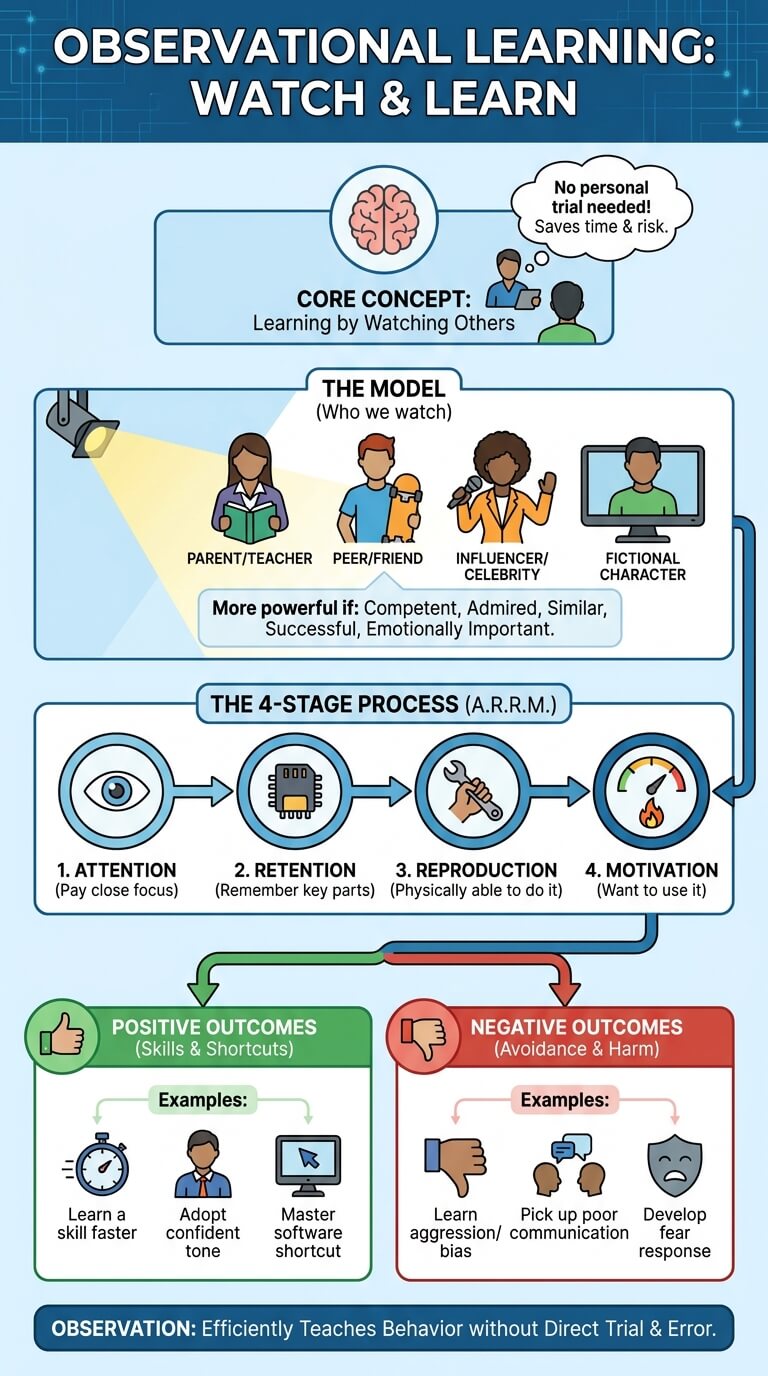
Observational learning means learning by watching someone else. It matters because humans do not have to personally test every action to learn from it. We can see what others do, notice the result, and carry that information into our own choices.
Learning by watching a model
OpenStax explains that in observational learning, people learn by watching and modeling others. The model might be a parent, peer, teacher, manager, athlete, influencer, sibling, fictional character, or stranger.
Models are especially powerful when they seem competent, admired, similar to us, emotionally important, or successful. A teenager may copy a friend’s confidence. A new employee may copy how experienced coworkers handle meetings. A beginner may learn a skill faster by watching the exact movement before trying it.
Attention, retention, reproduction, and motivation
Four conditions make observational learning more likely. First, the person must pay attention. Second, they must retain the important parts. Third, they must be able to reproduce the behavior. Fourth, they need motivation to use it.
This explains why watching a tutorial is not always enough. You may understand what the expert did but still need practice to reproduce it.
Why observation can teach behavior without direct trial and error
Observation saves time and risk. You can learn not to touch a hot pan by seeing someone else react. You can learn what tone works in a meeting by watching how people respond. You can learn a shortcut in software because another person demonstrates it.
This kind of learning is not always positive. People can also learn avoidance, aggression, bias, fear, or poor communication by watching those patterns work for someone else.
Social Learning
Social learning is closely related to observational learning, but it puts more attention on the social environment. People do not only watch behavior. They also notice status, approval, belonging, group rules, identity, and whether others are rewarded or rejected.
How social context changes what people imitate
A person may see many behaviors but imitate only the ones that seem valued. A student may copy the confident classmate who gets respect. A worker may copy the manager’s communication style because it signals authority. A child may copy the sibling who gets laughter from the family.
Social context tells people what is safe, admired, embarrassing, normal, or powerful. That context can shape learning even when no one gives a formal lesson.
Role models, norms, status, and vicarious reinforcement
Vicarious reinforcement means seeing someone else receive a consequence and learning from that result. If a person is praised for speaking up, others may become more willing to speak. If someone is mocked for asking for help, others may learn to stay quiet.
Role models also carry symbolic meaning. People may imitate someone not only because the behavior worked, but because they want to belong to the same group, become similar to that person, or avoid social exclusion.
How this differs from everyday observational learning
| Question | Observational learning | Social learning |
|---|---|---|
| Main focus | What did the person watch and model? | How did the social world make that behavior attractive, safe, or costly? |
| Common example | Learning a cooking technique from a video. | Adopting the style of creators who gain attention and status. |
| Important factor | Attention, memory, ability, motivation. | Norms, identity, approval, status, and social consequences. |
Observational learning asks how watching teaches. Social learning asks how people, groups, and rewards shape what gets copied.
Cognitive Learning
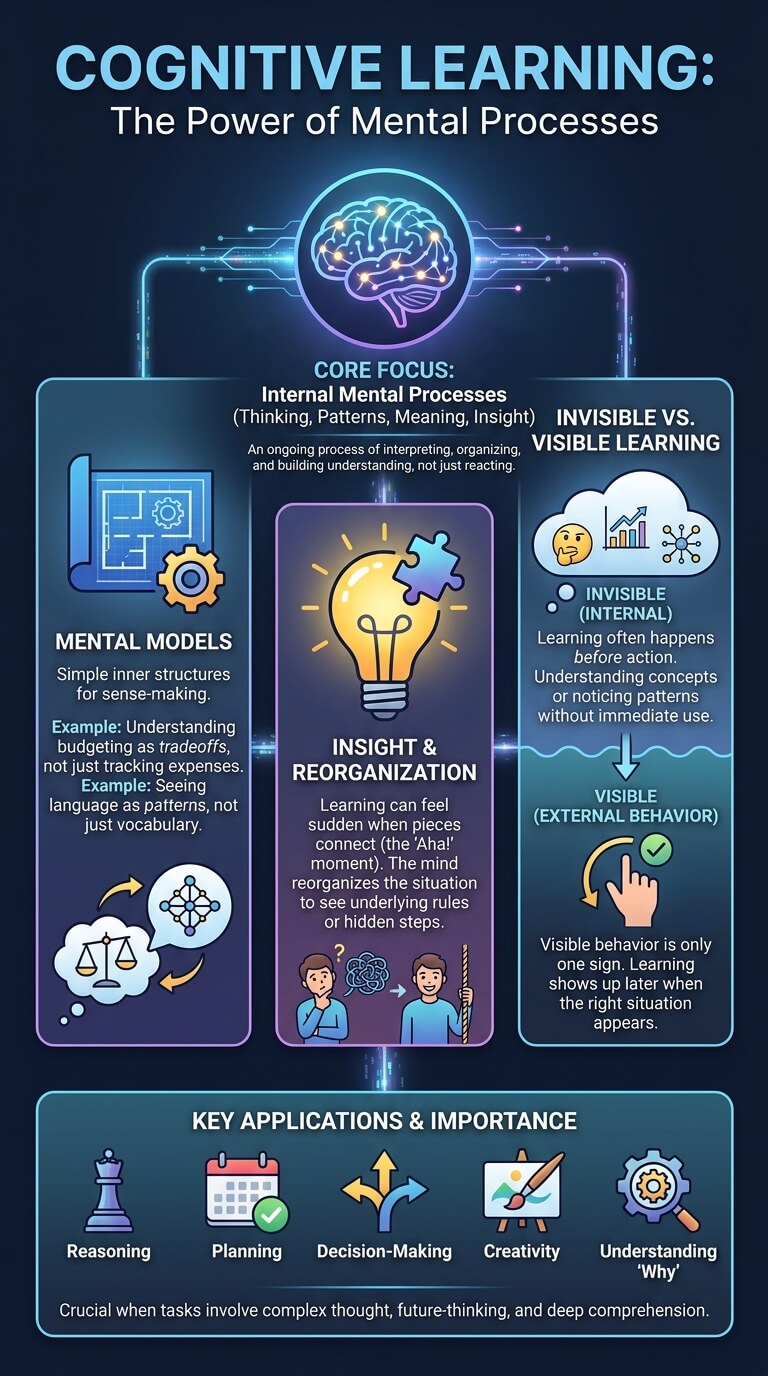
Cognitive learning focuses on mental processes such as attention, meaning, problem-solving, expectation, organization, and insight. It reminds us that not all learning is visible right away.
Learning through thinking, patterns, and mental models
The National Academies report How People Learn II describes learning as an ongoing process shaped by biological, cognitive, social, and cultural systems. That broader view helps explain why people do more than react. They interpret, organize, predict, and build understanding.
A mental model is a simple inner structure that helps you make sense of something. Once you understand that budgeting is about tradeoffs, not just tracking expenses, your decisions change. Once you understand that a language has patterns, not just vocabulary, sentences become easier to form.
Insight, problem-solving, and expectation
Sometimes learning feels sudden because the pieces finally connect. You may struggle with a math problem, then see the underlying rule. You may misunderstand a person’s behavior, then realize they are responding to pressure rather than dislike. You may keep failing at a task, then notice the hidden step you were skipping.
The change happens because the mind reorganizes the situation.
Why not all learning is visible behavior
A person can learn before they act. They may understand a concept, revise an expectation, or notice a pattern but not yet have a chance to use it. This matters because visible behavior is only one sign of learning. Sometimes learning shows up later, when the right situation appears.
Cognitive learning is especially important when the task involves reasoning, planning, decision-making, creativity, or understanding why something works.
Implicit Learning
Implicit learning happens when people pick up patterns without fully intending to learn them or being able to explain what they learned. It is one reason humans can become sensitive to patterns before they can describe the rule.
Learning patterns without fully explaining them
A review in PubMed Central describes implicit and statistical learning as ways the brain can detect patterns without full awareness of the learned structure. The article notes that implicit learning involves learning without awareness of the products of learning, which fits many everyday examples of pattern sensitivity.
This means the mind can absorb regularities from repeated exposure.
Language, habits, social cues, and intuition examples
| Area | Implicit learning example |
|---|---|
| Language | You know a phrase sounds natural even if you cannot name the grammar rule. |
| Social cues | You sense a group is uncomfortable before anyone says it directly. |
| Motor skill | Your hand adjusts during a familiar task before you consciously think through the step. |
| Habits | You move through a routine automatically because the sequence is familiar. |
When implicit learning can help or mislead
Implicit learning helps with fluency. It can make language, movement, social timing, and familiar routines feel smoother. But it can also mislead when the pattern you absorbed came from a narrow environment. If a person grew up around criticism, they may implicitly expect neutral feedback to become an attack. If someone worked in a blame-heavy workplace, they may read caution into situations that are actually safe.
The helpful question is not “Is my instinct always right?” It is “What pattern may my mind have learned, and does this situation truly match it?”
Experiential Learning
Experiential learning is learning from doing. It includes action, reflection, adjustment, and trying again. It is central to skill development because many abilities cannot be fully learned through explanation alone.
Learning from doing and reflecting
You can read about giving a presentation, but speaking in front of people teaches details your body and attention must experience directly. You can study a recipe, but cooking teaches timing, texture, heat, and judgment. You can learn communication advice, but real conversations teach pacing, tone, and the emotional difficulty of staying clear.
Reflection turns the experience into usable information. Without reflection, doing can become repetition rather than growth.
Why experience alone is not enough without meaning
Having many experiences does not guarantee learning from them. Someone can repeat the same argument, the same study mistake, or the same work pattern for years. Experience teaches more when the person asks what happened, what mattered, what they expected, what surprised them, and what they will try differently next time.
Meaning turns “that happened” into “now I understand something I can use.”
How feedback turns experience into learning
Feedback helps experience become more precise. It shows the difference between effort and effect. A person might think they explained something clearly until a listener asks a confused question. A musician might think a rhythm is steady until a teacher points out the drift. A writer might think an idea is obvious until a reader misses it.
Good feedback does not simply judge. It gives information that helps the next attempt improve.
How the Types Overlap in Real Life
The easiest way to understand learning types is to watch them combine in everyday situations. Most learning has layers.
Example: learning to cook
A beginner cook learns by watching someone chop onions, which is observational learning. They learn that turning the heat too high burns garlic, which is consequence-based learning. They associate a certain smell with food being ready, which is classical conditioning. They build a mental model of heat, moisture, and timing, which is cognitive learning. After enough practice, some judgments become implicit.
Cooking improves most when experience is paired with reflection and feedback.
Example: learning confidence after mistakes
Confidence is often learned through experience, not through a single pep talk. If a person makes a mistake and discovers they can recover, the consequence may teach safety. If they watch others admit mistakes without being rejected, social learning may reduce shame. If they rethink what mistakes mean, cognitive learning changes the interpretation.
One small recovery can teach more than a perfect performance because it changes what the person expects will happen after imperfection.
Example: learning workplace norms
A new employee learns official rules from training, but they also learn hidden rules from observation. Who speaks first? Which questions are welcomed? What gets praised? What gets ignored? Which mistakes are treated as learning, and which ones become gossip?
Workplace learning is often social and implicit. People learn the culture by noticing consequences, status, tone, and repeated reactions.
Which Type Matters Most for Your Situation?
When you are trying to understand a habit, emotion, skill, or repeated behavior, the best question is not “Which learning type is the correct one?” A better question is “Which mechanism is most active here?”
If consequences shape the pattern
Look at what happens after the behavior. Does avoidance bring relief? Does anger bring control? Does checking bring temporary certainty? Does effort bring useful feedback or only criticism? Consequences often explain why a behavior continues even when the person does not like the long-term result.
If models and social norms shape the pattern
Ask who the person has been watching and what the group rewards. People often learn how to argue, apologize, work, parent, dress, lead, and express emotion by observing what seems normal or respected around them.
If practice and feedback shape the skill
For skills, repetition alone is usually not enough. Ask whether the person is practicing the right part, noticing errors, receiving feedback, and adjusting. Skill learning improves when practice is specific rather than mindless.
If memory or transfer is the problem
Sometimes the issue is not that learning never happened. The person may understand the idea in one context but fail to retrieve or apply it elsewhere. A student may know a concept during practice but freeze during a test. A manager may learn a communication method in training but forget it in a tense meeting. That is where memory and transfer become important.
Common Misunderstandings About Learning Types
Learning terms become more useful when you know what they do not mean. Three misunderstandings create the most confusion.
Not all learning is conscious
People can learn without deciding to learn. They can absorb emotional associations, social rules, movement patterns, and expectations through repeated exposure. This does not remove responsibility for behavior, but it does explain why some reactions feel automatic at first.
Not all learning is behaviorism
Behaviorism gave psychology powerful ways to understand association and consequence, but learning is not only outward behavior. People also learn meanings, beliefs, categories, strategies, norms, and expectations. A person may learn something important before anyone else can see it.
Not every habit is reinforcement
Reinforcement is important, but it is not the only explanation for a habit. A habit may also come from modeling, identity, environment design, emotional association, implicit routine, or lack of alternative skills. If you assume every habit is only about reward, you may miss the social or cognitive part that keeps it in place.
FAQ About Types of Learning
What are the main types of learning in psychology?
The main types often discussed include classical conditioning, operant conditioning, observational learning, social learning, cognitive learning, implicit learning, and experiential learning. Some textbooks group them differently, but the practical distinction is clear: people learn through association, consequences, models, social context, thinking, hidden pattern detection, and experience.
What is the difference between operant and classical conditioning?
Classical conditioning is about learning an association between cues, especially when one cue predicts another event or response. Operant conditioning is about behavior changing because of what follows it. If a ringtone makes you tense because it predicts urgent messages, that is closer to classical conditioning. If you check your phone more because checking sometimes brings a rewarding update, that is closer to operant conditioning.
Is social learning the same as observational learning?
They overlap, but they are not exactly the same. Observational learning focuses on learning by watching a model. Social learning puts more attention on the wider social setting, including status, approval, group norms, imitation, and vicarious reinforcement. Watching a tutorial is observational learning. Copying the behavior that earns respect in a group is more clearly social learning.
What is an example of implicit learning?
An example of implicit learning is sensing that a sentence sounds wrong without being able to explain the grammar rule. Another example is adjusting your timing in a familiar sport or task before consciously naming what changed. The person has picked up a pattern, but the knowledge is not fully verbal or deliberate.
Can one lesson involve several learning types?
Yes. Most real learning includes several types at once. Learning to cook, drive, speak in public, manage conflict, or use a new tool may involve observation, consequences, practice, feedback, mental models, emotional associations, and implicit pattern learning. The categories show which part needs attention.
Key Takeaways
- Learning in psychology includes changes in knowledge, behavior, skill, expectation, emotion, and response patterns.
- Classical conditioning explains learned associations, while operant conditioning explains how consequences shape future behavior.
- Observational learning focuses on watching models; social learning adds the influence of norms, status, approval, and group context.
- Cognitive learning shows that understanding, insight, mental models, and expectations can change before visible behavior changes.
- Implicit learning helps explain pattern sensitivity that people may not be able to describe clearly.
- Experiential learning works best when doing is paired with reflection, feedback, and adjustment.
Final Thoughts
The most useful way to think about learning types is to treat them as lenses. If a reaction feels automatic, look for learned associations. If a behavior keeps repeating, look at consequences. If someone copied a style, look at models and social reward. If a skill is not improving, look at practice, feedback, and reflection.
For your next step, choose one behavior, skill, or emotional response you want to understand. Ask which kind of learning may have shaped it, then ask what kind of new learning would help it change. That keeps the idea practical instead of turning it into a list of terms.

Michael Reed is the Founder and Lead Writer at Psychology Exposed. He writes about human behavior, relationships, emotional patterns, self-awareness, and practical psychology topics using research-informed, easy-to-understand content.
Read More About Michael Reed: https://psychologyexposed.com/michael-reed/