

A lot of learning begins after something happens. You try a method and it works, so you use it again. You avoid a task and feel temporary relief, so avoidance becomes easier next time. Someone praises your effort, and you repeat the strategy that earned the praise. A consequence has taught your brain, even if no one called it a lesson.
Reinforcement and learning psychology explains why some behaviors become more likely after their outcomes. It is not only about gold stars, treats, prizes, or formal rewards. Reinforcement can be attention, relief, progress, praise, comfort, status, a sense of control, or the small feeling of “that worked.” When the outcome makes a response more likely to happen again, reinforcement has shaped learning.
This idea is useful, but it can also be misunderstood. Reinforcement is not the same as motivation, bribery, kindness, or praise. It is also not a complete explanation for every human choice. People learn through memory, observation, meaning, goals, identity, emotions, and social context too. Reinforcement is one important piece of the learning process, especially when behavior changes because of what follows it.
Quick Answer

Reinforcement makes some learning more likely to repeat
In learning psychology, reinforcement is a consequence that increases the chance that a behavior, response, or strategy will happen again. If studying with practice questions leads to better recall, that success can reinforce the study method. If avoiding a hard conversation brings relief, that relief can reinforce avoidance. Reinforcement teaches through outcomes.
Why reinforcement is not the same as motivation, praise, or bribery
Motivation is a reason or drive to act. Praise is a social response. Bribery usually means offering something in advance to get compliance. Reinforcement is defined by its effect after behavior: the response becomes more likely in the future. A reward is not reinforcement if it does not actually strengthen the learning or behavior.
What Reinforcement Means in Learning
Reinforcement as a consequence that strengthens a response
The APA Dictionary of Psychology defines reinforcement as a process in operant conditioning where the frequency or probability of a response increases because of a dependent relationship with a stimulus or circumstance. In simpler language, something happens after a response, and that outcome makes the response more likely to return.
This is why reinforcement belongs naturally inside learning psychology. It explains how a person learns from the results of action. A child learns that asking clearly gets help. A student learns that retrieval practice works better than rereading. A team member learns that speaking up early prevents confusion. The outcome does not merely feel good, it changes what the person is likely to do next.
Repeated practice becomes more useful when it includes attention, correction, and a clear target for what should improve next.
Why timing and contingency matter
Reinforcement is strongest when the learner can connect the behavior with the outcome. If the consequence comes too late, feels random, or rewards something unclear, the learning signal becomes noisy. A student who gets a vague “good job” may feel encouraged, but may not know which part of the work to repeat.
Contingency means the outcome depends on the behavior. If a learner receives the same reward regardless of effort, strategy, accuracy, or follow-through, the reward may feel pleasant without teaching much. The brain needs a clear enough connection: when I do this, this result tends to follow.
Learning the behavior vs learning the expectation
Reinforcement does not only teach a behavior. It can also teach an expectation. If careful preparation repeatedly leads to calmer performance, a person may learn, “Preparation helps me handle pressure.” If last-minute rushing repeatedly works, they may learn, “Pressure is how I get things done.” Both expectations shape future learning.
This is one reason reinforcement can create habits that feel logical from the inside. A behavior may not be ideal long term, but if it has repeatedly brought relief, approval, speed, status, or escape, the person has learned a pattern. Changing it requires more than telling them the pattern is bad. They need a new outcome that teaches a better expectation.
Positive and Negative Reinforcement in Plain English

Positive reinforcement adds something that strengthens behavior
Positive reinforcement means something is added after a behavior, and that addition increases the likelihood of the behavior. The “positive” part means added, not morally good. The APA Dictionary terminology for positive reinforcement is useful because it keeps the focus on the increase in future responding.
Everyday examples are easy to recognize. A beginner practices a guitar chord and hears it sound cleaner, so they practice again. A manager thanks someone for raising a problem early, so that person is more likely to bring up problems before they become bigger. A child reads aloud and receives warm attention, so reading begins to feel worth repeating.
Negative reinforcement removes something unpleasant and strengthens behavior
Negative reinforcement is often misunderstood. It does not mean punishment. It means something unpleasant is removed, prevented, or postponed after a behavior, and that removal strengthens the behavior. The APA Dictionary definition of negative reinforcement focuses on the removal or prevention of an aversive stimulus as the consequence that increases the response.
For example, you check your calendar early and feel less anxious about forgetting something. The relief makes early checking more likely. You put on noise-canceling headphones and the distracting sound drops, so the behavior becomes easier to repeat. You avoid a difficult task and the tension fades for a few minutes, so avoidance becomes more tempting next time.
Why negative reinforcement is not the same as punishment
Reinforcement increases behavior. Punishment decreases behavior. Negative reinforcement increases behavior by removing or reducing something unpleasant. If avoidance makes anxiety drop, avoidance is being strengthened. If checking a checklist prevents mistakes, checklist use is being strengthened.
This distinction matters because many people call any unpleasant experience “negative reinforcement.” That creates confusion. Negative reinforcement is not about being harsh. It is about relief, escape, prevention, or removal teaching the learner what to repeat.
Reward, Feedback, and Consequence: What Is the Difference?

Reward as something desirable
A reward is something the person wants, enjoys, values, or sees as beneficial. Rewards can include money, praise, grades, points, attention, privileges, progress, comfort, approval, or a satisfying result. But a reward only functions as reinforcement if it makes the response more likely later.
This is why a reward can fail as a learning tool. A badge may not matter to a learner. Praise may feel generic. A prize may distract from the skill. A reward can even teach the wrong lesson if the learner focuses on getting the prize rather than understanding the process that produced improvement.
Feedback as information
Feedback tells the learner something about performance. It may say what was accurate, what was missing, what changed, what strategy helped, or what needs another attempt. Feedback can feel encouraging or uncomfortable, but its main function is informational.
Good feedback can become reinforcing when it helps the learner notice improvement or choose a better strategy. For example, “Your second example made the argument clearer” gives both information and a reason to repeat that strategy. Vague praise such as “Great work” may feel nice, but it may not teach the learner what to keep doing.
Consequence as what follows behavior
A consequence is simply what follows a behavior. It might be pleasant, unpleasant, neutral, immediate, delayed, social, private, expected, or surprising. Consequences do not have to be formal. A sigh from a listener, a solved problem, a quieter room, a completed checklist, or a burst of attention can all become learning signals.
The important question is not only, “Was the consequence good or bad?” The better question is, “What did the consequence make more likely next time?” That question reveals what the learner may actually be learning.
Reinforcement as the effect on future behavior
Reinforcement is the effect a consequence has on future behavior. A consequence becomes reinforcing when it strengthens the response. The same outcome can reinforce one person and not another because people differ in goals, needs, history, context, and meaning.
| Term | Main idea | Learning question |
|---|---|---|
| Reward | Something desirable | Does the person value it? |
| Feedback | Information about performance | Does it guide the next attempt? |
| Consequence | What happens after behavior | What followed the response? |
| Reinforcement | A consequence that strengthens behavior | Did the response become more likely? |
How Reinforcement Supports Learning
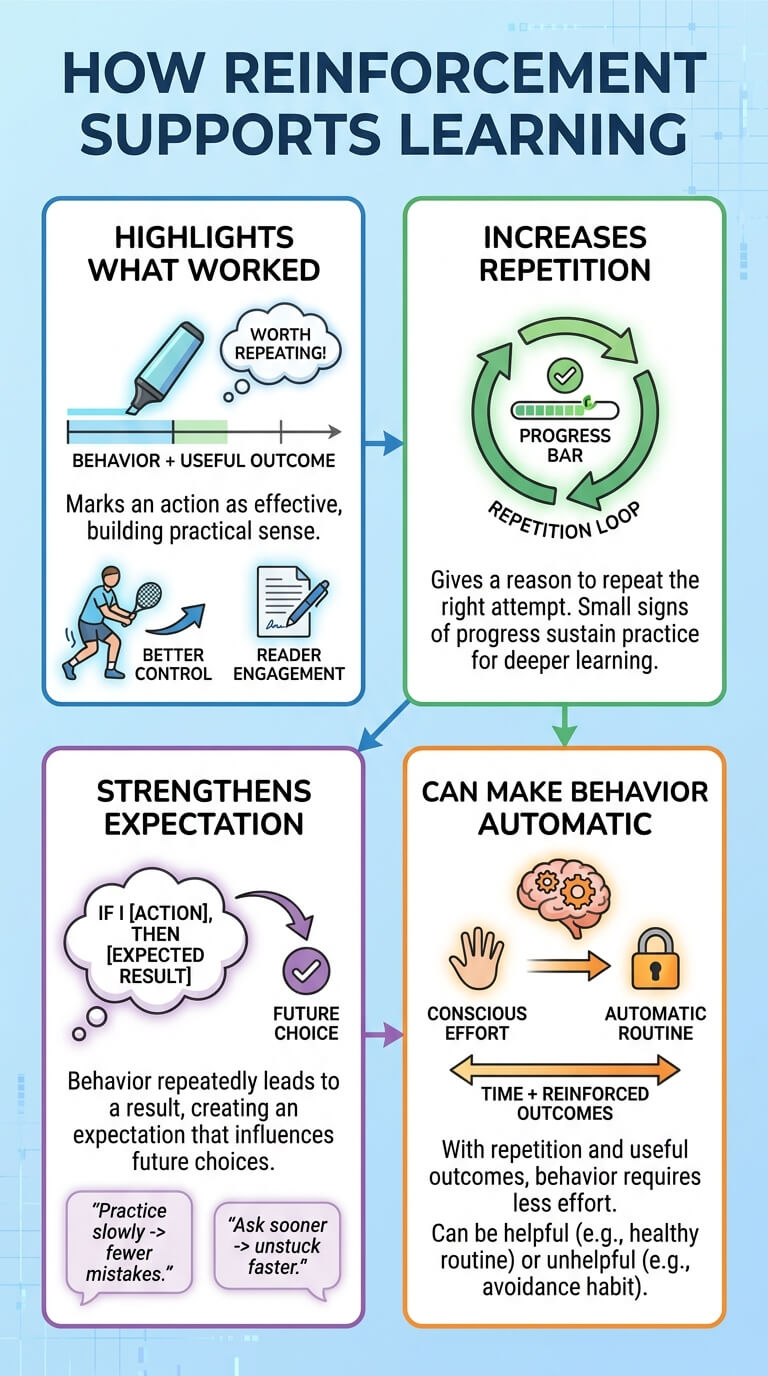
It highlights what worked
Learning often improves when the learner can identify which action created a useful outcome. A tennis player notices that bending their knees creates more control. A writer sees that revising the opening paragraph keeps readers engaged. A student realizes that explaining a concept out loud reveals gaps faster than rereading silently.
In these examples, reinforcement acts like a highlighter. It marks a behavior as worth repeating. The learner does not only feel rewarded, they gain a practical sense of what worked.
It increases repetition
Repetition matters because many skills need multiple attempts before they become stable. Reinforcement helps because it gives the learner a reason to repeat the right kind of attempt. A small sign of progress can keep practice going long enough for deeper learning to occur.
OpenStax Psychology 2e explains operant conditioning as learning shaped by consequences that follow behavior. In real learning situations, the consequence does not need to be dramatic. Sometimes a tiny improvement, a clearer correction, or a smoother attempt is enough to keep the learner engaged.
It strengthens expectation
When a behavior repeatedly leads to a result, the learner begins to expect that result. This expectation can become part of the learning. “When I practice slowly, I make fewer mistakes.” “When I ask sooner, I get unstuck faster.” “When I delay starting, I feel panic later.” Expectations influence future choices before the next consequence even arrives.
This is why learning environments matter. If effort is repeatedly ignored, learners may stop expecting effort to matter. If mistakes are handled as useful information, learners may become more willing to try. Reinforcement teaches what the environment seems to value.
It can make behavior automatic over time
At first, a new behavior may require conscious effort. The learner has to remember, choose, and repeat it. Over time, if the behavior keeps producing useful outcomes, it may become easier and more automatic.
This can be helpful. A person who repeatedly lays out workout clothes at night and finds mornings easier may build a stable routine. It can also be unhelpful. A person who repeatedly checks their phone to escape boredom may learn an automatic avoidance habit. Reinforcement does not care whether the habit is wise, only whether the outcome has strengthened the response.
When Reinforcement Backfires

Rewarding the wrong behavior
Sometimes the outcome strengthens a behavior no one intended to teach. A learner complains dramatically and gets immediate attention, so dramatic complaining becomes more likely. A student rushes through work and receives praise for speed, so speed becomes more important than accuracy. A team rewards constant availability, so people learn to ignore rest.
The problem is not that reinforcement is bad. The problem is that people often reinforce the visible behavior without asking what lesson it teaches. If the fastest person always gets praised, careful thinking may quietly lose value.
Creating dependence on external reward
External rewards can help start a behavior, especially when a task feels unfamiliar, boring, or intimidating. But if the learner only acts when a reward is present, the learning may stay fragile. The person may learn, “I do this for the prize,” rather than, “I know how to use this skill and why it matters.”
This does not mean rewards should never be used. It means they should be used carefully. Reinforce effort, strategy, attention, improvement, and problem-solving, not only the final prize. Over time, the learner needs more connection to competence, meaning, usefulness, or identity.
Strengthening avoidance through relief
Relief is one of the most powerful everyday reinforcers. If avoiding a presentation makes fear drop, avoidance may feel like proof that avoidance worked. If delaying a conversation prevents discomfort, delay may become the default. If quitting at the first mistake removes embarrassment, quitting becomes easier next time.
This is where negative reinforcement can accidentally trap people. The immediate relief is real, but the long-term learning may be costly. The person may not learn that they can survive discomfort, improve through practice, or solve the problem in smaller steps.
Making learning feel controlled instead of chosen
Reinforcement can also backfire when it makes the learner feel controlled. If every behavior is rewarded, scored, ranked, or monitored, the learner may focus on approval instead of understanding. They may become less curious and more cautious.
A useful learning environment does not treat people like machines. It leaves room for autonomy, questions, mistakes, reflection, and personal meaning. Reinforcement works best when it supports learning, not when it becomes a pressure system.
Reinforcement vs Feedback Psychology
When a learner needs information, not a reward
Sometimes learners do not need more motivation. They need better information. A person may already be trying hard but repeating the wrong method. More praise, points, or pressure will not solve that. They need to know what to adjust.
For example, telling a student “keep going” may be kind, but if they misunderstand the concept, encouragement alone may reinforce persistence without accuracy. Better feedback might say, “Your answer uses the right formula, but the units changed halfway through.” That gives the learner a path forward.
When praise is too vague to guide improvement
Praise can reinforce effort, confidence, and persistence, but vague praise often lacks instructional value. “You are smart” may feel good, yet it does not show what action to repeat. “You checked your answer two ways, and that caught the mistake” is more useful because it reinforces a specific learning behavior.
The difference is practical. Vague praise may strengthen the desire to be seen positively. Specific praise can strengthen the method that helped learning happen.
How corrective feedback and reinforcement can work together
Corrective feedback and reinforcement do not have to compete. Feedback gives the information, and reinforcement helps the learner repeat the useful change. A coach might say, “Your timing was late on the first attempt. On the second attempt, you paused before moving, and the result improved.”
Research reviews in learning contexts often emphasize that feedback is most useful when learners can use it to adjust performance. A PubMed Central review on feedback in learning discusses feedback as a process that can influence motivation and performance when it is received and used by the learner.
Reinforcement in Social Learning
Watching someone else get rewarded
People can learn from consequences they only observe. If a classmate asks a question and the teacher responds warmly, others may learn that asking is safe. If a coworker takes credit for another person’s work and gets praised, the group may learn a very different lesson.
This kind of learning matters because people constantly scan social environments for cues. They notice what earns respect, what gets ignored, what brings embarrassment, and what seems to create status. Those observed outcomes can shape behavior before direct experience occurs.
Status, attention, and approval as social reinforcement
Social reinforcement can be subtle. A laugh, a like, eye contact, silence, status, approval, or inclusion can teach people what to repeat. This is why groups can accidentally reinforce habits they later complain about.
If sarcasm gets the most attention, sarcasm may spread. If careful listening earns trust, listening may become more common. If interrupting always wins airtime, interrupting may be learned as the practical way to be heard.
Why vicarious reinforcement can teach without direct experience
Vicarious reinforcement means behavior is influenced by seeing another person rewarded or reinforced. The observer does not need to receive the outcome personally. They learn from the model’s consequence.
The social environment also teaches people which behaviors seem rewarded, admired, ignored, or discouraged.
The APA Dictionary of Psychology defines vicarious reinforcement as a process where observing another person receive reinforcement influences the observer’s behavior. This helps explain why role models, peer groups, online attention, and workplace norms can be powerful learning environments.
Practical Examples of Reinforcement in Learning
Learning a study habit
A student tries practice testing instead of rereading. At first it feels harder. Then they notice they remember more during class. That improved recall becomes reinforcing because it makes the study method feel useful, not just difficult.
A wise next step would be to reinforce the process: choosing questions, checking errors, and trying again after correction. If the student only celebrates the grade, they may miss the strategy that created the improvement.
Learning confidence after practice
Confidence is not always something people think themselves into. Sometimes it is learned through repeated evidence. A person practices a presentation, receives specific feedback, improves one section, and notices less panic during delivery. The calmer performance reinforces preparation.
The lesson is not “I should feel confident before I start.” The lesson is, “Some confidence comes after I see myself improve.” Reinforcement helps turn practice into self-trust.
Learning avoidance after relief
A person avoids opening an email because it feels stressful. The moment they avoid it, their body relaxes. That relief reinforces avoidance, even though the problem remains. Next time, opening the email may feel even harder because avoidance has been practiced.
The first step is not to shame the person. The first step is to change the learning signal. They might open the email for one minute, write down the next action, and stop. The goal is to let the brain experience a smaller version of approach followed by manageable relief.
Learning workplace or social behavior
In a workplace, people learn quickly from what happens after behavior. If careful planning is ignored but crisis heroics are celebrated, the team may learn to wait for emergencies. If respectful disagreement is welcomed, people may learn to raise concerns earlier.
Social groups work the same way. If gossip brings closeness, gossip grows. If honesty brings punishment, honesty shrinks. Reinforcement is not only individual. It can be built into group norms.
How to Use Reinforcement More Wisely
Reinforce the process, not only the result
Results matter, but results are not always fully under the learner’s control. Process is easier to repeat. Reinforce the actions that make learning more likely: starting on time, checking errors, asking for clarification, practicing deliberately, trying again after feedback, or using a better strategy.
A helpful phrase is: “What should become more likely after this?” If you want deeper learning, reinforce the behavior that builds it, not only the final outcome that displays it.
Make feedback specific and useful
Specificity improves the learning signal. Instead of saying, “Nice job,” name the behavior: “You slowed down before answering, and your explanation became clearer.” Instead of saying, “Try harder,” name the adjustment: “Compare the two examples before choosing your answer.”
The National Academies report How People Learn II emphasizes that learning is shaped by learners, contexts, and environments. Reinforcement is more useful when the environment helps people notice what to try next, not only whether they succeeded.
Avoid rewarding avoidance when growth is the goal
When someone is overwhelmed, pushing too hard can make learning worse. But rescuing them from every discomfort can also teach avoidance. The better path is often a smaller, safer step toward the task.
For example, if speaking in a meeting feels frightening, the first step might be writing one sentence in advance or asking one prepared question. Reinforce the approach behavior, not only escape from discomfort. If fear, panic, compulsive behavior, or severe distress is taking over daily life, professional support may be more appropriate than self-guided practice alone.
Fade external rewards when skill becomes stable
External rewards can help early learning, but stable skills often need internal reasons too. As the learner improves, gradually shift attention from the reward to competence, usefulness, autonomy, or identity. “You earned a point” can become “You found the strategy that works.”
This shift helps learning last. The goal is not to remove all encouragement. The goal is to help the learner recognize the value of the skill itself.
What This Connects To in Everyday Learning
Types of Learning in Psychology
Reinforcement is one type of learning mechanism, but it is not the only one. People also learn through association, observation, insight, memory, practice, and experience. Understanding the wider family of learning types prevents reinforcement from being treated as the whole story.
Feedback Psychology
Feedback deserves separate attention because it teaches through information. Reinforcement teaches through changed likelihood of behavior. The two often overlap, but they are not identical. A learner may need correction more than reward, or encouragement more than a score.
Social Learning Theory Explained
Reinforcement also works socially. People learn from watching what happens to others, especially when the model is admired, similar, powerful, or emotionally meaningful. This is why attention, status, and approval can teach even when no direct reward is given.
Practice and Skill Acquisition Psychology
Skill development depends on repeated attempts, useful feedback, and gradually more automatic performance. Reinforcement supports that process when it strengthens the kind of practice that actually improves skill, not just the appearance of effort.
FAQ About Reinforcement and Learning
What is reinforcement in learning psychology?
Reinforcement is a consequence that makes a behavior, response, or strategy more likely to happen again. In learning, it helps explain why people repeat actions that lead to reward, relief, progress, approval, or useful results. The key is the future effect, not whether the consequence looks positive from the outside.
Is reinforcement always a reward?
No. A reward is something desirable, but reinforcement is defined by whether the behavior becomes more likely. Some rewards do not reinforce learning because they are too vague, unwanted, delayed, or disconnected from the behavior. Relief can also reinforce behavior, which is why avoidance may grow when avoiding something quickly reduces discomfort.
What is the difference between reinforcement and punishment?
Reinforcement increases behavior. Punishment decreases behavior. Positive reinforcement adds something that strengthens behavior, while negative reinforcement removes something unpleasant and strengthens behavior. Punishment is a different process because its purpose or effect is to reduce a behavior, not increase it.
Can reinforcement make bad habits stronger?
Yes. Reinforcement can strengthen unhelpful habits if the immediate outcome feels rewarding or relieving. Procrastination, avoidance, checking, interrupting, overworking, or seeking attention can all become stronger when they repeatedly produce a short-term payoff. Changing the habit usually means changing the outcome and reinforcing a better alternative.
How is feedback different from reinforcement?
Feedback gives information about performance. Reinforcement increases the chance that a behavior will happen again. Feedback can become reinforcing when it helps the learner improve and makes the improved strategy more likely. But feedback can also be ignored, misunderstood, or too vague to change behavior.
Key Takeaways
- Reinforcement shapes learning when a consequence makes a behavior or strategy more likely to happen again.
- Positive reinforcement adds something that strengthens behavior, while negative reinforcement removes or prevents something unpleasant and strengthens behavior.
- Rewards, feedback, consequences, and reinforcement are related, but they are not the same thing.
- Reinforcement can support skill growth when it highlights useful strategies, increases practice, and builds accurate expectations.
- It can backfire when it rewards the wrong behavior, strengthens avoidance, or makes learning feel controlled.
- The most useful reinforcement usually supports process, correction, autonomy, and real-world application.
Final Thoughts
Reinforcement is easiest to understand when you stop asking only, “Was this reward good?” and start asking, “What did this outcome teach the person to repeat?” That question applies to study habits, confidence, avoidance, workplace norms, social behavior, and skill development.
A practical next step is to notice one repeated behavior in your own life and identify the consequence that keeps it going. Does it bring relief, praise, progress, status, comfort, or escape? Once you see the learning signal, you can decide whether to keep reinforcing it, reshape it, or build a better response in its place.

Michael Reed is the Founder and Lead Writer at Psychology Exposed. He writes about human behavior, relationships, emotional patterns, self-awareness, and practical psychology topics using research-informed, easy-to-understand content.
Read More About Michael Reed: https://psychologyexposed.com/michael-reed/