

You do not learn only from direct practice. You also learn by watching how other people act, what they get away with, what they are praised for, what they avoid, and how they handle situations you have not tried yet. A child watches an adult apologize. A new employee watches how coworkers speak in meetings. A teenager watches a creator make confidence look easy. An anxious person watches someone else panic in a situation and starts treating that situation as dangerous too.
This is one part of a larger question in learning psychology: how experience changes what people notice, remember, expect, and do next.
That is the everyday power of observational learning. It explains why people can pick up habits, skills, social cues, emotional reactions, and expectations before anyone formally teaches them. Sometimes this helps. It lets you learn faster, avoid unnecessary mistakes, and build skill by studying someone who already knows what to do. Other times, it can mislead you, especially when you copy surface behavior without understanding the reason behind it.
This guide explains observational learning in a practical way: how it works, why some people influence us more than others, when watching helps learning, when it distorts learning, and how to choose better models for what you want to become.
Quick Answer

Observational learning is learning that happens by watching another person, remembering what they did, and using that information to shape your own behavior, expectations, or choices. It is not the same as copying everything you see. People are more likely to learn from models they notice, understand, relate to, respect, or see being rewarded.
Observational learning in one sentence
Observational learning means your mind uses another person’s behavior as information. You may learn what to do, what not to do, what seems safe, what seems risky, what gets approval, or what kind of response is expected in a situation.
The APA Dictionary of Psychology describes social learning theory as a view of learning that emphasizes modeling, imitation, social interaction, and reinforcement. Observational learning is one of the clearest everyday ways this social side of learning shows up.
Why watching can change behavior before direct practice
Watching gives the brain a preview. Before you try a behavior yourself, you can see the steps, the timing, the tone, the risk, and the likely reaction from other people. That preview can lower uncertainty. It can also create expectations, such as “people like this,” “people laugh at this,” “this is embarrassing,” or “this is how someone confident acts.”
What Observational Learning Means
Learning from models, not just instructions
A model is anyone whose behavior becomes something another person observes and may learn from. A model can be a parent, friend, teacher, coach, coworker, partner, public figure, fictional character, or online creator. The model does not need to be trying to teach. People can learn from someone who is demonstrating on purpose, but they can also learn from someone who is simply being watched.
OpenStax Psychology 2e explains observational learning as learning by watching others and then imitating or modeling what they do or say. In everyday life, the imitation may be exact, partial, delayed, or internal. Sometimes you do not copy the action, but your expectations still change.
Behavior, emotion, skill, and social cue examples
Observational learning is not limited to obvious actions. A child may learn table manners by watching adults. A student may learn how to organize notes by watching a classmate. A new worker may learn whether it is safe to disagree by watching how disagreement is handled. A person may learn calmness around dogs from a relaxed friend, or fear from watching someone else tense up.
It can shape four broad areas:
- Behavior: what people do, such as apologizing, interrupting, preparing, joking, avoiding, helping, or asking for clarification.
- Emotion: how people react, such as staying calm, showing fear, expressing excitement, hiding disappointment, or becoming defensive.
- Skill: how people perform a task, such as cooking, presenting, negotiating, driving, drawing, caregiving, or practicing a sport.
- Social cues: what seems acceptable in a group, such as how direct to be, when to speak, how to greet people, or what kind of humor is welcomed.
Why observation is not the same as copying everything
People do not simply absorb every behavior around them. They filter what they see. They may notice one person more than another, remember only part of the behavior, decide the behavior is not worth trying, or lack the ability to reproduce it yet. They may also learn the opposite lesson: “I do not want to handle things that way.”
This is an important nuance. Observational learning is selective. It depends on attention, memory, ability, motivation, values, consequences, and context. The same model can inspire one observer, warn another, and mean nothing to a third.
The Four-Part Process of Observational Learning
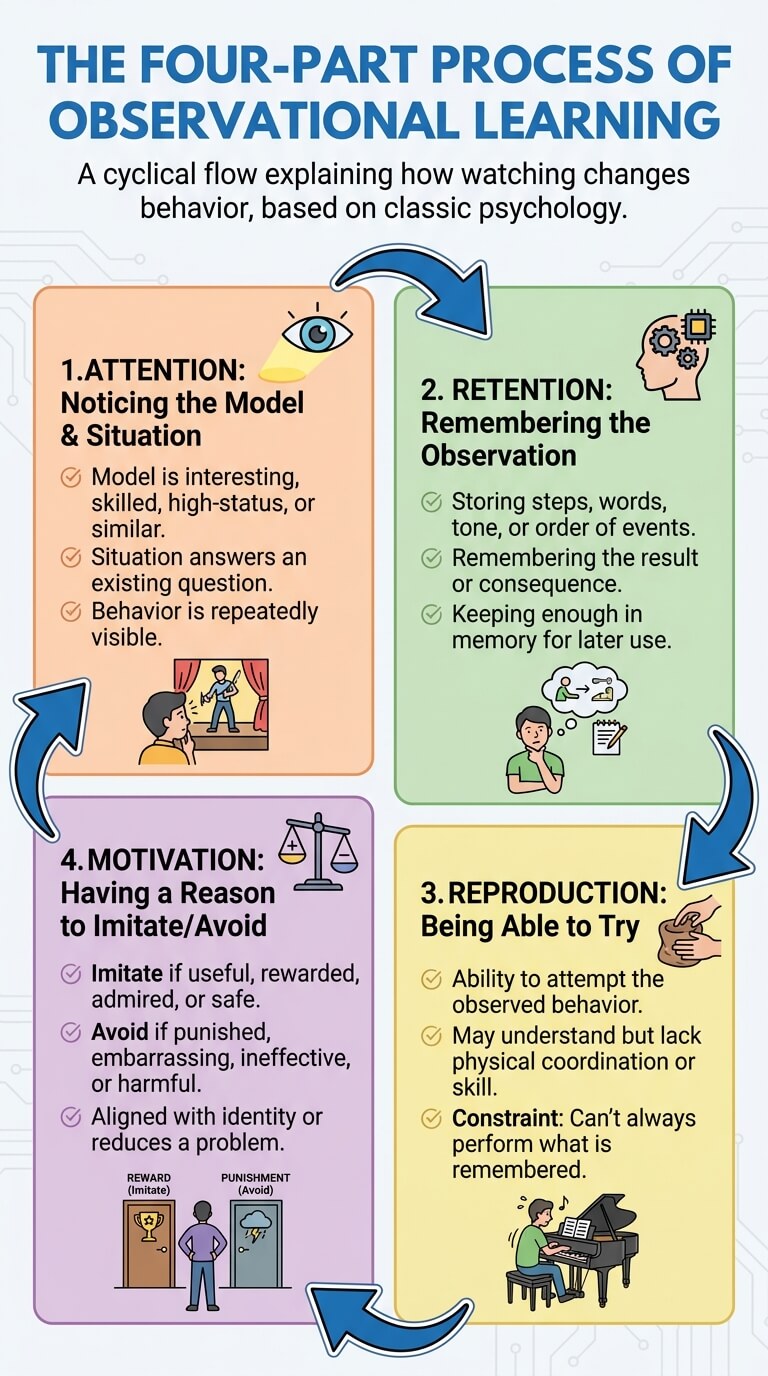
Observational learning is easier to understand when you break it into four parts. The classic sequence often discussed in psychology is attention, retention, reproduction, and motivation. These are not rigid steps that always happen perfectly, but they explain why watching sometimes changes behavior and sometimes does not.
Attention: noticing the model and the situation
Learning starts with attention. You have to notice the model, the behavior, and the situation enough for it to matter. Attention is stronger when the model is interesting, skilled, similar to you, emotionally important, high status, or repeatedly visible. It is also stronger when the situation answers a question you already have.
Retention: remembering what was observed
Retention means the observer keeps enough of the behavior in memory to use later. This may include the steps of an action, the words someone used, the emotional tone, the order of events, or the result that followed. Without retention, the behavior may be noticed but not learned in a useful way.
Reproduction: being able to try the behavior
Reproduction is the ability to attempt what was observed. You may understand what someone did and still be unable to do it yet. A person can watch a pianist play beautifully, remember the sequence, and still lack the hand coordination to reproduce it. A person can watch someone handle criticism gracefully and still struggle to do the same when their own body feels tense.
Motivation: having a reason to imitate or avoid it
Motivation answers the question: why would I use this behavior? People are more likely to imitate when the behavior seems useful, rewarded, admired, safe, aligned with their identity, or likely to reduce a problem. They may avoid a behavior when it appears punished, embarrassing, harmful, ineffective, or inconsistent with who they want to be.
Why Some Models Influence Us More Than Others

Similarity and relatability
People often learn strongly from models who feel similar enough to make the behavior seem possible. A beginner may learn more from an advanced beginner than from a world-class expert because the advanced beginner shows a path that feels reachable. A student may learn more from a peer who struggled and improved than from someone who always made the subject look easy.
Skill, confidence, status, and credibility
Competence matters too. People tend to watch models who appear skilled, calm, confident, respected, or successful. In a group, the person who gets listened to may become a model for how to speak. On a team, the person who solves problems under pressure may become a model for how to stay composed.
Emotional connection and repeated exposure
Emotion makes models memorable. People often absorb patterns from people they love, fear, admire, envy, or spend a lot of time around. Repeated exposure also matters. A behavior seen once may be forgotten. A behavior seen daily can start to feel normal.
Everyday Examples of Observational Learning

Children learning social behavior from adults
Children learn many social patterns by watching adults before they can explain the rules. They may learn how to greet guests, how to express frustration, how to treat service workers, how to apologize, or how to talk about mistakes. They may also learn whether emotions are welcomed, mocked, ignored, or repaired after conflict.
This does not mean parents or caregivers are to blame for every habit a child develops. Children are influenced by many people and environments. It does mean adults often teach through behavior even when they are not giving a lesson. A calm repair after a mistake can teach as much as a lecture about kindness.
Adults learning workplace norms from coworkers
When adults enter a new workplace, they rarely learn the real culture from the handbook alone. They watch. Who speaks in meetings? Who stays silent? Are questions welcomed or treated as weakness? Do people admit mistakes? Does the team reward speed, accuracy, loyalty, creativity, or image management?
Learning confidence, avoidance, or fear by watching others
Observation can shape emotional expectations. If someone sees a trusted person react with fear to a dog, a medical appointment, a public mistake, or a social situation, the observer may start treating that situation as more threatening. Research on social fear learning discusses how people and animals can learn about threat through observing others rather than through direct harm alone, as reviewed in work on social learning of fear.
Learning skills through demonstration and correction
Many skills become easier when you can watch someone perform them. A recipe, yoga pose, repair task, drawing technique, sales call, or difficult conversation becomes more concrete when you can see the steps. Demonstration reduces guesswork.
Observational Learning vs Imitation
Imitation as visible copying
Imitation is the visible copying of another person’s action, sound, wording, posture, style, or routine. A child repeats a phrase they heard. A trainee uses the same greeting as a mentor. A person copies a workout movement from a video. Imitation is often easy to see because the behavior resembles the model’s behavior.
Observational learning as a broader change in expectation or behavior
Observational learning includes imitation, but it is broader. You might watch someone and learn a principle, not just an action. You might learn that preparation reduces stress, that asking one clear question works better than overexplaining, or that rushing creates more errors. You may not copy the exact behavior, but your expectation changes.
Why people sometimes learn what not to do
Observation can teach avoidance. You may watch someone interrupt constantly and notice that people stop trusting them. You may see someone ignore safety steps and face consequences. You may watch a leader shame a team and notice how quickly people withdraw. In those cases, the lesson is not “do this.” The lesson is “avoid this.”
This kind of learning is valuable when it helps you prevent harm or choose a wiser response. It is less helpful when it turns into overgeneralized fear, such as “never speak up” because you once watched someone be criticized. The quality of the lesson depends on how accurately the observer interprets the situation.
Observational Learning vs Social Learning Theory
Observational learning as the mechanism
Observational learning is the process of learning by watching. It answers practical questions: who was observed, what was noticed, what was remembered, what could be reproduced, and why the observer might try or avoid the behavior later.
Social learning theory as the broader theory
Social learning theory is broader. It looks at how behavior is shaped by models, reinforcement, imitation, social context, and expectations. It asks not only whether someone observed a behavior, but also how rewards, punishments, norms, identity, and the environment affect whether that behavior is adopted.
Observational learning is one of several forms of learning, alongside learning through consequences, direct practice, and mentally organized ideas.
Classic work connected with Albert Bandura helped bring attention to the idea that people can learn from modeled behavior without needing to be directly rewarded or punished first. A PubMed Central article discussing Bandura’s aggression modeling experiments notes how those studies influenced later thinking about imitation, self-regulation, and social cognitive theory.
When social context, reward, and norms matter more
Sometimes the most important question is not “What did the person watch?” but “What did the group reward?” In a classroom, a student may know the right answer but stay quiet if the group mocks effort. In a workplace, an employee may watch ethical behavior but copy corner-cutting if shortcuts are rewarded. In a family, a child may see kindness but learn that anger gets attention faster.
That is where the wider social environment matters. Observational learning gives the example. Social context gives the meaning around the example. A model becomes more powerful when the environment signals that the behavior works, protects status, earns belonging, or avoids punishment.
When Observation Helps Learning
Demonstration before practice
Observation helps when the learner needs a clear picture before trying. Demonstrations are useful for tasks with steps, timing, body movement, tone, or decision points. They reduce the blank-page feeling of “I do not even know what this is supposed to look like.”
Seeing mistakes and corrections
Watching mistakes can be surprisingly helpful when the correction is visible. If a teacher solves a problem perfectly, students may see the final path but not the decision-making. If the teacher shows a common mistake and repairs it, students learn how to notice the error and recover.
Watching someone similar succeed
Seeing someone similar succeed can change what feels possible. This does not mean success becomes automatic. It means the observer may move from “people like me cannot do that” to “maybe there is a path.” That shift can increase effort, persistence, and willingness to practice.
When Observation Misleads Learning
Copying surface behavior without understanding
Observation can mislead when the observer copies what is visible but misses the hidden reasoning. A person may copy a confident speaker’s casual style without noticing years of preparation. A beginner may copy an advanced athlete’s routine without understanding recovery needs. A new employee may copy a senior person’s bluntness without having the same trust or context.
The safer question is: what is the function of the behavior? Is the model trying to create clarity, reduce risk, build connection, save time, or signal confidence? When you understand the function, you can adapt the behavior instead of copying the surface.
Learning unhealthy norms from repeated exposure
Repeated exposure can make unhealthy behavior feel normal. If a person grows up around constant yelling, they may learn that intensity is how serious feelings are expressed. If a workplace rewards public shaming, people may learn that humiliation is part of accountability. If a group treats burnout as proof of loyalty, members may learn to ignore limits.
Observation does not make someone responsible for every environment they were shaped by. It does, however, help explain why some patterns feel familiar even when they are not helpful. If learned patterns involve fear, threats, coercion, humiliation, or retaliation, the priority is safety and support rather than trying to communicate perfectly with the person causing harm.
Mistaking confidence for competence
Confident models are easy to notice. They speak clearly, decide quickly, and look certain. But confidence can hide poor judgment. In some settings, the person who acts most sure becomes the model even when they are not the most careful, skilled, or ethical.
Before adopting a behavior, look for evidence beyond presentation. Does the model’s approach create good outcomes over time? Do other competent people respect the method? Does it work only because of status, charm, or pressure? Does it fit your values and situation?
How to Use Observational Learning Intentionally

Choose better models
You cannot control every influence around you, but you can choose some models more intentionally. Choose people who demonstrate the process you want, not only the result you admire. A good model may be someone who handles feedback well, prepares consistently, admits uncertainty, treats people with respect, or practices a skill in a way you can learn from.
Watch for process, not just outcome
The most useful part of observation is often the process behind the outcome. Instead of only noticing that someone is good at something, watch how they prepare, how they make decisions, how they handle errors, how they respond to feedback, and what they repeat when no one is watching.
Watching is only the first step. People usually learn more when they notice what the model did, try the behavior in a safe way, get feedback, and pay attention to what happened after the behavior.
Practice soon after watching
Observation becomes stronger when it is followed by action. If you watch a demonstration and then wait too long, the details fade. If you try shortly afterward, you discover what you understood, what you missed, and what needs correction.
Ask what the model is not showing
Every model leaves something unseen. A creator may show the polished result but not the failed drafts. A manager may show confidence but not the preparation behind it. A skilled friend may make a task look easy because the hard part happened years ago.
A Simple Self-Check for What You Are Learning From Others
| Question | Why it matters |
|---|---|
| Who do I watch most often in this area? | Repeated exposure quietly shapes what feels normal, possible, or expected. |
| What behavior am I actually learning from them? | The lesson may be a skill, a habit, an emotional reaction, or a social rule. |
| What result does the model seem to get? | Observed consequences affect whether the behavior feels worth copying. |
| Am I copying the surface or understanding the process? | Surface copying can create mistakes when context is different. |
| Does this behavior fit my values and situation? | Not every effective-looking behavior is healthy, ethical, or right for you. |
These questions are not meant to make you suspicious of every influence. They are meant to make learning more conscious. Once you see who you are learning from, you can decide what to keep, what to adapt, and what to question.
Common Misunderstandings About Observational Learning
“If I saw it, I learned it”
Seeing is not enough. You may notice a behavior without understanding it, remembering it, being able to reproduce it, or wanting to use it. Observation opens the door, but attention, retention, ability, and motivation decide whether learning becomes usable.
“If someone copied it, they agreed with it”
People can copy patterns they do not fully endorse. A person may interrupt because that was modeled in their environment, not because they consciously believe interruption is respectful. Someone may avoid conflict because they watched conflict go badly, not because they think silence is ideal.
This does not remove responsibility, especially when behavior harms others. It does add context. Learned behavior can be questioned, practiced differently, and replaced with better examples.
“Good models have to be perfect”
A helpful model does not need to be flawless. In fact, a model who makes mistakes and repairs them can be more useful than one who appears perfect. The observer gets to see recovery, not just performance.
The key is whether the model demonstrates something worth learning: a better process, a healthier response, a clearer method, or a more responsible way to handle difficulty.
When Support May Help
Observational learning is a normal part of human development, but some learned patterns are painful or difficult to change alone. Support may help if you learned fear, shame, avoidance, people-pleasing, aggression, or emotional shutdown in an environment where mistakes were punished harshly or safety felt uncertain.
If a current relationship or environment involves threats, coercion, humiliation, stalking, intimidation, or retaliation, it is not just a learning problem. Safety comes first. In that situation, consider reaching out to a trusted person or a qualified support service before trying to change the dynamic through conversation.
For less urgent patterns, a therapist, counselor, coach, teacher, mentor, or supportive group can help you find healthier models and practice new responses in a safer setting. The aim is not to blame where you learned something. The aim is to give you more choice in what you keep repeating.
FAQ
What is an example of observational learning in psychology?
An example is a child learning to say “thank you” after watching adults use the phrase consistently. Another example is a new employee learning how to ask questions in meetings by watching a respected coworker do it calmly. In both cases, the person learns from a model before needing direct instruction for every detail.
Is observational learning the same as imitation?
Not exactly. Imitation is copying a visible behavior. Observational learning is broader because the observer may learn expectations, emotional responses, rules, or problem-solving strategies without copying the behavior exactly. You might watch someone handle conflict well and learn that calmness is possible, even if you use different words later.
Why do people copy bad behavior?
People may copy unhelpful behavior when it is repeated often, rewarded, modeled by someone influential, or treated as normal in a group. They may also copy it when they have not seen a better alternative. Copying a harmful pattern does not mean it is fixed forever, but changing it often requires awareness, new models, practice, and sometimes support.
Can adults learn through observation too?
Yes. Adults learn by observation in workplaces, relationships, parenting, hobbies, media environments, and social groups. Adults may be more selective than children in some situations, but they still pick up norms, strategies, emotional reactions, and skills by watching others.
How can I use observational learning to build a skill?
Choose a model who demonstrates the process clearly, watch for steps rather than just results, practice soon after observing, and seek feedback when possible. It also helps to watch mistakes and corrections, because they show how learning continues after the first attempt.
Key Takeaways
- Observational learning happens when watching another person changes what you know, expect, feel ready to do, or choose to avoid.
- The four useful parts to watch are attention, retention, reproduction, and motivation.
- People learn more from models who feel relevant, credible, emotionally important, or repeatedly visible.
- Imitation is visible copying, while observational learning can also change expectations, confidence, caution, and decision-making.
- Watching helps most when it is followed by practice, feedback, and attention to the process behind the behavior.
- Not every familiar model is a good model. Choose examples that fit your values, safety, and real situation.
Final Thoughts
Observational learning is one of the quiet ways people become who they are. You learn from what is taught directly, but also from what is demonstrated repeatedly. You learn from confidence, fear, repair, avoidance, effort, shortcuts, kindness, and pressure.
A useful next step is simple: choose one area where you want to improve, then ask who you are currently learning from in that area. Watch their process, not just their result. Then practice one small piece soon afterward. Learning by watching becomes more powerful when you turn observation into deliberate action.

Michael Reed is the Founder and Lead Writer at Psychology Exposed. He writes about human behavior, relationships, emotional patterns, self-awareness, and practical psychology topics using research-informed, easy-to-understand content.
Read More About Michael Reed: https://psychologyexposed.com/michael-reed/