

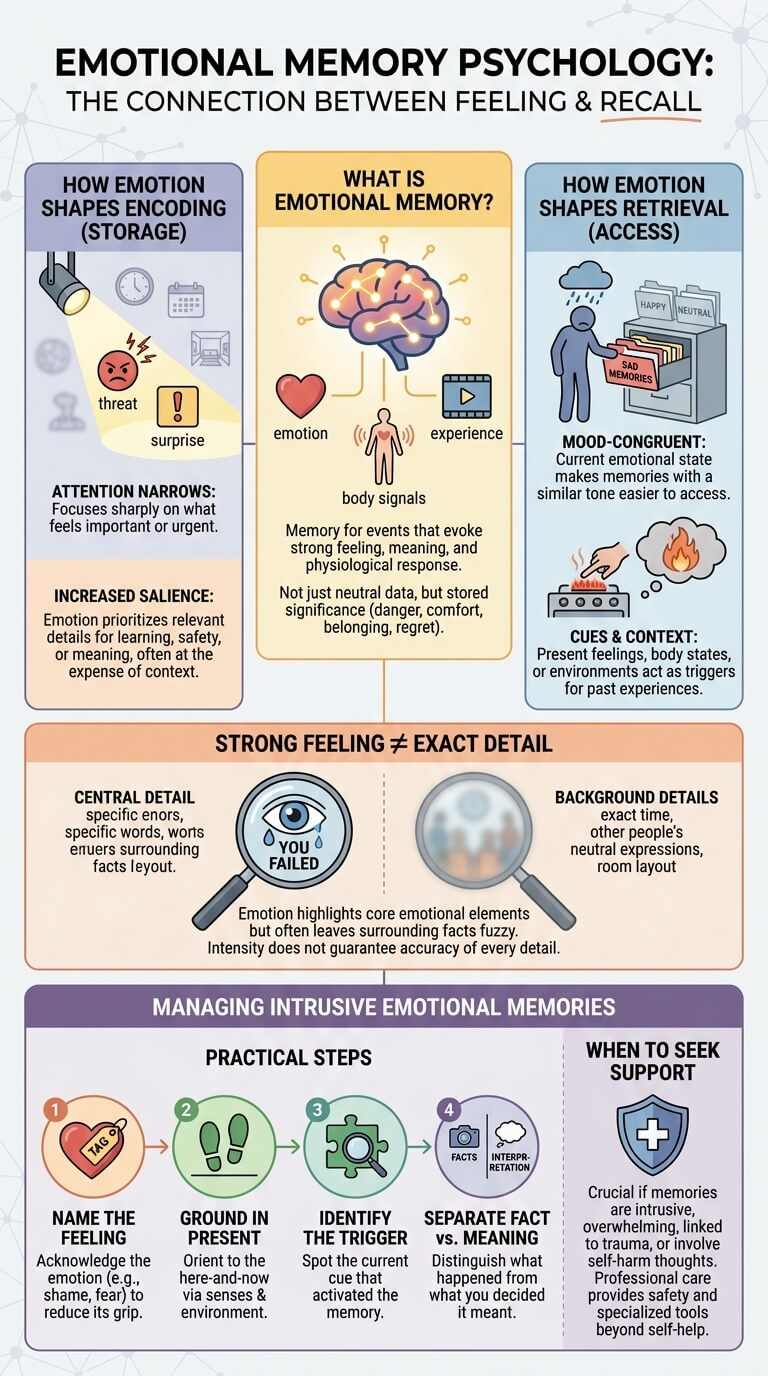
Some memories do not feel like ordinary information. A single song can bring back an old relationship. A smell can return you to a childhood kitchen. A mistake from years ago can suddenly feel close again when you are tired, stressed, or ashamed. Emotional memories often feel powerful because the mind does not store experience as neutral data only. It stores meaning, body signals, danger, comfort, surprise, belonging, and regret.
Emotional memory psychology explains why feelings can shape what gets noticed, what gets stored, and what comes back later. The feeling attached to a memory may help you learn from experience, protect yourself, connect with others, or understand your own story. At the same time, a strong feeling does not prove that every remembered detail is exact. Memory is useful, but it is not a perfect recording.
This guide explains emotional memory in everyday terms. It is not a diagnosis tool and it is not a replacement for mental health care. If memories feel intrusive, overwhelming, connected to trauma, or tied to thoughts of self-harm, support from a qualified professional or crisis resource matters more than trying to analyze the memory alone.
Quick Answer
Emotion tells the brain something matters
Emotional memory is memory for experiences that carry a strong emotional response. The APA Dictionary of Psychology defines emotional memory as memory for events that evoke emotion, which may be conscious or less conscious. In daily life, this means the mind may hold onto moments that felt unsafe, joyful, embarrassing, surprising, meaningful, or deeply personal.
Strong feeling does not guarantee exact detail
Emotion can make a memory easier to access, but it can also narrow attention, highlight certain meanings, and leave other details blurry. A painful memory may be emotionally true in the sense that it reflects how something affected you. That does not always mean every detail, timeline, motive, or interpretation is equally accurate.
What Emotional Memory Means
Memories with emotional significance
An emotional memory is not only a memory of a dramatic event. It can be a warm memory of being encouraged, a sharp memory of being laughed at, a calming memory of a safe place, or a tense memory of a conversation that changed how you saw someone. The common thread is significance. The memory carries feeling, and the feeling tells the mind, “This mattered.”
That emotional significance can come from different places. Some memories are emotional because they involve threat or loss. Others are emotional because they involve connection, pride, surprise, relief, belonging, or identity. A graduation, a breakup, an accident, a compliment, a public mistake, and a quiet moment of comfort can all become emotionally marked for different reasons.
Emotional memory vs emotional reaction
Emotional memory is the stored experience. An emotional reaction is what happens when that stored experience gets activated. For example, remembering a harsh comment from school is the memory. Feeling your stomach tighten during a similar comment at work is the reaction. The reaction may be linked to the old memory, but it is also happening in the present.
This distinction matters because people often treat the reaction as proof that the present situation is identical to the past. Sometimes it is. Sometimes the current moment only resembles the old one in tone, setting, facial expression, or body feeling. Emotional memory can offer information, but it still needs present-day checking.
Why emotional memory can be useful
Emotional memory is not a flaw. It helps people learn what to approach, what to avoid, who feels safe, what gives meaning, and what deserves attention. Without emotional memory, a person might remember facts but miss the personal importance of those facts.
It also supports social learning. You remember the teacher who made you feel capable, the friend who showed up during a hard time, the meeting where your idea was dismissed, or the apology that repaired a relationship. These memories help guide future choices. The challenge is using them as information without letting them become the only information.
How Emotion Shapes Encoding
Attention narrows toward what feels important
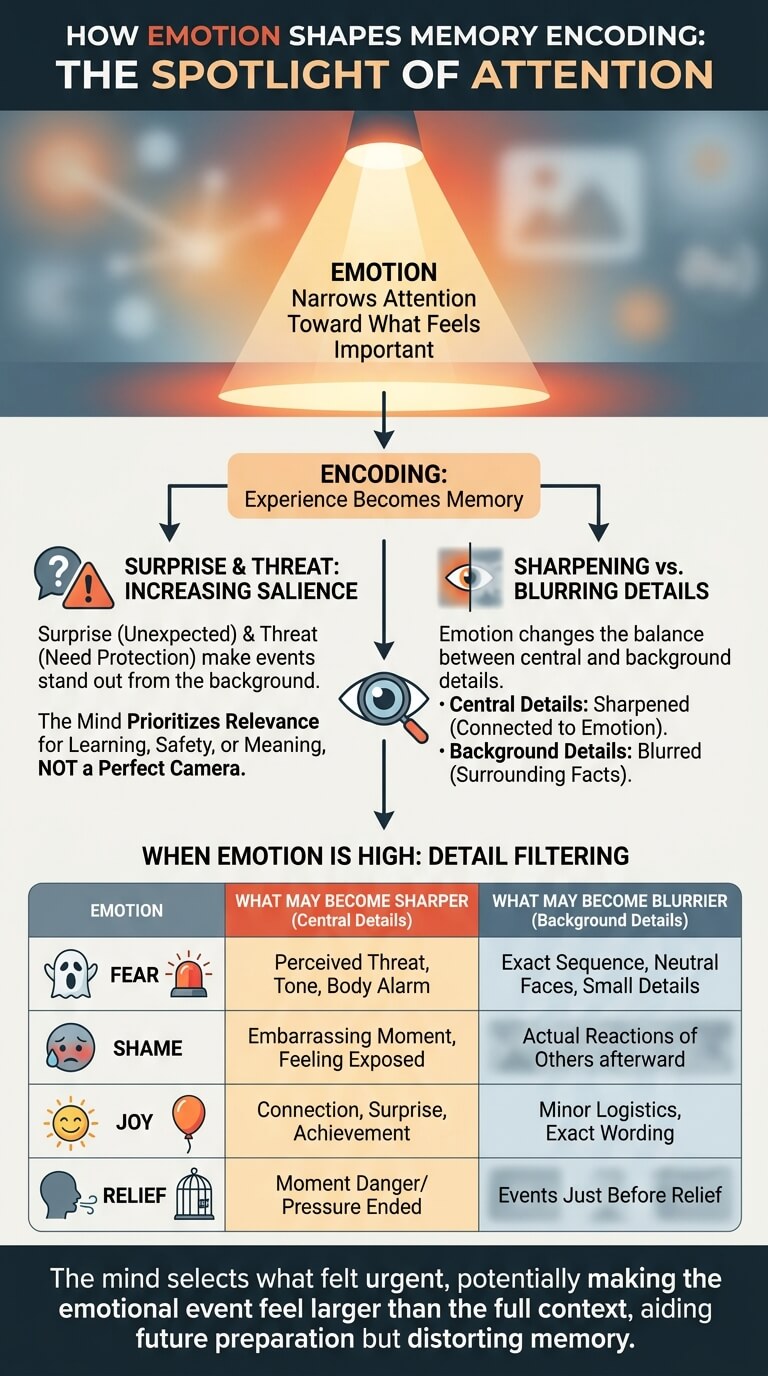
Encoding is the stage where experience begins to become memory. Emotion affects encoding by guiding attention. When something feels important, the mind tends to focus on it more sharply. A frightened person may notice the angry voice more than the wallpaper. A proud person may remember the applause more than the exact room layout.
Research reviews on emotion and learning describe emotion as closely tied to attention, perception, learning, and memory, not as something separate from thinking. One open-access review explains that emotion has a strong influence on attention and learning, which helps explain why emotionally important material often stands out in memory. You can see this in everyday life when ordinary errands disappear from recall, while one uncomfortable look stays with you for days.
Surprise and threat can increase salience
Surprise tells the mind that something does not match expectation. Threat tells the mind that something may require protection. Both can raise salience, which means the moment stands out from the background. This does not mean the mind becomes a perfect camera. It means the mind prioritizes what seems relevant for learning, safety, or meaning.
For example, if someone suddenly criticizes you in a meeting, you may remember the phrase, the tone, and the feeling in your chest. You may not remember who else spoke afterward. The mind selected what felt urgent. That selection may help you prepare for future situations, but it can also make the event feel larger than the full context.
Why some details sharpen while others blur
Emotion often changes the balance between central details and background details. Central details are the parts that feel most connected to the emotion: the face, the words, the sound, the loss, the relief, the mistake, the moment of safety. Background details are the surrounding facts: time, exact order, minor comments, or neutral context.
| When emotion is high | What may become sharper | What may become blurrier |
|---|---|---|
| Fear | The perceived threat, tone, escape route, or body alarm | Exact sequence, neutral faces, small details |
| Shame | The embarrassing moment and how exposed it felt | How other people actually reacted afterward |
| Joy | The feeling of connection, surprise, or achievement | Minor logistics or exact wording |
| Relief | The moment danger or pressure ended | What happened just before the relief |
How Emotion Shapes Retrieval
Mood-congruent memory
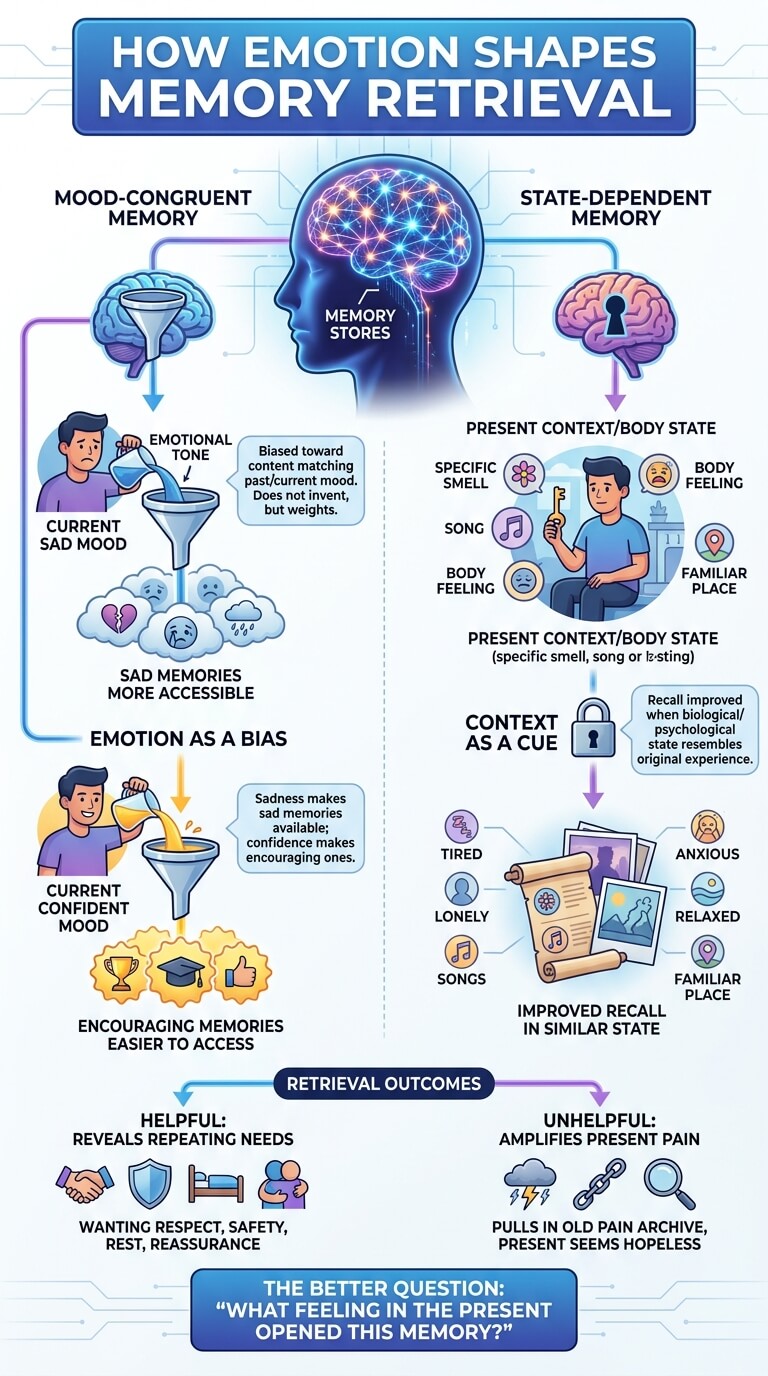
Retrieval is the process of bringing stored information back into awareness. Mood can influence retrieval by making memories with a similar emotional tone feel easier to access. An open-access review of mood-congruent memory describes the phenomenon as emotional memory being biased toward content that matches a past or current mood.
This is why sadness may make sad memories feel more available, while confidence may make encouraging memories easier to access. It does not mean the mood invented the memory. It means the current emotional state may change which memories come forward first and how much weight they seem to carry.
Why a current feeling can bring back old memories
A current feeling can act like a cue. You might feel ignored in a conversation and suddenly remember other times you felt invisible. You might feel proud after finishing a hard project and remember earlier moments of growth. The mind often retrieves by association, not by calendar order.
This can be helpful when it reveals a repeating need, such as wanting respect, safety, rest, or reassurance. It can be unhelpful when one current feeling pulls in a whole archive of old pain and makes the present seem more hopeless than it really is. The key question is not, “Why am I remembering this?” The better question is, “What feeling in the present opened this memory?”
Why context and body state matter
Memory is often easier to access when something about the present resembles the past. That resemblance may be a place, smell, song, facial expression, time of year, body state, or mood. The APA Dictionary describes state-dependent memory as improved recall when a person is in a similar biological or psychological state to the one present during the original experience.
This helps explain why you may remember certain things when you are tired, lonely, anxious, relaxed, or back in a familiar place. The body can become part of the retrieval environment. Sometimes a memory returns not because you chose it, but because the present gave the mind a similar cue.
Why Bad Memories Can Come Back So Easily
Strong emotion can highlight some details while making others harder to access, which helps explain why people forget things during stressful or emotionally loaded moments.
Negativity and threat learning
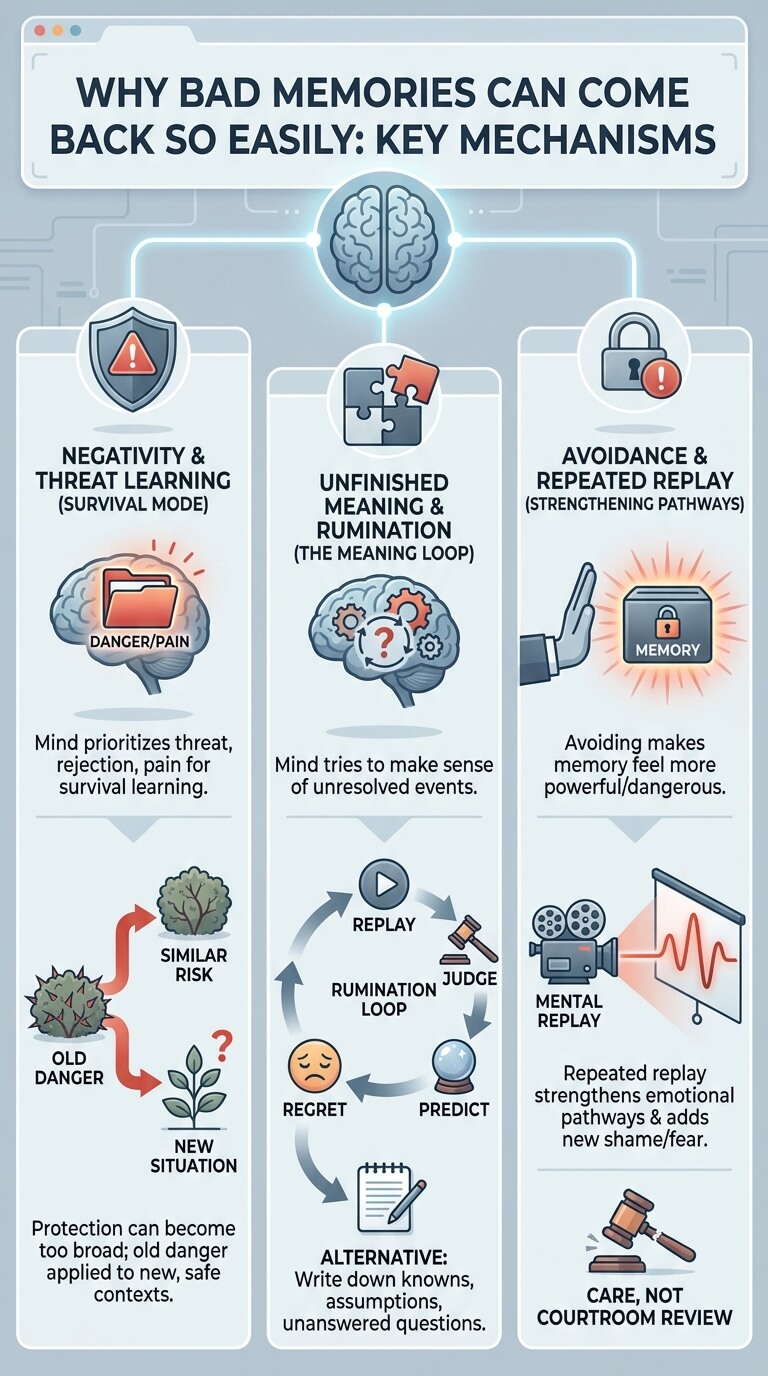
Bad memories often return easily because the mind treats threat, rejection, pain, and humiliation as important learning material. From a survival perspective, remembering danger matters. If something hurt before, the mind may keep it accessible so you can notice similar risk earlier next time.
This does not mean every painful memory is useful in the present. A memory that once helped you learn may later become overactive. You may react strongly to a tone, setting, phrase, or silence because it resembles an older experience. The mind is trying to protect you, but protection can become too broad when old danger gets applied to new situations without enough checking.
Unfinished meaning and rumination
Some memories come back because the mind is still trying to make meaning from them. You may replay a conversation because you never understood why it happened. You may revisit an embarrassing moment because you are still trying to decide what it says about you. You may return to a painful ending because part of you is still searching for a different explanation.
Rumination can feel like problem-solving, but it often repeats the same loop: replay, judge, predict, regret, replay again. If the memory does not produce new information, the next helpful step is usually not more analysis. It may be writing down what is known, what is assumed, and what question cannot be answered from memory alone.
Avoidance, reminders, and repeated mental replay
Avoiding a memory can sometimes make it feel more powerful. When a person pushes a memory away every time it appears, the mind may learn that the memory is dangerous to even notice. This can make the reaction stronger when a reminder appears.
Repeated mental replay can also strengthen the emotional pathway around a memory. Each replay may add new interpretations, new shame, or new fear. This is one reason it helps to notice when remembering has turned into rehearsing pain. The memory may need care, but it may not need another hour of courtroom-style review.
Why Positive Memories Can Feel Powerful Too
When an emotional memory becomes part of a person?s life story, it begins to overlap with autobiographical memory.
Nostalgia and connection
Emotional memory is not only about pain. Positive memories can carry comfort, identity, and connection. Nostalgia often blends warmth with longing, and it can bring the past into the present in a way that feels meaningful. Research on nostalgia has linked it with self-reflection, autobiographical memory, emotion regulation, and reward-related processes in the brain. One brain-imaging study on nostalgia-related activity found patterns involving systems connected with memory, emotion, reward, and self-reflection.
That is why a childhood meal, a song from a certain year, an old message, or a familiar street can feel emotionally rich. The memory is not just about the object. It is about the self that existed there, the people connected to it, and the meaning attached to that time.
Meaning, identity, and belonging
Positive emotional memories often tell us who we have been and what has mattered. A memory of being helped may support the belief that connection is possible. A memory of completing something difficult may remind you that effort can change your life. A memory of belonging may become a reference point during loneliness.
These memories can be grounding when they are used gently. They become less helpful when they turn into a demand that the present should feel exactly like the past. A positive memory can comfort you without requiring you to recreate the same life stage, relationship, or version of yourself.
Why comfort memories can regulate mood
Comfort memories can help regulate mood because they give the mind a felt example of safety, love, competence, or relief. This is not the same as pretending current problems do not exist. It is a way of reminding the nervous system that the present feeling is not the whole story.
A useful comfort memory is usually specific: the porch light at home, a friend laughing with you, the sound of rain during a peaceful morning, the look on someone’s face when they were proud of you. Specificity gives the mind something concrete to hold. The memory works less like a motivational quote and more like a small, lived piece of evidence.
Emotional Memory vs Vivid Memory
Emotional memories often feel vivid, but memories that feel unusually clear are not always perfectly accurate.
Strong feeling vs clear imagery
An emotional memory is defined by the feeling attached to it. A vivid memory is defined by how clear, detailed, or image-like it feels. The two often overlap, but they are not the same. You can have a strong emotional memory that is fuzzy in detail. You can also have a vivid memory that is emotionally mild, such as remembering the layout of a classroom.
| Question | Emotional memory | Vivid memory |
|---|---|---|
| Main feature | The memory carries strong feeling or meaning | The memory feels clear, detailed, or image-like |
| Common trigger | Mood, body state, personal meaning, emotional cue | Novelty, repetition, imagery, sensory detail, surprise |
| Risk | The feeling may color interpretation | Clarity may be mistaken for accuracy |
| Useful question | What feeling is attached to this? | Which details are clear, and which are assumed? |
Why vivid does not always mean accurate
A memory may feel clear because it has been repeated often, because it carries strong emotion, or because it fits a powerful story about what happened. Clarity is meaningful, but it is not the same as proof. People can be confident about details that later turn out to be incomplete or shaped by later interpretation.
This is especially important with shame, fear, and regret. When a memory is both vivid and painful, the mind may treat it as a complete verdict: “Everyone judged me,” “I ruined everything,” or “That moment proves who I am.” A gentler and more accurate approach is to separate the image, the feeling, the known facts, and the meaning you added later.
When vividness is the better question
If the main thing bothering you is not the emotion itself but how clear the memory feels, then the better question may be why some memories feel so detailed. That question is more about imagery, repetition, surprise, and confidence. Emotional memory is more about how feeling marks experience and influences recall.
In real life, both questions can matter. A memory can be vivid because it was emotional, and emotional because it was vivid. Separating the two keeps you from assuming that intensity, detail, and accuracy are all the same thing.
Emotional Memory and Memory Bias
When current emotion changes which memories feel available, the issue overlaps with memory bias.
How mood colors interpretation
Emotion can influence not only what you remember, but how you interpret what you remember. When you feel rejected, older memories of rejection may seem more central. When you feel safe, older memories of support may become easier to believe. This is part of why memory and mood can reinforce each other.
One open-access review on memory and emotional disorders discusses how mood-congruent recall can make memories matching the current emotional context easier to retrieve. This does not mean emotions are dishonest. It means emotions can filter attention toward certain parts of the past, especially when the present already feels emotionally loaded.
Why shame and fear can exaggerate meaning
Shame often turns a memory into a statement about the self. Fear often turns a memory into a warning about what could happen again. Both reactions can be understandable, but they can exaggerate meaning. A mistake becomes “I am incompetent.” A rejection becomes “I am not wanted.” A bad conversation becomes “I am never safe being honest.”
It helps to ask whether the memory is showing you a fact, a feeling, a lesson, or a fear prediction. Those are not the same. A fact might be, “I forgot my lines.” A feeling might be, “I felt exposed.” A lesson might be, “I need more preparation next time.” A fear prediction might be, “Everyone will always think I am foolish.”
How to separate feeling from fact gently
Separating feeling from fact should not be used to dismiss yourself. The point is not to say, “I should not feel this.” The point is to give the memory enough structure that it stops swallowing the whole present moment.
| Part of the memory | Helpful question | Example |
|---|---|---|
| Known fact | What would a camera or transcript show? | They said, “We need to talk about the mistake.” |
| Feeling | What emotion came up in my body? | I felt ashamed and tense. |
| Meaning | What did I decide it meant? | I thought they no longer respected me. |
| Missing information | What do I not actually know? | I do not know what they thought afterward. |
| Present cue | What triggered this memory today? | Someone used a similar tone in a meeting. |
What to Do When an Emotional Memory Keeps Returning
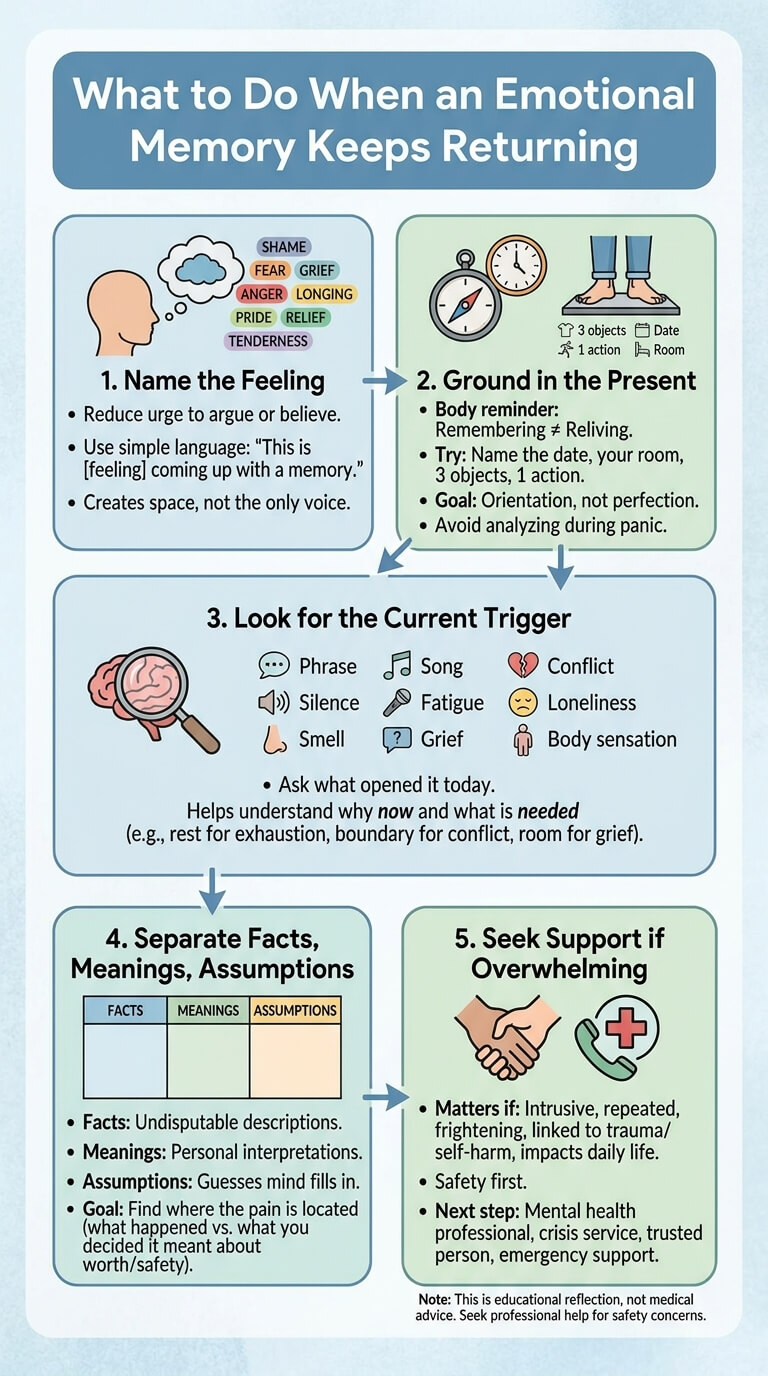
Name the feeling before analyzing the memory
When a memory keeps returning, start by naming the emotion in simple language: shame, fear, grief, anger, longing, pride, relief, or tenderness. Naming the feeling can reduce the urge to immediately argue with the memory or believe every interpretation inside it.
You might say, “This is shame coming up with a memory,” or “This is fear attaching old evidence to a current situation.” That small shift creates space. The memory is still present, but it is no longer the only voice in the room.
Ground in the present moment
Grounding does not erase memory. It reminds the body that remembering is not the same as reliving. Try naming the date, the room you are in, three objects you can see, and one action you can choose next. Keep it plain. The goal is orientation, not perfection.
If the memory is intense, avoid forcing yourself to analyze it while your body is highly activated. Analysis during panic, shame, or strong fear often turns into looping. A first step might be water, movement, fresh air, a text to a steady person, or a few minutes of sensory grounding.
Look for the current trigger
Ask what opened the memory today. Was it a phrase, silence, a facial expression, a smell, a song, fatigue, rejection, conflict, loneliness, or a body sensation? The trigger can help you understand why this memory returned now instead of treating it as random.
Finding the trigger also helps you decide what is needed. If the trigger is exhaustion, rest may matter. If the trigger is a similar conflict pattern, a present boundary or conversation may matter. If the trigger is an anniversary, grief may need room instead of problem-solving.
Write facts, meanings, and assumptions separately
When a memory keeps affecting your mood, write three columns: facts, meanings, assumptions. Facts are the parts you can describe without guessing. Meanings are the personal interpretations attached to those facts. Assumptions are the parts you do not know but your mind keeps filling in.
This exercise is not meant to prove the memory wrong. It helps you find where the pain is located. Sometimes the pain is in what happened. Sometimes it is in what you decided it meant about your worth, safety, future, or identity.
Seek support if memories feel overwhelming
Support matters if memories are intrusive, repeated, frightening, linked to trauma, connected to self-harm thoughts, or making daily life hard to manage. The National Institute of Mental Health describes PTSD as involving symptoms such as flashbacks, recurring memories or dreams, and strong physical reactions after traumatic events. You do not need to diagnose yourself to decide that extra support would be wise.
If you feel unsafe, at risk of harming yourself, threatened by someone else, or unable to stay grounded, seek urgent support in your location. Educational reflection is not enough when safety is involved. The right next step may be a mental health professional, crisis service, trusted person, or emergency support.
FAQ About Emotional Memory Psychology
Why do painful memories come back randomly?
Painful memories may feel random because the cue is not obvious. The trigger might be a tone of voice, time of year, body state, smell, mood, or current situation that resembles the earlier experience. The memory may also return because the mind is still trying to understand what happened or protect you from something similar.
Can emotions change how I remember the past?
Yes, emotions can influence what comes to mind, which details feel important, and how you interpret the meaning of an event. This does not mean your memory is fake. It means memory is shaped by attention, feeling, context, and later understanding. Strong emotion can preserve some parts while making other parts less clear.
Why do embarrassing memories feel so intense?
Embarrassing memories often carry shame, social threat, and self-judgment. The mind may replay them because belonging and acceptance matter to humans. The memory can feel intense even if other people barely remember the event. A helpful question is, “What did I fear this moment proved about me?”
Are emotional memories more accurate?
Not automatically. Emotional memories can be easier to access and may preserve central details, but strong feeling does not guarantee exact accuracy. Emotion can narrow attention, strengthen meaning, and increase confidence. It is wise to respect the feeling while still checking details, context, and assumptions.
What can I do when a memory affects my mood?
Start by naming the feeling, grounding in the present, and noticing the trigger. Then separate known facts from meanings and assumptions. If the memory is mild, this may be enough to reduce its grip. If it is overwhelming, trauma-linked, or interfering with your daily life, support from a qualified professional can be an important next step.
Key Takeaways
- Emotional memory is memory for experiences that carry strong feeling, meaning, threat, comfort, or personal significance.
- Emotion can help the mind notice and retrieve important events, but it does not make every remembered detail perfectly accurate.
- Current mood can make memories with a similar emotional tone easier to access, which is why sad, anxious, or confident states can shape recall.
- Painful memories often return through cues such as tone, setting, body state, anniversaries, or unresolved meaning.
- Positive emotional memories can support identity, belonging, and comfort when they are used as grounding rather than escape.
- When a memory keeps returning, separate facts, feelings, meanings, and assumptions before deciding what the memory is telling you.
Final Thoughts
Emotional memory is one reason the past can feel close even when the event is over. The mind remembers not only what happened, but what it meant, how it felt, and what it seemed to require from you. That can be protective, comforting, painful, or confusing.
A useful first step is to treat the memory as information, not as a final verdict. Ask what feeling is attached, what present cue brought it back, what facts are clear, and what meaning may need gentler review. If the memory feels too intense to work with alone, support is not a failure of insight. It may be the safest and most practical next step.

Michael Reed is the Founder and Lead Writer at Psychology Exposed. He writes about human behavior, relationships, emotional patterns, self-awareness, and practical psychology topics using research-informed, easy-to-understand content.
Read More About Michael Reed: https://psychologyexposed.com/michael-reed/