

When you think about who you are, you probably do not start with a list of facts. You remember moments: a childhood room, a family story, an embarrassing mistake, a first success, a time you felt alone, a person who changed your direction, or a decision that still feels important. These memories do more than replay the past. They help you explain yourself to yourself.
Autobiographical memory psychology looks at how people remember personally lived experience. It is about birthdays, losses, turning points, ordinary routines, family stories, places, relationships, and the meanings people attach to them over time. Some memories become part of your identity. Others fade, return in a new way, or change meaning as you grow.
This does not mean your life story is fake, and it does not mean you can simply rewrite painful experiences by thinking differently. Personal memory is both grounded and flexible. It contains real experience, missing detail, later interpretation, emotion, and the self you are now. Understanding that mix can help you reflect on your past with more clarity and less harshness.
Quick Answer
Autobiographical memory is memory for your lived story
Autobiographical memory is memory for personal episodes and life information. The APA Dictionary of Psychology describes autobiographical memory as memory for episodes or experiences from one’s own life, and more broadly as memory for information about the self. In everyday terms, it is how your mind stores pieces of your life story.
It shapes identity but is not a perfect archive
Autobiographical memory helps you feel like the same person across time, but it is not a complete recording. It blends events, places, emotions, personal meanings, later reflection, and stories you have heard from others. A memory can be important to your identity while still being incomplete, selective, or influenced by your current view of yourself.
What Autobiographical Memory Means
Autobiographical memory often includes episodic memory, which is one of the important types of memory involved in remembering events, places, and personal experiences.
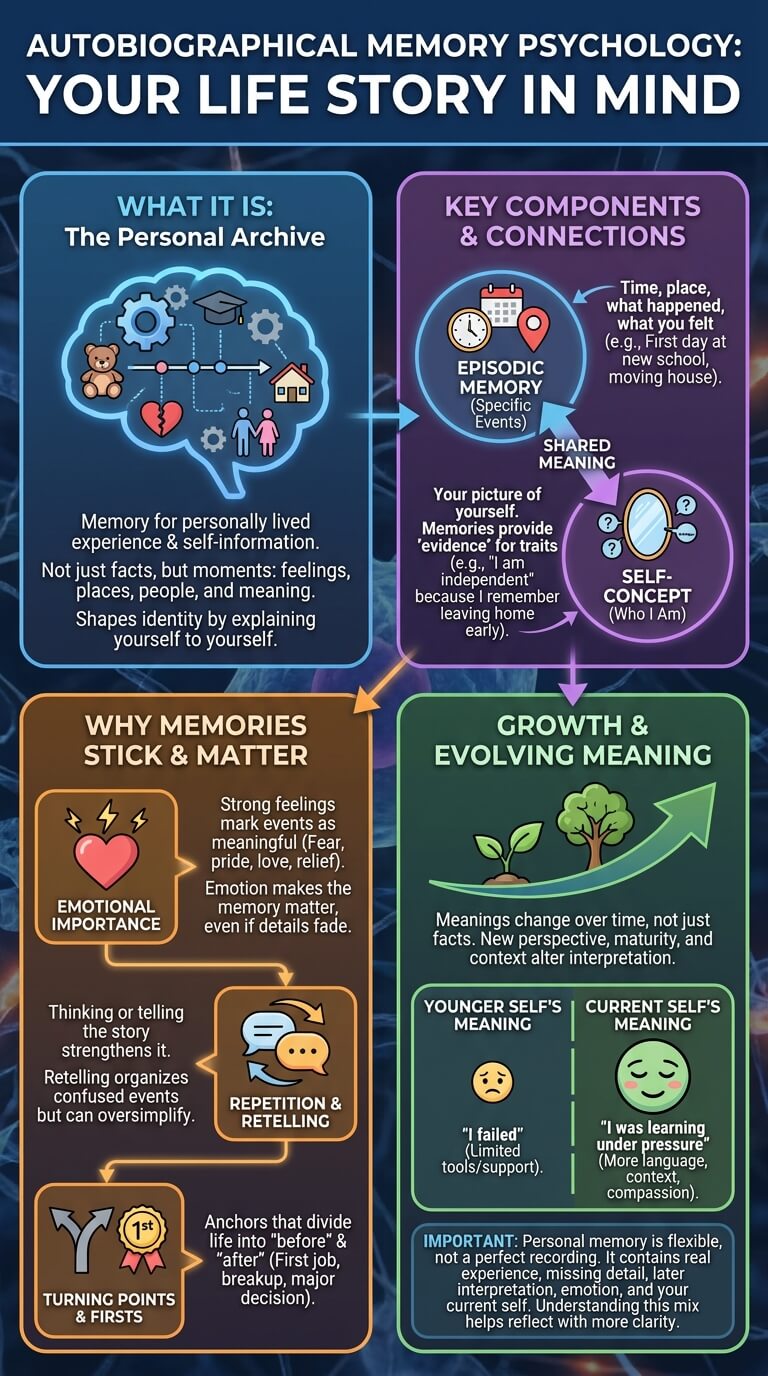
Personal events, time, place, and meaning
Autobiographical memories usually involve a sense of “this happened to me.” They may include a time, a place, people who were there, what you did, what you felt, and what the event came to mean. Remembering your first day at a new school is not only remembering a building. It may also include nervousness, the person who spoke to you, and the belief you formed about whether you belonged.
Some personal memories are specific episodes, such as the day you moved house. Others are repeated patterns, such as “family dinners were tense” or “summer meant staying with my grandparents.” Together, they form a personal background. You may not remember every dinner, every conversation, or every room, but you may remember the emotional shape of that period.
How it connects to episodic memory
Autobiographical memory often overlaps with episodic memory. The APA Dictionary defines episodic memory as the ability to remember personally experienced events linked to a particular time and place. If you remember where you were when you received important news, that is episodic in structure. It has a “what, where, and when” quality.
Autobiographical memory is broader because it also includes knowledge about your life. You may know the name of your first school without remembering a specific day there. You may know you were shy as a child because of repeated experiences, family descriptions, photos, and your own fragments of memory. Your life story uses both specific episodes and general knowledge about yourself.
How it connects to self-concept
Your self-concept is the picture you hold of who you are. The APA Dictionary describes self-concept as one’s description and evaluation of oneself, including qualities and characteristics. Autobiographical memory feeds that picture by giving it examples. You may think, “I am independent,” because you remember leaving home early, solving problems alone, or being praised for not needing much help.
The same process can also make old labels feel sticky. If you remember several times you were criticized for being “too sensitive,” you may carry that phrase into adulthood even when your current behavior is more nuanced. Personal memories can support identity, but they can also trap a person inside an old explanation that no longer fits.
Why Some Memories Become Part of Your Life Story
Turning-point memories often feel unusually clear, which connects to the question of why some memories feel so vivid.
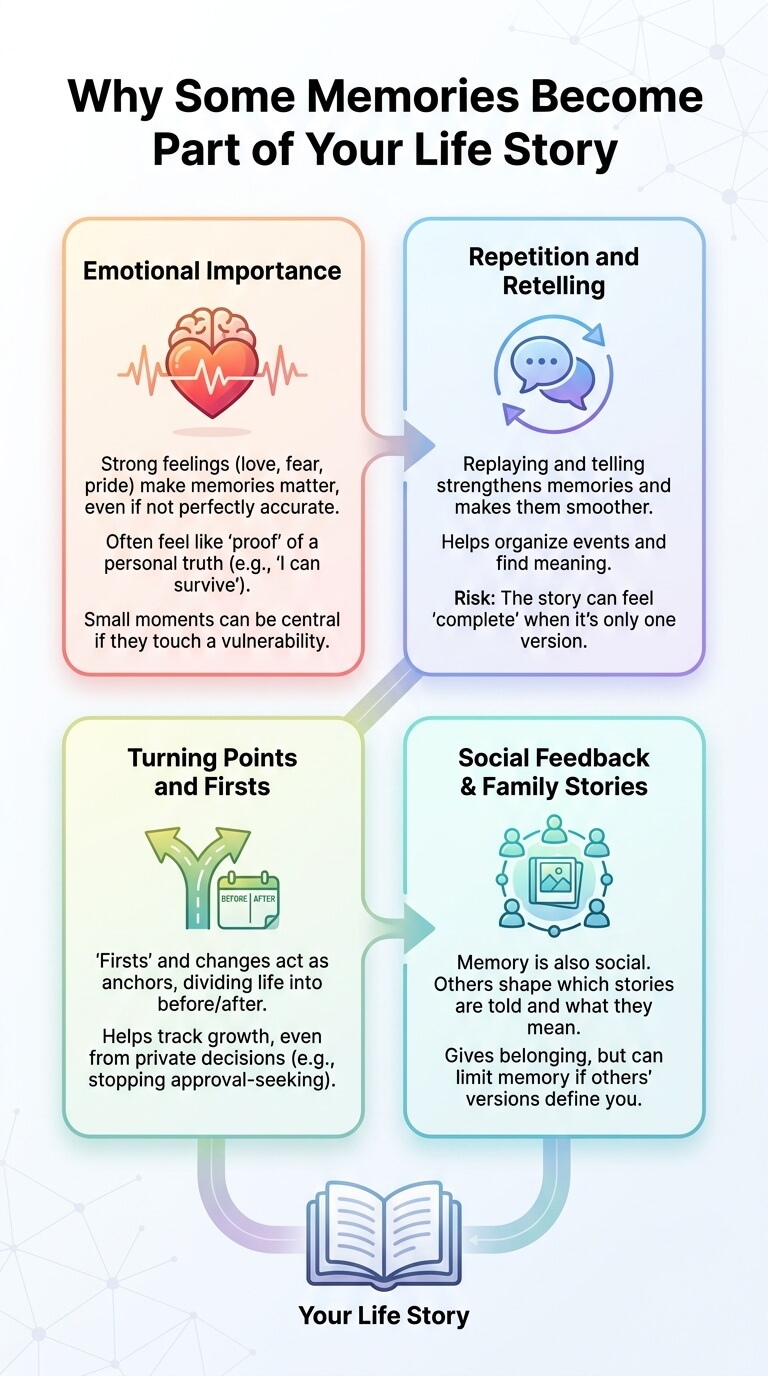
Emotional importance
Memories that carry strong feeling are more likely to feel personally meaningful. Fear, shame, pride, grief, love, relief, and belonging can mark an event as important. The event may become part of your story because it felt like proof of something: “I am safe with this person,” “I should not trust easily,” “I can survive change,” or “I do not belong there.”
Emotion does not make every detail accurate, but it does make the memory matter. A small moment can become central if it touched a vulnerable part of the self. A teacher’s encouragement may last longer than an entire school year. A careless joke may become memorable because it landed on an insecurity that was already there.
Repetition and retelling
Memories become stronger in a life story when they are repeated. Repetition can happen privately, through thinking and replaying, or socially, through telling the story to other people. Each retelling can strengthen certain details while leaving others behind. Over time, the story may become smoother than the original experience.
This is not always bad. Retelling can help organize a confusing event. It can help a person make meaning, notice growth, or feel less alone. The risk is that a repeated story can start to feel complete even when it is only one version. A family story, a personal failure story, or a “that was when everything changed” story may become so familiar that it stops being questioned.
Turning points and first-time experiences
Firsts and turning points often become autobiographical anchors. The first time you lived away from home, the first serious breakup, the first job, a move to a new city, a major illness, a public success, or a sudden loss may organize memory because it divides life into “before” and “after.” These memories matter because they help people track change.
A turning point does not need to be dramatic from the outside. It can be a private decision no one else noticed. You may remember the night you decided to stop chasing approval, the moment you realized a friendship was unequal, or the day you chose a different path. The mind often remembers moments that explain why the self changed direction.
Social feedback and family stories
Autobiographical memory is personal, but it is also social. Families, friends, cultures, and communities shape which stories are repeated, which are ignored, and which meanings are attached to them. A childhood memory may be partly yours and partly built from photos, family jokes, repeated descriptions, or stories told before you were old enough to understand them.
This can be comforting when shared stories give continuity and belonging. It can also be limiting when other people’s version of you becomes the main version you remember. If your family always told the story of you as “the difficult one” or “the responsible one,” you may remember your past through that role even when the full truth was more complex.
How Autobiographical Memory Shapes Identity

The stories you use to explain yourself
People often explain themselves through remembered examples. “I do not like attention because I was embarrassed once in front of everyone.” “I became careful with money because we struggled when I was young.” “I care about fairness because I remember being blamed for something I did not do.” These statements connect memory to identity.
Research on narrative identity describes personal memories as part of how people create a coherent sense of self across time. One open-access paper on autobiographical memory and life narratives discusses how translating memories into personal narratives can help shape identity. The key idea for everyday life is simple: the memories you repeat often become the stories you live from.
Why one event can become a label
One event can become a label when it gets treated as proof of a lasting trait. You fail one exam and decide, “I am not smart.” You freeze in one conflict and decide, “I am weak.” You make one brave choice and decide, “I am someone who can handle hard things.” The memory becomes more than an event. It becomes evidence in a personal case about who you are.
| Memory | Possible label | A more flexible interpretation |
|---|---|---|
| I froze during a presentation. | I am bad under pressure. | I was overwhelmed in one high-pressure moment and may need preparation and practice. |
| I left a relationship that hurt me. | I always give up. | I made a boundary decision in a difficult situation. |
| I was praised for being independent. | I should never need help. | Independence is a strength, but support can still be healthy. |
| I was ignored as a child. | My needs do not matter. | That experience hurt, but it does not define the value of my needs now. |
How growth can change the meaning of old memories
Growth does not erase the past. It can change the meaning you attach to it. A memory that once meant “I failed” may later mean “I was learning without enough support.” A memory that once meant “I was rejected” may later mean “I was in a place that could not meet me well.” The event stays, but the interpretation becomes more spacious.
This is one reason personal memory can change without becoming dishonest. Your younger self understood the event with the tools available at the time. Your current self may have more language, context, and compassion. A changed meaning does not cancel the original feeling. It gives the memory a wider frame.
Why Personal Memories Change Over Time
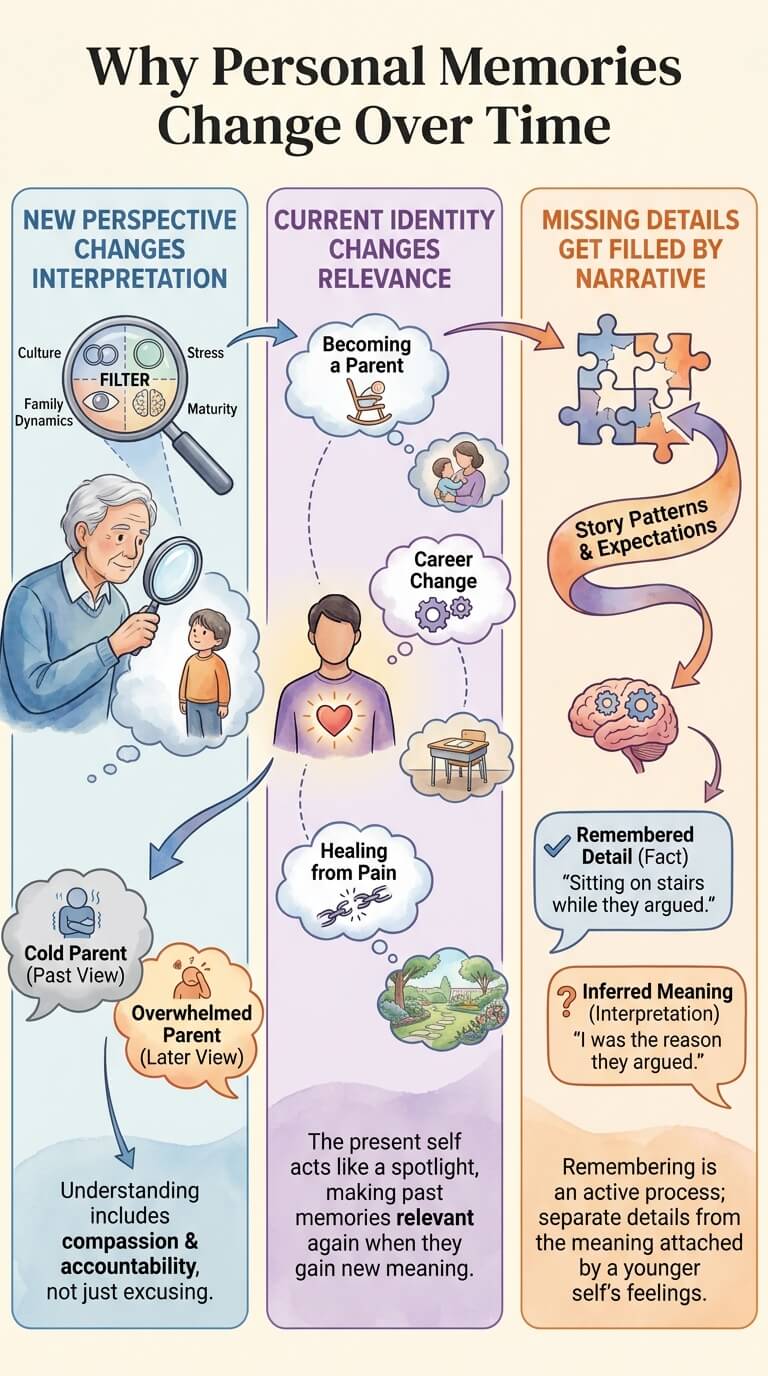
New perspective changes interpretation
As people age, they gain new information. They learn about family dynamics, culture, stress, money, illness, personality, maturity, and other people’s limits. Those new perspectives can change how older memories are understood. A parent who seemed cold may later be seen as overwhelmed. A childhood fear may later be understood as a response to instability.
Perspective can soften a memory, but it can also sharpen it. Sometimes adulthood reveals that something was more unfair, unsafe, or emotionally painful than you could name at the time. Understanding is not the same as excusing. A more mature interpretation can include compassion, accountability, grief, and boundaries at the same time.
Current identity changes what feels relevant
The self you are now affects which memories stand out. When you become a parent, memories of being parented may return. When you change careers, old memories of confidence or discouragement may become important. When you heal from a painful relationship, memories that once felt normal may look different.
This is why people sometimes say, “I had not thought about that in years.” The memory may not have disappeared. It may not have felt relevant until your current life gave it new meaning. Autobiographical memory is partly organized around the concerns of the present self.
Missing details get filled by narrative
Personal memories rarely contain every detail. When details are missing, the mind often fills gaps with what makes sense. It may use later knowledge, common story patterns, emotional expectation, or what other people said happened. This does not mean you are lying. It means remembering is an active process.
A helpful habit is to separate remembered detail from inferred meaning. “I remember sitting on the stairs while they argued” is different from “I was the reason they argued.” The first may be a memory. The second may be an interpretation attached to a younger self’s fear or confusion.
Childhood Memories and the Self
Why early memories can feel meaningful
Early memories can feel meaningful because they seem close to the beginning of the self. A first friendship, a first fear, a family ritual, or a repeated childhood role may feel like a clue to who you became. People often return to early memories when trying to understand patterns in adulthood.
At the same time, early memories should be handled with care. A childhood memory may reveal something important about how you felt, what you needed, or what stood out to you. It may not provide the whole context. Children remember from inside a child’s understanding, not from an adult’s full view of the situation.
Why childhood memory is often incomplete
Many people have patchy childhood memory. That can happen for ordinary reasons, including age, time, attention, language development, lack of repeated recall, and the way family stories were or were not discussed. Not remembering everything does not automatically mean something terrible happened. It means childhood memory is often incomplete by nature.
Some gaps may feel neutral. Others may feel unsettling, especially if the person senses that certain years were confusing, stressful, or emotionally heavy. If gaps are connected to distress, fear, intrusive memories, or daily functioning problems, gentle professional support may be more useful than trying to force memory on your own.
Family stories, photos, and later interpretation
Photos and family stories can help memory, but they can also reshape it. A photo may make a moment feel more vivid than it was before. A repeated family joke may turn a complicated event into a simple label. A parent’s version may become part of your memory even if your own experience felt different.
When reflecting on childhood, it helps to hold multiple layers: what you personally remember, what you were told, what photos show, what you felt, and what you understand now. These layers do not need to collapse into one perfect account. Sometimes the most honest statement is, “I know this memory matters, but I do not know every detail.”
Autobiographical Memory vs Emotional Memory
Life story vs emotional charge
Autobiographical memory is about personally lived experience and the story of the self. Emotional memory is about how feeling marks an experience and makes it easier or harder to revisit. The two overlap often, but they are not identical. A memory can be autobiographical because it happened to you, even if it is emotionally mild.
| Question | Autobiographical memory | Emotional memory |
|---|---|---|
| Main concern | How this event fits into my life story | How the feeling attached to this event affects recall |
| Common example | Remembering your first apartment | Feeling fear or pride when that period comes to mind |
| Useful reflection | What does this say about who I became? | What feeling returns with this memory? |
| Common risk | Turning one event into a fixed identity label | Treating emotional intensity as proof of every detail |
How the two overlap
A memory often becomes central to identity because it was emotional. A painful rejection, a proud achievement, a comforting relationship, or a frightening transition may become part of your life story because the feeling was strong. The emotion tells the mind, “This mattered,” and the life story tries to explain why.
Still, it helps to ask two separate questions. First: What happened, and how does it fit into my story? Second: What feeling is attached, and how does that feeling influence my current interpretation? This separation keeps reflection from becoming either cold analysis or emotional certainty.
When emotion is the main question
If the main issue is that a memory keeps coming back with a strong body reaction, fear, shame, grief, longing, or distress, the emotional side may need more attention than the life-story side. The question may not be “What does this say about who I am?” It may be “What feeling is my mind still carrying, and what does my body need now?”
That distinction matters because identity reflection can become too heavy when the nervous system is activated. Sometimes the first step is not meaning-making. It is grounding, support, rest, safety, or naming the emotion simply.
Autobiographical Memory and Memory Bias
The stories people tell about their past can also be shaped by memory bias, especially when shame, nostalgia, or self-protection changes what feels most important.
Self-protective stories
Memory can protect the self by highlighting some parts of the past and softening others. You may remember the times you were wronged more clearly than the times you contributed to a conflict. You may remember how hard you tried more than how someone else experienced your behavior. This does not make you a bad person. It means memory often supports the self’s need to feel coherent and acceptable.
Self-protective stories can be useful when they preserve dignity after a painful experience. They become limiting when they block learning. A balanced story can say, “I was hurt,” and also ask, “Is there anything I now understand differently?”
Shame-based stories
Shame can push memory in the opposite direction. Instead of protecting the self, it may turn many memories into evidence against the self. A neutral silence becomes “they disliked me.” A mistake becomes “I always ruin things.” A conflict becomes “I am too much.” The memory is no longer one event. It becomes a courtroom where the self is always guilty.
When shame is present, it helps to slow the story down. What are the known facts? What did you feel? What did you assume other people thought? What did you decide it proved about you? Shame often hides in the meaning layer, not only in the event layer.
Idealized stories about the past
Some autobiographical memories become idealized. A past relationship, childhood place, old friendship, or earlier version of yourself may seem simpler, kinder, or more complete than it really was. Idealizing the past can bring comfort, especially during change. It can also make the present feel unfairly poor by comparison.
A useful question is, “What did that time genuinely give me, and what was also hard about it?” This protects appreciation without turning the past into a perfect world. A mature life story can hold gratitude and complexity together.
Reflective Self-Check: How You Tell Your Story
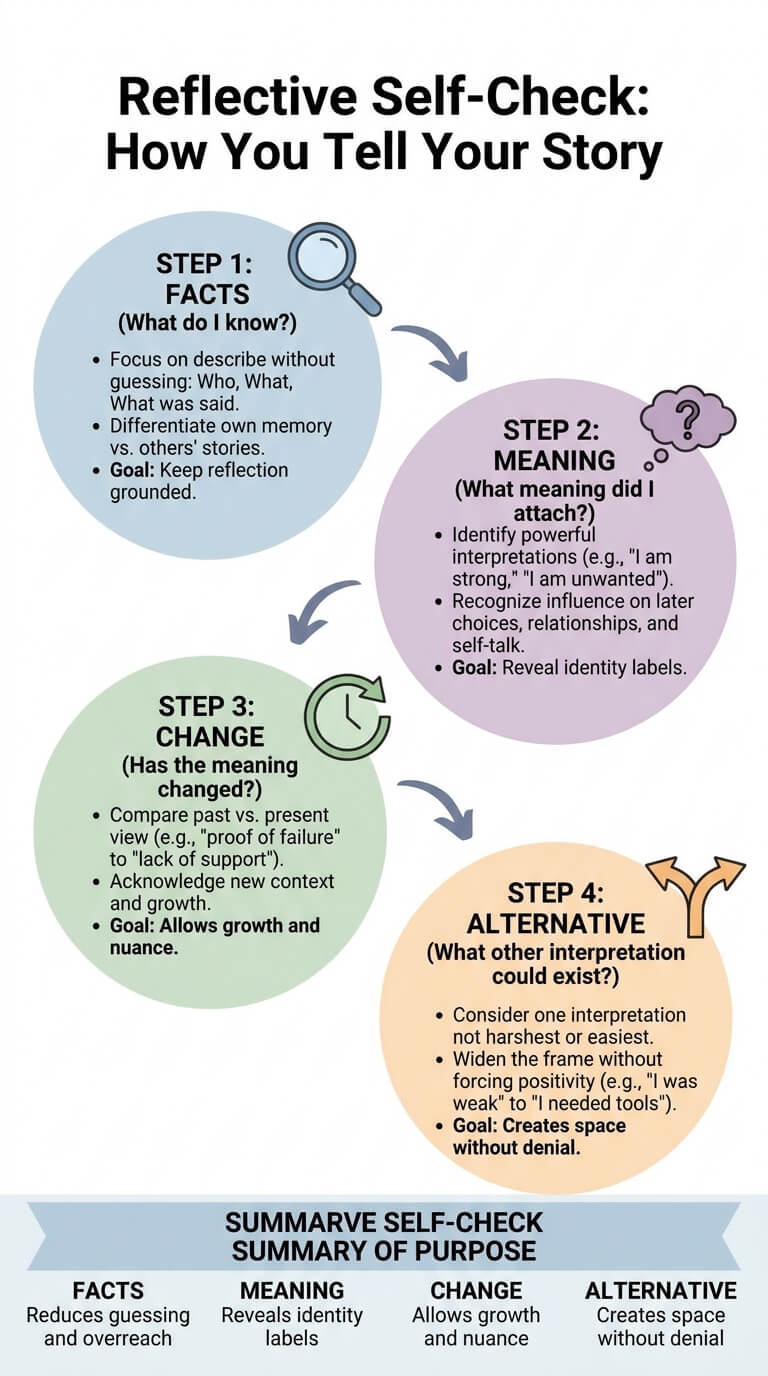
What facts do I know?
Start with the facts you can describe without guessing. Who was there? What happened? What was said? What do you know from your own memory, and what do you know from someone else’s story? This step keeps reflection grounded.
What meaning did I attach?
Next, name the meaning. Did the memory come to mean “I am strong,” “I am unwanted,” “I cannot trust people,” “I have to perform,” or “I can begin again”? Meanings are powerful because they travel beyond the original event. They influence later choices, relationships, and self-talk.
Has the meaning changed?
Ask whether the memory means the same thing now that it meant then. Maybe it once felt like proof of failure, but now looks like a lack of support. Maybe it once felt like freedom, but now you also see avoidance. A changed meaning does not make the earlier meaning stupid. It shows that you have more context now.
What other interpretation could exist?
Finally, consider one interpretation that is not the harshest or the easiest. You do not have to force positivity. You are simply widening the frame. “I was abandoned” might become “I was left without enough explanation, and that hurt.” “I was weak” might become “I did not have the tools I needed yet.”
| Reflection step | Question to ask | What it helps with |
|---|---|---|
| Facts | What do I actually remember? | Reduces guessing and overreach |
| Meaning | What did I decide it said about me? | Reveals identity labels |
| Change | Does my current self see it differently? | Allows growth and nuance |
| Alternative | What else could be true? | Creates space without denial |
When Personal Memories Feel Heavy
Distressing memories and identity pain
Some memories do not feel reflective. They feel heavy, intrusive, shame-filled, or hard to put down. A person may feel trapped by a past event, haunted by a version of themselves, or unable to imagine an identity not organized around pain. When memory affects sleep, relationships, mood, safety, or daily functioning, it deserves care.
Research on memory and the self has also explored how autobiographical memory supports self-concept. One open-access article on memory and self-concept discusses how personal knowledge can help support a stable sense of self. When memories feel painful or fragmented, the issue is not weakness. It may mean the person needs support, steadiness, and room to make sense of experience safely.
When support may help
Consider support if memories feel overwhelming, trauma-linked, connected to self-harm thoughts, or tied to fear, threats, humiliation, coercion, or danger. The National Institute of Mental Health provides education on coping after traumatic events and notes that people may need help when reactions are intense or do not ease over time.
You do not need to diagnose yourself before asking for help. If a memory is repeatedly pulling you into distress, a qualified mental health professional can help you approach it with more safety than forced reflection alone. If you feel at immediate risk of harming yourself or being harmed by someone else, seek urgent local support or emergency help.
FAQ About Autobiographical Memory Psychology
Why do I remember some life events more than others?
You may remember some life events more because they were emotionally important, repeated often, tied to a turning point, connected to identity, or retold by other people. Memory gives priority to what feels meaningful, not only to what happened most recently or most often.
Can personal memories change meaning?
Yes. A personal memory can change meaning as you gain new context, mature, learn more about yourself, or understand other people differently. The event may stay the same, but the story around it can become more nuanced. This is not the same as pretending the past did not hurt.
Are childhood memories reliable?
Childhood memories can be meaningful, but they are often incomplete. They may include genuine fragments, later interpretation, family stories, photos, and emotional impressions. It is wise to respect what the memory tells you about your experience while staying careful about details you cannot confirm.
How does memory shape identity?
Memory shapes identity by giving you examples of who you believe you are, what you have survived, what you value, and how you explain your choices. When certain memories are repeated often, they can become self-defining. That can support confidence, but it can also keep painful labels alive.
Can changing my self-story help?
It can help when “changing the story” means adding truth, context, compassion, and flexibility. It is not helpful when it means denying pain or forcing positivity. A healthier self-story usually does not erase hard memories. It gives them a wider frame so they are not the only evidence for who you are.
Key Takeaways
- Autobiographical memory is memory for personally lived experience and information about the self.
- Personal memories shape identity because they become examples people use to explain who they are.
- A memory can be meaningful without being a perfect recording of every detail.
- Childhood memories may include real fragments, family stories, photos, and later interpretation.
- Old memories can change meaning as your current self gains more context and compassion.
- If memories feel overwhelming, trauma-linked, or connected to safety concerns, support matters more than analyzing them alone.

Michael Reed is the Founder and Lead Writer at Psychology Exposed. He writes about human behavior, relationships, emotional patterns, self-awareness, and practical psychology topics using research-informed, easy-to-understand content.
Read More About Michael Reed: https://psychologyexposed.com/michael-reed/