
Spoken language feels as if it arrives in neat units. You hear a sentence, recognize the words, and usually do not notice how much variation the sound contains. In reality, speech reaches the ear as a rapidly changing acoustic signal. Word boundaries are often not marked by silence, neighboring sounds overlap, speakers differ from one another, and the same person changes pronunciation with speed and context.
Speech perception psychology asks how listeners turn that unstable signal into usable linguistic information. The central puzzle is not simply hearing sound. It is recognizing sound as speech despite variation. That distinction matters because understanding whether a voice sounds warm, tense, confident, or sarcastic is a different psychological question from identifying the linguistic units being spoken.
Quick Answer

Speech perception is the cognitive process of mapping a variable acoustic signal onto useful linguistic categories and candidates. Listeners combine multiple cues from timing, frequency patterns, context, prior experience, and sometimes visible mouth movements. The process is flexible rather than a perfect sound-to-letter translation, which helps explain why people can understand fast speech, adapt to unfamiliar accents, and recover meaning in noisy conditions.
Speech Is a Moving Signal, Not a String of Separate Sound Tiles
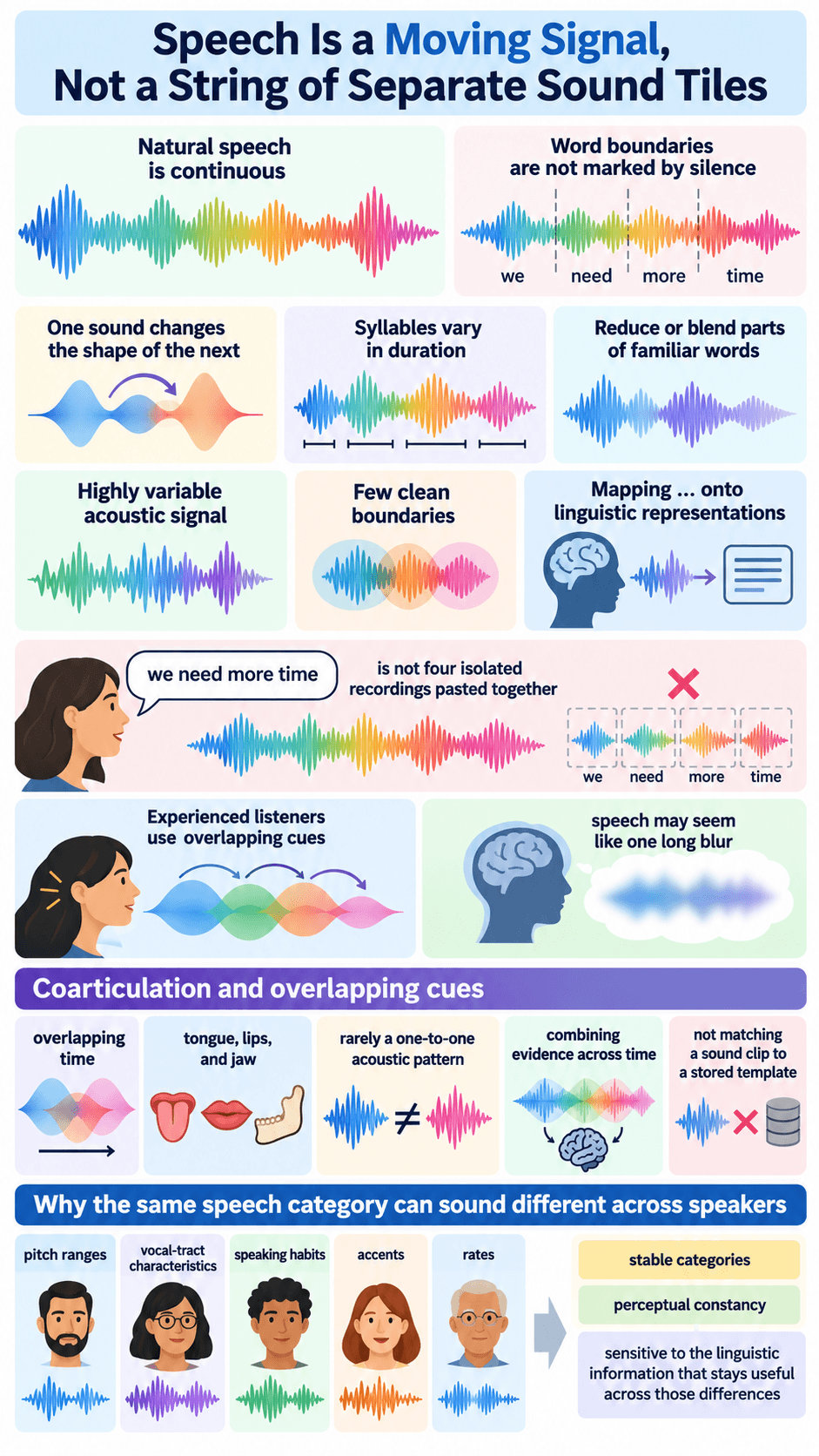
A printed sentence contains spaces. Natural speech usually does not provide equivalent acoustic spaces between every word. Instead, speech is continuous. One sound changes the shape of the next, syllables vary in duration, and a speaker may reduce or blend parts of familiar words. Yet listeners usually experience the result as stable enough to understand.
A useful starting point is the idea that speech perception involves mapping a highly variable acoustic signal onto linguistic representations. A tutorial review in Psychonomic Bulletin & Review describes speech perception as a categorization problem in which acoustically different signals can still be treated as functionally equivalent speech units. That does not mean the ear throws away all fine detail. It means the system must find useful regularities in a signal that never repeats in exactly the same way.
Why spoken language has few clean boundaries
If you look at a waveform of ordinary conversation, you do not see a neat visual gap after every word. The sentence “we need more time” is not produced as four isolated recordings pasted together. The movements used to produce the words flow into one another, and the listener has to infer where useful units begin and end.
This is one reason a familiar language can sound surprisingly fast to a beginner. Experienced listeners have learned many overlapping cues that help them segment the stream. When those cues are unfamiliar, the speech may seem like one long blur even when every sound is physically audible.
Coarticulation and overlapping cues
Speech movements are planned and executed in overlapping time. The position of the tongue, lips, and jaw for one sound is influenced by what came before and what is coming next. This overlap is called coarticulation. It makes speech efficient, but it also means there is rarely a one-to-one acoustic pattern for a single phoneme that looks identical in every context.
For example, the acoustic details of a consonant can change depending on the vowel beside it. The listener therefore cannot depend on one fixed cue. Perception is more like combining evidence across time than matching a sound clip to a stored template.
Why the same speech category can sound different across speakers
Two people can pronounce the same word with different pitch ranges, vocal-tract characteristics, speaking habits, accents, and rates. Even the same person does not reproduce a word identically each time. Listeners still tend to hear stable categories because perception is calibrated to relationships among cues, not just absolute acoustic values.
This ability is sometimes described as perceptual constancy. The goal is not to erase differences between speakers. It is to remain sensitive to the linguistic information that stays useful across those differences.
A Simple Speech-Perception Model

For a general reader, one way to picture the process is:
ACOUSTIC SIGNAL → SPEECH CUES → CANDIDATE UNITS → CONTEXT → RECOGNITION
This sequence is a mental model, not a claim that the brain processes speech in five sealed boxes. Real speech perception is more interactive. Information at one level can change how ambiguous information at another level is interpreted, and different theoretical models disagree about exactly where those interactions occur.
ACOUSTIC SIGNAL → SPEECH CUES → CANDIDATE UNITS → CONTEXT → RECOGNITION
The acoustic signal contains changing patterns of energy over time. From that signal, listeners become sensitive to cues that help distinguish possible speech categories. Those cues support candidate units, such as possible consonants, vowels, syllables, or portions of words. Context can then make some interpretations more plausible than others.
The key word is candidate. Early speech information often supports more than one possibility. Recognition becomes more stable as additional evidence arrives.
Why the model is interactive rather than a perfect sound-to-letter conversion
Letters are a writing system. Speech existed before writing, and spoken-language perception does not require mentally converting every sound into a letter. A single spelling can also represent different pronunciations, while similar speech sounds can be spelled differently.
A more accurate idea is that listeners use acoustic patterns to activate learned linguistic possibilities. Written letters may influence how adults think about speech, but they are not the basic unit that the ear must reconstruct in real time.
What Counts as a Useful Speech Cue?
No single cue explains speech perception. Listeners draw on multiple kinds of information, and the importance of a cue depends on the language, the contrast, the speaker, and the surrounding context.
Timing, spectral information, and other acoustic patterns at an accessible level
Some speech contrasts depend partly on timing. Others depend more on the distribution of acoustic energy across frequencies, transitions between sounds, duration, or combinations of several cues. You do not need to identify these consciously. The perceptual system becomes sensitive to patterns that have been useful across experience.
This is why the same acoustic dimension can matter differently depending on context. Duration, for example, can carry linguistic information, but raw duration also changes when a speaker talks faster. Research on speaking-rate normalization shows that listeners interpret temporal cues relative to surrounding speech rather than treating an absolute duration as having one fixed meaning.
Phonetic categories and phonemes without turning this into a linguistics lesson
A phoneme is a language-specific sound category that can help distinguish words. In English, for example, changing the first sound of “bat” to the first sound of “pat” changes the word. Speech perception research often studies how listeners map continuously varying acoustic information onto such categories.
The important psychological point is that categories are useful abstractions. They help explain stable recognition, but listeners can remain sensitive to fine-grained acoustic differences within a category. Modern research does not require the assumption that every bit of speech is reduced to a rigid label before anything else happens.
How the Mind Finds Words in Continuous Speech

One of the most impressive parts of everyday listening is segmentation, the process of finding useful boundaries in a continuous stream. In normal conversation, there may be no silence exactly where one word ends and the next begins.
Segmentation when spaces are not audible
Listeners use combinations of clues. Stress patterns, familiar sound sequences, likely word forms, syntax, and broader context can all contribute. Research on multiple cues to speech segmentation shows that no single cue is perfectly reliable and that listeners can flexibly combine several sources of information.
Consider the phrase “an ice cold drink.” Depending on how it is spoken, boundaries between sounds can be less obvious than the spaces on the page suggest. Familiarity with English word patterns and sentence structure helps the listener settle on the intended segmentation.
Familiar patterns and contextual expectations
Context does not magically replace missing sound, but it changes the set of interpretations that make sense. If you hear “Please put the book on the…” the next sound is processed against a narrower range of likely continuations than if you heard it with no sentence context.
Experiments on lexical and sentence context show that ambiguous or masked speech can be interpreted differently when the surrounding linguistic information supports one candidate. The effect is especially useful when the signal is noisy or uncertain.
Why segmentation can be temporarily harder in unfamiliar speech
When the accent, dialect, or speaking style is unfamiliar, some of the cues you normally use may occur in different forms. Stress may fall differently, vowels may shift, or familiar sound sequences may be realized in an unexpected way. This can briefly increase processing effort.
That extra effort is not evidence that the speaker is producing “bad” language or that the listener has a deficit. It reflects a mismatch between current expectations and the speech patterns being heard. With exposure, listeners often recalibrate.
Why Speaker, Speed, and Accent Change Processing Demands
Speech perception must solve a moving-target problem. A useful cue in one speaker cannot always be interpreted with exactly the same absolute value in another speaker.
Speaker variability
Voices differ because bodies differ and speaking habits differ. The same vowel category, for example, can occupy different acoustic ranges for different speakers. Listeners gradually build an interpretation of the current talker and use that information to stabilize recognition.
This does not mean listeners consciously estimate the speaker’s anatomy. It means perception adapts to patterns in the input. Familiarity with a particular voice can make later recognition easier because the listener has more information about how that talker tends to produce speech.
Speaking-rate adaptation
Fast speech compresses durations and often increases reductions. Slow speech can stretch them. If listeners treated every duration literally, the same sound might be assigned to different categories simply because the speaker sped up.
Instead, listeners interpret timing relative to the rate around it. That relative adjustment helps preserve linguistic categories across changes in tempo. The system is not perfect, which is why an abrupt rate change can sometimes cause a moment of uncertainty before perception catches up.
Accent familiarity without deficit framing
An unfamiliar accent changes the relationship between what the listener expects and what the speaker produces. Early in exposure, recognition may take more effort or more context. Studies of perceptual adaptation to accented speech show that listeners can learn systematic accent patterns and adjust how they interpret later input.
Accents and dialects are normal language variation. Familiarity matters. A listener who struggles with a new accent on first contact may understand it much more easily after repeated exposure, and a listener raised with that accent may experience it as effortless from the start.
Categorical Perception: Useful Idea, Important Nuance
Speech perception is often introduced with the idea of categorical perception. The classic observation is that listeners can hear a sharp change in category even when the acoustic stimulus changes gradually. This helped researchers understand how continuous input can support apparently discrete linguistic judgments.
What category-like perception illustrates
Imagine a series of sounds changing in tiny steps from a clear “b” toward a clear “p.” Listeners may not describe every step as a unique sound. Instead, many steps are grouped as one category until a region where responses shift toward the other.
This is useful because language depends on treating many slightly different physical events as equivalent enough to serve the same linguistic function. A category allows variable pronunciations to count as the same meaningful contrast.
Why acoustic information does not map perfectly onto fixed phoneme boxes
The strongest version of categorical perception is too simple. Listeners can preserve detailed acoustic information even when they make a category judgment. Recent reviews have emphasized that speech perception is not adequately described as deleting all within-category detail.
A better picture is flexible categorization. Linguistic categories matter, but fine acoustic detail, context, uncertainty, and competing possibilities can remain available during processing.
When Context Helps the Ear
People often notice context most when the signal is unclear. A muffled word may suddenly become obvious after the next few words arrive. When you replay the same audio, the once-ambiguous segment can seem surprisingly clear.
Top-down information and candidate interpretation
Linguistic knowledge can bias the interpretation of ambiguous speech. In the classic Ganong-style finding, an acoustically ambiguous consonant is more likely to be categorized in a way that completes a real word rather than a nonword. Related work on phonemic restoration and supportive sentence context shows how surrounding language can help listeners construct a coherent percept when part of the signal is masked.
These findings are important because they show that speech perception is not a passive recording of sound. Prior linguistic knowledge changes which interpretation is favored when the evidence is incomplete.
Why context can guide recognition without replacing the signal
Context is not permission to hear anything at all. Strong acoustic evidence can override an expectation, and misleading context can produce temporary mistakes. The system combines bottom-up evidence from the signal with information about what is plausible in the current linguistic environment.
This balance explains why expectation is helpful but not infallible. It narrows uncertainty without guaranteeing the answer.
Seeing Speech as Well as Hearing It
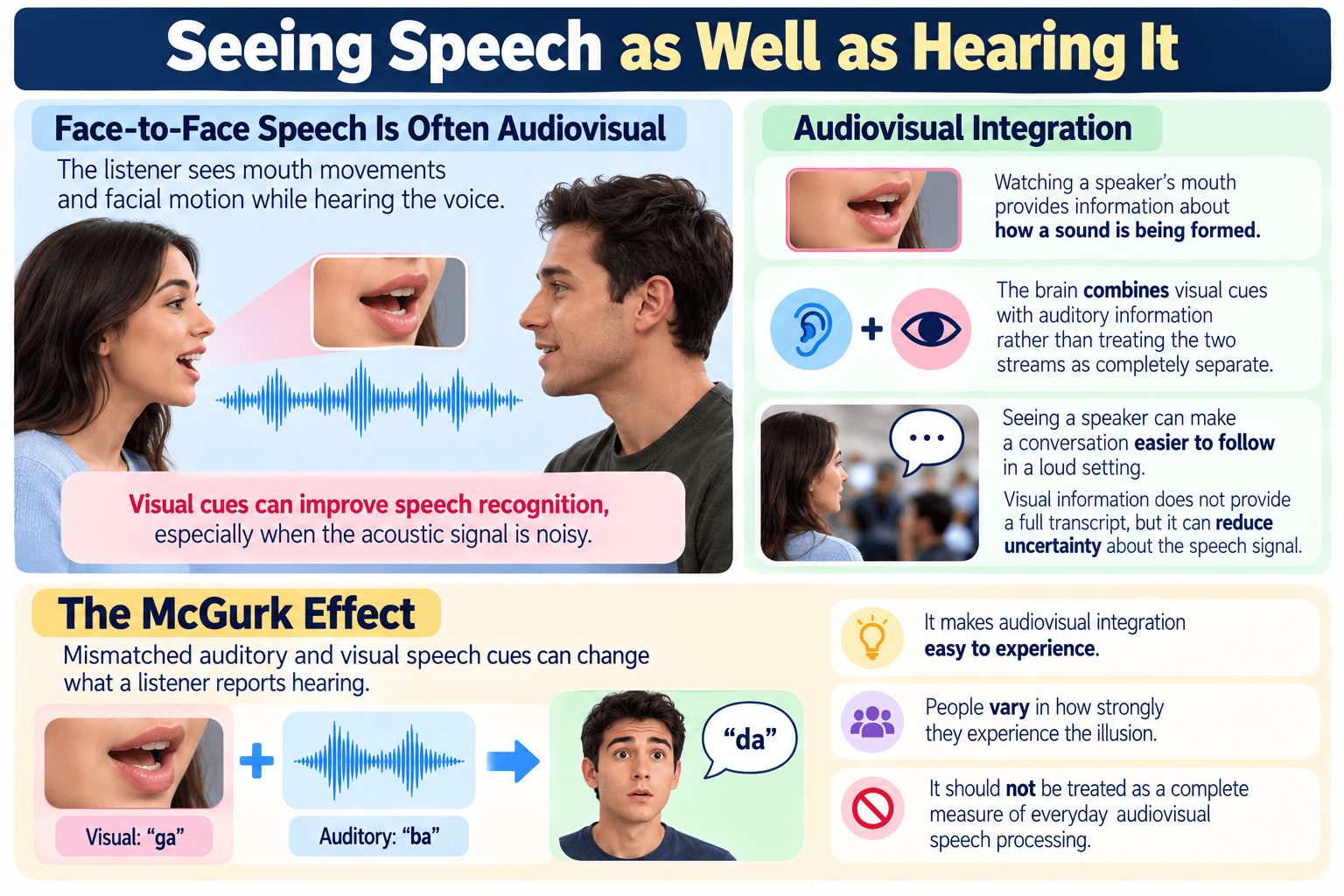
Face-to-face speech is often audiovisual. The listener sees mouth movements and facial motion while hearing the voice. Those visual cues can improve speech recognition, especially when the acoustic signal is noisy.
Audiovisual integration
Watching a speaker’s mouth provides information about how a sound is being formed. Some distinctions are visually informative, while others are not. The brain combines these visual cues with auditory information rather than treating the two streams as completely separate.
This is why seeing a speaker can make a conversation easier to follow in a loud setting. The visual information does not provide a full transcript, but it can reduce uncertainty about the speech signal.
The McGurk effect as one demonstration rather than the whole story
The McGurk effect occurs when mismatched auditory and visual speech cues change what a listener reports hearing. It became famous because it makes audiovisual integration easy to experience. However, a modern review on audiovisual speech perception beyond the McGurk effect cautions against treating one illusion as a complete measure of everyday audiovisual speech processing.
People vary in how strongly they experience the illusion, and natural conversation normally contains matching rather than deliberately conflicting audio and video. The broader lesson is that visible articulation can influence spoken-language perception.
Speech Perception vs Tone of Voice vs Word Recognition
| Question | Main focus | Typical example |
|---|---|---|
| Speech perception | How acoustic input becomes plausible linguistic speech units | How a changing sound pattern is heard as a consonant or syllable |
| Tone of voice | How vocal cues contribute to emotional or social meaning | Whether a voice sounds warm, tense, irritated, or playful |
| Word recognition | Which familiar lexical item the incoming form corresponds to | Whether the unfolding sound is recognized as “candle” rather than another candidate |
Linguistic recognition versus emotional and social vocal cues
Pitch, timing, intensity, and voice quality can contribute to both linguistic and social information, but the questions are different. Speech perception asks how the signal supports linguistic recognition. Tone-of-voice psychology asks how vocal cues shape interpretation of emotion, attitude, urgency, warmth, or interpersonal meaning.
Keeping those questions separate prevents a common mistake: assuming that because a vocal feature changes linguistic processing, it must reveal personality or emotion.
Acoustic-to-linguistic candidates versus familiar-word identification
Speech perception also stops short of the full word-recognition question. It explains how the signal becomes a plausible linguistic form. Word recognition asks which familiar lexical entry is being activated and selected as the speech unfolds.
In real listening the stages overlap. The distinction is still useful because it separates two different problems: making linguistic sense of the sound, then determining which known word best matches that evolving input.
Everyday Examples of Speech Perception Adapting in Real Time
The flexibility of speech perception becomes easier to see in ordinary moments. The same listener can move from effortful to fluent understanding as the signal, speaker, or context becomes more predictable.
Fast speech
You begin listening to someone who speaks faster than you expected. The first sentence feels compressed, but after a short time the pace becomes easier to follow. Your perceptual system has adjusted how it interprets duration and reduction patterns in that speaker’s speech.
Unfamiliar accent
A new accent initially requires concentration. After several minutes or repeated conversations, recurring sound patterns become more predictable. The speaker has not necessarily changed. Your expectations have become better matched to the speaker.
Noisy background
In a busy café, parts of words may be masked. You use the remaining acoustic signal, sentence context, and sometimes the speaker’s visible mouth movements to reduce uncertainty. If the noise becomes too strong, context cannot fully compensate, but it can help when the signal is incomplete rather than absent.
A word that becomes clear after later context
You hear “She bought a new…” followed by a muffled word. A moment later the sentence continues, “because the old refrigerator stopped cooling.” The earlier word may suddenly become easier to reinterpret as “fridge.” Later information has changed the plausibility of the candidates you were considering.
What to Notice First When Speech Feels Hard to Process
A difficult listening moment does not automatically tell you why it was difficult. Before drawing conclusions, separate the conditions around the speech from assumptions about the speaker or yourself.
Context, familiarity, signal quality, and speaking rate
- Signal quality: Was there background noise, echo, a poor microphone, or distance from the speaker?
- Familiarity: Was the voice, accent, dialect, or speaking style new to you?
- Speaking rate: Was the person speaking much faster or more softly than you expected?
- Context: Did you know the topic, or were you hearing isolated words with little support?
- Visual access: Could you see the speaker clearly, or were you relying on audio alone?
These factors can change listening effort without implying that anything is wrong. They are ordinary properties of the situation speech perception is trying to solve.
Why temporary effort does not by itself imply a disorder
Needing repetition in a noisy room, taking time to adapt to a new accent, or mishearing a fast phrase can happen in normal speech perception. An educational article cannot determine why a person experiences persistent or sudden difficulty understanding speech.
If a marked change in understanding spoken language is new, severe, or functionally disruptive, especially if it appears suddenly alongside other neurological symptoms, it deserves professional medical evaluation rather than self-diagnosis from ordinary listening examples.
When the Question Shifts to Familiar-Word Recognition
Speech perception does not end language comprehension. Once the incoming sound has been organized into plausible linguistic material, another problem comes forward: identifying which familiar word the unfolding form corresponds to.
From hearing speech to identifying a known word
Suppose an acoustic sequence has already been interpreted as plausible speech. The next question is which familiar word it matches. At that point, factors such as word frequency, lexical competition, familiarity, and the activation of similar word candidates become central.
That is a different level of explanation. Speech perception gives the system structured linguistic input. Word recognition asks which known lexical form wins out as the best match.
Where broader perception still matters
Speech perception is one specialized form of perception. It relies on general abilities to detect patterns, combine uncertain evidence, adapt to context, and integrate information across senses. What makes it distinctive is that the target is linguistic structure learned through a language community.
This is why speech perception belongs within both cognitive psychology and language psychology without becoming identical to auditory perception as a whole.
FAQ
These questions address common points of confusion about accents, spelling, audiovisual effects, and the role of context in spoken-language perception.
Why can unfamiliar accents take more effort at first?
Your perceptual expectations are tuned by prior experience. An unfamiliar accent can shift vowels, consonants, rhythm, stress, or other patterns away from what you predict. That mismatch can temporarily slow recognition. With exposure, listeners often learn the accent’s regularities and become faster. The extra effort reflects familiarity and adaptation, not a judgment about the quality of the accent.
Does speech perception work by matching sounds to letters?
No. Letters are symbols used in writing, while speech perception works with acoustic patterns and learned linguistic categories. Literate adults may think about speech through spelling, but spoken language can be perceived without converting every sound into a written character. The relationship between spelling and speech is also imperfect in many languages, including English.
What does the McGurk effect actually show?
It shows that visual speech information can influence what a person reports hearing when auditory and visual cues conflict. It is a striking demonstration of audiovisual integration, but it is not the whole of speech perception and it should not be treated as a universal score of someone’s ability to understand real conversation.
Can context change what speech sound I think I heard?
Yes, especially when the acoustic signal is ambiguous or degraded. Word and sentence context can bias which interpretation feels most plausible. Context does not freely overwrite strong acoustic evidence, but it can help resolve uncertainty and sometimes produce a different percept of an unclear sound.
Key Takeaways
- Speech arrives as a continuous, variable acoustic signal rather than a sequence of neatly separated units.
- Listeners combine timing, spectral patterns, learned categories, context, and sometimes visual information to recognize speech.
- Coarticulation, speaker differences, speaking rate, and accent make the signal variable, so perception must adapt rather than rely on fixed templates.
- Speech segmentation depends on multiple imperfect cues, not on audible spaces between every word.
- Categorical perception is useful for understanding stable linguistic judgments, but listeners can still preserve fine acoustic detail.
- Speech perception is distinct from reading emotional tone in a voice and from identifying which familiar word has ultimately been recognized.
Educational note: This article explains general cognitive processes involved in speech perception. It does not diagnose hearing, language, neurological, or developmental conditions.

Michael Reed is the Founder and Lead Writer at Psychology Exposed. He writes about human behavior, relationships, emotional patterns, self-awareness, and practical psychology topics using research-informed, easy-to-understand content.
Read More About Michael Reed: https://psychologyexposed.com/michael-reed/