
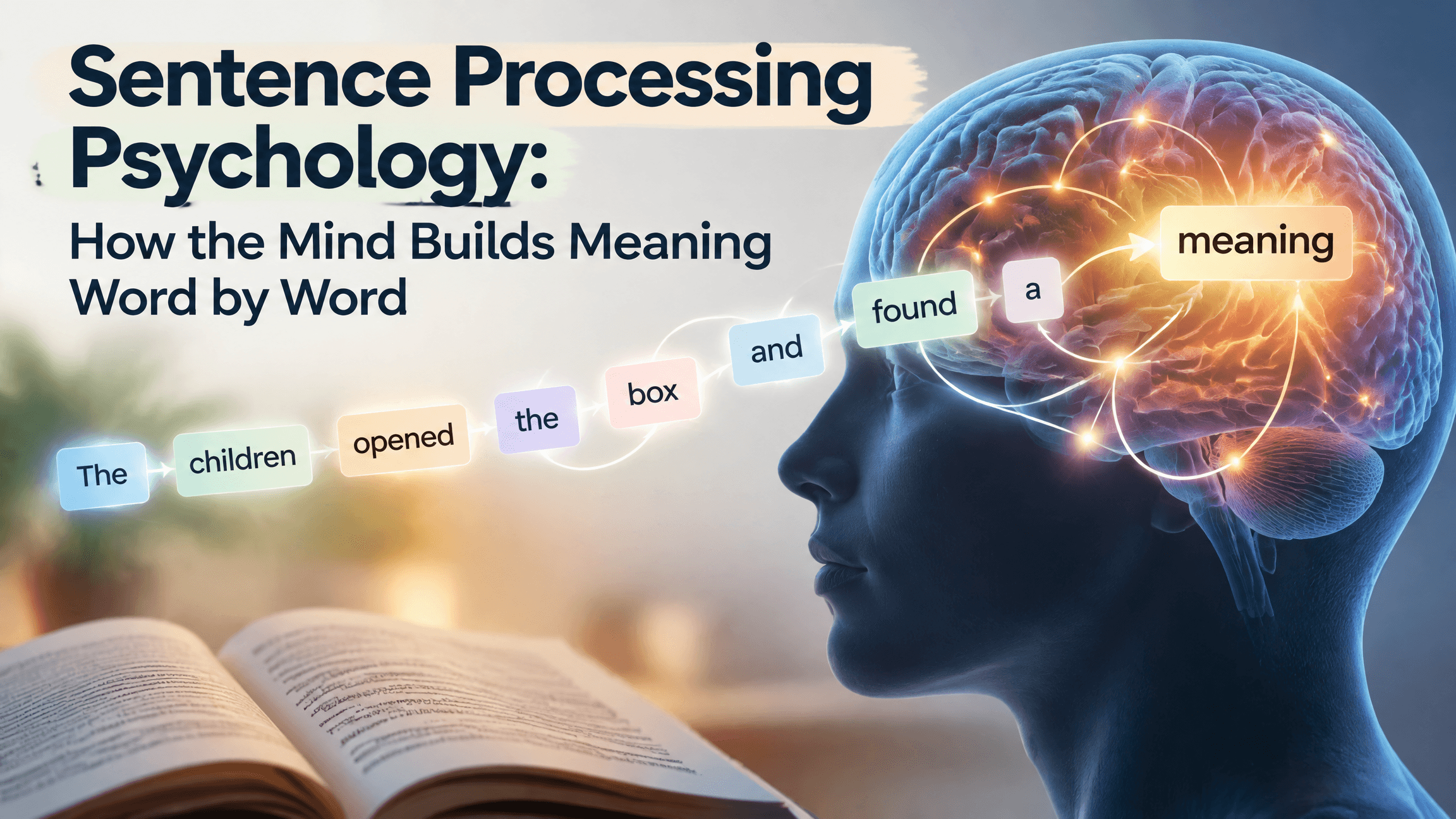
A sentence does not arrive in the mind as a finished package. Whether you are listening or reading, the words appear one after another. Yet you rarely wait for the final word before understanding anything. Instead, the mind begins building a likely interpretation almost immediately, then adjusts it as new information arrives.
This is the central problem studied in sentence processing psychology. The mind has to combine word meanings, word order, grammatical relationships, plausibility, and context while the sentence is still unfolding. Most of the time, this happens so quickly that the process is invisible. You notice it when a sentence is ambiguous, unexpectedly difficult, or forces you to go back and reinterpret what you first thought it meant.
Understanding sentence processing helps explain why word order matters, why some sentences are easy even when they are long, why others feel confusing despite familiar vocabulary, and why rereading can suddenly make a sentence clear. It also helps separate sentence-level comprehension from nearby topics such as word meaning, wider speaker intention, and general working memory.
Quick Answer
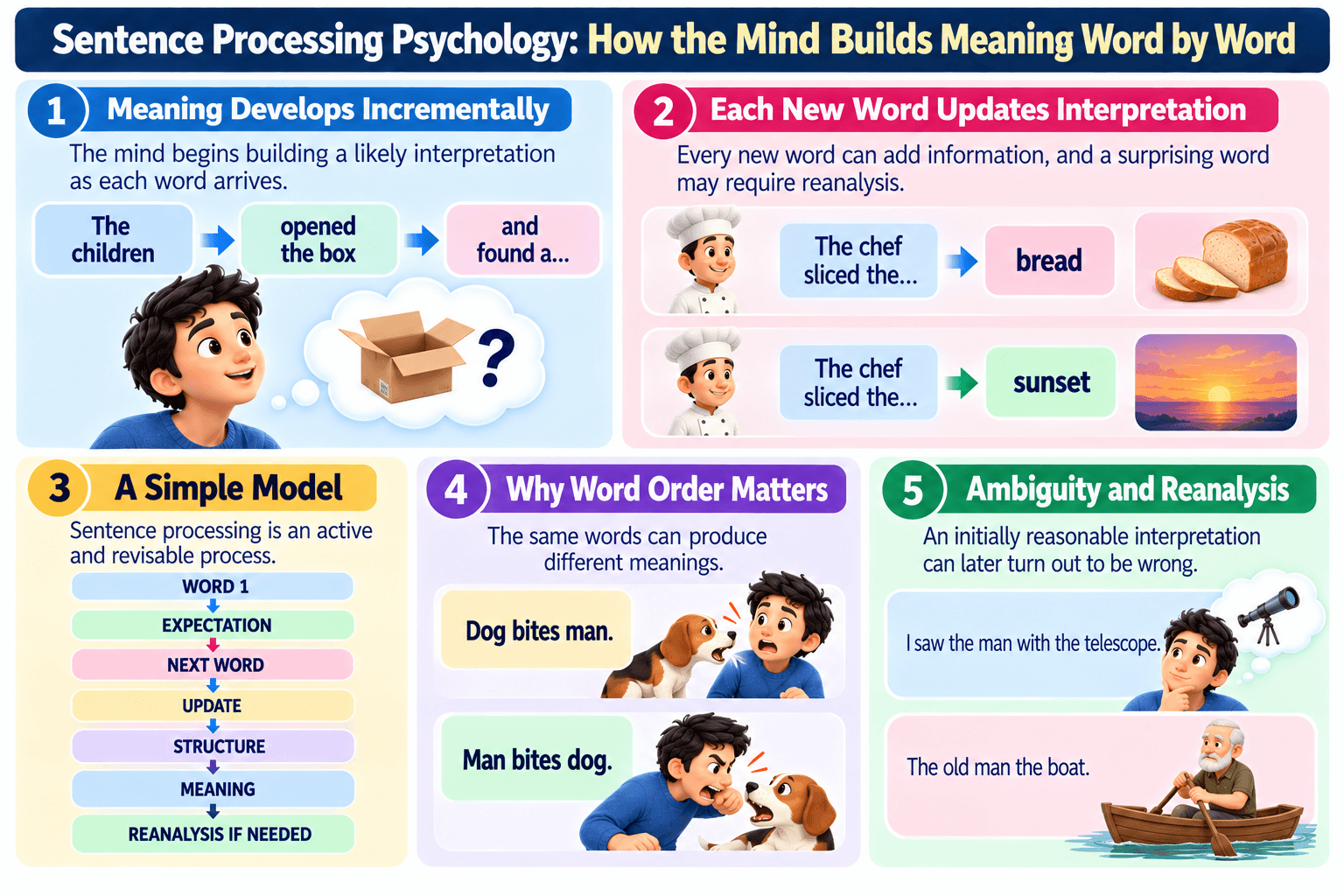
Sentence processing is the mental process of combining words into an evolving interpretation as a sentence unfolds. Readers and listeners use word meaning, syntax, order, plausibility, prior context, and learned language patterns to update what they think the sentence means. When later information conflicts with an early interpretation, the mind may need to revise or rebuild part of that interpretation.
Sentence Understanding Starts Before the Sentence Ends
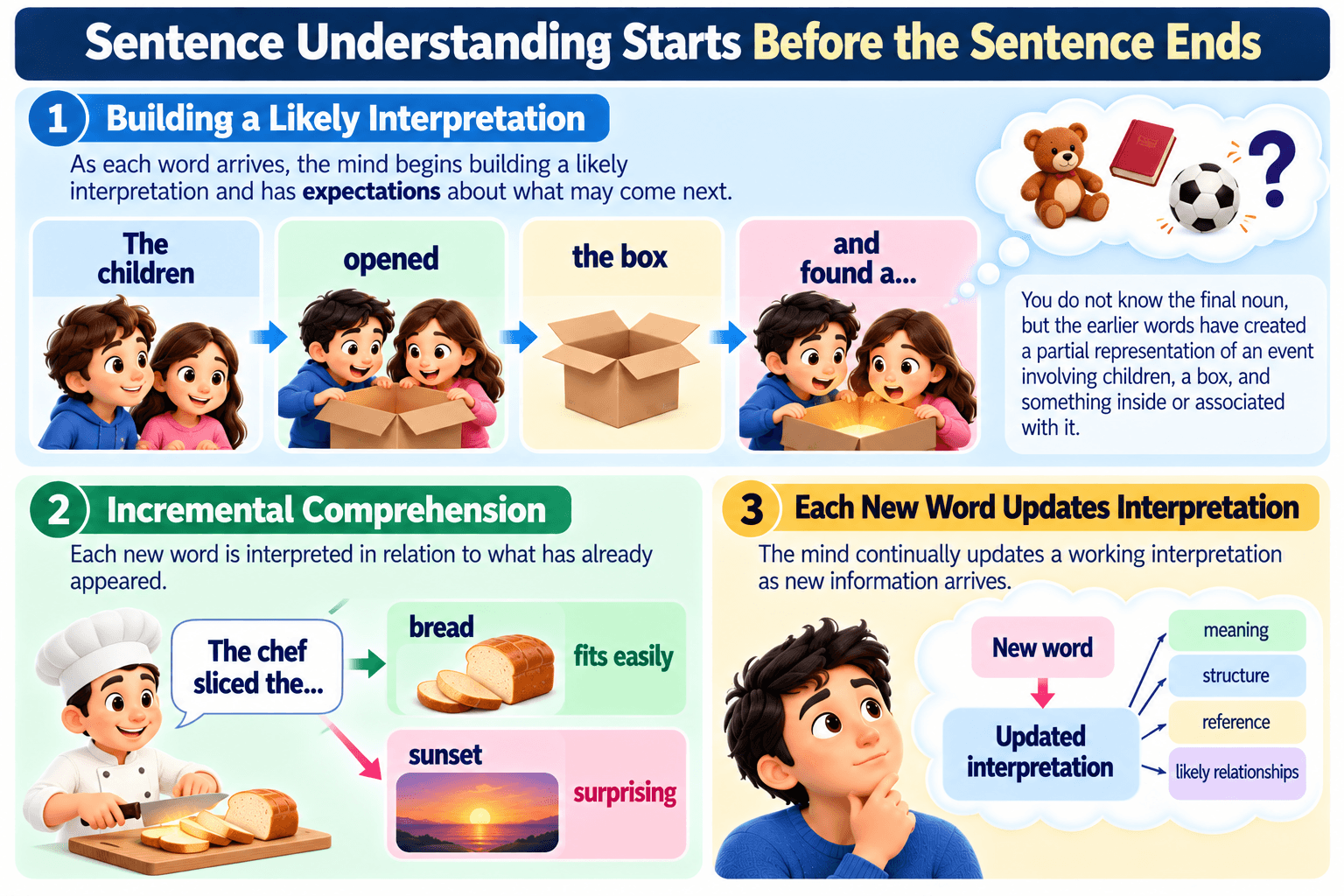
Consider the sentence, “The children opened the box and found a…” By the time you reach found a, you already have expectations about what may come next. You do not know the final noun, but the earlier words have created a partial representation of an event involving children, a box, and something inside or associated with it.
Research on incremental sentence processing supports the idea that people interpret sentences as information arrives rather than routinely waiting until the end. This makes comprehension efficient, but it also creates the possibility that an early interpretation will later need correction.
Incremental comprehension
Incremental comprehension means that each new word is interpreted in relation to what has already appeared. When you hear “The chef sliced the…,” the verb sliced makes certain kinds of objects more plausible than others. A word such as bread fits easily. A word such as sunset would be surprising and would force you to reconsider whether the sentence is metaphorical, unusual, or incomplete.
The same process operates with grammatical structure. A verb may make one type of continuation more expected than another. A noun phrase may initially appear to fill one role, then later words reveal that it belongs somewhere else in the structure. The interpretation is therefore provisional, not frozen.
Why each new word updates an active interpretation
Every new word can add information about meaning, structure, reference, or likely relationships. The important point is that the mind does not simply collect words and assemble them afterward. It continually updates a working interpretation.
This helps explain why a surprising word can slow reading or cause a pause in listening. The new input does not fit the current interpretation smoothly, so more processing may be needed to revise expectations, test another structure, or reconsider an earlier word.
A Reader-Friendly Sentence-Processing Model
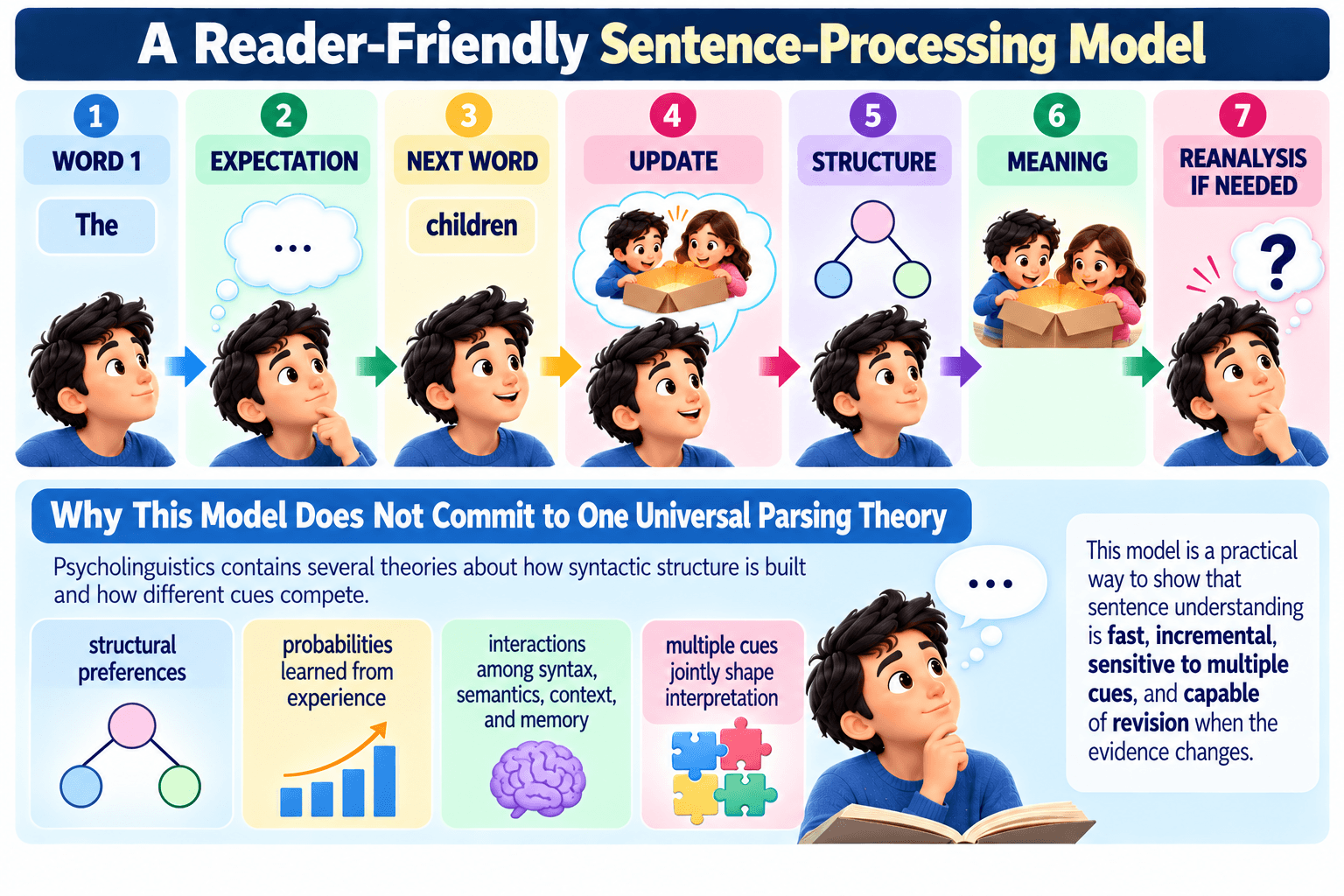
A simple way to picture the process is:
WORD 1 → EXPECTATION → NEXT WORD → UPDATE → STRUCTURE → MEANING → REANALYSIS IF NEEDED
This is not a literal sequence that must always happen in separate stages. It is a practical model for showing that comprehension is active and revisable. Meaning develops through repeated cycles of receiving input, comparing it with what is already active, and updating the interpretation.
Why this model does not commit to one universal parsing theory
Psycholinguistics contains several theories about how syntactic structure is built and how different cues compete. Some accounts emphasize structural preferences, some emphasize probabilities learned from experience, and others emphasize interactions among syntax, semantics, context, and memory. Research on constraint-based ambiguity resolution illustrates one influential approach in which multiple cues jointly shape interpretation.
For a general reader, the safest conclusion is not that one model has solved sentence comprehension completely. It is that sentence understanding is fast, incremental, sensitive to multiple cues, and capable of revision when the evidence changes.
Syntax, Word Order, and Grammatical Expectations
Knowing the meanings of individual words is not enough to understand a sentence. “Dog bites man” and “Man bites dog” contain the same three words, but the change in order changes who is doing what to whom. Sentence processing must therefore represent relationships among words, not just their separate meanings.
Structure as a set of relationships between words
Syntax describes how words and phrases are organized into relationships. During comprehension, the mind has to work out roles such as which noun is linked to a verb, which phrase modifies which object, and how clauses fit together.
These relationships matter because meaning often depends on them. In “The teacher praised the student,” the teacher is doing the praising. In “The student praised the teacher,” the same words are present, but the grammatical arrangement reverses the event.
Why grammatical expectations can guide interpretation
Language experience creates expectations about common structures. Some verbs are frequently followed by particular kinds of complements. Some word orders are more common than others. These regularities can guide comprehension before the sentence is complete.
Research on sentence processing suggests that syntactic probabilities can influence which structure is favored as words arrive. That does not mean a reader consciously calculates grammar statistics. It means repeated language experience can shape what interpretations become easier or more expected.
Why this is not a grammar lesson
Grammar instruction asks which forms are considered correct or how to construct sentences according to a set of rules. Sentence processing psychology asks a different question: what does the mind actually do in real time when it receives a sequence of words?
A person can process a structure without being able to name it. You do not need to identify a relative clause or describe a verb complement in order to understand one. The psychological question concerns the operation of comprehension, not the ability to explain grammatical terminology.
Semantics and Plausibility During Sentence Comprehension
Syntax is only part of the picture. Word meaning and real-world plausibility can support or challenge a structural interpretation. A sentence that is grammatically possible may still be difficult if the event it describes is unusual.
Word meaning entering the sentence
As each word is recognized, relevant semantic information becomes available. Those meanings have to be combined across the sentence. “The mechanic repaired the engine” creates a coherent event because the meanings and relationships fit familiar expectations.
But word meaning alone does not specify the entire sentence. The phrase “the old man” could initially be understood as a noun phrase referring to an elderly man. In a different continuation, man might function as a verb. Structure determines how the same familiar forms fit together.
Plausibility as a competing or supporting cue
Plausibility can help the mind decide among interpretations. If a sentence allows more than one structural analysis, an interpretation that creates a familiar, plausible event may gain an advantage. Other cues, however, can push in a different direction.
This is one reason sentence processing is better understood as cue integration than as simple rule matching. Syntax, meaning, frequency, and context can agree, or they can temporarily compete.
Imagine hearing, “The waitress served the customer with the…” Before the final noun arrives, more than one relationship is possible. If the sentence ends with tray, the phrase is likely to describe the instrument used for serving. If it ends with red hat, the phrase is more likely to identify which customer was served. The grammatical form does not change much, but knowledge about plausible events shifts the preferred interpretation.
This does not mean plausibility overrides grammar whenever the two disagree. Rather, it shows why researchers examine several cues together. A sentence can be structurally legal yet difficult because its event is unexpected, or semantically plausible yet temporarily confusing because the structure points elsewhere. The final interpretation emerges from how these signals interact over time.
What Happens When a Sentence Is Ambiguous?
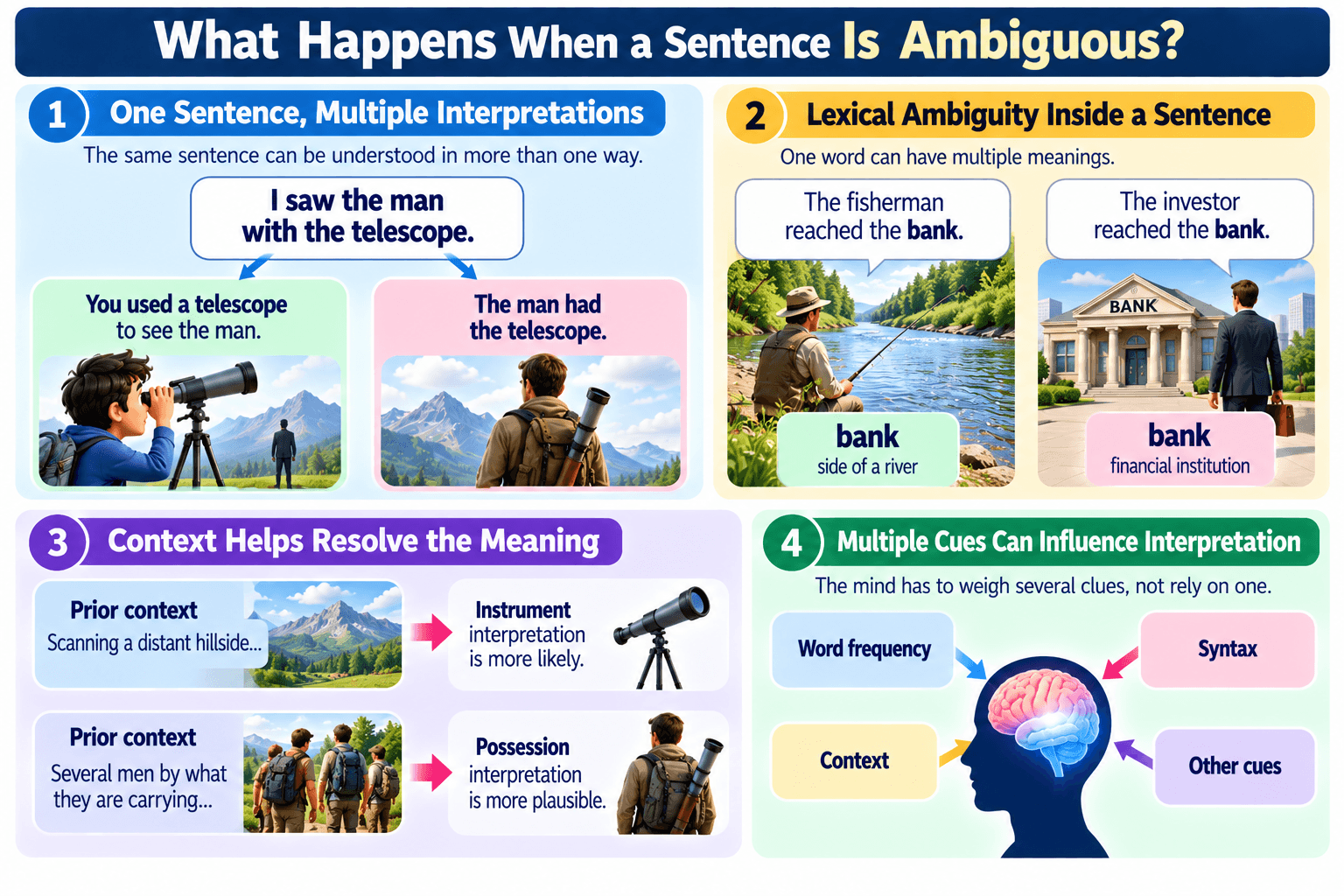
Ambiguity means that the available input is compatible with more than one interpretation. Sometimes the uncertainty comes from one word. Sometimes it comes from how several words could be grouped or connected.
Syntactic ambiguity
Consider: “I saw the man with the telescope.” One interpretation is that you used a telescope to see the man. Another is that the man had the telescope. The individual words are familiar, but the phrase with the telescope can attach to different parts of the sentence.
Context often resolves the uncertainty. If the previous sentence describes you scanning a distant hillside, the instrument interpretation becomes more likely. If the previous sentence identifies several men by what they are carrying, the possession interpretation becomes more plausible.
Lexical ambiguity inside a sentence
A sentence can also contain a word with multiple meanings. “The fisherman reached the bank” is compatible with a river interpretation, while “The investor reached the bank” favors a financial one. Sentence processing incorporates word-level meaning but does not stop there. It must integrate the selected meaning with the unfolding structure.
This is where semantic processing and sentence processing meet. The former helps make word meanings available. The latter combines them across a larger linguistic structure.
Multiple cues pointing toward different interpretations
Real ambiguity often involves several clues at once. Word frequency may support one interpretation, syntax may support another, and context may favor a third. The system has to weigh the available information rather than consult a single decisive cue.
This is why ambiguous sentences are useful in research. They reveal the hidden expectations that usually make comprehension feel effortless.
Garden-Path Sentences and Reanalysis
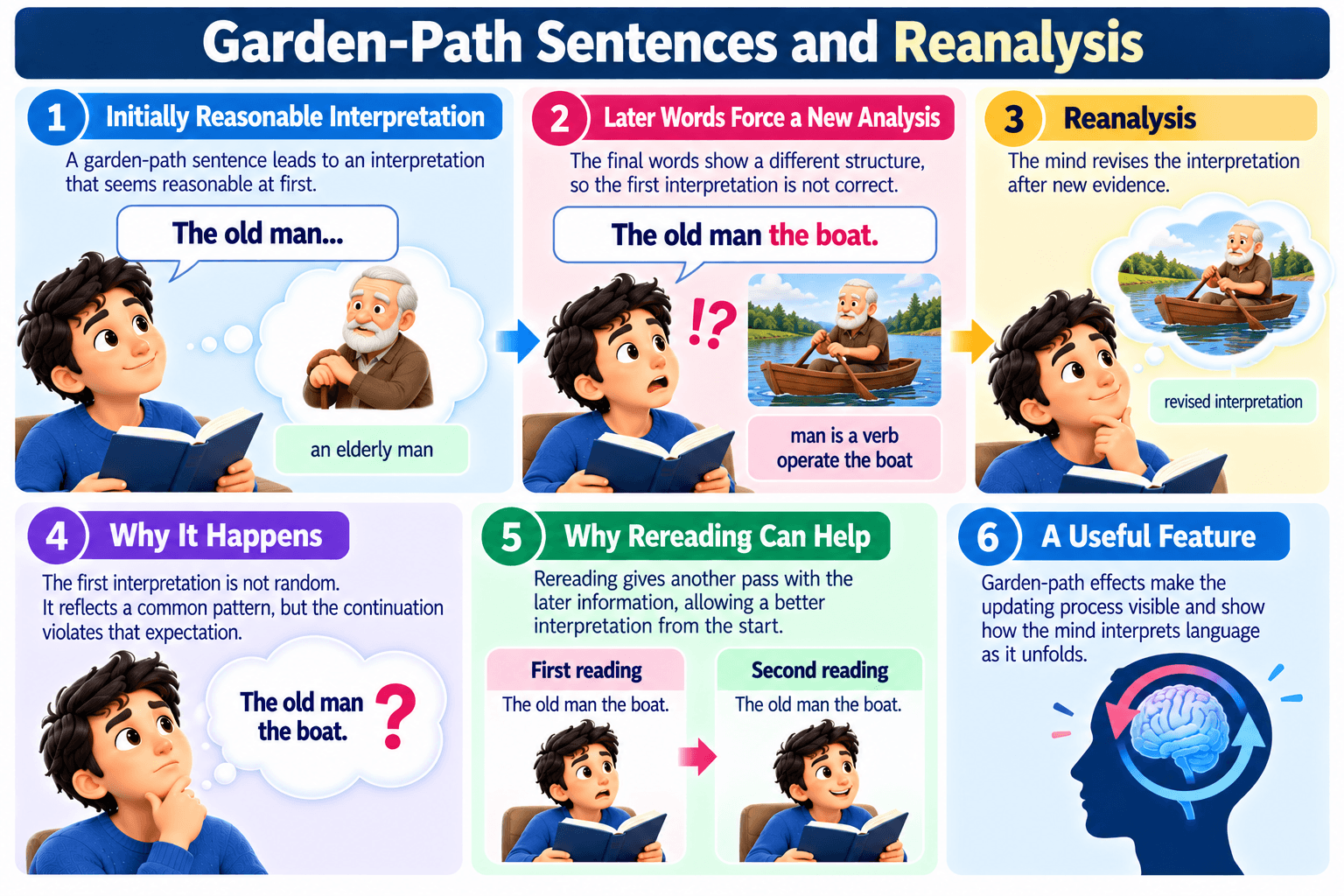
A garden-path sentence leads the reader toward an initially reasonable interpretation that later turns out to be wrong or incomplete. The temporary misunderstanding is useful because it makes the updating process visible.
Research on garden-path effects shows how earlier cues can create a preferred interpretation and how later words can require that interpretation to be reconsidered.
How an initially reasonable interpretation can fail
Take the classic form: “The old man the boat.” Most readers first treat the old man as a noun phrase meaning an elderly man. The final words force a different analysis: man is functioning as a verb, roughly meaning “operate” or “staff.”
The first interpretation was not random. It reflected a common pattern in English. The difficulty arises because the continuation violates that expectation.
Garden-path effects therefore reveal something useful about efficiency. A comprehension system that never committed to any likely interpretation might avoid some errors, but it would also lose the speed advantage of using regularities in the language. The occasional need to revise is part of the tradeoff created by interpreting language as it unfolds.
What reanalysis means psychologically
Reanalysis means revising some part of the interpretation after new evidence makes the current one inadequate. The mind may need to assign a word a different grammatical role, attach a phrase somewhere else, or reinterpret the relationship between earlier elements.
Research describing syntactic revision emphasizes that sentence structure can be updated retrospectively when later input changes which interpretation fits best. In ordinary reading, this may appear as a brief pause, a feeling that something sounded wrong, or a return to the beginning of the sentence.
Why rereading can help
Rereading gives the system another pass with information that was unavailable during the first pass. On the second reading, you already know the disambiguating word or unusual structure, so the earlier material can be interpreted with a better expectation from the start.
This is not evidence of poor comprehension by itself. Temporary misinterpretation is a predictable consequence of an efficient system that normally uses likely interpretations to keep pace with incoming language.
Prediction Without Claiming the Mind Knows the Future
Researchers often use words such as prediction, anticipation, or pre-activation when discussing sentence comprehension. These terms can sound stronger than they are.
Expectations based on prior context and linguistic regularities
If someone says, “She spread the warm bread with…,” words such as butter may become more expected than words such as planet. The prior context narrows the range of likely continuations. This expectation can make predictable input easier to integrate.
A review of predictive processes in sentence comprehension describes evidence that people can become sensitive to likely upcoming semantic and syntactic information. The degree and form of prediction vary with context, task, and the kind of information involved.
Predictive processing as graded preparation rather than certainty
Prediction does not mean the mind silently generates one exact next word every time. In many situations, several continuations remain possible. Expectations can be broad, graded, and uncertain.
The distinction matters because unexpected language is common and often meaningful. A joke, metaphor, correction, surprising fact, or unusual phrase may violate expectations while remaining perfectly understandable. A flexible comprehension system must benefit from regularity without becoming trapped by it.
When Sentence Complexity Increases Processing Demand
Some sentences require the reader or listener to keep earlier material available while waiting for a later word that completes the relationship. Longer distance between related elements can increase processing demands, especially when several possible relationships compete.
Temporary maintenance of earlier material
Consider: “The report that the committee after several months of debate finally approved was published.” To understand the sentence, you have to keep track of the report across intervening material until the later structure makes its role clearer.
This kind of comprehension requires access to earlier linguistic information. A review of memory mechanisms in sentence comprehension explains why maintaining and retrieving earlier material is important for understanding long-distance relationships within sentences.
Working memory as a bridge concept, not the main topic
Working memory helps explain why temporary maintenance and retrieval can matter, but sentence complexity cannot be reduced to a single capacity score. Different structures place different demands on comprehension, and familiarity, expectation, interference, and experience can also matter.
If the main question is how the mind temporarily holds and manipulates information across tasks, working memory is the broader topic. Here the focus remains narrower: how memory demands support the construction of sentence meaning.
Sentence Processing vs Semantic Processing
These two processes cooperate continuously, but they operate at different levels of the problem.
Meaning of words and concepts
Semantic processing asks what a familiar word or concept means in the current context. If the word bank is recognized, semantic processing helps make financial and river-related meanings available and supports selection of the appropriate one.
Integration across multi-word structure
Sentence processing asks how meanings are combined across several words and grammatical relationships. “The bank approved the loan” and “The loan approved the bank” contain much of the same vocabulary, but the structural relationships produce radically different interpretations.
The practical distinction is: semantic processing centers on meaning access, while sentence processing centers on building an interpretation across an unfolding sequence.
Sentence Processing vs Pragmatics
Sentence comprehension can produce a fairly complete literal interpretation and still leave the listener unsure what the speaker intends.
Linguistic sentence meaning
Sentence processing combines words, syntax, and semantic relationships into an interpretation. “It is cold in here” describes a temperature state at the literal sentence level.
Intended meaning in wider context and shared knowledge
Pragmatic interpretation asks whether the same sentence is also functioning as a request, hint, complaint, joke, or other context-dependent act. In a room with an open window, “It is cold in here” might indirectly mean “Please close the window.”
That additional inference depends on context, shared knowledge, and assumptions about intention. Sentence processing supplies important linguistic material, but pragmatics addresses what the speaker is doing with it in that situation.
Examples That Reveal Sentence Processing
Everyday sentences usually hide the work involved in comprehension. Carefully chosen examples make the process easier to see.
A garden-path example
“While the man hunted the deer ran into the woods.” Many readers initially interpret the deer as the object of hunted. When ran appears, that structure fails. The reader has to reinterpret the deer as the subject of the second clause: while the man hunted, the deer ran into the woods.
The temporary confusion shows that interpretation began before the final structure was known.
Ambiguous attachment
“She photographed the actor with the red scarf.” Did she use a red scarf in some unusual way, or was the actor wearing it? Most readers prefer the second interpretation because it is more plausible, but the grammatical form alone may allow more than one attachment.
Changing the earlier context can alter which interpretation feels natural. That makes attachment ambiguity useful for showing how structure and context interact.
A sentence whose plausibility changes the likely parse
Compare “The detective examined the evidence with the magnifying glass” and “The detective examined the evidence with the torn label.” In the first sentence, the final phrase easily describes the instrument used for examining. In the second, it more naturally describes which evidence was examined.
The structure is similar, but plausibility helps guide the relationship assigned to the final phrase. This is a good reminder that sentence comprehension uses several cues together.
What to Do Next When the Literal Sentence Is Not Enough
Sometimes the sentence itself is the main puzzle. At other times, the words and grammar are clear but the intended message remains uncertain. Knowing which problem you are dealing with prevents several language concepts from being collapsed together.
When Pragmatics Psychology is the better next question
Move toward pragmatics when you understand the literal words and structure but still need to infer what a person meant in context. Indirect requests, irony, shared assumptions, reference, implicature, and speaker intention belong more naturally there.
When Semantic Processing is the better next question
Return to word-level meaning when the central issue is what a particular word or concept means, why several meanings became active, or how surrounding words selected one interpretation. That is a narrower question than building the structure of an entire sentence.
FAQ
The questions below focus on common points of confusion about how sentence meaning develops in real time.
Why do we interpret a sentence before hearing the final word?
Waiting until the end of every sentence would be inefficient. Research indicates that comprehension is incremental, meaning the mind uses available information as it arrives. Earlier words, grammatical patterns, context, and plausibility create provisional interpretations that can be updated when later words appear. This lets comprehension keep pace with normal speech and reading.
What is a garden-path sentence?
A garden-path sentence encourages an interpretation that later turns out to be wrong or incomplete. The reader then has to revise the structure or meaning. These sentences are valuable in research because they reveal the expectations that normally guide comprehension invisibly.
Is sentence processing just grammar?
No. Syntax is important, but sentence processing also uses word meaning, plausibility, context, frequency, expectations, and memory for earlier material. Grammar describes structural relationships, while sentence processing asks how those relationships are identified and integrated in real time.
Why do difficult sentences need rereading?
Rereading can help when an early interpretation was misleading, when related words are far apart, or when several structural possibilities compete. A second pass begins with knowledge of later information, so earlier words can be organized more effectively. Needing to reread an occasional complex sentence is not by itself evidence of a disorder.
How is sentence processing different from pragmatics?
Sentence processing focuses on building linguistic meaning from words, order, syntax, semantics, and context within the sentence. Pragmatics focuses more on intended meaning beyond the literal structure, including what a speaker implies, assumes, requests indirectly, or expects the listener to infer from the wider situation.
Key Takeaways
- Sentence meaning develops incrementally as words arrive rather than appearing only after the final word.
- Syntax, word meaning, plausibility, prior context, and learned language patterns can jointly shape interpretation.
- Ambiguous sentences reveal how several possible structures or meanings may compete during comprehension.
- Garden-path effects show that an efficient early interpretation can later require reanalysis when new information conflicts with it.
- Prediction in language is best understood as graded expectation or preparation, not certainty about the next word.
- Sentence processing differs from word-level semantic processing, broader working memory, and pragmatic inference about speaker intention.

Michael Reed is the Founder and Lead Writer at Psychology Exposed. He writes about human behavior, relationships, emotional patterns, self-awareness, and practical psychology topics using research-informed, easy-to-understand content.
Read More About Michael Reed: https://psychologyexposed.com/michael-reed/