
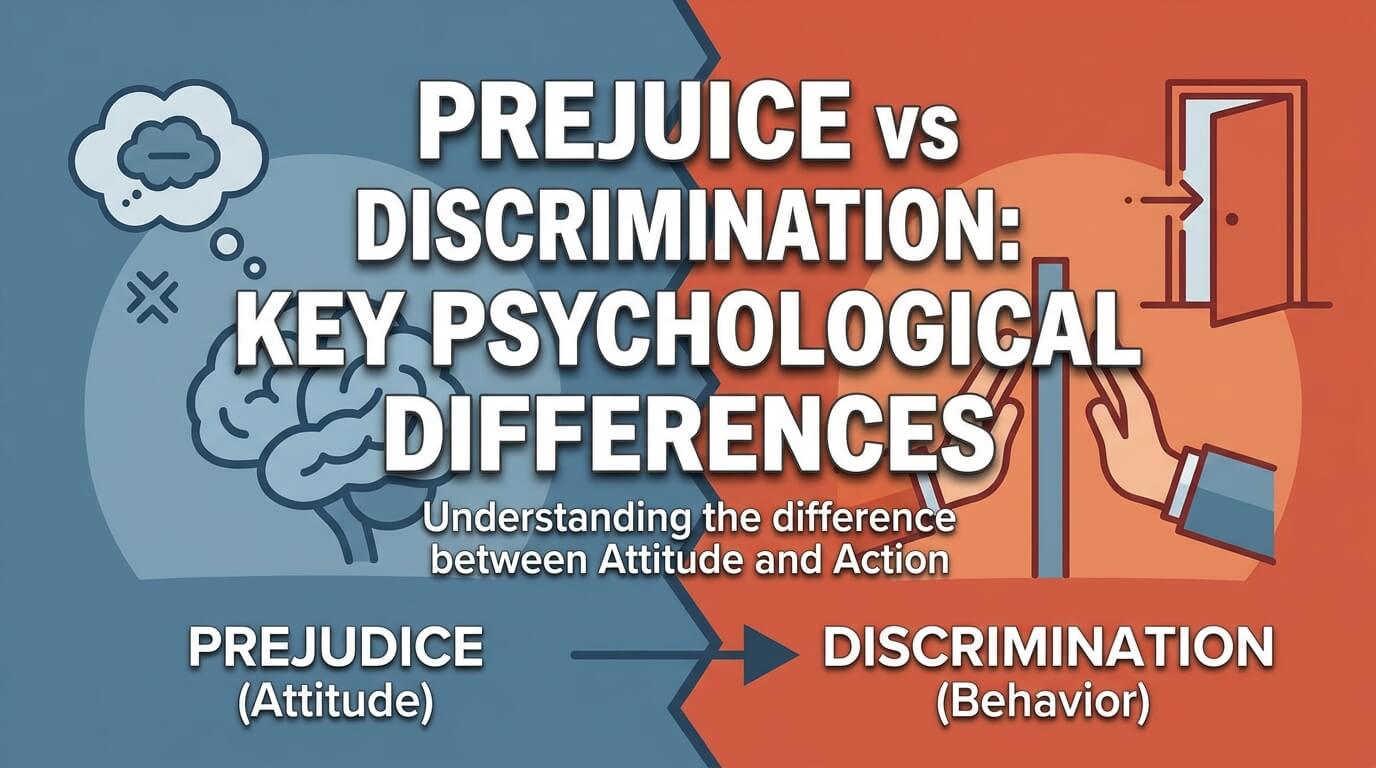
Prejudice and discrimination are often spoken about as if they were two names for the same thing. Psychologically, they describe different parts of a social process. Prejudice concerns evaluation: how a person feels about, judges, or orients toward someone because of perceived group membership. Discrimination concerns behavior or treatment: what a person, group, or system actually does differently toward people based on a social category.
Attitudes and actions do not line up perfectly. A person may hold a negative group-based attitude and refuse to act on it, while someone with little consciously endorsed prejudice may follow a biased norm or apply vague standards unevenly. Clear language separates what was evaluated from what was actually done.
Quick Answer

Prejudice is primarily an attitude, evaluation, or emotional orientation toward people based substantially on perceived group membership. Discrimination is differential behavior or treatment based on group membership. Prejudice can influence discrimination, but one does not mechanically prove the other. Context, norms, rules, incentives, self-control, and decision procedures can all affect whether an attitude becomes action.
The Core Difference: Evaluation vs Treatment
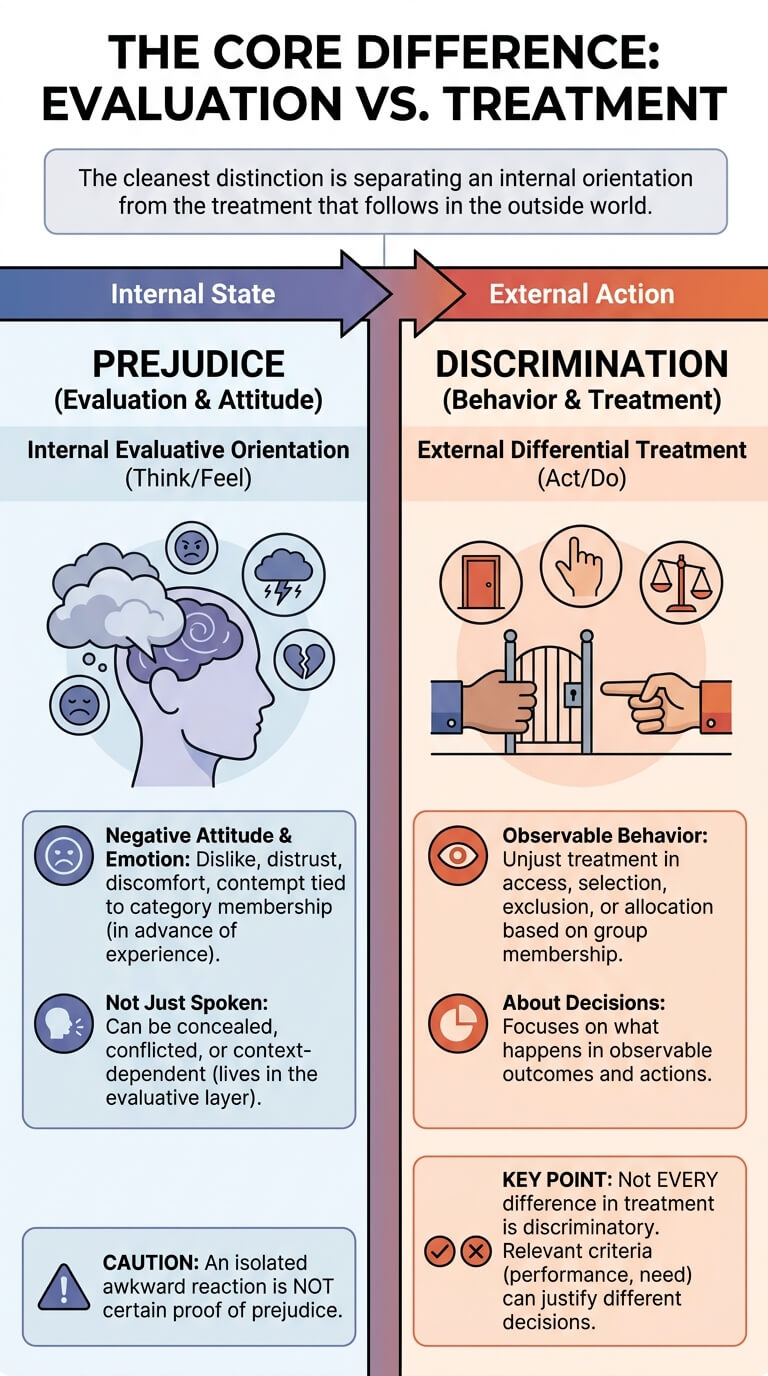
The cleanest distinction is to separate an internal evaluative orientation from the treatment that follows in the outside world.
Prejudice as attitude, emotion, or evaluative orientation
The APA Dictionary of Psychology definition of prejudice emphasizes a negative attitude toward a person or group formed in advance of experience with that person or group. In everyday terms, prejudice lives in the evaluative layer. It may involve dislike, distrust, discomfort, contempt, pity, or another favorable or unfavorable orientation that is tied substantially to category membership rather than to relevant individual evidence.
Prejudice is not limited to a spoken declaration. People may report attitudes openly, conceal them, feel conflicted, or vary by context. Still, an awkward reaction or isolated negative judgment is not enough to establish prejudice with certainty.
Discrimination as differential behavior or treatment
In the social-psychological sense relevant here, discrimination refers to differential treatment linked to group membership. The APA Dictionary entry on discrimination includes unjust differential treatment at individual and institutional levels. For a reader trying to distinguish concepts, the crucial point is behavioral: discrimination is about what happens in treatment, access, selection, exclusion, allocation, evaluation, or another observable decision.
Not every difference in treatment is discriminatory. Relevant differences in experience, role, performance, need, or eligibility may justify different decisions. The key questions are whether the criterion was relevant and whether comparable people faced comparable standards.
| Concept | Main psychological layer | Question to ask | What it does not prove by itself |
|---|---|---|---|
| Stereotype | Belief or expectation | What is being assumed about members of the category? | That the person dislikes the group or will act unfairly |
| Prejudice | Evaluation or affect | How is the group or person being evaluated because of membership? | That a specific discriminatory act will occur |
| Discrimination | Behavior or treatment | Was treatment different because of category membership? | Exactly what private attitude or motive produced the action |
Where Stereotypes Fit Without Becoming the Same Construct
Stereotypes add a belief layer to the picture, but a belief about a category is not automatically an attitude or an action.
Belief or expectation is not identical to evaluation
A stereotype is a generalized belief, expectation, or association about members of a social category. That makes it conceptually different from prejudice. Someone might expect members of a particular profession to behave in a certain way without strongly liking or disliking them. Another person might have a negative evaluative response toward a group even when they could not name a single detailed stereotype behind it.
The broader psychology of how beliefs are acquired and maintained is covered by how beliefs form and shape interpretation. For group-based expectations specifically, it helps to keep a simple sequence in mind: belief or expectation can feed evaluation, and evaluation can influence behavior, but each step is separable.
Beliefs can influence both attitude and behavior under context
Stereotypes can affect what people notice, expect, or interpret, which may shape evaluation and quick decisions. Yet the path is not automatic. Individual evidence, clear criteria, social norms, and accountability can redirect the response.
OpenStax Psychology presents stereotypes, prejudice, and discrimination as related but distinct cognitive, affective, and behavioral components. That framework is useful precisely because it prevents one label from swallowing the others.
Four Ways Attitude and Action Can Diverge
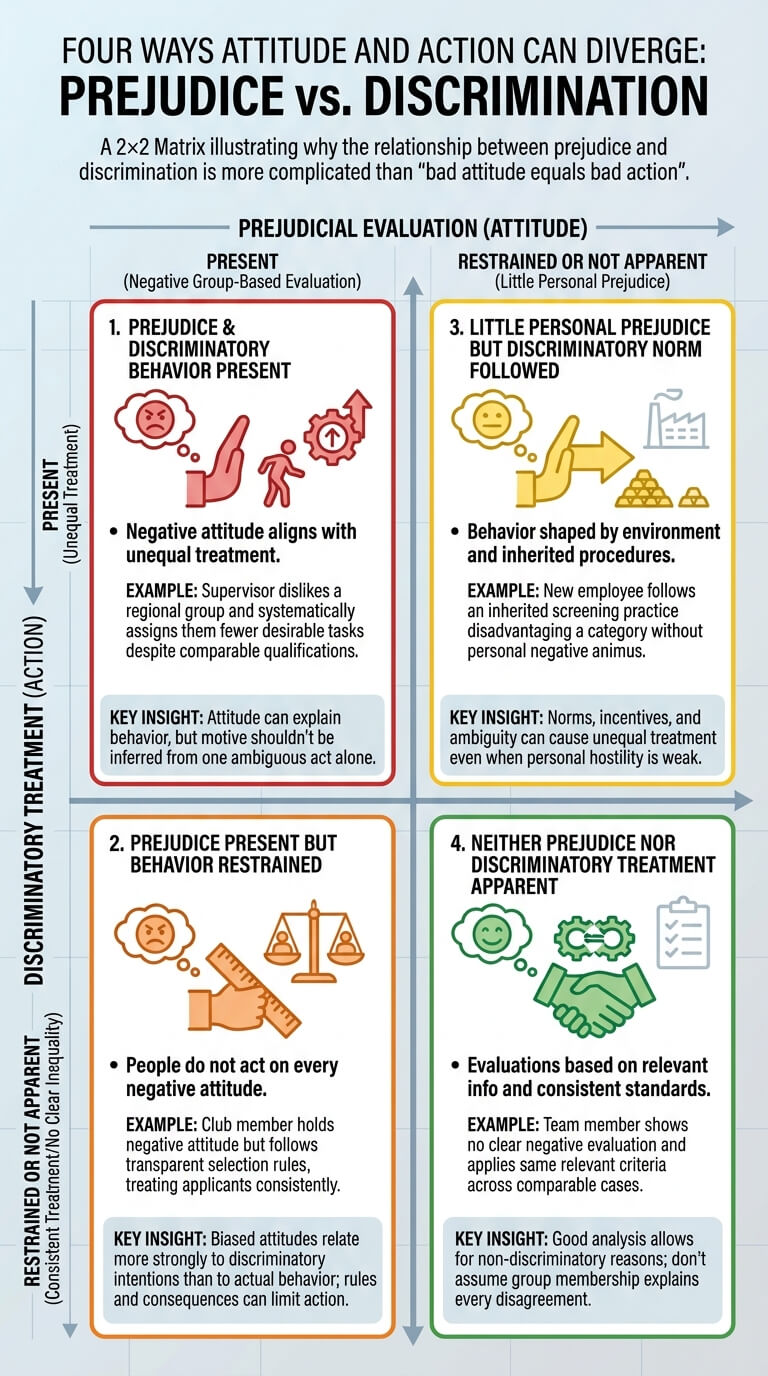
A simple two-by-two matrix shows why the relationship between prejudice and discrimination is more complicated than “bad attitude equals bad action.” The examples below are intentionally neutral. They illustrate structure, not moral equivalence between every real-world case.
| Discriminatory treatment present | Discriminatory treatment restrained or not apparent | |
|---|---|---|
| Prejudicial evaluation present | A supervisor dislikes members of a regional group and also gives them systematically fewer desirable assignments despite comparable qualifications. | A club member holds a negative attitude toward another school but follows a transparent selection rule and treats applicants consistently. |
| Little personal prejudice apparent | A new employee follows an inherited screening practice that disadvantages one category without having a strong personal negative attitude toward that category. | A team member shows no clear group-based negative evaluation and applies the same relevant criteria across comparable cases. |
Prejudice present and discriminatory behavior present
This is the combination people often imagine first: a negative group-based evaluation aligns with unequal treatment. The attitude may help explain the behavior when other evidence links the evaluation to the decision, but motive should not be inferred from one ambiguous act alone.
Prejudice present but behavior restrained
People do not act on every attitude they hold. Someone may recognize that a reaction is unfair, value consistency, anticipate consequences, or deliberately use a rule that limits discretion. A negative attitude can therefore remain psychologically relevant without appearing as unequal treatment in a particular decision.
A meta-analysis found that biased attitudes related more strongly to discriminatory intentions than to actual discriminatory behavior, and the relationship varied with what researchers measured. The open-access review supports caution against treating an attitude as a direct forecast of a specific action.
Little personal prejudice but a discriminatory norm followed
Behavior can also be shaped by the environment. Imagine a department where one informal group has always received first access to training opportunities. A newcomer may continue the custom without personally disliking anyone outside that group. The unequal treatment still deserves attention even if the newcomer’s private attitude is not strongly prejudicial.
Norms, inherited procedures, incentives, and ambiguity can therefore matter even when personal hostility is weak or unclear.
Neither prejudice nor discriminatory treatment apparent
Sometimes the evidence simply does not support either conclusion. A person may evaluate another individual on relevant information and apply the same standard they would use for comparable people from other groups. Good analysis leaves room for that possibility rather than assuming group membership must explain every disagreement or unfavorable decision.
Why Prejudice Does Not Always Become Discrimination
Between evaluation and action sit several psychological and social controls that can alter what a person actually does.
Personal standards and self-control
Humans can notice a reaction without treating it as an instruction. A person who recognizes a category-based dislike may decide that it is inconsistent with their values or irrelevant to the decision at hand. They can slow down, gather individual evidence, and choose behavior that does not follow the initial evaluation.
The practical aim is to make behavior answerable to relevant evidence and consistent standards rather than to a first evaluative impulse.
Social norms and accountability
Norms tell people what behavior is expected, tolerated, or likely to be challenged. A prejudicial attitude may be less likely to shape action where peers expect fair treatment, decisions are visible, and reasons must be explained. In a different environment, the same person may feel greater permission to act on the attitude.
This is one reason social context can influence judgment and behavior without erasing individual responsibility. People act within environments, but environments do not make choices meaningless.
Rules, incentives, consequences, and structured decisions
Structured processes reduce the number of places where vague impressions can quietly change the standard. A team choosing candidates might define criteria before reviewing names, use the same questions for everyone, document reasons, and separate relevant evidence from personal familiarity. These practices do not prove that prejudice is absent, but they can reduce the opportunity for inconsistent treatment.
Consequences matter too. Policy, accountability, role expectations, and relationship costs may restrain unequal behavior even when the underlying attitude has not fully changed.
How Discriminatory Behavior Can Occur Without Strong Personal Prejudice

Unequal treatment may also be carried by norms and routines, so personal dislike is not the only possible pathway.
Conformity to a local norm
Suppose a volunteer committee informally gives leadership opportunities to people who already belong to a familiar social circle. A new member may copy that pattern because “that is how things are done,” not because they have a strong negative attitude toward outsiders. If group membership is influencing access, the treatment can still be unequal.
Conformity matters because behavior is social. People often use others as cues for what is normal, especially when rules are unclear. That can preserve a treatment pattern long after nobody can clearly explain why it began.
Habit or inherited procedure
Procedures can outlive the intentions of the people who created them. A screening rule, referral habit, scheduling practice, or informal preference may continue by inertia. Someone can administer that process neutrally from their own point of view while still participating in a pattern that treats categories differently.
The point is explanatory: routine and context can contribute to behavior alongside personal attitudes.
Ambiguous criteria and unequal application
Vague standards create room for selective interpretation. Terms such as “fit,” “professionalism,” “attitude,” or “leadership presence” may sometimes capture real qualities, but if they are undefined, two comparable people can be judged differently without the evaluator noticing the shift.
A useful check is to translate the vague criterion into observable evidence. What behavior counts? What would count as meeting the standard? Would the same behavior be evaluated similarly if the person’s group membership were different? This does not prove bias, but it makes hidden inconsistency easier to detect.
Incentives and institutional context
People respond to what systems reward. If speed is rewarded but careful review is not, decision-makers may lean on shortcuts. If referrals are valued more than open applications, existing networks may reproduce themselves. If nobody reviews outcomes, inconsistent treatment may remain invisible.
Behavior can have several sources, including personal evaluation, norms, incentives, procedures, authority, and ambiguity.
Explicit, Concealed, and Ambiguous Evaluation
Attitudes are sometimes visible and sometimes uncertain, which makes evidence discipline especially important when interpreting motive.
What people report versus what they may choose not to disclose
Some attitudes are openly stated. Others may be softened, concealed, or expressed only in settings where a person expects agreement. Self-report therefore provides useful but incomplete information. It tells us what someone is willing and able to report in that context, not everything that could possibly influence their judgment.
Uncertainty about self-report is not permission to read minds. Concealment may be possible, but possibility is not proof that a specific person is concealing an attitude.
Why one behavior cannot reliably reveal a concealed attitude
One action can have multiple plausible causes. A manager may decline a request because of group bias, limited resources, a relevant performance concern, a mistaken assumption, pressure from a superior, or some combination of factors. Observing the decision may justify asking questions, but it rarely gives direct access to the manager’s private attitude.
This is closely related to the broader problem of how people infer causes from behavior. The more ambiguous the situation, the more careful the inference should be.
Favoritism Is Not Always Direct Hostility
Group-based inequality can emerge through who receives extra advantages, not only through who receives openly negative treatment.
Preferential treatment of an ingroup
Unequal treatment does not always look like overt attack. Sometimes it appears as extra trust, warmer mentoring, more forgiving interpretation, faster responses, or first access to opportunities for people who feel familiar or belong to one’s own group. The disadvantage to others emerges through preferential allocation rather than explicit hostility.
Marilynn Brewer’s influential review on ingroup favoritism and outgroup hostility argued that attachment to an ingroup does not inherently require hostility toward an outgroup. Research in this tradition helps explain why favorable treatment of “us” and negative treatment of “them” should not be treated as identical motives.
Unequal opportunity can emerge through advantage rather than overt attack
Imagine two equally qualified students seeking informal mentoring. A teacher repeatedly spends extra time with students from an organization they once belonged to because conversation feels easier. No one is insulted or openly rejected, yet one group accumulates more advice and access over time. The mechanism is preferential attention, not necessarily explicit dislike.
Favoritism also differs from broader moral questions about loyalty and group boundaries. Ingroup and outgroup moral judgment concerns selective empathy and moral standards; here the narrower issue is differential treatment.
Unequal Treatment vs Justified Individual Differentiation
A difference in outcomes becomes more informative when we know which criteria were used and whether those criteria were relevant.
Relevant individual evidence
Treating two people differently is not automatically discriminatory. If one applicant has a required certification and another does not, different decisions may be justified by relevant individual evidence. If one team member is available on weekends and another is not, scheduling differences may follow from availability rather than group membership.
The key is relevance. A decision should be tied to information that genuinely bears on the task, opportunity, risk, or need being evaluated.
Consistent criteria
Consistency is a powerful diagnostic question. If lateness counts against one person, does it count similarly against comparable others? If prior experience earns flexibility for one candidate, does it do so for another? If an exception is granted, what principle explains it?
Consistency does not require identical treatment. It means relevant differences explain different decisions rather than standards shifting with social category membership.
Group membership as a decision shortcut
A problem arises when category membership stands in for information that could have been assessed directly. Assuming someone will be unreliable because of their neighborhood, technically weak because of their department, or unsuitable because of an age category replaces individual evidence with a group-based shortcut.
A better approach is to ask what trait actually matters and measure that trait as directly as practical. This does not require ignoring social context. It requires avoiding the unsupported move from “this person belongs to category X” to “therefore this individual has characteristic Y.”
Psychological Definition vs Legal Definition
The same word can serve different purposes in research and law, so the level of claim should remain clear.
Psychology describes attitudes and behavior
Psychology asks questions about evaluation, perception, learning, norms, motivation, and behavior. It can examine whether people are treated differently because of group membership, how attitudes relate to decisions, and which contextual factors increase or reduce unequal treatment.
A behavior can be psychologically relevant without automatically meeting a legal definition in a particular jurisdiction.
Laws vary by jurisdiction, setting, and protected category
Legal definitions depend on where someone lives, the setting involved, the protected category, the type of action, available evidence, and applicable statutes or regulations. Employment, housing, education, healthcare, public accommodations, and other domains may be governed by different rules.
Psychological terminology is not a substitute for legal analysis. When real rights or obligations may be involved, qualified local guidance is more appropriate.
Why the psychological label is not legal advice
“This resembles group-based differential treatment” is a psychological description. “This violates a specific law” is a legal conclusion. The first does not automatically establish the second.
A Context-and-Evidence Check Before Drawing Conclusions

When a situation feels unfair or group-based, a structured check can improve clarity. It does not require minimizing the experience, and it does not require accusing someone of a hidden motive before the evidence is available.
| Question | Why it matters | Useful evidence |
|---|---|---|
| What exactly was evaluated? | Separates a claimed attitude from a general impression. | Statements, ratings, repeated comments, expressed preferences |
| What treatment actually occurred? | Keeps the analysis anchored to behavior. | Access, assignment, selection, exclusion, timing, resources |
| Were comparable cases judged similarly? | Tests whether standards shifted. | Criteria, records, repeated decisions, matched examples |
| What alternative explanations remain? | Prevents overconfident motive attribution. | Relevant qualifications, constraints, role differences, timing |
| What conclusion does the evidence support? | Keeps certainty proportional to evidence. | Pattern strength, consistency, direct statements, corroboration |
What exactly was evaluated?
If prejudice is being discussed, identify the attitude claim. Was there explicit dislike of a category? A pattern of distrust? A stated belief that members deserve less consideration? Or is the attitude being inferred only from an outcome? Naming the claim prevents the word “prejudice” from becoming a catch-all label.
What behavior or treatment actually occurred?
If discrimination is the concern, describe the action concretely. “They were unfair” may capture the emotional experience but gives little behavioral detail. “Three comparable requests were approved, while this one was rejected under a different standard” provides something that can be examined.
Was the same standard applied across comparable cases?
Comparison is often more informative than intuition. Look for cases that are genuinely similar on relevant dimensions. If different standards repeatedly track group membership, the evidence for group-based differential treatment becomes stronger. If the cases differ in important ways, those differences should be considered rather than ignored.
What alternative explanations remain plausible?
Alternative explanations are not excuses. They test causal reasoning by asking what else could produce the behavior and what evidence would distinguish among explanations.
Where Implicit Associations Fit
Automatic associations add another possible influence on judgment without collapsing intention, attitude, and behavior into one thing.
Automatic associations may influence judgment under some conditions
People can have relatively automatic associations involving social categories. Such associations may become more influential when decisions are rushed, ambiguous, cognitively demanding, or weakly structured. They are relevant to understanding how an evaluation or expectation might enter a judgment without deliberate planning.
The APA overview of implicit bias describes implicit social cognition as involving perceptions, attitudes, and stereotypes that may operate before conscious intention or endorsement. That possibility adds nuance to the attitude-behavior relationship, but it does not erase the distinction between a measured association and an observed action.
An implicit measure is not proof of intent or discriminatory action
An implicit score does not establish discriminatory intent or prove that a particular decision was discriminatory. Reliability, context, task design, and links with behavior all matter. Such a measure is one possible piece of evidence, not a reading of hidden character.
Common Conceptual Errors
Most confusion comes from drawing a stronger conclusion than the evidence supports or using one concept to stand in for another.
Treating prejudice and discrimination as synonyms
This collapses attitude and behavior into one category. The result is confusion about what evidence is needed. A prejudicial statement is evidence about evaluation. A repeated allocation difference is evidence about treatment. Either may inform the interpretation of the other, but they are not interchangeable.
Treating outcome difference alone as proof of motive
An unequal outcome may justify investigation, but it can have several causes. It does not automatically identify a particular person’s psychological motive.
Treating absence of overt hostility as proof of equal treatment
Politeness and lack of overt hostility do not prove equal treatment. Criteria may still be applied unevenly, so behavior and standards matter more than tone alone.
What to Do Next When You Need a Clearer Psychological Description
When labels feel too broad, move back to observable claims, relevant comparisons, and the degree of certainty the evidence allows.
Describe attitude claims separately from observed behavior
Use two sentences if necessary. For example: “The speaker expressed a negative evaluation of that group. Later, they denied a member access to an opportunity under a criterion not applied to comparable people.” This is clearer than using one broad label to cover both the attitude and the action.
Use evidence proportional to the conclusion
A direct statement can support a claim about an expressed attitude. A repeated pattern under comparable conditions can strengthen a claim about treatment. A single ambiguous interaction may support concern or further inquiry, but usually not certainty about hidden beliefs.
If the issue is an attitude that someone wants to examine or change, the psychology of how attitudes change through information and experience is a separate question from whether a specific behavior counts as differential treatment.
Keep legal questions separate from psychological interpretation
If the stakes involve employment, housing, education, healthcare, or another regulated setting, record concrete facts and seek appropriate local guidance when needed. A psychological framework can organize what happened, but it cannot determine jurisdiction-specific rights, deadlines, burdens of proof, or remedies.
Educational note: Psychological concepts can help describe patterns of evaluation and treatment, but they do not diagnose a person’s character or settle a legal dispute. If a situation includes threats, stalking, coercion, targeted intimidation, harassment, or credible fear, prioritize safety and appropriate support rather than trying to resolve the issue only through conversation.
FAQ
These questions focus on the places where attitude, behavior, favoritism, and legal meaning are most often confused.
Can someone be prejudiced but never discriminate?
Yes. A person can hold a negative group-based attitude while choosing not to treat people differently. Personal values, self-control, strong norms, transparent procedures, accountability, or limited opportunity to act may restrain behavior. That does not make the attitude irrelevant, but it shows why attitudes and actions must be measured separately.
Can discriminatory behavior occur without strong personal prejudice?
Yes. Someone may conform to a local norm, follow an inherited rule, use vague criteria inconsistently, or respond to incentives that produce unequal treatment without strongly disliking the affected group. This is one reason explaining discrimination only through personal hostility can miss important behavioral and contextual mechanisms.
Is ingroup favoritism the same as prejudice?
No. Favoring one’s own group and negatively evaluating an outgroup are related possibilities, but they are not identical. A person may give extra opportunities to familiar ingroup members without expressing strong hostility toward outsiders. The result may still be unequal treatment, which is why favoritism and hostility are worth examining separately.
Does unequal treatment always count as psychological discrimination?
No. People can be treated differently for relevant individual reasons, such as qualifications, role requirements, availability, performance, or need. The key question is whether group membership is driving the differential treatment when it should not be, or whether comparable cases are being judged by different standards without a relevant reason.
Is the psychological meaning of discrimination the same as the legal meaning?
No. Psychology uses discrimination to study differential treatment and the processes that may produce it. Legal definitions depend on jurisdiction, setting, protected category, evidence, and applicable law. A psychological description can inform understanding, but it should not be presented as a legal conclusion.
Key Takeaways
- Prejudice is primarily an evaluative or attitudinal construct, while discrimination concerns behavior or treatment.
- Stereotypes are generalized beliefs or expectations, so they should not be treated as synonyms for either prejudice or discrimination.
- A prejudicial attitude may be restrained, and unequal treatment can also arise through norms, routines, incentives, favoritism, or ambiguous criteria.
- Ingroup favoritism does not require direct outgroup hostility, although preferential treatment can still create unequal opportunities.
- One isolated behavior rarely proves a hidden attitude. Strong conclusions require evidence that matches the claim being made.
- Psychological and legal definitions serve different purposes, so real legal questions require jurisdiction-specific guidance.
A useful next step is to separate the situation into two columns: what was evaluated or expressed, and what was actually done. Then compare the treatment with genuinely similar cases. That small shift from labels to evidence often makes it easier to see whether the main question is about prejudice, discrimination, both, or something else that still needs clarification.

Michael Reed is the Founder and Lead Writer at Psychology Exposed. He writes about human behavior, relationships, emotional patterns, self-awareness, and practical psychology topics using research-informed, easy-to-understand content.
Read More About Michael Reed: https://psychologyexposed.com/michael-reed/