

Knowing only someone’s profession, school, neighborhood, age group, hobby community, or organization can still trigger a detailed expectation about what that person will be like. Sometimes this is loose shorthand. Sometimes it becomes a rigid shortcut that competes with the evidence in front of you.
In psychology, stereotypes are generalized beliefs, expectations, or associations connected to a social category. They are not identical to prejudice or discriminatory behavior. A stereotype may become mentally available without being consciously endorsed, and a group-level pattern does not tell you what is true of one individual.
Quick Answer

Stereotype psychology examines generalized beliefs and expectations about members of social categories. Stereotypes can be learned through observation, language, media, norms, and repeated experience. Once available, they may shape attention, memory, and interpretation, especially when individual information is limited. A useful safeguard is to treat category-based expectations as hypotheses, not conclusions, and update judgments with person-specific evidence.
What a Stereotype Is in Psychology
The cleanest way to understand stereotyping is to separate cognitive expectations from evaluations and actions.
Generalized belief, expectation, or association
The APA Dictionary of Psychology definition of stereotype describes it as a set of cognitive generalizations, including beliefs and expectations, about members of a group or social category. The key word is generalization. Information attached to a category is being carried over to people who belong to, or are perceived to belong to, that category.
Not every stereotype is a fully stated belief. Some operate as expectations that appear before enough individual information is available. Others are familiar cultural associations a person recognizes without personally accepting them.
Stereotype versus prejudice
A stereotype is primarily about what someone expects or believes about a group. Prejudice is about evaluation, attitude, or affect toward people based substantially on perceived group membership. The two often interact, but they should not be collapsed into one concept.
This distinction also prevents a common reasoning error: treating a mistaken prediction as proof of hostility. A person can make a category-based assumption and still hold no strong negative feeling toward the group. That assumption may still deserve correction, especially if it affects an important decision, but the psychological label should match the evidence.
For example, a manager might expect members of one department to prefer highly structured work. That is a stereotype when the expectation is applied because of category membership. Liking or disliking people because of that category is a separate evaluative question.
Stereotype versus discrimination
Discrimination concerns behavior or treatment. A stereotype may influence behavior, but a category-based expectation does not prove that discriminatory treatment occurred. Unequal treatment can also emerge from rules, habits, incentives, or norms without a simple one-to-one link to personal prejudice.
OpenStax Psychology 2e separates stereotypes, prejudice, and discrimination as related but distinct social psychological concepts. Keeping these layers separate makes it easier to ask a precise question: Are we examining a belief, an evaluation, or an action?
The Main Forms Stereotypes Can Take
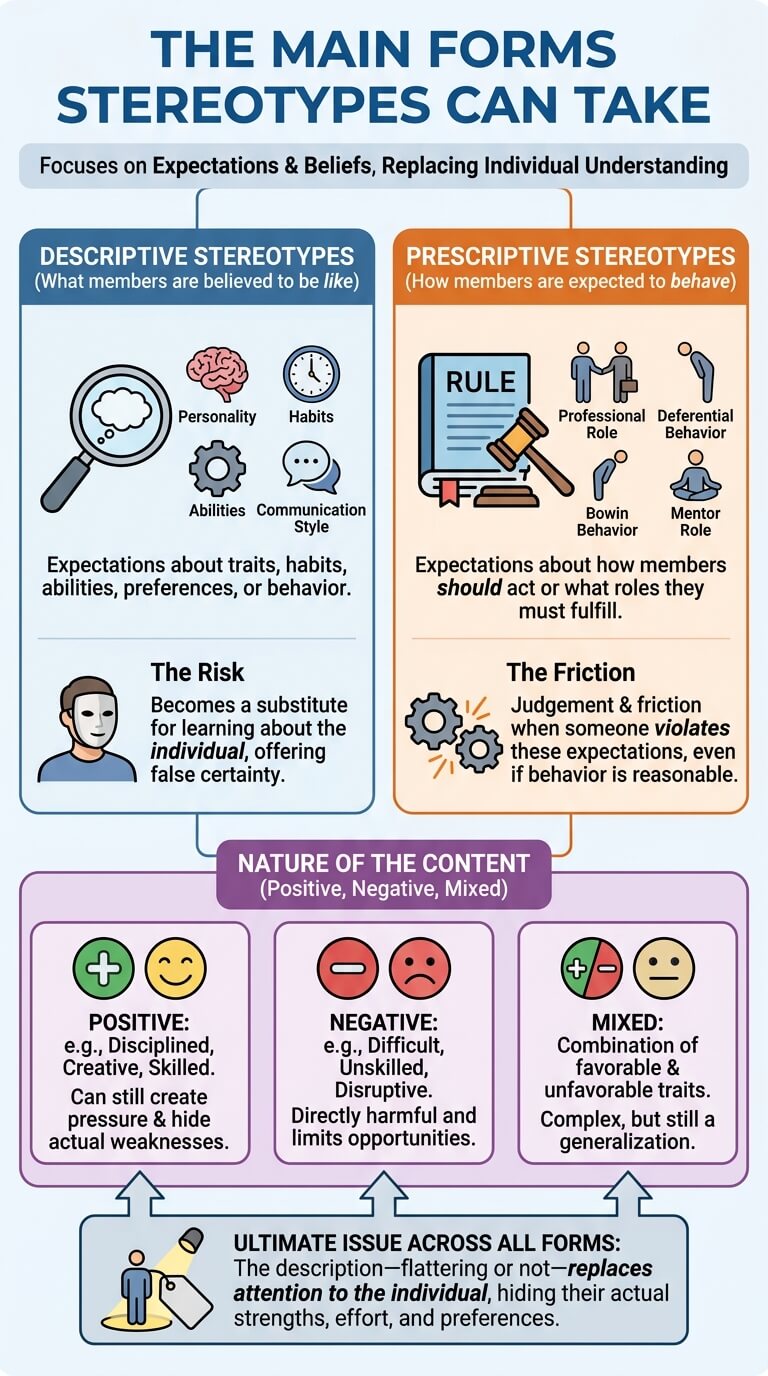
Stereotypes differ not only in whether they sound favorable or unfavorable, but also in what kind of expectation they impose.
Descriptive expectations about what group members are like
Descriptive stereotypes concern what members of a category are believed to be like. The expectation might involve personality, habits, abilities, preferences, communication style, or typical behavior. A person may think, for example, that students from one academic major are more detail-focused, or that members of a certain hobby community tend to be highly competitive.
The risk begins when the category supplies more certainty than the evidence supports and becomes a substitute for learning about the individual.
Prescriptive expectations about how group members should behave
Prescriptive stereotypes are different. Instead of describing what people are believed to be like, they concern how members of a group are expected to behave. A team may assume that senior employees should be calm mentors, that newcomers should be quiet and deferential, or that members of a particular professional role should communicate in a certain way.
These expectations can create friction when someone violates them. A person may be judged against what others think someone in that category is supposed to do, even when the behavior itself is reasonable.
Positive, negative, and mixed stereotypes
Stereotypes can be positive, negative, or mixed. A group might be described as disciplined, creative, technically skilled, difficult, or some combination. The issue is not solved by whether the description sounds flattering.
A positive stereotype can still replace attention to the individual. Assuming someone is naturally good at a task because of group membership may hide their actual strengths, weaknesses, effort, and preferences, and can create pressure to match the expectation.
How Stereotypes Are Acquired

Group expectations can be learned from direct encounters, repeated messages, and samples that look broader than they really are.
Observation and repeated social information
People build expectations from repeated observation. If several members of a group are encountered in similar roles, a person may attribute the pattern to the group rather than the setting that produced the sample.
Someone whose only contact with a profession occurs during crises may form an image of that profession from behavior shown under pressure. The behavior is real, but the sample may not represent the category as a whole.
Language, media, stories, and norms
Repeated descriptions in conversation, entertainment, news, family stories, organizational culture, and online communities can make group-trait pairings familiar. People do not absorb every message passively, but cultural knowledge can exist separately from personal endorsement. That distinction became influential in Patricia Devine’s classic work on automatic and controlled components of stereotyping and prejudice.
Direct experience and uneven samples
Personal experience feels convincing, yet it is often selective. We rarely meet a random sample of a social group; work, geography, networks, algorithms, institutions, and shared interests shape whom we encounter.
If someone meets five members of a region only through a competitive online game, they may associate that region with aggressive interaction. The better question is what kind of sample produced the impression.
A useful way to audit personal experience is to ask three questions. First, where did I meet these people? Second, what conditions were shaping their behavior at the time? Third, who from the same category was invisible to me because they were not in that setting? This turns “I saw it myself” into a more precise claim. The observation may still matter, but its meaning becomes tied to the conditions under which it was collected.
From Category Cue to Expectation
The shift from noticing a category to forming an expectation can happen quickly, especially when little person-specific information is available.
Category becomes salient
A stereotype cannot influence a judgment unless some category becomes relevant in the perceiver’s mind. Salience can come from appearance, a label, a uniform, a username, an accent, a job title, an affiliation, or simply the context of the interaction. Which category stands out can change from one situation to another.
The same person can be categorized as a manager, parent, runner, city resident, age-group member, or sports fan. Which category becomes prominent affects which expectations are easiest to access.
Associated information becomes accessible
Once a category is active, related information may become easier to retrieve, allowing a preliminary expectation to form quickly. That expectation may be weak, strong, accurate in some contexts, or irrelevant to the current person. Accessibility does not establish truth or endorsement.
Expectation influences what gets noticed
After an expectation forms, attention may become uneven. Matching behavior can be easy to recognize, while contradictory behavior may be treated as surprising, exceptional, or less diagnostic.
Consider two interns who make equally direct suggestions during a meeting. If one has already been mentally categorized as coming from a highly competitive program, the same directness may be interpreted as ambition. Without that expectation, the behavior might simply register as confidence or enthusiasm. The category changes the lens, not necessarily the behavior.
Activation Is Not the Same as Endorsement
This distinction is central because mental accessibility tells us less about deliberate belief than everyday language often assumes.
A thought can become accessible without deliberate agreement
A useful distinction is between a stereotype becoming mentally available and a person deliberately agreeing with it. Cultural knowledge can come to mind without being chosen as a personal belief. Later research has refined how automaticity and control are understood, but the practical point remains: the first association is not necessarily the final judgment.
Why intention cannot be inferred from mental accessibility alone
Because accessibility and endorsement differ, an association is not a complete explanation of motive. Someone may notice an expectation and reject it, consciously endorse it but restrain behavior, or act unfairly for reasons not captured by a simple stereotype. One observation cannot reveal hidden character with certainty.
How Expectations Shape Attention and Interpretation
Once an expectation is active, it can influence which details seem meaningful and how ambiguous behavior is read.
Expectancy-consistent information feels easier to organize
Information that matches an existing expectation has an obvious place to go. If you expect a department to be disorganized, each missed deadline fits immediately. Contradictory evidence may also attract attention because it is surprising. What matters is whether it updates the belief or gets explained away.
Ambiguous behavior can be interpreted through a category lens
Stereotypes can matter most when behavior is ambiguous. A short reply might be read as efficient, rude, shy, distracted, or stressed. With little context, a category-based expectation may supply the interpretation.
Susan Fiske’s broad review of stereotyping, prejudice, and discrimination emphasizes that category-based responses involve both cognition and motivation within social contexts. That wider view is useful because interpretation is rarely produced by a single mental mechanism acting alone.
When contradictory evidence gets more or less attention
Contradictory information can weaken a stereotype, but not automatically. A relevant, representative counterexample may prompt revision; an easily labeled exception may leave the broader belief intact. The key question is whether the new case is allowed to inform the group expectation.
Why Stereotypes Can Persist Despite Exceptions

Contradictory evidence does not always erase a broad expectation because people must decide whether an exception represents the group.
Memory for consistent and inconsistent information
Memory is not a neutral spreadsheet. Existing expectations influence how information is organized and retrieved. Both matching and contradictory details can be memorable, but their impact depends on how they are interpreted. One vivid confirming example may outweigh several ordinary counterexamples if it feels especially diagnostic.
Subtyping and the exception rule
Subtyping occurs when a person treats someone who violates a stereotype as a special kind of group member rather than evidence that the broader stereotype needs revision. The thought may be, in effect, “This person is different from the rest.”
Research on subtyping in the face of stereotype-disconfirming information found that additional characteristics can become reasons to treat a counterexample as exceptional, leaving the broader expectation intact.
Small or selective samples can preserve broad expectations
A stereotype may survive because the evidence is not representative. Customers see service workers while they are serving, patients see medical staff during health problems, and managers see employees within a hierarchy. When context shapes the sample, ask whether that sample justifies a claim about the larger group.
Why Positive Stereotypes Can Still Constrain Individuals
A flattering group assumption can still narrow how much individuality another person is allowed to show.
Favorable assumptions can create pressure or narrow expectations
Favorable assumptions can create a narrow script. Someone expected to be naturally gifted, emotionally steady, technically capable, or socially confident because of group membership may receive less room to be inexperienced, uncertain, or simply different. Ordinary performance can then look disappointing against an imagined category profile.
Group averages are not individual predictions
Even when a measurable group difference exists, individuals may overlap substantially. An average describes a distribution, not a specific person. In hiring, education, teamwork, healthcare, and everyday judgment, individual evidence should carry more weight as soon as it becomes available.
Stereotypes vs Outgroup Homogeneity
These ideas often appear together, but one concerns expected attributes while the other concerns perceived similarity among group members.
Attribute expectation versus perceived similarity
Stereotyping and the outgroup homogeneity effect are related but different. A stereotype assigns expected attributes to members of a category. Outgroup homogeneity concerns the perception that members of another group are more similar to one another than they really are, or more similar than members of one’s own group seem.
| Question | Stereotyping | Outgroup homogeneity |
|---|---|---|
| Core judgment | “What are people in this category like?” | “How similar are people in this category to one another?” |
| Main output | Trait or behavior expectation | Perceived lack of within-group variation |
| Individual risk | Applying a group expectation to one person | Failing to notice meaningful differences among members |
How the two processes can reinforce one another without being identical
If another group seems highly similar, a stereotype may feel easier to apply broadly. A strong stereotype may also make differences among members less noticeable. Still, neither process requires the other: someone can perceive diversity while holding an attribute expectation, or perceive homogeneity without a strongly evaluative stereotype.
Stereotypes and Illusory Correlation
Some stereotypes may be strengthened when distinctive events create an exaggerated sense that a group and behavior belong together.
Memorable pairings can create exaggerated group-behavior links
An illusory correlation occurs when a relationship between two categories or events is perceived as stronger than the evidence supports. In classic experiments by David Hamilton and Robert Gifford, distinctive group-behavior pairings could produce exaggerated perceived associations.
Unusual events are often memorable. If a rare behavior and a less familiar group appear together, the pairing may receive disproportionate attention, creating the impression of a strong pattern when the denominator is missing.
Why base rates matter
Four stories about members of a large organization can sound meaningful until you consider the denominator and comparison rate. Ask how often the behavior occurs in that group, how often it occurs elsewhere, how the sample was selected, and which cases were visible enough to be remembered.
Category → Expectation → Evidence Check → Individualized Judgment

This four-step framework is a practical way to slow down stereotype-based judgment without pretending that category information can simply be erased from the mind.
Name the category-based expectation
Identify what the category is causing you to expect. “I have a bias” is too vague. A clearer statement is, “Because this person is from that department, I expect them to resist change.” Naming the expectation turns a silent assumption into something testable.
Separate expectation from person-specific evidence
List what you actually know about the individual. Which facts come from direct observation, and which arrived through the category? A simple two-column check can help:
| Category-based expectation | Individual evidence |
|---|---|
| What I predicted before knowing much about the person | What this person has actually shown in the relevant context |
| Information drawn from a group label | Behavior, performance, preferences, or choices specific to the individual |
| May be useful as a weak hypothesis | Should increasingly guide judgment as evidence accumulates |
Look for disconfirming and confirming evidence symmetrically
Use symmetrical evidence standards. If one confirming example counts as proof while several contradictory examples are dismissed as exceptions, the test is uneven. The reverse can also happen. Decide what evidence would count in either direction and apply the same threshold.
Update at the individual level before generalizing
Update your judgment of the person first. You do not need to settle a claim about an entire category before deciding whether this colleague is reliable or this applicant has the required skill. This keeps the conclusion matched to the evidence available.
For everyday use, try a brief evidence check before a consequential decision: What did I expect before this person acted? What behavior did I actually observe? Would I describe the same behavior differently if the category label changed? What additional information would genuinely help me decide? These questions are especially useful when an impression feels obvious but the evidence is thin. They create a pause between recognition and conclusion without requiring you to pretend that prior knowledge does not exist.
Common Mistakes When Talking About Stereotypes
Precision matters because several common shortcuts turn a useful psychological concept into an unsupported claim about a person.
Treating stereotype activation as endorsement
A cultural association can come to mind without reflecting a considered belief. The more precise question is whether the person accepts the expectation as true and lets it guide judgment after relevant evidence appears.
Assuming every stereotype is prejudice
Stereotypes can contribute to prejudice, but a belief and an evaluation are not the same construct. A person may expect a group to behave a certain way without feeling strongly positive or negative toward the group. Conversely, prejudice can involve broad emotional or evaluative reactions that are not reducible to one specific stereotype.
Using a group statistic as proof about one person
Statistical information can be useful when reliable and relevant. The mistake is turning a population tendency into certainty about one person. As individual evidence becomes available, let it replace category-based guessing for the decision at hand.
First Steps for Slowing Stereotype-Based Judgment
The most practical corrections change how evidence is gathered and weighted, rather than demanding perfect control over every first thought.
Delay high-stakes conclusions when evidence is thin
Fast impressions are sometimes unavoidable. High-stakes conclusions do not have to be. When decisions affect hiring, discipline, access, evaluation, trust, or responsibility, take more time if the evidence is ambiguous or heavily category-based.
Use consistent criteria across people
Before evaluating several people, define what counts as relevant evidence. If confidence is valued in one person but labeled arrogance in another, or one mistake is ordinary for one group but diagnostic for another, the standard may be drifting. Consistent criteria reduce the room for expectation to fill ambiguity.
Seek individuating information that is relevant to the decision
Individuating information is most useful when it directly answers the decision. For reliability, look at follow-through. For skill, examine performance. For communication style, observe communication across situations. Relevant individual evidence is more useful than collecting unrelated personal details.
When Group Expectations Start Shaping Evaluation or Treatment
Beliefs can feed later evaluations and actions, but moving from one layer to another is not automatic. A different process appears when someone worries that a negative group stereotype may shape how their own performance is judged, a situational pressure known as stereotype threat.
Prejudice adds evaluative orientation
A stereotype becomes a different psychological question when it feeds a favorable or unfavorable evaluation because of group membership. The focus shifts from “What do I expect?” to “How am I evaluating this person because of the category?”
Discrimination concerns treatment
The behavioral layer asks what happened in practice: exclusion, favoritism, penalties, opportunities, or different standards. Stereotypes and prejudice may influence treatment, but context, rules, accountability, incentives, and deliberate restraint can change what people do.
Implicit associations may influence speeded judgment under some conditions
Some group-related associations operate quickly, especially under ambiguity, time pressure, or limited attention. Stereotypes describe generalized group-related knowledge and expectations; implicit-bias research asks more specifically about relatively automatic associations and their measurement. Neither should be treated as a lie detector for hidden character.
FAQ
These questions address the points most likely to be confused when stereotypes are discussed outside a research setting.
Are stereotypes always false?
No. A stereotype may resemble a measurable group tendency, distort a tendency, describe an outdated pattern, or be unsupported. The key error is often overgeneralizing from a group-level claim to an individual. Accuracy depends on the evidence, population, context, and level of inference.
Can a stereotype be activated even when someone rejects it?
Yes. Cultural associations can be learned without becoming personal beliefs. A category cue may make an association accessible before reflection. What happens next matters: the person can question it, seek individual evidence, and choose not to let the association determine judgment or behavior.
Why does one counterexample sometimes fail to change a stereotype?
A counterexample may be treated as exceptional rather than representative. Change is more likely when contradictory evidence is relevant, repeated, difficult to dismiss, and drawn from a broader range of examples rather than one memorable case.
Are positive stereotypes harmless?
Not necessarily. Positive stereotypes can narrow expectations, create pressure, and hide individual differences. A favorable group assumption should still be checked against the person’s actual abilities, preferences, and behavior.
How is stereotyping different from simply noticing patterns?
Noticing a possible pattern is not automatically stereotyping. The risk appears when a social category becomes the basis for a generalized expectation applied too confidently to individuals. Ask whether the evidence is representative, whether alternatives exist, and whether person-specific information changes the conclusion.
Key Takeaways
- A stereotype is a generalized belief, expectation, or association about members of a social category, not the same thing as prejudice or discrimination.
- Stereotypes can be learned through direct experience, repeated stories, language, media, norms, and selective exposure to particular group members.
- Activation does not prove endorsement. An association can become accessible without representing a person’s deliberate belief or intention.
- Stereotypes can persist when contradictory cases are treated as exceptions, when samples are narrow, or when confirming information receives disproportionate weight.
- Positive stereotypes can still constrain individuals because favorable group expectations may replace attention to the person’s actual strengths, limits, and preferences.
- For practical judgment, move from category to expectation, check the evidence, and update at the individual level before making broader claims.
The next useful step is not to demand that your mind never notices categories. It is to become more precise about what happens after a category is noticed. When an expectation appears, separate it from the evidence about the person in front of you, test the same evidence standards in both directions, and let individual information do more of the work as it becomes available.
Educational note: This material explains social-psychological concepts for general education. It is not a tool for diagnosing a person’s beliefs, motives, morality, or mental health from a single thought, test result, or isolated behavior.

Michael Reed is the Founder and Lead Writer at Psychology Exposed. He writes about human behavior, relationships, emotional patterns, self-awareness, and practical psychology topics using research-informed, easy-to-understand content.
Read More About Michael Reed: https://psychologyexposed.com/michael-reed/