
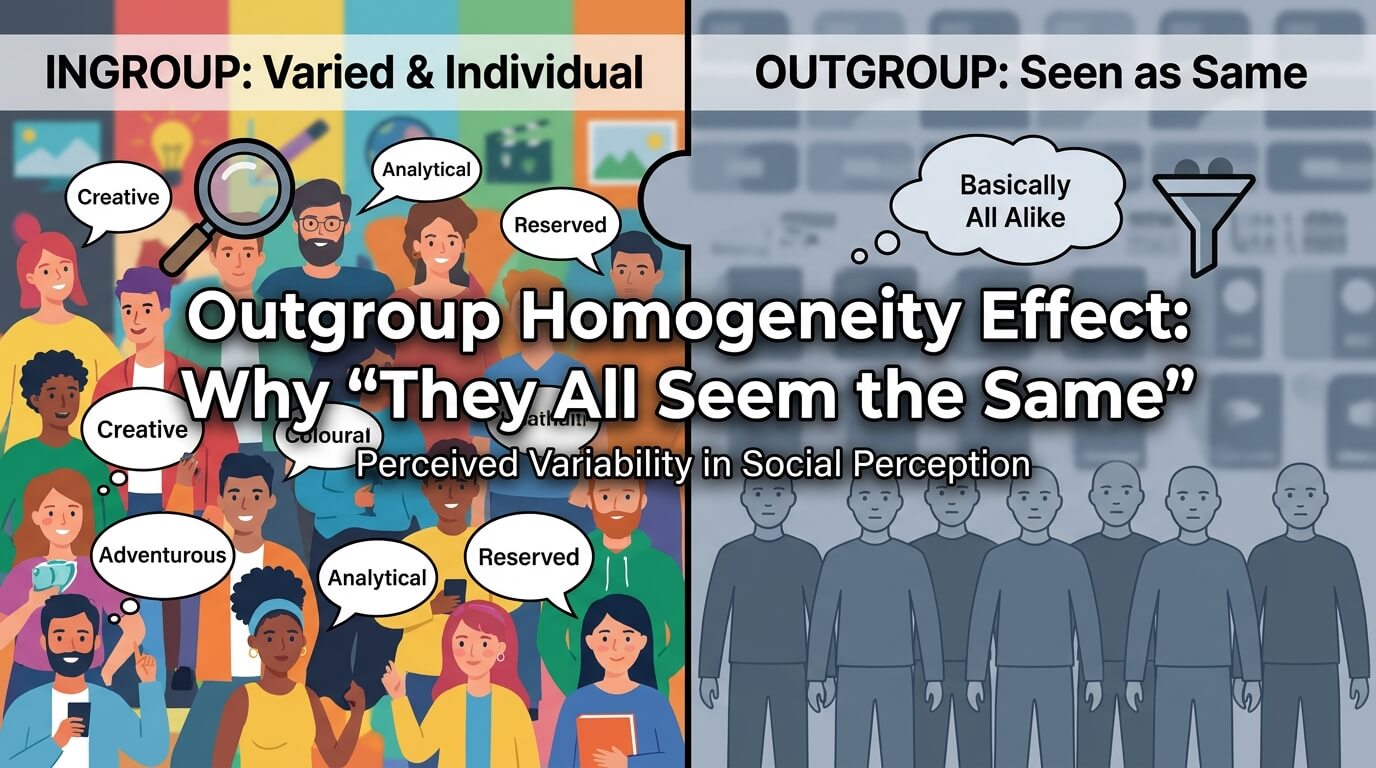
You may know ten people in your own department well enough to describe how different they are, yet think people in another department are basically alike. Psychology calls this tendency the outgroup homogeneity effect: under some conditions, members of an outside group are perceived as more similar to one another than members of a familiar group.
The effect is about perceived variability. It does not prove that an outside group is objectively less diverse, that the observer dislikes that group, or that every broad impression is false. The useful question is narrower: how much individual variation are you noticing, and how much of your judgment is being compressed by a group label?
Quick Answer

The outgroup homogeneity effect is the tendency to perceive members of an outside group as more alike than members of one’s own or a more familiar group. Familiarity, access to individuating information, category-based processing, group salience, and social context can all matter. The effect is not universal, and it is different from stereotyping or ingroup favoritism even though those processes can interact.
What the Outgroup Homogeneity Effect Means
In social perception, people rarely process every person from scratch. We notice categories, roles, affiliations, and situational cues, then combine them with whatever person-specific information is available. An outgroup is simply a group that a person does not currently see as “us” in the relevant context. OpenStax Psychology’s overview of ingroups and outgroups provides accessible background on how these group boundaries enter social perception. The effect belongs within the wider psychology of prejudice and stereotyping, but its specific question is how much variation people perceive within another group.
Perceived within-group similarity
The core idea is not that every outgroup member seems identical. Differences among them may simply be less noticeable or less richly represented, leaving a coarse picture of the outside group and a detailed picture of the familiar group.
Imagine two regional offices. Someone in Office A knows colleagues as cautious, improvisational, client-focused, data-focused, or calm under deadlines. The same person may know only three people in Office B and summarize them as “very formal.” One side is represented by differentiated individuals, the other by a category plus a few encounters.
Why it is a perception effect, not a statement that groups truly lack diversity
Calling this a perception effect matters because actual group variability is an empirical question. Some groups really are more similar than others on a particular dimension because of selection, training, shared rules, or context. A choir may be more similar in musical experience than a random crowd. A certification program may produce more similar technical knowledge among its graduates.
The problem appears when perceived sameness outruns the evidence or a broad impression is treated as sufficient information about a person. The goal is to avoid converting a group-level impression into unwarranted certainty about an individual.
The Perceived Variability Problem

Uneven information changes what comes to mind during judgment. Classic work asked whether observers generalize more readily from one outgroup member to the whole group. Using students from rival universities, Quattrone and Jones examined this generalization process and found evidence of stronger outgroup generalization under some conditions.
Rich detail about familiar ingroup members
Familiar groups often come with a mental library of exceptions: the beginner, the expert, the rule follower, the improviser, and the person who changes by situation. Those examples make broad sameness claims harder to sustain.
This does not require affection. You can be frustrated with your own team and still know its members in great detail. The important ingredient is differentiated knowledge, not simply positive feeling.
Fewer individuating examples for unfamiliar outgroups
Outside groups are often encountered at greater distance through a few representatives, shared labels, or selected posts. When person-specific information is sparse, category information has more room to fill the gap.
This creates an uneven comparison. The familiar group is represented by dozens of concrete people and exceptions, while the unfamiliar group may be represented by five encounters and a reputation. Judging variability from those two knowledge bases is like comparing a detailed map with a thumbnail.
Category labels compress information
Categories reduce complexity. Labels such as “accounting,” “design,” or “supporters of Team X” organize social information quickly, but they can also compress it. When a label is highly salient, differences inside the category may receive less attention.
Compression is not automatically prejudice. It becomes risky when a category summary substitutes for relevant evidence about the person in front of you.
Why Familiarity Can Change What You Notice
Familiarity is an intuitive explanation for perceived variability, but not the only one. Reviews also consider information processing, group-specific beliefs, relative group size, identity salience, and context. Familiarity changes what information is available; context changes how it is organized and used.
More repeated contact produces more exceptions
Repeated contact can reveal dimensions that were invisible at first. Someone who initially sees “the engineering team” may later distinguish people by specialty, temperament, seniority, tools, and work habits. The group may not have changed. The observer’s representation has become more granular.
Importantly, simple exposure is not guaranteed to produce accurate individuation. If every encounter is brief, competitive, highly scripted, or filtered through the same role, the observer may still learn very little about within-group variation.
Role-based knowledge reveals dimensions of difference
Knowledge becomes useful when it reveals dimensions that matter inside the group. To an outsider, a hobby community may look uniform. An insider sees substyles, skill levels, motivations, and informal roles.
This is why expertise can change perception. A novice sees “all the same kind”; an experienced observer sees meaningful distinctions. The relevant differences need not be personality differences. They can involve goals, histories, strategies, responsibilities, or situational behavior.
Familiarity is helpful but not the only mechanism
If familiarity explained everything, the effect would appear in the same direction whenever one group was better known. Research is less tidy. A major review by Ostrom and Sedikides found substantial support for outgroup homogeneity in natural-group settings but no consistent effect across minimal-group settings. That pattern suggests that real-world knowledge, history, meaning, and group context matter.
So “just get more familiar” is an incomplete explanation. The kind of information you receive, how groups are positioned, what identity is salient, and which distinctions matter in the situation can all shape perceived variability.
Category-Based Processing vs Individuation

A practical way to understand the effect is to contrast two modes of perception. Neither is completely absent in ordinary life. The question is which one is carrying more weight in a particular judgment.
Thinking “member of group” first
Category-based processing starts with the label. You notice that someone belongs to Department B, a rival school, a particular profession, or an online community. Expectations associated with that category become easy to retrieve, and the person is interpreted through that frame.
This mode is efficient when information is limited, but it can hide within-group variation. If three people from the same category behave similarly, you may feel that you have learned something broad even though the sample is tiny or the situation itself constrained their behavior.
Thinking “this particular person” first
Individuation gives more weight to person-specific evidence. What has this person actually done? What experience do they have? How do they behave across situations? Which traits or preferences have been observed rather than inferred?
Individuation does not require pretending categories never matter. A professional role can provide relevant information about training, for example. The discipline is to separate what the category legitimately tells you from what still needs individual evidence.
How context shifts the balance
Time pressure, limited information, strong labels, and one-off encounters may encourage category processing. Repeated interaction, clear decision criteria, and person-level information create more room for differentiation.
A useful mental move is: label, detail, comparison. Notice the label that became salient. Identify concrete details about the individual. Then ask whether you would interpret those details the same way if the label changed.
When Group Salience Matters
A group boundary can fade into the background or become the most noticeable feature of a situation. That difference matters because a salient boundary makes “us” and “them” easier categories for organizing information.
Competition, comparison, and visible boundaries
Rivalry can make group membership unusually prominent. Two sales teams competing for one award may suddenly seem more internally uniform than they did a month earlier. School colors, uniforms, separate seating, rankings, or repeated “our side versus their side” language can have a similar organizing effect.
This does not mean competition always produces distorted perception. It means the group boundary has become a stronger cue, which may reduce attention to cross-cutting individual differences.
Situations where subgroup differences become more noticeable
The opposite can happen when a task makes internal differences useful. If you need to select collaborators from another department, you may rapidly learn who handles budgets, who understands technical constraints, who is good with clients, and who has specific domain expertise. The broad category becomes less informative than the roles inside it.
Perceived variability is partly task-dependent. People differentiate others more when individual distinctions become relevant to the task.
Outgroup Homogeneity vs Stereotyping
These concepts are related but not interchangeable. Confusing them makes it harder to see what exactly has gone wrong in a judgment.
Similarity judgment versus attribute expectation
| Question | Outgroup homogeneity | Stereotyping |
|---|---|---|
| Core judgment | How similar are members of this group to one another? | What traits, behaviors, or outcomes do I expect from members of this group? |
| Main focus | Perceived variability | Generalized attribute expectations |
| Example | “People in that department seem very similar.” | “People in that department probably prefer highly structured work.” |
| What evidence is needed | Information about variation within the group | Evidence about whether the attributed expectation is warranted and applicable |
A person could perceive an outside group as homogeneous without attaching a strong positive or negative trait to it. Conversely, someone could hold a stereotype about a group while recognizing substantial diversity among its members.
How perceived sameness can make stereotypes feel more broadly applicable
If a group feels internally uniform, a generalized expectation can seem easier to apply to any new member. “They are mostly the same” quietly lowers the perceived need to ask, “Does this individual fit the expectation?”
That is one reason perceived variability matters. The work of Linville and Fischer on perceived group variability examined cognitive models that distinguish judgments about how variable groups seem from judgments about how stereotypical they seem. The two processes can reinforce each other, but they are not the same psychological question.
Outgroup Homogeneity vs Ingroup Favoritism
Another common mix-up is treating “they seem alike” as equivalent to “I prefer us.” Those statements describe different dimensions of intergroup perception.
“They are alike” versus “we are better or preferred”
Outgroup homogeneity concerns differentiation. Ingroup favoritism concerns preferential evaluation or treatment of one’s own group. You can see an outside team as internally similar without thinking your own team is superior. You can also favor your own team while recognizing that the rival team contains many distinct personalities and abilities.
Perceived variability can occur without direct preference
Suppose you recently joined a professional association and have met only a few members from another local chapter. They may blur together because you lack detailed knowledge, not because you dislike them. That distinction matters because it prevents overinterpreting a perceptual shortcut as evidence of hidden hostility.
If preferential treatment, empathy, fairness, or moral double standards are the central issue, that is a different question from simple perceived similarity. Psychology becomes more useful when the construct matches the evidence rather than when every group-related judgment is placed under one label.
Why the Effect Is Not Universal

The phrase “outgroup homogeneity effect” can sound more absolute than the evidence warrants. Researchers have long documented moderators, reversals, and conditions in which the expected difference is weak or absent. A review of perceived group variability by Alberto Voci emphasizes that individuation, group type, relative size, and identity salience can alter how variability is perceived.
Expertise can reverse familiarity advantages
A person may know an outside group unusually well through work, study, collaboration, or specialized interest. Expertise can therefore weaken the assumption that “my group is always more differentiated.”
Minority and majority position can alter perception
Relative group position can change which group receives more differentiated attention. A study of Portuguese participants in Portugal and Germany found the expected effect among non-minority participants but a reversed pattern among minority participants, linked to greater outgroup differentiation. The PubMed record for that research highlights how social position and first-hand experience can change the direction.
Some contexts produce ingroup homogeneity or no clear difference
People sometimes perceive their own group as especially unified, particularly when common identity, solidarity, or a shared defining characteristic becomes important. In other situations, there may be little difference in perceived variability at all.
So the safe interpretation is probabilistic: outgroup homogeneity is a documented tendency under some conditions, not a rule for every person, group, culture, or task.
The Exception Knowledge Gap
One reason broad impressions persist is that exceptions are distributed unevenly in memory. Familiar groups often come with named, vivid counterexamples. Unfamiliar groups may not.
Why people often know more counterexamples inside familiar groups
Suppose someone says, “People in our field hate improvisation.” You may immediately think of four colleagues who love experimentation. If the same claim is made about a field you barely know, you may have no counterexamples available. The claim can therefore feel more plausible even when you have less evidence.
This is an important metacognitive clue: the absence of a remembered exception is not the same as evidence that exceptions are rare. Sometimes it simply reflects limited exposure.
How a broad label hides subgroups and individual roles
Most social categories contain subgroups. Universities contain faculties, year levels, clubs, and roles. Professions contain specialties and levels of experience. Online communities contain creators, moderators, regulars, casual readers, and dissenting voices.
When a label feels overly uniform, deliberately asking “what subgroups exist inside this category?” often restores complexity without requiring you to know every individual personally.
An Individualization Checklist
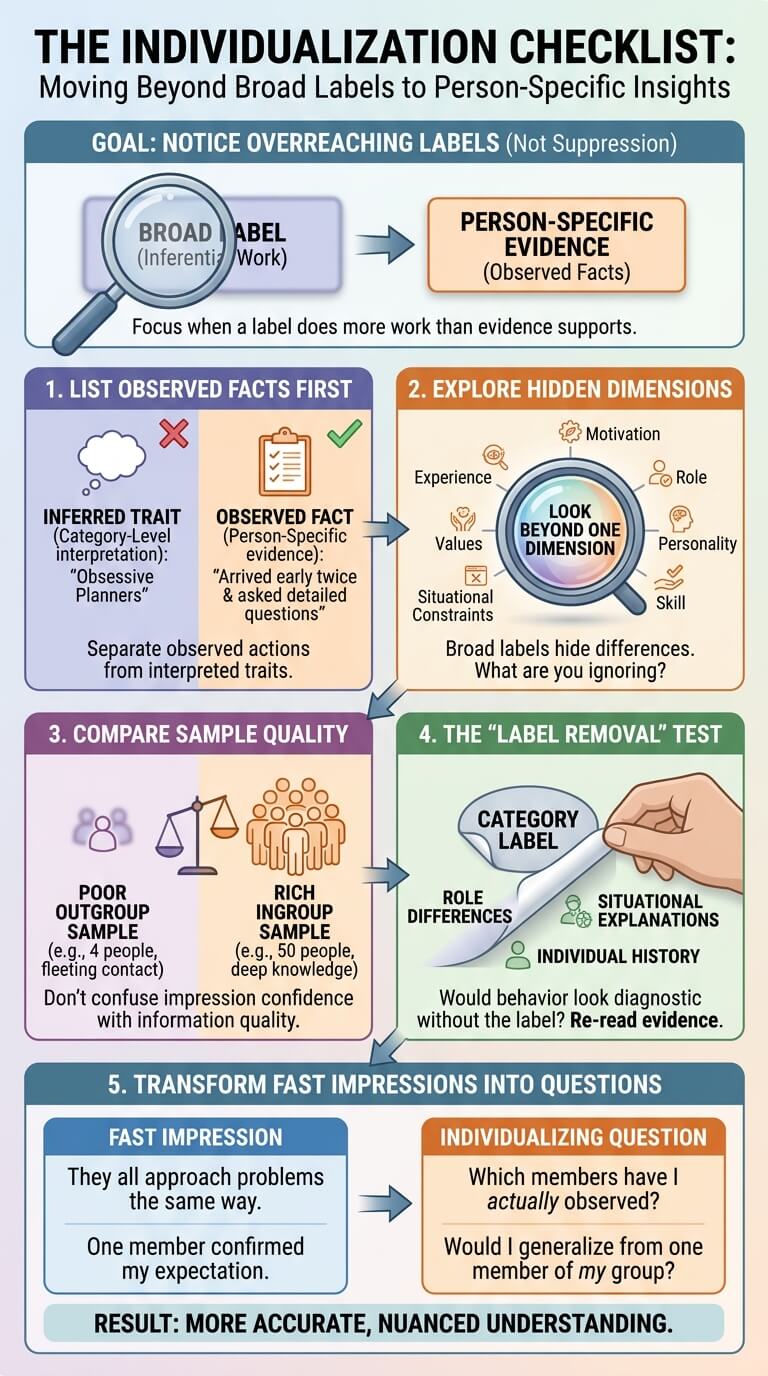
You do not need to suppress every category thought. A better goal is to notice when a broad label is doing more inferential work than the evidence can support.
What person-specific information do I actually know?
List observed facts before inferred traits. “They arrived early twice and asked detailed questions” is person-specific evidence. “People from that organization are obsessive planners” is a category-level interpretation.
Which dimensions of difference am I ignoring?
Groups can look homogeneous when you are measuring them on only one dimension. Ask whether experience, motivation, role, personality, skill, values, or situational constraints reveal differences that the broad label hides.
Am I comparing one outgroup sample with a richer ingroup sample?
Compare information quality, not only impressions. If you know fifty people in one group and four in another, confidence about relative variability should be modest. A small or selected sample is especially poor evidence for what the whole group is like.
What would I notice if the category label were removed?
Mentally remove the label and re-read the evidence. Would the same behavior still look diagnostic? Would you notice situational explanations, role differences, or individual history that the category made less visible?
| Fast impression | Individualizing question |
|---|---|
| “They all approach problems the same way.” | Which members have I actually observed solving comparable problems? |
| “That community is basically one type of person.” | What subgroups, roles, and motives exist inside it? |
| “Everyone there reacts like this.” | What is the denominator, and what counterexamples have I seen or not had access to? |
| “One member confirmed what I expected.” | Would I generalize equally from one member of my own group? |
Everyday Examples Without Harmful Stereotypes
Neutral examples are useful because they reveal the mechanism without importing socially degrading claims. The effect can appear around almost any meaningful group boundary.
Rival schools or sports groups
Situation: A student knows many personalities at their own school but calls a rival school “all intense.” What they may feel: that repeated encounters prove a group trait. What it may mean: the rival school is known mostly through competitive settings. What to do next: compare equivalent settings and look for within-group variation.
Departments or professions
Situation: A product team says legal “all thinks the same way” because members raise similar review concerns. What they may feel: that individual conversations are predictable. What it may mean: the role constrains what legal staff must discuss. What to do next: separate role-driven similarity from person-level differences.
Online communities and hobby groups
Situation: Someone sees several visible posts from a hobby community and assumes one shared attitude. What they may feel: that visible content represents typical members. What it may mean: algorithms and posting incentives may overrepresent active voices. What to do next: inspect quieter members, subgroups, and the difference between posting and belonging.
How Perceived Sameness Can Feed Broader Expectations
Perceived homogeneity matters because it changes how confidently information about one member is generalized to another. If you think a category contains little internal variation, learning something about one member feels more informative about the rest. Perceived sameness can also interact with illusory correlation when a distinctive behavior becomes mentally linked with a group and is then generalized too broadly.
Why low perceived variability can strengthen broad expectations
If one member of an unfamiliar organization behaves competitively, perceived uniformity can make that encounter feel representative of “what those people are like.” Seeing the group as varied makes it easier to treat the same behavior as information about one person in one situation.
This is one route by which perceived sameness can make a stereotype feel broadly applicable. It is not proof that every stereotype comes from outgroup homogeneity, and it does not mean the observer necessarily endorses a negative evaluation.
Why individual evidence can interrupt the shortcut
Individual evidence creates friction against automatic generalization. Names, roles, histories, specific behavior, and repeated observation make it harder for a single category summary to explain everyone. The goal is not endless data collection before making any decision. It is proportionality: the stronger the individual judgment, the stronger the person-specific evidence should be.
This is also where a broader understanding of social psychology and social context helps. Group cues are one part of perception, but situations, roles, norms, and individual histories also shape what people do.
Perceived Similarity Is Not the Same as a Moral Double Standard
Seeing outsiders as less differentiated is a perception question. Applying different standards of fairness, empathy, forgiveness, or accountability across group boundaries is a moral-evaluation question. The two can interact, but one does not establish the other.
Similarity judgments do not prove exclusion or unequal empathy
If someone says, “People in that club seem alike to me,” you cannot infer from that statement alone that they deny those people empathy or apply harsher moral standards to them. More evidence is needed about evaluation and behavior.
When the concern is specifically about loyalty, selective empathy, moral exclusion, or unequal standards between “us” and “them,” the distinction is explored more directly in ingroup vs outgroup morality. Keeping these questions separate prevents a perceptual effect from being treated as a moral diagnosis.
FAQ
Do people always see outgroups as more homogeneous?
No. The effect varies by group, familiarity, identity salience, relative group position, expertise, measurement, and context. Research has found classic outgroup-homogeneity patterns, weak or absent effects, and reversals. It is best understood as a tendency that can emerge under certain conditions rather than as a universal feature of social perception.
Is outgroup homogeneity the same as stereotyping?
No. Outgroup homogeneity concerns perceived variability: how similar group members seem to one another. Stereotyping concerns generalized beliefs or expectations about attributes associated with a group. Perceiving a group as uniform can make a stereotype easier to apply broadly, but a person can recognize group diversity while still holding a stereotype, or perceive similarity without attaching a strong trait expectation.
Does familiarity eliminate the effect?
Not automatically. Familiarity often provides more individuating information and more counterexamples, which can increase perceived variability. But contact can be shallow, repetitive, role-bound, or filtered through the same setting. What matters is not only how often you encounter a group but what kind of information those encounters provide.
Can people see their own group as more homogeneous?
Yes. Ingroup homogeneity can appear in some contexts, especially when shared identity or unity is highly salient. Research on perceived group variability does not support a simple rule that the ingroup must always look diverse and the outgroup must always look uniform. The direction can depend on what dimension is being judged and why that dimension matters.
How can I notice more individual variation in an unfamiliar group?
Replace broad labels with person-specific evidence where possible. Look for subgroups, roles, motives, experience levels, and exceptions. Compare equivalent samples rather than a rich picture of your own group with a tiny sample of another. Most importantly, ask what you actually know about the individual before treating a category-level impression as a personal prediction.
Key Takeaways
- The outgroup homogeneity effect concerns perceived within-group similarity, not proof that an outside group is objectively less diverse.
- Unequal familiarity can matter because familiar groups usually come with more individuating examples, exceptions, roles, and subgroups.
- Outgroup homogeneity is different from stereotyping: one concerns perceived variability, while the other concerns generalized attribute expectations.
- It is also different from ingroup favoritism and from moral double standards, so the effect alone does not prove hostility, prejudice, or unequal empathy.
- The effect is not universal. Expertise, minority or majority position, identity salience, group type, and task context can weaken, eliminate, or reverse it.
- A practical next step is to compare category information with person-specific evidence before generalizing from one or a few members to an entire group.
Final Thoughts
The most useful response to “they all seem the same” is curiosity about the information behind the impression. Ask how many members you know, which differences you have actually observed, whether a shared role creates surface similarity, and whether one memorable example is standing in for a larger group.
A simple first step is to choose one outside group you encounter regularly and name three meaningful dimensions on which its members differ. Then, when judging a particular person, use the group label only for information it genuinely supports and let individual evidence do the rest.

Michael Reed is the Founder and Lead Writer at Psychology Exposed. He writes about human behavior, relationships, emotional patterns, self-awareness, and practical psychology topics using research-informed, easy-to-understand content.
Read More About Michael Reed: https://psychologyexposed.com/michael-reed/