

Putting people from different groups in the same room does not automatically reduce prejudice. Sometimes contact creates familiarity, corrects exaggerated expectations, and makes another group feel less abstract. In other situations, it is brief, unequal, competitive, humiliating, or openly hostile, which can leave old assumptions untouched or even strengthen them.
Contact hypothesis psychology asks a more useful question than whether contact happens at all: what kind of contact is taking place, under what conditions, and what does the interaction give people a chance to learn? That distinction matters in schools, workplaces, neighborhoods, organizations, hobby communities, sports settings, and online spaces where people from different social categories may meet without necessarily understanding one another.
Quick Answer

The contact hypothesis proposes that constructive interaction between members of different groups can reduce prejudice, especially when people meet with reasonably equal status, pursue meaningful common goals, cooperate rather than compete, and receive support for respectful interaction. Contact is not a guaranteed cure. Its quality, repetition, emotional tone, context, and opportunity for genuine learning all shape what people take away from the encounter.
What the Contact Hypothesis Means
In social psychology, intergroup contact refers to interaction between people who understand themselves, at least partly, as members of different social groups. Those groups might be departments, schools, professions, regions, generations, sports communities, neighborhoods, nationalities, or other meaningful categories. The central idea is that certain forms of contact can make broad group-based expectations less influential by adding direct experience with actual individuals.
This sits within the wider study of prejudice and intergroup relations described in OpenStax Psychology’s discussion of prejudice and discrimination. It also helps explain why a person may change how they evaluate another group after repeated interaction, while still reminding us that direct experience is only one route through which attitudes can change.
Allport’s historical proposal
Gordon Allport’s 1954 book The Nature of Prejudice gave the contact hypothesis its classic form. He argued that contact was most promising when people interacted under conditions of equal status, common goals, cooperation, and social or institutional support. Later work refined those ideas rather than treating them as a simple four-item recipe. A major review of advances in intergroup contact theory describes those conditions as important facilitators while also reviewing newer work on mechanisms and generalization.
Contact as a conditional process, not simple exposure
Seeing members of another group across a hallway, serving them briefly as customers, or following someone online may create exposure without creating much opportunity for mutual understanding. Contact becomes more psychologically informative when people have enough interaction to notice individual variation, revise inaccurate expectations, and experience one another as participants in a shared situation rather than as symbols of a category.
The Four Classic Facilitative Conditions

The four conditions associated with Allport are best understood as features that improve the chances that contact will be constructive. They do not guarantee attitude change, and the absence of one condition does not prove that contact will fail. Together, however, they help distinguish meaningful interaction from mere proximity.
Equal status within the contact situation
Equal status does not require two people to have identical life circumstances or identical authority everywhere. The relevant question is whether the contact setting itself treats participants as reasonably equal contributors. If one group is consistently positioned as subordinate, incompetent, dependent, or unwelcome, the interaction may reproduce the very hierarchy that contact is supposed to challenge.
Common goals
A common goal gives people a reason to attend to shared outcomes rather than only category boundaries. The goal should matter enough that participants see value in the other person’s contribution. A ceremonial objective that everyone can ignore is unlikely to create the same learning opportunity as a task where progress genuinely depends on coordinated effort.
Intergroup cooperation
Cooperation means that people work in a way where helping the shared task also helps one another succeed. This differs from simply placing two groups beside each other while they compete for praise, resources, or rank. If the structure rewards one side for the other side’s failure, frequent contact may provide more opportunities for rivalry rather than revision of prejudice.
Institutional or authority support
People read the social rules of a setting. When teachers, managers, coaches, moderators, community leaders, or other legitimate authorities clearly support respectful cross-group interaction, participants receive a signal that cooperation and fair treatment are expected. Support also matters when problems occur, because norms have little credibility if harassment or humiliation is tolerated.
Are All Four Conditions Always Required?
It is tempting to turn the contact hypothesis into a pass-fail checklist: all four conditions present means success, one missing means failure. The evidence is more nuanced. The conditions appear to make positive outcomes more likely, but contact effects have also been observed when researchers could not verify every condition.
Meta-analytic evidence on facilitative versus strictly necessary conditions
A landmark meta-analysis by Pettigrew and Tropp examined 515 studies with 713 independent samples and found that intergroup contact typically related to lower prejudice. Contact structured around Allport’s favorable conditions tended to show stronger effects, but the conditions were not found to be individually necessary in every case.
This is useful because real life rarely offers perfectly controlled encounters. A neighborhood committee, workplace project, volunteer group, or online community may satisfy some conditions strongly and others only partly. The practical question becomes how many features of the setting support constructive learning, not whether an interaction matches an ideal laboratory design.
Why stronger conditions often improve the odds of constructive contact
The conditions work partly because they reduce predictable obstacles. Equal status can reduce role-based confirmation of hierarchy. Common goals can redirect attention toward shared outcomes. Cooperation can make another person’s contribution valuable rather than threatening. Institutional support can reduce uncertainty about whether respectful interaction is safe or socially accepted.
Quality vs Quantity of Contact

Counting encounters can miss what makes contact psychologically meaningful. Ten rushed, tense, or purely transactional exchanges may teach less than a smaller number of respectful interactions where people share responsibility, communicate openly, and see one another across different situations.
| Contact feature | What it may provide | What it may fail to provide |
|---|---|---|
| Frequent but superficial contact | Familiarity and reduced novelty | Deep individuation or trust |
| Repeated cooperative contact | Evidence about competence, reliability, and variation | Automatic generalization to every group member |
| One unusually positive encounter | A useful counterexample | Durable change in a broad group belief |
| Frequent negative contact | High salience and strong memory | Fair representation of the wider group |
Repeated meaningful interaction
Repeated contact matters because first impressions are noisy. A single awkward exchange may reflect fatigue, misunderstanding, role pressure, or chance. When people interact across multiple situations, they can observe a wider sample of behavior and see that one person is not reducible to a group label.
Superficial proximity without relationship
Physical closeness can coexist with social distance. Students may attend the same school but rarely work together. Employees may share a building but occupy separate status levels. Neighbors may see one another daily yet interact only during disputes. In each case, there is contact in a literal sense but limited opportunity to learn enough to revise group-based expectations.
This is one reason the contact hypothesis should not be confused with a simple familiarity principle. Familiarity can matter, but intergroup contact research asks about social conditions, category meaning, goals, emotional tone, and what people actually do together.
Friendship potential and mutual recognition
Contact tends to become richer when people have enough time and freedom to exchange personal information rather than staying locked into formal roles. Friendship is not required, but the possibility of mutual recognition can matter because people discover interests, habits, concerns, and differences that broad labels do not capture.
How Contact May Reduce Prejudice
If contact helps, what changes psychologically? Researchers have studied several possible pathways. No single mechanism explains every case, but the most discussed include learning, reduced anxiety, perspective-taking, empathy, and greater individuation.
Learning about individuals and the outgroup
Direct interaction can replace imagined information with observed information. People may discover that a group is more internally varied than they assumed, that a feared behavior is less common than expected, or that shared goals exist where only difference had been noticed.
Knowledge alone is not always the strongest pathway. A meta-analysis of contact mechanisms found evidence for increased knowledge, reduced intergroup anxiety, and increased empathy or perspective-taking, with anxiety reduction and empathy-related processes showing stronger mediation than knowledge in that analysis.
Lowering intergroup anxiety
Unfamiliar group boundaries can make people uncertain about what to say, how they will be judged, or whether an interaction will become uncomfortable. That uncertainty can lead to avoidance, stiff behavior, or over-monitoring. Repeated respectful contact can make future interactions feel more predictable and reduce the tendency to interpret every awkward moment as evidence of group incompatibility.
Perspective-taking and empathy as possible mechanisms
Conversation can reveal how the same situation looks from another position. Understanding why a person experienced a rule, joke, neighborhood issue, or workplace practice differently does not require agreeing with every interpretation. It means gaining information that was unavailable from outside the interaction.
Empathy may support warmer evaluation, but it should not be treated as a moral performance or a demand to feel a particular emotion. The evidence is better understood as showing that some forms of contact can make another person’s perspective easier to represent mentally.
Individuation and category updating
One of the most practical effects of meaningful contact is individuation: the other person becomes a person with a specific pattern of traits, choices, strengths, limits, and context. That richer representation competes with the shortcut of judging primarily from category membership.
From One Person to the Wider Group
A positive interaction with one individual is useful, but prejudice concerns evaluation of a category, not only one person. This creates a central challenge: how does learning about one contact partner generalize beyond that individual?
Generalization beyond the contact partner
The 2006 meta-analysis found that contact effects often generalized beyond the specific person involved. Generalization becomes more plausible when the interaction is clearly understood as occurring across group lines while still allowing genuine person-to-person learning.
Why purely exceptionalizing one person may limit generalization
People can protect an old stereotype by treating every counterexample as an exception: “She is different from the rest of them.” This preserves the broad belief while making room for one liked individual. Psychologically, the person has been individuated, but the group representation has not necessarily changed.
Balancing individuality with awareness of group membership
There is a subtle balance here. If category membership dominates the interaction, people may see only “us” and “them.” If group membership becomes completely irrelevant, positive learning may remain attached only to the individual. Constructive contact can allow both truths to coexist: this is a distinct person, and this person is also one real member of a broader group that may be more varied than expected.
Direct, Extended, and Indirect Contact
Not all contact requires the same degree of direct interaction. Research has examined face-to-face contact, extended contact through the relationships of people we know, and imagined or mediated forms of contact. These approaches differ in intensity and evidence base, so they should not be treated as interchangeable.
Direct face-to-face interaction
Direct contact offers the richest stream of information because people can observe behavior, adjust to one another, correct misunderstandings, and build a history of interaction. It also has the greatest potential for both positive and negative experiences because actual disagreement, status differences, and social risk are present.
Knowing an ingroup member has an outgroup friend
Extended contact refers to learning that someone from your own group has a close relationship with someone from another group. Research on cross-group friendship has found links between both direct and extended contact and more positive attitudes, with mechanisms such as reduced intergroup anxiety and self-disclosure playing roles in some studies. One example is a series of studies on direct and extended cross-group friendship.
Extended contact may be useful when opportunities for direct interaction are limited, but it provides less firsthand evidence. Knowing that a trusted friend has a positive cross-group relationship can make contact seem more normal and less threatening, yet it is not equivalent to building your own relationship.
Imagined or mediated forms where evidence supports them
Researchers have also tested imagined contact, online interaction, stories, media, and other indirect formats. Some studies and meta-analyses find small beneficial effects under certain conditions, especially when the imagined or mediated interaction is positive and sufficiently concrete. These approaches may help prepare people for later interaction, but they should not be presented as substitutes for all forms of real-world contact.
When Contact Can Fail
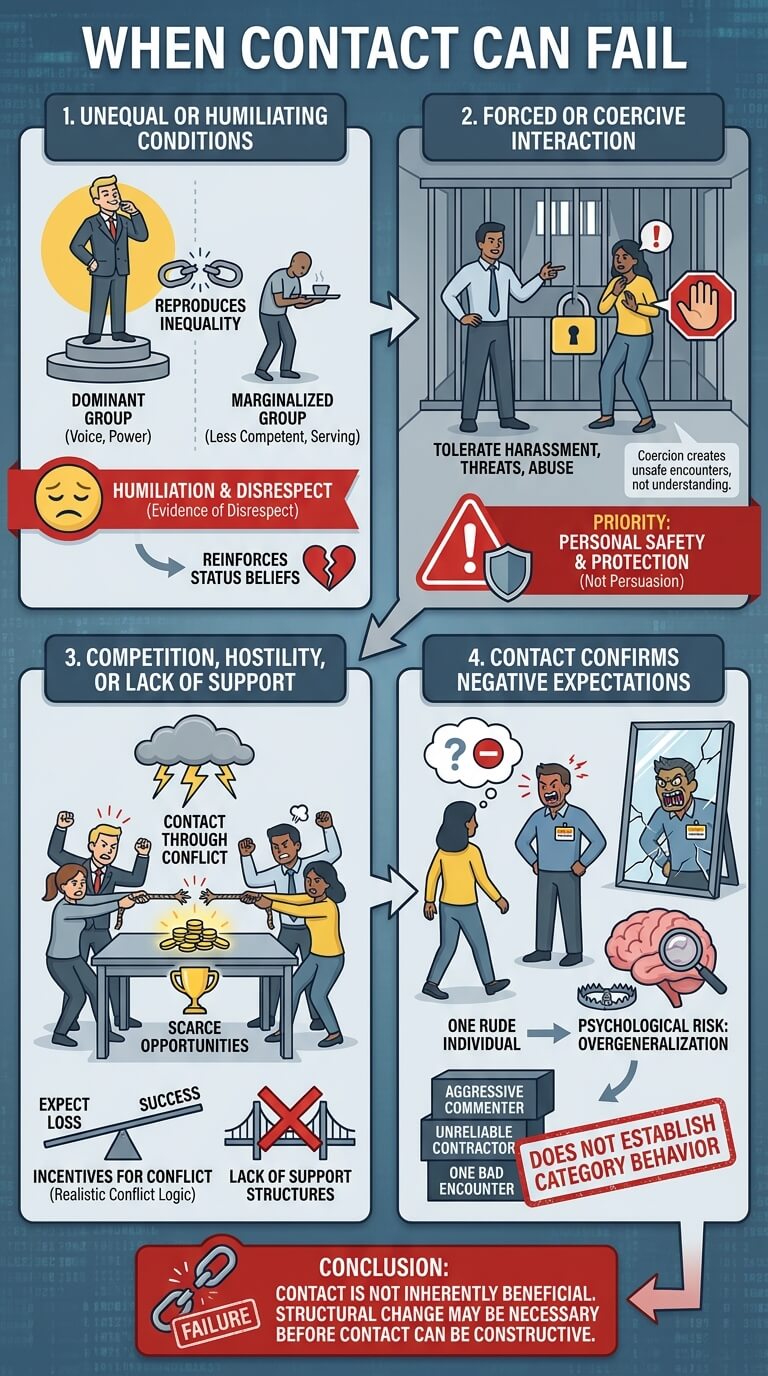
Contact is not inherently beneficial. It can fail when the interaction reproduces inequality, makes people feel coerced, rewards competition, or exposes participants to humiliation. The fact that contact sometimes reduces prejudice should never be used to pressure someone into an unsafe encounter.
Unequal or humiliating conditions
If one group is consistently treated as less competent, less worthy of voice, or present only to serve another group, the encounter may reinforce status beliefs. Humiliation is especially damaging because it makes the contact itself evidence of disrespect.
Forced or coercive interaction
Required participation can sometimes create useful opportunities, such as assigned mixed-group classroom projects, but coercion becomes a serious concern when a person is expected to tolerate harassment, threats, stalking, intimidation, abuse, or retaliation in the name of “building understanding.” Contact theory does not override personal safety.
If there is credible fear or targeted mistreatment, the priority is protection, appropriate support, and safer structures, not persuading the affected person to spend more time with the person causing harm.
Competition, hostility, or lack of support
When groups are competing over scarce opportunities, contact may occur mainly through conflict. A shared meeting does not neutralize incentives that make each side expect loss when the other succeeds. This is where the logic of realistic conflict becomes relevant: changing the structure of goals may be necessary before contact has a fair chance to become constructive.
Contact that confirms existing negative expectations
Sometimes a negative expectation is followed by a genuinely negative encounter. The psychological risk is overgeneralization. One rude colleague, hostile fan, unreliable contractor, or aggressive commenter provides evidence about that individual and situation. It does not establish how an entire social category behaves.
Negative Contact and Why It Can Matter Strongly
Positive and negative contact do not simply cancel each other out like points on a scoreboard. Negative encounters are often vivid, emotionally charged, and easy to recall. That can make them especially influential when people already expect danger or dislike from another group.
Bad interactions can become highly salient
A 2024 meta-analysis on positive and negative intergroup contact found that positive contact was associated with lower prejudice and negative contact with higher prejudice. Across the studies synthesized, the detrimental association of negative contact was larger than the beneficial association of positive contact, with the size of that asymmetry varying by context and opportunities for self-selection.
One negative encounter should not be generalized to a whole group
After a bad experience, the mind may want a broad lesson: “Now I know what those people are like.” That conclusion feels efficient but usually exceeds the available evidence. A better question is, “What exactly did this person do, what conditions shaped the interaction, and what evidence do I have about the wider group?”
Positive and negative contact can coexist
Most real-world contact histories are mixed. Someone may have supportive colleagues from a group and also remember one painful conflict. The task is not to erase either experience, but to avoid allowing the most vivid encounter to become the sole representative of a category.
Contact vs Cooperation Psychology
Contact and cooperation overlap, but they answer different questions. Contact research asks how interaction across group boundaries may change intergroup evaluation. Cooperation research asks how people coordinate behavior toward compatible outcomes, whether or not group prejudice is involved.
Cooperation explains coordination toward compatible outcomes
A team can cooperate effectively even when everyone comes from the same group. Cooperation involves aligned goals, information sharing, role coordination, trust, and mutual dependence. None of those features automatically makes a situation intergroup contact.
Cooperation can improve the quality of intergroup contact
When cooperation occurs across a meaningful group boundary, it can create exactly the kind of evidence contact needs: people see each other’s contributions, depend on one another, and experience success as jointly produced. This is why cooperation appears inside Allport’s favorable conditions without becoming the whole theory.
Contact Hypothesis vs General Attitude Change
Changing prejudice is a special case of changing an evaluation. The broader psychology of attitude change includes persuasion, new information, repeated experience, emotion, behavior, social norms, identity, and other mechanisms. Intergroup contact focuses on what happens when experience specifically crosses a social group boundary.
Intergroup-specific contact pathway
The distinctive feature is that the person encounters evidence while the group category is psychologically relevant. That makes it possible for the experience to update expectations about the wider group rather than only about one individual.
General attitude change includes many non-contact mechanisms
A person can change an opinion about a product, habit, policy, profession, or social practice without interacting with a member of another group. For that broader process, Psychology Exposed’s discussion of how attitudes change through information and experience provides the more general framework. Contact theory is narrower because the social category and cross-group encounter are central.
A Constructive Contact Checklist
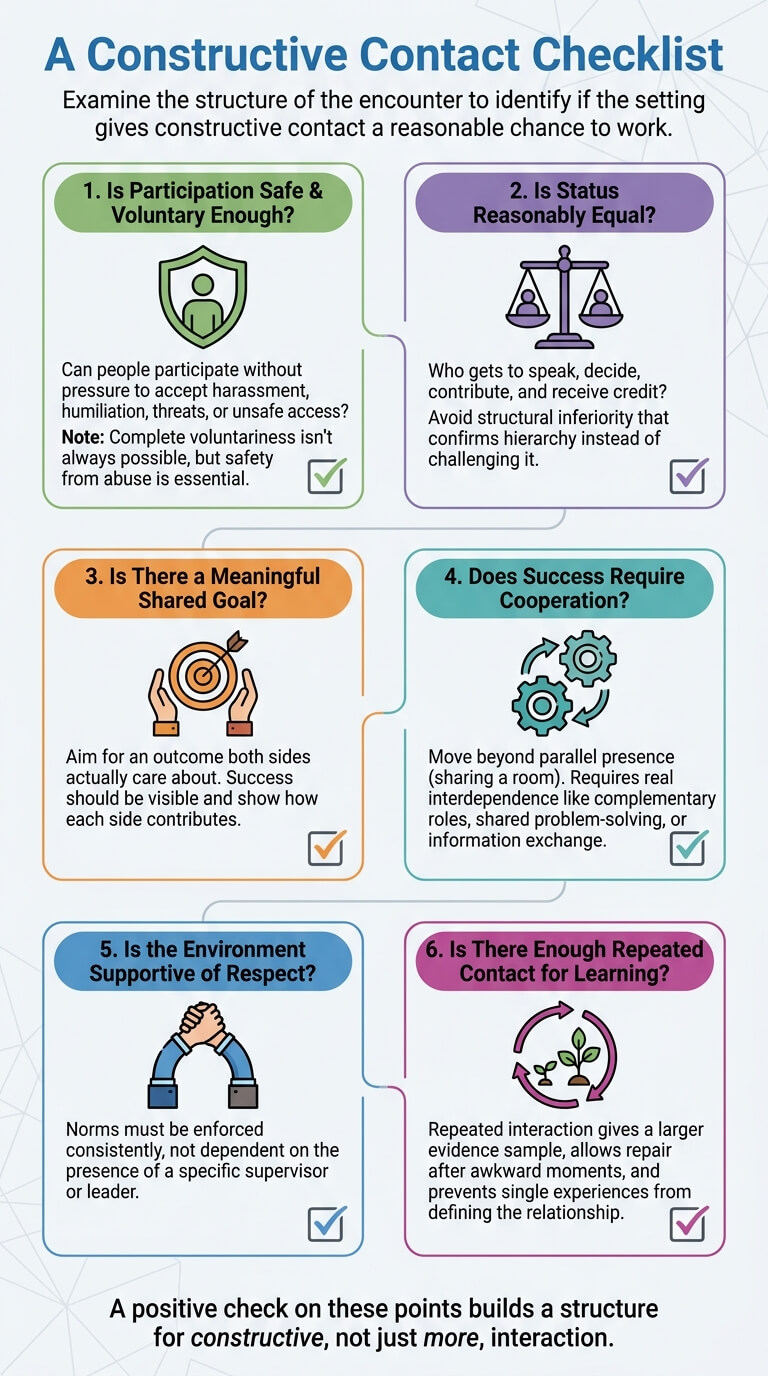
Before assuming that more interaction will help, examine the structure of the encounter. The following questions are not a guarantee of success. They are a way to identify whether the setting gives constructive contact a reasonable chance to work.
Is participation safe and voluntary enough for the context?
Some settings involve required interaction, such as classrooms or workplaces, so complete voluntariness is not always realistic. What matters is whether people can participate without being pressured to accept harassment, humiliation, threats, or unsafe personal access.
Is status reasonably equal within the interaction?
Ask who gets to speak, decide, contribute, and receive credit. If one side is structurally treated as inferior during the encounter, contact may confirm hierarchy instead of challenging it.
Is there a meaningful shared goal?
Look for an outcome that both sides actually care about. A goal works better when success is visible and when each side can see how the other contributes to it.
Does success require cooperation rather than parallel presence?
Sharing a room is not the same as working together. Stronger contact often involves complementary roles, shared problem solving, information exchange, or another form of real interdependence.
Is the environment supportive of respectful interaction?
Norms matter most when they are enforced consistently. Respectful conduct should not depend on whether a particular supervisor, teacher, moderator, or group leader happens to be present.
Is there enough repeated contact for learning to occur?
One meeting can open a door, but repeated interaction gives people a larger evidence sample. It also allows repair after awkward moments and makes it harder for one exceptional experience to define the entire relationship.
Contact as One Part of Reducing Prejudice
Contact is a major psychological pathway, not the whole landscape. Prejudice can be maintained by stereotypes, norms, incentives, selective information, institutional routines, competition, ambiguous evaluation criteria, and other forces that one friendly encounter cannot address on its own.
Contact is a mechanism, not the whole intervention landscape
Constructive contact may change expectations and emotional responses, but those changes still occur inside larger environments. A workplace can contain positive cross-group friendships while using an evaluation process that leaves excessive room for subjective bias. A school can encourage mixed-group projects while social norms outside the classroom pull students back toward separation.
Norms, structure, individuation, and decision processes can also matter
Durable change is more plausible when interpersonal learning is reinforced by fair procedures and social norms. Clear evaluation criteria, opportunities to know people as individuals, repeated cooperative experiences, and consistent expectations for respectful treatment can work together rather than asking contact to do everything.
For a broad starting point on how social context shapes group behavior, the overview of social psychology basics explains the wider role of norms, groups, social influence, and context.
FAQ
These questions address the points that are easiest to oversimplify when people first encounter contact theory.
Does simply spending time with another group reduce prejudice?
Not necessarily. Mere proximity may provide familiarity, but it may also leave social separation, unequal status, competition, or negative expectations untouched. Contact tends to be more promising when people interact meaningfully, have opportunities to learn about one another, and operate in a context that supports respectful, reasonably equal participation. Quantity matters less if the contact is consistently superficial or hostile.
Are Allport’s four conditions required in every case?
No. Research suggests that equal status, common goals, cooperation, and authority support generally facilitate more favorable contact, but meta-analytic evidence does not support treating each one as an absolute requirement for every positive outcome. They are better used as design principles that improve the quality of contact and reduce common obstacles.
Can one negative interaction increase prejudice?
It can influence later evaluation, especially if the encounter is emotionally intense and the person’s group membership is highly salient. Recent meta-analytic evidence suggests negative contact can have a particularly strong association with prejudice. Still, one event does not logically justify a conclusion about an entire group. The safer inference is specific: judge the behavior that occurred, then ask whether broader evidence supports any wider conclusion.
Does a positive friendship generalize to the wider group?
Sometimes it does, but not automatically. Generalization is more likely when the person is recognized both as an individual and as a genuine member of the group. If someone is mentally filed as “the one exception,” the friendship may remain positive while the broader stereotype stays unchanged. Contact with multiple people and settings can provide a wider evidence base.
Can indirect contact work when direct contact is limited?
Indirect approaches such as knowing about cross-group friendships, structured online interaction, or imagined positive contact have shown promising effects in parts of the research literature. Their effects are generally more limited than the rich information available through direct interaction, and the quality of the indirect experience still matters. They are best understood as additional pathways, not proof that direct contact is unnecessary.
Key Takeaways
- The contact hypothesis is about the conditions and quality of cross-group interaction, not the assumption that proximity alone reduces prejudice.
- Equal status, common goals, cooperation, and authority support usually improve the setting for constructive contact, but they are not absolute requirements in every study or situation.
- Contact may work partly by reducing intergroup anxiety, supporting perspective-taking, and giving people enough evidence to individuate one another.
- Positive learning does not always generalize from one person to an entire group, especially when the person is treated as an exception.
- Negative contact matters. A bad interaction can be highly salient, but the conclusion drawn from it should remain proportionate to the evidence.
- Safety comes before contact. No one should be pressured into interaction with someone who threatens, stalks, harasses, abuses, intimidates, or retaliates against them.
About the author: Michael Reed is the Founder & Lead Writer at Psychology Exposed. He writes about human behavior, relationships, emotional patterns, self-awareness, and everyday decisions in a clear, research-aware way for general readers.

Michael Reed is the Founder and Lead Writer at Psychology Exposed. He writes about human behavior, relationships, emotional patterns, self-awareness, and practical psychology topics using research-informed, easy-to-understand content.
Read More About Michael Reed: https://psychologyexposed.com/michael-reed/