

Two groups do not need to dislike each other from the beginning to become rivals. Give them a reason to believe that only one side can get the budget, the best schedule, the limited places, the recognition, or the outcome they value, and ordinary differences can start to feel threatening. Expectations harden, mistakes are interpreted less generously, and the other group may come to look like an obstacle rather than a set of individuals.
Realistic conflict theory explains one important route into intergroup tension: perceived competition over goals or resources that seem incompatible. It does not claim that all prejudice comes from competition, or that competition automatically produces hostility. Its value is narrower and more practical. It helps identify when a conflict is being organized around a zero-sum belief, whether that belief reflects real constraints, and whether the situation can be changed so that groups have something meaningful to accomplish together.
Quick Answer
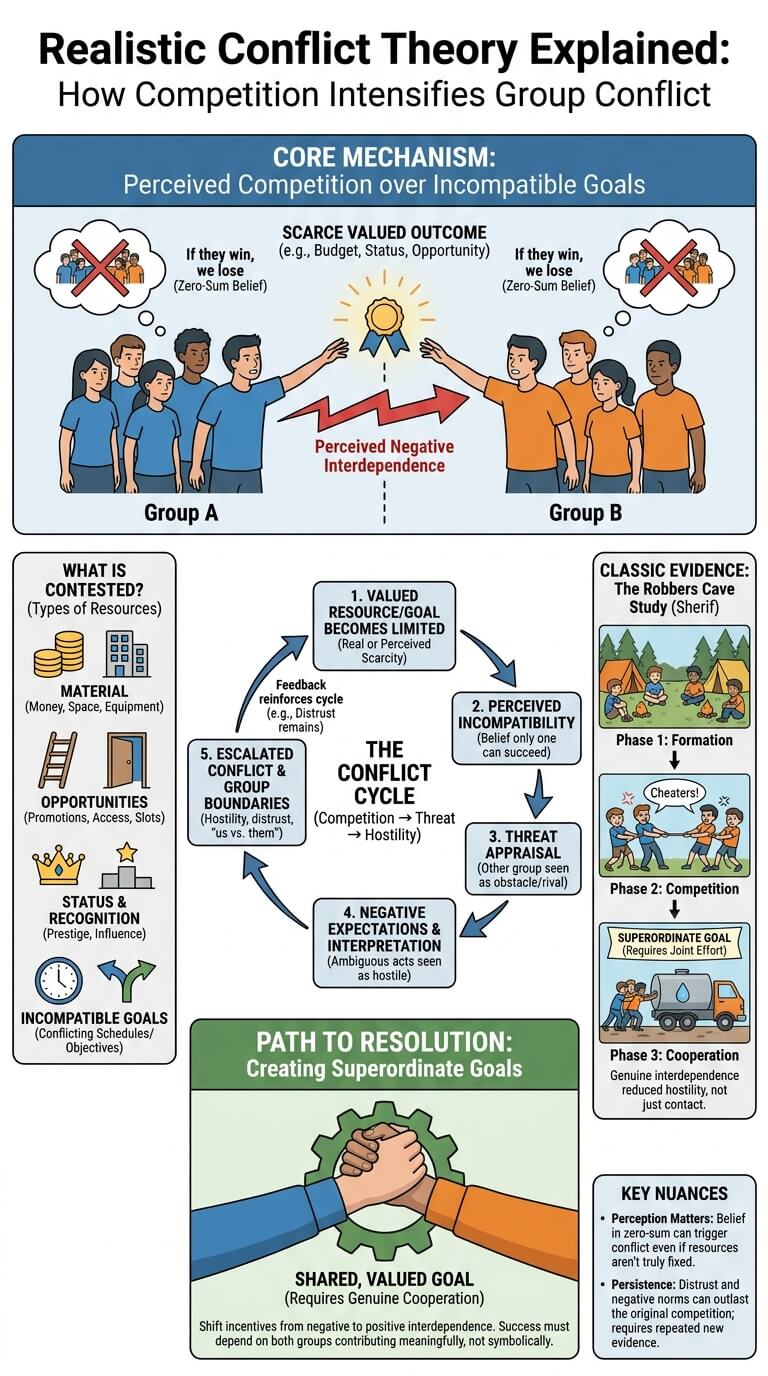
Realistic conflict theory proposes that intergroup hostility becomes more likely when groups perceive that their interests, resources, opportunities, status, or goals are incompatible. If one group believes the other must lose for it to succeed, threat and negative expectations can intensify. Shared goals that require genuine cooperation may reduce tension, but the effect depends on context, incentives, history, and whether the cooperation is meaningful rather than symbolic.
What Realistic Conflict Theory Means
The APA Dictionary of Psychology definition of realistic group conflict theory centers on competition between social groups for scarce resources and the antagonism that may follow. In everyday terms, the theory asks what happens when Group A believes that Group B is competing for something both sides value and both sides cannot fully obtain. Realistic conflict theory describes one pathway within the broader psychology of prejudice and group bias, specifically when perceived incompatibility between groups becomes central.
Intergroup competition over incompatible interests
The core mechanism is negative interdependence. One side’s desired outcome appears to reduce the other side’s chance of getting what it wants. A department may believe that another department’s larger budget necessarily means less funding for its own projects. Two teams may compete for one playoff place. Two neighborhood groups may want the same limited booking slots at a shared facility.
The important point is not that people merely notice another group. The other group becomes relevant because its success is interpreted as connected to one’s own loss. That perceived connection gives rivalry psychological weight.
Objective scarcity versus perceived scarcity
Sometimes the scarcity is real. There may truly be one job opening, one grant, ten places, or a fixed budget. In other cases, people assume the situation is more zero-sum than it actually is. Rules may be negotiable, resources may be expandable, or the groups may be competing because information is incomplete.
This is why perceived competition matters. A conflict can intensify even when an outside observer sees room for compromise, especially if group members sincerely believe the other side is blocking something important.
The Competition → Threat → Group Conflict Pathway

A useful way to read the theory is as a sequence rather than a label. Competition changes what the other group means. The other side is no longer simply different; it becomes relevant to whether valued goals can be reached.
| Stage | Psychological shift | Useful question |
|---|---|---|
| Valued outcome | A resource, opportunity, status position, or goal matters. | What is actually at stake? |
| Perceived incompatibility | The groups believe they cannot both succeed. | Which outcomes truly conflict? |
| Threat appraisal | The other group is seen as blocking access or security. | What evidence shows the other side is the obstacle? |
| Negative expectations | Ambiguous actions are interpreted through rivalry. | Would the same action look different outside competition? |
| Conflict feedback | Defensive or hostile behavior creates new reasons for distrust. | What part of the cycle is now maintaining itself? |
A valued resource, opportunity, or status becomes limited
Competition only matters when the outcome has value. Groups rarely become deeply invested in a contest over something they do not care about. The stronger the importance of the reward, the more attention people may give to who is gaining, who is losing, and whether the process seems fair.
Another group is seen as blocking access
Scarcity alone does not specify an enemy. Conflict sharpens when a particular group becomes tied to the blocked outcome. The rival may be viewed as taking scarce places, receiving favored treatment, controlling access, or preventing the ingroup from reaching a goal.
Negative expectations become easier to justify
Once rivalry is established, ordinary behavior can be read more suspiciously. A request for more resources may look greedy when it comes from the competing side but reasonable when made by one’s own group. A scheduling mistake may be interpreted as strategic rather than accidental.
This does not mean every negative judgment during competition is biased. Competitors sometimes do act strategically. The psychological caution is to avoid treating the existence of rivalry as proof of motive.
Conflict can reinforce group boundaries
Competition can make group labels more salient. People pay more attention to who belongs to which side, talk more in terms of “we” and “they,” and may become more loyal to their own side. These identity effects can then outlast the original contest, which helps explain why a conflict may continue after the practical stakes shrink.
What Counts as a Resource in the Theory?
The word resource can sound purely material, but intergroup competition can involve several kinds of valued outcomes. The best test is whether the groups perceive access as limited and their goals as negatively linked.
Material resources
Money, equipment, land, space, supplies, and other tangible goods fit the most literal version of the theory. A fixed annual budget can create direct trade-offs if every dollar allocated to one unit is unavailable to another.
Opportunities and access
Groups may compete for admissions, promotions, speaking time, contracts, preferred shifts, training places, or access to facilities. These are not physical goods, but they can still be scarce and highly valued.
Status and recognition
Recognition can also feel scarce. Two teams may believe only one can be viewed as the organization’s top performer. Two professional groups may compete over influence or prestige. Status deserves careful treatment because hierarchy has its own psychology, but it can function as a contested outcome when groups see rank as limited.
Goals that cannot all be achieved simultaneously
Sometimes the conflict is not over a thing at all. The goals themselves are incompatible. One committee wants a public space used for quiet study while another wants the same hours reserved for events. Both goals may be legitimate, yet they cannot occupy the same time and place without negotiation.
The Robbers Cave Studies in Context
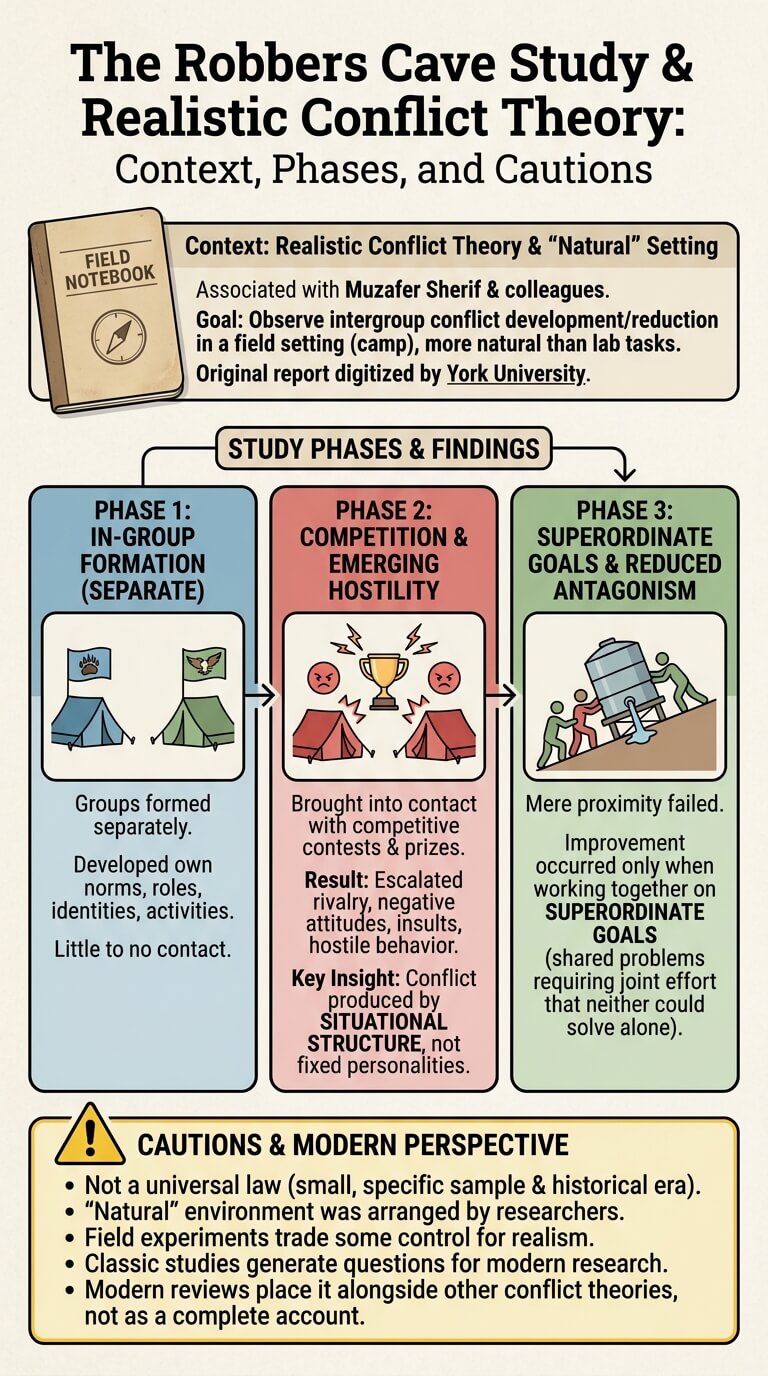
Realistic conflict theory is closely associated with Muzafer Sherif and colleagues’ field research at a boys’ summer camp in Oklahoma. The original work remains historically important because it tried to observe the development and reduction of intergroup conflict in a setting that felt more natural than a short laboratory task. A digitized version of the Robbers Cave research report hosted by York University’s Classics in the History of Psychology preserves the original account.
Basic study design and phases
The researchers formed two groups of boys separately, allowing each group to develop its own activities, norms, roles, and identity. The groups were then brought into contact under competitive conditions involving contests and prizes. Later, the researchers introduced situations that required cooperation across the group boundary.
Competition and emerging hostility
During the competitive phase, rivalry escalated beyond the contests themselves. The groups developed negative attitudes toward one another, insults and hostile behavior appeared, and social distance increased. The findings helped illustrate how conflict can be produced by the structure of a situation rather than being assumed to come from fixed hostile personalities.
Superordinate goals and reduced antagonism
In the later phase, merely placing the groups near each other was not enough to repair relations. More improvement appeared when the boys had to work together on problems that neither group could solve alone. Sherif later summarized this pattern in a peer-reviewed paper on superordinate goals and the reduction of intergroup conflict.
Historical, methodological, and generalizability cautions
The study should not be treated as a universal law of human groups. The participants were a small and highly specific sample, the camp environment was arranged by researchers, and the study came from an earlier era with research practices that differ from modern expectations. Field experiments also trade some control for realism.
Classic studies are most useful when they generate questions that later research can test, refine, or challenge. A modern review of psychological theories of intergroup conflict places realistic conflict alongside other explanations rather than presenting it as a complete account of every form of intergroup bias.
Superordinate Goals and Cooperative Interdependence

A superordinate goal is valuable to both groups and difficult or impossible for either group to achieve alone. The key idea is not friendliness. It is changing the incentive structure so that successful action depends on cooperation across the boundary.
A goal neither group can achieve alone
Imagine two departments that compete for visibility all year but suddenly face a technical migration that will fail unless both teams contribute specialized knowledge. If success genuinely depends on both groups, the other side becomes useful to one’s own outcome rather than merely obstructive.
Repeated cooperation versus one symbolic task
One cooperative exercise may not erase months or years of rivalry. Trust is shaped by repeated expectations. If groups cooperate once and then return immediately to a reward system in which one side benefits from the other’s failure, the old conflict structure remains.
Research also suggests that superordinate goals are not magic. In one study, Deschamps and Brown found that the effects of cooperative goals depended on how group roles and distinctiveness were structured. Shared goals can help, but the conditions around cooperation still matter.
Why shared success can change expectations
Genuine interdependence creates new evidence. Members see people from the other group contributing, coordinating, keeping commitments, and helping produce a valued result. That experience can weaken the assumption that the other side’s gain must always be one’s own loss.
Perceived Competition vs Actual Scarcity
One of the most useful extensions of realistic conflict thinking is that beliefs about competition can matter even when scarcity is partly subjective. People act on the situation as they understand it, not on an omniscient view of all possible arrangements.
Beliefs about zero-sum outcomes can matter
If two teams believe only one can receive leadership attention, they may guard information and interpret praise for the other team as a threat. The belief itself can produce competitive behavior, which then makes cooperation harder and seems to confirm that the groups truly are opponents.
Research on perceived realistic group conflict has examined how perceived economic or work-related threat can relate to negative intergroup attitudes. This does not mean perception is detached from reality. It means that psychological responses depend partly on how people interpret the resource situation.
Information and institutions can shape perceived incompatibility
Allocation rules, leadership messages, opaque decision processes, and reward systems can make conflict look more or less zero-sum. If managers reward departments only for beating one another, they create a different social environment from one in which teams also share responsibility for organization-wide outcomes.
Correcting false scarcity does not instantly erase learned hostility
Suppose two groups have spent a year treating each other as rivals and later discover that the resource constraint was misunderstood. The factual correction matters, but distrust, habits, stories, and reputational expectations may remain. Information can remove one cause of conflict without immediately undoing everything that developed around it.
Why Conflict Can Continue After Conditions Change
Realistic conflict theory begins with the structure of competition, but human relationships develop history. Once rivalry has produced injuries, expectations, and norms, the conflict can gain additional supports.
Memory of past harm
People remember being excluded, mocked, blocked, or treated unfairly. Even when the original contest ends, those experiences can affect future interpretation. A new cooperative offer may be read through old evidence rather than judged only on current conditions.
Norms and reputational expectations
Groups develop stories about what “people like them” do. Members may expect betrayal because betrayal was common during competition, or because distrust has become a group norm. Breaking that expectation usually requires more than announcing that everyone should cooperate now.
Identity and narratives built during conflict
Rivalry can become part of how a group defines itself. That is where realistic conflict starts to overlap with identity-based explanations. The original competition may have helped create the boundary, but later bias may be maintained by social comparison, loyalty, memory, and identity even when the resource conflict is weaker.
Realistic Conflict Theory vs Social Identity Theory
These theories answer related but different questions. Keeping them separate prevents a common mistake: assuming that group bias requires a concrete fight over resources.
| Question | Realistic conflict theory | Social identity theory |
|---|---|---|
| Central trigger | Perceived incompatible interests, goals, or resources | Group membership, categorization, comparison, and identity processes |
| Is concrete competition required? | Competition or negative interdependence is central | No. Favoritism can emerge without meaningful resource conflict |
| What makes the outgroup relevant? | It is seen as affecting the ingroup’s valued outcomes | It provides a comparison point for social identity |
| Can both operate together? | Yes. Competition can make group identity more salient, and identity can shape how competition is interpreted. | |
Competition as the center versus identity effects without concrete competition
Minimal-group research associated with social identity theory showed that people can display ingroup preference even when group divisions are relatively arbitrary and there is little meaningful history. Realistic conflict theory instead focuses on conditions in which the groups’ outcomes are negatively interdependent.
If you want the broader background on how group context changes judgment and behavior, Psychology Exposed’s overview of social psychology basics provides that wider frame. Here, the narrower question is whether perceived competition is organizing the relationship between groups.
How both mechanisms can operate together
In real settings, theories do not take turns politely. Two departments may have strong identities and also compete for money. Sports supporters may identify deeply with their team while also caring about scarce championships. A useful analysis asks which processes are active rather than forcing every conflict into one explanation.
Realistic Conflict Theory vs Social Dilemmas
The phrases sound similar because both involve competing interests, but the unit of analysis differs.
Group A versus Group B
Realistic conflict concerns negative interdependence between groups. If Team A gets the single available contract, Team B does not. The conflict is organized around group-level outcomes.
Individual incentive versus collective outcome
A social dilemma concerns a person’s incentive relative to the welfare of a larger group. For example, every resident may benefit if everyone conserves a shared resource, yet each person may be tempted to use more. That is not the same structure as two groups competing against each other.
Realistic Conflict Theory vs Scapegoating
Competition and scapegoating can reinforce one another, but they describe different processes.
Competition can create threat
If another group genuinely competes for a valued outcome, members may experience frustration, vigilance, or threat. Those feelings can make negative explanations about the rival more believable.
Scapegoating concentrates blame on a convenient target
Scapegoating occurs when responsibility for a broader problem is loaded disproportionately onto a convenient person or group. A rival may become an easy scapegoat, but competition alone does not prove that blame is misplaced. The question is whether causal responsibility matches the evidence.
Three Everyday Examples Without Political Baggage
Realistic conflict becomes easier to recognize when the examples are ordinary enough to inspect without strong prior loyalties.
Departments competing for one budget line
Two departments both want funding for new software, but only one request can be approved this quarter. Meetings become sharper, each group highlights the other’s inefficiencies, and neutral delays are interpreted as strategic obstruction. The scarcity is real, yet the negative judgments that grow around it may extend well beyond the actual budget decision.
Teams competing for limited scheduling slots
Two sports clubs share one facility and both want the most convenient evening slots. Members begin to describe the other club as selfish. A useful intervention is not simply “be nicer.” It is to clarify the allocation rule, expand options if possible, and identify any shared outcome, such as keeping the facility funded and available.
Community groups competing for shared facilities
Two hobby communities request the same rooms for recurring events. If the booking system is opaque, each may suspect favoritism. Transparent criteria can reduce imagined zero-sum threat, although real scheduling conflicts may still require compromise.
A Conflict Diagnosis Framework
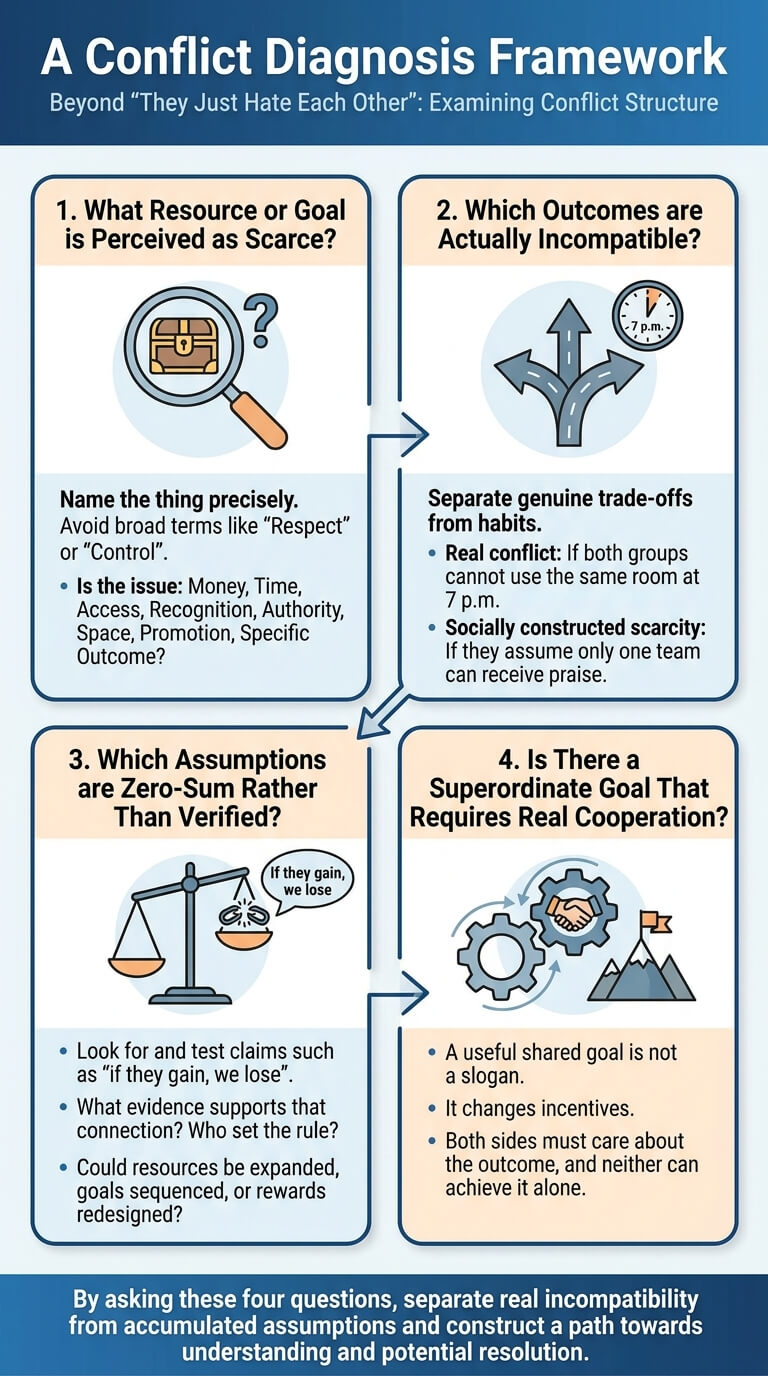
Before concluding that two groups “just hate each other,” examine the structure of the conflict. The following four questions separate real incompatibility from assumptions that have accumulated around it.
1. What resource or goal is perceived as scarce?
Name the thing precisely. “Respect,” “opportunity,” or “control” may be too broad. Is the issue money, time, access, recognition, authority, space, promotion chances, or a specific outcome?
2. Which outcomes are actually incompatible?
Separate genuine trade-offs from habits. If both groups cannot use the same room at 7 p.m., that conflict is real. If they assume only one team can receive praise, the scarcity may be socially constructed rather than fixed.
3. Which assumptions are zero-sum rather than verified?
Look for claims such as “if they gain, we lose” and test them. What evidence supports that connection? Who set the rule? Could resources be expanded, goals sequenced, or rewards redesigned?
4. Is there a superordinate goal that requires real cooperation?
A useful shared goal is not a slogan. It changes incentives. Both sides must care about the outcome, and neither side should be able to achieve it alone while the other merely watches.
First Steps for Reducing Unnecessary Competition
Not every conflict can or should be dissolved. Some interests genuinely compete. The practical task is to remove avoidable rivalry without pretending that real trade-offs do not exist. Reducing avoidable zero-sum structures can therefore be one component of broader prejudice reduction, although competition is only one pathway to group bias.
Clarify actual constraints
Write down what is fixed and what is assumed. Scarcity feels more threatening when rules are vague. Clear information about budgets, schedules, criteria, and decision authority can reduce speculation even when the outcome remains limited.
Separate fixed scarcity from negotiable processes
One promotion may be fixed scarcity. How candidates are evaluated, how feedback is given, and whether other development opportunities exist may be negotiable. Distinguishing the two prevents every part of the situation from becoming zero-sum.
Create shared goals only when incentives truly align
Do not invent a ceremonial team-building task while leaving the reward system untouched. Shared goals work best when success genuinely requires coordination and both groups receive meaningful value from the outcome.
How Shared Goals Change the Conditions for Contact
Cooperation and contact overlap, but they are not identical. Two groups can have frequent contact while competing intensely, and that contact may simply provide more opportunities for irritation.
Cooperative interdependence can improve contact conditions
When people need one another to achieve a valued result, interaction can provide individuating information and new expectations. Members see competence, reliability, and variation within the other group rather than only the rival label.
Contact alone is not the same as shared goals
The contact hypothesis asks more specifically when cross-group interaction is likely to improve attitudes. Realistic conflict theory contributes one piece of that puzzle: whether the surrounding goals place the groups in negative or positive interdependence. Contact in a hostile incentive structure is psychologically different from contact organized around meaningful cooperation.
FAQ
These questions address the limits of the theory and the distinctions that most often cause confusion.
Does realistic conflict theory say competition always creates prejudice?
No. Competition can increase threat and antagonism, but outcomes depend on the stakes, norms, prior relationships, fairness, identity, power, and how the competition is structured. People can compete respectfully, and not every rival relationship becomes prejudicial.
Can perceived scarcity matter even when resources are not objectively scarce?
Yes. People respond to their understanding of the situation. If groups believe opportunities are zero-sum, that belief can shape behavior even when the assumption is mistaken. This is why clarifying allocation rules and actual constraints can matter.
What did the Robbers Cave studies actually show?
They provided a vivid field demonstration in which structured competition between two groups of boys was followed by increased intergroup hostility, while later tasks requiring cooperation across groups were associated with improved relations. The studies were influential, but their small, specific sample and researcher-designed setting limit how broadly any single result should be generalized.
How is realistic conflict different from social identity theory?
Realistic conflict theory centers on perceived negative interdependence between groups, such as competition over limited goals or resources. Social identity theory explains how group categorization and comparison can produce ingroup preference even without concrete resource conflict. Both processes may operate in the same real-world situation.
Why can hostility persist after competition ends?
Competition can leave behind memories, distrust, norms, reputational expectations, and identity narratives. Removing the original scarcity may stop one pressure while those learned expectations continue. Rebuilding relations may therefore require both structural change and repeated new experience.
Key Takeaways
- Realistic conflict theory focuses on perceived incompatibility between groups over valued resources, opportunities, status, or goals.
- Scarcity can be objective, partly constructed by rules, or exaggerated by assumptions, so the first task is to identify what is actually limited.
- Competition can make rival group membership more salient and encourage suspicious interpretations, but it does not automatically produce prejudice or hostility.
- The Robbers Cave studies are historically important evidence about competition and superordinate goals, but they should be interpreted with modern methodological caution.
- Superordinate goals work by creating genuine positive interdependence, not by simply putting rival groups in the same room.
- A useful next step is to map the contested resource, verify which outcomes are truly zero-sum, and look for shared goals that require meaningful cooperation.
Final Thoughts
When two groups are locked in conflict, it is tempting to explain the problem as fixed dislike or bad character. Realistic conflict theory offers a more testable question: what do the groups believe they are competing for, and how is the other side connected to that outcome?
That question does not excuse hostility, and it does not make every conflict solvable. It does reveal where change may be possible. Clarifying real constraints, correcting false zero-sum assumptions, redesigning incentives, and building genuinely shared goals can alter the conditions that keep rivalry alive. The practical first step is simple: identify exactly what each group thinks it can only gain if the other group loses.

Michael Reed is the Founder and Lead Writer at Psychology Exposed. He writes about human behavior, relationships, emotional patterns, self-awareness, and practical psychology topics using research-informed, easy-to-understand content.
Read More About Michael Reed: https://psychologyexposed.com/michael-reed/