

When a complicated problem has many causes, people often want a simple answer to a difficult question: who is responsible? Sometimes that search is careful and evidence-based. Other times, responsibility gets compressed onto one visible person or group that becomes an easier target than the full system of causes.
Scapegoating psychology helps separate careful responsibility judgments from blame that becomes concentrated on one convenient target. The concept does not mean that criticism is unfair or that a target must be completely innocent. It asks whether the share of blame matches the available causal evidence.
Quick Answer
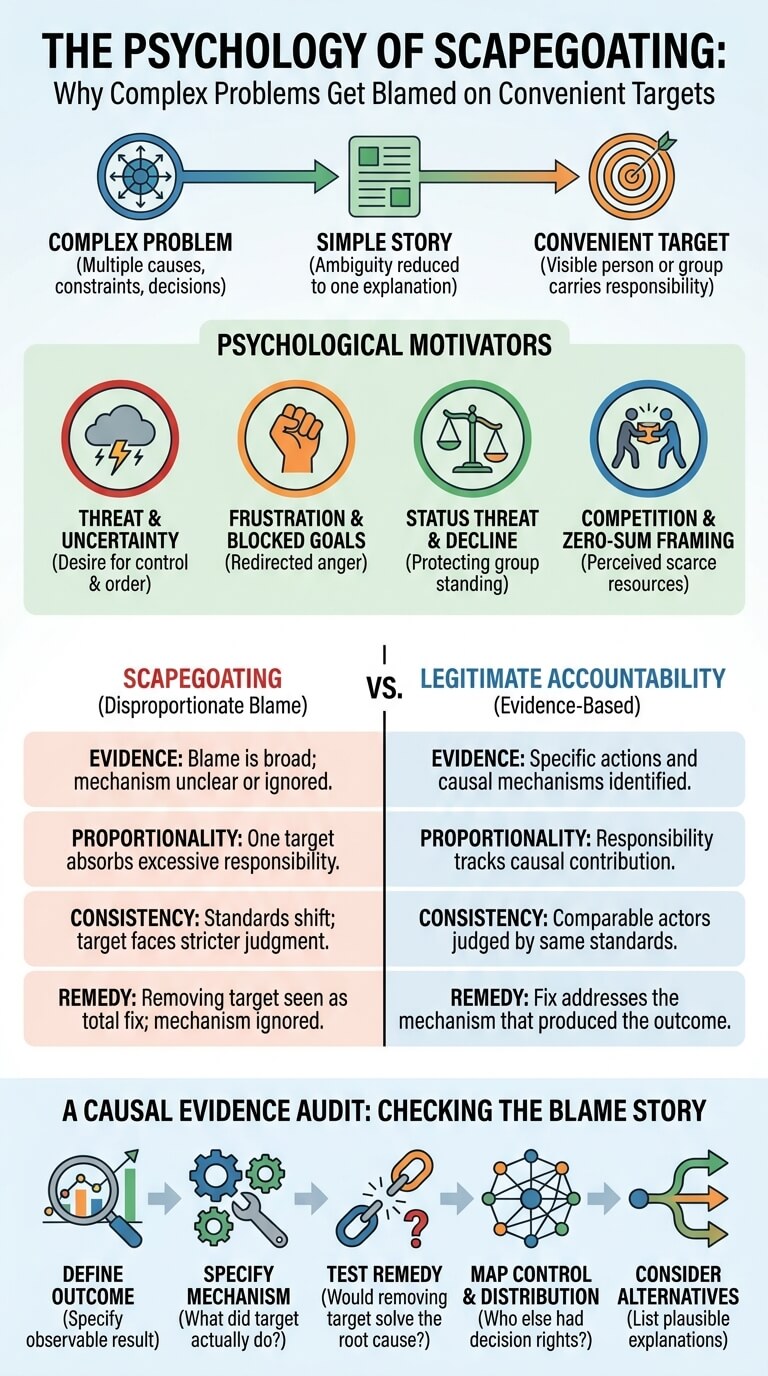
Scapegoating is the process of placing excessive or displaced blame for a broader negative outcome onto a convenient person or group. It may become more attractive when people feel frustrated, threatened, uncertain, guilty, or low in control. The key test is not whether blame exists, but whether responsibility is supported by evidence, proportionate to causal contribution, and applied consistently.
What Scapegoating Means
The APA Dictionary of Psychology entry on scapegoating places the concept within the psychology of directing blame toward another person or group. In social psychology, the term is often used when a negative outcome has multiple causes but one target absorbs more responsibility than the evidence warrants. Scapegoating can intersect with the broader psychology of prejudice and stereotyping when existing group expectations make a particular target easier to blame.
Disproportionate or displaced blame
The word disproportionate is important. A scapegoated target may have made mistakes or contributed to a problem. Scapegoating does not require total innocence. The distortion appears when the target is treated as the central explanation while other meaningful causes, decision makers, constraints, or failures are ignored.
Why scapegoating is a blame process rather than a synonym for prejudice
Prejudice concerns group-based evaluation or attitude. Scapegoating concerns causal blame. The two can overlap because a disliked group may be easier to blame, but they are not the same psychological process. A person can hold a negative attitude without blaming that group for a broader problem, and a group can become a scapegoat during a crisis even when prior hostility was not especially strong.
OpenStax Psychology 2e describes scapegoating in the context of frustrated ingroups blaming an outgroup. That classic account is useful background, but modern work suggests that frustration is only one route into scapegoating.
The Core Pathway: Complex Problem → Simple Story → Convenient Target

Scapegoating often becomes easier to understand when it is viewed as a compression process. A messy outcome contains many moving parts. A simple story reduces those parts to one cause. A target then gives that cause a face, and repeated agreement can make the story feel more certain than the evidence justifies.
| Stage | What happens | Question worth asking |
|---|---|---|
| Complex problem | Several causes, constraints, and decisions contribute. | What are the major causal pathways? |
| Simple story | Ambiguity is reduced to one understandable explanation. | What has been left out? |
| Convenient target | A visible person or group becomes the carrier of responsibility. | Why this target rather than other contributors? |
| Repeated blame | The explanation is repeated until familiarity feels like proof. | What independent evidence supports the claim? |
| Social reinforcement | Agreement, authority cues, or group loyalty stabilize the story. | Would the evidence standard change for another target? |
Uncertainty creates demand for explanation
Uncertain problems are uncomfortable because they make prediction and control difficult. A sudden drop in sales, a project failure, a local shortage, or a team conflict may not have one obvious cause. The mind still prefers an explanation that makes events feel understandable.
A series of experiments by Rothschild and colleagues proposed two motives that can support scapegoating: reducing guilt about one’s own role and restoring a sense of control when a negative outcome seems difficult to explain. Their dual-motive model of scapegoating found that both value threat and control threat could increase disproportionate blame under specific experimental conditions.
A visible target makes the story easier to tell
Systems are abstract. People are concrete. “Several weak processes interacted over six months” is harder to picture than “that department caused the failure.” A visible target makes a causal story easier to remember, repeat, and act on.
Visibility does not prove convenience, and an obvious actor may truly be responsible. The point is that psychological salience can make a target feel causally larger than a careful analysis would show.
Repetition and group agreement can stabilize the claim
Once a blame story circulates, each repetition can become social evidence. People may hear the same claim from multiple colleagues without realizing that all of them trace back to one original assumption. Agreement then appears broader than the underlying evidence.
This is one reason it helps to separate “many people are saying this” from “many independent lines of evidence support this.” Those are not equivalent.
Psychological Conditions That Can Make Scapegoating More Likely

No single emotional state creates scapegoating automatically. Threat, frustration, uncertainty, and competition are better understood as conditions that can make a simple target-based explanation more attractive, especially when a plausible target is already available.
Frustration and blocked goals
Classic social psychology connected scapegoating with frustration when people or groups are blocked from desired goals. A team that repeatedly loses resources, recognition, or opportunities may become more receptive to explanations that identify an obstructing “them.”
Frustration is not enough by itself. Many frustrated people investigate causes carefully, solve problems cooperatively, or direct anger toward the actual source. Treat it as one possible pressure, not a deterministic trigger.
Threat and loss of control
When an outcome feels chaotic, an identifiable enemy or culprit can paradoxically make the world feel more orderly. In experimental work, Sullivan, Landau, and Rothschild found that threats to perceived control could increase attributed influence to enemies. A powerful culprit can feel easier to understand than random, distributed, or impersonal causes.
That psychological benefit can be misleading. Feeling that a story restores control does not make the story true.
Status threat and perceived decline
People may become especially sensitive to blame when they believe their group is losing standing, influence, access, or respect. In that setting, another group can be framed not merely as different but as the cause of the decline.
Status concerns deserve their own analysis because rank and hierarchy are broader topics. Here, the important point is narrower: perceived decline can create a motive to locate responsibility outside the group rather than examine a mix of internal and external causes.
Competition and zero-sum framing
If two groups are told that one side’s gain necessarily requires the other side’s loss, ordinary setbacks may be interpreted through competition. A rejected proposal, lost contract, or scarce opportunity can then become evidence that the other group is “taking” what belongs to us.
Actual competition can be real. The error occurs when competition becomes a total explanation and replaces evidence about the specific problem. Later discussion of realistic conflict helps clarify why resource competition is one route to intergroup hostility rather than a complete theory of scapegoating.
Why Simple Causal Stories Feel Satisfying
A simple blame story does psychological work. It organizes confusion, assigns agency, and suggests what should happen next. Those functions help explain why weak explanations can remain attractive even after contradictory evidence appears.
They reduce complexity
Multi-causal explanations require people to hold several factors in mind at once. A failed product launch might involve timing, pricing, technical quality, market conditions, unclear positioning, and execution. “The new team ruined it” is easier to process, even if it is less accurate.
Simplicity is useful when it reflects reality. It becomes risky when cognitive convenience is mistaken for causal strength.
They offer a clear agent
People understand intentional agents more intuitively than diffuse systems. A person can be questioned, punished, excluded, replaced, or opposed. A chain of interacting incentives and structural constraints is harder to confront.
This makes agency an important part of the appeal of scapegoating. The target turns an abstract problem into a story with a protagonist and a villain.
They create a direct remedy even when the system is multi-causal
If one target supposedly caused everything, removing that target seems like a solution. This can create false confidence: “Once they are gone, the problem will stop.”
A stronger remedy test asks whether changing the target would alter the mechanism that produced the outcome. If the same incentives, bottlenecks, or decision failures remain, the proposed fix may be emotionally satisfying without being causally effective.
Group Norms, Leadership Cues, and Permission to Blame
Scapegoating rarely depends only on one person’s private reasoning. Groups shape what explanations feel acceptable, what evidence receives attention, and which targets can be criticized without social cost.
Repetition from influential group members
A manager, community leader, popular creator, senior teammate, or respected insider can give a blame story legitimacy simply by repeating it confidently. The effect is stronger when the situation is ambiguous and others are unsure what happened.
Research on small groups has long examined how leadership and group dynamics can affect scapegoat formation. A classic analysis of scapegoating dynamics in small groups emphasized how group conflict and anxiety can be displaced onto a particular member. Such work is informative, but it should not be treated as a universal model for every group.
Social proof and conformity
When people are uncertain, they look to others for information. They may also go along with a group to preserve acceptance. OpenStax’s overview of conformity and social influence distinguishes informational influence from normative influence, a useful distinction when a blame narrative spreads through a group.
How responsibility narratives become shared
Shared stories gain structure over time. One person supplies an anecdote, another adds a complaint, and a third links a separate failure to the same target. Eventually, different events are organized around one explanation.
This is where how beliefs form and guide interpretation becomes relevant. Once a causal story is established, new information may be filtered through it rather than evaluated from scratch.
Power Asymmetry and Target Availability
Targets are not selected only because they are weak, disliked, or different. Availability matters in a more complicated way. A target must usually be visible enough to carry the story and plausible enough, in the eyes of the group, to be blamed.
Why safer or weaker targets can attract blame
Sometimes anger is redirected toward a person who is easier to confront than the true source of frustration. A junior employee may receive anger about decisions made far above them, or one department may absorb criticism for failures created by several layers of management.
Lower power can make resistance harder, but weakness alone does not explain scapegoating. Research on the dual-motive model found that a target’s perceived ability to plausibly bear responsibility mattered, which cautions against the simplistic rule that people always choose the weakest available target.
Visibility and symbolic association
A spokesperson, newcomer, unusual subgroup, or highly visible team can become symbolically associated with a problem larger than their actual role. Visibility may make them easier to remember when people ask, “Who represents what went wrong?”
The evidence question remains the same: does symbolic association track causal contribution?
Why this is not a complete explanation for every case
A useful analysis checks both directions: whether a target is being protected from deserved accountability because of status, and whether a target is absorbing excessive responsibility because challenging more powerful contributors is difficult.
Scapegoating vs Legitimate Accountability

This distinction is the practical center of the topic. Calling all criticism “scapegoating” can shield real wrongdoing. Calling disproportionate blame “accountability” can hide a poor causal analysis. The difference rests on evidence, proportionality, consistency, and remedy.
| Question | More consistent with accountability | More consistent with scapegoating |
|---|---|---|
| What caused the outcome? | Specific actions and mechanisms are identified. | The target is blamed broadly without a clear mechanism. |
| How much responsibility belongs here? | Responsibility tracks causal contribution and control. | One target absorbs responsibility that is widely distributed. |
| Are standards consistent? | Comparable actors are judged by comparable evidence. | The target faces a stricter or shifting evidence standard. |
| What would fix the problem? | The remedy addresses the mechanism that produced the outcome. | Removing or punishing the target is treated as sufficient by itself. |
Evidence of causal contribution
Accountability begins with actions, decisions, omissions, authority, and consequences. Ask what the person or group actually controlled and how those choices contributed to the outcome.
Attribution psychology provides the broader framework for how people explain causes. In a scapegoating analysis, the narrower question is whether one target has been assigned more causal weight than the evidence supports.
Proportionate responsibility
Responsibility is rarely all-or-nothing. One actor may deserve 20 percent of the criticism rather than zero or 100 percent. Proportional thinking makes it harder for one convenient target to absorb every failure in a complex system.
Comparable standards across actors
Ask whether the same evidence would be considered sufficient if the target belonged to a different department, school, profession, neighborhood, or social group. A moving standard is a warning sign because it allows the conclusion to survive regardless of the evidence.
Remedy matched to the actual cause
Good accountability improves the system. If a scheduling process failed, redesign the process. If a decision maker ignored repeated warnings, clarify decision rights and consequences. If several units contributed, divide corrective action accordingly.
Punishment that leaves the causal mechanism untouched may satisfy anger while allowing the same problem to recur.
Scapegoating vs Ordinary Blame
Blame is not inherently irrational. Everyday life requires assigning responsibility when someone breaks an agreement, ignores a safety rule, misuses authority, or knowingly causes harm.
One event and one responsible actor
If a person had clear control, took a specific action, and produced a foreseeable outcome, assigning responsibility may be straightforward. Calling that scapegoating simply because the criticism is uncomfortable would misuse the concept.
Broader problems with distributed causes
The risk rises when a broad outcome is produced by many interacting factors. A company’s decline, a school’s weak performance, a community conflict, or a recurring operational failure usually deserves a causal map before it deserves a single villain.
Scapegoating vs Prejudice
Negative group attitudes can make scapegoating easier, but prejudice is neither necessary nor sufficient. Keeping the concepts separate prevents us from inferring hidden attitudes from one blame claim.
Negative evaluation can make a target easier to blame
If a group is already viewed with suspicion, stories that assign it responsibility may face less scrutiny. Existing stereotypes can supply ready-made explanations for why the group supposedly caused the problem.
That does not mean every negative judgment reflects prejudice. Evidence may still support responsibility in a specific case, which is why the causal audit matters.
Scapegoating can also emerge from situational threat without a fully developed prejudice
A newly visible group or individual can become a target when circumstances change quickly. People may first encounter the target through the problem itself, then build a negative evaluation around the blame story.
This direction matters because it shows that blame and prejudice can reinforce each other without being interchangeable. For broader distinctions involving group judgment and unequal moral standards, ingroup and outgroup morality addresses a different question: whether standards of fairness, empathy, or accountability shift across group boundaries.
Scapegoating vs Why People Blame Others
Both topics involve responsibility, but the unit of analysis differs. General blame can involve one person explaining one event. Scapegoating becomes especially useful when a target is loaded with responsibility for a larger problem that has multiple causes.
Individual responsibility assignment versus broader target concentration
A driver blames another driver for a collision. A manager blames a colleague for missing a deadline. Those may involve accurate or biased attributions, but they are not automatically scapegoating.
Now imagine an organization with years of poor planning, understaffing, unclear priorities, and technical debt blaming one new manager for its entire decline. The concentration of responsibility is what changes the psychological question.
Why causal explanation remains the broader issue
The general psychology of explanation asks how people decide why events happened. Scapegoating narrows the focus to a specific failure mode: excessive responsibility becomes attached to a convenient target while important alternative causes are discounted.
That is why a good response is not “never blame.” It is “match blame to evidence and control.”
A Causal Evidence Audit

When a blame story feels unusually simple, use a structured audit before accepting or rejecting it. The goal is not to defend the target automatically. The goal is to make responsibility track causation.
Problem: define the outcome precisely
Replace broad labels such as “they ruined everything” with an observable outcome. Was revenue down 12 percent? Did a deadline slip three weeks? Did complaints rise after a policy change? Precision reduces the space in which vague blame can expand.
Claimed cause: specify the mechanism
Ask what the target supposedly did that produced the outcome. “They caused the shortage” is a conclusion. “They changed ordering rules that reduced inventory before demand increased” is a causal claim that can be checked.
Evidence: what changes when the target changes?
Look for comparison. Did the problem begin after the target entered? Did it continue when the target was absent? Do similar settings without the target show the same outcome? Perfect experiments are rarely possible in everyday life, but comparison improves reasoning.
Alternatives: what other causes are plausible?
List at least three credible alternatives before settling on one explanation. This is not false balance. Some alternatives will be weak. The purpose is to prevent one vivid story from occupying the entire causal field.
Responsibility distribution: who else had control or contribution?
Map decision rights. Who set the budget, approved the plan, controlled staffing, supplied information, implemented the process, and had authority to intervene? Responsibility becomes clearer when control is visible.
Remedy: would the proposed response address the actual mechanism?
If removing the target would leave the main causal process unchanged, the remedy is weak evidence for the blame story. A proposed fix should interrupt the mechanism that produced the problem.
Warning Signs in Reasoning
None of these signs proves scapegoating on its own. Together, however, they indicate that a blame story deserves more scrutiny.
One target is blamed for unrelated failures
A target begins to explain events that require different causal pathways: missed deadlines, low morale, customer complaints, budget problems, and strategic mistakes. The wider the blame spreads, the more important it is to ask whether one mechanism truly connects those outcomes.
Evidence standards change depending on the group
A rumor is accepted when it implicates the target but dismissed as unreliable when it points elsewhere. This asymmetry can be strengthened by familiar judgment biases, which is why a broader review of cognitive biases and evidence evaluation can be useful without reducing scapegoating to a generic bias.
Counterevidence is treated as irrelevant by definition
If good outcomes are credited to someone else while every bad outcome is attributed to the target, the claim becomes difficult to disconfirm. An explanation that cannot lose is not being tested.
Removing the target is proposed without a causal pathway
“Get rid of them and everything improves” is a prediction. Ask what specifically changes afterward. If no process, resource, incentive, behavior, or decision structure changes, confidence in the remedy is doing more work than evidence.
How Threat, Attribution, and Intergroup Competition Intersect
Scapegoating sits near several other social-psychological processes, but each answers a different question. Keeping the boundaries clear makes the explanation more useful.
Attribution provides the causal language
Any scapegoating claim contains an attribution: this target caused that outcome. The distinctive feature is not that a cause was inferred, but that the target receives excessive causal responsibility relative to the evidence.
Status threat and realistic conflict can make simple blame narratives more attractive
Perceived decline may increase the desire to identify who is responsible. Competition over scarce opportunities can make another group a plausible target. Yet neither status threat nor competition automatically creates scapegoating, and neither explains every case.
The best model treats them as possible inputs into a blame process rather than synonyms for the process itself.
What to Do First When Evaluating a Scapegoating Claim
You do not need a full investigation before improving the quality of your reasoning. Three moves can slow a blame story enough to reveal whether it is built on evidence or convenience.
Slow the causal story
Translate slogans into mechanisms. Instead of “that group is the problem,” ask what action, decision, or constraint is being claimed and how it produces the outcome.
Separate responsibility from category membership
Judge the individual or organization using relevant evidence rather than assuming category membership supplies the missing facts. A group average, reputation, or stereotype does not establish what one member did.
Compare evidence across alternative causes
Use the same standard for competing explanations. If one theory requires documents, timelines, and direct evidence while another is accepted because it feels plausible, the comparison is not fair.
If a blame campaign involves threats, stalking, targeted intimidation, harassment, retaliation, or violence, personal safety matters more than winning the causal argument. In those situations, distance, documentation, organizational safeguards, or qualified local support may be more appropriate than direct debate with hostile people.
FAQ
These questions focus on the places where scapegoating is most often confused with ordinary accountability, prejudice, or intentional manipulation.
Is scapegoating always intentional?
No. People can participate in scapegoating without consciously deciding to find an innocent target. Uncertainty, group agreement, selective attention, and repeated stories can gradually concentrate blame. Intentional blame shifting also exists, but intention should not be inferred merely because a scapegoating pattern appears plausible.
How is scapegoating different from holding someone accountable?
Accountability ties responsibility to evidence, causal contribution, control, and proportionate consequences. Scapegoating gives a target more responsibility than those factors justify, often while other causes receive too little attention. A target can be partly responsible and still be scapegoated if their share of blame is exaggerated.
Can prejudice exist without scapegoating?
Yes. Prejudice is an evaluative orientation toward people based substantially on perceived group membership. Scapegoating is a blame process. Someone may hold prejudice without blaming a group for a broader problem, and scapegoating can emerge from uncertainty or threat even before a strong negative attitude has developed.
Why do groups sometimes unite around a common scapegoat?
A shared target can simplify disagreement inside the group. Members may temporarily agree on what caused the problem, who is responsible, and what should be done. That shared story can reduce uncertainty and redirect attention away from internal conflict, but group cohesion does not make the explanation accurate.
What evidence weakens a scapegoating explanation?
Evidence that the target had substantial control, made specific decisions that reliably produced the outcome, and bears responsibility proportionate to other contributors weakens the claim that they are being scapegoated. Consistent standards and a remedy that directly addresses the identified mechanism also point more toward legitimate accountability.
Key Takeaways
- Scapegoating is disproportionate or displaced blame for a broader negative outcome, not simply criticism or disagreement.
- Frustration, uncertainty, guilt, threat, perceived loss of control, and competition may make simple target-based explanations more attractive, but none makes scapegoating inevitable.
- Prejudice can make a group easier to blame, yet prejudice and scapegoating remain different psychological processes.
- The strongest distinction between scapegoating and accountability is whether responsibility matches causal evidence, control, proportionality, and consistent standards.
- A useful audit defines the problem, specifies the claimed mechanism, compares alternatives, maps responsibility, and checks whether the proposed remedy addresses the actual cause.
- When blame escalates into threats, stalking, harassment, intimidation, retaliation, or violence, safety should take priority over trying to correct the group’s reasoning directly.
A practical next step is to take one blame claim you have heard recently and rewrite it as a testable causal statement. Name the outcome, the proposed mechanism, the evidence, at least two alternative causes, and who actually had control. If the story becomes weaker as it becomes more specific, the original certainty may have come from a convenient target rather than a complete explanation.

Michael Reed is the Founder and Lead Writer at Psychology Exposed. He writes about human behavior, relationships, emotional patterns, self-awareness, and practical psychology topics using research-informed, easy-to-understand content.
Read More About Michael Reed: https://psychologyexposed.com/michael-reed/