

People often use the words stereotype, prejudice, bias, and discrimination as if they describe the same thing. They do not. Psychology separates them because a belief about a group, an emotional evaluation of that group, an automatic association, and a decision about how to treat a person are different psychological events.
That distinction matters in everyday life. A category can become noticeable before we know much about an individual. An expectation may then enter attention, interpretation, or memory. Yet an expectation does not automatically tell us what someone consciously believes, how they feel, what they intend, or how they will behave. A useful approach is to keep category information separate from person-specific evidence for as long as possible.
Quick Answer

In psychology, stereotypes are generalized beliefs or expectations about social groups, prejudice concerns evaluation or affect toward people based substantially on group membership, and discrimination concerns differential behavior or treatment. These processes can influence one another, but they do not form an inevitable chain. Context, norms, individual evidence, conscious reflection, and opportunities to update an impression can all change what happens next.
Stereotypes concern generalized beliefs and expectations
A stereotype is a cognitive generalization about the characteristics of members of a group or social category. The APA Dictionary of Psychology definition of stereotype emphasizes beliefs and expectations, which is useful because it keeps the concept distinct from emotion and behavior. A stereotype can be negative, positive, or mixed, and it may be culturally familiar even when a person does not personally endorse it.
Prejudice concerns evaluation and affect
Prejudice is closer to an attitude or evaluative orientation. The APA Dictionary of Psychology entry on prejudice includes both affective and cognitive components. In practice, that means prejudice may involve liking, dislike, discomfort, contempt, pity, suspicion, or another evaluation that is tied substantially to perceived group membership.
Discrimination concerns behavior and treatment
Discrimination is about what happens in treatment or action. A person may hold a prejudicial attitude but restrain discriminatory behavior because of values, rules, accountability, or deliberate choice. Conversely, someone with little personal hostility may follow a biased norm or procedure. OpenStax Psychology’s discussion of prejudice and discrimination also separates beliefs, feelings, and behavior, while showing how they can interact.
What Prejudice and Stereotyping Mean in Psychology

Social categories as cues, not conclusions
Human beings constantly sort information into categories. In social life, categories may include profession, school, neighborhood, age group, region, sports affiliation, online community, or many other identities. Categorization helps the mind organize complexity, but a category label contains less information than a person does.
Suppose you meet a new colleague from a department you rarely work with. The department label may activate expectations before the colleague has said much. Those expectations can guide what you notice, what questions you ask, or how you interpret an ambiguous comment. None of that proves that the expectations are accurate, consciously endorsed, or morally charged. It simply shows why category cues can shape early judgment.
Why noticing a category is not automatically prejudice
Recognizing that someone belongs to a social category is not the same as evaluating them negatively. Categories can be perceptually obvious, explicitly stated, or relevant to a situation. The important psychological question is what happens after the category becomes salient.
Does the category supply an assumption? Does that assumption outweigh individual evidence? Is the same behavior interpreted differently depending on who performs it? Does the person remain open to revision? These questions are more informative than treating mere category recognition as proof of prejudice.
Why This Topic Matters for Everyday Judgment
Category information can enter before individual evidence
Imagine a manager choosing who should present a project, a student deciding whom to ask for help, or a neighbor interpreting unfamiliar behavior. In each case, the observer may have incomplete information. When evidence is thin, prior expectations can fill the gap. That is one reason first impressions are especially vulnerable to category-based assumptions.
The practical problem is not that people must somehow become category-blind. Categories sometimes contain relevant context. The problem begins when broad category information is treated as if it settles what is true about an individual. A group average, even when measured carefully, does not prove where one person falls within that distribution.
Bias can affect interpretation without proving conscious hostility
An ambiguous action can support several explanations. If two people make the same mistake but one is seen as careless while the other is seen as unlucky, prior expectations may have influenced interpretation. Still, one unequal judgment is not enough to read a person’s private motives with certainty.
Responsible interpretation separates observable behavior from inferred attitude and inferred intention. That separation makes it possible to examine unfair patterns without pretending that psychology can function as a mind-reading tool.
Core Mental Model: Category Cue to Social Feedback
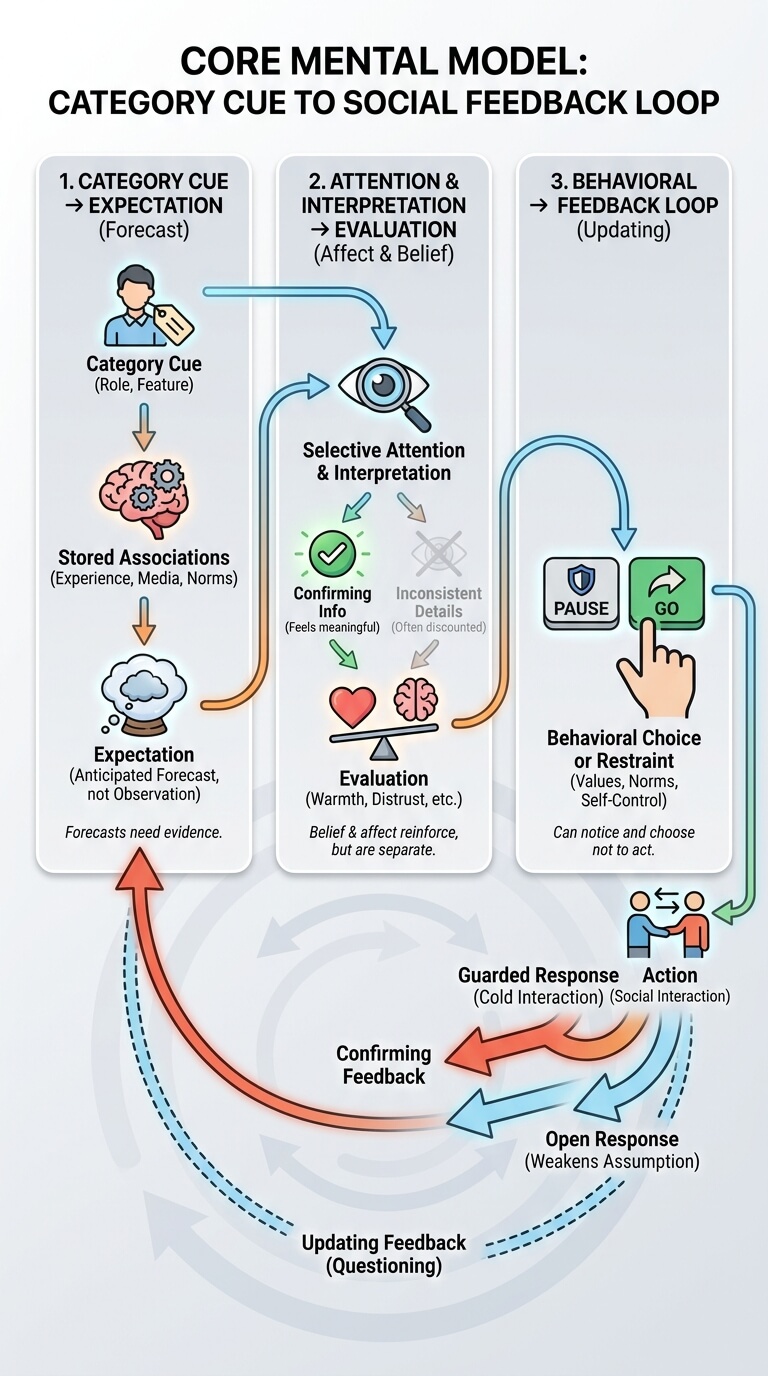
Category cue → stored association → expectation
A category cue may activate information already stored in memory. That information can come from direct experience, stories, repeated language, media, cultural norms, institutional routines, or previous encounters. Some associations may be deliberate beliefs; others may simply be mentally accessible because they have been repeated often.
The next step is expectation. An observer begins to anticipate what a person might be like or how an interaction might unfold. Expectations are not observations. They are forecasts, and forecasts need evidence.
Attention and interpretation → evaluation
Once an expectation is active, attention may become selective. Information that fits the expectation can feel more noticeable or more meaningful, while inconsistent details may be discounted as exceptions. Ambiguous behavior may also be interpreted through the expectation.
Evaluation adds another layer. A person may feel warmth, discomfort, distrust, admiration, irritation, or indifference. This is where belief and affect can begin to reinforce each other, but they still should not be collapsed into a single concept.
Behavioral choice or restraint → feedback and updating
Evaluation and expectation can influence action, yet behavior is also shaped by values, rules, incentives, social norms, accountability, time pressure, and deliberate self-control. Someone can notice an automatic reaction and choose not to act on it. Someone can also act unfairly while insisting that no negative attitude is present.
Behavior then produces feedback. A cold interaction may invite a guarded response, which can be misread as confirmation of the original expectation. A more open interaction may reveal information that weakens the initial assumption. Social judgment is therefore not only a one-way path from belief to action. It is a loop in which behavior changes the evidence people later use.
A Practical Evidence Model: Category Information vs Individual Evidence
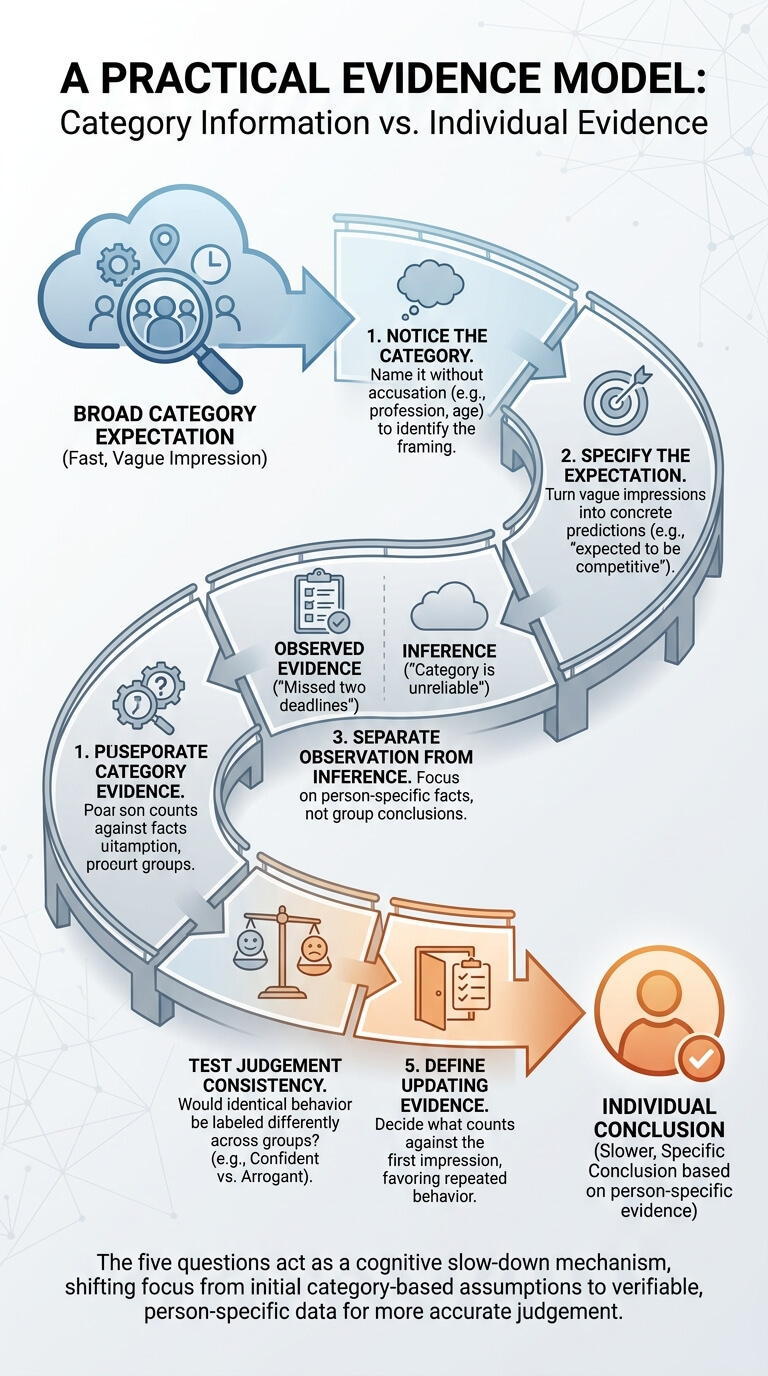
When a social category becomes mentally prominent, the following five questions help slow the move from broad expectation to individual conclusion.
What category became salient?
Name the category without treating it as an accusation. It might be a profession, school, age group, neighborhood, hobby community, region, or another identity. The aim is simply to notice what information may be framing the interaction.
What expectation entered because of it?
Ask what you predicted before enough individual evidence was available. Perhaps you expected someone to be competitive, inexperienced, rigid, sociable, unreliable, or highly skilled. Turning a vague impression into a specific prediction makes it easier to examine.
What person-specific evidence is actually available?
Separate what you observed from what you inferred. “They missed two deadlines” is evidence. “People from that department are unreliable” is a category-level conclusion. The first statement can be investigated directly; the second requires much broader evidence and still may not be useful for judging the next individual.
Would the same behavior be judged similarly across groups?
This question tests consistency. If identical behavior would be described as “confident” in one person and “arrogant” in another, the difference deserves examination. The goal is not to prove motive. It is to check whether evaluation standards are shifting with group membership.
What evidence could update the initial expectation?
A belief that cannot be revised is difficult to test. Decide in advance what kind of information would count against your first impression. Repeated person-specific behavior is usually more informative than one vivid anecdote or one category label.
Area 1: Stereotypes and Category-Based Expectations
Stereotype Psychology in brief
Stereotypes organize generalized expectations about groups. They may concern traits, roles, abilities, preferences, or likely behavior. They can be learned through direct observation, but also through language, stories, repeated cultural messages, and selective examples. Importantly, knowing that a stereotype exists is not the same as endorsing it.
A deeper examination of stereotyping asks why expectations persist despite exceptions, how activation differs from endorsement, and how people can shift from category-based judgment toward individuated evidence. It also considers “positive” stereotypes, which may sound flattering while still placing restrictive assumptions on individuals.
Outgroup Homogeneity Effect in brief
People sometimes perceive members of another group as more similar to one another than members of their own group. One plausible contributor is information richness: we often know more individual exceptions, subgroups, and personal histories inside groups we encounter frequently.
This effect is narrower than stereotyping. A stereotype concerns expected attributes; perceived outgroup homogeneity concerns how much variation we think exists within a group. The pattern is not universal, and context matters. The practical lesson is to notice when a broad label is hiding meaningful individual variation.
Illusory Correlation Psychology in brief
An illusory correlation occurs when a relationship between two kinds of events or categories feels stronger than the evidence supports. In social judgment, distinctive group members and distinctive behaviors can become especially memorable, making a pairing feel more frequent than it actually is.
This mechanism can feed stereotypes, but it is not the same as a stereotype. The useful evidence check is to examine denominators and comparison groups. How often did the behavior occur in each group? How large was each group? Were ordinary cases forgotten because unusual combinations were easier to remember?
Area 2: Prejudice, Implicit Associations, and Discrimination
Prejudice vs Discrimination in brief
Prejudice concerns evaluation; discrimination concerns treatment. The difference becomes clearest when attitude and behavior diverge. A person may privately dislike a group but still treat individuals consistently because rules, values, or accountability constrain action. Another person may follow an unfair routine without reporting strong personal dislike.
This distinction also prevents a common reasoning error: inferring a complete inner attitude from one behavior. Repeated patterns can provide important evidence about treatment, but the psychological claim about motive requires additional evidence. Legal definitions are a separate matter and vary by jurisdiction and context.
Implicit Bias Psychology in brief
Implicit bias refers to relatively automatic social associations or evaluative tendencies that may operate without deliberate endorsement. The American Psychological Association overview of implicit bias describes these processes as part of implicit social cognition, where perceptions and associations may become active before conscious intention.
Researchers often study such associations through response-time tasks and other measures. These measures can be useful in research, but a score should not be treated as a diagnosis, lie detector, or direct reading of a person’s “true” beliefs. Context, measurement reliability, and the size of links with behavior all matter.
Why automatic association is not the same as deliberate endorsement
People can recognize or automatically activate information they reject consciously. Someone may know a cultural stereotype precisely because it is widely repeated, while deliberately believing it is unfair or inaccurate as a guide to individuals.
At the same time, saying an association is automatic does not make its consequences irrelevant. Under speed, ambiguity, fatigue, weak accountability, or low information, accessible associations may have more room to influence judgment. The responsible position is neither “automatic means innocent and meaningless” nor “automatic means secret belief.”
Area 3: Intergroup Perception and Conflict Mechanisms
Stereotype Threat Psychology in brief
Stereotype threat focuses on the experience of a person who is aware that a negative stereotype about a relevant group could shape how their performance is judged. In some evaluative settings, that awareness may add pressure, distraction, or concern about confirming the stereotype.
The concept should not be used as a universal explanation for performance differences. Effects vary across populations, tasks, settings, and study designs, and research debates concern effect size and boundary conditions. It is best understood as a situational possibility rather than a fixed trait or guaranteed outcome.
Scapegoating Psychology in brief
Scapegoating occurs when disproportionate responsibility for a broader problem is concentrated on a convenient person or group. It often becomes attractive when the true causes are complex, distributed, uncertain, or difficult to change. Threat, frustration, status concerns, and leadership cues can all shape which explanations become socially compelling.
The key distinction is between blame and evidence. A target may genuinely bear some responsibility, so “scapegoat” should not be used to dismiss accountability automatically. The question is whether responsibility is being assigned in proportion to causal evidence or whether a visible target is absorbing blame that belongs to a wider system of causes.
Realistic Conflict Theory in brief
Realistic Conflict Theory examines what can happen when groups perceive their interests, resources, opportunities, or goals as incompatible. Competition can increase suspicion and hostility, while some forms of cooperative interdependence can reduce antagonism.
This is only one pathway to intergroup bias. People can show group preference even when no meaningful resource conflict exists, which is why competition-based explanations should not replace social identity explanations. The most useful question is whether people actually perceive a zero-sum conflict, whether that perception is accurate, and what conditions might make shared goals possible.
Area 4: Contact and Prejudice Reduction
Contact Hypothesis Psychology in brief
The contact hypothesis asks when interaction between members of different groups is more likely to reduce prejudice. Contact is not simply a matter of putting people in the same room. Equal status within the situation, cooperation, common goals, supportive norms, and opportunities for meaningful interaction can influence the outcome.
A major meta-analysis of intergroup contact research found that contact typically corresponded with lower prejudice across a large body of studies, while also examining the conditions under which effects were stronger. Contact can still fail, especially when it is coercive, unequal, threatening, or dominated by negative interaction.
Prejudice Reduction Psychology in brief
Prejudice reduction is broader than contact. Researchers have examined approaches involving individuation, norms, structured decision processes, perspective taking, counter-stereotypical information, cooperative goals, and repeated intergroup interaction. Different approaches target different outcomes, such as self-reported attitudes, automatic associations, or observable behavior.
The evidence does not support a simple promise that one conversation or training session permanently removes prejudice. A major review of prejudice reduction research highlighted both promising findings and substantial limits, including uncertainty about durability and concerns about how much some intervention evidence can support confident practical conclusions.
How Group Expectations Can Become Self-Reinforcing
Selective attention and interpretation
Expectations influence what feels noteworthy. If you expect members of a certain organization to be disorganized, a missed detail may stand out while many ordinary competent actions disappear into the background. The expectation then seems confirmed, partly because it shaped the evidence that received attention.
Ambiguity creates even more room for expectation. A short reply might be read as efficient, rude, nervous, or distracted. When group assumptions guide that interpretation, the observer may become more confident without gaining better evidence.
Repetition, norms, experience, and social transmission
Group expectations do not come only from private observation. They travel through jokes, warnings, stories, headlines, workplace lore, family conversation, social media, and institutional routines. Repetition can make an association easy to retrieve, even when the repeated material was never based on a representative sample.
Norms also affect whether people challenge or repeat an assumption. In one setting, a category-based joke may be rewarded with laughter. In another, the same joke may be questioned. Over time, those social responses teach people what is acceptable to say, what is embarrassing to admit, and sometimes what seems normal to believe.
Why exceptions do not always update a broad belief
One counterexample should not logically erase a belief that was supposedly about a whole population, but neither should it be dismissed automatically. People sometimes protect a stereotype by treating inconsistent cases as special exceptions: “They are different from the rest.” That preserves the broad belief while absorbing disconfirming evidence.
A better updating process asks whether the original expectation was too broad, whether the evidence base was representative, and whether the category itself is useful for the judgment being made. Repeated person-specific evidence should gradually carry more weight than a vague category expectation.
Common Misunderstandings That Distort the Topic

Not every stereotype becomes prejudice
A person can hold or recognize a generalized belief without developing a strong positive or negative evaluation. The belief may be weak, uncertain, or consciously rejected. Keeping cognition separate from evaluation helps explain why awareness of a stereotype does not prove hostility.
Not every prejudice produces discrimination
Attitudes influence behavior, but behavior has many other determinants. Rules, values, fear of consequences, social norms, competing goals, and deliberate restraint all matter. Someone may feel prejudice and choose fair treatment, or may participate in unequal treatment because of a norm or system they did not create.
Group averages do not establish what is true of an individual
Even when a measured group difference is real, groups usually contain substantial internal variation. Knowing a mean does not reveal an individual score. Applying a statistical tendency directly to a person can therefore produce confident errors.
This point matters especially when decisions affect opportunities, trust, evaluation, or inclusion. Individual evidence should be given appropriate weight instead of using group-level statistics as a shortcut to personal certainty.
One behavior does not reveal a hidden belief with certainty
Behavior deserves attention, especially when it creates unequal treatment, but psychological interpretation should remain disciplined. The same action can have multiple causes, and people are often poor at inferring motive from isolated events.
Look for patterns, context, comparison cases, stated reasons, incentives, and consequences. It is reasonable to evaluate whether behavior was fair without claiming perfect access to the person’s inner beliefs.
Which Article Should You Read Next?
If your question is about group beliefs or expectations
Focus on the psychology of stereotypes when your main question is how generalized group expectations form, become activated, survive exceptions, or shape person perception. If the narrower issue is why another group seems unusually uniform, the outgroup homogeneity effect is the more precise concept. If the issue is a memorable group-behavior pairing that seems more common than the evidence supports, illusory correlation is the better fit.
If your question is about attitude versus behavior
Use the prejudice-discrimination distinction when you want to separate an evaluation from a behavioral outcome. This is especially useful when someone expresses a negative attitude but behaves consistently, or when unequal treatment occurs without obvious personal hostility.
If your question is about automatic associations or measurement
Implicit bias is the appropriate topic when the question concerns automatic group-related associations, response-time measures, conscious endorsement, or what a test result can and cannot justify. Avoid using an implicit measure as a character verdict or as proof of hidden intention.
If your question is about perception, performance pressure, conflict, or blame
Stereotype threat is about a target’s experience in a stereotype-relevant evaluative setting. Scapegoating is about concentrating blame for a broad problem on a convenient target. Realistic Conflict Theory is about perceived incompatible interests between groups. These mechanisms may interact, but they answer different questions.
If your question is about contact or reducing prejudice
The contact hypothesis examines conditions under which cross-group interaction is more likely to improve intergroup attitudes. Prejudice reduction examines a wider range of approaches and asks what changes, how much it changes, and whether effects last or reach behavior rather than only self-report.
Research Limits and Responsible Interpretation
Group-level findings versus individual inference
Social psychology often studies averages across groups of participants. Those findings can reveal patterns, but they do not tell us exactly how any one person will think or act. Effect sizes, measurement choices, population differences, and context all shape what a study can support.
When applying research to daily life, use findings as probability-informed context rather than as a diagnostic label. “This mechanism may influence judgment” is usually more defensible than “this explains what that person really thinks.”
Psychological description versus moral and legal judgment
Psychology can describe beliefs, attitudes, behavior, social learning, and intergroup processes. It does not replace moral reasoning, organizational policy, or legal standards. The legal meaning of discrimination differs across countries and settings, including employment, housing, education, and healthcare.
Likewise, explaining why biased judgment may occur does not excuse harassment, humiliation, threats, coercion, or unfair exclusion. Understanding a mechanism and deciding whether conduct is acceptable are separate tasks.
Classic findings need modern context and boundary conditions
Some of the best-known ideas in intergroup psychology come from classic experiments and field studies. They remain useful historically, but no single study should be treated as universal proof. Replication, later reviews, alternative explanations, cultural context, and methodological criticism all matter.
A research-aware reading asks not only “Was an effect found?” but also “How large was it, under what conditions, with which measures, and how consistently has it appeared?” That standard is especially important for popular concepts that are often simplified in public discussion.
FAQ
Are stereotypes always negative?
No. Stereotypes can be positive, negative, or mixed because the core concept is a generalized belief or expectation about a social category. A seemingly positive stereotype can still be limiting if it creates pressure or causes observers to ignore individual differences. The key issue is not only whether the content sounds flattering, but whether a broad category expectation is being substituted for person-specific evidence.
Can someone hold a stereotype without feeling prejudice?
Yes. A person may know or activate a culturally familiar stereotype without strongly endorsing it or feeling a negative evaluation toward the group. Stereotype activation and prejudice can influence each other, but they are not identical. This is why it is useful to ask separately what someone expects, how they evaluate the group, and how they actually behave.
Can discrimination occur without strong personal prejudice?
Yes. Behavior may be shaped by conformity, habit, rules, incentives, organizational routines, or social pressure as well as personal attitudes. That does not make unequal treatment unimportant. It simply means the psychological explanation for behavior should not automatically be reduced to a single private attitude.
Does implicit bias reveal what a person secretly believes?
No single implicit measure should be treated as a direct reading of hidden beliefs. Automatic associations can reflect learned cultural information, experience, context, and other influences. Researchers can study patterns in these measures, but interpreting one person’s result requires caution, especially when trying to predict specific behavior or intention.
Can prejudice change over time?
It can. Attitudes and expectations may shift through new evidence, meaningful contact, changing norms, repeated experiences, structured decision practices, and other processes. Change is not guaranteed, and different outcomes may move at different speeds. A person’s self-report, automatic associations, and observable behavior may not all change together.
Key Takeaways
- A stereotype is a generalized group-based belief or expectation; prejudice is an evaluation or affective orientation; discrimination concerns behavior or treatment.
- A social category can influence attention and interpretation without proving conscious hostility, deliberate endorsement, or hidden intent.
- Category information is usually less informative about an individual than direct evidence about that person’s behavior, history, and context.
- Outgroup homogeneity, illusory correlation, stereotype threat, scapegoating, and realistic conflict describe different mechanisms and should not be used as interchangeable explanations.
- Intergroup contact can help under many conditions, but contact alone is not a guaranteed cure, and prejudice-reduction evidence varies by method, outcome, context, and durability.
- A practical next step is to identify the expectation a category introduced, compare it with person-specific evidence, and decide what information would genuinely change your mind.
Educational note: This article explains psychological concepts for general education. It cannot determine a person’s motives from an isolated event and is not a substitute for legal or professional guidance where discrimination, harassment, threats, or safety concerns are involved.

Michael Reed is the Founder and Lead Writer at Psychology Exposed. He writes about human behavior, relationships, emotional patterns, self-awareness, and practical psychology topics using research-informed, easy-to-understand content.
Read More About Michael Reed: https://psychologyexposed.com/michael-reed/