
A stranger drops a bag of groceries and someone stops to help. A traveler gives directions to a person they may never see again. A commuter notices someone looking faint and asks whether they need assistance. These everyday moments are psychologically interesting because the helper has little relationship history to rely on. There may be no clear obligation, no certainty of future repayment, and limited information about what the other person actually needs.
Helping a stranger therefore combines ordinary prosocial motives with unusually high uncertainty. The potential helper may be trying to understand the situation, estimate risk, judge whether help is welcome, decide whether they have the right skills, and weigh the cost of becoming involved. At the same time, empathy, social norms, perceived similarity, visibility, and simple human identification can make a stranger’s need feel immediate enough to act on.
This does not mean that stopping always proves altruism or that declining to intervene proves indifference. Stranger helping is strongly shaped by context. Useful help can also be indirect, brief, or delivered from a safe distance.
Quick Answer

People help strangers when a need feels clear enough, some responsibility is felt, the cost and risk seem manageable, and a useful action is available. Empathy, perceived similarity, social norms, visibility, and human identification can increase helping, while ambiguity, time pressure, low confidence, and safety concerns can reduce it. Because future reciprocity is uncertain, stranger helping often depends more heavily on immediate cues and generalized social expectations.
Stranger helping combines prosocial motives with unusually high uncertainty about need, obligation, safety, and future exchange
Prosocial behavior includes voluntary actions intended to benefit others. OpenStax’s overview of prosocial behavior emphasizes that helping can arise from several motives and that situational context matters. Stranger helping adds a distinctive layer because the helper often knows very little about the person, the situation, or what will happen after the interaction.
A close friend may have asked you for help before, may know your boundaries, and may be likely to return support later. A stranger provides fewer of those cues. The decision may therefore depend more strongly on what can be inferred in the moment.
Why Helping a Stranger Is a Distinct Context
Low familiarity
Familiarity gives people information. With someone you know, you may understand their normal behavior, likely needs, communication style, and ability to repay or reciprocate later. With a stranger, much of that background is missing.
This makes interpretation harder. A person staring at a transit map may need directions or may simply be planning a route. Someone sitting on the floor may be unwell, resting, or waiting. A request for a ride may be legitimate, unsafe, or impossible for you to evaluate quickly.
Uncertain future reciprocity
Many social relationships contain some expectation of future exchange. With strangers, future contact may be unlikely or unknowable. A person who gives directions, holds a door while someone carries a stroller, or helps retrieve dropped belongings may receive no direct return.
Research on why humans sometimes cooperate with strangers notes that real-life interactions are not always as clearly one-shot or anonymous as laboratory situations. People may be uncertain whether they will meet again, whether their behavior is observed, or whether broader social consequences exist. Stranger helping can therefore occur even when direct repayment seems unlikely.
Limited information about need and intent
Helping requires at least some interpretation of what is happening. With a stranger, the helper may not know whether assistance is actually wanted. A person carrying a large box may prefer to manage it alone. Someone who looks upset may want privacy rather than conversation.
Limited information also affects risk assessment. The potential helper may not know whether another person is intoxicated, medically unwell, confused, frightened, or involved in a conflict. Caution can be appropriate without meaning that concern is absent.
Less role-based obligation than in many close relationships
Roles create expectations. Parents, close friends, coworkers, caregivers, and professionals often have some established responsibility to respond in particular situations. Strangers usually have less clearly defined obligations to one another.
That can make helping more voluntary, but also more uncertain. A person may ask, “Is it my place to get involved?” In many everyday cases, a small, respectful offer can answer that question better than assuming either total responsibility or total noninvolvement.
The Stranger-Helping Decision Map
| Decision point | Useful question | What can make action harder |
|---|---|---|
| Interpretation | Is there enough evidence that help may be needed? | Ambiguity, incomplete information |
| Responsibility | Is there a reasonable role for me here? | Weak obligation, uncertainty about boundaries |
| Competence and safety | Can I do something useful without creating unnecessary risk? | Low skill, fear of worsening the situation |
| Cost | What would helping require in time, effort, money, or opportunity? | Time pressure, limited resources |
| Response | What is the smallest proportionate form of help? | Assuming only direct or dramatic action counts |
Is the need clear enough to interpret?
A specific, observable need is easier to respond to than a vague possibility. If someone drops a suitcase on the stairs and asks for help lifting it, the need is clear. If someone appears confused but says nothing, more interpretation is required.
The decision does not require perfect certainty. It requires enough information to justify a proportionate next step. Sometimes that next step is simply asking.
Do I feel any responsibility to respond?
Responsibility toward a stranger is often weaker than responsibility toward someone with whom you have an established role. Still, people can experience a general sense that another person’s obvious need deserves some response.
That response may be very small: picking up an item, pointing out a dropped wallet, giving directions, or alerting staff. Stranger helping often works through limited responsibilities rather than taking full control of another person’s problem.
Can I help effectively and safely?
Good intentions are not the same as competence. Someone may need medical care, conflict de-escalation, transportation, translation, or specialized assistance that you cannot safely provide.
A competent response can include finding someone else. Calling appropriate help, notifying staff, locating an employee, or giving accurate information may be more useful than direct intervention.
What will it cost in time, effort, risk, or resources?
Costs matter even when the recipient is a stranger. A small favor may require seconds. Another request may involve money, transportation, entering an unfamiliar location, sharing personal information, or taking on responsibility that you cannot realistically sustain.
Cost does not tell us whether a person is caring. It helps explain whether one form of help is feasible.
Is there a proportionate form of help available?
Helping is not all-or-nothing. You may be unable to solve the whole problem but still be able to reduce it. You cannot give someone a ride, but you can show them the correct bus. You cannot provide medical treatment, but you can call trained help. You cannot stay for an hour, but you can spend thirty seconds making sure a dropped phone gets back to its owner.
Clear vs Ambiguous Need
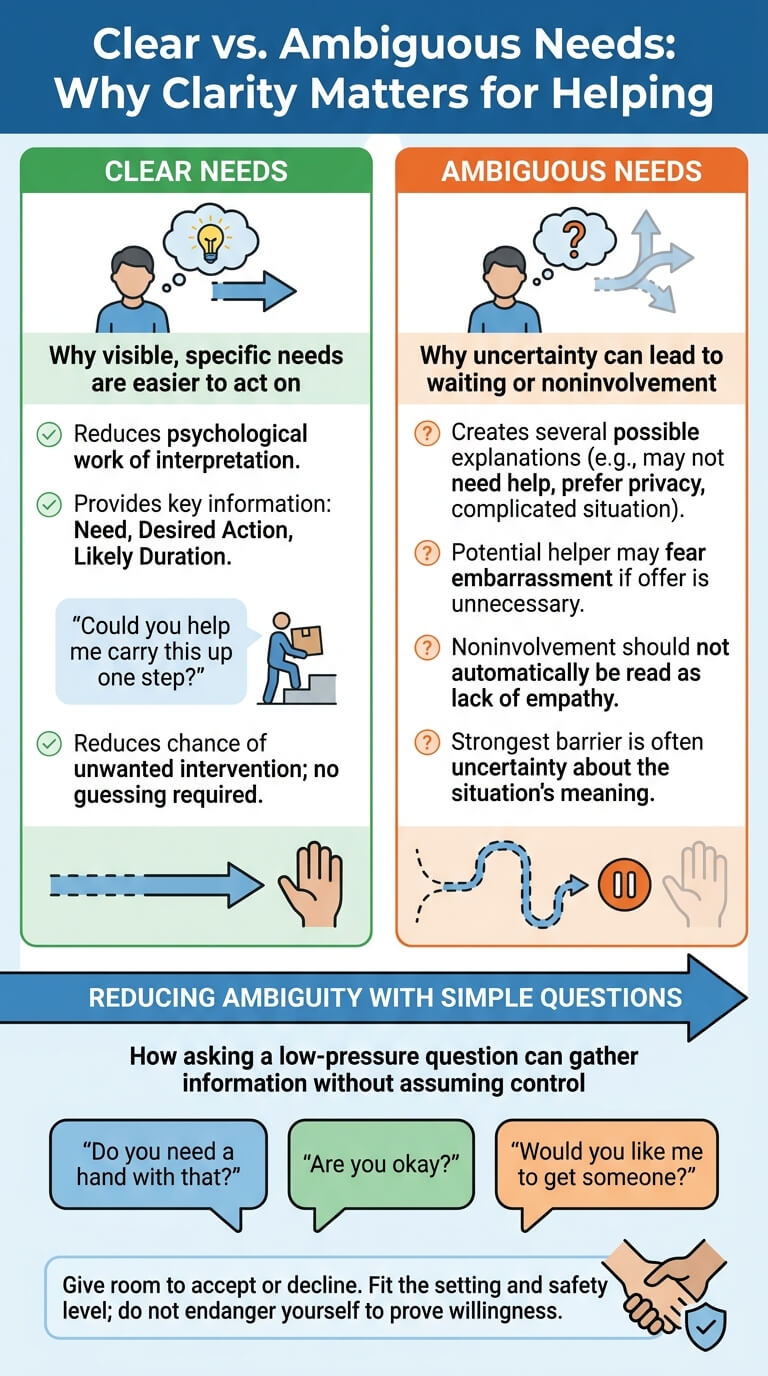
Why visible, specific needs are easier to act on
Clear needs reduce the psychological work of interpretation. A person explicitly asking, “Could you help me carry this up one step?” gives the potential helper information about the need, the desired action, and the likely duration.
Specificity also reduces the chance of an unwanted intervention. The helper does not need to guess whether the person wants assistance or what form it should take.
Why uncertainty can lead to waiting or noninvolvement
Ambiguity creates several possible explanations. The person may not need help. They may prefer privacy. The situation may be more complicated than it looks. The potential helper may also fear embarrassment if the offer is unnecessary.
This is why noninvolvement should not automatically be read as lack of empathy. Sometimes the strongest barrier is uncertainty about what the situation means.
How asking a simple question can sometimes reduce ambiguity
A low-pressure question can gather information without assuming control. “Do you need a hand with that?” “Are you okay?” or “Would you like me to get someone?” gives the other person room to accept or decline.
The question should fit the setting and safety level. You do not need to move closer to a potentially dangerous situation just to prove willingness to help.
Empathy, Similarity, and Human Identification
Empathic concern as one possible route to action
Seeing another person’s difficulty can evoke concern even when there is no existing relationship. A broad review of empathy-related responding and prosocial behavior describes sympathy and other-oriented concern as important contributors to prosocial action while also emphasizing that helping can have multiple motives.
With strangers, empathic concern may help bridge the lack of familiarity. The helper knows little about the person’s history but can still recognize fear, frustration, pain, confusion, or practical need.
Perceived similarity and identification without treating them as moral requirements
People often find it easier to understand someone when they notice a shared experience, role, identity, or situation. The empathy review above also notes that perceived similarity can sometimes support empathic responding, although findings vary across groups and contexts.
A parent may quickly notice another parent struggling with a stroller. A traveler who once got lost in the same station may be more alert to someone staring at a map. Shared experience provides a mental shortcut for understanding the need.
Similarity is not a moral requirement for helping. It is one cue that can make another person’s situation easier to imagine.
Why helping across difference still occurs
People also help strangers who seem very different from themselves. Human identification can occur at a broader level: the person is lost, injured, overloaded, confused, frightened, or simply needs information.
The ability to recognize a concrete need does not require matching background, age, culture, or lifestyle. Similarity may increase empathy in some situations without setting the boundary of who can receive concern.
Cost, Risk, Competence, and Time Pressure
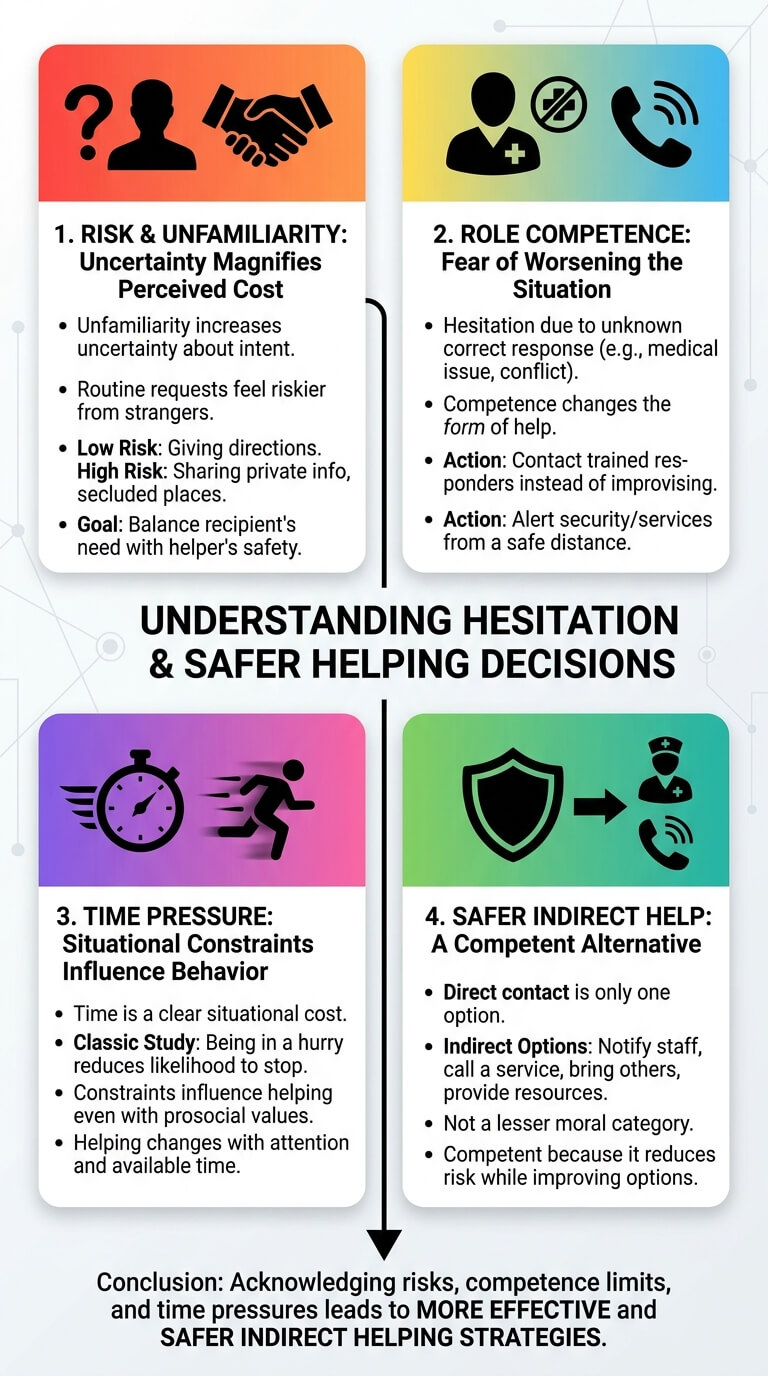
Why even small risks can matter more with an unfamiliar person
Unfamiliarity increases uncertainty about intent. A request that would feel routine from a friend may feel riskier from someone unknown. Giving a stranger directions is low risk. Getting into an unfamiliar vehicle, sharing private contact information, or entering a secluded place is different.
A useful helping decision keeps the recipient’s need and the helper’s safety in view at the same time.
Role competence and fear of making the situation worse
People may hesitate because they do not know what the correct response is. This is especially relevant when someone appears medically unwell, intoxicated, distressed, or involved in a conflict.
Competence can change the form of help. Instead of improvising treatment, you can contact trained responders. Instead of physically intervening in a threatening confrontation, you may alert security or emergency services from a safe position.
Time pressure and competing obligations
Time is one of the clearest situational costs. In the classic Darley and Batson study, participants who believed they were in more of a hurry were less likely to stop for a person appearing to need help. The original study on time pressure and helping is a reminder that situational constraints can influence helping even when people endorse prosocial values.
The result should not be turned into a universal rule. It is one well-known example showing that helping behavior can change when attention and available time change.
Why safer indirect help can be the better response
Direct contact is only one option. A person can notify staff, call a service, bring another person into the situation, provide a phone number, or point someone toward a safer resource.
Indirect help is not a lesser moral category. Sometimes it is the most competent response because it reduces risk while still improving the other person’s options.
Reputation, Visibility, and Anonymity

Visible helping can carry reputational benefits
When helping is visible, other people can observe the behavior and form impressions about the helper. A large meta-analysis of observability and prosociality found a small positive association between being observed and prosocial behavior, with important differences across settings and study designs.
Reputation can therefore be one incentive for helping strangers, especially when behavior is public. But it is only one possible incentive.
Anonymous helping can reduce reputation incentives
If nobody knows who helped, public approval becomes less available. Anonymous acts can therefore be useful when thinking about how much reputation matters.
Still, anonymity does not remove every self-relevant consequence. A person may feel satisfaction, act from a personal norm, avoid guilt, or simply want the stranger’s problem to improve.
Neither visibility nor anonymity reveals a person’s true motive by itself
Visible helping does not prove that someone acted for attention. Anonymous helping does not prove pure selflessness. Motives can be mixed, and one feature of the setting rarely settles the question.
If motive is the main question, altruism psychology offers a more precise framework. In stranger helping, visibility matters mainly because it changes the social incentives surrounding an unfamiliar interaction.
Expected Reciprocity vs One-Time Helping
Why future return is less certain with strangers
A stranger may never have the opportunity to repay you. That removes one common pathway that supports helping in repeated relationships.
Yet real interactions are not always perfectly one-time. People may share a neighborhood, workplace, school, transit route, or community without knowing one another. Even when direct return is unlikely, people may still expect that helpful behavior supports a social environment in which assistance circulates more broadly.
Social norms and generalized expectations can still support helping
People learn general expectations such as returning lost property, assisting with simple directions, making space for someone carrying a heavy load, or alerting others to an obvious problem. These expectations can guide behavior even when the recipient is unknown.
In this sense, stranger helping can be supported by generalized social expectations rather than a specific personal debt. A person may help because “this is what people should do in this situation” rather than because they expect the same stranger to return the favor.
Why one-time help can occur with mixed motives
A person may help because they care, because the action is easy, because they want to follow a norm, because other people are watching, because they would feel uncomfortable ignoring the need, or because several of these motives operate at once.
The lack of future reciprocity narrows one explanation. It does not reduce helping to a single alternative motive.
The Identifiable Individual and Concrete Need
Why a specific visible person can feel psychologically different from an abstract need
A concrete person is easier to represent mentally than a vague or statistical need. Recent research on the identifiable victim effect in prosocial decision-making found greater willingness to help identifiable individuals than unidentifiable ones across tasks involving monetary or physical-effort costs.
For stranger helping, the practical implication is modest: a visible, specific person with a clear need may evoke a stronger response than an abstract statement that “someone somewhere needs help.”
Keep claims cautious and context-sensitive
The identifiable-person effect is not a universal law. Effects vary across studies, how identification is created, the type of need, emotional salience, and the cost of helping.
It is better to say that concreteness can increase psychological engagement under some conditions than to claim that people always help identifiable individuals more.
Do not turn this into charitable-giving psychology
Much research on identifiable victims uses donation decisions because they are easy to measure experimentally. Everyday stranger helping includes much more than giving money.
A clear request for directions, practical assistance with a physical task, returning lost property, or contacting appropriate support all involve a concrete person without becoming charitable giving.
Why People Sometimes Avoid Involvement
Ambiguity
If the need is unclear, the helper risks misreading the situation. Waiting can therefore reflect uncertainty rather than indifference.
Personal safety
A person may decide not to approach because the setting feels unsafe, the stranger appears threatening, or the situation involves violence, severe intoxication, weapons, stalking, fire, or another credible danger.
That can be a reasonable boundary. Help may still be possible through trained or emergency support.
Low confidence or competence
People may worry that they do not know what to say or do. This is common when someone appears medically unwell, emotionally distressed, or involved in a conflict.
Not knowing how to solve the problem does not eliminate every helping option. It changes which option is appropriate.
Time pressure and limited resources
People can care and still be constrained. They may be rushing to childcare, work, medical appointments, transportation, or another responsibility.
A smaller response may sometimes fit: giving one piece of information, notifying staff, or identifying another person who can help.
Uncertainty about boundaries or what help is wanted
Unwanted help can feel intrusive. People may hesitate because they do not want to embarrass, patronize, or control someone who is capable of deciding for themselves.
When appropriate, asking rather than assuming protects autonomy.
Helping Strangers vs Nearby Topics
Stranger helping versus general helping behavior
General helping behavior asks how people notice need, interpret it, feel responsibility, assess ability and cost, and choose an action. Stranger helping uses many of the same steps but emphasizes what changes when familiarity is low and future exchange is uncertain.
Stranger helping versus bystander effect
The bystander effect concerns how the presence and behavior of other observers change interpretation and responsibility. A stranger can need help when nobody else is present, so unfamiliarity itself is not a bystander effect.
When several observers are present and their behavior changes what you think or do, the bystander framework becomes more precise.
Stranger helping versus altruism
Helping an unfamiliar person may look especially selfless because direct repayment is uncertain. But the behavior alone does not reveal motive. Concern, norms, reputation, guilt reduction, personal values, or mixed motives may all contribute.
Altruism is the better question when the focus shifts from the stranger context to whether another person’s welfare was an important ultimate goal of the action.
Proportionate Ways to Help Safely
Ask or check from a safe distance when appropriate
A simple question can clarify both need and consent: “Do you need help?” “Would you like me to call someone?” or “Are you looking for this address?”
You can keep physical distance when the situation is uncertain. The goal is information, not proving bravery.
Offer information or practical assistance
Many stranger-helping situations are ordinary. Directions, carrying one end of an object, pointing out a dropped item, locating an employee, lending a pen, or explaining a ticket machine can solve a specific problem without creating a large commitment.
Recruit additional people or trained help
If the problem exceeds your competence, involve someone better placed to respond. Staff, security, medical professionals, transit employees, event organizers, or another nearby person may have the tools or authority you lack.
Contact appropriate local emergency or professional support when credible danger is present
When a situation involves a medical emergency, violence, weapons, fire, stalking, threats, severe intoxication, abuse, coercion, or another credible danger, do not make direct physical intervention the default. Contact appropriate local emergency, medical, security, safeguarding, or professional support when possible and follow trained instructions.
Respect boundaries and avoid assuming that direct intervention is always best
Adults who are safe and able to decide can decline help. A respectful helper leaves room for “no.” If assistance is accepted, provide only what you can safely and competently offer.
Helping is useful when it improves another person’s options without unnecessarily overriding autonomy.
When a Different Question Becomes More Useful
Use Helping Behavior Psychology for the general action process
If your question is why people notice, interpret, accept responsibility, assess competence, weigh cost, and finally act, the general helping framework gives the fuller process. Stranger helping adds the low-familiarity conditions around that sequence.
Use Altruism Psychology when the question becomes motive under personal cost
If the main puzzle is whether a costly act was driven substantially by concern for the other person’s welfare or by self-relevant benefits, move from context to motive.
Use Bystander Effect Psychology when other observers change responsibility or interpretation
If the presence, inaction, or behavior of other witnesses changes how you read the event or who feels responsible, the social influence of bystanders becomes the more specific explanation.
FAQ About Why People Help Strangers
Why help someone you may never see again?
People can respond to a stranger’s concrete need through empathy, personal values, social norms, low helping cost, generalized reciprocity, or a desire to support a cooperative social environment. Direct future repayment is only one possible incentive. Real-life interactions also contain uncertainty about whether contact is truly one-time or whether behavior will be observed.
Does anonymity make stranger helping less likely?
Sometimes observability increases prosocial behavior because helping can affect reputation, so anonymity can remove that particular incentive. But anonymous helping still occurs. People may care about the recipient, follow a personal or social norm, anticipate satisfaction, avoid guilt, or simply see the action as the appropriate thing to do.
Why is ambiguous need harder to respond to?
Ambiguity makes it harder to know whether help is needed, whether it is wanted, and what action would be useful. With a stranger, there is little relationship history to clarify the situation. A brief question can sometimes reduce uncertainty without requiring a large commitment.
How can I help a stranger without taking an unsafe risk?
Choose the safest useful role available. That might mean offering information, checking from a distance, notifying staff, recruiting another person, or contacting appropriate emergency or professional support. Direct physical involvement is not required when the situation may be dangerous or exceeds your competence.
Is helping a stranger proof of altruistic motivation?
No. Low familiarity and uncertain reciprocity can make altruistic concern plausible, but visible behavior alone cannot prove a pure motive. Concern, norms, reputation, values, emotional reward, and mixed motives can all influence stranger helping. Motive should therefore be interpreted cautiously.
Key Takeaways
- Helping strangers is distinctive because familiarity, role obligation, information, and expected future reciprocity are unusually limited.
- Clear need, manageable cost, competence, empathy, norms, and a proportionate action can make stranger helping more likely.
- Similarity can support empathy in some contexts, but people also help across differences and similarity should never be treated as a moral requirement.
- Visibility can add reputation incentives, while anonymity removes some social rewards without revealing the helper’s true motive.
- Time pressure, ambiguity, low confidence, and safety concerns can reduce involvement without proving indifference.
- When helping feels uncertain, the best first response is often the smallest safe action that clarifies need or connects the person with appropriate assistance.

Michael Reed is the Founder and Lead Writer at Psychology Exposed. He writes about human behavior, relationships, emotional patterns, self-awareness, and practical psychology topics using research-informed, easy-to-understand content.
Read More About Michael Reed: https://psychologyexposed.com/michael-reed/