
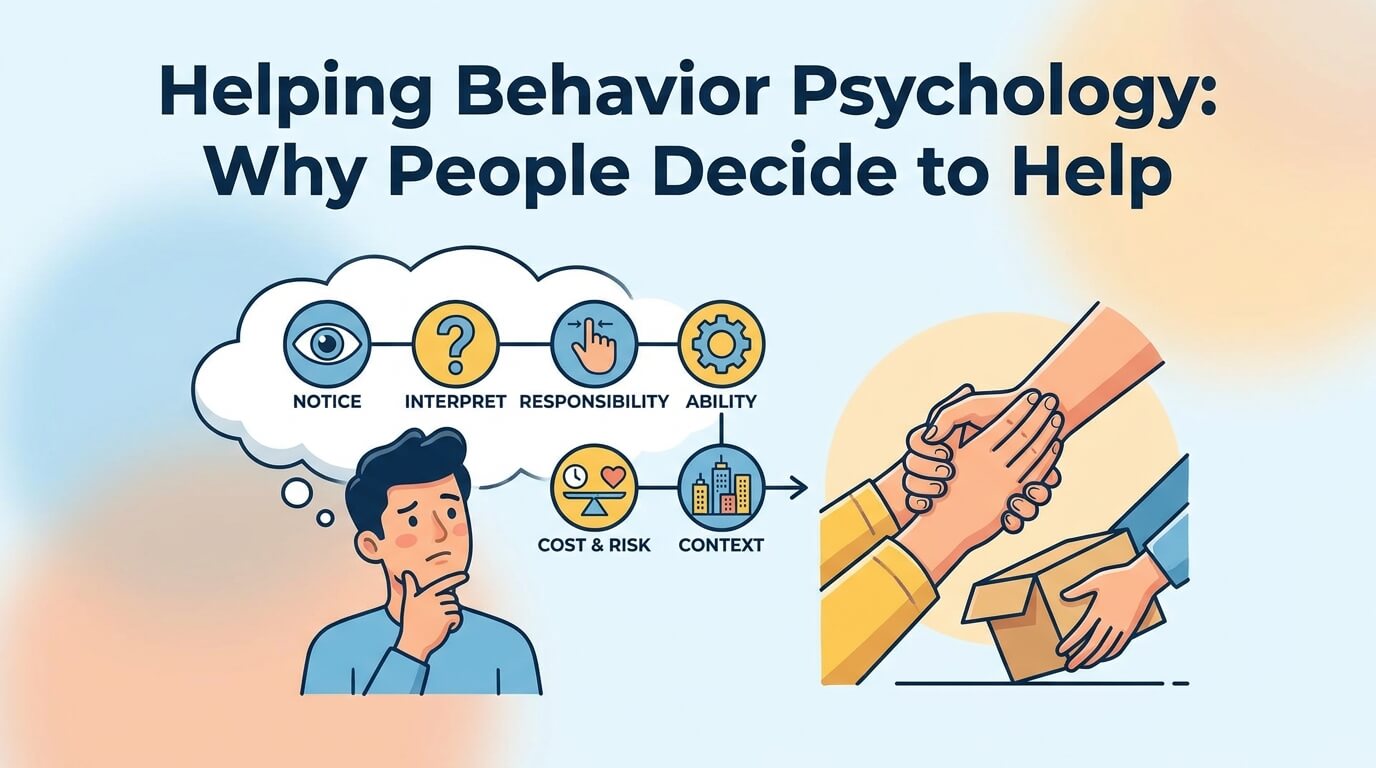
You can notice that someone is struggling, care about what happens to them, and still hesitate. A coworker looks overwhelmed, a neighbor is carrying something awkward, a friend sounds upset, or a stranger seems confused. The question is not only whether you are a caring person. It is also whether you recognize the need, understand what kind of help is appropriate, feel responsible enough to respond, believe you can be useful, and judge the cost or risk as manageable.
Helping behavior is better understood as a decision process than as a personality test. OpenStax’s overview of social psychology emphasizes that behavior reflects both personal and situational influences. The same person may act quickly in one setting, hesitate in another, and choose indirect support in a third.
Quick Answer

Helping depends on noticing, interpretation, responsibility, ability, cost, and context
Helping behavior is action intended to improve another person’s situation. Whether help happens often depends on six practical questions: Did I notice the need? Do I understand it correctly? Do I feel some responsibility? Can I help effectively? What will helping cost or risk? What form of help fits this situation? Caring can matter, but caring alone does not guarantee useful action.
What Helping Behavior Means
Helping as a specific prosocial action aimed at improving another person’s situation
Helping behavior refers to concrete action directed toward another person’s need or difficulty. The action may be small, such as giving directions, sharing information, carrying an object, or checking whether someone wants assistance. It may also involve more sustained effort, such as covering a practical task for a sick coworker or helping a friend find an appropriate service.
The useful distinction is between an internal response and an observable response. You may feel concern but not act. You may also help for reasons that have little to do with strong emotion, such as recognizing a role responsibility, knowing exactly what to do, or seeing that your small action can solve the problem efficiently. A recent review of prosocial helping behavior similarly distinguishes internal empathic processes from concrete helping actions.
Helping versus prosocial behavior, altruism, and cooperation
These terms overlap, but they answer different questions. Prosocial behavior is the broad category. It includes helping, sharing, comforting, cooperating, and other voluntary actions intended to benefit another person or a wider group. OpenStax Psychology describes prosocial behavior as voluntary behavior intended to help other people and discusses altruism as a narrower question about motivation.
| Concept | Main question | Simple example |
|---|---|---|
| Prosocial behavior | Is the action intended to benefit someone else or a collective? | Helping, sharing, comforting, or contributing |
| Helping behavior | What action is taken to improve a person’s situation? | Explaining a process to a confused coworker |
| Altruism | What motivates the helping, especially when there is personal cost? | Accepting a cost mainly out of concern for another person’s welfare |
| Cooperation | How do people coordinate toward compatible or shared outcomes? | Neighbors dividing tasks for a shared project |
Keeping those questions separate prevents a common mistake: assuming visible help proves a particular motive. Motives can be mixed, and a caring person may still fail to act when the need is unclear, timing is poor, risk is high, or the right response is uncertain.
The Helping Decision Pathway

A useful way to understand everyday helping is to follow the decision from noticing a cue to choosing a response. These steps may happen quickly, but uncertainty at any stage can delay or redirect action.
Step 1: Notice a possible need
Help cannot begin if the need never enters awareness. Attention is limited. Someone rushing to a meeting may fail to process a cue that would be obvious to a person standing still. This is one reason non-helping should not automatically be read as indifference: sometimes the need never becomes salient enough to interrupt competing demands.
Step 2: Decide whether help is actually needed
Not every sign of difficulty means the person wants assistance. Someone studying a map may be lost, or simply checking a route. Interpretation matters because people often want to avoid intruding or making a wrong assumption. Clear requests reduce uncertainty; ambiguous cues increase it. In a safe, ordinary situation, a brief check such as “Would a hand with that be useful?” leaves room to accept, decline, or clarify.
Step 3: Decide whether you have a role or responsibility
People are more likely to act when responsibility feels specific. A manager may feel responsible for clarifying a confusing task. A friend may feel responsible for checking in after hearing distress in someone’s voice. A passerby may feel less certain because there is no established role and the situation is less clear.
Responsibility is not the same as blame. The useful question is, “Is there a reasonable part for me to play here?” That part may be direct help, passing information to someone better equipped, or simply checking whether assistance is wanted.
Step 4: Judge whether you can help effectively
Good intentions do not create competence. Helping is easier when the person understands the task, has relevant skills, or can see a low-risk action that is likely to be useful. Specific requests help too. “Can you review these two numbers before noon?” makes the required skill and time clearer than “I need help with everything.”
Step 5: Weigh cost, risk, time, and alternatives
Helping has costs even when the cost is small. It may require time, attention, money, emotional effort, inconvenience, social risk, or physical effort. Classic field research by Darley and Batson found that time pressure influenced whether participants stopped to help, illustrating how situational demands can affect action even when people may endorse helping in principle.
Cost does not mean people are selfish calculators. The question may simply be practical: “Could I make this worse?” “Do I have time?” “Is someone else better equipped?” Declining one form of help may lead to another that is more realistic.
Step 6: Choose direct, indirect, or no immediate action
The final choice is not simply help versus do nothing. Direct assistance, indirect assistance, waiting for clarification, or respecting a refusal may each fit different situations. Carrying a box after someone accepts the offer differs from grabbing it without asking. Helping is not more useful merely because it is more dramatic.
What Makes Helping More or Less Likely
Empathic concern without treating empathy as the whole topic
Empathy-related responses can make another person’s need feel more personally significant. Research reviews have linked sympathy and other forms of empathy-related responding with prosocial behavior, while also showing that empathy is not a single process and does not determine action by itself. The review by Eisenberg and colleagues describes several ways empathy-related responding can be associated with prosocial behavior.
Concern may increase motivation, but strong emotion can also leave someone unsure what to do. Another person may feel less emotional intensity yet provide excellent practical support. Helpful behavior is better evaluated by what it does than by how visibly emotional the helper appears.
Relationship closeness, similarity, and identification
People often have more information about the needs of those they know well, so familiarity can reduce uncertainty about what kind of help will be welcomed. Similarity or identification may also make another person’s situation easier to imagine, but similarity is not required for helping and difference does not imply lack of concern.
Time pressure and competing demands
Someone with ten free minutes may notice more and act more readily than the same person who is late or managing competing demands. Time pressure can also change the form of help. You may not have an hour for a coworker, but you might answer one key question or identify the right person to ask.
Perceived competence and fear of making things worse
Hesitation sometimes reflects uncertainty about skill rather than lack of care. If a friend describes a complicated legal, medical, or financial problem, you may be available without being qualified to solve it. You can listen, help organize information, or help find appropriate professional support without pretending expertise.
Social modeling and whether other people are already helping
Other people’s behavior provides information. If colleagues routinely offer practical support when workloads spike, helping may feel easier to initiate. If everyone stays silent, uncertainty can increase. Social cues do not mechanically control behavior, but they can clarify what is happening or demonstrate a possible response. When other observers themselves become the main reason for hesitation, bystander psychology becomes the more precise question.
Direct, Indirect, Planned, and Spontaneous Helping

Helping is easier to understand when we stop treating it as one single behavior. The form of assistance can vary by how close the helper gets to the problem and by whether the response is prepared in advance.
| Form of help | What it looks like | When it may fit |
|---|---|---|
| Direct | You personally perform the helpful action | Carrying an item, explaining a task, listening, or assisting with a practical step |
| Indirect | You connect the person with information, resources, or someone better equipped | The need exceeds your role, skill, time, or safety limits |
| Planned | You prepare help before the need becomes urgent | Scheduling time, arranging transport, preparing information, or dividing a workload |
| Spontaneous | You respond to a need you notice in the moment | Giving directions, picking up dropped belongings, or offering a brief practical assist |
Practical assistance, information, emotional support, and connecting someone to resources
A useful response starts with the type of problem. Practical problems may need hands-on assistance. Information gaps may need a clear answer. Emotional strain may call for listening rather than fixing. Specialized problems may be best addressed by helping the person reach someone with the right expertise.
These categories can overlap. A friend dealing with a difficult appointment might appreciate emotional support, a ride, and help writing down questions. The point is not to provide everything. It is to identify which contribution actually reduces the burden.
Planned help versus spontaneous response
Spontaneous helping is visible because it happens in the moment. Planned help can be less noticeable but equally valuable. Setting aside an hour to help a relative with paperwork, bringing supplies before a group task, or checking in at an agreed time are deliberate forms of assistance.
Planning can improve fit because it allows both people to clarify expectations. Spontaneous action is useful when the need is immediate and simple. Neither form is automatically more caring.
Why indirect help can still be meaningful help
People sometimes assume that “real” help requires personally solving the problem. That assumption can create unnecessary risk or overreach. Indirect assistance may be more effective when someone else has the appropriate authority, knowledge, equipment, or relationship.
If a colleague needs a technical answer you do not know, introducing them to the right specialist is help. If a public situation looks unsafe, getting trained assistance may be more appropriate than stepping physically into danger. The relevant question is not “Did I do everything myself?” but “Did my action reasonably improve access to the help that was needed?”
Helping Without Assuming What Someone Needs
Ask before taking over when the situation allows
Unrequested help can sometimes feel supportive, but it can also feel intrusive, embarrassing, or controlling. If there is time and the person can answer, a brief offer protects their agency: “Would you like a hand?” “Do you want ideas or just someone to listen?” “Would it help if I handled this one task?”
Questions like these reduce mind-reading on both sides. The person in need gets more control over the response, and the helper gets clearer information about what would actually be useful.
Match the form of help to the person’s stated need and your role
Imagine that a coworker says, “I am behind on this report and I cannot find the latest numbers.” Taking over the whole report may create more confusion. Sending the correct data file or showing where it is stored may solve the actual problem with less disruption.
Matching help also means respecting role boundaries. A friend can provide company without acting as a clinician. A colleague can assist with work without becoming responsible for another adult’s entire workload. A neighbor can offer a ride without committing to ongoing transportation. Specific help is often easier to give and easier to receive.
Respect a no unless immediate safety duties or professional responsibilities change the situation
Adults generally have the right to decline ordinary assistance. Repeatedly insisting after a clear no can turn an offer into pressure. If someone says they have the situation handled, a respectful response might be, “Okay. If that changes, let me know.”
There are exceptions when legal duties, workplace responsibilities, safeguarding rules, or immediate danger change what a person reasonably needs to do. Those situations are context-specific. The general principle for everyday helping is simple: useful support should not erase consent, competence, or autonomy.
Everyday Examples of the Helping Process
A coworker overwhelmed by a task
Situation: A coworker has three deadlines and is visibly jumping between tasks. What you may feel: concern mixed with uncertainty about whether offering help will imply they are incapable. What it may mean: the need is visible, but the useful form of help is unclear. What to do next: offer one bounded option, such as checking a document, covering a routine task, or helping prioritize the next step.
A neighbor who may need practical assistance
Situation: A neighbor is trying to carry several heavy bags up the stairs. What you may feel: an immediate urge to assist but a small concern about intruding. What it may mean: the practical need looks clear, yet consent is still easy to check. What to do next: ask whether they would like help carrying one or two items rather than taking the bags out of their hands.
A friend who wants listening rather than solutions
Situation: A friend tells you about a frustrating conflict and becomes quieter when you start offering fixes. What you may feel: confused because your suggestions were intended to help. What it may mean: the type of support does not match the need. What to do next: check whether they want ideas, perspective, or simply room to talk. Helpful intent becomes more useful when it adapts to feedback.
A small public situation where information or practical help is enough
Situation: Someone near a transit map looks between the sign and their phone several times. What you may feel: unsure whether they are lost or simply checking details. What it may mean: the need is ambiguous and low stakes. What to do next: if it feels appropriate, ask a simple question such as, “Are you looking for a particular platform?” If they decline, there is no need to push.
Helping Behavior vs Nearby Topics
Helping versus altruism: action versus motive
Helping behavior asks what a person does in response to another person’s need. Altruism asks why some helping occurs, particularly when concern for another person’s welfare appears to motivate an action that carries personal cost.
Those questions should not be collapsed. Someone can help partly because they care, partly because they feel responsible, and partly because helping preserves a valued relationship. Mixed motives do not make the action unreal. They simply make motive harder to infer from behavior alone.
Helping versus bystander effect: broad helping factors versus other people’s presence
General helping psychology includes attention, interpretation, responsibility, competence, cost, time, and the fit of the response. Bystander psychology becomes especially relevant when the presence or behavior of other observers changes how responsibility or urgency is interpreted.
That distinction matters because hesitation when many people are present is not identical to hesitation when you are alone and unsure what kind of help is needed. The surface behavior may look similar, but the psychological problem can be different.
General helping versus helping strangers: familiarity and expected future interaction
Helping behavior applies across familiar and unfamiliar relationships. Helping a stranger adds specific uncertainty: you know less about the person, their preferences, their situation, and whether you will ever interact again.
That low-familiarity context can change perceived responsibility, risk, expected reciprocity, and confidence about what is appropriate. It deserves separate treatment rather than being used as the default example for all helping.
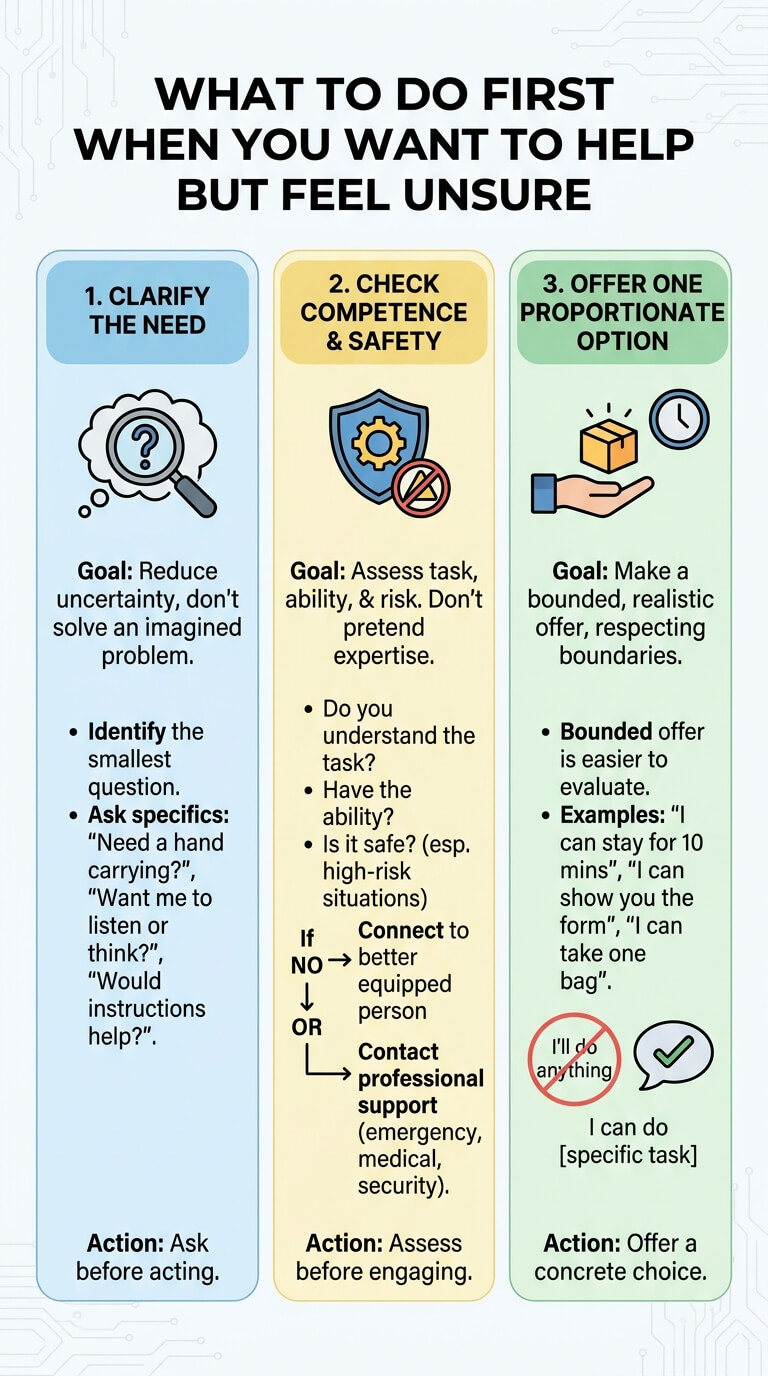
What to Do First When You Want to Help but Feel Unsure
Clarify the need
Before offering a large solution, identify the smallest question that would reduce uncertainty. “Do you need a hand with the carrying?” “Would it help if I found the instructions?” “Do you want me to listen or help think through options?”
Clarification prevents a common helping mistake: solving the problem you imagine rather than the problem the other person is actually experiencing.
Check your competence and safety
Ask yourself whether you understand the task, have the needed ability, and can help without creating unreasonable risk. If not, consider whether you can connect the person to someone better equipped.
This is especially important in medical, legal, technical, violent, or otherwise high-risk situations. Caring does not require pretending to have expertise. When there is credible danger, the safer contribution may involve contacting appropriate local emergency, security, medical, or professional support rather than direct physical intervention.
Offer one proportionate option instead of taking control
A bounded offer is easier to evaluate than a vague promise to “do anything.” It tells the other person what you can realistically provide while leaving them room to decide whether it fits.
Examples include, “I can stay for ten minutes while you make the call,” “I can show you where that form is,” or “I can take one of these bags upstairs.” Proportionate help protects both usefulness and boundaries.
When a Different Question Becomes More Useful
When personal cost makes motive more central
If the main question is not whether help occurred but why someone accepted a meaningful cost to benefit another person, the psychology of altruism is the more precise lens. It allows a deeper look at empathic concern, self-relevant rewards, mixed motives, and the limits of inferring motive from action.
When other observers change responsibility
If the critical feature is that several people are present and everyone appears to wait, look around, or assume someone else will respond, the psychology of the bystander effect becomes more useful. That topic examines ambiguity, responsibility, audience effects, and the behavior of other observers in greater detail.
When low familiarity changes obligation and uncertainty
If the person needing help is a stranger, uncertainty itself may become central. You know less about what they need, whether your involvement is welcome, how risky the situation is, and whether any future exchange is possible. That is different from helping a friend, neighbor, or coworker whose preferences and context are more familiar.
For an even broader view of how situations and other people shape behavior, Psychology Exposed’s introduction to social psychology provides useful context. The narrower question here remains the sequence that turns a perceived need into a specific helping action.
FAQ About Helping Behavior Psychology
How do I know whether help is actually wanted?
In ordinary situations, the clearest approach is to make a specific offer and allow the person to answer. “Would you like help carrying that?” is usually more respectful than taking over without asking. You can also watch for feedback after the offer. If the person declines, hesitates, or asks for a different kind of support, adjust rather than assuming your first idea was correct.
Why do I hesitate even when I want to help?
Hesitation can arise at several points. You may be unsure whether the person needs help, whether it is your place to intervene, whether you have the right skill, or whether the cost or risk is reasonable. Wanting to help and knowing how to help are separate problems. Reducing uncertainty about one step is often more useful than judging yourself for the hesitation.
Does helping need to be direct to count?
No. Indirect help can be highly effective when it connects someone with better information, resources, authority, or expertise. Giving the correct contact, finding a qualified person, alerting staff, or helping someone navigate a process may improve the situation more than attempting to solve a problem outside your ability.
Can practical help be more useful than emotional support?
Sometimes, and the reverse can also be true. The useful form depends on the need. A person facing a logistical problem may value concrete assistance. Someone who has already solved the practical issue may mainly want to be heard. Rather than assuming one type is superior, check what burden the person is actually trying to reduce.
Is refusing help always unkind?
No. A person may decline because they prefer privacy, already have a plan, want to maintain independence, or simply do not need the offered form of assistance. Respecting a clear refusal is often part of helpful behavior. The important exceptions involve situations where legal duties, professional responsibilities, safeguarding requirements, or immediate danger create different obligations.
Key Takeaways
- Helping behavior is the action taken to improve another person’s situation, not a reliable test of the helper’s inner motive.
- A useful six-step pathway is to notice the need, interpret it, assess responsibility, judge ability, weigh cost and risk, and choose an appropriate form of action.
- Empathy, closeness, time pressure, competence, and social cues can influence helping, but no single factor explains every decision.
- Indirect or planned help may be more effective than dramatic direct intervention when the need exceeds your role, skill, time, or safety limits.
- Asking what is wanted and offering one proportionate option helps preserve the other person’s autonomy while improving the fit of the assistance.
- If the central question becomes motive, other observers, or low familiarity, altruism, bystander behavior, or stranger helping may provide a more precise explanation.
The most useful next step is not to decide whether you are “a helpful person.” Look at the next situation more precisely. Notice what the person seems to need, reduce uncertainty with one respectful question, check what you can realistically offer, and choose the smallest response that is both useful and proportionate. Helping becomes easier to understand when it is treated as a series of judgments that can change from one context to another.
Educational note: This article explains everyday social psychology and is not a substitute for professional, medical, legal, emergency, or crisis guidance. If a situation involves credible danger, serious injury, violence, threats, stalking, fire, severe intoxication, or another urgent safety concern, prioritize appropriate local emergency or trained support rather than assuming direct personal intervention is the safest option.
About the author: Michael Reed is Founder & Lead Writer at Psychology Exposed. He writes about human behavior, relationships, emotional patterns, self-awareness, and everyday decisions in a clear, research-aware way for general readers.

Michael Reed is the Founder and Lead Writer at Psychology Exposed. He writes about human behavior, relationships, emotional patterns, self-awareness, and practical psychology topics using research-informed, easy-to-understand content.
Read More About Michael Reed: https://psychologyexposed.com/michael-reed/