
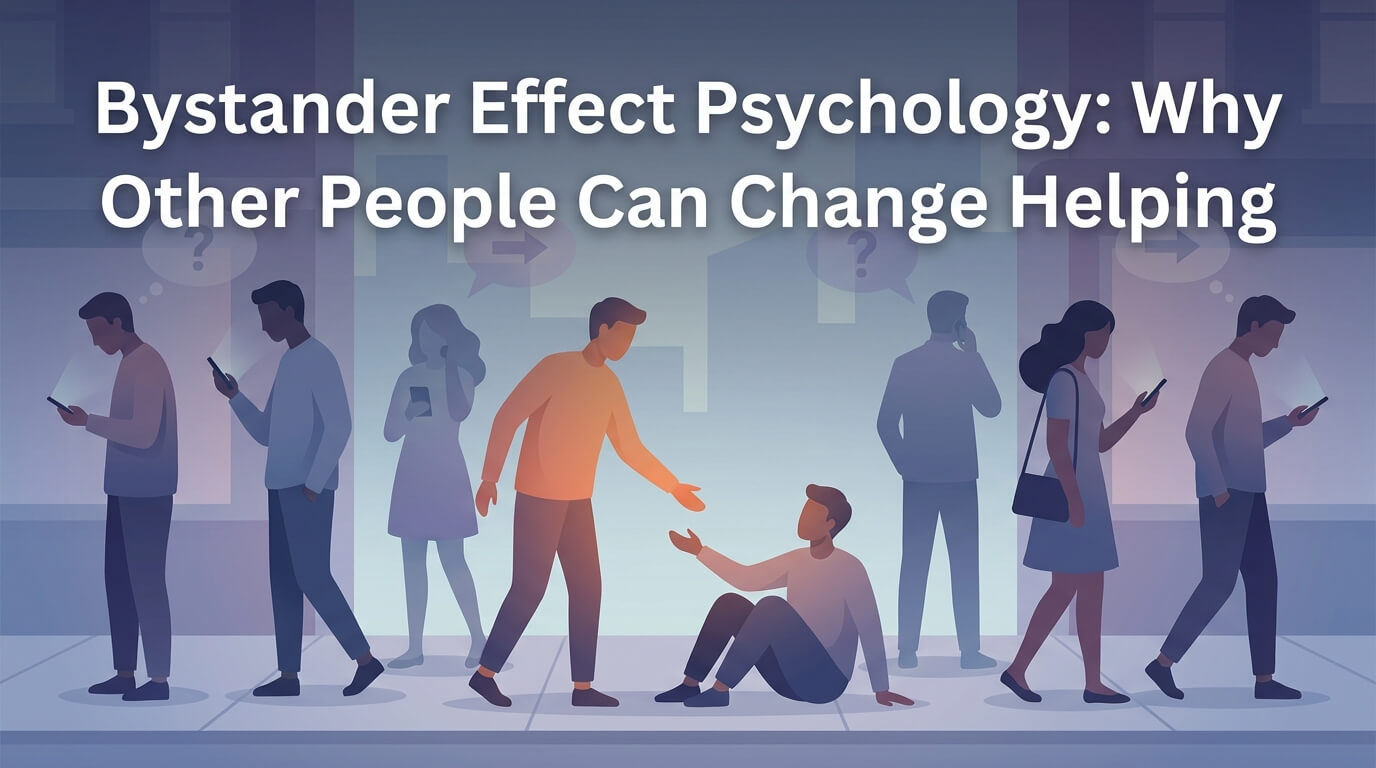
You notice someone sitting on the floor of a crowded station. They look pale, but nobody nearby seems alarmed. For a few seconds, you may wonder whether anything is wrong, whether someone else already checked, whether you would embarrass the person by approaching, or whether you know enough to help. Those seconds illustrate why bystander behavior is more complicated than simply caring or not caring.
The bystander effect describes situations in which the presence of other people can reduce or delay an individual’s likelihood of helping. The mechanism is not a single switch. Other people can change how we interpret an event, how much responsibility we feel, how confident we are about acting, and how risky intervention seems. In other circumstances, bystanders can make helping easier by confirming that something is wrong or by providing practical support.
Understanding this psychology is useful because it replaces a harsh moral story with a more accurate decision process. Hesitation does not automatically mean indifference. At the same time, knowing where hesitation comes from can make it easier to choose a specific, proportionate action when help is genuinely needed.
Quick Answer

The bystander effect is the tendency for the presence of other people to sometimes reduce or delay helping. Other observers can create ambiguity, spread perceived responsibility, increase fear of reacting incorrectly, or affect confidence about what to do. The effect is not universal. Clear danger, visible action by others, social connection, competence, and supportive bystanders can reduce or even reverse it. The bystander effect is one situational pathway inside the broader psychology of prosocial behavior.
What the Bystander Effect Means
A situational pattern, not a fixed rule about human selfishness
The OpenStax overview of the bystander effect describes how the presence of other people can affect whether a witness volunteers to help someone in distress. The key word is situational. The concept does not mean that people in groups stop caring, nor does it say that every crowd suppresses helping.
This distinction matters because people often turn one episode into a character judgment: “Everyone ignored them because people are selfish.” Sometimes that interpretation fits poorly. A witness may have misunderstood the event, believed help was already underway, felt unqualified, feared making things worse, or chosen an indirect form of assistance that was not obvious to other observers.
Why context and the behavior of other bystanders matter
Other people do more than increase the head count. They provide information. If several people suddenly stop, look concerned, and move toward someone who has fallen, you receive a strong cue that the event deserves attention. If everyone continues walking calmly, the same scene may feel more ambiguous.
Bystanders can also change the practical environment. Two people may be able to move an obstacle that one person cannot. A group may provide safety in a threatening setting. Someone else may have medical training, speak the needed language, know the building, or already be contacting emergency services.
The Bystander Decision Sequence
A classic way to understand bystander intervention is as a sequence of decisions. A person does not jump directly from seeing an event to helping. Several judgments usually happen first, sometimes very quickly.
| Decision point | Typical question | What can interrupt action |
|---|---|---|
| Notice | Did I register that something unusual happened? | Distraction, hurry, divided attention |
| Interpret | Does this person actually need help? | Ambiguity, calm reactions from others |
| Responsibility | Is it my role to do something? | Assuming someone else will act |
| Competence | Do I know what useful action looks like? | Low confidence, fear of making things worse |
| Action | What is the safest proportionate response? | Risk, uncertainty, lack of a clear next step |
Notice that something may be happening
Before anyone can help, they have to notice. Crowded environments contain competing signals: phones, traffic, announcements, conversations, work, children, luggage, deadlines. An event can be visible without receiving enough attention to register as a possible need.
Interpret whether the situation actually requires help
Not every unusual event is an emergency. Someone sitting on the ground may be resting. A loud disagreement may be ordinary conflict, or it may involve intimidation. A person leaning against a wall may be tired, intoxicated, ill, or waiting for someone.
Interpretation is especially difficult when cues are incomplete. People often look to others for information about how serious the situation is. That can be useful when others know more, but it can also create a loop in which everyone is checking everyone else.
Decide whether you are responsible for acting
Once you think help may be needed, another question appears: who should respond? If you are the only witness, the answer may feel straightforward. In a group, responsibility can feel shared.
You may assume that the person standing closest will help, that an employee has already been alerted, that someone else called, or that a more qualified person will step in. Sometimes those assumptions are correct. The problem occurs when several people make the same assumption and no one confirms that action is actually happening.
Decide what kind of help you can competently provide
Responsibility is not the same as competence. Recognizing that someone needs help does not mean you should perform an action you do not know how to perform.
Useful intervention might mean asking a simple question, getting a staff member, calling trained assistance, moving other people away, providing factual information, or following instructions from an emergency dispatcher. A person who does not know how to give medical care may still be able to summon someone who does.
Recent research on real medical emergencies reinforces the importance of knowledge and confidence. A 2026 scoping review of bystander intervention in medical emergencies identified lack of knowledge, skills, and self-efficacy among important barriers to action.
Act, recruit others, contact trained help, or wait based on the situation
The final choice is not simply “intervene” or “do nothing.” There are many forms of action. You can speak to the person, recruit another witness, notify staff, call emergency services, document information when appropriate, or create space for someone with the right skills.
Ambiguity and Pluralistic Ignorance

Why unclear situations invite social checking
When an event is ambiguous, people naturally use social information. Imagine smoke entering a room. If you are alone, you may investigate quickly. If several people remain calm, you may infer that there is an ordinary explanation. Their calmness becomes evidence, even if they are privately uncertain too.
This process is often discussed through pluralistic ignorance: individuals may privately suspect that something is wrong while interpreting other people’s lack of visible concern as evidence that the situation is normal. Each person is reading the same uncertain room.
How calm-looking bystanders can unintentionally signal that nothing is wrong
People cannot directly observe one another’s private uncertainty. They see outward behavior. A witness who is thinking, “Should I do something?” may simply look quiet. Another person reads that quietness as confidence that no action is necessary.
The same process can occur in everyday situations. A person appears dizzy at a meeting, but coworkers continue talking. Someone receives aggressive comments in a public setting, while nearby people stare at their phones. An online request for urgent assistance receives many views but few responses. Lack of visible reaction can be mistaken for informed nonconcern.
A useful correction is to remember that silence is weak evidence. Other people may know more than you, but they may also know exactly as little as you do.
Why seeing one person respond can change interpretation
Visible action breaks ambiguity. When one person asks, “Are you okay?” others receive new information: someone else also interpreted the situation as worth checking. That can make it easier for additional people to assist.
Diffusion of Responsibility

Why responsibility can feel spread across many observers
Diffusion of responsibility refers to the tendency for personal responsibility to feel reduced when responsibility appears shared among several people. It is one of the best-known explanations for the bystander effect, but it is not the whole phenomenon.
Suppose ten people receive the same group message asking for help with an urgent task. Each person may think, “Someone else probably has this.” Compare that with a direct message saying, “Maya, can you call the building manager now?” The task is almost identical, but responsibility is no longer vague.
Why directly assigning a task can make responsibility specific
When help is needed and it is safe to do so, specificity can reduce diffusion. Instead of shouting “Somebody call for help,” pointing to one person and asking them to make the call gives the task a clear owner.
The principle works outside emergencies too. In a group project, “someone should check on Alex” is easy to diffuse. “Jordan, can you message Alex and see whether they need the notes?” is concrete.
Why diffusion is one mechanism inside the broader bystander effect
Diffusion explains the responsibility stage. It does not explain every form of hesitation. A person can feel fully responsible and still be unsure whether an emergency exists. They can know an emergency exists and still lack the skill to respond. They can know what to do but judge direct action unsafe.
Keeping these stages separate prevents a common mistake: explaining every nonresponse by saying “responsibility was diffused.” Sometimes interpretation, competence, risk, or attention is the more important barrier.
Audience Inhibition and Perceived Competence
Fear of overreacting, looking foolish, or doing the wrong thing
Helping is a public action when other people are watching. That can add social risk. A person may fear misreading the event, offending someone who did not want help, looking dramatic, or being criticized for handling the situation badly.
This concern is sometimes called audience inhibition. The imagined audience changes the cost of acting. Checking on someone in private may feel easy. Doing the same thing in a silent train carriage, where everyone can hear, may feel much more exposing.
Why uncertainty about skills can delay action
People may also worry that they will worsen a medical problem, escalate a confrontation, or interfere with a professional response. Those concerns are not irrational. Competence matters.
The mistake is assuming that lack of expertise means there is no useful role. Sometimes the safest contribution is communication: alerting staff, calling trained responders, giving a precise location, bringing a first-aid kit to someone qualified, or staying available for instructions.
Choosing a safe role that fits actual competence
A helpful question is, “What can I do reliably from where I am?” That shifts attention away from performing a dramatic rescue and toward the next useful action.
If someone appears medically unwell, that may mean contacting emergency services and following dispatcher guidance rather than improvising treatment. If you see harassment, options may include checking in with the targeted person, recruiting staff or security, creating a distraction when safe, or documenting relevant information if appropriate. Direct confrontation is not automatically the best response.
When More Bystanders Do Not Reduce Helping

Clear emergencies versus ambiguous events
The familiar version of the bystander effect can sound absolute: more witnesses means less helping. Research does not support such a simple rule.
A major meta-analysis of bystander intervention research found an overall bystander effect, but also found that it was weaker in dangerous emergencies. One explanation is that danger can make the situation clearer, reducing uncertainty about whether intervention is needed.
Visible action by another person as a cue to help
A passive crowd and an active group are psychologically different environments. If another person begins helping, you no longer have to decide from scratch whether the event deserves attention. You can decide how to complement the action already underway. Visible reactions from other people can also communicate social expectations around helping, even when nobody explicitly tells a witness what to do.
Group relationships, competence, danger, and other moderators
Social relationships matter too. People are not interchangeable dots in a crowd. Friends may coordinate quickly. Coworkers may know who has first-aid training. Residents may recognize who belongs in the building. A stranger may feel less certain about role and responsibility than someone connected to the person in need.
Real-world evidence also challenges the idea that crowds are uniformly passive. A study of violent incidents captured on CCTV found that bystanders frequently intervened and that the likelihood of at least one person helping increased with the number of bystanders present. That does not erase the classic effect. It shows why context, social relations, danger, and the unit of analysis matter.
Why modern evidence requires nuance rather than a universal rule
Different studies ask different questions. Some measure whether a particular individual helps. Others ask whether anyone in a group helps. Some use ambiguous laboratory situations. Others examine real emergencies. Some bystanders are strangers; others know one another.
The best takeaway is therefore conditional: other people’s presence can inhibit an individual’s helping under some conditions, but it can also provide information, confidence, skills, physical support, and coordinated capacity. Bystander psychology is about social context, not a fixed law that crowds make people uncaring.
Five Situations Where the Process Looks Different
Someone appears unwell in a public place
Situation: A person on a platform looks unsteady and sits down abruptly. What you may feel: uncertainty about whether they are ill or simply tired. What it may mean: ambiguity is slowing interpretation rather than eliminating concern. What to do next: if it is safe, a simple check such as “Are you okay, or would you like me to get staff?” can clarify need without assuming a diagnosis.
Dropped belongings in a busy setting
Situation: A bag opens and items scatter while several people are nearby. What you may feel: an assumption that somebody closer will pick things up. What it may mean: responsibility feels distributed. What to do next: if helping is easy and appropriate, pick up one or two items or ask whether the person wants a hand instead of waiting to see who moves first.
Public harassment where safe intervention options exist
Situation: One person is repeatedly bothering another on public transport. What you may feel: concern mixed with fear of escalating the situation. What it may mean: risk assessment and uncertainty about role are central. What to do next: depending on the circumstances, safer options may include notifying staff, recruiting another person, moving closer to the targeted person, or checking in after the immediate interaction. Direct confrontation is not required if it could increase danger.
An unclear incident where nobody seems certain
Situation: You hear a crash in a building corridor, but nobody around you reacts. What you may feel: reluctance to look overly alarmed. What it may mean: social checking may be feeding uncertainty. What to do next: gather information. Looking toward the source, asking “Did anyone see what happened?” or alerting appropriate staff can break the loop without assuming the worst.
An online request seen by many people
Situation: A group chat contains a request for a ride, notes, or urgent practical help, and dozens of people have seen it. What you may feel: confidence that somebody else will answer. What it may mean: the audience is large, but responsibility has no owner. What to do next: if you cannot help directly, a specific response such as “I cannot drive, but I can call Sam and check” is more useful than assuming the request is covered.
Bystander Effect vs Nearby Explanations
Bystander effect versus helping behavior generally
Helping behavior in social psychology is the broader process of noticing a need, assessing responsibility and ability, weighing cost and risk, and choosing an action. The bystander effect is narrower. It asks how the presence and behavior of other people alter that process.
If a person hesitates because they are exhausted, short on time, or unsure the help is wanted, the general helping framework may be sufficient. If hesitation changes because ten other people are standing nearby, bystander psychology becomes especially relevant.
Bystander effect versus stranger helping
Many bystander situations involve strangers, but unfamiliarity is not the defining feature. You can experience diffusion of responsibility among coworkers who all know one another. You can also help a stranger when nobody else is present, which is not a bystander problem.
The stranger-helping question focuses on low familiarity, uncertain obligation, possible risk, and limited expectation of future reciprocity. The bystander question focuses on how other observers change interpretation and responsibility.
Bystander effect versus conformity and social norms
Bystanders often look to others, but that does not make every bystander effect a conformity effect. Conformity concerns aligning behavior or judgment with group pressure or group responses more broadly. Bystander hesitation may instead come from uncertainty, responsibility, competence, or audience concerns.
How to Make Responsibility More Specific Without Taking Unsafe Risks
Name the problem if it is safe and clear enough
A short factual statement can reduce ambiguity: “That person fell,” “There is smoke coming from that room,” or “She said she needs medical help.” You do not need to assign a diagnosis or dramatize the event. The point is to make the shared observation explicit.
Direct a specific request to a specific person when appropriate
Vague requests are easy to diffuse. Specific tasks create ownership. “You in the blue jacket, please tell the station employee” is clearer than “Can somebody get help?”
If you are the person who receives the request, answer clearly too. “I am calling now” lets others know the task is covered and frees them to take different roles.
Choose a proportionate action within your competence
Your role does not have to be the most direct role. You may be best placed to make a call, find a trained person, stay with someone while help is coming, translate information, guide responders to the location, or create physical space.
Proportionate action also means respecting the person receiving help when the situation allows. Someone who is safe and capable of deciding may decline assistance. Helping is not a license to take control of another adult simply because you are concerned.
Contact trained or emergency support when danger or medical risk is credible
When a situation involves serious injury, a medical emergency, violence, weapons, fire, stalking, severe intoxication, threats, abuse, or another credible danger, personal safety comes first. Do not treat direct physical intervention as the default.
Use the appropriate local emergency, medical, security, safeguarding, or professional service and follow trained instructions when available. A useful bystander response may be getting qualified help quickly, providing accurate information, or staying at a safe distance rather than moving closer to danger.
How Visible Action Can Change What the Group Does
One response can reduce uncertainty for everyone else
The first visible response can change the meaning of the scene. Asking whether someone needs help, notifying staff, or clearly assigning a task signals that the event has been noticed and deserves a response.
This can turn an uncoordinated collection of observers into a group with roles. The effect is practical as well as psychological: people now know what has already been done and what remains uncovered.
No visible action can increase uncertainty without proving indifference
The reverse is also important. A quiet group may look unconcerned even when several members are privately debating whether to act. That is why “nobody else is doing anything” should not automatically be treated as strong evidence that nothing is wrong.
If you have enough reason to be concerned, a small information-gathering action can be more reliable than reading the crowd’s silence as a verdict.
The general helping process still matters after responsibility becomes clear
Making responsibility specific does not solve every barrier. The person still needs to consider competence, cost, risk, the recipient’s wishes, and the best available form of assistance.
That is a useful limit to the concept. Bystander psychology can explain why responsibility becomes blurry in groups, but it does not tell us that every witness should personally perform every helpful action.
FAQ About Bystander Effect Psychology
Does having more bystanders always reduce helping?
No. Research supports a bystander effect under many conditions, but the size and even direction of the effect vary with context. Dangerous situations may be interpreted more clearly, other bystanders may provide support, and groups can contain skills or relationships that make action easier. It is more accurate to say that other people’s presence changes the helping environment than to say crowds always suppress helping.
Is diffusion of responsibility the same as the bystander effect?
No. Diffusion of responsibility is one mechanism that can contribute to the bystander effect. It describes how personal responsibility can feel reduced when several people appear able to act. Bystander behavior also involves noticing, interpreting ambiguity, social checking, fear of reacting incorrectly, perceived competence, and risk. Keeping diffusion inside this larger process gives a more complete explanation.
Why do people look at one another in an ambiguous situation?
Other people’s behavior provides social information. When you are unsure whether an event is serious, observing how others respond can help you interpret it. The problem arises when everyone is uncertain but looks calm. Each person may mistakenly read everyone else’s outward calm as evidence that intervention is unnecessary.
How can responsibility be made specific without shaming anyone?
Use clear, task-focused language rather than accusations. “Could you call the front desk while I stay here?” assigns responsibility without saying that the other person has failed morally. In urgent situations, directing a specific task to a specific person can reduce uncertainty and make it easier to confirm that help is actually underway.
What if direct intervention could be dangerous?
Do not assume that being helpful requires moving toward danger. In situations involving violence, weapons, fire, stalking, severe intoxication, medical crisis, or credible threats, safer action may mean contacting local emergency services, alerting trained staff, recruiting support, providing accurate information, or following professional instructions from a safe position.
Key Takeaways
- The bystander effect concerns how other people’s presence and behavior can change an individual’s interpretation, responsibility, confidence, and decision to help.
- Pluralistic ignorance can develop when several uncertain people read one another’s outward calm as evidence that nothing is wrong.
- Diffusion of responsibility is one mechanism within bystander behavior, not a complete explanation for every delayed response.
- Specific task assignment can reduce ambiguity about who is responsible, while visible helping can give other witnesses useful information and roles.
- Modern evidence shows that the bystander effect is context-dependent. Danger, social relationships, competence, and supportive groups can weaken or reverse the classic pattern.
- When credible danger is present, useful helping may mean contacting trained assistance or coordinating from a safe position rather than intervening physically.

Michael Reed is the Founder and Lead Writer at Psychology Exposed. He writes about human behavior, relationships, emotional patterns, self-awareness, and practical psychology topics using research-informed, easy-to-understand content.
Read More About Michael Reed: https://psychologyexposed.com/michael-reed/