
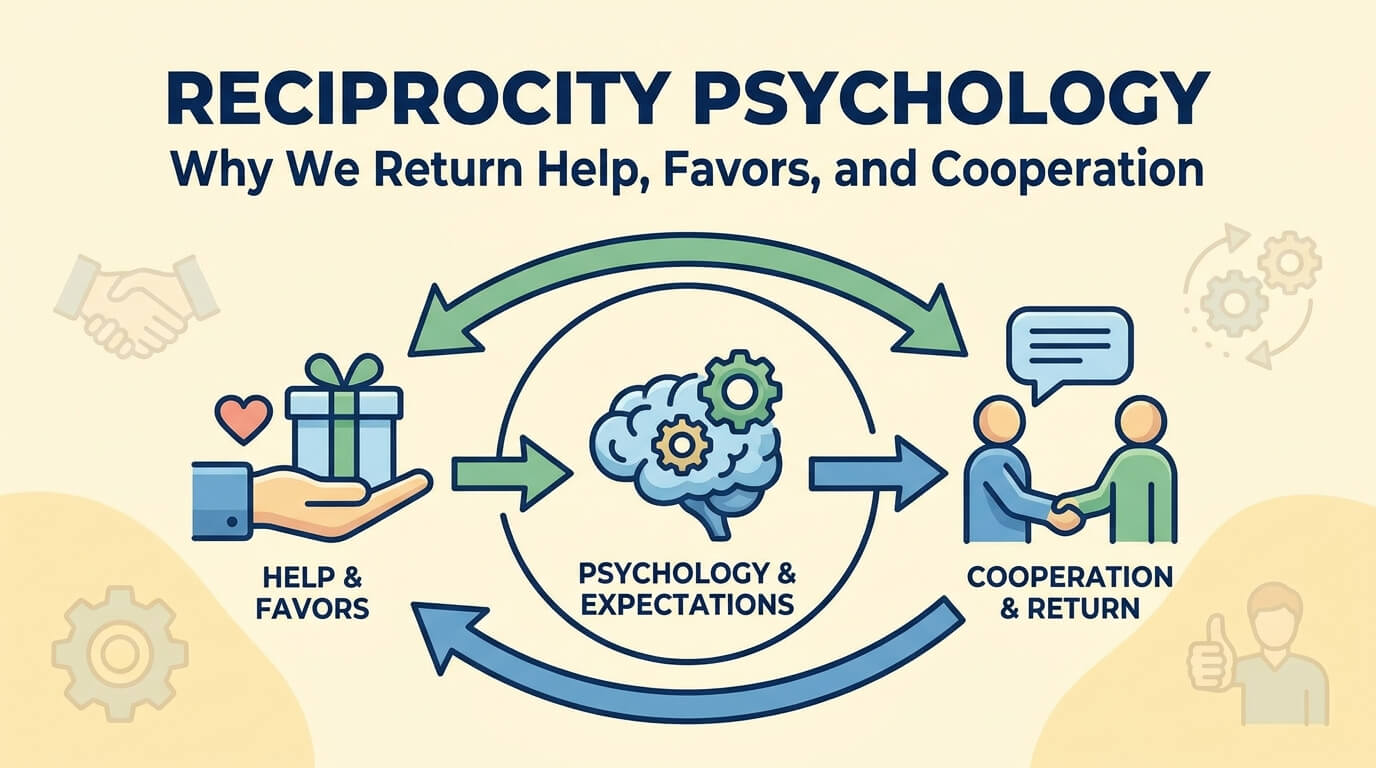
Someone covers a task for you when you are overwhelmed. Later, you feel drawn to help them when they are under pressure. A neighbor lends you a tool, and you become more willing to share something of your own. A colleague repeatedly withholds useful information, and you begin to protect your own effort in return. These are different situations, but each involves reciprocity: one person’s action changes what another person is inclined to do next.
Reciprocity is often described as “give and take,” but that phrase can make it sound like exact repayment. Human reciprocity is usually looser than that. The return may happen later, take a different form, go to a different person, or never become a conscious calculation. What matters psychologically is that past treatment can shape expectations, emotions, and future social behavior.
This also means reciprocity has a boundary. Appreciation is not the same as debt, and receiving help does not create unlimited obligations. A favor, gift, payment, sacrifice, or act of generosity never creates automatic entitlement to another person’s body, privacy, obedience, access, control, or continued contact.
Quick Answer

Reciprocity in psychology refers to patterns in which one person’s behavior influences another person’s response and expectations about future exchange. Positive treatment can invite help, trust, or cooperation, while harmful treatment can invite withdrawal or negative response. Reciprocity does not require exact repayment. Gratitude, indebtedness, reputation, repeated interaction, social norms, and perceived intent can all shape what happens next.
Reciprocity connects an action to a response and to future expectations
The important unit is not one isolated favor. It is a sequence. Something happens, the receiver interprets what it meant, emotions and expectations change, a response becomes more or less likely, and that response updates what both people expect next time.
What Reciprocity Means in Psychology
Response patterns rather than exact repayment rules
In everyday life, reciprocity is rarely a perfect ledger. You help a friend move on Saturday, and months later they listen when you need support. A coworker shares useful information, and you later give them credit in a meeting. A neighbor waters your plants, and you help carry a heavy package another day.
The exchanges are not identical, yet each can be reciprocal because one person’s earlier behavior influences the other’s later willingness to respond. OpenStax describes reciprocity as the give and take that people often expect in relationships. That broad idea is useful as long as we do not confuse reciprocity with rigid scorekeeping.
Reciprocity versus fairness, trust, and social exchange theory
Reciprocity sits near several other psychological concepts, but each asks a different question. Reciprocity asks, “How does what happened before shape my response now?” Fairness asks, “Was the outcome, process, contribution, or treatment acceptable?” Trust asks whether someone is willing to accept vulnerability based on expectations under uncertainty. Social Exchange Theory examines a broader structure involving perceived rewards, costs, alternatives, and dependence.
| Concept | Core question | Simple example |
|---|---|---|
| Reciprocity | How does your action shape my response? | You helped me before, so I am more willing to help you now. |
| Fairness | Was this treatment or allocation acceptable? | Did each person receive a reasonable share? |
| Trust | Can I accept vulnerability with you under uncertainty? | Can I rely on you with information that matters? |
| Social exchange | How do perceived rewards, costs, alternatives, and dependence shape interaction? | Why does this ongoing exchange still feel worthwhile? |
The Reciprocity Cycle
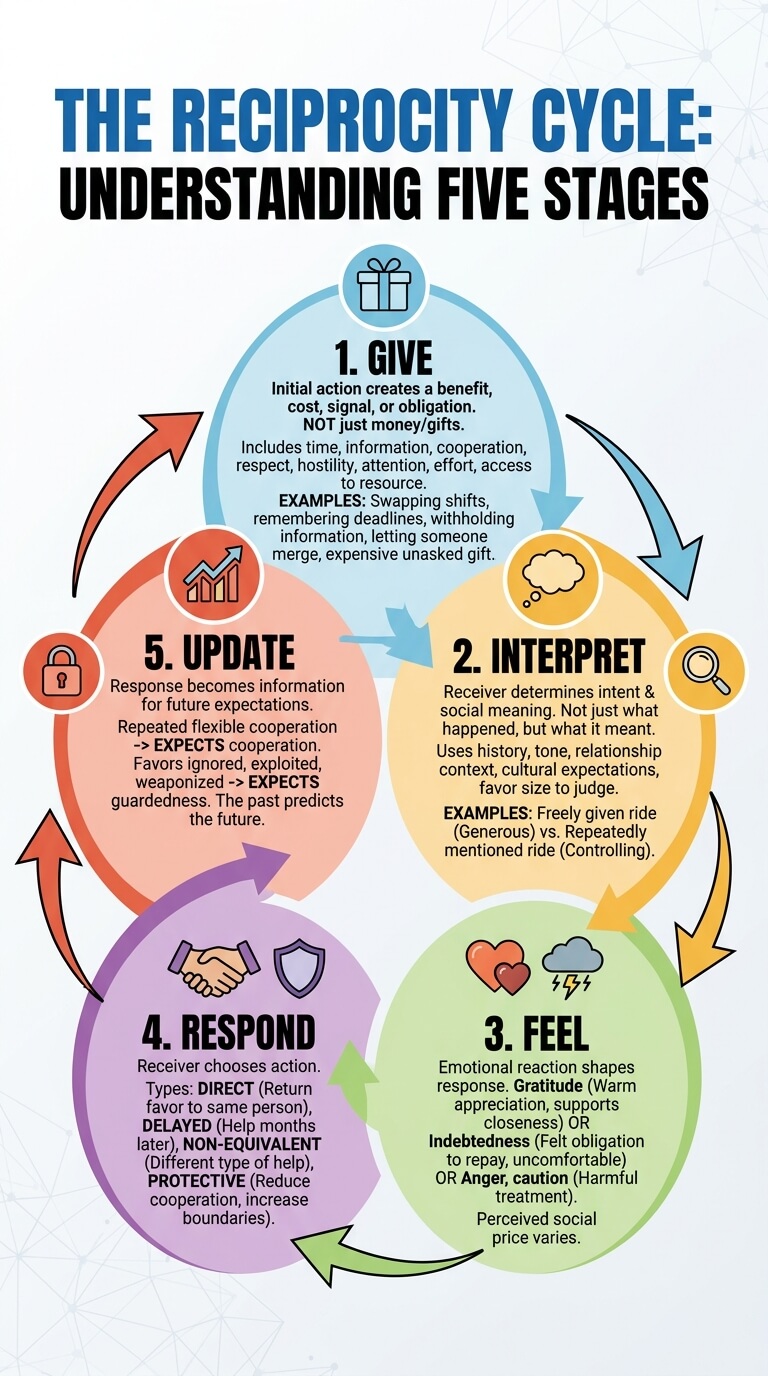
A useful way to understand reciprocity is through five stages: Give, Interpret, Feel, Respond, Update. The word “give” does not only mean money or gifts. It can mean time, information, cooperation, respect, hostility, attention, effort, or access to a resource.
1. An action creates a benefit, cost, signal, or obligation cue
The cycle begins when one person does something that affects another. A coworker swaps shifts. A friend remembers an important deadline. A stranger lets you merge into traffic. A teammate withholds information. A relative gives an expensive gift you did not ask for.
2. The receiver interprets intent and social meaning
People respond not only to what happened but to what they think it meant. An offered ride can feel generous if it was freely given. The same ride can feel controlling if the giver repeatedly brings it up later as proof that they are owed compliance.
Intent is often uncertain. Was the coworker genuinely being helpful, trying to build goodwill, or expecting something specific later? People use history, tone, relationship context, cultural expectations, and the size of the favor to interpret the act.
3. Gratitude, indebtedness, anger, or expectation can shape response
A helpful act may produce gratitude, a warm appreciation of what another person did. It may also produce indebtedness, a less comfortable feeling that something is now owed. Harmful treatment can create anger, caution, or a wish to restore balance.
Research distinguishes gratitude from indebtedness rather than treating them as the same emotional state. A recent study of thank-you gifts and reciprocity summarizes evidence that indebtedness is more closely tied to a felt obligation to repay, while gratitude can support closeness and appreciation without the same sense of debt.
That difference helps explain why receiving help can feel good in one relationship and uncomfortable in another. The act may be beneficial in both cases, but the perceived social price is different.
4. The receiver chooses a response
The response may be direct: you return a favor to the same person. It may be delayed: you help months later. It may be non-equivalent: they lent you money, while you later provide time, information, transportation, or advocacy. It may also be protective: after repeated hostility, you reduce cooperation or increase boundaries.
5. The response updates future expectations
Every response becomes information for the next interaction. If help is repeatedly returned in flexible ways, both people may expect future cooperation. If favors are ignored, exploited, or weaponized, expectations may become more guarded.
Research on human cooperation shows that repeated interaction and opportunities for reputation formation can support cooperative behavior. Reciprocity is one reason the past matters: what happened before changes what each person predicts about what will happen next.
Positive and Negative Reciprocity
Returning help, generosity, trust, or cooperation
Positive reciprocity occurs when positive treatment increases the likelihood of a positive response. Someone shares useful notes, so you later send them a resource. A colleague credits your contribution, so you become more willing to support their work. A neighbor checks your property during a storm, and you later do the same for them.
Responding to hostility, exploitation, or perceived harm
Negative reciprocity occurs when harmful or hostile treatment increases the likelihood of a negative response. If someone repeatedly takes credit for your work, you may stop sharing early drafts with them. If a teammate refuses to contribute while benefiting from everyone else’s effort, others may reduce their own willingness to cooperate.
Research on reciprocity has documented both positive and negative forms, with culture and context influencing how strongly people respond. A cross-cultural review and experiment on reciprocity and cooperation found substantial variation in both cooperative and punitive responses, which is a useful reminder that reciprocity is not expressed identically everywhere.
Why negative reciprocity is not the same as revenge as a personality trait
A negative response after harmful treatment does not prove that someone is vindictive. It may reflect situational caution, an effort to stop exploitation, an attempt to restore boundaries, anger, or a learned expectation that cooperation will not be returned.
Direct and Generalized Reciprocity
Direct reciprocity between the same people
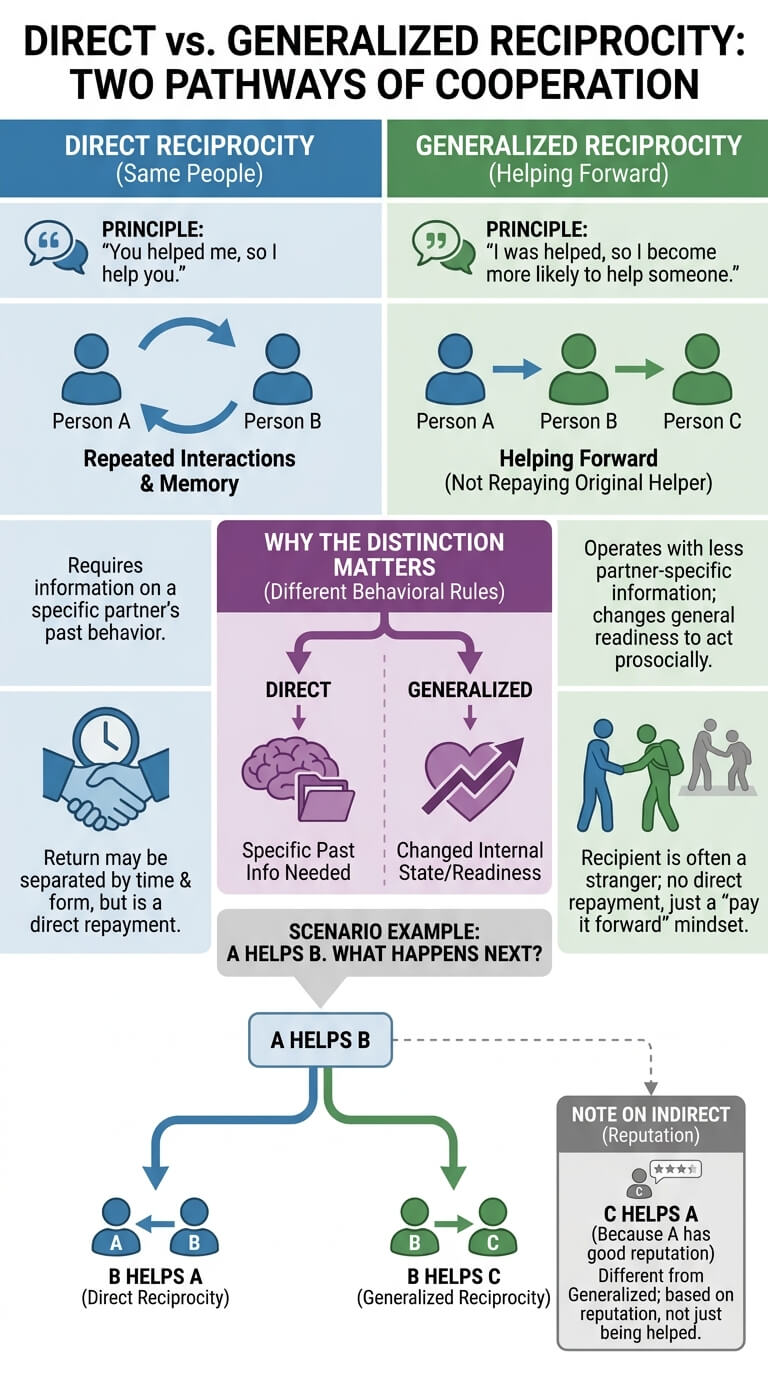
Direct reciprocity follows the familiar pattern “you helped me, so I help you.” It becomes especially relevant when the same people interact repeatedly and can remember what happened before.
A review of human cooperation describes direct reciprocity as situations in which individuals help those who helped them previously. In real life, the return may be separated by time and may not resemble the original favor.
Generalized reciprocity as helping forward rather than repaying the original helper
Generalized reciprocity takes a different path: “I was helped, so I become more likely to help someone.” The recipient of your help is not necessarily the person who helped you.
Think of a traveler who receives unexpected assistance from a stranger and later becomes more willing to help another traveler. There is no direct repayment. The earlier experience changes the person’s general readiness to act prosocially.
Why generalized reciprocity should not be treated as identical to direct exchange
Direct reciprocity requires information about a particular partner’s past behavior. Generalized reciprocity can operate with much less partner-specific information. Research on different reciprocity strategies emphasizes that direct, indirect, and generalized reciprocity follow different behavioral rules.
This distinction matters because “someone helped someone” can describe several social pathways. If A helps B and B later helps A, that is direct reciprocity. If B later helps C because B was helped, that is generalized reciprocity. If C helps A because C knows A has a good reputation for helping others, reputation-based or indirect reciprocity becomes more relevant.
Repeated Interaction, Reputation, and Future Expectations
Why repeated contact can stabilize reciprocal cooperation
When people expect to meet again, today’s behavior affects tomorrow’s options. Refusing every request may save effort now but weaken future willingness to cooperate. Consistently contributing may cost something now while building a relationship in which help is more available later.
Repeated interaction creates learning. You discover who follows through, who communicates when they cannot help, who exploits generosity, and who contributes in less visible ways. Reciprocity becomes less dependent on one event and more informed by a pattern.
How reputation changes what people expect from exchange
Reputation extends the effects of past behavior beyond direct experience. You may decide whether to cooperate partly from what you know about how someone has treated other people.
A review of the psychological foundations of reputation-based cooperation explains how reputational information can influence partner choice and whether people reward others through forms of indirect reciprocity. In ordinary language, people are often more willing to cooperate when there is credible evidence that the other person has cooperated responsibly before.
Reputation is imperfect evidence. Information can be incomplete, biased, outdated, or shaped by gossip. It should inform expectations cautiously rather than become a permanent social verdict.
Why one interaction should not become a permanent character test
One unreturned favor can be disappointing without proving that a person is exploitative. They may have forgotten, lacked capacity, interpreted the favor differently, or assumed the exchange did not require repayment. Similarly, one generous act does not guarantee future reliability.
Reciprocity becomes more informative when you look at repeated behavior and context. Are expectations communicated? Are contributions recognized? Does the person contribute in other forms? Do they respect limits when someone cannot reciprocate immediately?
Gratitude, Indebtedness, and the Feeling of Owing

Gratitude as appreciation and a relational signal
Gratitude involves recognizing that another person’s action benefited you. It can motivate acknowledgment, warmth, closeness, or later prosocial behavior. Importantly, gratitude does not require turning the favor into an invoice.
Research on gratitude in everyday relationships argues that gratitude can support relationship formation and maintenance beyond simple repayment. A thank-you may therefore communicate, “I noticed what you did and it mattered,” rather than, “I now owe you an equivalent service.”
Indebtedness as pressure to repay or restore balance
Indebtedness has a different emotional tone. The benefit is still recognized, but attention shifts toward an obligation: “I need to repay this.” That pressure may be mild and socially useful, or it may become uncomfortable. Reciprocity can also become a social expectation, which is where prosocial norms help explain why returning help may feel expected.
A favor can produce both gratitude and indebtedness. You may sincerely appreciate that a colleague helped you while also worrying that they will ask for something you cannot give later. The two feelings do not cancel each other.
| Experience | Typical focus | Possible response | Potential risk |
|---|---|---|---|
| Gratitude | Appreciation of another person’s beneficial action | Thanks, warmth, future helpfulness, closeness | Assuming gratitude requires compliance |
| Indebtedness | Sense that balance or obligation must be restored | Repayment, discomfort, urgency to return a favor | Pressure, resentment, avoidance |
| Coercive obligation | Fear of consequences for not repaying | Compliance despite unwillingness | Loss of autonomy and boundary violations |
Why healthy reciprocity can unfold over time without constant accounting
Stable reciprocal relationships often tolerate uneven periods. One friend may be the listener during a difficult month. Later, the roles change. A family member may contribute more money while another contributes time. Coworkers may trade expertise rather than identical favors.
Constant accounting can actually damage reciprocity by making every interaction feel conditional. If every helpful act is immediately followed by a reminder of what is owed, the receiver may become reluctant to accept help at all.
A healthier pattern is flexible responsiveness: contributions are noticed, people generally show up for one another, imbalances can be discussed when they become chronic, and nobody treats one favor as ownership over the other person.
Reciprocity Without Exact Equality
Different forms of contribution can still be reciprocal
Two people rarely have identical resources. One may have money but little time. Another may have practical skills but limited finances. A third may be able to offer information, transportation, emotional presence, or useful introductions.
Reciprocity can therefore involve different forms of value. A friend who helped you move does not necessarily need you to move their furniture later. You might help them prepare for an interview or care for a pet when they travel.
Timing, ability, context, and relationship history change what return looks like
An immediate return may be impossible or even inappropriate. If someone helps you during a medical crisis, your main responsibility may be recovery, not finding a way to repay them within a week. If a mentor gives advice, the meaningful return may eventually be helping another newcomer rather than paying the mentor back directly.
Context also changes expectations. A paid professional service already has an explicit exchange structure. A freely offered favor may not. A gift given with “no strings attached” should not later be converted into hidden obligations.
Why reciprocity does not require identical value in every exchange
Exact equivalence is difficult because people value resources differently. Ten minutes of expert advice may save someone hours. A small favor at a critical moment may matter more than a larger favor when there is no urgency.
Rather than pricing each act, people often judge the broader pattern: Is contribution generally mutual? Can each person say no? Are expectations discussable? Does one person consistently take while presenting every small contribution as a major debt owed by the other?
Reciprocity vs Fairness Psychology
Action-response-expectation versus “Was this fair?”
Reciprocity concerns how one action shapes another response. Fairness psychology is broader and asks whether outcomes, rules, treatment, contributions, or procedures are perceived as acceptable.
You can reciprocate without thinking an exchange is perfectly fair. A coworker may help you less than you helped them, yet you still respond positively because you know they had less capacity. Conversely, an exchange can feel mathematically equal but relationally unpleasant if every favor is used to exert pressure.
How reciprocity can influence fairness judgments without becoming the same construct
People sometimes use reciprocity as one clue when evaluating fairness. If one person repeatedly receives support but never contributes when able, others may judge the arrangement as unfair. The fairness judgment is about the acceptability of the pattern; reciprocity describes the return process within that pattern.
Keeping the two ideas separate prevents the article from becoming a debate about equality, equity, need, proportionality, or procedural justice. Those are fairness questions. The reciprocity question remains: how does prior treatment shape the next social response?
Reciprocity vs Social Exchange Theory
Reciprocity as a specific response mechanism
Reciprocity can be understood without calculating every reward and cost. A person helps you, and that experience increases your willingness to help them. That is already a reciprocal process.
The focus is temporal and relational: what happened before changes what becomes more likely next. Emotions such as gratitude or indebtedness may help carry that influence forward.
Social exchange theory as a broader model
Social Exchange Theory asks a wider set of questions about ongoing interaction. What rewards and costs does a person perceive? What outcomes do they expect? What alternatives seem available? How dependent are they on the current relationship or exchange?
Reciprocity can operate inside that larger structure, but it is not the whole theory. A person may remain in an exchange because alternatives are limited even when reciprocity is poor. Another person may reciprocate a favor in a relationship they do not consider especially rewarding overall.
When Reciprocity Becomes Pressure or Entitlement
A favor is not a blank check for access or obedience
“After everything I have done for you” can describe genuine hurt about a one-sided pattern. It can also be used as leverage. The difference becomes clearer when the speaker moves from expressing disappointment to claiming ownership over another person’s choices.
Reciprocity does not mean that accepting help transfers control to the helper. You can appreciate a favor and still decline a future request. You can acknowledge generosity without agreeing to conditions that were never stated.
Gifts, money, sacrifice, or prior help do not create consent
No gift, favor, meal, payment, ride, emotional support, or past sacrifice creates automatic consent to sex, physical contact, private information, passwords, access to a home, obedience, or continued contact. Consent must exist for the specific action being requested.
If someone uses prior generosity to pressure you into unwanted access or compliance, the issue is no longer ordinary reciprocal expectation. Protecting autonomy and safety matters more than balancing an informal social account.
How scorekeeping can distort cooperative expectations
Scorekeeping turns flexible reciprocity into constant auditing. “I called you three times, so you owe me three calls.” “I bought dinner, so you must agree with me.” “I helped last month, so you cannot say no now.”
This style creates two problems. First, people often disagree about the value of contributions. Second, it makes help feel conditional even when no condition was stated at the time.
When a relationship genuinely feels one-sided, a direct conversation about the pattern is clearer than converting each past favor into a debt instrument. The relevant question is whether contribution and respect are sustainable, not whether every act has been repaid item by item.
What to Do Next When Reciprocity Feels Unclear
Separate appreciation from obligation
Try naming both accurately: “I appreciate what you did” and “I am not sure I can do what you are asking now.” Those statements can coexist. Gratitude does not require pretending that your capacity, consent, or priorities have changed.
Clarify expectations rather than assuming an unspoken debt
If you are giving substantial help and expect a specific return, clarity is kinder than hidden accounting. “I can cover Friday if you can cover my shift next Tuesday” is an explicit exchange. “Of course, anything for you” followed by resentment when the person does not guess the expected repayment is much harder to navigate.
If you are receiving a large favor and the expectations are unclear, asking can reduce uncertainty: “I really appreciate this. Are you offering it freely, or is there something you need me to take on later?”
Use boundaries when a reciprocal expectation becomes coercive
A boundary can be simple: “I am grateful for the help you gave me, but I am not agreeing to that.” If the other person becomes threatening, retaliatory, controlling, or repeatedly ignores your refusal, prioritize distance, safety, and appropriate support over trying to perfect the exchange.
The goal is not to reject reciprocity. It is to distinguish mutual responsiveness from forced repayment.
When Another Concept Gives You a Better Explanation
Use cooperation psychology when the problem is coordination toward a shared outcome
If several people are trying to divide roles, share information, synchronize effort, or complete a joint task, cooperation is the more precise lens. Reciprocity may support that cooperation, but the central problem is coordination.
Use social exchange theory when rewards, costs, alternatives, and dependence are central
If the question is why someone stays in an ongoing exchange despite high costs, how available alternatives change dependence, or why the perceived value of an interaction has shifted, Social Exchange Theory offers the broader framework.
Use fairness psychology when the real question is whether treatment is acceptable
If you are asking whether contributions are equitable, rules are impartial, treatment is respectful, or an allocation is justified, the issue has moved from reciprocal response to fairness judgment. Reciprocity may be evidence within that judgment, but it should not replace it.
Use trust psychology when vulnerability under uncertainty is the main issue
Reciprocity can influence trust because past responses become evidence about future behavior. Still, trust psychology asks a different question: whether you are willing to accept vulnerability based on expectations about another person under uncertainty.
FAQ About Reciprocity Psychology
Is reciprocity the same as fairness?
No. Reciprocity concerns how one person’s action influences another person’s response over time. Fairness concerns whether an outcome, process, contribution, allocation, or treatment is perceived as acceptable. Reciprocity can influence fairness judgments, especially when one person repeatedly takes without contributing, but the two concepts are not interchangeable.
Do favors have to be repaid equally?
No. Reciprocal exchange can occur through different forms of contribution and over different time periods. People vary in money, time, skills, health, and opportunity. A workable reciprocal relationship is more about mutual responsiveness and respect than calculating exact equivalence after every favor.
Why can gratitude turn into indebtedness?
A favor may produce both appreciation and a sense of obligation. Indebtedness becomes stronger when the receiver feels that repayment is expected, the favor was unusually large, or the giver signals that the act created a debt. Gratitude can support closeness without the same pressure to restore balance immediately.
When does reciprocity become social pressure?
The pressure becomes concerning when a person treats previous help as a right to control another person’s choices, punishes reasonable refusal, hides conditions until after the favor, or claims that gifts or sacrifice create consent. Mutual exchange allows negotiation and boundaries. Coercive obligation does not.
Can reciprocity support cooperation without close friendship?
Yes. Coworkers, neighbors, classmates, temporary groups, professional contacts, and strangers in repeated settings can respond reciprocally without strong emotional closeness. Reliable contribution, clear expectations, reputation, and repeated interaction can support cooperative behavior even when the relationship is mainly practical.
Key Takeaways
- Reciprocity is best understood as a sequence in which one person’s action shapes another person’s response and future expectations, not as exact one-for-one repayment.
- Positive reciprocity can strengthen helping and cooperation, while negative reciprocity can protect against exploitation or contribute to escalation.
- Direct reciprocity returns behavior to the same person, while generalized reciprocity can pass a beneficial response onward to someone else.
- Gratitude centers on appreciation, whereas indebtedness places more weight on the feeling that repayment is owed. The two can occur together.
- Reciprocity and fairness are related but different: one describes response patterns, while the other evaluates whether treatment or outcomes are acceptable.
- A practical next step is to separate appreciation from obligation, make major expectations explicit, and refuse any claim that past help creates entitlement to consent, access, obedience, or control.

Michael Reed is the Founder and Lead Writer at Psychology Exposed. He writes about human behavior, relationships, emotional patterns, self-awareness, and practical psychology topics using research-informed, easy-to-understand content.
Read More About Michael Reed: https://psychologyexposed.com/michael-reed/