

Why do people keep investing in some social relationships but pull back from others? Why can the same favor feel worthwhile to one person and draining to another? Why might someone remain in an exchange that is not especially satisfying, while another person leaves a seemingly positive arrangement because better options are available?
Social Exchange Theory offers one way to organize these questions. It proposes that people are sensitive to what they receive, what they give up, what they have come to expect, what alternatives they believe they have, and how dependent they are on a particular social connection. These evaluations can shape friendships, teamwork, favors, information sharing, professional relationships, and community cooperation.
The theory is useful when treated as a framework, not a claim that people consciously calculate every interaction like an accountant. Social rewards and costs are often subjective. People can misjudge alternatives, value things that are difficult to compare, act from care or obligation, and remain constrained by circumstances that give them very few realistic options.
Quick Answer

Social Exchange Theory explains social interaction partly through perceived rewards, costs, expectations, alternatives, and dependence. People tend to evaluate whether an exchange feels worthwhile compared with what they expect and what other options seem available. These judgments can be fast, emotional, habitual, and imperfect. Reciprocity may stabilize exchange, but the theory is broader than simply returning favors or keeping score.
Social Exchange Theory explains perceived value without assuming literal calculation
A useful way to think about the theory is as a set of comparison questions. What do I gain from this interaction? What does it require from me? Is this better or worse than what I have learned to expect? What realistic alternatives do I have? How much do I rely on this particular person, group, or arrangement for an outcome I value?
What Social Exchange Theory Means
Exchange as a framework for social interaction
Social Exchange Theory has developed across psychology, sociology, organizational research, and related fields. A systematic review of Social Exchange Theory traces major contributions from Homans, Thibaut and Kelley, Blau, Gouldner, Emerson, and later researchers, showing how the framework has expanded beyond simple economic exchange.
At its broadest, the theory asks how interdependent people respond to benefits, burdens, expectations, and exchange rules over time. An action by one person changes the social situation for another. The response then changes the relationship, which can affect what each person expects in later interactions.
Tangible and intangible resources
Not everything exchanged is money or a physical object. People may value time, information, practical help, emotional support, recognition, status, flexibility, attention, reliability, access, expertise, or belonging.
Costs are equally broad. They can include money, effort, time, uncertainty, stress, conflict, inconvenience, lost opportunity, reputational risk, or having to depend on someone whose behavior is unpredictable.
Why the theory is broader than romantic relationships
Social Exchange Theory is often introduced through dating or close relationships, but its logic applies much more broadly. Coworkers exchange information and effort. Neighbors exchange practical assistance. Communities depend on contribution and reputation. Professional relationships involve access, expertise, support, reliability, and repeated expectations.
A 2024 study applying Social Exchange Theory to oncologists’ referral relationships with palliative care teams illustrates this wider use. The exchange in that setting concerns professional collaboration, perceived benefits and costs, expectations, and available alternatives rather than romance.
The Core Pieces of Social Exchange Theory
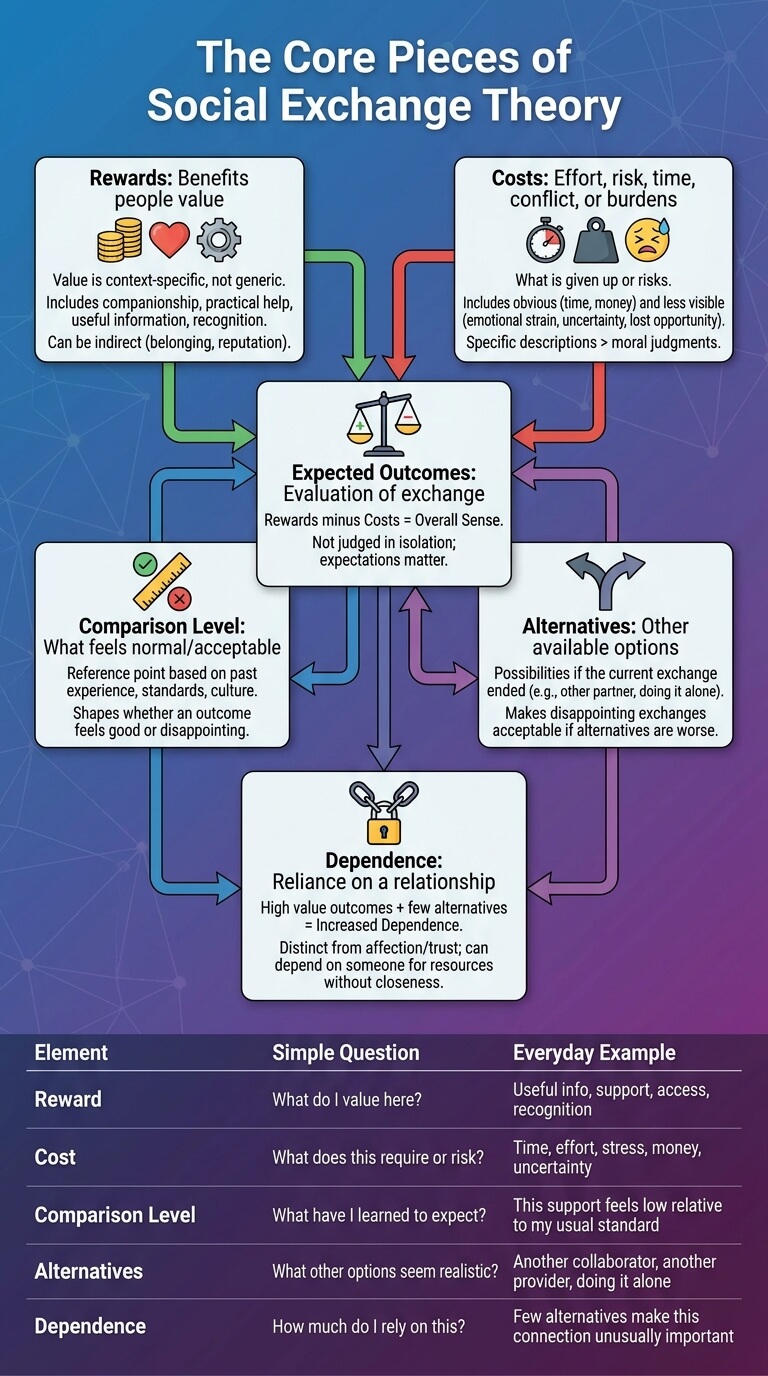
Rewards: benefits people value
A reward is not simply something pleasant in a generic sense. It is an outcome the person values in that context. In friendship, that may be companionship, understanding, humor, practical help, shared experience, or reliability. At work, it might be useful information, autonomy, recognition, learning, access, or smoother coordination.
Rewards can also be indirect. Helping a community group may produce belonging or meaning. Sharing knowledge may strengthen a professional reputation. Cooperating on a difficult task may make future cooperation easier.
Costs: effort, risk, time, conflict, or other burdens
Costs are what a person gives up, risks, or experiences as burdensome. Some are obvious, such as money or time. Others are less visible, such as emotional strain, uncertainty, role overload, repeated interruptions, loss of privacy, or the opportunity cost of saying yes to one commitment instead of another.
The theory becomes more useful when costs are described specifically rather than morally. “I am selfish for not wanting to do this” gives less information than “This takes three hours every weekend and prevents me from meeting another responsibility.”
Expected outcomes: how current exchange is evaluated
Rewards and costs combine into an overall sense of outcome, but that outcome is not judged in isolation. A moderately positive interaction may feel excellent if expectations were low, or disappointing if someone expected much more.
Comparison level: what feels normal or acceptable based on expectations
The comparison level is a reference point for what a person believes they should reasonably expect from an exchange or relationship. It can be shaped by past experience, observation of other relationships, cultural expectations, personal standards, and what has become normal over time.
A person who is accustomed to highly responsive teamwork may view slow communication as unusually costly. Someone who has repeatedly experienced unreliable support may consider modest reliability surprisingly rewarding. The objective behavior may be identical, but the reference point changes the evaluation.
Alternatives: what other options appear available
Alternatives concern what a person believes could happen if they reduced or ended the current exchange. The alternative might be another partner, another coworker, a different service provider, a new group, doing the task alone, changing roles, or simply going without the benefit.
Available alternatives matter because a disappointing exchange may still be chosen when every realistic alternative looks worse. Conversely, a reasonably rewarding exchange may lose attractiveness when a clearly better alternative becomes available.
Dependence: how much outcomes rely on a particular relationship or exchange
Dependence increases when a person strongly values an outcome and has few good ways to obtain it elsewhere. If only one colleague knows a critical system, others may depend heavily on that person. If a remote community has one provider for an important service, alternatives may be limited even if the exchange is costly.
Dependence is therefore not the same as affection or trust. You can depend on someone because they control access to a needed resource while feeling little emotional closeness. You can also trust someone deeply while having many other ways to meet a particular practical need.
| Element | Simple question | Everyday example |
|---|---|---|
| Reward | What do I value here? | Useful information, support, access, recognition, companionship |
| Cost | What does this require or risk? | Time, effort, stress, money, uncertainty, lost opportunity |
| Comparison level | What have I learned to expect? | This amount of support feels low relative to my usual standard |
| Alternatives | What other options seem realistic? | Another collaborator, another provider, doing it alone |
| Dependence | How much do I rely on this particular exchange? | Few alternatives make this connection unusually important |
People Do Not Literally Calculate Every Interaction
Perceptions can be fast, emotional, habitual, and context-dependent
Social exchange language can sound more deliberate than real social life. Most people do not stop after a conversation and calculate a formal reward-minus-cost score. Evaluations are often intuitive.
You may simply look forward to one meeting and dread another. You may become more willing to share information with a colleague who consistently reciprocates. You may feel reluctant to ask someone for help because past assistance came with uncomfortable pressure.
Values and costs can be hard to compare on a single scale
How much is an hour of time worth compared with emotional support? How do you compare professional visibility with privacy? Is receiving expert advice worth the discomfort of feeling indebted? There is no universal conversion rate.
This is one limitation of simple “benefit minus cost” explanations. Social outcomes live in different psychological categories. People also care about identity, fairness, duty, belonging, meaning, and values that may resist being reduced to one common metric.
People can misjudge alternatives or future outcomes
An exchange can feel irreplaceable because a person cannot imagine another option. Later, after gaining information or resources, alternatives become visible. The reverse can also happen: an alternative that looked ideal may turn out to carry costs that were not obvious at first.
Social Exchange Theory is therefore strongest when it describes perceived alternatives rather than assuming people possess complete information. Decisions are made from what seems available, not from every option that objectively exists.
Reciprocity Inside Social Exchange
Why returning benefits can stabilize exchange
If one person repeatedly offers useful support and the other responds in kind, the exchange becomes more predictable. Each side receives evidence that contribution is likely to be noticed and returned in some form.
Reciprocity can therefore lower the perceived risk of contributing. When people expect that helping, information, or cooperation will not simply disappear into a one-way relationship, continued exchange becomes easier to justify.
Why reciprocity is one process rather than the whole theory
Reciprocity asks how one person’s earlier behavior shapes another person’s response. Social Exchange Theory asks a wider set of questions. A person may reciprocate a favor while still deciding that the overall exchange is too costly. Another person may receive little reciprocity but remain highly dependent because alternatives are limited.
The systematic review of exchange scholarship highlights reciprocity as one influential rule among several approaches to exchange. Treating reciprocity as the entire theory would leave out comparison standards, alternatives, dependence, power, and the wider structure of repeated interaction.
How repeated interaction changes expectations
Repeated interaction creates a record. People learn who follows through, who contributes only when watched, who communicates when unable to help, and who turns small favors into large demands.
That record can change both expected reward and expected cost. Reliability may make future exchange feel easier. Repeated conflict may make even a potentially useful interaction feel expensive before it begins.
Dependence, Alternatives, and Unequal Exchange

Why limited alternatives can increase dependence
Suppose one person controls something another person values and there are few substitutes. The second person’s dependence increases because leaving the exchange means losing access to an important outcome.
A review of social exchange, power, and inequality explains that unequal dependence can produce unequal power. The less dependent party may have greater ability to influence exchange terms because losing the relationship costs them less.
Why high dependence does not automatically mean trust
A person can depend on someone they do not fully trust. An employee may rely on a supervisor for approval. A community may depend on one provider because no alternative exists nearby. A project team may depend on one specialist even if communication with that person is inconsistent.
This is where trust psychology becomes a different question. Trust concerns willingness to accept vulnerability under uncertainty. Dependence concerns how costly it would be to lose a particular source of valued outcomes.
How power can emerge from unequal alternatives
If one side has many substitutes and the other has none, the exchange is asymmetric. The side with better alternatives can often leave more easily, bargain more strongly, or demand more favorable terms.
That does not mean every person with alternatives will exploit them. It means the structure gives them more leverage. Power here is an emergent property of relative dependence, not proof of a controlling personality.
Social Exchange Across Different Settings
Friendship and mutual support
In friendship, rewards may include companionship, emotional support, humor, practical help, acceptance, or shared activity. Costs may include time, conflict, unreliability, emotional strain, or repeated one-sided demands.
Teamwork and information sharing
Teams exchange expertise, information, effort, visibility, and credit. People may share more readily when they expect useful return, fair recognition, and continued cooperation. They may become guarded when contribution is repeatedly taken without acknowledgment.
Favors and practical assistance
A favor creates a small exchange history. If assistance is freely given and later met with appreciation or flexible return, the exchange may feel positive. If favors repeatedly come with hidden conditions, the perceived cost rises.
A favor should never be treated as a blank check. Receiving help does not create unlimited obligation, and gratitude does not erase autonomy.
Community exchange
Communities rely on many forms of exchange that are not direct trades. People contribute time, information, monitoring, care, or local knowledge and may receive belonging, safety, shared resources, or future support.
Professional relationships and repeated cooperation
Professional exchange includes referrals, expertise, introductions, mentoring, credit, flexibility, information, and access. A relationship may remain valuable because it reliably reduces uncertainty or helps both parties accomplish work that would be harder separately.
Social Exchange Theory vs Nearby Concepts
Social Exchange Theory versus reciprocity
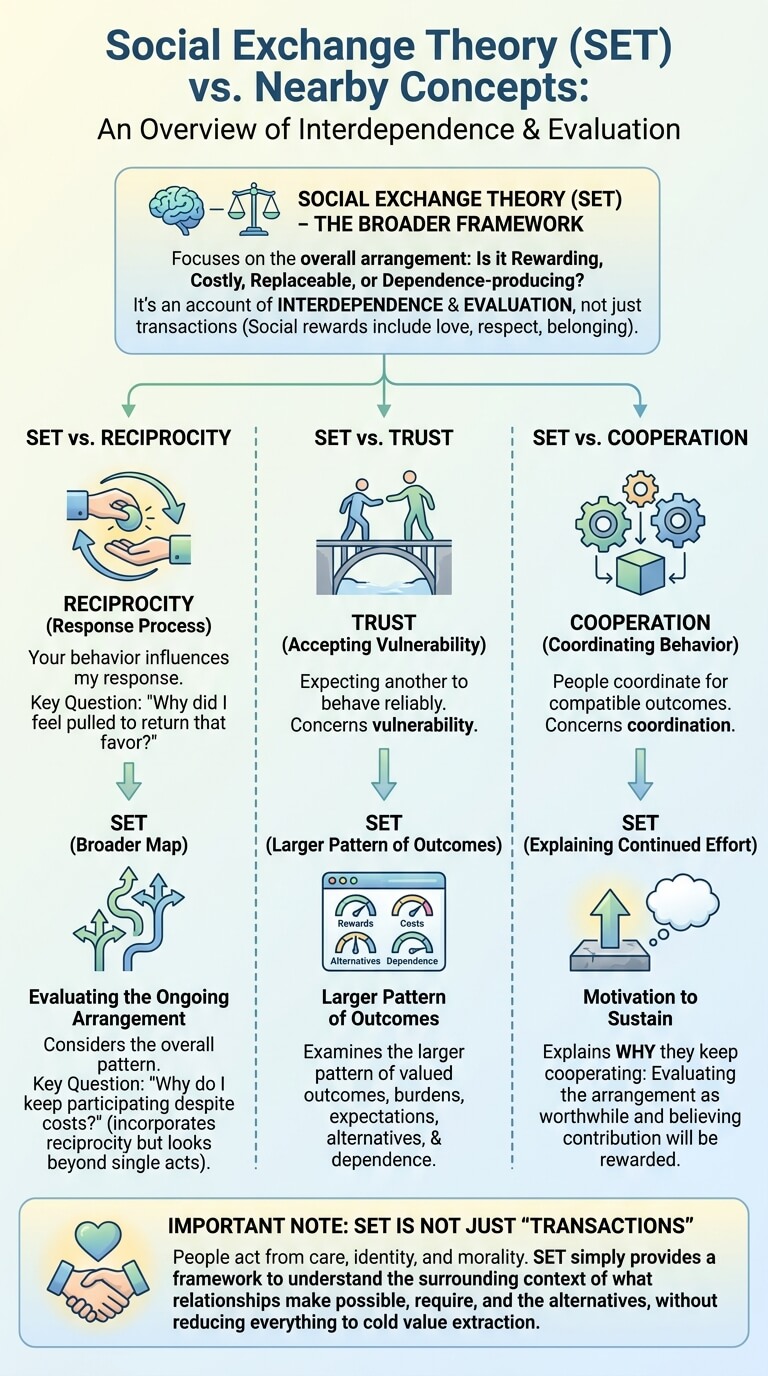
Reciprocity is a response process: your behavior toward me influences how I respond to you or others. Social Exchange Theory contains that process but also considers whether the overall arrangement is rewarding, costly, replaceable, or dependence-producing.
If the question is “Why did I feel pulled to return that favor?” reciprocity is likely the more precise explanation. If the question is “Why do I keep participating in this ongoing arrangement despite its costs?” exchange theory offers the broader map.
Social Exchange Theory versus trust
Trust concerns accepting vulnerability because another person is expected to behave in a sufficiently reliable way. Social exchange concerns the larger pattern of valued outcomes, burdens, expectations, alternatives, and dependence.
Social Exchange Theory versus cooperation
Cooperation concerns how people coordinate behavior toward compatible outcomes. Social Exchange Theory can help explain why they are willing to keep cooperating, especially when they evaluate the arrangement as worthwhile and believe contribution will be returned or rewarded.
Why the theory does not mean relationships are transactions
Calling every relationship a transaction suggests that people only care about extracting value. That is not necessary for using the theory. Social rewards can include love, belonging, loyalty, meaning, respect, and the satisfaction of contributing to someone else’s welfare.
The framework is better understood as an account of interdependence and evaluation. People notice what relationships make possible, what they require, and what alternatives exist, even when they also act from care, identity, morality, or commitment.
Where the Theory Is Useful
Explaining persistence in repeated exchange
The theory is useful when asking why people keep returning to an interaction. Repeated benefits, manageable costs, few attractive alternatives, and growing dependence can all support persistence.
Explaining sensitivity to alternatives and dependence
Alternatives change bargaining position and perceived freedom. When people gain access to more sources of information, support, income, expertise, or belonging, their dependence on one source may decrease.
Explaining why the same interaction can feel valuable in one context and costly in another
A two-hour favor may be easy during a quiet week and impossible during a crisis. Frequent feedback may feel supportive to a new employee and intrusive to an experienced one. A recurring meeting may be valuable when uncertainty is high and unnecessary when roles are stable.
Limits and Critiques of Social Exchange Theory
Human motives include identity, norms, care, obligation, and meaning
People do not always act to maximize personally rewarding outcomes. They may keep promises because they believe promises should be kept, help someone because they care, contribute because a group identity matters, or accept a burden because duty is important to them. Exchange processes can influence the broader psychology of prosocial behavior, but they do not explain every form of helping or cooperation.
Some of those motives can be described as psychologically rewarding, but doing so too broadly risks making the theory unfalsifiable. If every possible motive is redefined as a “reward,” the term stops distinguishing among different psychological processes.
Rewards and costs are subjective and culturally situated
What counts as rewarding depends partly on social context. Independence may be highly valued in one environment, while mutual obligation carries more value in another. Public praise may feel affirming in one group and embarrassing in another.
Research critiquing traditional applications of exchange models has emphasized that social position, culture, identity, and structural inequality can shape what resources and alternatives are realistically available. One critical discussion of social exchange in family research shows why context should not be treated as a minor afterthought.
Structural constraints can narrow alternatives
“Why don’t they just leave?” is a poor use of Social Exchange Theory when it ignores actual constraints. Alternatives may require money, transportation, social support, legal access, housing, institutional approval, language skills, or professional credentials.
A person who stays in a costly arrangement may not be revealing a preference for poor treatment. They may be responding to a constrained set of options.
The framework should not be treated as a complete theory of all relationships
A major critical review of Social Exchange Theory argues that the framework has often been used with overlapping concepts and insufficient theoretical precision. That criticism is useful for general readers too: a theory that can explain almost everything after the fact may need help from more specific concepts to explain what is happening in a particular case.
Use Social Exchange Theory when rewards, costs, alternatives, dependence, and repeated exchange genuinely illuminate the situation. Use a more precise framework when the central issue is trust, fairness, identity, coordination, coercion, attachment, or another mechanism.
What to Do Next When Using This Theory
Identify the perceived reward, cost, alternative, and dependence
Describe the exchange without accusing anyone of selfishness. Ask: What does each person value? What does each person give up? What has become normal? What realistic alternatives exist? Who depends more heavily on the current arrangement?
This turns a vague judgment such as “They are using me” into more testable observations, such as “I provide three recurring forms of support, the return is unclear, and I feel unable to say no because I rely on this person for access to something important.”
Separate reciprocity from the broader exchange structure
If your concern is simply whether help is returned, focus on the response pattern. If the issue includes alternatives, dependence, accumulated costs, or reasons for remaining in the arrangement, widen the analysis.
Check whether trust or cooperation is actually the more precise lens
If the main problem is “Can I rely on this person when I am vulnerable?” examine trust. If the main problem is “Why can’t we coordinate roles even though we want the same outcome?” examine cooperation.
Choosing the Most Useful Next Question
When return behavior is the puzzle
If you want to understand why people return favors, respond to generosity, feel indebted, or reduce cooperation after being treated poorly, the key process is reciprocity. The exchange framework provides context, but return behavior deserves its own closer look.
When coordination is the puzzle
If people agree on the goal but cannot align roles, timing, information, or effort, the central problem is cooperation. Rewards and costs may influence willingness to participate, but coordination explains whether separate actions actually fit together.
When vulnerability is the puzzle
If the real question is whether it feels safe to depend on another person’s honesty, competence, reliability, or intentions under uncertainty, trust becomes the more precise concept. Dependence may increase the stakes, but it does not automatically create trust.
FAQ About Social Exchange Theory Psychology
Does Social Exchange Theory say people are selfish calculators?
No. Simple descriptions can make it sound that way, but social exchange involves subjective perceptions, habits, emotions, norms, obligations, care, identity, and incomplete information. People may be sensitive to benefits and costs without consciously calculating them. The theory is most useful as a framework for interdependence and evaluation, not as proof that every social action is selfish.
What is a comparison level in simple terms?
A comparison level is the standard you use to judge whether a current exchange feels better or worse than what you have learned to expect. It can be shaped by past relationships, cultural expectations, observation, and personal standards. A positive outcome may still feel disappointing if it falls below that reference point.
How are alternatives different from rewards?
Rewards are benefits you receive from the current exchange. Alternatives are other ways you believe you could obtain valued outcomes or avoid current costs. You might value a collaboration because it offers useful expertise, yet become less dependent on it after finding another source of comparable expertise.
Does reciprocity explain all social exchange?
No. Reciprocity helps explain why one person’s action may invite a corresponding response and why repeated return can stabilize interaction. Social Exchange Theory also considers perceived rewards, costs, comparison standards, alternatives, and dependence. A person can reciprocate a favor while still judging the larger exchange as unsustainable.
Where does Social Exchange Theory fit poorly?
It fits poorly when it is stretched into a complete explanation for every relationship or when structural constraints, identity, culture, morality, care, coercion, or institutional rules are more central. It can organize part of the picture without replacing more specific psychological or social explanations.
Key Takeaways
- Social Exchange Theory explains ongoing interaction partly through perceived rewards, costs, expectations, alternatives, and dependence.
- Comparison level concerns what a person has learned to expect, while alternatives concern what other options seem realistically available.
- Dependence grows when valued outcomes rely heavily on one exchange and good alternatives are limited. Dependence is not the same as trust.
- Reciprocity can stabilize exchange, but it is one process within a broader framework rather than the whole theory.
- People do not need to consciously calculate social value. Evaluations can be emotional, habitual, culturally shaped, incomplete, and sometimes inaccurate.
- A practical first step is to identify the perceived reward, cost, comparison standard, alternative, and dependence before assuming that anyone is selfish or that a relationship is merely transactional.

Michael Reed is the Founder and Lead Writer at Psychology Exposed. He writes about human behavior, relationships, emotional patterns, self-awareness, and practical psychology topics using research-informed, easy-to-understand content.
Read More About Michael Reed: https://psychologyexposed.com/michael-reed/