

Two people can want the same result and still work badly together. A family may agree that household tasks need to be shared but keep missing responsibilities. Classmates may all want a strong project grade yet duplicate work because nobody clarified roles. Neighbors may support a community event while assuming someone else will handle the difficult parts. Cooperation is not just agreement. It is the psychological and practical work of coordinating behavior so that separate actions fit together.
That is why cooperation psychology focuses on interdependence, expectations, communication, contribution, trust, reputation, and feedback. People cooperate when their actions are linked to compatible outcomes and they can organize those actions well enough to make joint effort useful. Friendship can help, but it is not required. Pure altruism is not required either. People can cooperate because everyone benefits, because roles are clear, because future interaction matters, or because working together is simply the most effective way to reach a goal.
Quick Answer
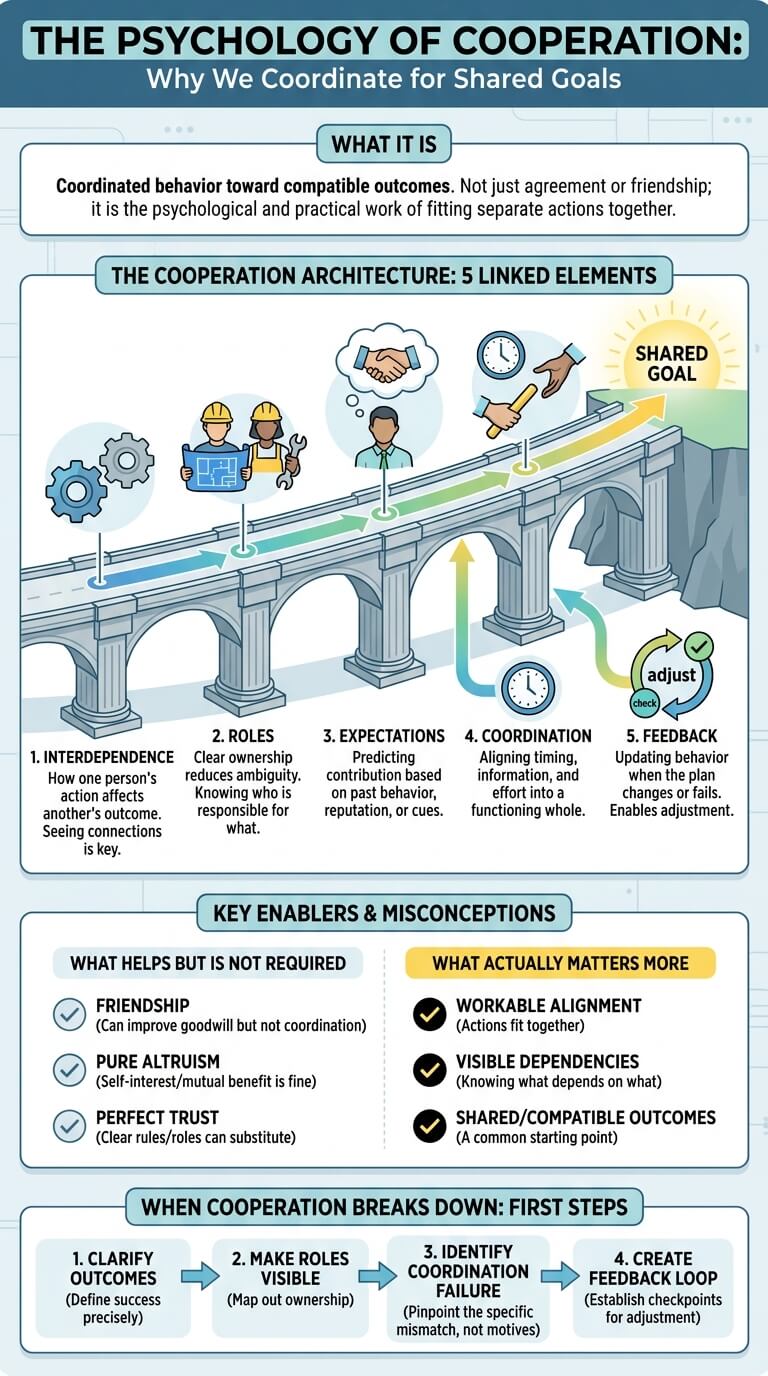
Cooperation in psychology means people coordinating their behavior toward shared or compatible outcomes. It works best when people understand how their actions affect one another, know their roles, can predict contribution reasonably well, communicate enough to reduce uncertainty, and adjust when the plan fails. Cooperation does not require friendship, perfect trust, equal motives, or identical contributions. It does require some workable alignment of behavior.
Cooperation depends on compatible outcomes plus workable coordination, expectations, and contribution
A shared goal is only the starting point. People also need to know what depends on what. If one person’s step must happen before another can begin, timing matters. If several people need the same information, communication matters. If one person controls a resource everyone else needs, expectations matter.
Cooperation becomes easier when those dependencies are visible. It becomes harder when people assume everyone has the same understanding but actually hold different expectations about effort, deadlines, authority, or acceptable tradeoffs.
What Cooperation Means in Psychology
Coordinating behavior toward compatible or shared outcomes
A recent review of cooperative behavior defines cooperation broadly as two or more individuals working together to achieve shared goals. That definition highlights something easy to miss: cooperation is about coordinated action, not simply positive feelings toward one another.
Two strangers carrying a heavy table can cooperate successfully if they align direction, timing, and effort. Close friends can cooperate poorly if they each assume the other is managing the same task. A temporary emergency team can coordinate effectively without emotional closeness, while a highly connected group may fail because responsibilities are vague.
Why cooperation does not require altruistic motivation
Altruism asks whether another person’s welfare substantially motivates a helpful action. Cooperation asks whether people coordinate toward outcomes that are compatible or shared. Those are different questions. Cooperation is one major form of the broader psychology of prosocial behavior, even when every participant also benefits personally.
Imagine two small businesses sharing delivery space because both save money. Each party benefits personally, but the arrangement is still cooperation. Classmates may divide research because everyone wants a better grade. Family members may coordinate schedules because each person’s day becomes easier. None of these situations requires one person to put the other’s welfare above their own.
Cooperation versus helping and reciprocity
Helping focuses on improving another person’s situation. Reciprocity focuses on how one person’s prior action shapes another person’s response. Cooperation focuses on coordinated behavior toward compatible outcomes.
| Concept | Main psychological question | Example |
|---|---|---|
| Helping | Will I act to improve another person’s situation? | You carry a box for a neighbor who is struggling. |
| Reciprocity | How does what you did before shape what I do now? | You covered my shift, so I am more willing to cover yours later. |
| Cooperation | How do our actions fit together toward a shared or compatible outcome? | We divide tasks and synchronize timing to finish a project. |
The Cooperation Architecture
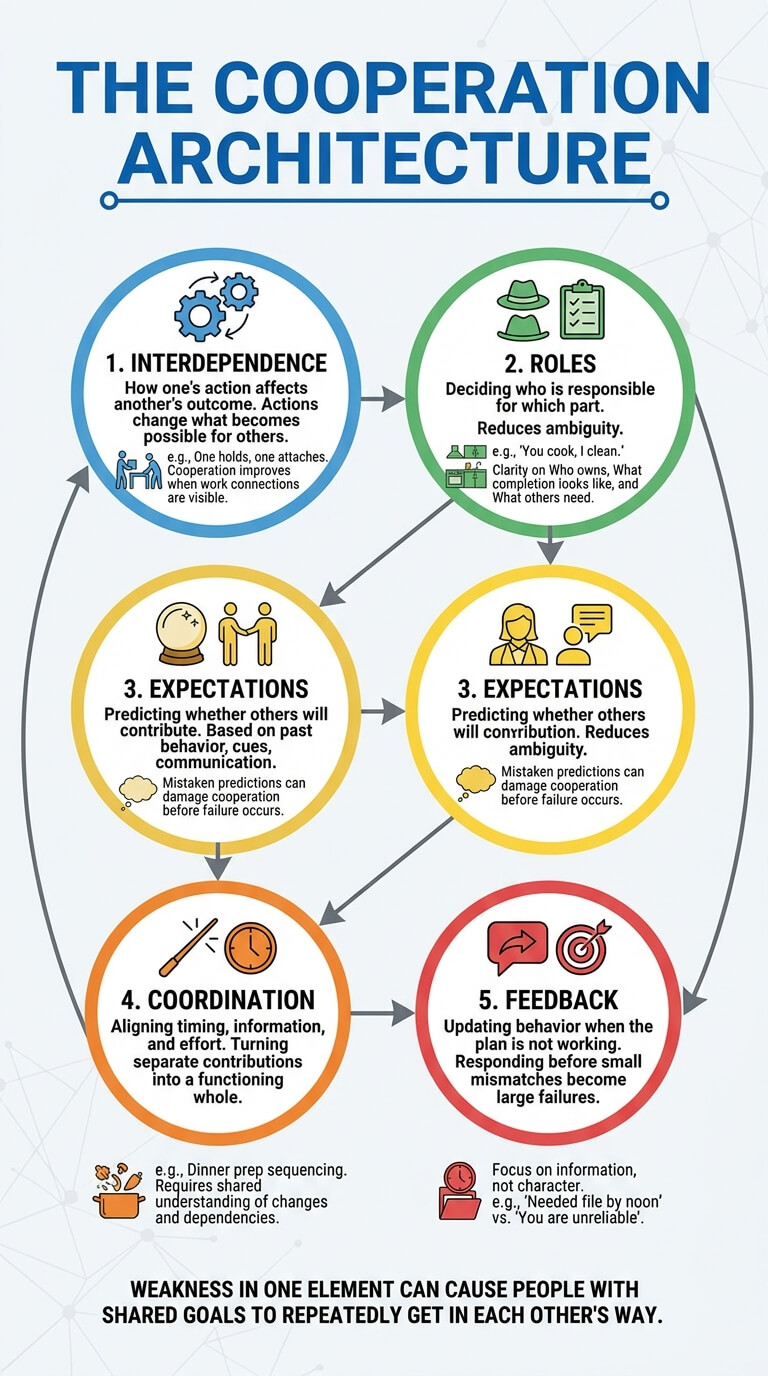
A practical way to understand cooperation is through five linked elements: Interdependence, Roles, Expectations, Coordination, Feedback. If one element is weak, people may still share the same goal but repeatedly get in one another’s way.
Interdependence: how one person’s action affects another’s outcome
Interdependence means that one person’s behavior changes what becomes possible for someone else. If you are assembling furniture together, one person may need to hold pieces in place while another attaches them. If you are planning an event, the person booking the venue affects what the person arranging equipment can do.
Research on social interaction emphasizes that different forms of interdependence shape social outcomes. The practical lesson is simple: cooperation improves when people can see where their work connects.
Roles: deciding who is responsible for which part
Roles reduce ambiguity. They do not have to be formal job titles. A role can be as small as “you call the venue, I confirm transportation” or “you cook, I clean up.”
Good role clarity answers three questions: Who owns this task? What does completion look like? What does someone else need from this task before they can continue?
Expectations: predicting whether others will contribute
Cooperation requires prediction. Before you invest effort, you usually make some estimate of whether other people will do their part. That estimate may come from past behavior, reputation, role expectations, communication, or situational cues.
A review of how people judge cooperativeness found that behavioral, personal, and situational cues can all influence predictions about who will cooperate, while people do not always use those cues accurately. This matters because mistaken expectations can damage cooperation before anyone actually fails.
Coordination: aligning timing, information, and effort
Coordination turns separate contributions into a functioning whole. Research on joint action examines how people align actions in space and time toward a shared task. Everyday cooperation often depends on the same principle, even when the task is less precise.
Consider preparing dinner together. If one person starts cooking before ingredients arrive, or both people prepare the same dish while nobody handles another, effort exists but coordination fails. More effort is not always the answer. Better sequencing may matter more.
Coordination also includes information flow. People need enough shared understanding to know what has changed, what remains undone, and what another person’s next move depends on.
Feedback: updating behavior when the plan is not working
No cooperative plan survives every change. A deadline moves. Someone gets sick. A resource becomes unavailable. One person discovers that a task takes twice as long as expected. Feedback allows the group to respond before a small mismatch becomes a large failure.
This is different from turning feedback into a verdict about character. “You are unreliable” provides less information than “I needed the file by noon to complete my section, and I did not know it would be late.”
Shared Goals Are Not Enough
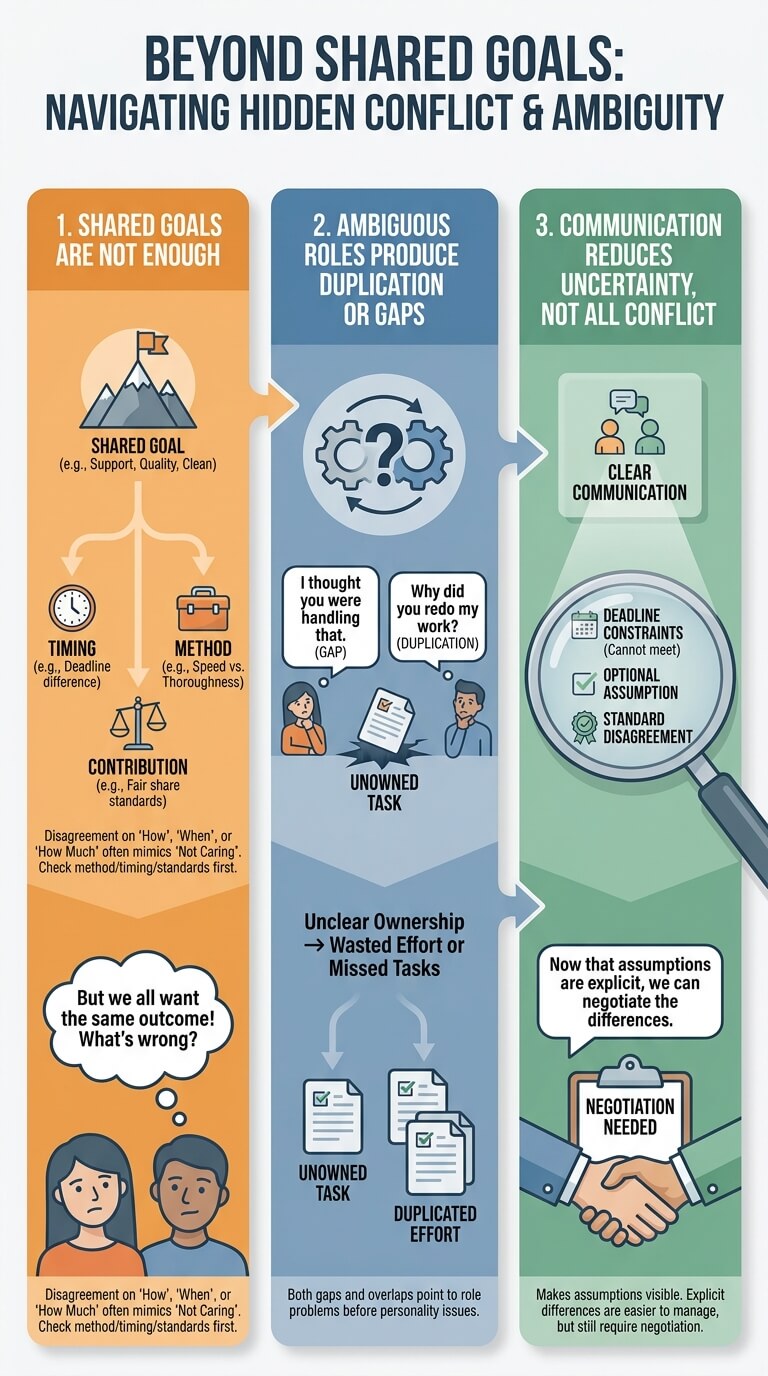
People can agree on the goal but disagree on method, timing, or contribution
A family may agree that an elderly relative needs regular support but disagree about what counts as a fair contribution. A project group may all want quality work but disagree about whether speed or thoroughness matters more. Neighbors may want a clean shared area but have different standards for what “clean” means.
Before concluding that someone “does not care,” check whether the disagreement is really about method, timing, standards, or the amount of effort each person expected.
Ambiguous roles can produce duplication or gaps
When nobody owns a task, everyone may assume someone else is doing it. When ownership is unclear in a different way, two people may both do it and waste effort.
A classic sign is the sentence, “I thought you were handling that.” Another is, “Why did you redo my work?” Both point to a role problem before they point to a personality problem.
Communication can reduce uncertainty without eliminating conflict
Communication is often presented as a cure-all, but people can communicate clearly and still disagree. The value of communication is that it makes assumptions visible.
You may discover that one person cannot meet the original deadline, another thought the task was optional, or two people disagree about quality standards. Those differences still need negotiation, but they are easier to solve once they are explicit.
Trust, Reputation, and Repeated Interaction
Trust can reduce the need for constant checking
Trust makes cooperation easier when you can rely on another person without verifying every step. If you believe a colleague will tell you when a deadline slips, you do not need to monitor their progress every hour.
But trust and cooperation are not the same thing. Research examining the relationship between trust and cooperative behavior stresses the need to distinguish the concepts carefully. People may cooperate because contracts, roles, monitoring, incentives, or immediate coordination make it sensible, even when interpersonal trust is limited.
Reputation changes expectations before cooperation begins
Past behavior can travel ahead of a person. If someone is known for following through, others may be more willing to depend on them. If they are known for taking benefits while avoiding contribution, others may protect themselves before a new interaction starts.
A review of reputation and cooperation describes reputation as one mechanism that can help people identify likely cooperators and reduce exposure to free riding. In ordinary settings, this might mean choosing a collaborator based on a history of reliable contribution.
Repeated interaction creates opportunities to learn who follows through
One interaction provides limited information. Repeated interaction lets people compare promises with behavior. Does the person communicate when circumstances change? Do they contribute only when monitored? Do they share credit? Can they accept feedback without abandoning the task?
Repeated contact also makes today’s choice relevant to tomorrow. Refusing every contribution may save effort now but make others less willing to cooperate later. Reliable participation can build expectations that lower the cost of future coordination. If the focus shifts to why people continue an exchange despite its benefits, burdens, and alternatives, Social Exchange Theory offers a broader explanation.
Why cooperation can still occur with limited trust when roles and safeguards are clear
People often cooperate successfully with strangers or weakly trusted partners because the structure reduces uncertainty. A marketplace may use clear rules and ratings. A temporary team may assign explicit roles. Two organizations may use contracts, checkpoints, and shared documentation.
This is important in everyday relationships too. “Trust me” is not always a substitute for a workable system. Sometimes a shared calendar, written task list, confirmation step, or clear boundary makes cooperation easier than asking for more faith.
Division of Effort and Free-Rider Concerns
Why visible contribution matters
Cooperation becomes fragile when people cannot tell whether others are contributing. If one person’s work happens behind the scenes, teammates may underestimate it. If nobody knows who completed what, someone may receive benefits without contributing and go unnoticed.
Visibility does not mean turning every action into a performance. It means having enough information to understand whether the system is functioning. In a household, that could mean explicitly dividing recurring tasks. In a community project, it could mean a shared list of responsibilities.
When unequal effort is functional versus destabilizing
Equal effort is not always the same as effective cooperation. One person may have more expertise, more available time, greater physical ability, or access to a needed resource. Unequal contributions can be sensible if everyone understands why they differ.
The problem is chronic, unexplained imbalance. If one person repeatedly contributes less while receiving the same benefits and ignoring requests to adjust, others may reduce their own cooperation.
Monitoring and feedback without turning every interaction into surveillance
Some monitoring can support cooperation because it makes contribution visible and catches coordination failures early. Too much monitoring can signal distrust, create resentment, and consume more effort than it saves.
A simple checkpoint often works better than constant observation. “Let’s confirm Friday what is complete and what is blocked” gives people autonomy while preserving accountability.
The goal is information, not control. Monitoring should answer whether dependencies are being met, not whether every person is performing in exactly the same style.
Shared Identity and Fairness as Supporting Influences
Shared identity can increase willingness to coordinate
People may cooperate more readily when they see themselves as part of a meaningful “we.” A neighborhood, classroom, family, team, or community identity can make shared outcomes feel more personally relevant.
Shared identity can reduce the psychological distance between “my effort” and “our result.” It may also increase expectations that contribution will be noticed and reciprocated.
Perceived fairness can support continued participation
People are more willing to continue cooperating when contribution rules feel reasonable. If one person consistently receives credit while others carry the difficult work, cooperation may erode even when the shared goal still matters.
Fairness can involve workload, recognition, decision-making, access to information, or how exceptions are handled. It is a supporting condition, not a synonym for cooperation.
Neither identity nor fairness guarantees effective coordination
A group can feel close and fair but still execute badly. Everyone may like each other, share credit generously, and remain confused about who is doing what.
Cooperation Without Friendship or Pure Motives
Temporary strangers can cooperate successfully
Imagine several travelers lifting a fallen suitcase off an escalator, drivers taking turns through a blocked intersection, or people forming a line to move supplies. They may never meet again, but their actions become mutually coordinated.
Temporary cooperation works when the goal is obvious, roles can be inferred quickly, and each person’s contribution complements the others. Emotional closeness is optional.
Self-interest and shared benefit can coexist
People often cooperate because joint action creates a better outcome for everyone. Two students study together because each learns more. Neighbors share equipment because both save money. Companies may share a standard because compatibility benefits the entire market.
Mixed motives do not make coordination unreal
One person may care about the group. Another may want recognition. A third may simply want the task completed quickly. If their actions still fit together toward the shared outcome, they are cooperating.
Everyday Cooperation Examples
Family members coordinating household tasks
Situation: Everyone wants the home to function, but chores are repeatedly missed. What people may feel: resentment and a sense that others do not care. What it may mean: task ownership and standards are unclear. What to do next: assign recurring responsibilities and define what “done” means instead of relying on shared intention.
Classmates dividing a project
Situation: Four students divide a presentation, but the final slides repeat some information and omit another section. What people may feel: frustration despite everyone working hard. What it may mean: effort was divided, but dependencies were not coordinated. What to do next: agree on one structure first and schedule a midpoint integration check.
Neighbors organizing a shared task
Situation: Several residents agree to prepare a common area for an event. What people may feel: uncertainty about who will bring supplies or arrive early. What it may mean: responsibility is shared too broadly. What to do next: convert general willingness into named tasks with simple confirmation.
A temporary group coordinating around a short-term goal
Situation: Passengers need to move around a blocked walkway. What people may feel: mild confusion about who should move first. What it may mean: the goal is obvious but sequencing is not. What to do next: use visible cues, brief communication, or turn-taking to create a temporary order.
A team sharing information under time pressure
Situation: A group has ten minutes to respond to a changing problem. What people may feel: pressure to act immediately. What it may mean: independent action may produce conflicting decisions. What to do next: establish what information everyone needs, who decides which part, and when updates must be shared.
Cooperation vs Nearby Concepts

Cooperation versus trust: coordination versus willingness to accept vulnerability
Trust psychology asks whether people are willing to accept vulnerability because they expect another person to act in a reasonably reliable way. Cooperation asks whether behavior is coordinated toward compatible outcomes.
Trust can support cooperation by reducing uncertainty, but neither guarantees the other. People can trust one another and still coordinate poorly. They can also cooperate with limited trust when rules, roles, incentives, and safeguards are clear.
Cooperation versus group cohesion: coordinated action versus attachment to the group
Group cohesion concerns the forces that keep members connected, attracted, or committed to a group. Cooperation concerns whether their actions fit together toward an outcome.
A cohesive friendship group may struggle to organize a trip because nobody wants to make decisions. A temporary group of strangers may coordinate effectively around a short practical task. Emotional connection and coordinated performance overlap sometimes, but they are not the same thing.
Cooperation versus social dilemmas: general coordination versus private-collective incentive conflict
Not every cooperation problem is a social dilemma. Sometimes everyone benefits from coordinating but roles are simply unclear. A social dilemma is more specific: an individually attractive choice conflicts with the collective outcome when enough people make it.
Free riding can appear in both conversations, which is why the topics are easy to merge. In this article, free-rider concerns matter mainly because they affect contribution expectations. When the central problem becomes the tension between private incentives and collective welfare, the social-dilemma lens is more precise.
What to Do First When Cooperation Is Breaking Down
Clarify the shared or compatible outcome
Ask what everyone is actually trying to accomplish. “Finish the project” may be too vague. Does success mean fastest completion, highest quality, minimum cost, equal participation, or meeting a particular standard?
Make roles and dependencies visible
Write down who owns each important step and what another person needs from it. You do not need elaborate software. A simple sequence such as “research by Tuesday, draft by Thursday, review Friday” makes dependencies clearer.
Identify the smallest coordination failure before blaming motive
Instead of starting with “Who is not committed?”, ask what exactly stopped fitting. Was the deadline unclear? Did two people assume ownership? Was important information missing? Did the plan depend on a person who never agreed to the role?
Create a feedback loop for adjusting expectations and effort
Choose a point where people will compare plan with reality. What is complete? What changed? What is blocked? Does effort need redistribution?
When Reciprocity, Competition, or Collective Incentives Become the Main Issue
Look at reciprocity when past contribution shapes current willingness
If the central question is “Why should I keep contributing when they never do?” reciprocity becomes especially relevant. Past responses are changing present expectations.
Compare goal structures when another person’s success affects your own
Some settings mix cooperation and competition. Teammates may cooperate internally while competing with another team. Coworkers may share information while also competing for a promotion.
Examine social dilemmas when private incentives threaten the collective outcome
If everyone benefits from a shared resource but each person has an incentive to contribute less or take more, the problem is no longer just poor coordination. It is an incentive conflict.
FAQ About Cooperation Psychology
Can people cooperate without trusting each other fully?
Yes. Trust can lower uncertainty, but cooperation can also be supported by clear roles, contracts, monitoring, reputation systems, repeated checkpoints, or mutually beneficial incentives. Two people may coordinate effectively while still limiting vulnerability. Deep trust is helpful in some settings, but it is not a prerequisite for every cooperative act.
Does cooperation require friendship?
No. Strangers, temporary groups, professional contacts, neighbors, and people with limited emotional closeness can cooperate successfully. What matters is that their actions are coordinated toward compatible outcomes. Friendship may improve communication or goodwill, but strong affection does not automatically produce good coordination.
Why do people with the same goal still coordinate poorly?
They may disagree about methods, timing, standards, or how much each person should contribute. Roles may be ambiguous, dependencies may be hidden, information may arrive late, or people may hold inaccurate expectations about one another. Shared motivation solves the “why work together?” question but not the “how should our actions fit?” question.
Is self-interested cooperation genuine cooperation?
Yes. Cooperation does not require altruism. If two people coordinate because both expect to benefit, the behavior is still cooperative. Mutual benefit often makes cooperation stable. The key issue is whether actions are aligned toward compatible outcomes, not whether every participant has a selfless motive.
How is cooperation different from group cohesion?
Cohesion concerns attachment, connection, or commitment to the group. Cooperation concerns coordinated action. A cohesive group can coordinate badly because roles or information are unclear. A group of strangers can coordinate well for a short task without developing strong cohesion. The concepts can support one another without being interchangeable.
Key Takeaways
- Cooperation is coordinated behavior toward shared or compatible outcomes, not simply agreement, friendship, or positive intention.
- A useful cooperation framework is Interdependence, Roles, Expectations, Coordination, and Feedback. Weakness in any one element can disrupt joint effort.
- Trust and reputation can reduce uncertainty, but cooperation can still occur with limited trust when roles, safeguards, and incentives are clear.
- Unequal contribution is not automatically a failure. The important question is whether effort makes sense given capacity, role, and shared dependencies.
- Cooperation differs from cohesion, reciprocity, and social dilemmas. Each explains a different part of social behavior.
- When cooperation is failing, first clarify the outcome, make ownership and dependencies visible, identify the smallest coordination failure, and create a feedback point before assuming bad motives.

Michael Reed is the Founder and Lead Writer at Psychology Exposed. He writes about human behavior, relationships, emotional patterns, self-awareness, and practical psychology topics using research-informed, easy-to-understand content.
Read More About Michael Reed: https://psychologyexposed.com/michael-reed/