

Two people can behave generously in one setting and competitively in another without becoming different kinds of people. Teammates may share every useful idea while preparing a group presentation, then compete against one another for a single scholarship. Coworkers may cooperate to serve a client while simultaneously comparing performance rankings. Even friends can become more guarded when a scarce reward makes one person’s gain feel like another person’s loss.
Cooperation versus competition psychology is therefore less about labeling people as cooperative or competitive and more about asking how outcomes are linked. When your success helps my success, sharing information and supporting your effort may make sense. When your success lowers my chance of winning, gaining status, or accessing a scarce resource, withholding, monitoring, and comparison may become more attractive. Many real situations contain both structures at the same time.
The most useful question is not “Which personality type is this person?” It is “What does the situation reward, and how does another person’s outcome affect mine?” That shift makes behavior easier to understand without treating cooperation as automatically virtuous or competition as automatically hostile.
Quick Answer
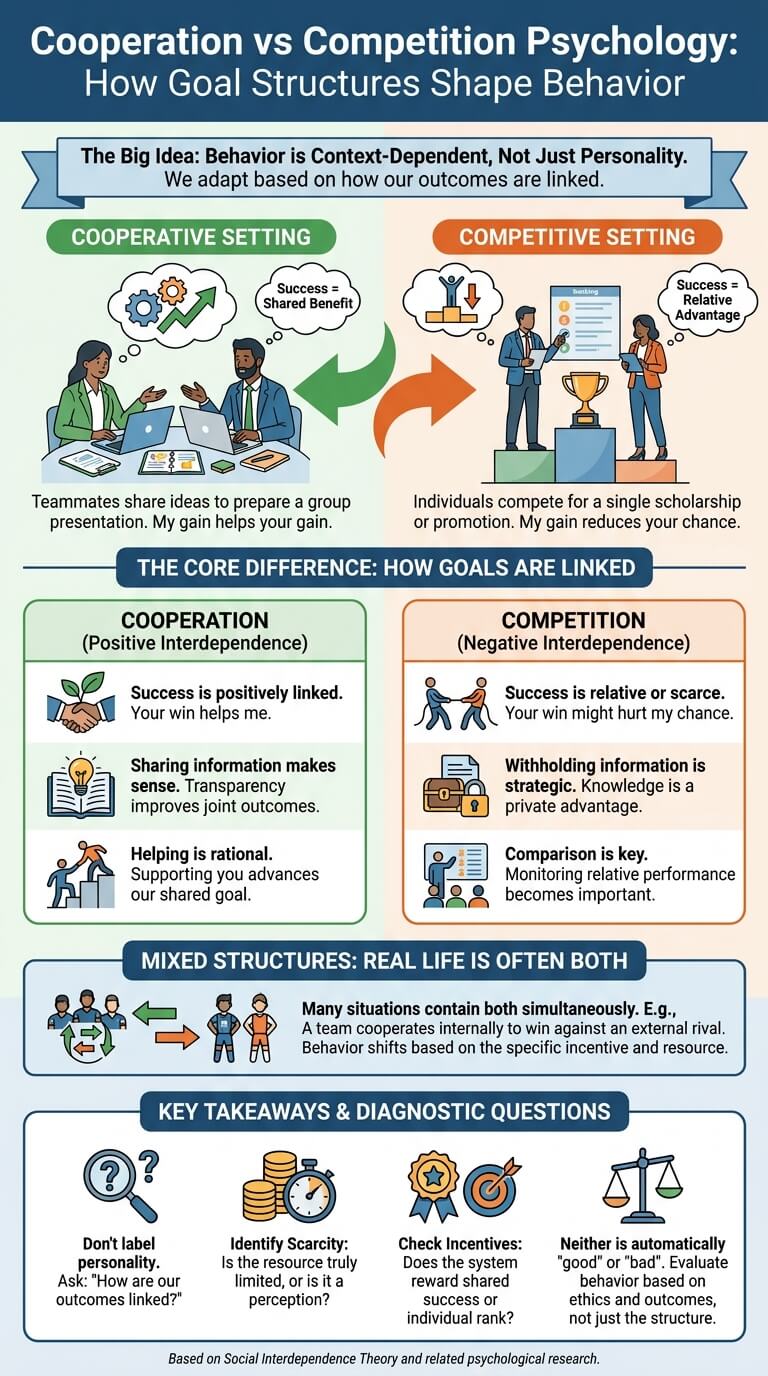
Cooperation links people’s outcomes positively, so one person’s success can support another’s. Competition makes outcomes more relative, scarce, or negatively linked, so another person’s gain may reduce one’s own chance of success. Many settings combine both. Incentives, scarcity, status cues, information flow, and zero-sum perceptions can shift the same person’s behavior without revealing a fixed competitive personality.
Cooperation links success positively, while competition makes success partly relative
Social interdependence theory begins with the idea that the way goals are structured changes how people interact. A classic review of social interdependence theory describes positive interdependence as a structure in which people perceive that they can attain their goals together, while negative interdependence creates a structure in which one person’s success is linked to another person’s failure or reduced success.
This does not mean that every cooperative setting produces supportive behavior or that every competitive setting produces obstruction. Goal structure changes incentives and expectations, but communication, identity, norms, skill, and individual choices still matter.
The Core Difference Is the Goal Structure
Positive outcome interdependence in cooperation
In a cooperative structure, your outcome improves when the other person’s contribution succeeds. If two students receive one shared grade, each has a reason to help the other understand the assignment. If two departments share responsibility for a launch, one team’s accurate information makes the other team’s work easier.
The important feature is not friendliness. It is positive linkage. Your success and mine are at least partly compatible, so helping you can also move our shared outcome forward.
Relative or negatively linked outcomes in competition
In a competitive structure, success depends partly on relative performance, rank, access, or winning. If only one applicant can receive a prize, another person’s strong performance can lower your chance. If bonuses are allocated only to the top five percent, coworkers may interpret one another as comparison targets even while doing similar work.
Competition can therefore make information, time, visibility, and status more strategically important. What was previously a shared resource may start to feel like an advantage that should be protected.
Mixed structures where both can exist at once
Many environments contain positive and negative interdependence simultaneously. A sports team cooperates internally while competing against another team. Researchers may share equipment while competing for grants. Sales representatives may contribute to a team target while also being ranked individually.
A 2025 open-access study in Communications Psychology examined cooperation and competition as continuously shifting influences in social decision-making. That framing fits everyday life better than a strict either-or model. People can move between cooperative and competitive choices as incentives and expectations change.
Cooperation vs Competition at a Glance
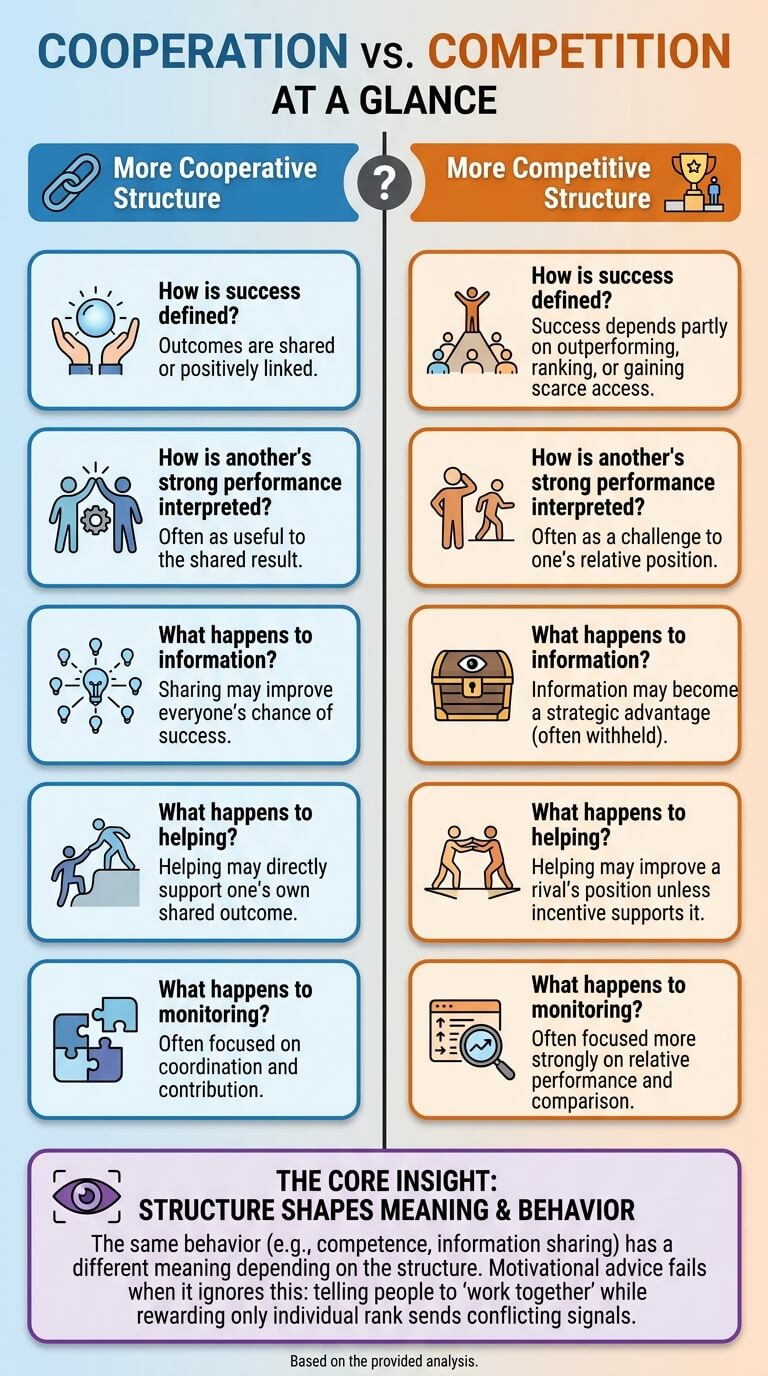
| Question | More cooperative structure | More competitive structure |
|---|---|---|
| How is success defined? | Outcomes are shared or positively linked | Success depends partly on outperforming, ranking, or gaining scarce access |
| How is another person’s strong performance interpreted? | Often as useful to the shared result | Often as a challenge to one’s relative position |
| What happens to information? | Sharing may improve everyone’s chance of success | Information may become a strategic advantage |
| What happens to helping? | Helping may directly support one’s own shared outcome | Helping may improve a rival’s position unless another incentive supports it |
| What happens to monitoring? | Often focused on coordination and contribution | Often focused more strongly on relative performance and comparison |
| Is trust required? | No, but it can reduce uncertainty | No, and limited cooperation can still occur around mutually useful tasks |
How success is defined changes what behavior makes sense
If everyone receives the benefit only when the group reaches a threshold, supporting another person’s progress may be rational. If the reward goes only to the highest performer, the same support may reduce one’s relative advantage.
This is why motivational advice that ignores structure can fail. Telling people to “work together” while rewarding only individual rank sends conflicting signals.
What information people have incentives to share
Information is especially sensitive to goal structure because knowledge can be both a shared resource and a private advantage. Under cooperative conditions, sharing useful information can improve the joint decision. Under competition, the same information may increase another person’s chance of winning.
A review of cooperation, competition, and information sharing in group decision-making argues that information use can become strategic rather than automatically cooperative. People may share, emphasize, or withhold information partly according to the social goals surrounding the decision.
How another person’s strong performance is interpreted
Under positive interdependence, another person’s competence can feel reassuring: their strong performance improves the shared result. Under competition, the same competence can feel threatening because it changes relative standing.
The behavior has not changed. The meaning of the behavior has. That shift helps explain why admiration and threat can coexist in competitive settings.
What happens to monitoring, trust, and helping
Cooperative structures often encourage monitoring that answers, “Are our pieces fitting together?” Competitive structures may encourage monitoring that answers, “How am I doing compared with you?”
Helping can shift for the same reason. If helping another person advances a shared result, assistance may be easy to justify. If helping improves a direct rival’s chance of taking a scarce reward, the person may hesitate even when they are generally generous in other contexts. Cooperative behavior belongs within the broader psychology of prosocial behavior, but goal structure determines whether another person’s success helps or threatens one’s own outcome.
Zero-Sum and Non-Zero-Sum Perceptions
When people believe one person’s gain requires another’s loss
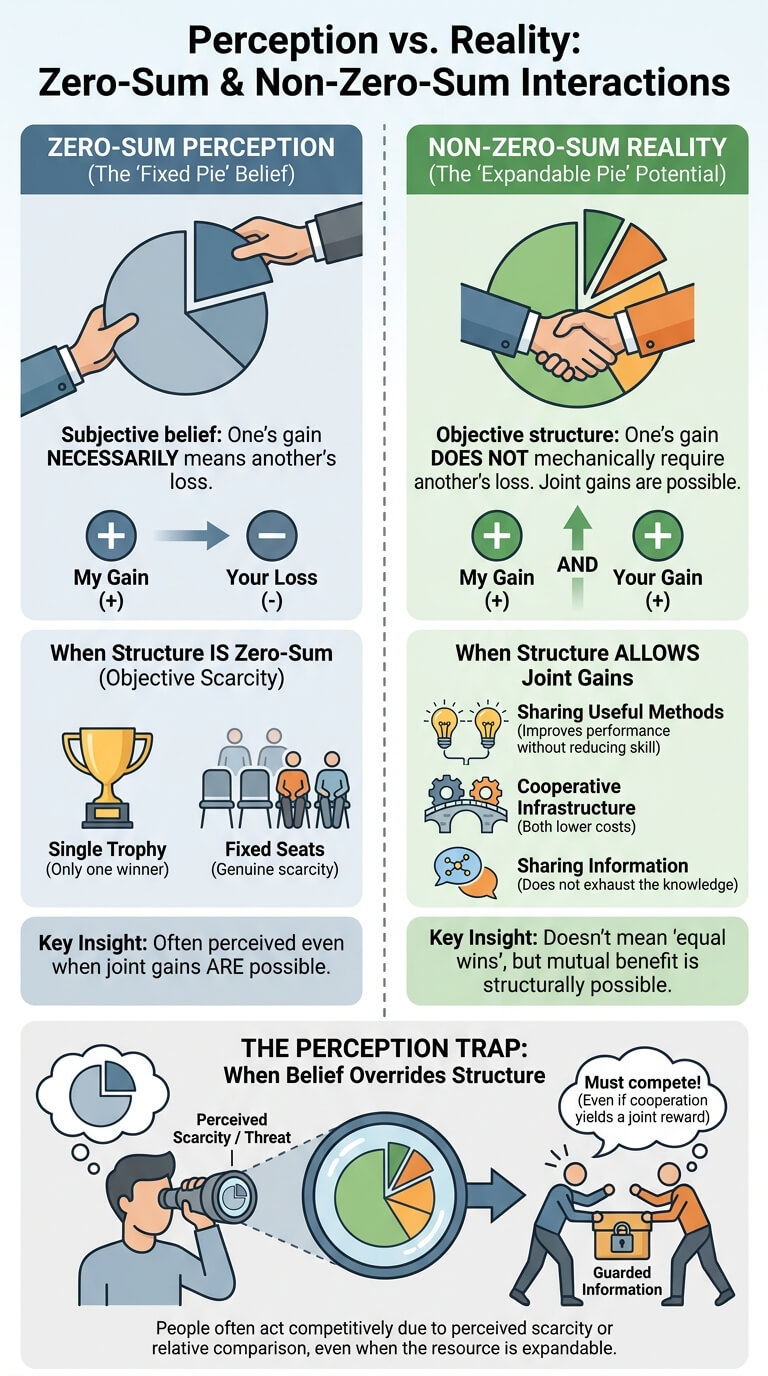
A zero-sum belief assumes that gains and losses are tightly opposed: if you get more, I must get less. Sometimes that accurately describes the structure. One person winning a single trophy means another person does not win it. A fixed number of seats creates genuine scarcity.
But zero-sum thinking also appears where the objective structure allows joint gains. A 2023 Nature Reviews Psychology article on zero-sum beliefs defines them as subjective beliefs that one party’s gain necessarily comes at another party’s expense, independent of whether resources are actually distributed that way.
When the situation actually allows joint gains
Many interactions are non-zero-sum. Sharing a useful method can improve everyone’s performance without reducing the sharer’s skill. Two businesses can cooperate on shared infrastructure and both lower costs. Neighbors can share information about local services without exhausting the information.
Non-zero-sum does not mean “everyone wins equally.” It means one person’s gain does not mechanically require another person’s loss. There may still be disagreements about how gains are distributed.
How perception can be more competitive than the objective structure
People sometimes act competitively because they perceive scarcity, threat, or relative comparison even when the resource is expandable. If two coworkers assume that recognition is limited to one person, they may guard information even when management would reward both for a strong joint result.
Incentives, Scarcity, and Status
Scarce rewards can increase competitive orientation
Scarcity changes the meaning of another person’s success. If ten people can receive recognition, a colleague’s achievement may not threaten yours. If only one person can receive it, comparison becomes more consequential.
Scarcity can involve money, time, attention, promotion opportunities, access to desirable roles, admission slots, or social recognition. The scarcer the outcome, the easier it becomes for people to interpret others as obstacles rather than potential collaborators.
Rank and status cues can make comparison more salient
Leaderboards, public rankings, winner-take-all prizes, and visible status markers direct attention toward relative position. People start asking not only “How well am I doing?” but “Where am I compared with everyone else?”
That does not mean rank is always harmful. Clear ranking can provide feedback or motivate effort in some contexts. The psychological change is that another person’s performance now carries information about one’s own position.
Incentives can change behavior without revealing a fixed competitive personality
A person who shares freely in one project may become guarded in another if rewards are allocated differently. That shift does not necessarily expose their “true nature.” It may show that behavior is responsive to incentives. Changing rewards and costs can also alter behavior, which is where Social Exchange Theory can add another layer of explanation.
This is one reason situational diagnosis is often more useful than personality labeling. Before calling someone selfish or overly competitive, ask what the current system makes scarce, visible, or relative.
Communication and Information Sharing
Why cooperative structures can reward transparency
When outcomes are shared, hidden information can hurt everyone. Cooperation therefore creates a reason to disclose what others need to coordinate: deadlines, constraints, expertise, mistakes, and changes in the plan.
Transparency becomes useful because another person’s better decision can improve the shared result. The incentive to protect private advantage becomes weaker.
Why competitive structures may reduce disclosure or helping
Competition can turn knowledge into leverage. A student may be less willing to share a study shortcut with someone competing for the same award. A salesperson may withhold a promising lead if individual ranking determines compensation.
Experiments on strategic information sharing have found that cooperative versus competitive goals can change how people share and use unshared information. The effect is not simply about honesty. Information becomes part of the strategic environment.
When strategic information sharing still occurs under competition
Competition does not eliminate all information exchange. Rivals may share information when both benefit from a common standard, when reputation matters, when today’s competitor may be tomorrow’s partner, or when cooperation in one area improves the larger environment in which they compete.
This is common in mixed structures. Two companies may compete for customers while cooperating on safety standards. Students may compete for grades while sharing basic course logistics. The important question is which information supports a shared interest and which information changes relative advantage.
When Competition Can Increase Effort
Clear comparison standards and feedback
Competition can sometimes increase effort by making goals concrete and performance visible. A person may practice harder when they can compare their result against another strong performer or against a ranking standard.
However, the relationship is not universally positive. A meta-analysis of competition and performance found that competition can activate opposing processes, including approach and avoidance motivation, which helps explain why performance effects vary rather than moving in one direction.
Challenge without humiliation or coercion
Competition is easier to use constructively when the rules are clear, participation is appropriate, losing does not carry humiliation, and people are not pressured into unsafe or degrading behavior.
Challenge can be energizing when it communicates, “Here is a standard to test yourself against.” It becomes psychologically different when it communicates, “Your value depends on defeating someone else.”
Why greater effort does not guarantee better collective outcomes
People may work harder individually while the group performs worse collectively. If everyone protects information, duplicates work, or undermines coordination, higher effort does not automatically produce a better shared result.
This distinction is important whenever individual metrics and collective outcomes coexist. A system can successfully increase effort while accidentally damaging cooperation.
When Cooperation Creates Its Own Problems
Free-rider concerns
Cooperation can become unstable when people receive the benefit of group effort without contributing enough to sustain it. The concern is not merely that effort is unequal. Unequal effort can make sense when roles and capacity differ. The problem is when someone repeatedly benefits while strategically avoiding contribution.
Once people suspect free riding, they may reduce their own effort or demand stronger monitoring. The cooperative structure remains, but confidence in contribution weakens.
Diffuse responsibility for effort
Shared responsibility can also become vague responsibility. If everyone is responsible for a task, nobody may feel clear ownership. Work gets delayed because each person assumes someone else will handle it.
This is not an argument against cooperation. It is a reason to combine shared goals with specific roles and visible dependencies.
Pressure for harmony that hides coordination problems
A cooperative atmosphere can become unhelpful when disagreement is treated as disloyal. People may avoid raising errors because they do not want to appear difficult, competitive, or unsupportive.
Effective cooperation still needs correction. A team that never challenges a flawed plan may look harmonious while coordinating badly.
Why Cooperation Is Not Always Morally Superior
Cooperation can support harmful goals
People can coordinate efficiently toward outcomes that harm others. A group can cooperate in exclusion, deception, harassment, or unfair advantage. The presence of teamwork does not tell us whether the goal itself is ethical.
This is why cooperation should be evaluated at two levels: how well people coordinate and what the coordinated behavior is accomplishing.
Competition can be structured without hostility
Competitors do not have to dislike one another. They can follow fair rules, respect boundaries, acknowledge good performance, and cooperate around shared standards while still trying to win.
A race is competitive because positions are relative. It does not require sabotage. Two candidates can seek the same role without treating each other as enemies.
Evaluate behavior and outcomes rather than moralizing the structure
Instead of assuming “cooperation is good” and “competition is bad,” ask more specific questions. Are people deceiving or coercing one another? Are rules transparent? Are gains created or merely redistributed? Does the structure reward useful effort, exploitation, innovation, secrecy, or harm?
The goal structure explains part of the behavior. Ethical evaluation requires looking at the behavior and consequences themselves.
Mixed-Motive Environments
Cooperating within a team while competing across teams
Team sports make the mixed structure obvious. Players coordinate intensely with teammates because their outcomes are positively linked, while opposing teams compete because winning is relative.
The same structure appears in businesses, classrooms, politics, research, and community organizations. A person may be highly cooperative toward one set of partners while competing strongly with another set at the same time.
Sharing some resources while competing for others
Mixed motives can exist even between the same two people. Colleagues might share software tools and technical knowledge while competing for one promotion. Businesses can share infrastructure while competing for customers.
Behavior may therefore vary by resource. “Why did they share this but hide that?” often becomes easier to answer once you identify which resource creates joint benefit and which changes relative advantage.
How changing incentives can shift the same person’s behavior
Imagine a class where students first receive a shared group grade and later switch to a ranking in which only the top student receives a reward. The people did not change overnight, but the social meaning of assistance changed.
Changing incentives can produce more guardedness, comparison, or strategic help without proving that previous cooperation was fake. The environment has altered what different actions accomplish.
Cooperation vs Social Dilemmas
Goal-structure comparison versus private-collective incentive conflict
Cooperation versus competition asks how outcomes are linked between people. A social dilemma is more specific: an action that is individually attractive can produce a worse collective result when many people make the same choice.
For example, two students competing for one prize illustrates competition. A shared resource that everyone benefits from preserving but each person has an incentive to overuse illustrates a social dilemma. Both involve interdependence, but the psychological problem is different.
A social dilemma can contain cooperative and competitive incentives without being identical to competition
In a social dilemma, people may cooperate by restraining personal use or contributing to a shared resource. They may also feel competitive if they believe others are taking more than their share. Yet the defining conflict is private incentive versus collective outcome, not simply relative rank.
This distinction matters because the solutions differ. A pure coordination problem may improve with clearer roles. A competitive structure may change when rewards are redesigned. A social dilemma may require changes to communication, monitoring, contribution rules, reputation, or incentives that protect the shared resource.
First Diagnostic Question: What Is Actually Linked?
Is success shared, relative, or both?
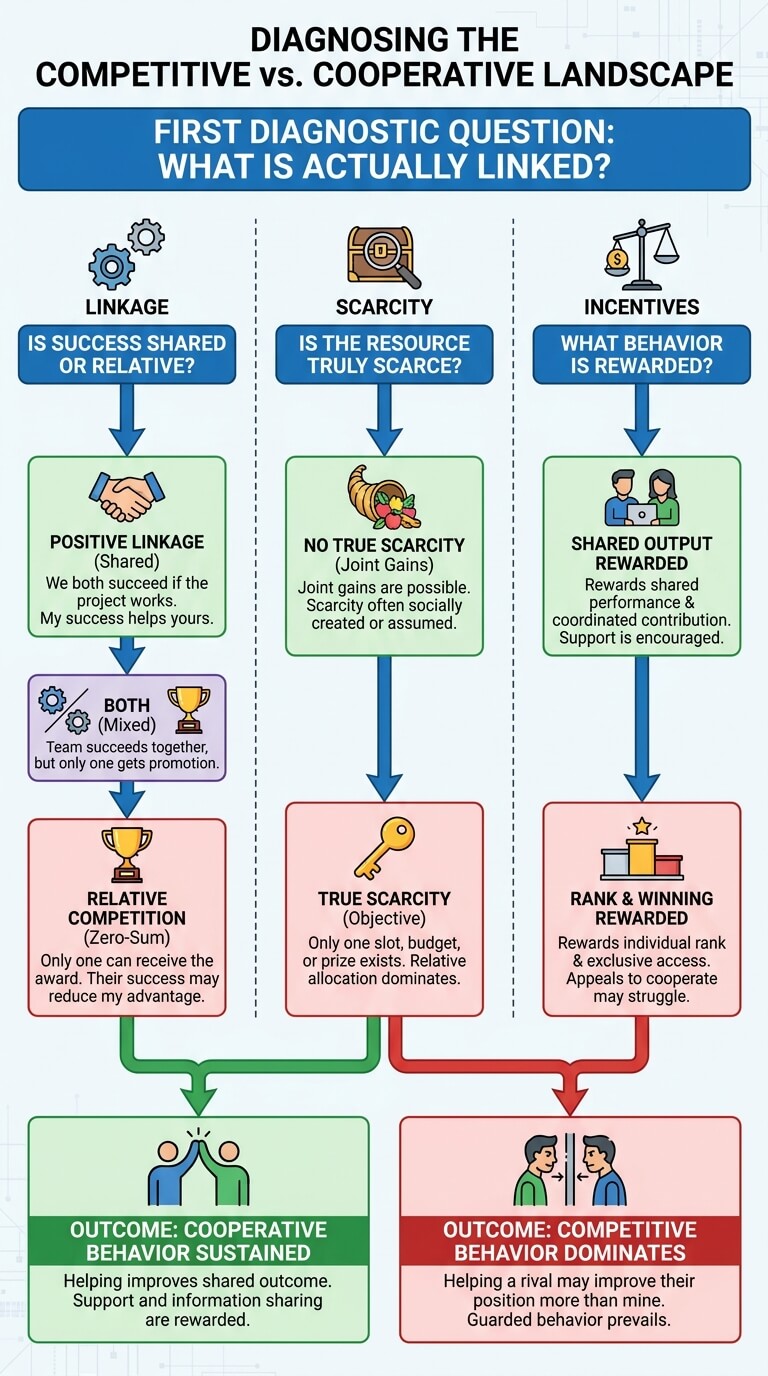
Write the outcome in one sentence. “We both succeed if the project works” indicates positive linkage. “Only one of us can receive the award” indicates relative competition. “Our team succeeds together, but only one person receives the promotion” indicates both.
Naming the structure often explains behavior that otherwise looks inconsistent.
Which resource or outcome is scarce?
Do not assume scarcity. Identify it. Is there truly only one slot, one budget, one leadership role, or one prize? Or is the perceived scarcity about attention, recognition, influence, or status?
Sometimes scarcity is objective. Sometimes it is socially created. Sometimes it is only assumed. Each version can produce competitive behavior, but they suggest different responses.
What behavior does the incentive system reward?
Look beyond stated values. A group may say “we value collaboration” while rewarding only individual rank. Another may encourage competition but give the strongest rewards for shared performance.
People learn from consequences. If helping others reliably lowers one’s own chance of recognition, appeals to cooperate may struggle. If joint success is actually rewarded, sharing and coordination become easier to sustain.
| Diagnostic question | If the answer points to cooperation | If the answer points to competition |
|---|---|---|
| Does another person’s success help mine? | Support and information sharing may be rewarded | Their success may reduce relative advantage |
| Is the key resource truly scarce? | Joint gains may be possible | Relative allocation may dominate |
| What gets rewarded? | Shared output, coordinated contribution | Rank, winning, exclusive access |
| What happens when I help? | The shared outcome improves | A rival’s position may improve more than mine |
Choosing the Right Explanation for What You Are Seeing
Focus on coordination once goals are compatible
If people already benefit from the same outcome but cannot divide roles, sequence tasks, share enough information, or adjust to changing conditions, the main issue is cooperation itself. The problem is how actions fit together, not whether success is shared.
Focus on collective incentives when private advantage undermines a shared outcome
If people understand the shared goal but each has an incentive to contribute less, take more, or protect a private benefit even though widespread use of that strategy harms everyone, the social-dilemma lens becomes more useful.
Focus on power and status when hierarchy is driving the comparison
Competition can involve status, but not every competitive situation is primarily about hierarchy. If behavior is changing because rank determines whose voice matters, who controls resources, who receives deference, or who can impose consequences, power and status become more central than goal structure alone.
FAQ About Cooperation vs Competition Psychology
Is competition always harmful to cooperation?
No. Competition can coexist with cooperation, especially when people cooperate within one level and compete at another. Teams can share information internally while competing externally. Competitors can also cooperate around safety rules, shared infrastructure, or standards. Problems become more likely when competition makes deception, withholding, humiliation, or sabotage useful.
Is cooperation always the better structure?
No. Cooperation can reduce duplication and support joint gains, but it can also create free riding, vague responsibility, conformity pressure, or efficient coordination toward harmful goals. Competition can sometimes sharpen effort or provide useful comparison. The better structure depends on the task, incentives, risks, and outcomes being evaluated.
Can the same situation be cooperative and competitive at once?
Yes. Mixed structures are common. Coworkers can cooperate to reach a team target while competing for promotion. Researchers can share methods while competing for funding. The key is to identify which outcomes are positively linked and which are scarce or relative.
Is zero-sum thinking the same as an objectively zero-sum situation?
No. An objectively zero-sum structure really does link one party’s gain to another party’s loss. Zero-sum thinking is a belief that may appear even when joint gains are possible. People can therefore behave competitively because of perceived scarcity or threat even when the situation is not objectively winner-take-all.
How can I tell whether the real problem is a social dilemma instead?
Ask whether the key conflict is between an attractive private choice and a collective outcome. If everyone benefits when the group preserves a resource or contributes enough, but each individual is tempted to take more or contribute less, a social dilemma is likely. Simple competition is more directly about relative success, rank, winning, or access.
Key Takeaways
- Cooperation and competition are best distinguished by how outcomes are linked, not by labeling people as cooperative or competitive personalities.
- Positive interdependence makes another person’s success useful to your own outcome, while competition makes success more relative, scarce, or negatively linked.
- Zero-sum beliefs can make a situation feel more competitive than its objective structure, especially when scarcity or threat is salient.
- Competition may increase effort in some settings, but greater individual effort does not guarantee better information sharing, coordination, or collective results.
- Cooperation has its own vulnerabilities, including free riding, diffuse responsibility, and pressure for harmony.
- When behavior changes, first identify what is actually linked, what is scarce, and what the incentive system rewards before treating the behavior as evidence of a fixed personality.

Michael Reed is the Founder and Lead Writer at Psychology Exposed. He writes about human behavior, relationships, emotional patterns, self-awareness, and practical psychology topics using research-informed, easy-to-understand content.
Read More About Michael Reed: https://psychologyexposed.com/michael-reed/