

A group of people can all value the same outcome and still make choices that gradually undermine it. Everyone wants the shared kitchen to stay clean, but each person is tempted to leave one small mess because cleaning takes time. Everyone wants a group project to succeed, but each member knows they can benefit if others carry more of the work. Everyone wants a shared resource to remain available, yet taking a little extra now may feel individually sensible.
These situations are social dilemmas. The psychological tension does not come from simple disagreement about the goal. It comes from the structure of incentives: a choice can look attractive for one person in the short term even though the same choice, repeated across many people, produces a worse outcome for the group.
That is why social dilemmas are useful for understanding cooperation failure without rushing to moral labels. Low contribution can reflect free-riding incentives, uncertainty about what others will do, unequal burdens, low trust, confusing rules, or weak feedback. The central question is not “Who is selfish?” but “What makes private protection more attractive than collective contribution, and what changes that calculation?”
Quick Answer
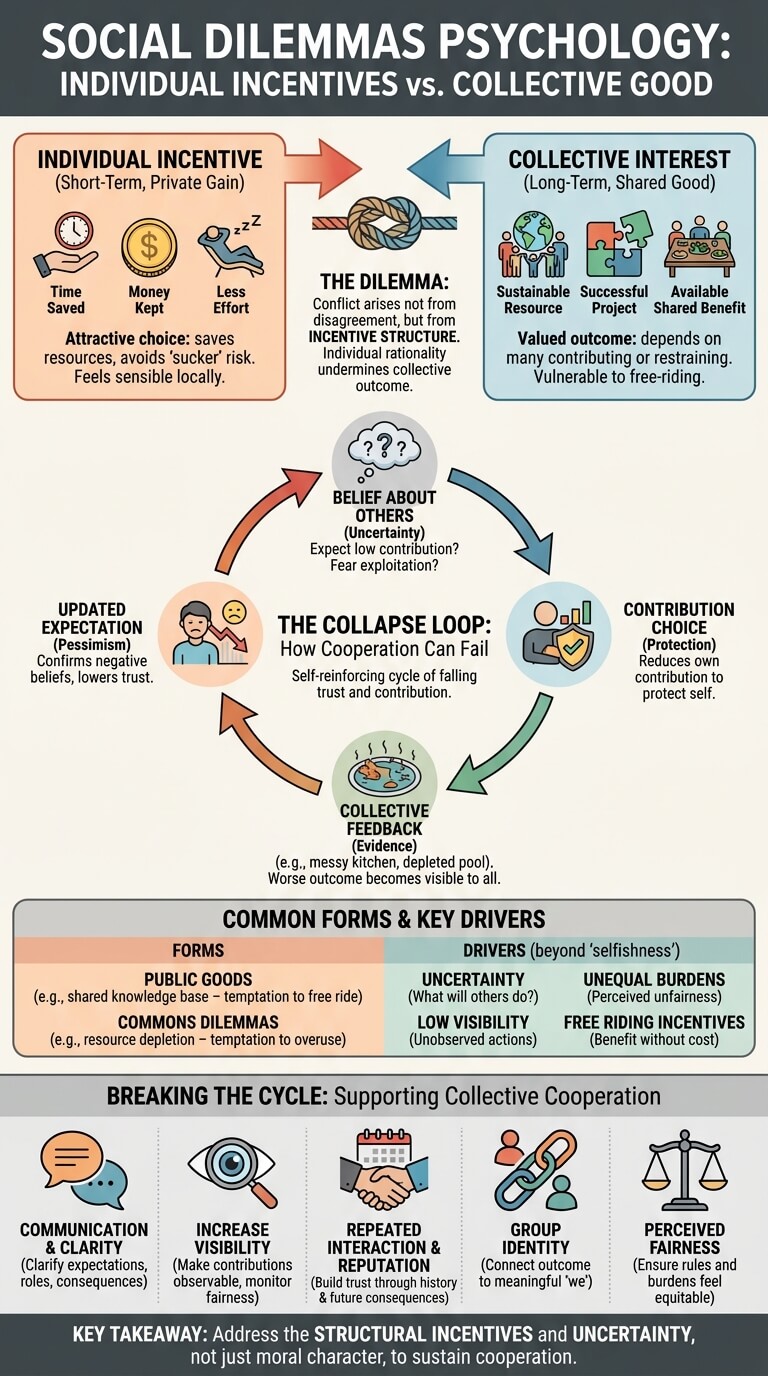
A social dilemma occurs when an individually attractive choice can produce a worse collective outcome if enough people make it. Cooperation becomes harder when people are uncertain about others, fear being exploited, cannot see contributions, or face unequal burdens. Communication, reputation, repeated interaction, monitoring, group identity, and perceived fairness can support cooperation, but none works automatically in every setting. Collective cooperation is one part of the broader psychology of prosocial behavior.
A social dilemma occurs when an attractive individual choice can harm the collective outcome if enough people make it
The APA Dictionary of Psychology defines a social dilemma as a conflict between individual and collective interests in which individually rewarding strategies can produce suboptimal outcomes for the group over time. The crucial feature is accumulation. One person’s choice may seem harmless, but the collective result changes when many people make the same choice.
This structure helps explain why people can sincerely value a shared outcome while still behaving in ways that weaken it. The immediate personal incentive and the longer collective interest point in different directions.
What Makes a Situation a Social Dilemma
Individual incentive
There must be some reason why the individually protective or non-cooperative option is attractive. It might save time, preserve money, reduce effort, avoid risk, increase access to a resource, or prevent the person from being the only one who contributes.
Consider a shared office kitchen. Washing your own cup takes only a minute, but leaving it in the sink saves that minute. For one person on one occasion, the cost appears tiny. The dilemma emerges because the same reasoning is available to everyone.
Collective interest
The group has an outcome that many members value. The kitchen stays usable. A project is completed well. A shared fund remains available. A common information resource stays accurate. A public space remains maintained.
Collective interest does not require every person to care equally. It means the group outcome depends on enough people restraining, contributing, maintaining, or sharing in a way that sustains the benefit.
Interdependence across many choices
Social dilemmas are built from linked choices. Your outcome depends partly on what other people do, and their outcomes depend partly on what you do. This interdependence creates uncertainty because no one controls the collective result alone.
A person can contribute fully and still experience a poor outcome if everyone else defects. Another person can contribute very little and still enjoy the group benefit if enough others cooperate. That asymmetry creates the temptation to protect one’s own resources while hoping others carry the collective burden.
Why the problem is structural rather than a simple selfishness label
The structure matters because the same person may contribute generously under one set of rules and much less under another. Clear expectations, visible contribution, repeated interaction, or lower individual burden can change behavior without changing the person’s values or personality.
Calling the person selfish may therefore explain less than examining the incentives. It also hides unequal constraints. One group member may contribute less because they have fewer resources, less relevant skill, or a heavier competing burden rather than because they value the group less.
Common Forms of Social Dilemmas
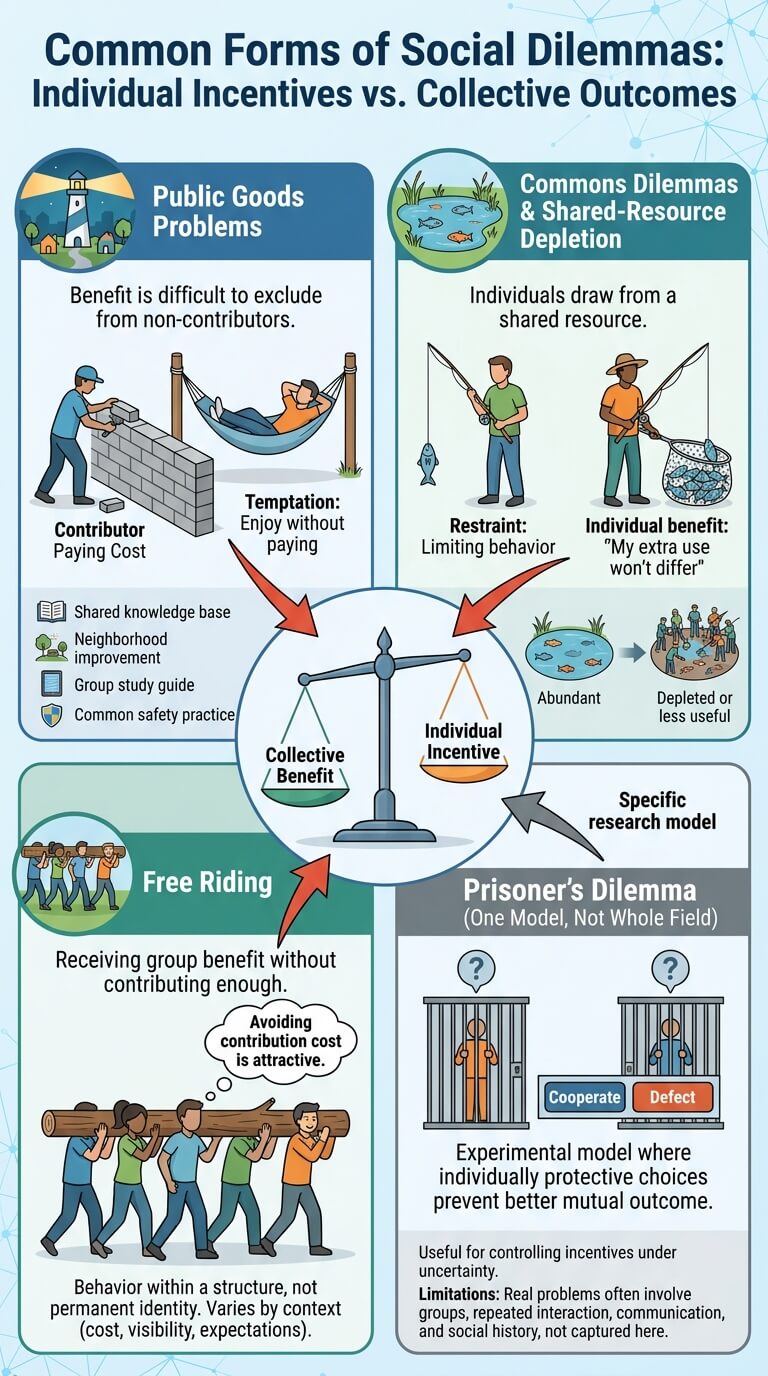
Public goods problems
A public good benefits people even when it is difficult to exclude non-contributors from receiving the benefit. This creates an obvious temptation: enjoy the outcome while allowing someone else to pay the cost of producing or maintaining it.
Public goods can be large or small. A shared knowledge base, a neighborhood improvement, a group study guide, or a common safety practice can all create situations where benefits spread more widely than contributions.
Commons dilemmas and shared-resource depletion
A commons dilemma begins with a shared resource that individuals can draw from. Each person may benefit from taking more, but if enough people do so, the resource becomes depleted or less useful.
The key psychological tension is restraint. Each user may think, “My extra use will not make much difference,” while the shared outcome depends on many people limiting the same individually attractive behavior.
Free riding
Free riding occurs when someone receives a group benefit without contributing enough to the process that creates or maintains it. A review of free riding and collective action describes the basic incentive problem: when contributors and non-contributors can access the same public benefit, avoiding the contribution cost can become individually attractive.
Free riding is a behavior within a particular structure, not a permanent identity. Someone may free ride in one setting and cooperate strongly in another because contribution costs, expectations, visibility, or confidence in others are different.
Prisoner’s Dilemma as one research model, not the entire field
The Prisoner’s Dilemma is a well-known experimental model in which individually protective choices can prevent a better mutual outcome. It has been useful because researchers can control incentives and observe cooperation under uncertainty.
But it is only one model. Public goods dilemmas involve groups. Commons dilemmas involve restraint in using shared resources. Volunteer-type dilemmas ask who will bear a cost that benefits everyone. Real collective problems often contain repeated interaction, communication, unequal resources, and social history that a simple laboratory game does not capture.
The Collapse Loop
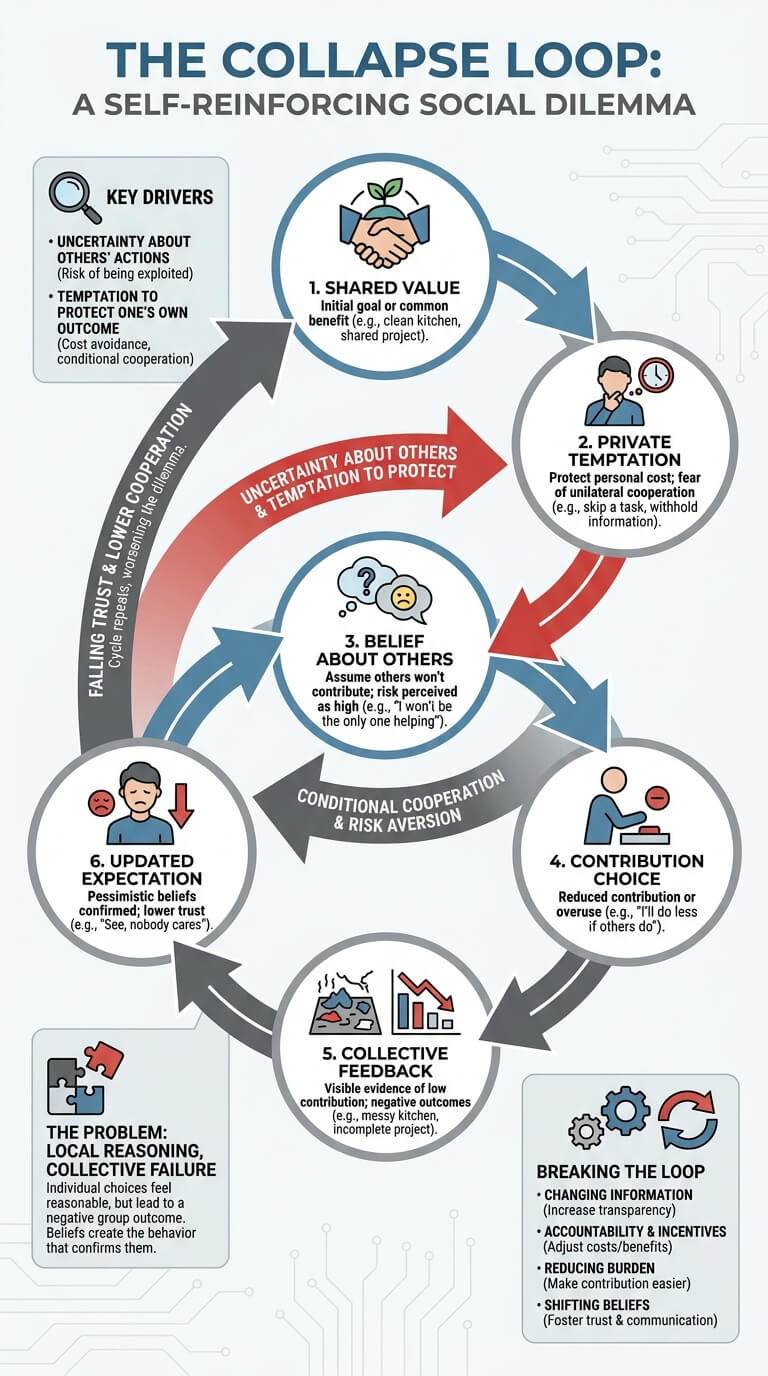
A social dilemma can deteriorate through a self-reinforcing sequence: Shared Value → Private Temptation → Belief About Others → Contribution Choice → Collective Feedback → Updated Expectation. Each round provides evidence that changes what people are willing to do next.
Uncertainty about what others will do
Contribution is riskier when you do not know whether others will cooperate. If you spend two hours preparing shared notes while everyone else contributes nothing, you bear the cost while they receive the benefit. That possibility makes caution understandable.
Uncertainty becomes especially powerful when contribution is hard to observe. People may underestimate what others are doing, overestimate free riding, or simply lack enough information to predict the group.
Temptation to protect one’s own outcome
When exploitation feels possible, protecting personal time, money, effort, or access becomes attractive. A person may contribute less not because the group outcome is unimportant, but because unilateral cooperation feels too costly.
The thought may be, “I will help if everyone else does,” or “I do not want to be the only person following the rule.” This is conditional cooperation, not necessarily rejection of the shared goal.
Reduced contribution or overuse
Once people begin protecting themselves, contribution can fall or resource use can rise. Someone skips a household task. A group member withholds information. A user takes more from a shared pool because they expect others to do the same.
Each choice may feel locally reasonable. The problem appears at the collective level.
Evidence that others may also defect or free ride
Lower contribution becomes visible to other people. The messy kitchen, incomplete project, declining shared resource, or unanswered request becomes evidence that “people are not doing their part.”
That evidence may be accurate, but it may also be incomplete. People often see outputs more clearly than constraints. A contribution may be invisible, delayed, or taking a different form.
Falling trust and lower future cooperation
As expectations worsen, people become less willing to risk another contribution. Cooperation falls further, producing more evidence for pessimistic expectations.
This is the collapse loop: beliefs about low cooperation can help create the behavior that confirms those beliefs. Breaking the loop often requires changing information, accountability, incentives, or burden rather than merely asking people to care more.
One-Shot vs Repeated Interactions
Why one-shot situations can increase uncertainty about future consequences
In a one-shot interaction, today’s choice may have little effect on how the same people treat you tomorrow because there may be no tomorrow. Reputation and future reciprocity are weaker if participants expect never to meet again.
That can make short-term protection more attractive. Yet one-shot cooperation still occurs. People may act from norms, identity, concern for fairness, habit, or a belief that contributing is simply appropriate. Collective contribution is also shaped by social expectations around helping and cooperation, especially when people watch what others contribute.
How repeated interaction creates reputation and learning
Repeated interaction changes the information environment. People can observe who contributes, who communicates when unable to contribute, and who repeatedly takes benefits without carrying cost.
A review of reputation and cooperation explains how reputational information can support cooperation by helping people decide whom to trust, reward, or choose as a future partner. In everyday groups, repeated interaction creates a smaller version of the same process.
Why repetition can support cooperation but does not guarantee it
Repeated contact can also stabilize poor patterns. If people repeatedly see non-contribution go unaddressed, they may learn that free riding is safe. If monitoring is unfair or reputation becomes gossip, repeated interaction can create suspicion rather than cooperation.
Repetition gives people more information and future consequences. Whether those features support cooperation depends on what the group learns and how behavior is rewarded.
What Supports Collective Cooperation
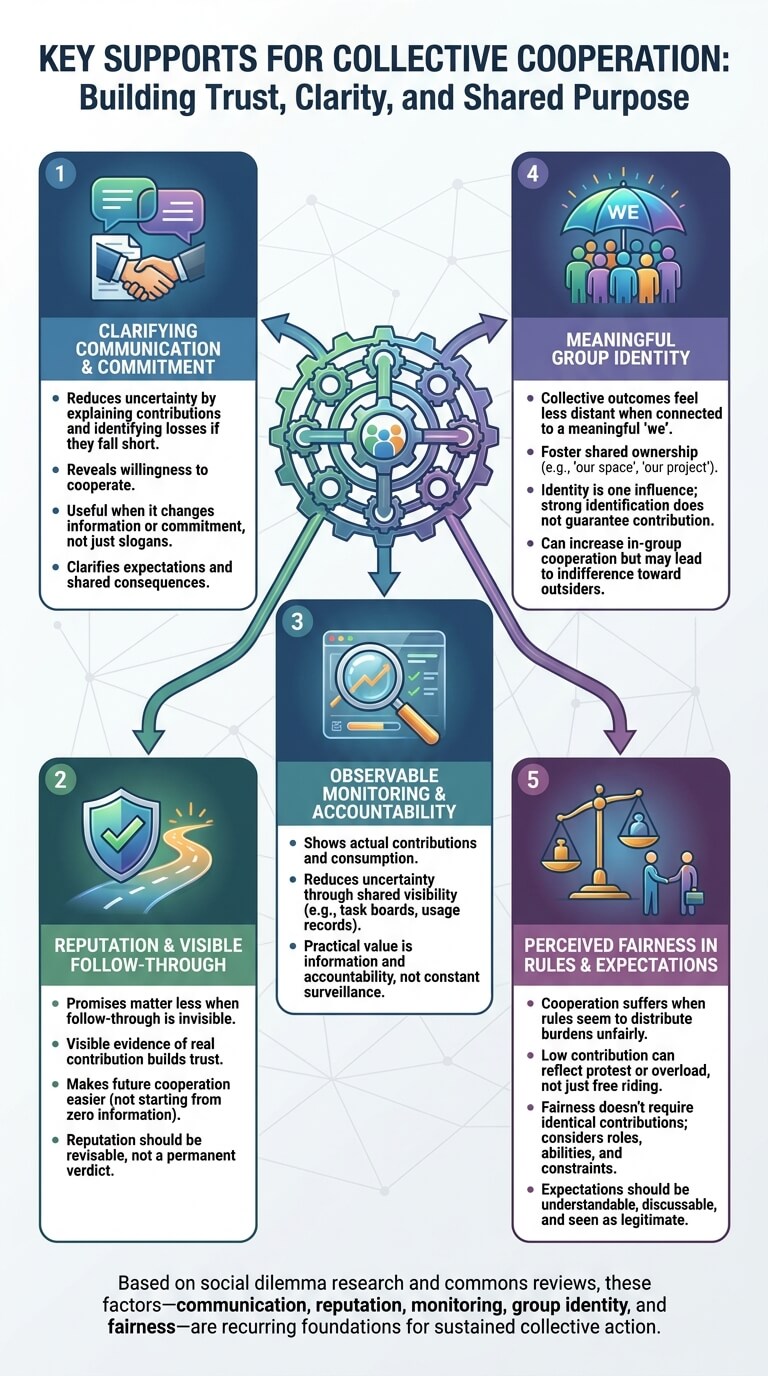
Communication that clarifies expectations and shared consequences
Communication helps when it reduces uncertainty. People can explain what they intend to contribute, identify what the group loses if contribution falls, and discover that others are more willing to cooperate than they assumed.
A recent review of three decades of social dilemma research identifies communication and reputation among recurring factors associated with greater cooperation. Communication is most useful when it changes information or commitment, not when it is only a slogan about teamwork.
Reputation and visible follow-through
Promises matter less when nobody can tell whether they were kept. Visible follow-through gives people evidence that contribution is real.
Reputation can then make future cooperation easier because people are not starting from zero information. At the same time, reputation should remain revisable. One missed contribution should not become a permanent character verdict.
Monitoring that makes contributions observable
Monitoring can reduce uncertainty when it shows what people actually contributed or consumed. A shared task board, usage record, attendance log, or transparent resource count can make the collective situation easier to understand.
A 2025 scoping review of cooperation in commons found that anonymity, monitoring, trust, communication, and several organizational features can shape cooperation. The practical value of monitoring is information and accountability, not constant surveillance.
Group identity as one influence on collective concern
People may contribute more readily when the collective outcome feels connected to a meaningful “we.” If a shared kitchen is “our space,” a neighborhood project is “our project,” or a study resource supports “our class,” the collective outcome can feel less psychologically distant.
Identity is only one influence. Strong identification does not guarantee contribution, and it can sometimes produce cooperation within one group while increasing indifference toward outsiders.
Perceived fairness in rules and contribution expectations
Cooperation becomes harder when people believe the rules distribute burdens unfairly. If everyone receives the same benefit but one person is expected to do most of the work despite having fewer resources, low contribution may reflect protest or overload rather than free riding.
Fairness does not require identical contribution. Different roles, abilities, and constraints can justify different burdens. What matters is whether expectations are understandable, discussable, and seen as reasonably legitimate.
Why Free Riding Is Not a Personality Diagnosis
Incentives, ambiguity, low trust, and unequal burdens can all change contribution
One of the easiest mistakes is to observe low contribution and infer a fixed selfish disposition. But contribution is sensitive to the environment. The person may believe others will not cooperate, may not understand the task, may face a higher cost than other members, or may think their contribution is unnecessary.
Research using public-goods experiments has also shown that apparent behavioral types can partly reflect misunderstanding. A study of conditional cooperation and confusion cautions against treating experimental contribution patterns as straightforward proof of stable selfish or fairness preferences.
One low contribution does not reveal a fixed selfish trait
A person who misses one group task may be overloaded. Someone who uses more of a shared resource on one occasion may have an unusual need. A colleague who withholds information may be responding to a competitive incentive built into the workplace.
Patterns matter more than isolated acts, and structure matters alongside patterns. Repeated strategic non-contribution after expectations are clear is more informative than one ambiguous episode.
Structural fixes can matter more than moral pressure
Shaming people can increase defensiveness without changing the incentive structure. If nobody knows what others contribute, make contributions more visible. If one role carries excessive burden, redistribute it. If the collective consequence is delayed and invisible, make it easier to see.
Moral appeals may matter in some settings, but they are often weaker than removing the uncertainty or imbalance that makes non-cooperation attractive.
Neutral Everyday Examples
Shared spaces and cleanup
Situation: Everyone wants a clean common room, but each person is tempted to leave a small mess. What people may feel: “My one cup will not matter.” What it may mean: the private saving is immediate while the collective cost is distributed. What to do next: clarify ownership and make the shared consequence visible rather than waiting for resentment to build.
Group projects and uneven contribution
Situation: A four-person project gives everyone the same grade even when effort differs. What people may feel: fear of doing extra work while others benefit. What it may mean: contribution is costly but the benefit is shared. What to do next: divide responsibilities clearly and create a midpoint check where work is visible.
Community resources
Situation: Residents share a limited supply of a community resource. What people may feel: pressure to take enough now before others do. What it may mean: uncertainty about others can accelerate overuse. What to do next: make current usage and agreed limits visible so decisions are based on better information.
Household responsibilities
Situation: Everyone benefits when recurring household tasks are completed, but each person would prefer someone else do the unpleasant ones. What people may feel: that their own contribution is disproportionately large. What it may mean: contribution expectations may be vague or burdens genuinely unequal. What to do next: discuss workload and capacity before interpreting every missed task as deliberate exploitation.
Information sharing and common knowledge resources
Situation: A team relies on a shared knowledge document, but updating it takes time. What people may feel: that documenting their own solution is extra work after the problem is already solved. What it may mean: the individual cost is immediate while future benefits are spread across many people. What to do next: lower the cost of contribution and make reuse visible so contributors can see the value created.
Social Dilemmas vs Cooperation vs Competition
Cooperation: how people coordinate toward compatible outcomes
Cooperation concerns whether people can align roles, information, timing, and effort toward an outcome that is compatible or shared. A group may have no major incentive conflict and still coordinate badly.
That is different from a social dilemma, where the structure makes a personally attractive non-cooperative choice available even when coordination is perfectly clear.
Cooperation versus competition: how goal structures are linked
Competition asks whether success is relative or negatively linked. One person’s gain may reduce another person’s chance of winning, ranking, or accessing a scarce reward. If the central question is whether success is shared or relative, examine cooperative and competitive goal structures instead.
A social dilemma can contain competitive feelings, but its defining problem is not simply relative success. The defining conflict is between private incentive and the collective outcome.
Social dilemma: private incentives conflict with the collective outcome
Imagine everyone agrees that a shared resource should be preserved and everyone understands the rule. The dilemma remains if taking a little extra benefits each individual while widespread overuse depletes the resource.
That is why social dilemmas cannot be reduced to communication failure or competition. People may understand the system perfectly and still face an incentive to protect themselves.
First Steps When a Social Dilemma Is Undermining Cooperation
Make the collective consequence visible
Distributed costs are easy to ignore. Show what happens when the private choice scales across the group. How much unfinished work accumulates? How quickly does the resource decline? How many hours are shifted onto other people?
The aim is not fear. It is to connect individual choices with the group-level pattern they create.
Clarify contribution expectations
People cannot reliably cooperate around invisible rules. State what contribution is expected, what counts as completion, and whether different roles have different responsibilities.
Where burdens differ, explain why. Equal treatment and reasonable treatment are not always identical.
Reduce uncertainty about others’ behavior where possible
People are more willing to contribute when they have evidence that others are also contributing. A visible progress board, clear confirmation, or regular update can reduce the fear of being the only cooperator.
Do not create monitoring simply for control. Use enough transparency to answer the question that sustains the dilemma: “Will other people do their part?”
Improve feedback, monitoring, or repeated accountability without assuming bad character
If the same problem repeats, create a feedback loop. What was expected? What actually happened? Was the burden realistic? Did someone misunderstand? Did the system reward non-contribution?
Accountability works better when it targets behavior and structure rather than turning one outcome into a personality judgment.
When Another Psychological Lens Fits Better
Use cooperation psychology for the mechanics of coordination
If everyone benefits from the same outcome and the main problem is unclear roles, duplicated work, poor sequencing, or missing information, the core issue is coordination. The incentive conflict may be small or absent.
Use trust psychology for vulnerability and expectations under uncertainty
If the main question is whether you can rely on another person when their behavior is uncertain and you have something to lose, trust psychology is more precise. Trust can strongly affect social dilemmas, but it is not identical to the dilemma itself.
Use social identity psychology when shared-group identification is the main influence
If contribution changes because people strongly identify with a group, distinguish insiders from outsiders, or define the collective outcome as part of “who we are,” social identity becomes a more specific mechanism.
Use communication psychology when unclear information is driving coordination failure
If people are willing to contribute but do not understand expectations, deadlines, roles, or consequences, the problem may be communication rather than private-versus-collective incentive conflict.
FAQ About Social Dilemmas Psychology
Is free riding the same as being a selfish person?
No. Free riding is a behavior within an incentive structure. It can be influenced by uncertainty, contribution cost, misunderstanding, low trust, unequal burdens, visibility, or expectations about others. Repeated deliberate non-contribution may become a meaningful pattern, but one episode is not enough to diagnose a fixed selfish personality.
Why can cooperation collapse even when everyone values the group outcome?
Because people also care about their own time, money, effort, safety, and risk of exploitation. If each person believes others may not contribute, protecting personal resources becomes more attractive. When several people do this, lower cooperation confirms everyone’s pessimistic expectations and the collective outcome deteriorates.
Does communication solve social dilemmas by itself?
No. Communication can reduce uncertainty, clarify commitments, and make collective consequences more visible, but it does not automatically remove conflicting incentives. If one person still benefits strongly from avoiding contribution, the group may also need changes to monitoring, burden, rules, feedback, reputation, or incentives.
How does repeated interaction change a social dilemma?
Repeated interaction creates future consequences and allows people to learn from previous behavior. Reputation, reciprocity, and partner choice can therefore become more important. Repetition can support cooperation when reliable contribution is visible, but it can also stabilize low cooperation if people repeatedly observe free riding without effective response.
Is the Prisoner’s Dilemma the same as every social dilemma?
No. It is one research model used to study cooperation under conflicting incentives. Other social dilemmas include public goods problems, commons dilemmas, volunteer dilemmas, and many real-world collective action problems. Different forms vary in group size, resource structure, visibility, repetition, and the consequences of one person’s choice.
Key Takeaways
- A social dilemma exists when an individually attractive choice can produce a worse collective outcome if enough people make the same choice.
- Free riding is a behavior shaped by incentives and context, not a reliable personality diagnosis.
- Uncertainty about other people’s contribution can trigger a collapse loop in which lower cooperation produces even lower future expectations.
- Communication, reputation, monitoring, repeated interaction, group identity, and perceived fairness can support cooperation, but each works through a different mechanism.
- Social dilemmas differ from general cooperation problems and from competition because their defining issue is private incentive versus collective outcome.
- When cooperation is weakening, first make the collective consequence visible, clarify contribution expectations, reduce uncertainty, and improve feedback before assuming bad character.

Michael Reed is the Founder and Lead Writer at Psychology Exposed. He writes about human behavior, relationships, emotional patterns, self-awareness, and practical psychology topics using research-informed, easy-to-understand content.
Read More About Michael Reed: https://psychologyexposed.com/michael-reed/