

You notice a coworker struggling with a heavy box, a stranger looking confused on a train platform, or a neighbor asking the building group chat for help. Sometimes you respond immediately. Other times you hesitate, assume someone else will step in, decide the situation is unclear, or conclude that helping would create more risk than benefit. The psychology behind these moments is broader than simple kindness.
Prosocial behavior psychology examines actions intended to benefit another person, a group, or a wider collective. That includes helping, sharing, comforting, cooperating, reciprocating, and contributing to common goals. These behaviors can come from empathy, concern, habit, social expectations, self-interest, reputation, shared identity, or several motives at once. What matters is that a helpful intention still has to pass through a real situation with uncertainty, costs, limits, and choices.
Understanding that process makes it easier to avoid two common mistakes: assuming every helpful act is purely selfless, and assuming every failure to help proves selfishness. Human behavior is usually more context-sensitive than either conclusion suggests.
Quick Answer
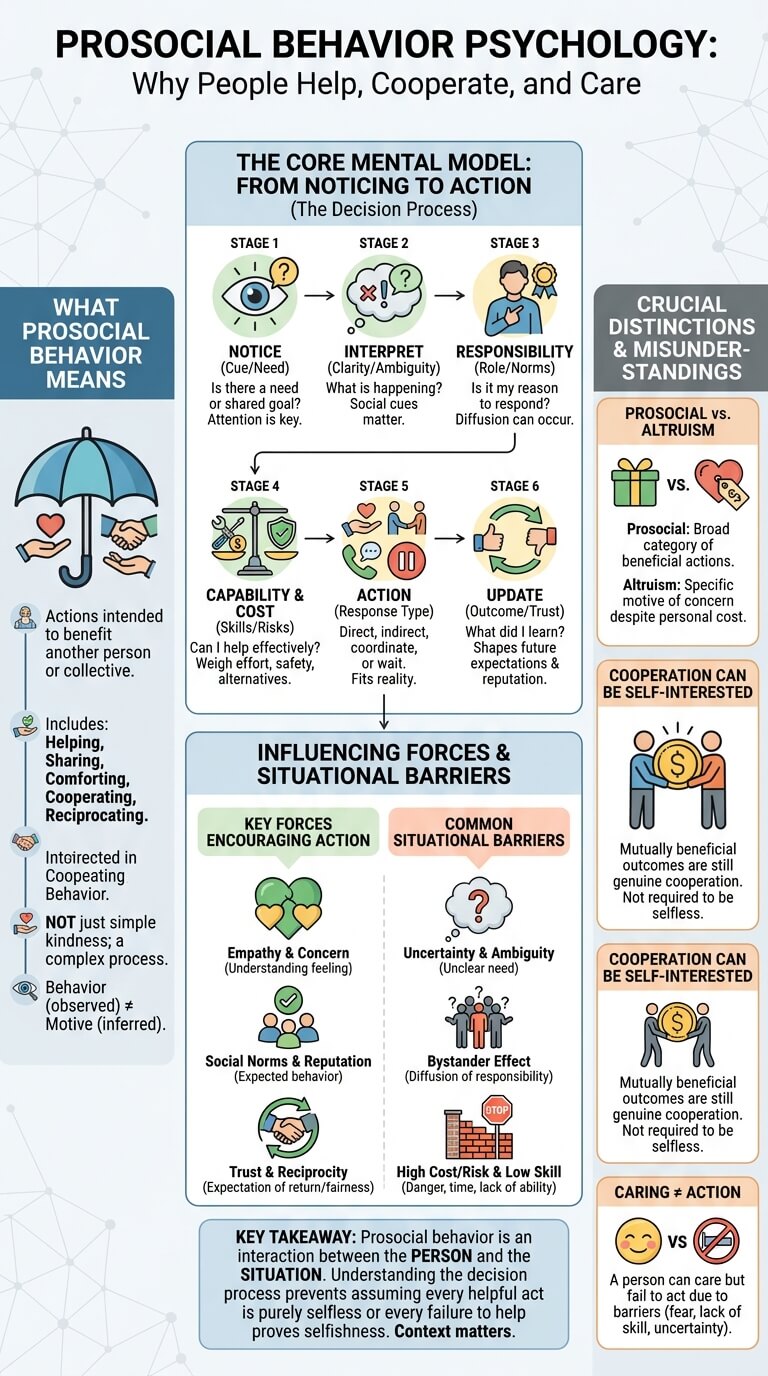
Prosocial behavior refers to actions intended to benefit other people or a collective. Whether someone actually helps depends on more than caring. People must notice a need or shared goal, interpret the situation, feel some responsibility, believe they can act, and weigh costs, risks, norms, trust, and alternatives. Helping, altruism, cooperation, reciprocity, and bystander behavior overlap, but they describe different parts of this process.
Prosocial behavior is an umbrella for actions intended to benefit others or a collective
The term covers more than dramatic sacrifice. Everyday examples include giving useful information, checking on someone who seems unwell, sharing resources, comforting a distressed friend, coordinating chores with housemates, contributing fairly to a group task, or returning a favor. OpenStax gives an accessible introduction to prosocial behavior and altruism, including the long-running question of why people help.
The broad category is useful because the same outwardly beneficial action can involve different psychological processes. Handing a coworker a missing document may be simple helping. Taking turns covering a shared task may involve cooperation and reciprocity. Staying late to protect someone else from a serious loss at significant personal cost raises a stronger question about altruistic motivation.
Caring, intention, and actual behavior are related but not identical
A person can care and still fail to act. They may misunderstand the need, lack the necessary skill, worry that intervention will embarrass the other person, believe somebody else is responsible, or decide that direct involvement is unsafe. The reverse is also possible: a person may help without feeling especially warm or empathic because the role, norm, or shared goal makes action sensible.
This distinction matters because psychology is usually better at describing patterns of behavior and the conditions around them than reading a person’s private motive from one event. A recent review of prosocial helping behavior also separates the perception of another’s need, possible empathic responses, and the helping action itself.
What Prosocial Behavior Means in Psychology
Helping, sharing, comforting, giving, cooperating, and contributing
Prosocial behavior includes several families of action. Helping is directed at improving another person’s situation. Sharing transfers access to resources. Comforting responds to another person’s emotional state. Cooperation coordinates behavior toward compatible or shared outcomes. Reciprocity describes responding to what another person has done, often in ways that affect future exchange.
These behaviors can overlap in one event. Imagine two neighbors cleaning a shared hallway after a leak. They may cooperate because both benefit, help an older resident move belongings, share supplies, and later reciprocate each other’s effort. Calling all of that “altruism” would lose useful distinctions.
Observed behavior versus inferred motive
Suppose someone anonymously pays for another person’s meal. The action benefits someone else, so it is reasonable to describe it as prosocial. It is harder to know exactly why it happened. The person might feel empathic concern, act from a personal value, enjoy the emotional reward of giving, hope to reinforce a social norm, or experience several motives at once.
A useful discipline is to separate two questions: What did the person do? and Why do we think they did it? The first is often observable. The second usually requires more caution. This prevents moral storytelling from replacing behavioral explanation.
Why prosocial behavior is not the same as moral virtue
Prosocial actions are often socially valued, but the label does not automatically establish that the person is morally better. Cooperation can serve a harmful group goal. A generous act can be used to create obligation. A helpful person can still behave unfairly elsewhere. Conversely, refusing a request can be reasonable when the request exceeds someone’s time, role, ability, consent, or safety limits.
It is more useful to ask what the action was intended to do, what effects it had, what constraints were present, and whether it respected other people’s autonomy.
The Core Mental Model: From Noticing to Action

A practical way to understand prosocial action is to follow the decision from the first cue to what happens afterward:
| Stage | Main question | What can change the outcome |
|---|---|---|
| Notice | Is there a need or shared goal? | Attention, time pressure, visibility |
| Interpret | What is happening? | Clarity, ambiguity, social cues |
| Responsibility | Is there a reason for me to respond? | Role, relationship, norms, other observers |
| Capability | Can I help effectively? | Skill, resources, confidence, alternatives |
| Cost and risk | What would action require? | Time, effort, money, safety, opportunity cost |
| Action | What response fits? | Direct help, indirect help, cooperation, waiting, withdrawal |
| Update | What did this interaction teach me? | Outcome, gratitude, trust, reciprocity, reputation |
Notice a need or shared goal
No prosocial response begins if the relevant cue is missed. Attention may be divided by a phone, deadline, noisy setting, fatigue, or competing demands. In cooperation, the cue is not always another person’s distress. It may be recognition that several people have a shared task that none can complete efficiently alone.
Interpret what is happening and whether action is needed
Seeing something is not the same as understanding it. A person sitting on the floor may need help or may simply be resting. Ambiguity makes people less certain about what response fits. A brief question such as “Are you okay?” can sometimes clarify the need without assuming what the other person wants.
Accept or reject responsibility
Responsibility depends on role and context. A parent, trained employee, close friend, and passing stranger may reasonably feel different levels of obligation. Other observers can also complicate responsibility if each person assumes somebody else will act, which is one process studied in bystander research.
Evaluate ability, cost, risk, norms, trust, and alternatives
Wanting to help does not create skill, time, money, authority, or safety. People also consider whether others can be trusted, whether helping is socially expected, and whether a safer alternative exists. Sometimes the most useful response is indirect, such as getting a trained person or sharing accurate information.
Act, cooperate, wait, or withdraw
The final behavior can take many forms. Direct action is only one option. A person can recruit assistance, coordinate with others, offer resources, share information, decline a request, or wait while gathering more information. In some circumstances, withdrawal is appropriate because intervention would be unsafe or outside the person’s role.
Update future expectations after the outcome
Prosocial behavior also has a memory. If cooperation goes well, people may become more willing to coordinate again. If a favor is acknowledged, reciprocal expectations can strengthen. If someone repeatedly contributes while others take advantage, willingness to keep contributing may fall.
Research on reciprocity and human cooperation illustrates how repeated social interaction and reciprocal responses can support cooperation, while also showing that behavior varies across social and cultural conditions.
The Main Forces That Change Prosocial Action

Clarity of need and perceived responsibility
Clear needs are easier to respond to than vague ones. “Can you hold the door while I carry this box?” creates a specific problem and a specific role. A person looking uncomfortable across a crowded room leaves more room for interpretation. Responsibility also becomes stronger when the request is direct, the relationship is close, or the person’s role makes action expected.
Empathy and empathic concern as one possible mechanism
Understanding or resonating with another person’s state can increase concern, but research on empathy and prosocial behavior does not support treating empathy as a simple switch that always produces action. It can coexist with uncertainty, competing demands, self-protection, or selective attention. Empathy is therefore one route to prosocial behavior, alongside duty, principle, reciprocity, habit, reputation, and shared goals.
Competence, time, cost, risk, and available alternatives
People are more likely to act when the response feels manageable. Cost matters, but it does not measure how much someone cares. A person who cannot solve a problem may still offer a smaller form of assistance, connect someone with a more suitable resource, or decline when the request exceeds realistic ability.
Social norms, modeling, reputation, and the behavior of others
People watch what others do. Visible helping can make action seem normal and appropriate. Inaction can create uncertainty. Approval, disapproval, and reputation can also shape whether people contribute, especially when behavior is visible to a community or repeated over time.
A broad review of social norms research shows that norms are commonly understood as social expectations that inform action, although theories differ on how norms operate and change. For prosocial behavior, the useful point is modest: people do not make helping and cooperation decisions in a social vacuum.
Trust, uncertainty, repeated interaction, and group context
Cooperation often depends on expectations that other people will contribute or keep agreements. Trust can reduce uncertainty, while clear roles and safeguards can sometimes support cooperation even when trust is limited. Repeated interaction also turns past behavior into information about what to expect next.
Helping and Altruism
Helping behavior focuses on the move from need to useful action
Helping behavior is narrower than prosocial behavior. It follows how someone recognizes another person’s need, decides whether intervention is appropriate, evaluates responsibility and competence, and chooses a response. The practical questions are concrete: Is help actually needed? Is it wanted? Do I have the skill or resources to help? Would direct action improve the situation, or would information, referral, or another form of support work better? This perspective fits everyday situations involving friends, coworkers, neighbors, and small public interactions. It describes the movement from perceived need to useful action without requiring a conclusion about whether the helper’s motive was purely selfless.
Altruism focuses on motivation and personal cost
Altruism shifts attention from what a person did to why they may have done it. Psychologists have long debated whether some helping is substantially motivated by concern for another person’s welfare rather than by expected personal reward. The question becomes especially interesting when helping carries meaningful cost and obvious external benefits are small. Costly behavior still does not prove a perfectly pure motive. People may anticipate emotional satisfaction, act from identity or values, or hold several motives at once. The careful position is that an action can be clearly prosocial while the exact balance of altruistic and self-relevant motives remains partly uncertain.
Helping strangers adds low familiarity and uncertain reciprocity
Helping an unfamiliar person removes many cues available in close relationships. You may know little about what the person needs, whether assistance is welcome, whether you will ever meet again, or whether any future reciprocity is possible. That makes clarity, safety, competence, social expectations, and perceived responsibility especially important. Giving directions to a lost traveler is low risk and easy to interpret. Approaching an unclear confrontation is different. Stranger helping is therefore not simply “more altruistic” helping. It is helping under greater uncertainty, with weaker relationship obligations and less predictable future exchange. A proportionate response may be direct, indirect, or limited by safety.
Bystander Action and Situational Barriers
Other people’s presence can change interpretation and responsibility
When several people witness the same unclear event, each person may look to others for clues. If everyone appears calm, the situation may seem less urgent. Responsibility may also feel spread across the group. These processes help explain why people sometimes hesitate in the presence of others. OpenStax provides a concise overview of the bystander effect and diffusion of responsibility.
Modern interpretation should be more careful than the simple rule “more people means less helping.” Context, danger, clarity, group relationships, and whether another person has already begun to act all matter. In a real emergency, a useful step can be to make responsibility specific: identify a person to contact appropriate assistance rather than assuming someone in the crowd has already done it. Helping also changes when other observers are present, which is where the bystander effect becomes especially useful.
Reciprocity, Exchange, and Cooperation
Reciprocity links one person’s action to another person’s response
Reciprocity describes how one person’s behavior can invite a corresponding response. Help may encourage help, cooperation may encourage continued cooperation, and hostility can invite negative responses. The return does not need to be immediate or exactly equal. In ongoing relationships, reciprocity often develops across time and across different kinds of contribution. A friend may help you move today, while you later provide information, emotional support, or practical assistance. Problems arise when reciprocity becomes rigid scorekeeping or when a favor is treated as a debt that overrides consent, privacy, access, or personal boundaries.
Cooperation is coordination toward compatible outcomes
Cooperation is coordinated behavior toward compatible or shared outcomes. It does not require selflessness, friendship, or identical motives. Two neighbors can cooperate because both benefit from a cleaner shared space. A temporary project team can coordinate effectively even if members barely know one another. Cooperation becomes harder when roles are unclear, contributions are difficult to observe, people expect free riding, or incentives reward withholding effort or information. It becomes easier when expectations, communication, division of effort, and feedback are clear enough for people to adjust to one another. The central issue is coordination, not proof of moral virtue.
Social Exchange Theory looks at rewards, costs, alternatives, and dependence
Social Exchange Theory offers a broader way to understand ongoing interaction. People may respond to perceived rewards and costs, compare current outcomes with what they have come to expect, notice available alternatives, and become more or less dependent on a particular exchange. That framework can apply to friendship, teamwork, favors, information sharing, community exchange, and professional relationships. It should not be reduced to the idea that people are selfish calculators. Much social evaluation is emotional, habitual, relational, and context-dependent, and caring, norms, identity, obligation, and reciprocity can operate alongside perceptions of cost and benefit.
Collective Cooperation, Competition, and Social Dilemmas
Cooperation and competition describe different ways outcomes are linked
Cooperation and competition differ partly in how people’s outcomes are linked. In cooperation, one person’s success is compatible with or connected to another’s success. In competition, success is partly defined relative to another person’s performance, access, rank, or outcome. Many settings mix both structures. Coworkers may cooperate on a team target while competing for a limited promotion. Neither structure is automatically virtuous or harmful. Competition can increase effort in some conditions, while cooperation can conceal unequal effort or support a harmful group goal. The useful question is what the situation rewards, discourages, and makes people expect from one another.
Social dilemmas pit private incentives against collective outcomes
A social dilemma occurs when an option that looks attractive for one person can create a worse result for the group if many people make the same choice. Free riding on a group project is a simple example: one person saves effort, but widespread low contribution can make the project fail. Shared resources can create a similar tension. Cooperation may be supported by clearer expectations, communication, reputation, monitoring, repeated interaction, shared identity, and perceived fairness. These conditions do not guarantee collective success, but they can change the uncertainty and incentives surrounding contribution. The issue is structural conflict between private and collective outcomes, not a diagnosis of selfish character.
Prosocial norms shape what people expect others to do
Prosocial norms are social expectations about helping, sharing responsibility, returning favors, or contributing to common goals. Seeing other people help can signal that action is normal and approved. Seeing nobody respond may increase uncertainty about whether help is expected or even necessary. Norms also interact with reputation because visible behavior gives others information about whether someone contributes. Yet a norm should not become permission to pressure people into overgiving. A community can value generosity and shared responsibility while still respecting consent, unequal capacity, personal limits, and safety. Prosocial expectations influence behavior, but they do not erase individual autonomy.
Which Psychological Lens Best Fits the Question?

| If your question is mainly about… | The most useful lens is… |
|---|---|
| Why someone took action to improve another person’s situation | Helping behavior |
| Whether concern for another person motivated costly help | Altruism |
| Why other observers changed whether help began | Bystander effect |
| Why help, generosity, or hostility tends to invite a response | Reciprocity |
| How people coordinate toward compatible outcomes | Cooperation |
| How cooperative and competitive goal structures differ | Cooperation versus competition |
| How rewards, costs, alternatives, and dependence shape exchange | Social Exchange Theory |
| Why private incentives can undermine a collective outcome | Social dilemmas |
| How expectations about helping and contribution influence behavior | Prosocial norms |
| Why people help when familiarity and future reciprocity are low | Stranger helping |
The advantage of choosing the right lens is precision. A person who fails to help in a crowded setting may be responding to ambiguity and distributed responsibility, not revealing a stable lack of empathy. A group that fails to cooperate may have a coordination problem, an incentive problem, a trust problem, or all three.
Why Good Intentions Do Not Guarantee Prosocial Action
Uncertainty can block action before motive is ever tested
People often infer character from outcomes, but a decision may stall earlier. The need may be unclear, the person may not know what to do, or they may assume someone else has already responded. Lack of action is therefore not sufficient evidence of bad intent.
Limited skill, time, role competence, or safety can change the reasonable response
Prosocial action works best when it fits reality. Someone who cannot safely provide direct assistance may still call trained help, share useful information, or handle one manageable part of the problem. Boundaries and competence help determine what form of action is responsible.
Not helping once does not prove selfishness or low empathy
Single events are weak evidence about character. Situational demands, cost, risk, social cues, attention, and uncertainty all matter. A more careful interpretation asks what information and options were available before turning one choice into a stable label.
Common Misunderstandings About Prosocial Behavior
Helping and altruism are not synonyms
Helping describes behavior directed at improving another person’s situation. Altruism concerns motivation, especially the possibility that concern for another person’s welfare is a substantial reason for accepting personal cost. You can observe helping more easily than you can verify a pure motive.
Cooperation can be mutually beneficial and still be genuine cooperation
If two neighbors share tools because both save money, their self-interest does not cancel the cooperation. Cooperation is about coordinated behavior and compatible outcomes, not about proving that one person received nothing in return.
Reciprocity is not the same as fairness
Reciprocity asks how one action invites another response across exchange. Fairness asks whether outcomes, rules, contributions, processes, or treatment are acceptable. A person can return a favor and still believe the overall arrangement is unfair.
Moral belief does not guarantee prosocial behavior
People may sincerely believe that helping is right and still hesitate when the situation is ambiguous, costly, risky, or socially confusing. Moral judgment and behavior influence one another, but they are not identical systems.
Prosocial behavior is not the same as people-pleasing or boundaryless giving
Helping that ignores consent, creates resentment, exceeds ability, or is driven by fear of retaliation may not be a good model of prosocial action. Benefiting others does not require permanent availability. Saying no to one request can preserve the capacity to contribute in more appropriate ways elsewhere.
When Helping or Cooperation Involves Risk
Preserve consent, boundaries, role competence, and personal safety
In ordinary situations, a brief check such as “Would you like help?” can prevent well-meant assistance from becoming intrusive. Prosocial behavior does not require entering a dangerous confrontation, handling a medical problem beyond your training, or remaining in a coercive situation because someone previously helped you.
Use trained, local emergency, professional, or safety support when credible danger is present
If a situation involves violence, weapons, fire, a medical emergency, stalking, serious threats, severe intoxication, or another credible danger, direct intervention may be unsafe. Contacting appropriate local emergency services, trained staff, security, medical professionals, or another qualified safety resource may be the more effective response.
FAQ About Prosocial Behavior Psychology
Is prosocial behavior the same as altruism?
No. Prosocial behavior is the broader category of actions intended to benefit others or a collective. Altruism is a narrower question about motivation, especially whether concern for another person’s welfare substantially motivates behavior despite personal cost. A helpful act can be prosocial even when the person’s motives are mixed or uncertain.
Can cooperation be self-interested?
Yes. Cooperation can benefit every participant. Two people may coordinate because each gets a better result than either could get alone. Self-interest does not disqualify the behavior from being cooperation, as long as their actions are genuinely coordinated toward compatible outcomes.
Why can caring about someone fail to become action?
Caring is only one part of the path to action. A person may miss the cue, misunderstand the need, doubt their responsibility, lack skill or resources, fear making things worse, face time pressure, or decide direct involvement is unsafe. Those barriers do not automatically tell you how much the person cared.
Does one failure to help mean a person is selfish?
Not by itself. A single event provides limited information about motive or character. The situation, available information, cost, risk, role, social cues, and perceived alternatives all matter. Repeated behavior across comparable situations can be more informative, but even then it is wise to distinguish observed choices from assumptions about inner motives.
Are prosocial tendencies fixed traits or situation-sensitive behaviors?
Both personal tendencies and situations can matter. Some people may be more consistently inclined toward helping or cooperation, yet the same person can behave differently depending on clarity, cost, trust, time, group expectations, familiarity, and risk. Prosocial behavior is best understood as an interaction between the person and the situation, not as a simple fixed label.
Key Takeaways
- Prosocial behavior includes helping, sharing, comforting, cooperating, reciprocating, and contributing, but these concepts should not be treated as synonyms.
- A useful decision model is: notice, interpret, assess responsibility, evaluate capability and cost, choose a response, then update expectations from the outcome.
- Empathy can support prosocial action, but norms, trust, competence, incentives, reputation, time, risk, and repeated interaction also matter.
- Helping describes action, while altruism focuses more narrowly on motive, especially when helping involves personal cost.
- Cooperation can be mutually beneficial and still be genuine cooperation; self-interest and prosocial outcomes can coexist.
- A reasonable next step is to identify which part of the process is actually puzzling you: motive, helping action, other observers, reciprocity, coordination, incentives, or social expectations.

Michael Reed is the Founder and Lead Writer at Psychology Exposed. He writes about human behavior, relationships, emotional patterns, self-awareness, and practical psychology topics using research-informed, easy-to-understand content.
Read More About Michael Reed: https://psychologyexposed.com/michael-reed/