

Two people can care about each other, work well together, or share a legitimate professional role while still having very unequal power. One may control money, information, access, grades, schedules, opportunities, housing, transportation, recommendations, or decisions that matter to the other. The relationship can remain respectful, or the imbalance can make disagreement, refusal, or exit costly.
Power imbalance psychology focuses on that asymmetry. The key question is not simply “Who is in charge?” It is how much each side depends on the other, what alternatives exist, who controls important outcomes, how safely each person can say no, and what happens after disagreement. Unequal power is not automatically abuse. Many family, educational, professional, caregiving, and workplace relationships legitimately contain unequal roles.
The concern grows when one side has few realistic alternatives, limited access to information or resources, little voice, and meaningful risk of retaliation. At that point, “just be more assertive” may ignore the structure. A better analysis looks at resources, dependence, options, voice, consequences, and safeguards together.
Quick Answer
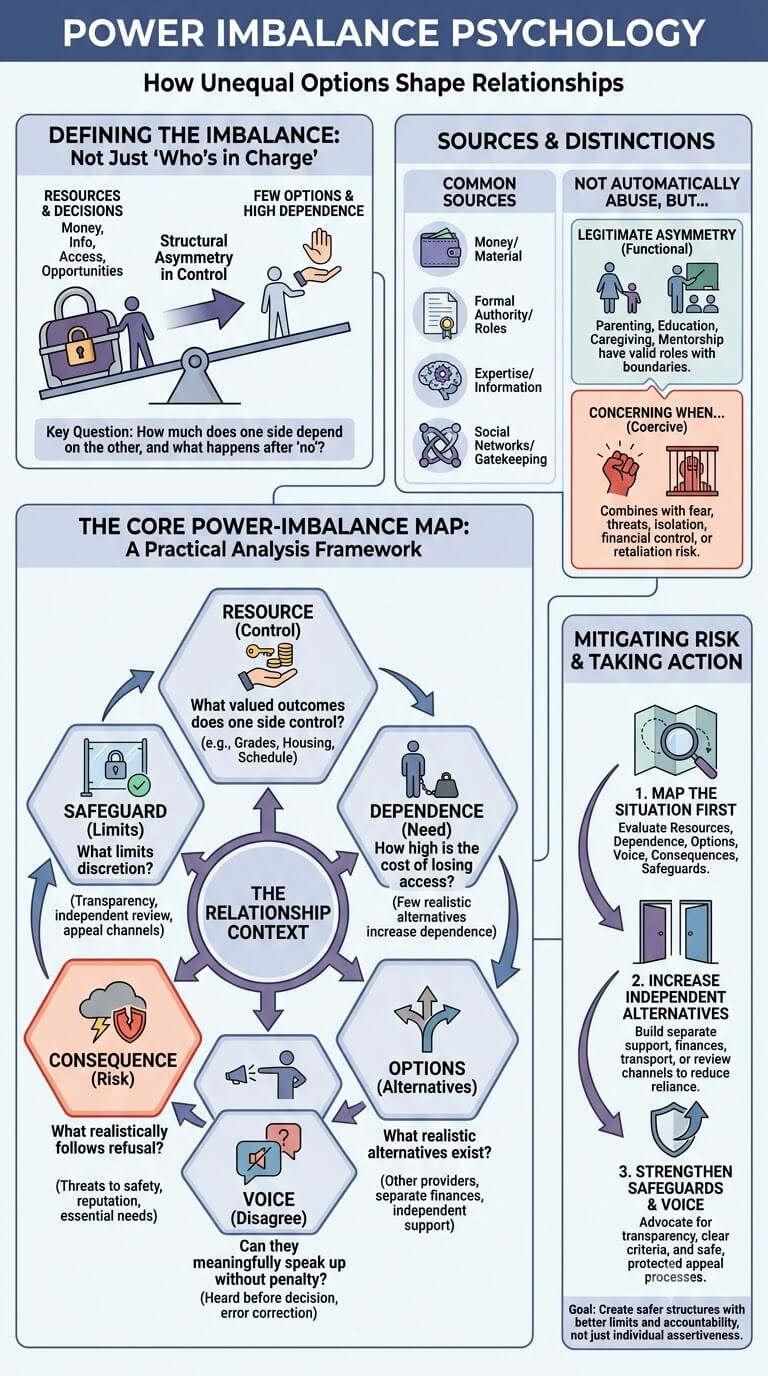
A power imbalance exists when one person or group has greater control over valued resources, decisions, opportunities, information, or consequences than another. The imbalance becomes more consequential when the lower-power side has few alternatives, high dependence, limited ability to refuse, weak voice, or realistic retaliation risk. Unequal power is not automatically abusive, but coercion, threats, isolation, financial control, or fear change the safety context.
What a Power Imbalance Is
Power imbalance is relational and can exist even when both people are well-intentioned. Power imbalance is one applied part of the broader psychology of power, status, and hierarchy.
Richard Emerson’s classic power-dependence theory makes dependence central to power. In simplified terms, the more one person’s valued goals depend on another person and the fewer alternatives exist, the more leverage the other person can have in that relationship.
Power imbalance is about relative control over outcomes
Imagine that two coworkers disagree. One can walk away from the project with little consequence. The other depends on the first person for a performance evaluation that affects continued employment. Both can speak, but the practical meaning of disagreement is not equal.
The imbalance comes from control over consequences, not from who talks louder or feels more confident.
Dependence matters more than titles alone
A formal title can create power, but dependence can also arise without one. Exclusive access to transportation, information, or valuable networks can create leverage without an official role.
Conversely, a formal authority may have limited leverage if the other person has strong protections, multiple alternatives, and meaningful review options.
The Core Power-Imbalance Map: Resource, Dependence, Options, Voice, Consequence, Safeguard
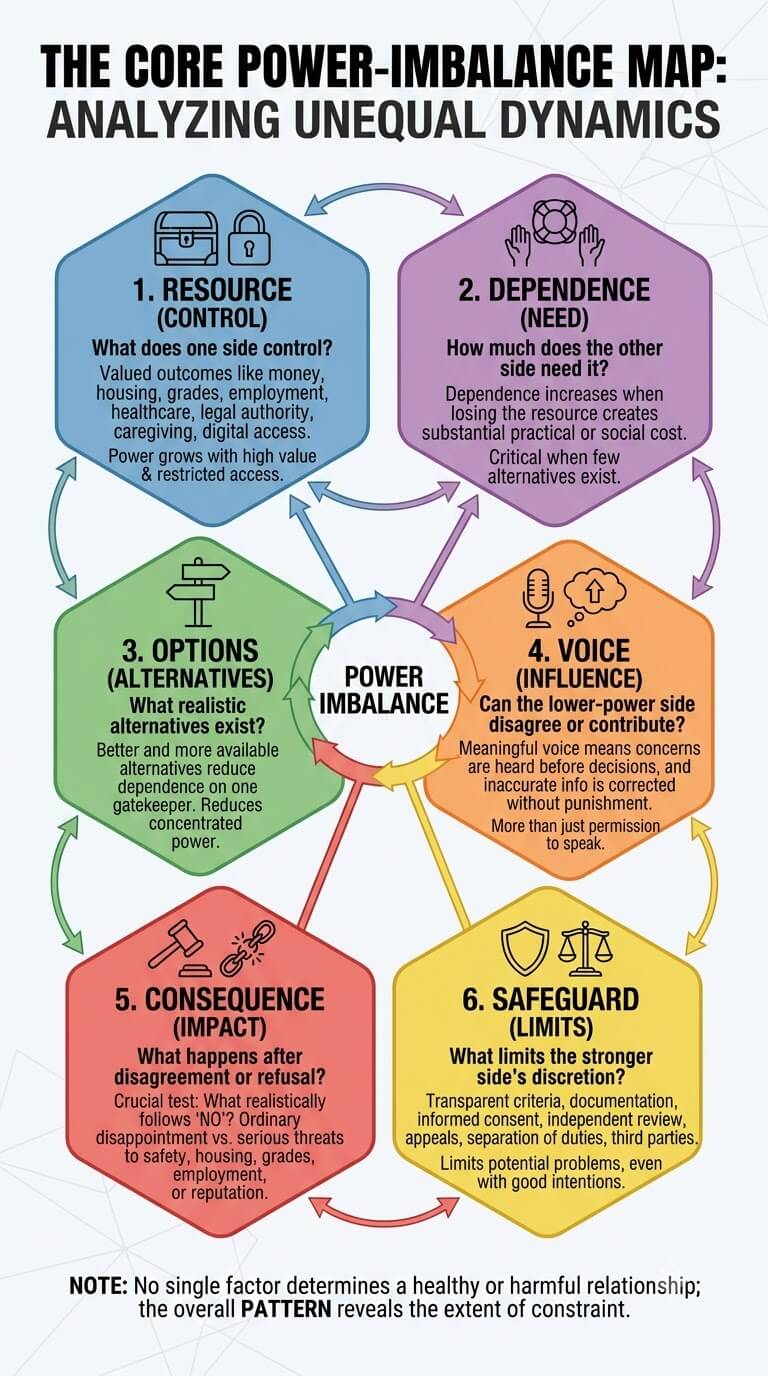
A practical analysis of unequal power can be organized around six connected questions. No single answer determines whether a relationship is healthy or harmful, but the pattern reveals how constrained one side really is.
Resource: what does one side control?
The resource may be money, housing, transportation, information, grades, employment, healthcare access, social inclusion, recommendations, legal authority, scheduling, caregiving, digital accounts, or another valued outcome.
Power grows when the resource matters greatly and access can be meaningfully restricted.
Dependence: how much does the other side need that resource?
Dependence is higher when losing the resource would create substantial practical or social cost. A recommendation from one professor matters differently when the student has several mentors than when that professor controls the only path to a required opportunity.
Options: what realistic alternatives exist?
Alternatives reduce concentrated power. Another provider, supervisor, transport option, independent financial access, appeal channel, or supportive relationship can reduce dependence on one gatekeeper.
A review of social exchange, power, and inequality emphasizes that actors with better and more available alternatives are less dependent and therefore tend to hold greater power in exchange relationships.
Voice: can the lower-power side disagree or provide information?
Permission to speak is not the same as meaningful voice. Ask whether concerns are heard before decisions are finalized and whether inaccurate information can be corrected without punishment.
When people repeatedly feel dismissed despite trying to explain themselves, Psychology Exposed’s guide to why people feel unheard can help separate communication problems from a deeper imbalance in who gets to define the situation.
Consequence: what happens after disagreement or refusal?
A crucial test is what realistically follows “no.” Does the person simply experience ordinary disappointment? Or could refusal threaten money, housing, grades, employment, social access, reputation, caregiving, or personal safety?
The more serious and one-sided the consequences, the more carefully consent and communication should be interpreted.
Safeguard: what limits the stronger side’s discretion?
Safeguards include transparent criteria, documentation, informed consent procedures, independent review, second opinions, appeal channels, separation of duties, and supportive third parties.
Safeguards do not assume malicious intent. They limit problems that concentrated discretion can create even when intentions are good.
Where Power Imbalances Come From
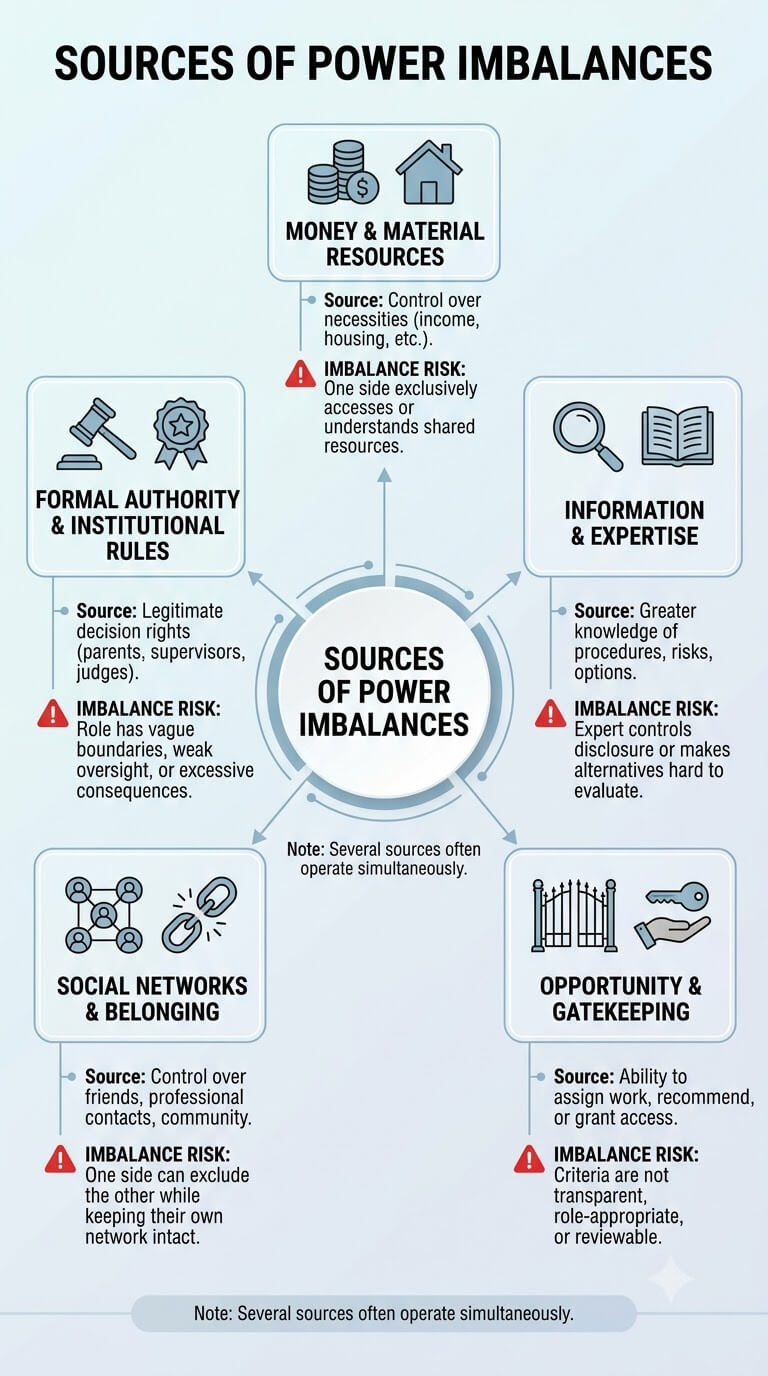
Unequal power can arise from many sources, and several can operate at once.
Money and material resources
Control over income, housing, transportation, tuition, food, equipment, or other necessities can give one side leverage. Shared finances are not inherently problematic, but the relationship becomes more asymmetric when only one person can access or understand the resources on which both depend.
Information and expertise
Professionals, institutions, and experienced insiders often know more about procedures, risks, and options than the person depending on them. Expertise can be useful and legitimate. The imbalance becomes more consequential when the expert controls what information is disclosed or makes alternatives difficult to evaluate.
Opportunity and gatekeeping
A supervisor can assign desirable work. A professor can recommend students. A community leader can make introductions. A platform moderator can control visibility. A caregiver can affect access to appointments or social contact.
Gatekeeping is not automatically unfair. The relevant questions are whether criteria are transparent, role-appropriate, and reviewable.
Social networks and belonging
Control over friends, professional contacts, or a valued community can also create power when one side can exclude the other while keeping their own network intact.
Formal authority and institutional rules
Parents, teachers, clinicians, supervisors, judges, and administrators may have legitimate decision rights. The existence of formal authority is not itself a problem. Risk rises when the role has vague boundaries, weak oversight, or consequences that extend beyond its proper scope.
Unequal Power Is Not Automatically Abuse
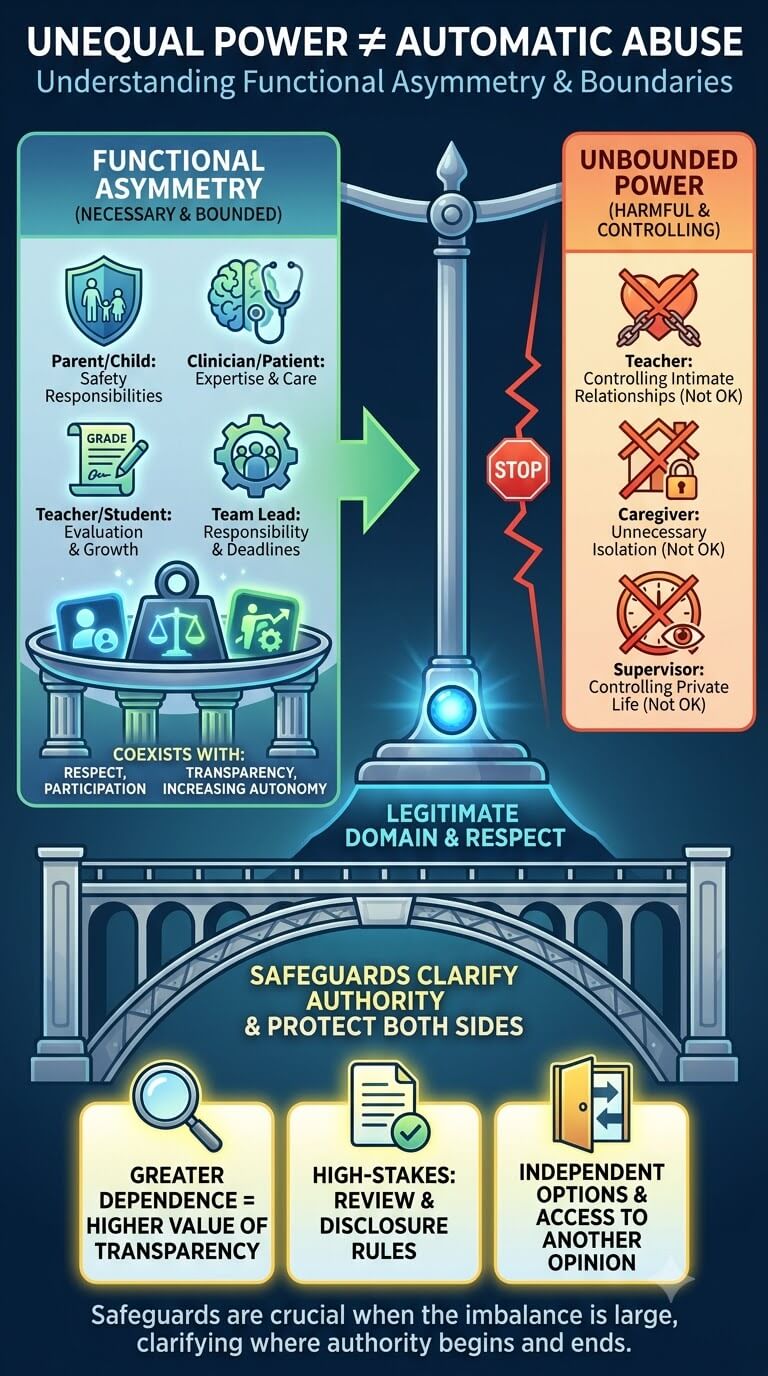
A power differential can be functional, temporary, protective, or necessary. The mistake is to label every unequal role as harmful simply because one side has more authority.
Some relationships require unequal decision rights
A young child cannot carry the same safety responsibilities as a parent. A clinician has expertise that a patient may not have. A teacher evaluates coursework. A team lead may have final responsibility for a deadline. Whether people see unequal authority as normal or appropriate is a related but separate issue examined through power distance.
These differences can coexist with respect, transparency, participation, and increasing autonomy where appropriate.
Healthy asymmetry has boundaries
Healthy unequal roles are easier to recognize when the stronger side’s power is limited to a legitimate domain. A teacher’s grading authority does not create a right to control a student’s intimate relationships. A caregiver’s responsibility does not justify unnecessary isolation. A supervisor’s scheduling role does not automatically give control over an employee’s private life.
Safeguards matter more when the imbalance is large
The greater the dependence, the more valuable transparency and independent options become. High-stakes relationships may need review, disclosure rules, or access to another opinion.
Safeguards protect both sides by clarifying where authority begins and ends.
Power Imbalance and the Ability to Say No
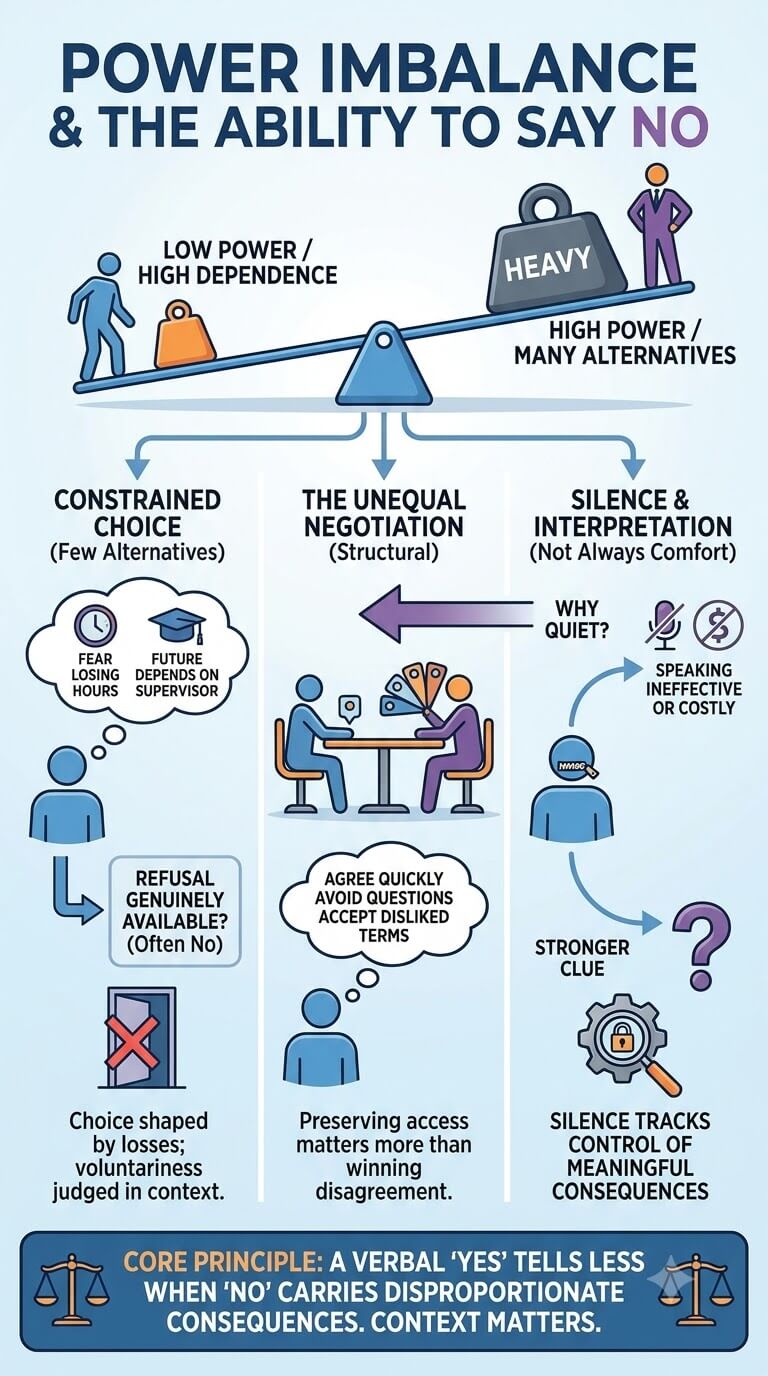
One of the clearest practical questions is whether refusal is genuinely available. A verbal “yes” tells us less when saying “no” carries disproportionate consequences.
Choice is shaped by available alternatives
A person can technically refuse while facing losses that make the choice heavily constrained. An employee may fear losing necessary hours; a student may believe future opportunities depend on one supervisor’s goodwill.
This does not automatically mean every agreement is invalid. It means voluntariness should be judged in context rather than from words alone.
High dependence can change negotiation
When one side has many alternatives and the other has none, the negotiation is structurally unequal. The more dependent person may agree quickly, avoid asking questions, or accept terms they dislike because preserving access matters more than winning the immediate disagreement. The structure also raises a separate question about how having more or less power can change behavior, attention, and decision-making.
Silence should not automatically be read as comfort
A lower-power person may stay quiet because speaking seems ineffective or costly. Silence also has ordinary explanations, so it should not automatically be treated as fear.
The stronger clue is whether silence consistently tracks situations where the higher-power person controls meaningful consequences.
Power Imbalance and Psychological Safety
Power imbalance and psychological safety are related but not identical. Power imbalance describes unequal capacity and dependence. Psychological safety concerns whether a group feels safe enough for interpersonal risk such as asking questions, admitting mistakes, or challenging ideas.
A hierarchy can exist with psychological safety
A team can have clear managers and junior members while still inviting dissent, correcting errors without humiliation, and protecting people who raise legitimate concerns.
Psychology Exposed’s guide to psychological safety at work examines that shared belief about interpersonal risk more directly.
Low psychological safety can magnify a power imbalance
If lower-power members already depend on senior people and also expect embarrassment or punishment for speaking, the practical imbalance becomes harder to correct. Information may stop moving upward even when the formal rules say that feedback is welcome.
Psychological safety does not erase material dependence
A warm, supportive climate cannot by itself remove a structural imbalance. A person may feel comfortable speaking while still depending on someone else for employment, housing, money, or access.
Interpersonal safety helps, but material alternatives and safeguards still matter.
Power Imbalance vs Manipulation and Coercion
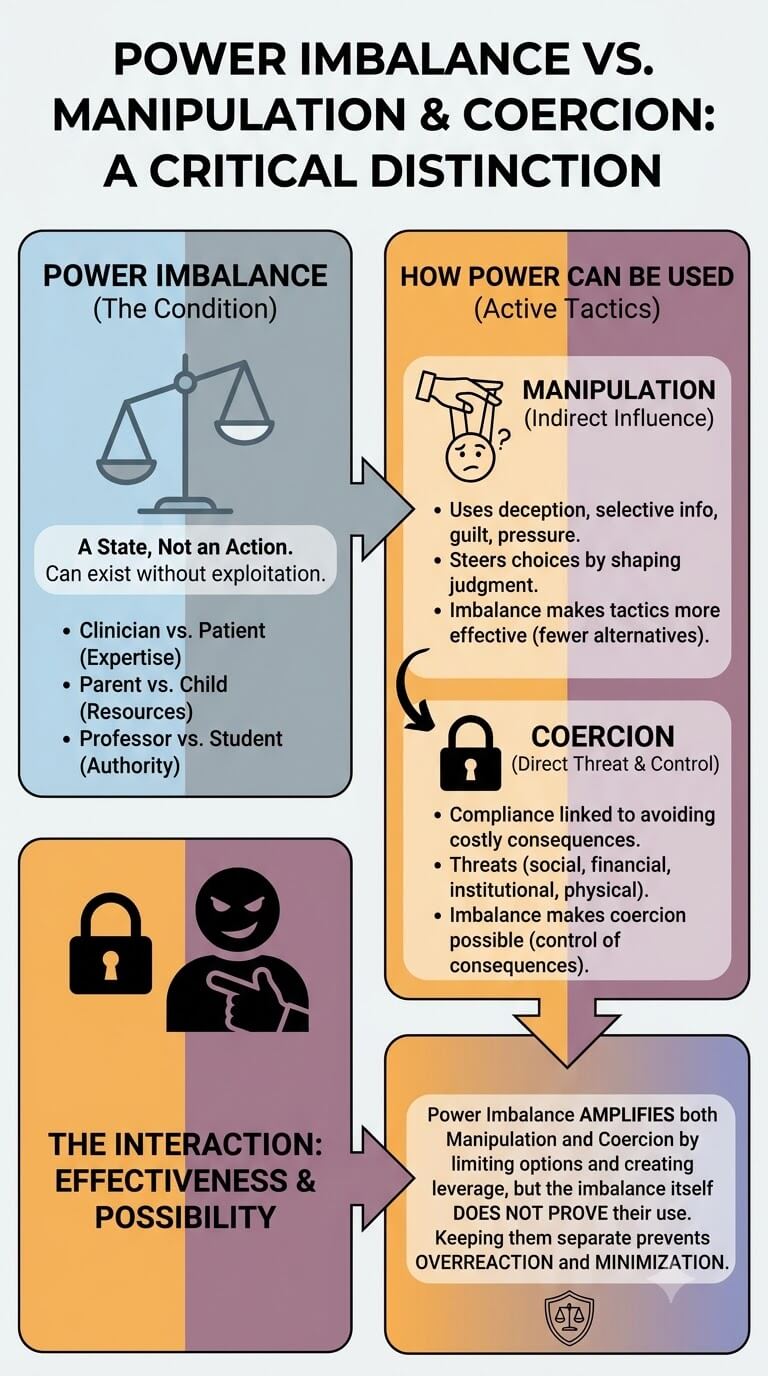
Power imbalance is a condition. Manipulation and coercion are ways power can be used. Keeping them separate prevents overreaction and minimization.
An imbalance can exist without deliberate manipulation
A clinician may have more expertise than a patient, a parent more resources than a child, or a professor evaluative authority over a student. None of this proves exploitation.
Manipulation uses influence to shape another person’s judgment or behavior
Manipulation becomes relevant when someone uses deception, selective information, guilt, confusion, pressure, or other tactics to steer another person’s choices. A power imbalance can make those tactics more effective because the lower-power person has fewer alternatives or more to lose.
Psychology Exposed’s overview of manipulation psychology addresses those influence tactics separately.
Coercion makes refusal costly through threat or control
Coercion is more direct: compliance is linked to avoiding an unwanted social, financial, institutional, or physical consequence.
A power imbalance makes coercion possible when one side controls consequences, but not every imbalance is used coercively.
When a Power Imbalance Becomes a Safety Concern
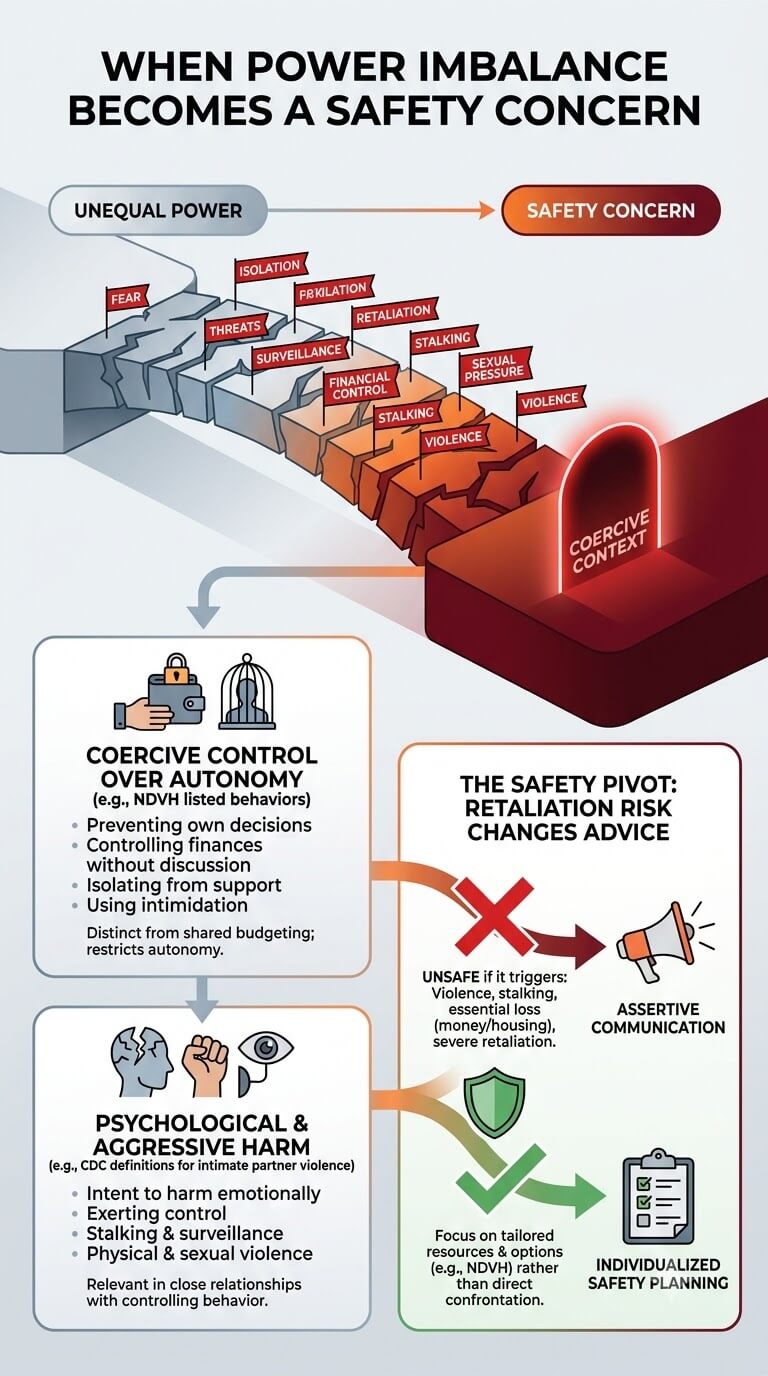
The safety context changes when unequal power is combined with fear, isolation, threats, surveillance, retaliation, financial control, stalking, sexual pressure, or violence.
Control over money or basic needs can become coercive
The National Domestic Violence Hotline lists behaviors such as preventing someone from making their own decisions, controlling household finances without discussion, isolating them from friends or family, and using intimidation among warning signs of relationship abuse.
These patterns are different from ordinary shared budgeting or agreed division of responsibilities because control is being used to restrict the other person’s autonomy.
Psychological aggression can include attempts to exert control
The CDC’s overview of intimate partner violence includes psychological aggression that is intended to harm a partner emotionally or exert control, along with stalking, physical violence, and sexual violence.
These definitions are specific to intimate partner violence and should not be copied onto every unequal relationship. They are most relevant when the power imbalance occurs in a close relationship and includes controlling or threatening behavior.
Retaliation risk changes the advice
If raising a concern could trigger violence, stalking, loss of essential money, housing instability, severe retaliation, or another credible safety threat, the lower-power person should not be told simply to communicate more assertively.
Safety-planning resources from the National Domestic Violence Hotline are designed around individualized circumstances and options rather than assuming direct confrontation is safe.
Power Imbalance at Work
Workplaces create legitimate asymmetry because supervisors evaluate, schedule, assign, and sometimes discipline employees. The issue is how those powers are bounded.
Evaluation power changes the meaning of disagreement
An employee may disagree with a peer freely but become more cautious with the person who controls promotion, hours, or references. That caution can be rational even when the manager has never threatened retaliation.
Transparent criteria reduce discretionary leverage
Written expectations, documented evaluations, multiple reviewers, appeal procedures, and anti-retaliation rules reduce one person’s discretionary control.
A difficult manager is not automatically an abusive power imbalance
Poor communication, inconsistency, or personality conflict can make work unpleasant without creating coercive control. Look for the structure: What does the manager control? Can decisions be reviewed? Are standards transparent? Is disagreement punished disproportionately?
Power Imbalance in Education and Mentoring
Teachers, professors, supervisors, and mentors can influence grades, references, opportunities, authorship, access, and reputation. These roles can be highly beneficial while still requiring boundaries.
Students may depend on one person’s evaluation
The imbalance is larger when a single person controls several outcomes at once, such as grades, funding, recommendation letters, and access to future work.
Multiple mentors, written criteria, independent review, and conflict-of-interest rules can reduce excessive dependence.
Mentorship should not require unrelated personal compliance
A mentor can set legitimate academic or professional expectations. That role should not be used to demand loyalty, secrecy, intimacy, or personal behavior unrelated to the learning relationship.
Power Imbalance in Caregiving and Professional Relationships
Caregiving, healthcare, counseling, legal services, and other professional relationships can involve major differences in expertise, information, vulnerability, and decision access.
Expertise creates responsibility as well as influence
A professional may understand risks and procedures that the client or patient does not. Good practice explains options, limits, uncertainty, and consequences without treating expertise as ownership of the other person’s values.
Second opinions and independent options reduce dependence
When stakes are high, the ability to consult another qualified person can protect autonomy and improve decision quality. A second opinion does not imply distrust. It reduces the cost of relying on one gatekeeper.
Vulnerability should not become permission for unnecessary control
Support with medication, transport, finances, or daily tasks can legitimately involve unequal responsibility. It becomes concerning when assistance is used to isolate, block information, or control choices beyond the role’s needs.
Power Imbalance in Families and Close Relationships
Families and close relationships often contain unequal resources without being unhealthy. One person may earn more, drive, speak the local language better, manage paperwork, or know more about a particular system.
Unequal contribution is not the same as unequal worth
Earning more money or managing paperwork can create practical leverage without creating greater human worth or automatic authority over every decision.
Shared decisions require access to relevant information
If one person controls accounts, documents, schedules, passwords, or communication with institutions, the other person may be unable to participate meaningfully even if decisions are described as “shared.”
Fear changes the meaning of agreement
If disagreement leads to intimidation, retaliation, threats, isolation, or violence, apparent agreement should not be assumed to reflect comfortable consent. The lower-power person may be responding to consequences rather than genuine preference.
Temporary vs Structural Power Imbalance
Some imbalances last minutes. Others are built into long-term relationships or institutions.
Temporary imbalance can follow a specific task
During an emergency, the person with medical training may direct others. During a complex financial filing, one family member may temporarily control the process because they understand it best.
Healthy temporary imbalance shrinks when the task ends or when knowledge becomes shared.
Structural imbalance persists across many decisions
A structural imbalance exists when the same side repeatedly controls money, information, opportunities, decisions, and consequences while the other has few independent routes around that control.
Structural imbalance deserves more safeguards because the effects accumulate across time.
Signs the Imbalance Is Becoming More Concerning
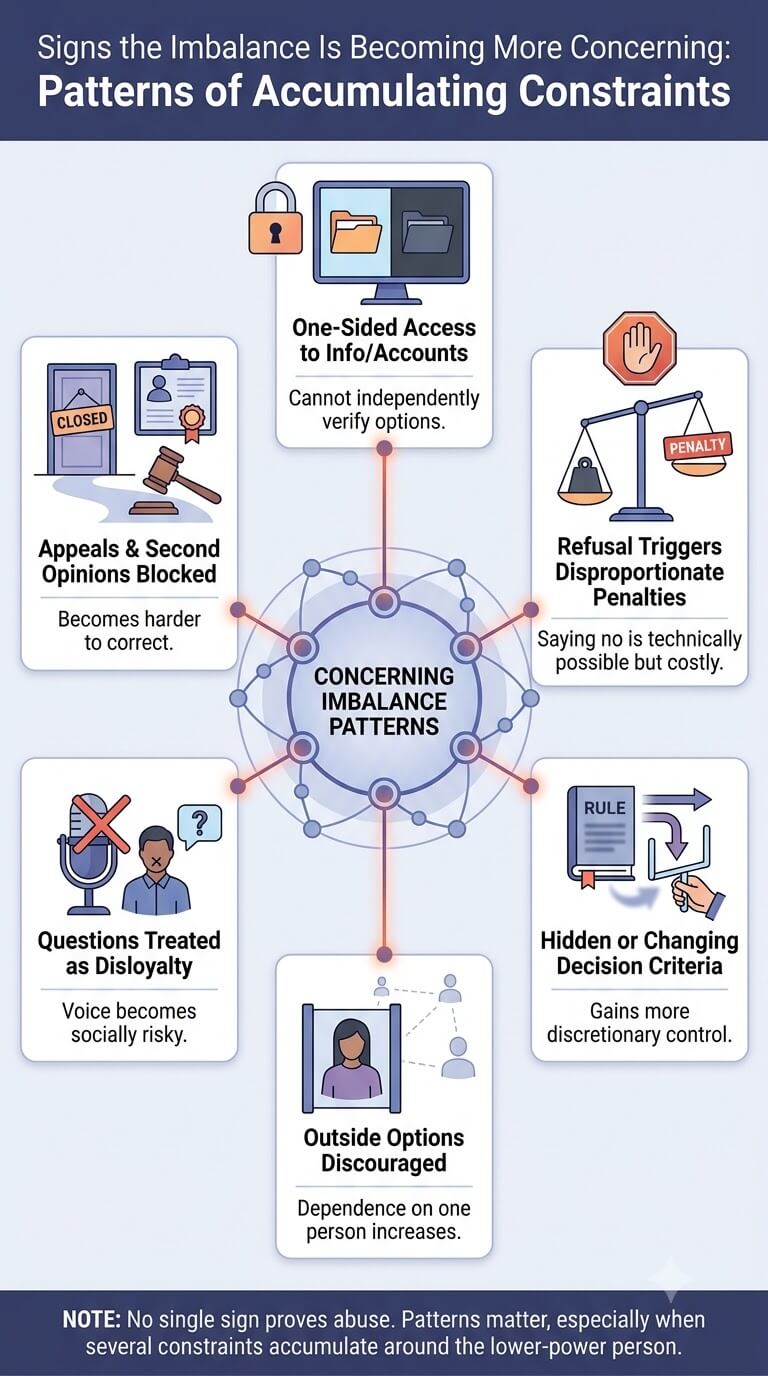
No single sign proves abuse or exploitation. Patterns matter, especially when several constraints accumulate around the lower-power person.
| Pattern | Why it matters |
|---|---|
| Only one side has access to important information or accounts. | The other person cannot independently verify options or decisions. |
| Refusal triggers disproportionate practical or social penalties. | Saying no is technically possible but increasingly costly. |
| Decision criteria are hidden or change unpredictably. | The stronger side gains more discretionary control. |
| Outside relationships or alternatives are discouraged. | Dependence on one person increases. |
| Questions are treated as disloyalty or disrespect. | Voice becomes socially risky. |
| Appeal, review, or second opinions are blocked. | The stronger side becomes harder to correct. |
Six Everyday Power-Imbalance Scenarios
These examples show how the same structural questions apply across very different relationships.
Workplace: the only manager who can approve hours
Situation: An employee depends on one manager for enough weekly hours to pay rent. What may matter: disagreement carries financial stakes. What it may mean: the manager has substantial reward and scheduling power. Useful safeguard: written scheduling criteria, another review channel, or access to another decision-maker.
Education: one supervisor controls several future opportunities
Situation: A student depends on one professor for funding, evaluation, and recommendation letters. What may matter: several important resources are concentrated in one relationship. What it may mean: dependence is unusually high. Useful safeguard: multiple mentors, transparent evaluation, and independent grievance procedures.
Caregiving: one relative controls transportation and appointments
Situation: An older adult depends on one family member for transport and scheduling. What may matter: the caregiver can influence access to healthcare and social contact. What it may mean: necessary assistance creates leverage. Useful safeguard: shared calendars, backup transportation, and direct access to relevant information where possible.
Professional service: the client cannot evaluate the expert’s recommendation
Situation: A client receives highly technical advice and cannot independently judge it. What may matter: information asymmetry increases reliance on the expert. What it may mean: expertise creates legitimate influence. Useful safeguard: clear explanations, written options, disclosure of conflicts, and second opinions for high-stakes choices.
Close relationship: one partner controls all financial access
Situation: One partner earns the income and also prevents the other from accessing accounts or making ordinary spending decisions. What may matter: the lower-power partner lacks independent financial options. What it may mean: the imbalance may be moving beyond unequal contribution toward controlling behavior. Useful safeguard: the appropriate response depends on safety and should not assume direct confrontation is risk-free.
Friendship group: one person controls social access
Situation: A socially central friend decides who receives invitations and threatens exclusion when challenged. What may matter: belonging becomes conditional on compliance. What it may mean: informal social power is being used to raise the cost of disagreement. Useful safeguard: independent relationships and alternative social support reduce dependence on one gatekeeper.
First Step: Measure Options Before Giving Communication Advice
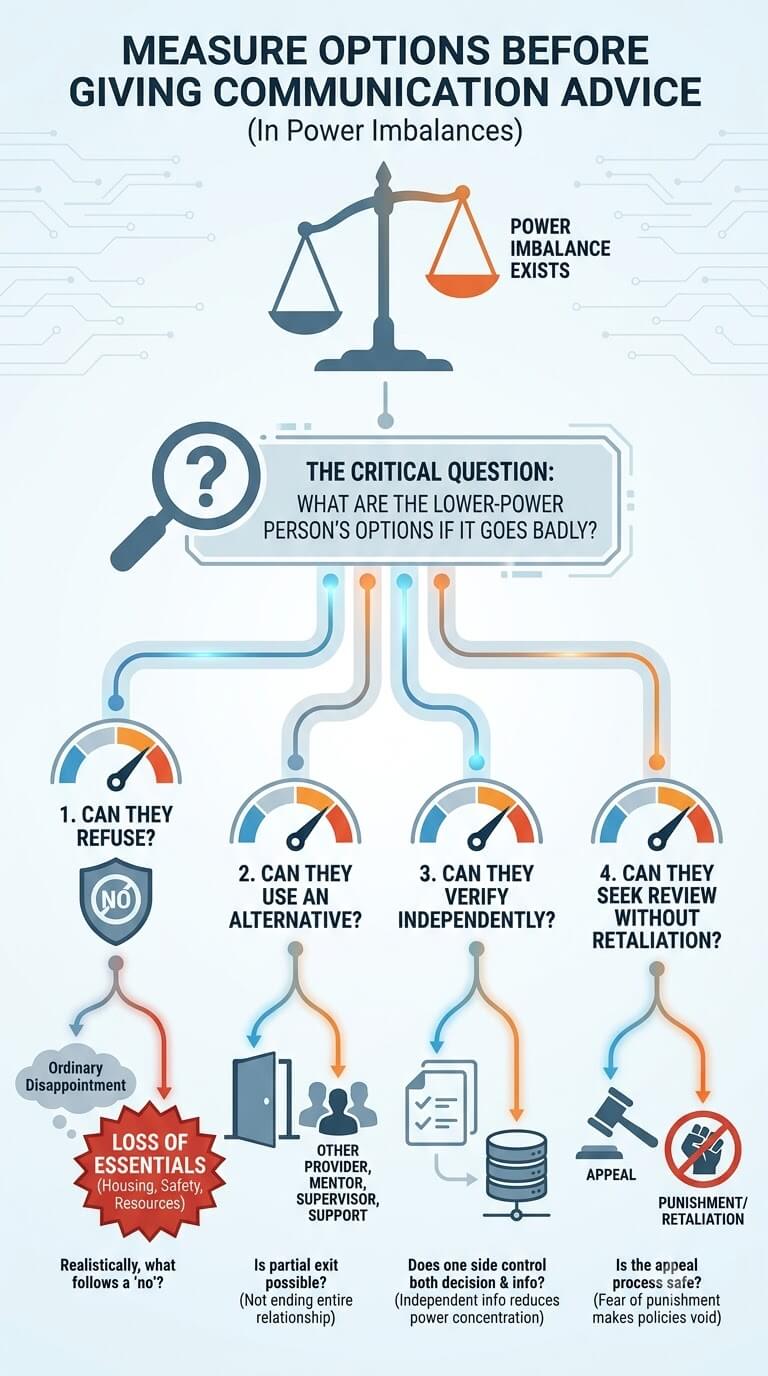
Power imbalance requires an extra question before communication advice: what options does the lower-power person have if the conversation goes badly?
Can they refuse?
Ask what realistically follows a no. Ordinary disappointment is different from losing essential resources, opportunities, housing, social support, or safety.
Can they leave or use an alternative?
Exit does not have to mean ending the entire relationship. Alternatives can include another provider, reviewer, supervisor, mentor, transportation source, account, or support person.
Can they verify information independently?
Power increases when one side controls both the decision and the information used to justify it. Independent information reduces that concentration.
Can they seek review without retaliation?
An appeal process is meaningful only if using it does not itself trigger punishment. Formal policies matter less when retaliation is realistically expected.
How to Reduce Risk in Unequal-Power Relationships
Reducing harmful asymmetry does not require making every role equal. Often the goal is better limits, alternatives, transparency, and accountability.
Increase transparency
Make criteria, responsibilities, options, conflicts of interest, and consequences understandable. Hidden rules increase dependence on the person who knows how the system works.
Create independent alternatives
Multiple mentors, separate financial access, second opinions, backup transportation, outside friendships, independent communication channels, and more than one decision-maker can all reduce dependence on a single gatekeeper.
Separate decision roles where possible
When one person controls evaluation, money, information, discipline, and appeal, safeguards are weak. Dividing roles can make abuse of discretion harder even when nobody expects wrongdoing.
Protect voice and review
Questions, disagreement, and appeals should have predictable channels so correcting inaccurate information does not require exceptional courage.
Match the response to retaliation risk
Where the environment is basically safe, direct clarification may help. Where retaliation is realistic, outside support, documentation, independent advice, or safety planning may be safer than confronting the stronger person alone.
Power Imbalance vs Social Power, Personal Agency, and Feeling Unheard
Several nearby concepts help describe different parts of the same situation.
Social power describes the underlying capacity
Social power asks who can affect valued outcomes and why. Power imbalance describes how unequal that capacity becomes between the sides of a relationship.
Personal agency concerns the ability to choose and act
A person may retain substantial internal confidence while facing external constraints. Psychology Exposed’s guide to personal agency psychology focuses on perceived capacity to choose and act, while power imbalance focuses on relational asymmetry in options and consequences.
Feeling unheard concerns voice, not the entire power structure
A person can feel unheard in an otherwise equal relationship. Power imbalance becomes relevant when voice repeatedly matters less because the other side controls outcomes or consequences.
FAQ
These questions address the most important distinctions around unequal power.
Does every relationship have a power imbalance?
Many relationships contain some unequal resources, expertise, status, or decision rights, but the degree and consequences vary. An imbalance becomes more psychologically important when one side depends heavily on the other, lacks realistic alternatives, has little voice, or faces meaningful costs for refusal. Small or task-specific differences are not equivalent to broad structural control.
Is a power imbalance automatically abusive?
No. Parenting, education, healthcare, caregiving, supervision, and many professional relationships legitimately involve unequal roles. Abuse becomes a different concern when power is used through intimidation, coercive control, isolation, financial restriction, threats, stalking, humiliation, sexual pressure, retaliation, or violence. The presence of inequality alone does not establish abuse.
Can consent exist when two people have unequal power?
Unequal power does not automatically eliminate consent, but it can affect how freely a person can refuse. The more one side controls essential resources, opportunities, evaluation, or consequences, the more important alternatives, disclosure, boundaries, independent advice, and protection from retaliation become. A verbal yes should be interpreted in the context of what saying no realistically costs.
Why are alternatives so important in power imbalance?
Alternatives reduce dependence. If a person can consult another expert, change providers, access separate money, appeal a decision, use different transportation, or maintain independent relationships, one gatekeeper has less control over the person’s options. Power-dependence theory treats the availability of alternative sources as a central determinant of relational power.
What if direct communication feels unsafe?
Do not assume that a lower-power person must confront the stronger person directly. If credible threats, stalking, retaliation, financial control, violence, or fear are present, communication advice should be secondary to safety. Independent support, documentation, professional guidance, or individualized safety planning may be more appropriate depending on the situation.
Key Takeaways
- Power imbalance is a relational asymmetry in control over valued resources, decisions, information, opportunities, or consequences.
- Dependence becomes stronger when the resource matters greatly and realistic alternatives are scarce.
- Unequal power is not automatically abuse; many caregiving, educational, professional, family, and workplace roles legitimately contain asymmetry.
- The imbalance becomes more concerning when saying no is costly, voice is weak, information is controlled, alternatives are blocked, or retaliation is realistic.
- Manipulation and coercion are ways power can be used, while power imbalance describes the underlying unequal structure.
- Transparency, independent alternatives, review, bounded authority, and protection from retaliation can make unequal-power relationships safer and more accountable.
A useful next step is to map the situation before deciding what kind of communication is appropriate. Identify the resource, the dependence, the available alternatives, the person’s actual voice, the consequences of refusal, and the safeguards around the stronger side’s discretion. If the map shows credible fear or retaliation risk, safety and independent support matter more than winning a direct argument.

Michael Reed is the Founder and Lead Writer at Psychology Exposed. He writes about human behavior, relationships, emotional patterns, self-awareness, and practical psychology topics using research-informed, easy-to-understand content.
Read More About Michael Reed: https://psychologyexposed.com/michael-reed/