

Power can change behavior, but not in one simple direction. A person who gains more control over decisions may act faster, speak more freely, focus harder on goals, or take risks that previously felt unavailable. The same person may also pay less attention to other people’s reactions because those reactions now carry fewer consequences. Yet another person may become more careful because their powerful position feels fragile or because responsibility for other people’s outcomes becomes more salient.
This is why the claim that “power corrupts” is too crude for psychology. Social power changes the structure around a person: how dependent they are on others, what constraints they face, which rewards become available, how costly disagreement feels, and how much freedom they have to act on their own goals. Those changes can influence attention, motivation, judgment, social perception, and behavior, but the effects depend on context, goals, accountability, stability, and individual differences.
The research is also methodologically mixed. Some findings come from experiments that temporarily assign or prime power, some from correlational studies, some from organizational or daily-life settings, and some from broad theoretical reviews. A careful explanation should therefore describe common tendencies without pretending that every person in a high-power role will show the same pattern.
Quick Answer

Power can change behavior because greater control over valued outcomes often reduces dependence and constraint while increasing freedom to pursue goals. Research links higher power with stronger approach tendencies, action, goal focus, confidence, and sometimes greater risk-taking or reduced perspective-taking. Lower power can increase monitoring of others and sensitivity to consequences. These are tendencies, not guarantees, and accountability, responsibility, role stability, goals, and personality can change the pattern.
Start With the Structure: Power Changes Dependence and Freedom to Act

The psychological effects of power make more sense when power is treated as a relationship rather than a personality trait. A person with more power can affect outcomes that matter to others while depending less on those same people for their own outcomes. That asymmetry changes the practical consequences of action. These behavioral effects are one part of the wider psychology of power, status, and hierarchy.
More power can reduce dependence on other people’s approval or cooperation
If your decision no longer requires several people’s permission, you may spend less time anticipating each person’s reaction. If you control a resource that others need, their preferences may matter less to your immediate ability to act. This can create psychological distance even when the person does not consciously intend to become detached.
The classic power, approach, and inhibition framework proposed that higher power is associated with more rewards and freedom from social constraint, whereas lower power is associated with more threat, punishment, and constraint. The framework predicts different motivational tendencies from those structural differences.
Less power can make other people’s reactions more consequential
A person who depends on a supervisor, gatekeeper, parent, landlord, group leader, or socially central friend may need to monitor what that person wants. Small cues can matter because the higher-power person’s approval or decision has practical consequences.
This does not mean lower-power people are naturally passive or anxious. It means that paying attention to powerful others can be adaptive when those others influence access, evaluation, resources, or safety.
Power Often Increases Approach and Action

One of the most influential ideas in power research is that higher power tends to activate approach-related processes: movement toward goals, rewards, action, and expression. Lower power tends to make inhibition and possible costs more salient.
Approach means moving toward goals and rewards
Approach is broader than confidence. It includes noticing desirable outcomes, initiating behavior, pursuing opportunities, and acting with fewer internal brakes. A person who gains authority over a project may begin proposing changes that previously seemed too difficult to push through.
This can be useful when a situation genuinely requires action. It can also become costly when speed replaces information gathering or when the person assumes that fewer constraints mean fewer consequences.
Power can make action feel more available
Experiments on power have found that activating or assigning power can increase action tendencies and reduce the feeling of being constrained by the immediate situation. In several experimental tasks, higher-power participants were less influenced by salient examples, group opinions, or external reputations.
These studies do not prove that powerful people are generally independent thinkers in real life. They show that experimentally manipulated power can sometimes reduce the psychological “press” of situational cues.
Power Can Intensify Goal Focus

Power does not simply make people more active. It can make active goals more influential. That helps explain why power sometimes produces constructive persistence and sometimes amplifies self-serving behavior.
Power can prioritize whatever goal is currently salient
A review by Ana Guinote describes power as an intensifier of goal-related approach. In this view, power energizes thought and action around goals that are already salient because of the person’s role, values, opportunities, or current task.
If the active goal is completing a difficult project, power may support persistence. If the active goal is protecting personal advantage, the same freedom to act may support self-interested choices. The theory therefore predicts variability rather than one moral effect.
Power may amplify existing priorities rather than create entirely new motives
Two people given the same authority can behave differently because they enter the role with different values, identities, incentives, and goals. One may focus on collective outcomes. Another may focus on personal recognition. A third may become highly procedural because protecting the institution matters most.
This is one reason it is misleading to say that power reveals a single hidden “true self.” Power can make some existing goals easier to express, but behavior remains shaped by the situation and by which part of the self is currently active.
Power and Confidence
Greater power often comes with more ability to act on one’s judgment. Repeated experience of having decisions implemented can also make one’s own viewpoint feel more consequential and more sufficient.
Power can increase confidence in one’s own judgment
When people are less dependent on external approval, they may rely more heavily on internal preferences and beliefs. This can make decision-making faster and reduce hesitation.
Confidence can be useful when expertise is strong and action is needed. The problem is that subjective confidence is not the same as accuracy. A person with power can become more willing to act before receiving enough corrective information.
Confidence may become overconfidence when feedback weakens
Powerful roles sometimes reduce the amount of candid feedback a person receives. Lower-power people may hesitate to correct, challenge, or interrupt someone who controls evaluations or opportunities. If the power-holder interprets that silence as agreement, confidence can grow without a matching increase in accuracy.
The risk is therefore partly structural. The person may not consciously reject feedback; the hierarchy may simply deliver less of it.
Power and Risk-Taking Are More Conditional Than Popular Claims Suggest
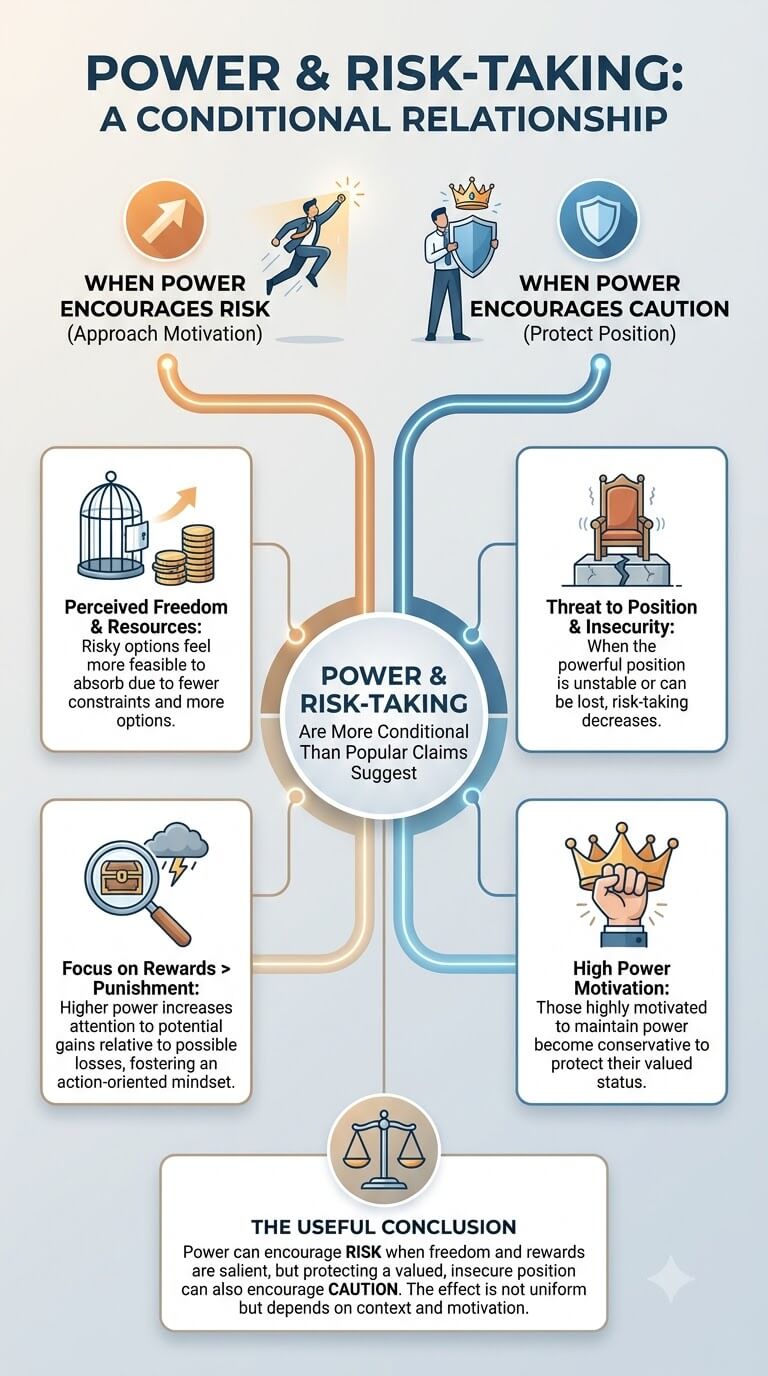
Research often links power with optimism, reduced constraint, and willingness to act, which can increase risk-taking. But the relationship is not uniform.
Greater freedom can make risky options feel more feasible
If a person believes they have more resources, more options, or fewer social constraints, a risky choice may appear easier to absorb. Higher power can also increase attention to potential rewards relative to possible punishment.
That fits the broader approach framework, but it should not be turned into a rule that powerful people are always reckless.
Threat to the powerful position can make some people more conservative
Research on power and risky versus conservative decision-making found that effects depended on power motivation and whether the person’s position was secure. Participants highly motivated by power became more conservative when their position could be lost.
The useful conclusion is conditional: power can encourage risk when freedom and reward are salient, but protecting a valued position can also encourage caution.
Power Can Change Attention to Other People
Power affects social attention because other people’s reactions do not carry equal consequences at every rank. Higher-power people can sometimes act without carefully tracking lower-power partners, while lower-power people may need to monitor those above them.
Lower power can increase monitoring of people who control outcomes
If another person’s decision affects your grade, work schedule, funding, access, or belonging, it makes sense to notice their mood, expectations, and likely reactions. This is strategic social attention, not evidence of inferior confidence.
A low-power person may therefore spend more cognitive effort asking: What does this person want? Is disagreement safe? Which details will matter to their evaluation?
Higher power can reduce spontaneous attention to other viewpoints
A well-known set of studies on power and perspective taking found that experimentally induced high power was associated with less spontaneous adoption of other people’s visual or informational perspectives.
This does not mean power eliminates empathy. The studies concern particular perspective-taking tasks, and later research shows that goals, responsibility, role stability, and how power is construed can alter social perception.
Perspective-Taking Is Not a Fixed Casualty of Power

“Power makes people unable to understand others” goes beyond the evidence. Power can reduce spontaneous attention to other viewpoints under some conditions, but that tendency is modifiable.
Responsibility can redirect attention toward others
When power is understood as responsibility rather than pure opportunity, social attention can change. A review of power and social information processing concluded that interpersonal accuracy depends partly on how people construe power, whether their position is stable, and what goals are active.
The review specifically notes that construing power as responsibility can improve interpersonal accuracy. This is strong evidence against a deterministic view in which high power automatically produces social blindness.
Accountability can make other people’s information matter again
If a powerful person knows they must explain a decision, face review, or depend on accurate information from others, perspective-taking becomes more relevant to their own goals. The structure restores consequences for ignoring other viewpoints.
This is why good systems do more than tell leaders to “be empathetic.” They create procedures that make listening useful and correction possible.
Power and Instrumental Attention to Other People
One of the more uncomfortable findings in power research is that people with power may sometimes attend to others in terms of usefulness to current goals. This idea deserves careful wording because “objectification” can easily be overgeneralized.
Goal-relevant qualities can become especially salient
In a series of studies on power and instrumental social perception, powerful participants were more likely under certain conditions to approach social targets based on attributes useful for an active goal. The effect was tied to goal relevance rather than a blanket claim that powerful people see everyone as objects.
An everyday version might be a project leader who begins noticing mainly who can solve which problem. That can be efficient for task allocation, but it becomes socially costly if people’s broader needs, boundaries, or perspectives disappear from consideration.
Instrumental attention is not inevitable dehumanization
There is an important difference between temporarily focusing on someone’s task-relevant skill and denying that person’s humanity. The research suggests a possible shift toward instrumental processing under power, not a universal moral transformation.
Context, responsibility, relationship quality, and goals matter. A caregiver or team leader can possess substantial power while remaining strongly attentive to the people affected by decisions.
Power May Increase Psychological Distance
Power differences can change how socially close people feel, even when they occupy the same room or organization.
Lower dependence can reduce the need for constant interpersonal coordination
A higher-power person often has more freedom to proceed without securing approval from each lower-power partner. That reduced dependence can create distance because fewer decisions require mutual adjustment.
The lower-power person may experience the relationship differently. If outcomes depend heavily on the power-holder, that relationship remains psychologically important and closely monitored.
Distance can be useful or costly
Some distance helps people make difficult decisions without being overwhelmed by every immediate reaction. Too much distance can reduce access to local information and make consequences for others easier to overlook.
The question is not whether distance is always bad. It is whether the role preserves enough feedback to keep decisions connected to reality.
Temporary Power and Stable Power Are Not the Same Experience
Many laboratory studies create power for a short period by assigning roles, asking participants to recall powerful experiences, or manipulating control over an experimental task. Real-world power can be longer-lasting and embedded in institutions.
New or temporary power may make change especially noticeable
A person newly given decision rights may feel an abrupt increase in freedom. They may act faster, experiment more, or become unusually conscious of their ability to influence outcomes.
Temporary power can therefore reveal mechanisms, but it does not reproduce years of status, organizational learning, accountability, or adaptation.
Stable power creates opportunities for feedback patterns and habits to develop
Long-term power can change who approaches a person, which information reaches them, and what kinds of disagreement they routinely encounter. Those repeated patterns may be as psychologically important as the power-holder’s internal motivation.
A person may gradually receive more filtered information, more agreement, or more requests that reinforce the sense that their own priorities are central.
Why Power Does Not Automatically Corrupt
Power expands capacity to act. Whether that capacity produces harm depends partly on which goals are active, what norms govern the role, what accountability exists, and how dependent the power-holder remains on accurate information.
Power can amplify prosocial as well as self-interested goals
If a person strongly identifies with a group, cares about stewardship, or sees the role as responsibility, power can support actions that protect collective outcomes. The same increased capacity that makes selfish action easier can make useful intervention easier too.
This is why moral claims about power should be separated from psychological claims about freedom, goal pursuit, and dependence.
Opportunity and responsibility are different ways of construing power
A power-holder who thinks “I can finally do what I want” may attend to different information from one who thinks “my decisions now affect more people.” Both interpretations are psychologically plausible.
Structures can encourage the second interpretation by making consequences visible, requiring explanations, and creating meaningful responsibilities rather than relying on personal virtue alone.
What Lower Power Can Change
Research often asks what power does to those who have more of it, but lower power has its own psychology. Reduced freedom and greater dependence can shape attention and behavior in adaptive ways.
More attention to threat, evaluation, and other people’s goals
The approach-inhibition framework predicts that lower power increases attention to punishment, threat, and the interests of people whose reactions matter. In everyday life, that may look like carefully reading a supervisor’s expectations or monitoring whether a gatekeeper seems receptive.
This can improve sensitivity to context, but it can also consume cognitive resources when the consequences of error or disagreement are high.
More inhibition does not mean less competence
A person can have excellent judgment and still speak cautiously because the social cost of being wrong is asymmetric. Silence or hesitation may therefore reflect the environment rather than lack of knowledge.
This distinction matters whenever powerful people evaluate lower-power behavior. The person who speaks least may not know least.
Five Everyday Power-Change Scenarios
These examples illustrate different pathways rather than one universal effect.
A new team lead acts faster
Situation: Someone who previously needed approval for every change becomes responsible for final decisions. What may change: they propose and implement ideas more quickly. Possible mechanism: reduced constraint and greater approach. Reality check: faster action is not automatically better judgment, so feedback channels still matter.
A gatekeeper stops noticing subtle reactions
Situation: One person controls access to a scarce opportunity and no longer needs others’ approval. What may change: they pay less attention to discomfort or hesitation among applicants. Possible mechanism: lower dependence reduces spontaneous social monitoring. Reality check: structured feedback or review can make those signals relevant again.
A respected coordinator becomes more cautious when the role feels unstable
Situation: A coordinator knows that one visible mistake could cost the position. What may change: they avoid risky innovations despite having substantial formal power. Possible mechanism: threat to the status quo shifts attention toward protecting the position. Reality check: high power and high risk-taking do not always travel together.
A parent with decision authority becomes highly responsibility-focused
Situation: A parent must make an urgent safety decision for a child. What may change: the parent becomes decisive but also carefully seeks relevant expert information. Possible mechanism: power is construed as responsibility for another person’s welfare. Reality check: authority can increase action without reducing attention to others.
A lower-power member watches the room closely
Situation: A newcomer depends on senior members for access to opportunities. What may change: the newcomer carefully monitors tone, reactions, and unwritten expectations. Possible mechanism: other people’s evaluations have greater consequences. Reality check: social vigilance can be adaptive rather than evidence of insecurity.
How Strong Is the Evidence?
Power research contains influential and replicated ideas, but the evidence should be interpreted at the level each study can support.
Laboratory experiments help test mechanisms
Experiments can randomly assign temporary roles or manipulate feelings of power, which helps isolate causal mechanisms. The tradeoff is that a short experimental role is not the same as being a parent, executive, teacher, moderator, caregiver, or institutional gatekeeper for years.
Correlational and field studies improve realism but complicate causality
Real-world power is entangled with personality, experience, selection into roles, organizational culture, status, income, and many other variables. Observing that powerful people behave differently does not prove that power alone caused the difference.
Reviews reveal patterns and contradictions
Modern reviews are especially useful because they show where early simple claims have become more conditional. Goal activation, responsibility, stability, social identification, and current tasks all help explain why the same level of power can produce different behavior.
The strongest practical conclusion is therefore not “power makes people X.” It is “power changes dependence and constraint, which can alter which goals, cues, and consequences guide behavior.”
A Practical Power-Effect Check: Freedom, Goal, Feedback, Stakes
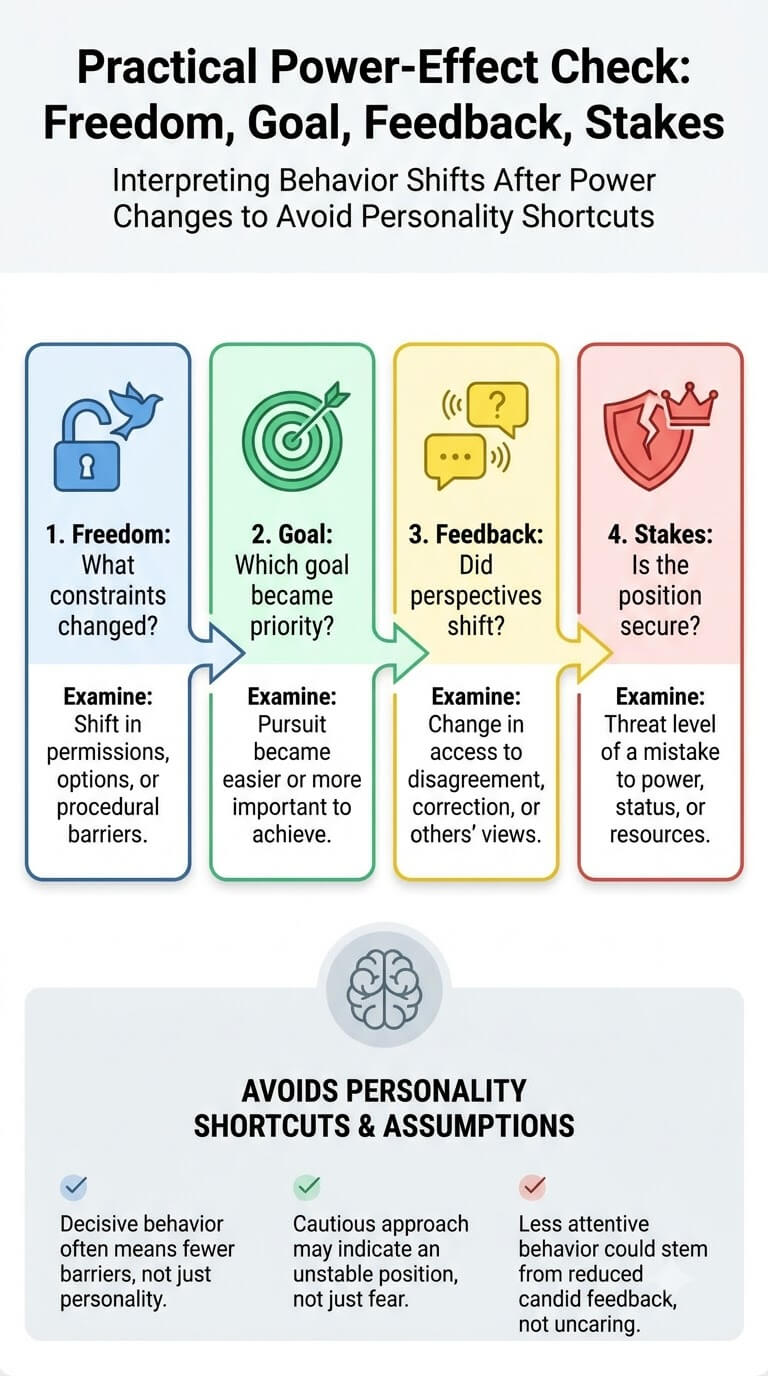
When someone’s behavior changes after gaining or losing power, four questions can make the shift easier to interpret.
| Question | What to examine |
|---|---|
| Freedom | What permissions, options, or constraints changed? |
| Goal | Which goal became easier or more important to pursue? |
| Feedback | Did access to disagreement, correction, or other people’s perspectives change? |
| Stakes | Is the position secure, or could a mistake threaten the person’s power, status, or resources? |
This framework avoids personality shortcuts. A more decisive person may simply have fewer procedural barriers. A more cautious power-holder may be protecting an unstable position. A less attentive decision-maker may be receiving less candid feedback rather than consciously caring less about people.
Power, Status, and Power Imbalance Answer Different Questions
The behavioral effects of power make the most sense when nearby concepts stay separate.
Social power explains the underlying relational capacity
The starting question is who can affect whose outcomes and how dependent each side is. The present topic begins after that structure is established and asks what those differences may do to attention, motivation, and behavior.
Status concerns respect and rank rather than control over outcomes
A high-status person may receive admiration and voluntary deference without controlling many resources. Status can influence behavior differently from power. For example, research has found that high status and high power can have different relationships with perspective-taking.
Power imbalance concerns the practical consequences of asymmetry
When one side has substantially fewer options, less ability to refuse, or greater retaliation risk, the issue is not only how power changes the power-holder’s psychology. The structure itself may constrain the lower-power person’s choices and require safeguards.
FAQ
These questions address the most common overgeneralizations about how power affects behavior.
Does power always make people selfish?
No. Power can make existing goals easier to pursue, which means self-interested goals may become more visible in some settings while responsibility or collective goals become more influential in others. Identity, accountability, incentives, role expectations, and current goals all matter. The evidence does not support a rule that everyone becomes selfish when they gain power.
Does power reduce empathy?
Some studies find reduced spontaneous perspective-taking or attention to others under higher power, but “power destroys empathy” is too broad. Social attention depends on current goals, responsibility, stability, and whether understanding others is useful to the role. Power-holders can be highly attentive when responsibility or accurate social information is made salient.
Does power make people take more risks?
Sometimes. Greater freedom, optimism, and approach motivation can make risky choices more attractive. But people may become more conservative when their powerful position feels unstable or when they are strongly motivated to protect it. Risk-taking is therefore a conditional effect rather than a fixed consequence of power.
Why do lower-power people sometimes monitor others more closely?
Because higher-power people’s reactions can have greater consequences. If another person controls evaluation, money, access, permission, or opportunities, monitoring that person’s expectations can be strategically useful. This increased attention should not automatically be interpreted as anxiety, submission, or lack of confidence.
Can accountability change how powerful people behave?
Yes, because accountability changes incentives and information. If a power-holder must explain decisions, face review, or depend on accurate input from others, ignoring other perspectives becomes more costly. Research also suggests that construing power as responsibility can improve social attention. Accountability does not guarantee good behavior, but it can change the conditions guiding it.
Key Takeaways
- Power changes behavior partly by changing dependence, constraint, freedom to act, and the consequences of other people’s reactions.
- Higher power is often associated with approach, action, goal focus, and confidence, but these are tendencies rather than guaranteed traits.
- Risk-taking, perspective-taking, and social attention depend strongly on context, role stability, goals, responsibility, and accountability.
- Lower power can increase monitoring of higher-power people because their evaluations or decisions have greater practical consequences.
- Power can increase instrumental attention to goal-relevant qualities in others under some conditions, but this should not be generalized into “power always dehumanizes.”
- The best evidence supports conditional models of power rather than the simple claim that power inevitably corrupts personality.
A useful next step is to look for what changed around the person, not just what changed inside them. Identify the new freedom, the active goal, the quality of feedback, and the stakes attached to keeping or losing the position. Those four factors usually explain more than saying that power simply “went to their head.”

Michael Reed is the Founder and Lead Writer at Psychology Exposed. He writes about human behavior, relationships, emotional patterns, self-awareness, and practical psychology topics using research-informed, easy-to-understand content.
Read More About Michael Reed: https://psychologyexposed.com/michael-reed/