

Two groups can have the same formal hierarchy and react to it very differently. In one classroom, students routinely question a professor and expect detailed explanations. In another, direct disagreement with the instructor may feel disrespectful even when the student sees a genuine problem. In one family, younger adults openly challenge older relatives. In another, age and seniority carry stronger expectations of deference.
Power distance psychology examines these expectations around unequal power. It asks how normal, acceptable, or appropriate people believe unequal authority should be, how much deference higher-ranking roles should receive, and how comfortable lower-ranking people feel speaking up, disagreeing, or participating in decisions. Power distance does not tell us whether a hierarchy exists. It tells us more about how people interpret and respond to unequal power within that hierarchy.
The concept is strongly associated with Geert Hofstede’s cross-cultural work, but it is easy to misuse. Country averages should not be treated as personality labels for every person from that country. Individuals within the same society can differ substantially, and measurement of cultural dimensions has important limitations. A useful modern approach treats power distance as a tendency or orientation that can appear at cultural, organizational, group, and individual levels rather than as a fixed national character.
Quick Answer

Power distance is the degree to which unequal power is expected, accepted, or treated as legitimate within a social setting. Higher power distance tends to involve more deference to authority and greater acceptance of unequal decision rights. Lower power distance tends to involve more expectation of participation and challenge. It is not the same as actual hierarchy, inequality, obedience, or abuse, and individuals can differ greatly within the same culture.
What Power Distance Means
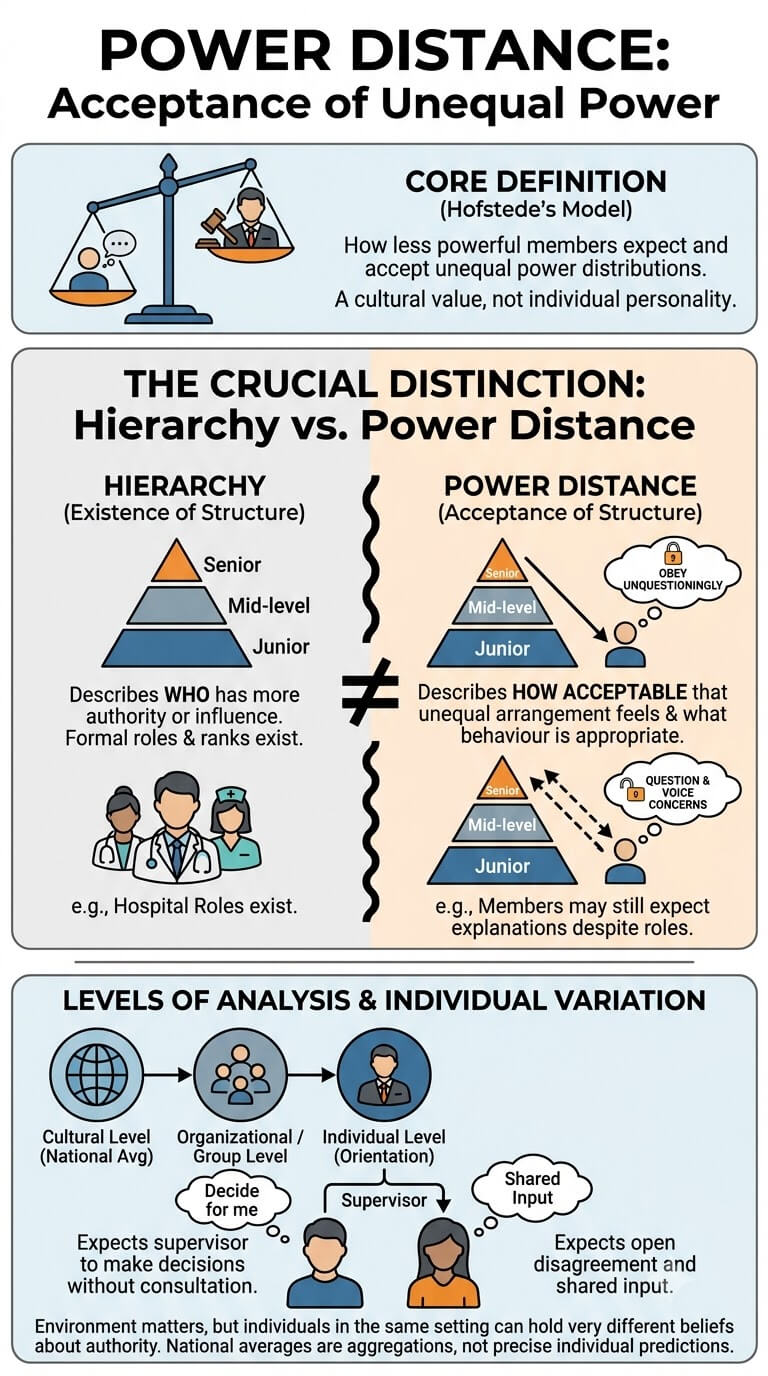
Power distance is usually discussed as a cultural value concerning unequal power relationships. Hofstede’s model describes it in terms of how less powerful members of institutions or groups expect and accept unequal distributions of power. Power distance is one part of the broader relationship among power, authority, status, and hierarchy.
In his overview of the Hofstede cultural dimensions model, Hofstede emphasizes that the dimensions operate at a level of aggregation and should not be confused with individual personality differences. That caution is especially important for power distance because national averages can sound more precise than they really are.
Power distance concerns acceptance and expectation, not the existence of hierarchy itself
A group can have unequal roles while members strongly question authority. A hospital has formal differences between senior physicians, junior clinicians, technicians, and patients, but people may still expect decisions to be explained and concerns to be voiced. Conversely, a relatively informal group may develop strong unwritten expectations that senior or respected members should not be challenged publicly.
The hierarchy describes who has more or less authority or influence. Power distance describes how acceptable that unequal arrangement feels and what behavior people believe is appropriate within it.
Power distance can be discussed at cultural, organizational, group, and individual levels
Early work often compared countries, but later research increasingly examined power distance orientation at the individual level. This matters because people living in the same country, organization, or family can hold very different beliefs about authority.
For example, one employee may believe supervisors should make decisions without much consultation, while a coworker in the same office may expect open disagreement and shared input. The broader environment matters, but it does not determine every individual’s values.
High vs Low Power Distance

High and low power distance are relative descriptions, not moral categories. Both can involve functional authority, and neither guarantees good or bad treatment.
| Higher power distance tendency | Lower power distance tendency |
|---|---|
| Unequal decision rights feel more expected or normal. | Unequal decision rights are more likely to require explanation or justification. |
| Higher-ranking people may receive more visible deference. | Lower-ranking people may be more comfortable challenging or questioning. |
| Centralized decisions may feel more appropriate. | Participation and consultation may feel more appropriate. |
| Open disagreement with authority can feel disrespectful or risky. | Open disagreement may be interpreted as normal discussion. |
| Status symbols and role differences may be more strongly emphasized. | Communication may be more informal across rank levels. |
Higher power distance does not mean people enjoy unfairness
Someone can accept strong authority while still caring deeply about fairness. The person may believe that legitimate roles should be unequal but also expect higher-ranking people to act responsibly, protect lower-ranking members, and follow role obligations.
Acceptance of hierarchy therefore should not be equated with acceptance of arbitrary mistreatment.
Lower power distance does not mean there is no authority
A low power distance setting can still have managers, teachers, judges, parents, or other decision-makers. The difference is that authority may be expected to explain decisions, invite relevant input, tolerate questioning, or minimize unnecessary status barriers.
Lower power distance is better understood as less acceptance of unquestioned inequality, not the elimination of roles.
How Power Distance Shapes Communication
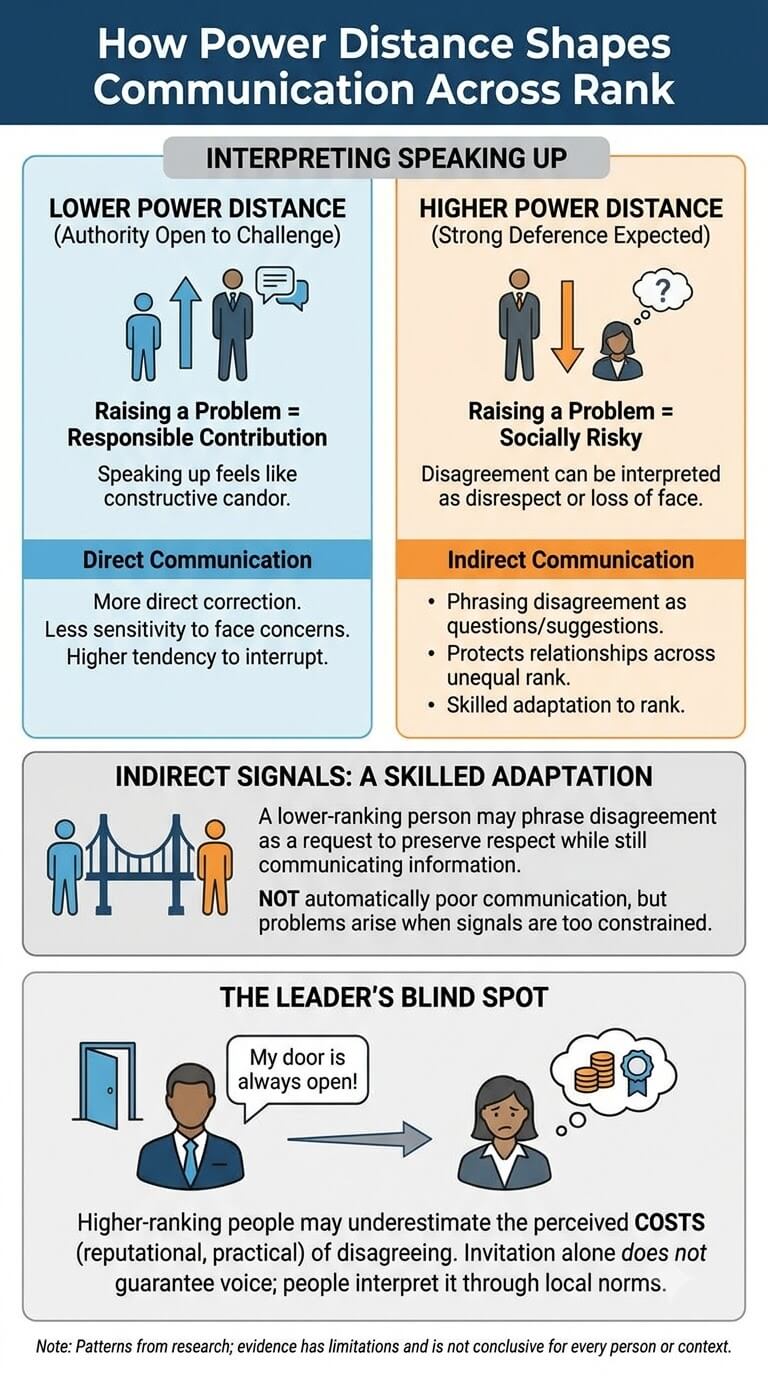
Power distance is especially visible in how people communicate across rank. The same sentence can be interpreted as constructive candor in one setting and inappropriate challenge in another.
Speaking up can feel like contribution or insubordination
When lower-ranking members believe authority should be open to challenge, raising a problem may feel responsible. When stronger deference is expected, the same action may feel socially risky because disagreement can be interpreted as disrespect or loss of face.
Research on cross-cultural communication has found associations between higher power distance and more indirect communication, greater sensitivity to face concerns, and lower tendencies to interrupt. A systematic and meta-analytic review of cultural values and communication reported these patterns while also warning that the available evidence had limitations and should not be treated as conclusive for every person or context.
Indirect communication can protect relationships across unequal rank
A lower-ranking person may phrase disagreement as a question, suggestion, or request rather than a direct correction. This can preserve respect while still communicating important information.
Indirectness is not automatically poor communication. In some contexts, it is a skilled adaptation to the social meaning of rank. Problems arise when indirect signals become so constrained that essential information never reaches the person who needs it.
Higher-ranking people may underestimate how difficult it is to disagree
A leader may sincerely say, “My door is always open,” while lower-ranking members still believe that disagreement carries reputational or practical cost. The authority figure experiences the relationship from a position with fewer consequences for speaking freely.
Understanding power distance helps explain why invitation alone does not guarantee voice. People interpret the invitation through local norms about what happens when authority is challenged.
Power Distance and Speaking Up
Speaking up is one of the clearest places where power-distance expectations matter because voice requires a lower-ranking person to introduce information that may challenge existing decisions.
Individual power distance orientation can differ inside the same group
Research on individual power distance orientation has shown that people within and across countries vary in how they respond to hierarchy. In one cross-cultural study, individual power distance orientation moderated reactions to transformational leadership, while country differences did not account for the pattern in a simple way.
This is a useful reminder that a country label is a weak substitute for measuring what an individual actually believes.
Speaking up depends on more than power distance
People also consider psychological safety at work, expected consequences, relationship quality, expertise, local norms, and whether their input is likely to matter. A 2026 study of teachers found that power distance orientation moderated links between psychological safety, voice self-efficacy, and speaking up, reinforcing the idea that hierarchy beliefs interact with the surrounding climate rather than operating alone.
Recent research on teacher voice and power distance orientation supports that conditional view in an educational setting. One study does not establish a universal cultural rule, but it shows why power distance is better treated as one factor in a larger speaking-up system.
Conversely, someone who values equality may remain silent if retaliation is likely. Power distance is one influence among several, not a complete explanation of voice behavior.
Power Distance in Families
Families teach ideas about authority long before people enter workplaces or institutions. Age, caregiving responsibility, financial control, seniority, and tradition can all shape expectations about who should decide and who should defer.
Age and seniority can carry different meanings
In some families, older relatives are expected to receive strong deference even when younger members possess more relevant knowledge on a particular issue. In others, age receives respect but not automatic decision authority.
The psychological question is not whether respect for elders is good or bad. It is whether seniority is expected to translate into unequal decision rights and how much challenge is considered appropriate.
Family power distance can vary across generations
Parents and adult children may have learned different expectations about obedience, privacy, independence, or decision-making. A parent may interpret direct disagreement as disrespect, while the adult child interprets the same conversation as ordinary autonomy.
Many family conflicts about “tone” are partly conflicts about what rank is supposed to mean.
Strong family authority is not automatically coercive control
A family can maintain clear parental or caregiving authority while still respecting boundaries and increasing autonomy appropriately. The safety context changes when authority is enforced through credible threats, isolation, financial control, humiliation, stalking, retaliation, or violence.
Power distance describes expectations about inequality. It should never be used to excuse unsafe behavior as merely “cultural.”
Power Distance in Education
Education makes authority highly visible because teachers and students occupy different roles, yet societies and institutions differ in what students are expected to do with that difference.
Questioning a teacher can signal engagement or disrespect
A student may believe that challenging an explanation shows intellectual engagement. Another may have learned that publicly correcting a teacher violates proper role boundaries.
Neither reaction can be understood from confidence alone. The student’s expectations about authority shape what behavior feels socially available.
Participation norms can change without removing teacher authority
A classroom can preserve the teacher’s responsibility for grading, safety, and curriculum while explicitly inviting questions and disagreement about ideas. This reduces ambiguity about whether voice is allowed.
The point is not to make all educational relationships equal. It is to separate necessary role differences from unnecessary silence.
Power Distance in Work and Organizations
Organizations often combine formal hierarchy with local norms about how that hierarchy should be expressed. Two companies with similar reporting structures can feel very different because one expects visible deference while the other normalizes direct challenge.
Centralization and consultation are not the same as competence
A centralized structure may place more decisions with senior roles. That can be appropriate when responsibility must be clear, but it does not mean senior people always possess the best information.
Lower-ranking employees often hold local knowledge about customers, operations, or technical problems. A high power distance climate can become costly when rank prevents that information from moving upward.
Informality can hide power instead of eliminating it
An organization may use first names, casual dress, and open offices while still punishing disagreement with senior people. Surface informality is not proof of low power distance.
The stronger test is behavioral: can lower-ranking members question decisions, report problems, or offer contradictory evidence without disproportionate social or practical cost?
Status Signals and Power Distance
Power distance can influence how strongly groups emphasize symbols of rank. Titles, office locations, seating arrangements, dress, honorifics, and access rules can all communicate hierarchy.
Status symbols can clarify roles
Visible rank can make responsibility easier to identify. A uniform may show who handles safety. A title may clarify who can approve a particular decision. Formal address may communicate respect within a cultural tradition.
Status symbols can also increase social distance
When symbols strongly separate higher and lower positions, lower-ranking people may become more cautious about spontaneous communication. The symbol does not cause silence by itself, but it can reinforce expectations about who may speak freely.
The same symbol may therefore feel reassuring in one setting and intimidating in another depending on the surrounding norms.
Power Distance vs Hierarchy, Authority, and Inequality

These concepts overlap but answer different questions.
| Concept | Core question |
|---|---|
| Power distance | How expected or acceptable is unequal power here? |
| Hierarchy | How are unequal ranks or influence organized? |
| Authority | Who is recognized as having a legitimate right to direct or decide? |
| Power | Who can affect valued outcomes? |
| Inequality | Who has unequal resources, rights, opportunities, risk, or access? |
Hierarchy can exist even when power distance is low
A hospital, school, or emergency team may need clear role differentiation. Members can still expect questions, explanations, and challenges when relevant. Formal hierarchy and low tolerance for arbitrary authority can coexist.
High power distance can exist without extreme material inequality
A family may have relatively equal material resources while strongly expecting younger members to defer to elders. Power distance concerns beliefs about unequal authority, not only money or wealth. Accepting unequal authority is different from experiencing an actual power imbalance in which one side has substantially fewer options or greater dependence.
Authority can be legitimate in both high and low power distance settings
The difference lies partly in how authority is expected to behave. Higher power distance may support more unilateral decision-making. Lower power distance may place stronger expectations on consultation or explanation.
Power Distance Is Not the Same as Obedience
Obedience refers to behavior in response to an authority’s command. Power distance is a broader orientation toward unequal authority relationships.
A person can value hierarchy and still refuse a specific command
Someone may believe teachers, parents, or managers deserve substantial authority while refusing an instruction they consider unsafe, immoral, illegal, or outside the role’s scope.
A person can obey despite disliking hierarchy
Compliance can occur because alternatives are limited, consequences are serious, or the person lacks power to resist. That behavior does not prove the person accepts unequal power as legitimate.
This distinction prevents observed compliance from being mistaken for cultural approval.
Country Averages Are Not Individual Personalities

Power distance is often presented through national rankings, which makes stereotyping tempting. The evidence does not justify treating country averages as precise descriptions of individuals.
Within-country variation can be very large
A large multilevel meta-analysis of individual and country variation in cultural values reported that a substantial majority of variation could reside within countries rather than between them. Individual characteristics and social conditions also related to cultural values.
This means two people from the same country may differ more from one another than a simple national score suggests.
Culture changes over time
Economic development, education, migration, institutions, generational change, media, and organizational experience can all shape beliefs about authority. Cultural dimensions should not be treated as permanent national DNA.
Subcultures and settings matter
A military organization, technology startup, religious community, university department, and extended family within the same country can express different expectations about authority. National culture is only one layer.
Measurement Limitations Matter
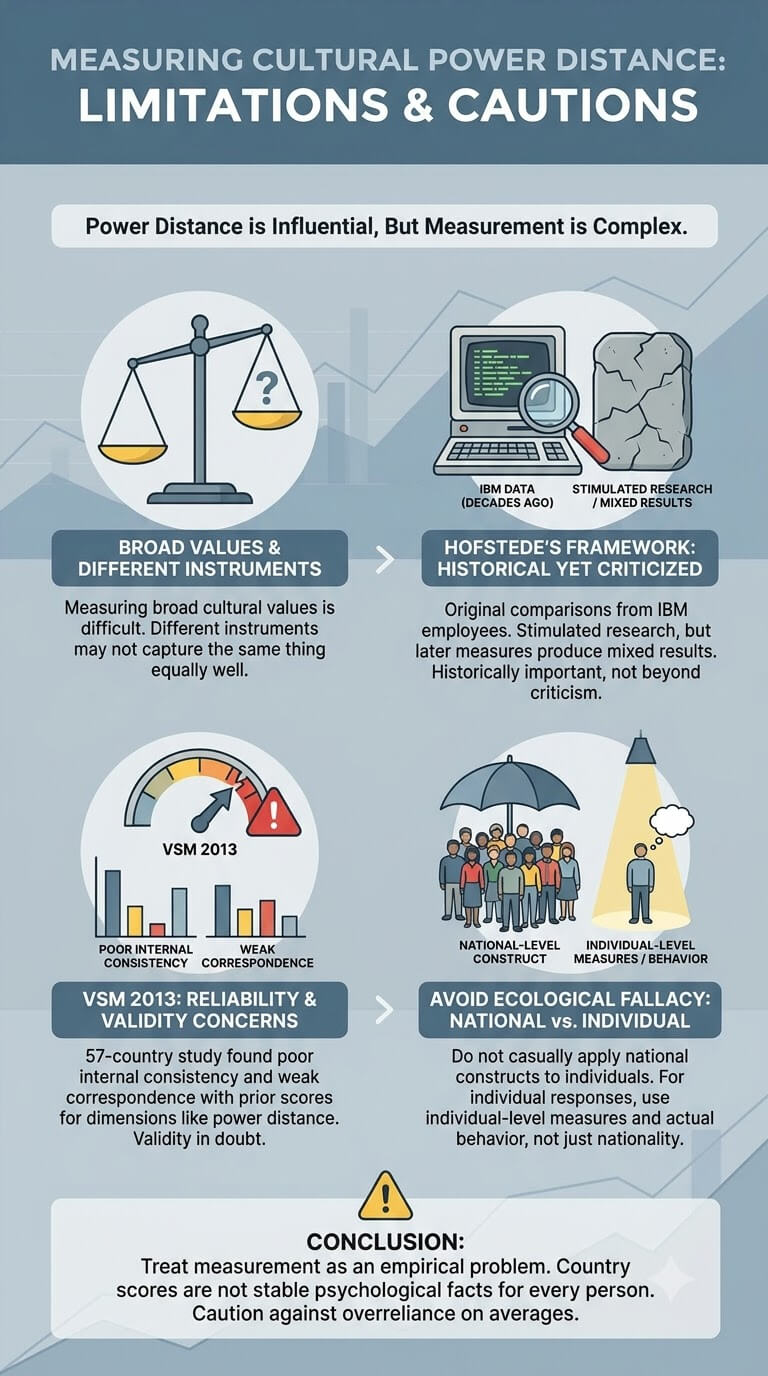
Power distance is influential, but measuring broad cultural values is difficult. Different instruments may not capture the same thing equally well.
The Hofstede framework is historically important, not beyond criticism
Hofstede’s original national comparisons emerged from data collected among IBM employees decades ago. The framework stimulated enormous research, but later measures and replications have produced mixed results.
VSM 2013 has shown reliability and validity concerns
A 57-country study testing Hofstede’s VSM 2013 cultural-dimension scales found poor internal consistency and weak correspondence with prior country scores for several dimensions, including power distance. The authors concluded that the instrument’s validity was in doubt and cautioned against overreliance on country averages.
This does not make the concept useless. It means measurement should be treated as an empirical problem rather than assuming every country score is a stable psychological fact.
National-level constructs should not be casually applied to individuals
A construct developed to compare groups can create an ecological fallacy when used to infer an individual’s beliefs directly. If the question is how one person responds to authority, individual-level measures and actual behavior are more informative than nationality alone.
Individual Power Distance Orientation
Modern research often examines individual beliefs about inequality and authority directly. This approach makes the concept more useful for everyday psychology.
People differ in how much inequality they see as appropriate
One person may prefer strong centralized leadership and clear status boundaries. Another may feel more comfortable when authority is approachable and decisions are shared. These preferences can exist among people from the same family, company, generation, or country.
Orientation can change across roles
A person may expect strong deference in a safety-critical emergency but prefer egalitarian discussion in a creative project. They may accept parental authority with young children while expecting near-equal decision rights among adult siblings.
That flexibility is another reason not to treat power distance as a fixed personal trait.
Five Everyday Power-Distance Scenarios
These examples show how power distance appears through expectations rather than simply through visible rank.
Family: disagreement with an older relative
Situation: A younger adult directly corrects an older family member during dinner. What one person may feel: that the correction is normal conversation. What another may feel: that public challenge violates proper respect. What it may mean: the conflict partly concerns expectations about age-based authority. What to do next: separate the factual issue from the preferred way of expressing disagreement.
Classroom: asking a professor to justify a rule
Situation: A student asks why attendance is mandatory. What the student may feel: they are requesting reasonable justification. What the instructor may feel: that the student is challenging legitimate authority. What it may mean: the parties differ in expectations about explanation and deference. What to do next: clarify whether questions are welcome while preserving the instructor’s actual decision rights.
Workplace: a junior employee identifies a serious risk
Situation: A junior employee spots a technical problem in a senior person’s plan. What the employee may feel: uncertain whether direct contradiction is safe. What it may mean: the hierarchy matters because upward voice can carry interpersonal risk. What to do next: use established escalation or review channels when available rather than relying only on informal courage.
Healthcare: expertise and participation
Situation: A patient expects the clinician to choose the treatment without much discussion, while another patient expects shared decision-making. What it may mean: people differ in how much authority they want experts to exercise. What to do next: clarify preferences and the boundaries between professional expertise and the patient’s own values and consent.
Online community: informal language but strong authority norms
Situation: Moderators use casual language and interact socially with members, but public criticism of moderation decisions leads to social exclusion. What it may mean: surface informality coexists with strong expectations of deference. What to do next: evaluate actual consequences for challenge rather than judging the culture by tone alone.
A Four-Part Power-Distance Check: Expectation, Voice, Boundary, Consequence
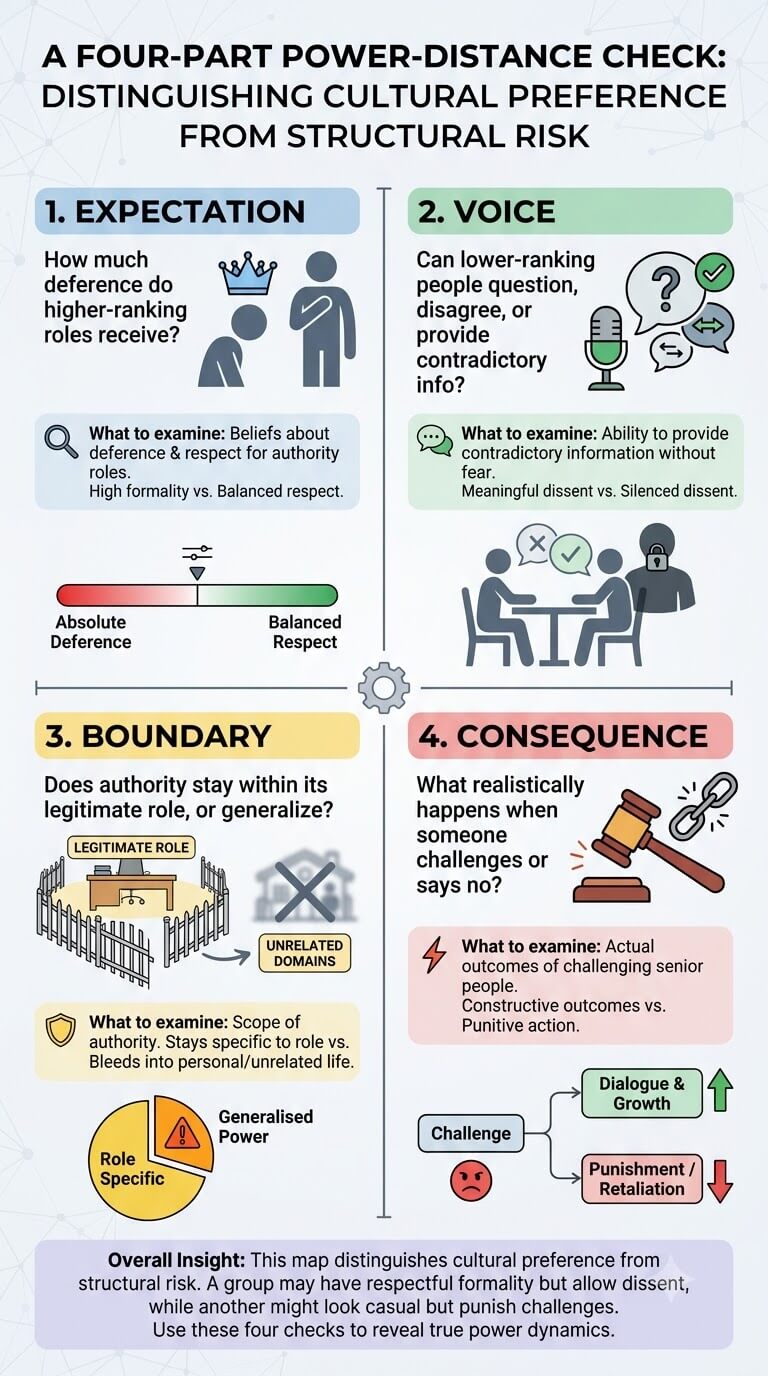
When a setting feels unusually hierarchical, four questions can reveal whether power-distance expectations are part of the experience.
| Question | What to examine |
|---|---|
| Expectation | How much deference do people believe higher-ranking roles should receive? |
| Voice | Can lower-ranking people question, disagree, or provide contradictory information? |
| Boundary | Does authority stay within its legitimate role, or does rank generalize into unrelated domains? |
| Consequence | What realistically happens when someone challenges or says no? |
This map distinguishes cultural preference from structural risk. A group may prefer respectful formality while still allowing meaningful dissent. Another may look casual but punish anyone who challenges senior people.
How to Communicate Across Different Power-Distance Expectations
Differences in authority norms can create unnecessary conflict when each side assumes its own communication style is universal.
Make decision rights explicit
Clarify who decides, who advises, what requires consultation, and what can be reviewed. Role clarity reduces the need to infer authority from tone or status symbols.
Make disagreement procedures explicit
Instead of saying only “speak up anytime,” explain how concerns should be raised, what happens after they are raised, and what protection exists against retaliation.
Do not confuse deference with agreement
A polite or indirect response may reflect respect for rank rather than genuine agreement. Higher-ranking people may need to ask specific questions and create space before assuming silence means consent.
Do not confuse directness with disrespect
In lower power distance settings, direct disagreement may signal engagement rather than hostility. Interpreting every challenge as a status attack can turn useful information into conflict.
Power Distance Does Not Excuse Harmful Behavior
Cultural expectations can explain why authority is expressed differently, but explanation is not justification. Threats, humiliation, stalking, financial control, isolation, retaliation, violence, or credible fear should not be dismissed as “high power distance.”
Power distance is a descriptive concept about beliefs concerning unequal authority. It should never be used to deny a person’s safety, consent, legal rights, or ability to seek independent support.
Where Power Distance Fits With Hierarchy and Authority
Three concepts are especially easy to collapse into one another.
Hierarchy is the structure
Hierarchy describes how unequal positions are arranged. It can be steep or flat, formal or informal, stable or fluid.
Authority is the recognized decision right
Authority asks whether a role or institution is seen as legitimately entitled to direct or decide within a particular scope.
Power distance is the expectation around inequality
Power distance asks how normal, appropriate, or acceptable those unequal authority relationships feel and how much challenge or participation people expect across rank.
The same hierarchy can therefore be experienced differently by people with different power distance orientations.
FAQ
These questions address the most common misunderstandings about power distance.
Is power distance the same as hierarchy?
No. Hierarchy describes the actual arrangement of unequal rank or influence. Power distance concerns how expected or acceptable unequal power is. A group can have a clear hierarchy while encouraging open challenge, or have relatively informal roles while maintaining strong unwritten expectations of deference.
Does high power distance mean people blindly obey authority?
No. Higher power distance means unequal authority is more likely to be accepted or expected, but people can still reject a specific command they see as unsafe, immoral, illegal, or outside the role’s legitimate scope. Obedience is a behavior; power distance is a broader orientation toward unequal authority.
Can two people from the same country have very different power distance beliefs?
Yes. Within-country variation can be substantial. Family background, education, generation, profession, organizational culture, socioeconomic conditions, and personal experience can all shape how someone views authority. Country averages should not be treated as individual personality profiles.
Is low power distance always better?
No. Lower power distance can support participation and challenge, but some situations benefit from clear responsibility and rapid decision-making. The more useful question is whether authority is appropriate to the task, whether relevant information can move upward, and whether lower-ranking people retain safe ways to question errors or overreach.
Can power distance change over time?
Yes. Cultural values and authority expectations can shift across generations, institutions, roles, and social conditions. Individuals may also behave differently depending on the setting. Someone may prefer centralized authority during an emergency while expecting collaborative decision-making in ordinary situations.
Key Takeaways
- Power distance concerns how expected, acceptable, or legitimate unequal power feels, not simply whether hierarchy exists.
- Higher power distance generally involves more deference and acceptance of unequal decision rights; lower power distance generally involves more expectation of participation and challenge.
- Power distance can shape speaking up, directness, status signals, consultation, and how disagreement with authority is interpreted.
- Country averages are not individual personalities, and within-country variation can be very large.
- Hofstede’s framework is historically influential, but measurement limitations and ecological fallacy make simplistic national labeling inappropriate.
- Power distance should never be used to excuse threats, humiliation, retaliation, coercion, violence, or violations of consent and safety.
A useful next step is to examine a real setting through four questions: What level of deference is expected, how safely can lower-ranking people speak, where does authority stop, and what happens when someone challenges it? Those answers reveal more about lived power distance than a national score or stereotype ever could.

Michael Reed is the Founder and Lead Writer at Psychology Exposed. He writes about human behavior, relationships, emotional patterns, self-awareness, and practical psychology topics using research-informed, easy-to-understand content.
Read More About Michael Reed: https://psychologyexposed.com/michael-reed/