
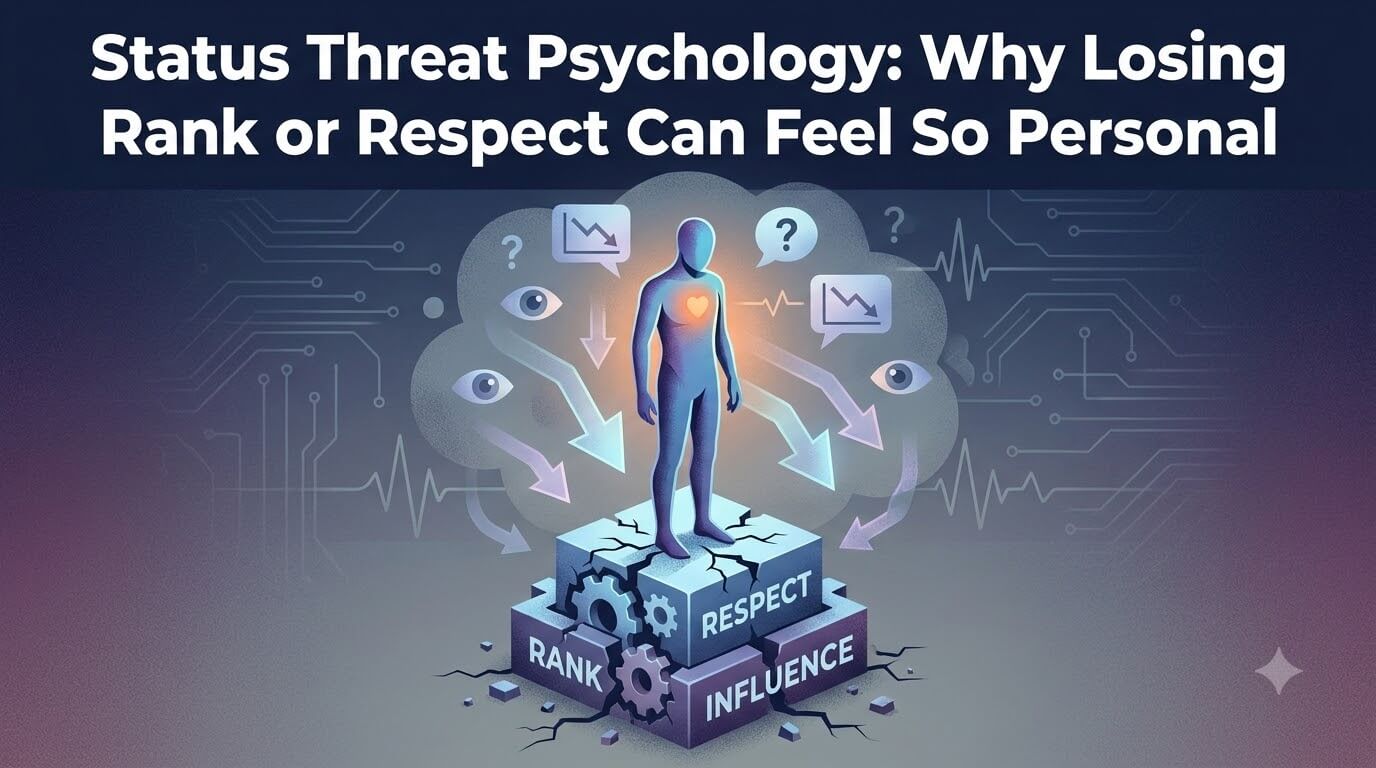
A correction in private can feel manageable, while the same correction in front of a group can feel much bigger. Being left out of a decision may seem like more than inconvenience if it suggests that your opinion no longer carries weight. A talented newcomer can trigger discomfort in an established member even when nobody has actually taken anything away. In each case, the event may be interpreted as a possible change in social standing.
Status threat psychology examines that interpretation. A status threat occurs when a person perceives that their rank, respect, reputation, prestige, influence, or valued position may be reduced. The threat can be based on real evidence, ambiguous cues, or an exaggerated prediction about what other people will think. That is why the emotional reaction can sometimes be much larger than the objective change in status.
Status threat is not the same as shame, humiliation, rejection, low self-esteem, defensiveness, or ordinary conflict. Those experiences can overlap, but each points to a different psychological question. The most useful task is to identify what social standing seems to be at risk, whether it has actually changed, and what response would protect dignity without escalating a situation unnecessarily.
Quick Answer
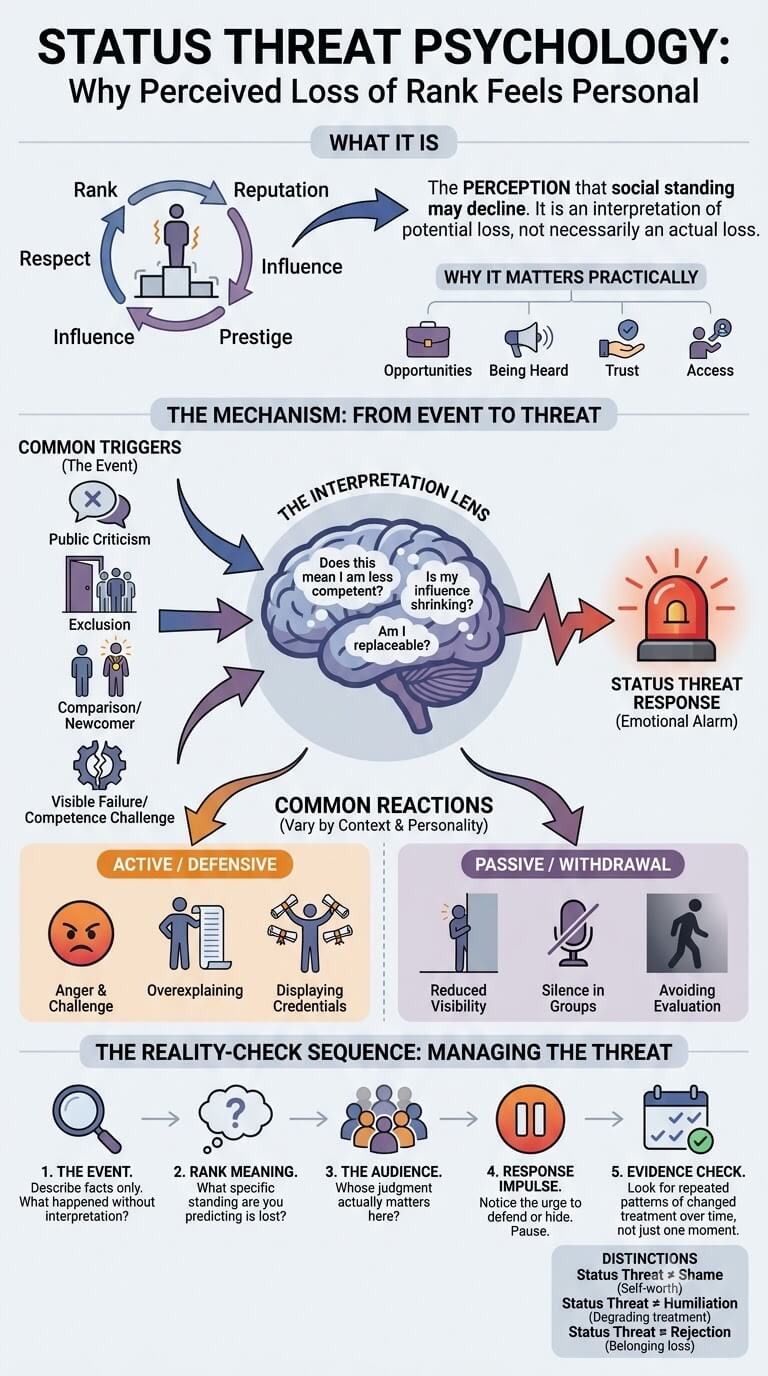
Status threat is the perception that a person’s social rank, respect, reputation, prestige, or influence may decline. It can be triggered by criticism, exclusion, comparison, public failure, being ignored, or challenges to competence. Reactions may include anger, withdrawal, overexplaining, impression management, or attempts to restore standing, but these responses vary and do not prove that status was objectively lost.
What Status Threat Means
Status itself concerns socially recognized standing. Status threat concerns the possibility of losing some of that standing. The threat may involve being seen as less competent, less respected, less central, less influential, or less deserving of deference than before. Status threat is one specific process within the broader psychology of power, status, and hierarchy.
Research on social status emphasizes that people track relative rank because status shapes attention, evaluation, and social interaction. A review of how social status shapes person perception highlights that rank is inferred across different domains and depends heavily on context. A threat therefore makes the most sense when the threatened dimension is named.
A threat to rank is not necessarily an actual loss of rank
Suppose a manager challenges one of your ideas during a meeting. One interpretation is factual: the idea has a weakness. Another is social: everyone now thinks you are less capable. The first may be true without the second being true.
Status threat begins with the perceived social meaning. The mind moves from “my idea was challenged” to “my standing may have fallen.” Sometimes that inference is accurate. Sometimes it is a prediction rather than an observed change.
Status threat is relational and domain-specific
A person may care deeply about being respected for technical judgment but care little about being seen as fashionable. A parent may feel secure in their family role but sensitive about being treated as less knowledgeable than an adult child. A musician may tolerate criticism of organization skills while reacting strongly to criticism of musical ability.
The threatened domain matters because people do not carry one single status score across all of life. Standing is often specific to a group, role, or valued ability.
Why Status Threat Can Feel So Personal
Social rank is not just an abstract number. It can affect who is listened to, trusted, consulted, included, or given opportunities. That gives status cues practical and emotional significance.
Standing influences how other people respond
If a group treats someone as competent, that person may receive more attention and responsibility. If their standing declines, they may worry about losing voice, influence, access, or future opportunity.
This does not mean every status concern is rational or every hierarchy is important. It means that reputation can have real social consequences, so people often monitor signals about how they are being evaluated.
Social evaluation can activate a broader threat response
Laboratory research on acute threat to the social self found that situations involving negative social evaluation were associated with changes in shame, social self-esteem, and cortisol responses. This work concerns social-evaluative threat broadly rather than status threat alone, but it helps explain why public evaluation can feel more consequential than an identical task completed without an evaluating audience.
The practical implication is modest: an audience can change the meaning of feedback. It should not be taken to mean that every uncomfortable evaluation causes a harmful stress response or lasting psychological damage.
People may protect reputation before they know whether it is actually damaged
Because reputation depends on other people’s perceptions, uncertainty can be difficult to resolve immediately. A person may begin defending competence, explaining motives, or trying to reassert expertise before anyone has actually lowered their opinion.
This anticipatory response is one reason status threat can escalate quickly. The attempt to protect standing may itself become more visible than the original mistake.
Common Triggers of Status Threat

A trigger becomes status-relevant when a person interprets it as evidence that their social standing may decline. The same event may threaten one person and barely register for another.
| Trigger | Possible status meaning | What it does not automatically prove |
|---|---|---|
| Public criticism | “People may see me as less competent or worthy of respect.” | That the audience actually changed its view. |
| Being excluded from a decision | “My influence or importance may be shrinking.” | That exclusion was deliberate or rank-based. |
| A high-performing newcomer | “My position as the expert may be less secure.” | That status is a zero-sum resource. |
| Being ignored or interrupted repeatedly | “My voice may carry less weight here.” | That every interruption reflects rank. |
| Visible failure | “My reputation may be damaged.” | That one failure defines long-term standing. |
| Challenge to competence | “A quality that supports my status is being questioned.” | That the challenge is hostile or inaccurate. |
Criticism becomes more threatening when it changes the audience
Private feedback has an evaluator. Public feedback has an evaluator plus witnesses. If a person believes those witnesses are important to their standing, the event may feel like a reputation problem rather than a simple correction.
That does not make public criticism automatically inappropriate. Sometimes public discussion is necessary. The question is whether the audience adds a realistic reputational consequence or only a feared one.
Exclusion can signal belonging loss, rank loss, or both
Being left out can hurt because a person values connection. It can also threaten status when exclusion suggests that their input is no longer considered important. These meanings are related but different.
Asking “Am I worried about losing the relationship, or about losing my position in the group?” can clarify what the event represents.
Comparison matters most when the other person competes on a valued dimension
A skilled newcomer is more likely to feel status-relevant when they excel in the exact domain that supports someone’s standing. If a person is known as the strongest technical problem-solver, another strong technical problem-solver may feel more threatening than someone with an unrelated talent.
This does not mean rivalry is inevitable. Status does not have to be treated as strictly zero-sum, and groups can respect multiple people for overlapping strengths.
The Event to Reality-Check Sequence

A useful way to slow status threat is to separate five stages: the event, the rank meaning attached to it, the audience, the response impulse, and the evidence about whether standing actually changed.
1. Event: what happened without interpretation?
Describe the observable event first. “My proposal was rejected.” “I was not invited to one meeting.” “A colleague corrected a factual error.” “Nobody responded when I offered an idea.” This reduces the chance that the conclusion is hidden inside the description.
2. Rank meaning: what change in standing are you predicting?
Complete the sentence: “This could mean people now see me as less…” The missing word might be competent, respected, central, experienced, important, influential, or trustworthy.
If you cannot name the threatened standing, the reaction may be about something else, such as belonging, fairness, embarrassment, workload, or disagreement.
3. Audience: whose judgment actually matters here?
Status is social, so ask who supposedly changed their view. Was the event private? Did relevant people witness it? Do those people control any meaningful opportunity or relationship? Are you imagining a broad reputational collapse from one person’s opinion?
4. Response: what are you tempted to do to restore standing?
The impulse may be to argue harder, explain everything, withdraw, display expertise, criticize a rival, seek reassurance, mention past accomplishments, or act unaffected. Naming the impulse creates space between threat and reaction.
5. Reality check: what evidence shows rank actually changed?
Look for observable shifts across time: less consultation, reduced responsibility, changed access, repeated exclusion, clear reputational feedback, or different treatment by several people. One awkward moment may matter, but it is weaker evidence than a sustained pattern.
Common Responses to Status Threat
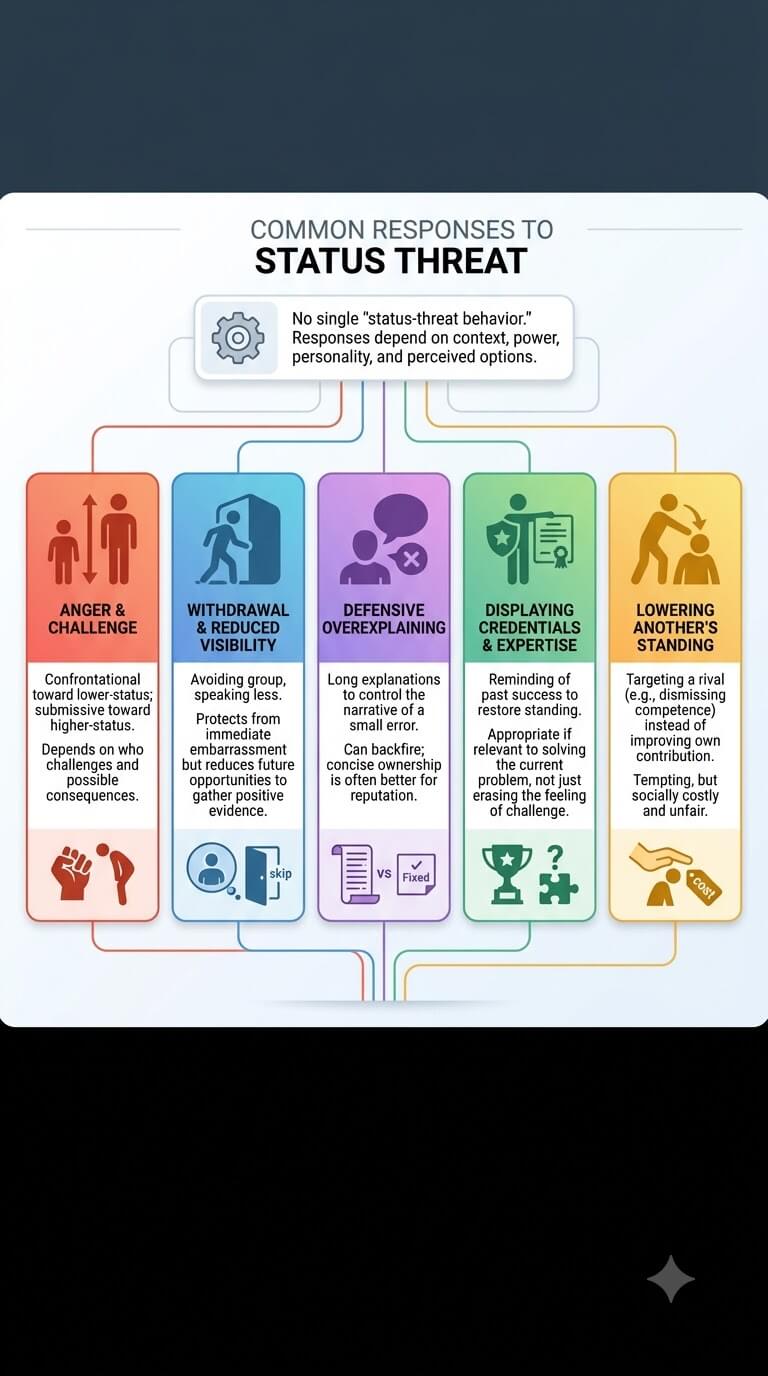
There is no single “status-threat behavior.” Responses depend on personality, context, actual power, audience, perceived options, and whether the threat comes from someone higher or lower in rank.
Anger and challenge
Some people respond by arguing, confronting, correcting the other person, or asserting competence more strongly. Research on social rank strategies under threat found that feeling criticized predicted different reactions depending on relative status, including more quarrelsome behavior toward lower-status interaction partners and more submissive behavior toward higher-status partners in the sampled work interactions.
This does not mean status threat always causes aggression. It shows that the direction of response can depend on who issued the challenge and what consequences seem possible.
Withdrawal and reduced visibility
Another response is to speak less, avoid the group, skip opportunities, or reduce exposure to further evaluation. Withdrawal may protect against another embarrassing moment, but it can also reduce opportunities to gather evidence that the feared status loss is smaller than expected.
Overexplaining and defensive impression management
A person may provide a long explanation for a small error because the real concern is not the error itself. They are trying to control what the mistake says about them.
This can backfire if the explanation sounds like refusal to take responsibility. A shorter response such as “I missed that detail. Here is the correction” may protect reputation better when the underlying issue is straightforward.
Displaying credentials, accomplishments, or expertise
Status restoration can involve reminding others of past success, emphasizing one’s role, or demonstrating competence. This is not inherently unhealthy. Providing relevant evidence of expertise can be appropriate. The question is whether the display helps solve the current problem or mainly attempts to erase the feeling of being challenged.
Trying to lower another person’s standing
Some restoration attempts target the perceived rival instead of repairing one’s own contribution. Dismissing a newcomer’s competence, spreading negative interpretations, or finding ways to exclude a challenger can become socially costly and unfair. Attempts to protect rank can also draw on different social strategies, including patterns related to dominance and prestige.
A status threat explains why such behavior may feel tempting. It does not justify it.
Status Threat vs Humiliation, Shame, Rejection, and Defensiveness

These experiences can occur together, but keeping them separate improves interpretation.
| Experience | Core concern | How it differs from status threat |
|---|---|---|
| Status threat | “My rank, respect, reputation, or influence may decline.” | The focal concern is social standing. |
| Humiliation | “I was publicly lowered, degraded, or made small by someone.” | Often includes unwanted public exposure and perceived degrading treatment. |
| Shame | “Something about me feels bad, inadequate, or unworthy.” | More directly concerns negative self-evaluation. |
| Rejection | “I may lose belonging, acceptance, or connection.” | The primary threatened resource is inclusion rather than rank. |
| Defensiveness | “I need to protect myself from blame, criticism, or threat.” | A response style that can arise from many kinds of threat. |
Humiliation usually adds degrading treatment or public lowering
Humiliation is especially relevant when a person feels deliberately lowered in front of others. Research on humiliation and public exposure suggests that audience reactions and threats to important aspects of the self can intensify humiliating experiences.
A factual correction can trigger status threat without being humiliating. Mocking someone publicly to make them look inferior is a different event.
Shame focuses more directly on the self
Status threat may produce shame, but the concepts are not identical. A person can fear reputation loss while privately believing they are still competent. Another can feel ashamed after a private mistake that nobody else knows about.
Rejection threatens belonging more directly
Exclusion can communicate both “you are not included” and “you are not important.” The first is a belonging threat. The second is a status threat. Clarifying which meaning hurts more can change what information is needed next.
Perceived Threat Can Be Larger Than the Objective Status Change
People do not receive a live dashboard showing how much respect everyone has for them. They infer standing from incomplete social evidence. That creates room for overestimation.
One criticism can be generalized into a global reputation judgment
A person may hear “this analysis is incomplete” and predict “everyone thinks I am incompetent.” The social conclusion is much broader than the actual feedback.
A useful correction is to narrow the claim: Who said it? About what? In front of whom? Was the criticism about one action, one skill, or your overall role? Has anyone’s behavior toward you actually changed?
Prior insecurity can make ambiguous cues feel more rank-relevant
If someone already feels uncertain about their standing, an unanswered message or missed invitation may carry more meaning. That does not make the feeling fake. It means the cue is being interpreted against an existing expectation of possible rank loss.
The best response is not to dismiss the concern but to look for stronger evidence before acting as though the feared status change is established fact.
High status can create something to lose
People who hold established standing may also become sensitive when a valued position feels less secure. A challenge can matter precisely because the role, reputation, or expertise has been central to how the group responds to them.
Status threat is therefore not limited to people with low rank. The content of the threat changes depending on where someone currently stands and what they believe could be lost.
Constructive Ways to Respond Without Turning the Moment Into a Rank Contest
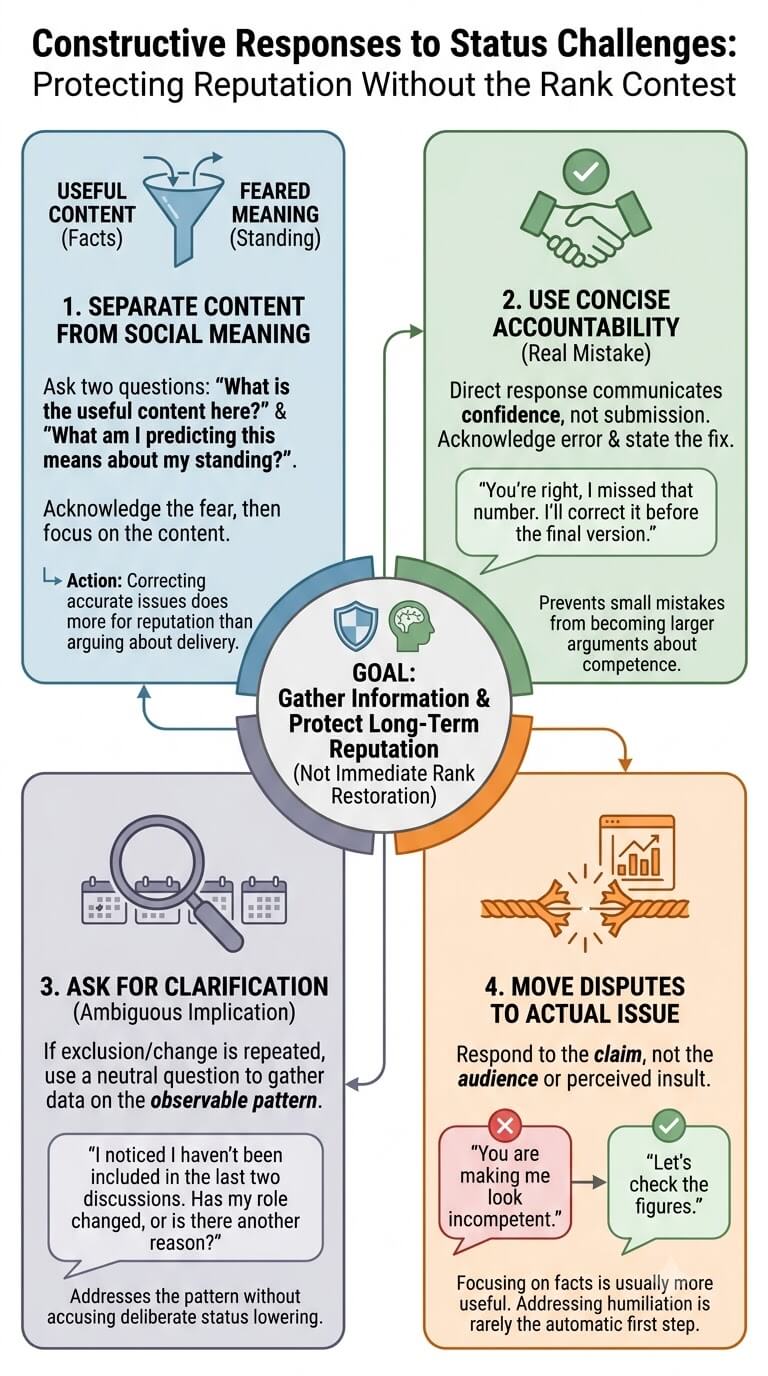
A status-relevant event often creates pressure to restore standing immediately. The most effective response may instead be the one that gathers information and protects long-term reputation.
Separate the content of feedback from the feared social meaning
Ask two questions: “What is the useful content here?” and “What am I predicting this means about my standing?” If the feedback is accurate, correcting the issue may do more for reputation than arguing about how it was delivered.
Use concise accountability when the mistake is real
A direct response can communicate confidence without pretending the error did not happen: “You’re right, I missed that number. I’ll correct it before we send the final version.”
This is different from submission. It prevents a small mistake from becoming a larger argument about competence.
Ask for clarification when rank implications are genuinely ambiguous
If exclusion or changed responsibility is repeated, a neutral question can gather data: “I noticed I haven’t been included in the last two planning discussions. Has my role changed, or is there another reason?”
The question addresses the observable pattern without accusing the other person of deliberately lowering your status.
Move public disputes toward the actual issue
When possible, respond to the claim rather than the audience. “Let’s check the figures” is usually more useful than “You are making me look incompetent.” The second statement may be appropriate if humiliation is deliberate, but it should not be the automatic interpretation of disagreement.
When Status Restoration Becomes Risky
Attempts to protect standing become more concerning when preserving rank matters more than fairness, accuracy, or other people’s safety.
Retaliating against criticism
Punishing someone simply for raising a legitimate concern can convert a status-sensitive moment into a power problem. This is especially serious when the higher-ranked person controls evaluations, money, access, or opportunities.
Humiliating a perceived rival
Trying to regain standing by publicly lowering another person may produce short-term compliance while damaging trust and increasing conflict. It also turns status restoration into an imposed-cost strategy rather than a competence-based one.
Blocking information that could lower one’s standing
A person may hide errors, discourage questions, or dismiss evidence because accepting it feels reputationally dangerous. In high-stakes settings, protecting rank this way can become more costly than the original mistake.
Using threats or fear to prevent challenge
When a person uses threats, stalking, coercion, financial control, isolation, humiliation, retaliation, violence, or credible fear to prevent disagreement, the situation should not be treated as an interesting status competition. Safety and independent support take priority over proving who is right.
Five Everyday Status-Threat Scenarios
These examples show why the same mechanism can appear in professional, social, family, educational, and online settings without reducing status threat to any one context.
A public correction during a meeting
Situation: A colleague points out an error in front of several people. What the person may feel: embarrassment and urgency to defend competence. What it may mean: the audience makes the correction feel reputation-relevant. What to do next: correct the factual issue first, then observe whether anyone’s actual trust or responsibilities change.
A newcomer becomes the new source of expertise
Situation: A new member quickly becomes the person others consult on a topic you were previously known for. What you may feel: replaceable or less important. What it may mean: a valued status domain is becoming shared. What to do next: ask whether your standing truly declined or whether the group simply gained another source of competence.
An adult child challenges a parent’s knowledge
Situation: An adult child explains that the parent’s information about a technical issue is outdated. What the parent may feel: disrespected or displaced. What it may mean: expertise and family seniority are pointing in different directions. What to do next: separate respect for the family role from who has the most current knowledge on this specific question.
A friend is repeatedly left out of planning
Situation: A friend learns that several group decisions happened without them. What they may feel: both excluded and less important. What it may mean: belonging and status concerns may overlap. What to do next: look for a repeated pattern and ask whether the person’s role in the group has actually changed.
An online creator receives a visible challenge
Situation: Another knowledgeable person publicly corrects a claim. What the creator may feel: pressure to prove expertise immediately. What it may mean: reputation is being evaluated in front of an audience. What to do next: distinguish whether the correction is accurate, whether it is respectful, and whether the audience’s response shows any real status shift.
First Step: Identify What Is Actually Threatened

Status threat becomes easier to evaluate when the feared loss is specific. Instead of “They disrespected me,” name what you think may change.
Rank, reputation, competence, influence, visibility, or deference?
- Rank: Do you think your place in an ordering is moving downward?
- Reputation: Are you worried other people will think less of you?
- Competence: Is an ability that supports your standing being questioned?
- Influence: Are people giving your views less weight?
- Visibility: Are you receiving less attention or fewer opportunities to contribute?
- Deference: Are people less willing to treat your judgment as carrying special weight?
Then separate evidence from prediction
Use a simple four-part check: Change, Audience, Pattern, Stakes. What observable change occurred? Which audience matters? Is this one event or a repeated pattern? What concrete opportunity, relationship, or role is actually at stake?
This does not eliminate emotion. It prevents an ambiguous social cue from becoming a conclusion before enough evidence exists.
When the Problem Is More Than Status Threat
Status language can clarify social evaluation, but it should not minimize mistreatment or unsafe behavior.
Repeated humiliation is not just sensitivity to rank
If someone deliberately uses public degradation to make another person feel small or socially inferior, the issue may be the treatment itself, not simply the target’s interpretation. Telling the person to become less status-sensitive can shift responsibility away from harmful behavior.
Retaliation risk changes what advice is appropriate
If raising a concern could realistically cost someone their job, housing, money, social access, or physical security, a direct conversation may not be the safest first step. Where coercion or credible fear is present, safety-planning guidance from the National Domestic Violence Hotline can be more appropriate than relying on direct confrontation. If the threat is backed by control over resources, opportunities, or retaliation, the situation may involve a broader power imbalance rather than status sensitivity alone.
Workplace conflict is one application, not the whole concept
Status threat can contribute to conflict when feedback, rank, expertise, or public evaluation are at stake, but workplace conflict has many other causes. Psychology Exposed’s guide to conflict at work psychology covers the broader workplace context, including communication, role ambiguity, resources, and escalation.
FAQ
These questions clarify the difference between threatened standing, ordinary feedback, and related emotional experiences.
Is status threat the same as low self-esteem?
No. Status threat concerns possible loss of social standing in a specific context. A person with generally stable self-esteem can still react when a valued reputation is challenged. Someone with low self-esteem may also feel distressed without any status issue being present. The constructs can interact, but they answer different questions.
Why does public criticism often feel worse than private criticism?
Public criticism adds an audience, which can make the event feel relevant to reputation rather than only performance. Social-evaluative research supports the idea that being negatively evaluated by others can produce stronger social-self threat responses. Still, the audience does not automatically mean status actually fell. The effect depends on who witnessed the event and how they interpret it.
Can status threat cause anger?
It can contribute to anger in some situations, particularly when a person interprets criticism as unfair lowering, disrespect, or a challenge from someone they believe should defer. Other people respond by withdrawing, submitting, overexplaining, or trying to prove competence. There is no single emotional or behavioral response that identifies status threat by itself.
Is being ignored always a status threat?
No. Being ignored can reflect distraction, disagreement, poor timing, group dynamics, exclusion, or many other causes. It becomes status-relevant when the person interprets repeated lack of attention as evidence that their standing or influence is declining. A pattern across time is stronger evidence than one missed response.
How can I tell whether my status actually changed?
Look for concrete, repeated changes rather than relying only on the intensity of the feeling. Has consultation decreased? Have responsibilities or invitations changed? Are several people treating your judgment differently? Has access to opportunities shifted? If behavior around you remains largely the same, the perceived threat may be larger than the actual change in standing.
Key Takeaways
- Status threat is the perception that rank, respect, reputation, prestige, influence, or valued standing may decline.
- Criticism, exclusion, comparison, public failure, being ignored, and competence challenges can become status threats when they carry a feared social meaning.
- A threat to status is not the same as an objective status loss, and strong emotion does not prove that other people’s evaluation actually changed.
- Common responses include anger, withdrawal, overexplaining, impression management, displaying competence, or attempts to lower a rival’s standing.
- Status threat differs from humiliation, shame, rejection, defensiveness, and low self-esteem even though these experiences can overlap.
- Threats, retaliation, humiliation, coercion, or credible fear should be treated as safety or power concerns rather than ordinary status competition.
The most useful next step is to name the feared social loss in precise terms. What standing do you think changed, who is the relevant audience, what repeated evidence supports that conclusion, and what is actually at stake? That separates a real shift in rank from a painful prediction about how one difficult moment will define you.

Michael Reed is the Founder and Lead Writer at Psychology Exposed. He writes about human behavior, relationships, emotional patterns, self-awareness, and practical psychology topics using research-informed, easy-to-understand content.
Read More About Michael Reed: https://psychologyexposed.com/michael-reed/