
Conflict at work often feels confusing because the surface issue is rarely the only issue. A comment about a deadline may also feel like a judgment about competence. A disagreement over priorities may also feel like a threat to status, fairness, belonging, or control. That is why a small workplace disagreement can suddenly become tense, personal, or politically loaded.
Conflict can become harder to read when influence and reputation are involved. A disagreement about a project may also be a disagreement about power, credit, or visibility.
Disagreement is easier to handle when people believe they can speak honestly without being punished. Without that belief, even small feedback can sound like a threat.
Conflict at work psychology looks at what is happening under the visible disagreement: the needs people are protecting, the assumptions they are making, the risks they feel, and the way team norms shape what people say out loud. The point is not to win arguments or diagnose coworkers. The point is to understand why conflict escalates and choose a response that protects clarity, respect, and your own professional boundaries.
For context, the APA Dictionary of Psychology defines interpersonal conflict as disagreement or discord between people involving goals, values, or attitudes. In the workplace, those disagreements can be useful when handled well, but costly when they become personal, hidden, or unsafe.

Quick Answer
Workplace conflict in one simple sentence
Conflict at work is a disagreement where people believe something important is at stake: a goal, deadline, standard, role, resource, identity, reputation, or sense of fairness. It escalates when people stop solving the work problem and start defending themselves against a perceived threat.
Why conflict is not automatically bad
Conflict is not always a warning sign. Healthy teams disagree about ideas, priorities, tradeoffs, and risks. The problem is not disagreement itself. The problem is disagreement without clarity, respect, repair, or a safe path back to the work.

What Conflict at Work Means Psychologically

Workplace conflict is not only a clash of opinions. It is also a clash of interpretations. Two people can hear the same sentence and attach different meanings to it. One hears a request for urgency. The other hears blame. One sees a quality concern. The other sees micromanagement. One sees a leadership decision. The other sees unfair exclusion.
This is why the psychology of conflict matters. The visible topic may be a report, meeting, client, schedule, or budget. The hidden layer may be trust, status, predictability, respect, responsibility, or fear of being embarrassed.
Task conflict vs relationship conflict
Task conflict is disagreement about the work itself: what to prioritize, how to solve a problem, what evidence matters, or which timeline is realistic. Relationship conflict is tension about the people involved: feeling disliked, disrespected, judged, excluded, or attacked.
The distinction matters because task conflict can sometimes improve decisions when people feel safe enough to challenge ideas. Relationship conflict usually drains attention away from the work and toward self-protection. Research on teams has long examined this difference, including work summarized in a meta-analysis on task conflict, relationship conflict, and team performance.
| Type of conflict | What it sounds like | Main risk | What helps |
|---|---|---|---|
| Task conflict | “I think this plan misses a risk.” | Debate becomes repetitive or unclear. | Define the decision, evidence, owner, and deadline. |
| Process conflict | “Who is responsible for this part?” | People feel blamed for unclear ownership. | Clarify roles, handoffs, and expectations. |
| Relationship conflict | “You never respect my input.” | The work issue becomes an identity fight. | Name impact, reduce blame, and rebuild trust through behavior. |
Visible disagreement vs hidden resentment
Visible disagreement is uncomfortable, but it gives people information. Hidden resentment is quieter, but it often spreads through avoidance, sarcasm, side conversations, passive resistance, or sudden escalation later.
A team can appear calm while conflict is building underground. People may stop asking questions because they expect defensiveness. They may agree in meetings and resist afterward. They may avoid a coworker instead of naming a repeated problem. When that happens, the conflict does not disappear. It becomes harder to solve because no one is working with the same facts.
Why conflict often feels bigger than the issue itself
Conflict feels bigger when the issue touches identity. A missed deadline may feel like irresponsibility. A corrected mistake may feel like public embarrassment. A changed decision may feel like a loss of influence. A request for documentation may feel like distrust.
Before responding, it helps to ask: “What is the work issue, and what meaning has been attached to it?” That question slows the jump from problem-solving to self-defense.
Why Workplace Conflict Escalates

Most workplace conflict escalates because people are trying to protect something. They may not say that directly. They may sound sharp, withdrawn, overly detailed, dismissive, or rigid. Underneath, they may be protecting competence, status, fairness, time, autonomy, belonging, or emotional safety.
Threat to competence, status, fairness, or belonging
At work, people are evaluated. That evaluation does not only come from performance reviews. It comes from meetings, email tone, who gets copied, who is interrupted, who receives credit, and who is trusted with important work. Because reputation matters, ordinary feedback can feel risky.
When competence feels threatened, people may overexplain. When status feels threatened, they may become controlling. When fairness feels threatened, they may become resentful. When belonging feels threatened, they may pull back, people-please, or seek allies.
Unclear ownership or expectations
Many conflicts are not personality problems. They are unclear system problems. If no one knows who owns the final decision, people may compete for control. If expectations keep changing, people may feel set up to fail. If success is defined differently by different leaders, employees may look “difficult” when they are actually trying to satisfy conflicting demands.
A useful test is simple: can everyone name the owner, standard, deadline, and decision rule? If not, the conflict may need structure before it needs another conversation about attitude.
Different incentives across roles or teams
Conflict often grows when people are rewarded for different outcomes. Sales may want speed. Compliance may want caution. Product may want quality. Support may want fewer customer problems. Leadership may want efficiency. None of these goals are automatically wrong, but they can collide.
When incentives differ, people may misread each other’s motives. The cautious person looks obstructive. The fast person looks careless. The detail-oriented person looks controlling. The relationship-oriented person looks avoidant. Naming the different incentives can lower blame.
Low trust and low psychological safety
When people do not trust the team response, they protect themselves before they speak honestly. They soften feedback too much, hide concerns, escalate around the person instead of to the person, or wait until frustration is high.
Psychological safety matters because people are more likely to raise problems early when they believe disagreement will not automatically lead to punishment or embarrassment. A team study on when task conflict becomes personal found that teams can differ in whether they keep task disagreement from turning into relationship tension.
Past unresolved tension entering the present conversation
Some conflicts become confusing because today’s conversation is carrying yesterday’s injury. A person may react strongly to a small comment because it resembles a previous dismissal. Another may resist a harmless suggestion because earlier suggestions became blame.
This does not mean every reaction is justified in the moment. It means the current conversation may not be the only conversation happening emotionally. When there is a history, it may be necessary to name the pattern, not only the latest example.
Common Conflict Patterns at Work

The same issue repeats with different examples
A recurring conflict often hides a recurring structure. The examples change, but the frustration stays the same. One person says deadlines are missed. Another says expectations are unclear. One person says meetings are inefficient. Another says decisions are already made before meetings happen.
When the same issue returns, stop treating each case as brand new. Ask what structure keeps producing the same friction: unclear authority, missing feedback loops, vague standards, too many approvals, unequal workload, or poor handoffs.
People debate solutions before agreeing on the problem
A common conflict trap is jumping into fixes too soon. One person proposes a process change. Another rejects it. A third offers a compromise. Soon the group is arguing about solutions, but no one has agreed what problem the solution is meant to solve.
Try this reset: “Before we pick a solution, can we agree on the problem we are solving?” That sentence is simple, but it redirects attention from winning a proposal to defining the shared challenge.
Feedback turns into identity defense
Feedback becomes conflict when impact is heard as identity. “This report needs more detail” becomes “You think I am careless.” “The client call needed clearer ownership” becomes “You are blaming me.” Once identity defense begins, people often stop listening for useful information.
To reduce escalation, keep the issue behavior-based. Name the work impact, not the person’s character. Instead of “You are unreliable,” say, “When the update did not arrive by noon, the team could not finalize the client response.”
Private frustration replaces direct conversation
Side conversations are tempting because they feel safer than direct conflict. They let people vent, test whether others agree, and feel less alone. But when private frustration replaces direct clarification, the conflict becomes harder to resolve.
There are exceptions. If direct conversation would create risk because of retaliation, harassment, coercion, or an unsafe power imbalance, getting support first may be wiser. But in ordinary work tension, side conversations should not become the main strategy.
Teams split into sides instead of clarifying goals
When conflict becomes social, people start sorting into camps. The original issue may fade while loyalty becomes the new test. People listen differently depending on who speaks. Good ideas get rejected because they come from the “wrong” side.
A manager or team lead can reduce this by returning to shared criteria: customer impact, quality standard, timeline, safety requirement, or business goal. The more the team uses neutral criteria, the less the conflict depends on personal alliances.
Conflict at Work vs Office Politics

Conflict is the open disagreement
Conflict is what people can point to directly. It may happen in a meeting, email thread, performance discussion, project review, or hallway conversation. The main question is: what are people disagreeing about, and what is being protected?
Office politics is the influence layer around the disagreement
Office politics is not the same thing as conflict. It is the informal influence system around conflict: alliances, reputation, access to decision-makers, timing, credit, visibility, and who gets believed. Conflict may be direct, while politics may happen before or after the visible disagreement.
Why both may need different responses
Direct conflict often needs clarification, listening, boundary-setting, and follow-up. Office politics may require stakeholder awareness, documentation, reputation management, and careful timing. If you treat a political issue like a simple misunderstanding, you may be too naive. If you treat every disagreement as politics, you may become defensive and miss ordinary problem-solving opportunities.
| Question to ask | Likely conflict focus | Likely politics focus |
|---|---|---|
| Is the disagreement happening openly? | Yes, people are naming different views. | Not fully, influence is happening around the conversation. |
| Is the issue mostly about work decisions? | Clarify goals, facts, roles, and tradeoffs. | Map stakeholders, incentives, and credibility risks. |
| Is the main problem hidden power? | Maybe, but not always. | More likely, especially if decisions change privately. |
Conflict at Work vs Toxic Workplace Signs
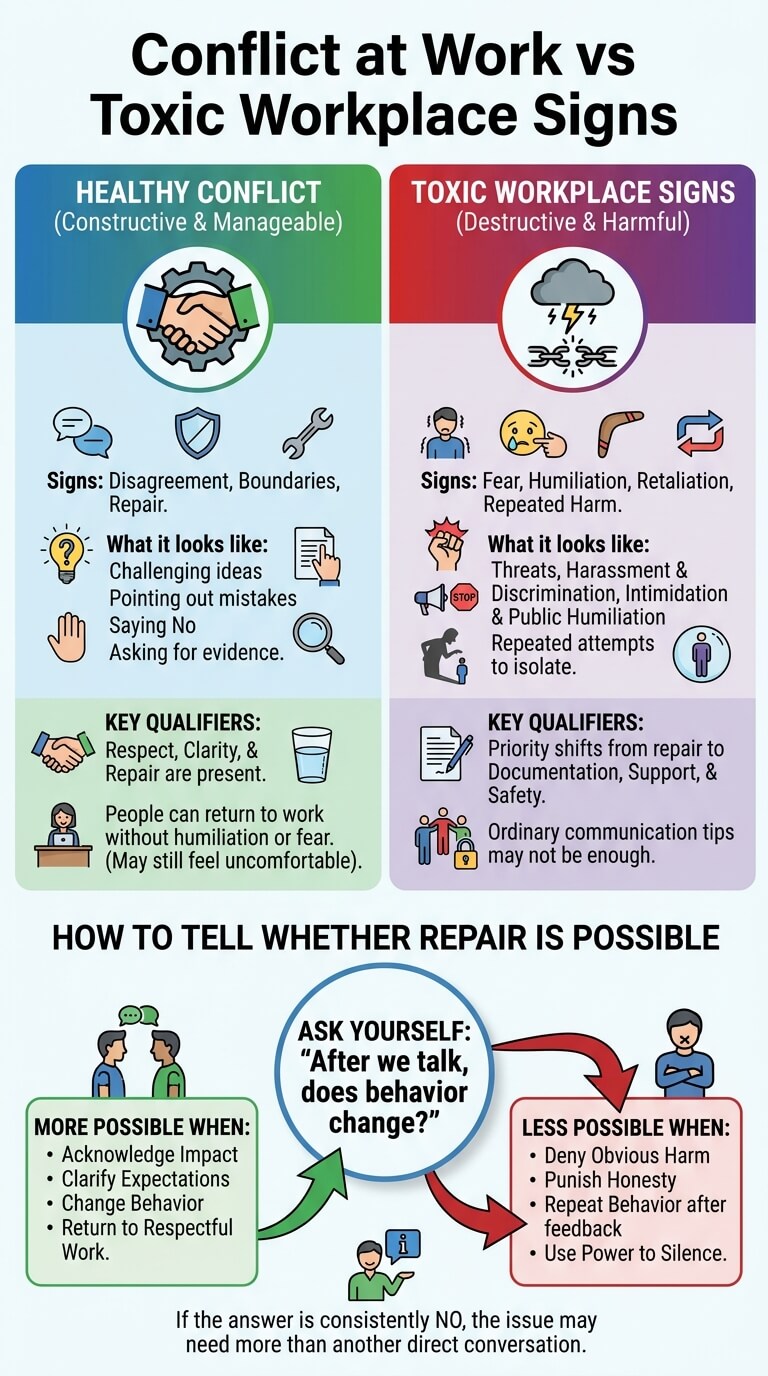
Healthy conflict includes disagreement, boundaries, and repair
Healthy conflict may still feel uncomfortable. People may challenge ideas, point out mistakes, say no, ask for evidence, or disagree with a decision. What makes it healthier is the presence of respect, clarity, and repair. People can return to the work without humiliation or fear.
Toxic conflict includes fear, humiliation, retaliation, or repeated harm
A conflict becomes more serious when disagreement is paired with threats, harassment, discrimination, intimidation, public humiliation, retaliation, or repeated attempts to isolate someone. In those situations, ordinary communication tips may not be enough, and the priority may shift from repair to documentation, support, and safety.
For workplace harassment concerns, the U.S. Equal Employment Opportunity Commission explains harassment in employment settings and when conduct may become unlawful. Rules vary by location and workplace, so this information is educational rather than legal advice.
How to tell whether repair is possible
Repair is more possible when people can acknowledge impact, clarify expectations, change behavior, and return to respectful work. Repair is less possible when one side denies obvious harm, punishes honesty, repeats the behavior after clear feedback, or uses power to silence the other person.
Ask yourself: “After we talk, does behavior change?” If the answer is consistently no, the issue may need more than another direct conversation.
How to Respond Before Conflict Escalates
The best time to work with conflict is before people are trying to save face. Once someone feels cornered, even a reasonable point can sound like an attack. A useful response slows the conversation, clarifies meaning, and turns vague tension into a solvable next step.
Name the shared goal first
Start with the goal that both sides can reasonably care about. “I think we both want the client handoff to be clean.” “We both want the project to move without last-minute surprises.” “We both want a decision that the team can actually execute.”
This does not mean pretending everyone has the same priorities. It means giving the conversation a shared frame before naming the disagreement.
Separate facts, interpretations, and impact
Conflict escalates when facts, meanings, and emotions get mixed together. A fact might be: “The file arrived at 4:30.” An interpretation might be: “You did not take the deadline seriously.” An impact might be: “I had to delay the client update.”
| Layer | Example | Why it matters |
|---|---|---|
| Fact | “The draft was sent after the review window.” | Gives the conversation a shared reference point. |
| Interpretation | “I read that as low priority.” | Shows meaning without presenting it as certainty. |
| Impact | “It left us without time for legal review.” | Connects the issue to work consequences. |
| Request | “Can we agree on a noon cutoff next time?” | Moves from blame to future behavior. |
Ask what constraint the other person is protecting
People often resist because they are protecting a constraint you have not heard yet. They may be protecting budget, accuracy, workload, compliance, staff capacity, reputation, or a promise made to another stakeholder.
A practical question is: “What constraint are you most worried about here?” This question does not surrender your view. It helps you understand the pressure shaping theirs.
Clarify ownership, next step, and deadline
Many conflicts calm down when the next step becomes concrete. Instead of ending with “We need better communication,” end with “Jordan owns the revised timeline, Priya will confirm client constraints, and we will decide by Thursday at 2 p.m.”
Vague agreement feels polite in the moment, but it often produces the next conflict. Concrete ownership reduces room for different assumptions.
Follow up in writing when the stakes are high
When a conflict involves deadlines, responsibility, leadership visibility, client commitments, or repeated misunderstandings, a written follow-up protects clarity. Keep it neutral: summarize the decision, owner, deadline, and open questions.
Do not use documentation as a weapon. Use it as a shared memory. If the conflict is unsafe or involves harassment, discrimination, or retaliation, documentation may also be important for support channels.
What to Say in a Difficult Work Conversation

Script for clarifying the real issue
“I want to make sure we are solving the same problem. From my side, the issue is not only the missed update. It is that the team did not know whether to wait, move ahead, or change the timeline. Is that how you see it, or is there another constraint I am missing?”
Script for disagreeing without attacking
“I see the reason for moving quickly, and I am concerned about the risk if we skip review. I am not saying your approach is careless. I am saying the current timeline gives us little room to catch problems before the client sees them.”
Script for resetting after tension
“That got tense, and I do not want the tone to get in the way of the decision. Can we reset around the criteria we are using: client impact, timeline, and who owns the next step?”
Script for escalating respectfully when needed
“We have tried to resolve this directly, but we are still leaving with different expectations. I think we need a manager to clarify ownership and decision authority so the project does not keep stalling.”
What Not to Do During Workplace Conflict
Do not diagnose the other person’s motive
It is tempting to say, “You just want control,” or “You do not care about the team.” Motive claims usually escalate conflict because they make the other person defend their character. Focus on observable behavior and impact instead.
Try replacing motive with effect: “When the decision changed after the meeting, the team did not know which direction to follow.” This is harder to argue with and easier to fix.
Do not collect allies before clarifying directly when safe
Venting to a trusted colleague can help you calm down, but collecting allies can turn a work disagreement into a social split. Before bringing others into ordinary conflict, consider whether a direct clarification is safe and appropriate.
If the power imbalance is serious, or if you fear retaliation, harassment, discrimination, or humiliation, direct confrontation may not be the safest first step. In that case, seek guidance from a manager, HR, trusted leader, employee assistance resource, union representative, or external professional as appropriate.
Do not confuse silence with resolution
Silence may mean the issue is resolved. It may also mean people gave up, shut down, or moved the conflict into private channels. Look for behavior, not only quiet. Are decisions clearer? Are handoffs improving? Are meetings less tense? Are people willing to raise concerns earlier?
How Workplace Conflict Affects the Rest of the Team
Why psychological safety changes how conflict feels
In teams with stronger psychological safety, disagreement is less likely to feel like personal danger. People can say “I see a risk” without assuming they will be punished for speaking. That does not remove conflict, but it changes how early and honestly people address it.
How criticism can trigger defensiveness at work
Criticism can turn conflict personal when people hear feedback as a verdict on their worth. The same correction can land differently depending on timing, tone, privacy, power dynamics, and whether the person has a fair chance to respond.
How chronic conflict can contribute to burnout
Conflict becomes exhausting when people feel they must constantly defend themselves, anticipate tension, or redo the same conversation without change. Workplace stress is not only an individual reaction. The CDC NIOSH describes job stress as harmful physical and emotional responses when job demands do not match a worker’s capabilities, resources, or needs.
When to Get Support
If conflict includes threats, harassment, discrimination, humiliation, retaliation, coercion, or fear
If a work conflict includes threats, stalking, harassment, discrimination, retaliation, coercion, public humiliation, or fear of consequences for speaking up, do not treat it as a normal disagreement. Communication skills may help in ordinary conflict, but they should not be used to pressure yourself into unsafe conversations.
In higher-risk situations, consider documenting what happened, saving relevant messages, and speaking with a trusted manager, HR, employee assistance program, union representative, legal resource, or external support service depending on the issue and your location.
When to involve a manager, HR, mediator, mental health support, or external advice
It may be time to involve support when the same conflict keeps repeating despite direct clarification, when the conflict affects your health, when decisions are blocked, when responsibilities remain unclear, or when there is a serious power imbalance.
Support is not a sign that you failed. Some conflicts are too complex for two people to solve alone, especially when role authority, policy, harassment, discrimination, or team-wide dysfunction is involved. The American Psychological Association discusses work stress as a workplace health issue, not simply an individual weakness.
FAQ About Conflict at Work Psychology
Is workplace conflict always a bad sign?
No. Workplace conflict can mean people care about quality, risk, fairness, or results. It becomes more concerning when disagreement turns into personal attacks, avoidance, retaliation, humiliation, or repeated unresolved tension. The quality of the conflict matters more than the presence of conflict itself.
Why do small issues become personal at work?
Small issues become personal when they touch reputation, competence, fairness, status, or belonging. A small correction may feel like public embarrassment. A scheduling issue may feel like disrespect. A disagreement over a process may feel like someone is questioning your judgment. Separating facts, interpretations, and impact can reduce this reaction.
How do I handle conflict with a coworker I cannot avoid?
Keep the conversation specific and behavior-based. Focus on shared work goals, clarify expectations in writing, reduce side conversations, and look for patterns rather than arguing over every example. If direct conversation keeps failing, involve a manager or agreed third party to clarify roles and expectations.
What if my manager is part of the conflict?
When the conflict involves your manager, power matters. Stay factual, document decisions, ask for clear expectations, and avoid turning the conversation into a character debate. If you fear retaliation or the issue involves harassment, discrimination, or repeated humiliation, seek guidance from HR, a trusted senior leader, an employee assistance program, or external support.
When should a work conflict be escalated?
Escalation may be appropriate when direct clarification has not worked, when the conflict affects deadlines or clients, when responsibilities remain unclear, when people are being harmed, or when there is a policy, safety, harassment, discrimination, or retaliation concern. Escalation should be framed around impact, risk, and needed clarity, not revenge.
Key Takeaways
- Workplace conflict often escalates when people hear a work problem as a threat to competence, status, fairness, or belonging.
- Task conflict can be useful when teams stay focused on evidence, goals, and tradeoffs. Relationship conflict usually needs repair and trust-building.
- Conflict differs from office politics because conflict is the visible disagreement, while politics is the informal influence layer around it.
- Healthy conflict includes disagreement, boundaries, and repair. Toxic conflict involves fear, humiliation, retaliation, discrimination, harassment, or repeated harm.
- Useful conflict responses separate facts, interpretations, impact, and requests so the conversation can return to solvable behavior.
- If conflict feels unsafe or involves serious power misuse, prioritize documentation and support over another direct conversation.
Final Thoughts
The next step is not to make every disagreement comfortable. That is unrealistic. The better goal is to make conflict clearer, less personal, and more honest about what is actually at stake. The next time tension rises, pause before defending your position. Ask what work problem you are solving, what meaning has been added, and what decision or behavior needs to change next.
If the conflict is ordinary, clarity and repair may help. If the conflict includes fear, retaliation, humiliation, harassment, discrimination, or repeated harm, get support instead of trying to manage the situation alone. Good workplace conflict skills should protect your judgment, your dignity, and the quality of the work.

Michael Reed is the Founder and Lead Writer at Psychology Exposed. He writes about human behavior, relationships, emotional patterns, self-awareness, and practical psychology topics using research-informed, easy-to-understand content.
Read More About Michael Reed: https://psychologyexposed.com/michael-reed/