
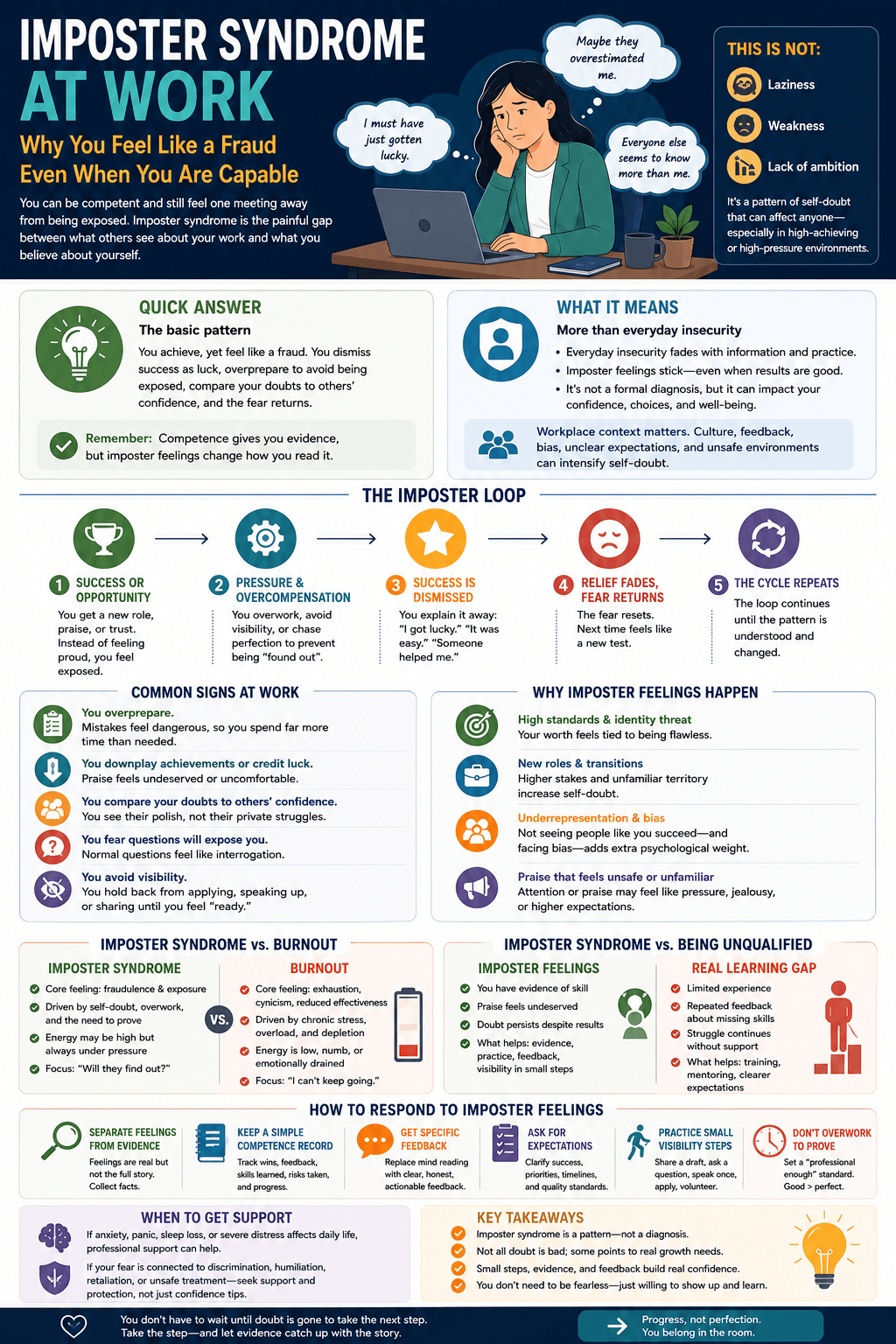
You can be competent and still feel one meeting away from being exposed. That is what makes imposter syndrome at work so confusing. The outside evidence may say you are doing well: you got hired, promoted, trusted with projects, invited into rooms, or praised by people who know the work. Inside, another story keeps running: maybe they overestimated you, maybe you got lucky, maybe everyone else understands something you missed.
Self-doubt can drain motivation because effort starts to feel like a way to avoid being exposed, not a way to grow. That pressure can make even meaningful work feel tense.
A safer team does not remove all self-doubt, but it can make questions, learning, and mistakes feel less threatening. That matters when someone already worries they are behind everyone else.
For someone with imposter feelings, criticism may feel bigger than the specific feedback. A small correction can sound like evidence that they never belonged in the role.
This feeling is not the same as laziness, weakness, or lack of ambition. It is often a painful gap between what others can see about your work and what you can emotionally accept about yourself. It can show up after a promotion, during a career change, in a high-performing team, or when you are one of the few people like you in the room.
At the same time, imposter feelings should not be used to erase real workplace problems. Bias, unclear expectations, hostile feedback, humiliation, exclusion, and unsafe team cultures can make self-doubt worse. The point is not to blame yourself for every fear. The point is to sort the fear carefully so you can tell the difference between a feeling, a learning gap, and an environment that needs attention.

Quick Answer
The basic pattern behind imposter feelings
Imposter syndrome at work is the experience of feeling like a fraud despite real signs of competence. You may dismiss success as luck, overprepare to avoid being exposed, compare your private doubts to other people’s public confidence, and feel relief after succeeding only briefly before the fear returns.
Why competence does not always erase self-doubt
Competence gives you evidence, but imposter feelings often change how you interpret that evidence. Praise may feel like pressure. A promotion may feel like a test. A mistake may feel like proof that you never belonged. The work is not only building skill. It is learning to internalize evidence without needing perfect certainty.
What Imposter Syndrome at Work Means

Imposter phenomenon vs everyday insecurity
Everyone has moments of insecurity at work. You might feel nervous before a presentation, unsure during your first week in a role, or uncomfortable when learning a new system. Everyday insecurity usually responds to information: you prepare, ask questions, practice, and the fear becomes more proportional.
Imposter feelings are stickier. Even when results are positive, the mind finds a way to reject them. A good review becomes “they were being nice.” A successful project becomes “I only pulled it off because someone helped.” Being trusted with more responsibility becomes “now they will see I cannot really do this.”
The APA Dictionary of Psychology describes the impostor phenomenon as a pattern in which successful people believe they are frauds and fear eventual failure or exposure. In a workplace, that fear often becomes tied to meetings, feedback, visibility, promotions, leadership, or being compared with peers.
Why it is not a formal diagnosis
Imposter syndrome is a common phrase, but it is not a formal mental disorder diagnosis. That matters because it keeps the language careful. Feeling like a fraud does not automatically mean something is clinically wrong with you. It may be a stress response, a confidence pattern, a reaction to past experiences, a response to current workplace culture, or a mix of several factors.
It can still affect your life. If the fear leads to chronic overwork, avoidance, sleep problems, panic symptoms, intense shame, or difficulty functioning, it deserves support. But the label itself should be used as a way to understand a pattern, not as a way to diagnose yourself or reduce your whole identity to a problem.
How workplace context can intensify self-doubt
Workplaces shape how people interpret themselves. A team that treats mistakes as learning data usually creates a different inner climate from a team where every mistake becomes gossip, punishment, or public embarrassment. A manager who gives clear expectations may reduce guessing. A manager who praises vaguely and criticizes suddenly may make you feel constantly unsafe.
Culture also matters. If you rarely see people with your background in leadership, if your ideas are ignored until repeated by someone else, or if you are held to a higher standard than peers, self-doubt may not be “just in your head.” An APA Monitor review of the impostor phenomenon notes that context, identity, and environment can play a role in these feelings, especially when people are navigating spaces where they do not feel fully represented or supported.
The Imposter Loop
Opportunity or praise creates pressure
The loop often begins with something positive. You get a new role, a compliment, a raise, a client win, a leadership task, or a seat in a room you wanted to enter. Instead of feeling only encouraged, you feel exposed. The mind says, “Now I have to keep proving they did not make a mistake.”
Pressure creates overwork, avoidance, or perfectionism
Once the pressure rises, people often respond in one of three ways. Some overwork. They spend far more time than needed preparing, checking, rewriting, researching, or rehearsing because anything less feels reckless. Some avoid visibility. They do not speak up, apply, present, publish, or lead unless they feel almost guaranteed not to fail. Some chase perfection. A normal draft, normal learning curve, or normal mistake feels unacceptable.
| Pressure response | What it can look like at work | Hidden cost |
|---|---|---|
| Overwork | Working late to make every detail flawless before anyone sees it | Temporary relief, followed by exhaustion and higher standards next time |
| Avoidance | Not volunteering, not asking questions, or not applying until you feel certain | Fewer chances to learn through normal exposure |
| Perfectionism | Treating small errors as proof of deep incompetence | Fear becomes attached to ordinary human performance |
Success is dismissed as luck or timing
After the work goes well, relief may arrive. But instead of allowing success to count as evidence, the mind explains it away. “The project was easy.” “The client was kind.” “My manager did not notice the weak parts.” “Anyone could have done it.” “I only succeeded because I worked twice as hard.”
Relief fades and the cycle restarts
The relief usually does not last because the core fear was never updated. You survived the meeting, but the mind says the next one will reveal you. You finished the project, but the next project feels like a new trial. You received praise, but now you feel pressure to keep the image alive.
Common Signs at Work

You overprepare because mistakes feel dangerous
Preparation is useful. Overpreparation is different. It happens when you are not preparing to do the work well, but preparing to avoid shame. You may reread an email ten times, rehearse a simple update for an hour, or stay up late fixing details no one asked for because you feel one mistake would expose you.
You downplay achievements or credit luck
When someone praises you, you may quickly shrink the moment. “It was nothing.” “The team did most of it.” “I just got lucky.” Humility can be a strength, but automatic dismissal prevents your brain from recording evidence of capability.
You compare your inside doubts to other people’s outside confidence
At work, you rarely see the full inner life of other people. You see their polished updates, finished slides, calm tone, quick answers, and confident posture. You do not see the private draft, the nervous preparation, the deleted messages, or the moments when they also wonder whether they are doing enough.
You fear questions will expose you
Questions can feel threatening when you believe a competent person should already know everything. In that state, a normal clarifying question from a manager may feel like interrogation. A colleague asking how you reached a conclusion may feel like an accusation.
But questions are often part of shared work. They can mean people are engaged, need context, want alignment, or are testing an idea before committing resources. When you notice your body reacting as if a question is danger, pause before you interpret it as proof of failure.
You avoid visibility even when growth requires it
Imposter feelings often whisper, “Stay hidden until you are ready.” The problem is that readiness grows through visible practice. Presenting, leading, publishing, asking, managing, and interviewing all involve some exposure before total certainty arrives.
Avoiding visibility may protect you from short-term anxiety, but it can also keep your career smaller than your ability. Growth does not require reckless exposure. It requires manageable exposure: one comment in a meeting, one application, one draft shared earlier, one honest question asked before you have every answer.
Why Imposter Feelings Happen
High standards and identity threat
High standards can support excellent work. They become painful when your sense of worth depends on meeting them perfectly. If being capable is part of how you stay safe, respected, or accepted, every imperfect moment can feel like an identity threat.
A PubMed Central open-access study examining mindset and the impostor phenomenon highlights the role of fear of failure in the relationship between mindset and impostor feelings. In everyday terms, if a mistake feels like a statement about who you are, not just information about what to improve, self-doubt becomes harder to shake.
New roles, promotions, and career transitions
Imposter feelings often rise during transitions because the old evidence no longer feels enough. You may have been strong in your previous role, but now the room is bigger, the stakes are higher, or the language is unfamiliar. A promotion can create a strange emotional split: externally, it confirms trust; internally, it raises the fear that you must now perform at a level you have not yet grown into.
Underrepresentation, bias, and not seeing people like you succeed
Some workplaces make people carry extra psychological weight. If you are regularly mistaken for being less senior, interrupted, excluded from informal networks, evaluated more harshly, or expected to represent an entire group, self-doubt can become entangled with real social pressure.
In those cases, the answer is not simply “believe in yourself.” Personal confidence can help, but it does not replace fair systems, good management, psychological safety, and accountability. A person may need mentorship, documentation, allyship, HR support, or a safer environment, depending on what is happening.
Praise that feels unsafe or unfamiliar
Praise can feel uncomfortable if you learned to associate attention with pressure, jealousy, criticism, or higher expectations. At work, praise may also feel vague. “Great job” is kind, but it may not tell you what was strong enough to repeat.
Imposter Syndrome vs Being Unqualified

Evidence of skill vs evidence of a learning gap
A fear is not the same as a fact. Still, it is wise to ask whether there is a real learning gap. The goal is not blind reassurance. The goal is honest sorting.
| Question | Imposter feeling may sound like | A real learning gap may look like |
|---|---|---|
| Do I have evidence of past competence? | “Yes, but none of it counts.” | “I have little experience in this specific task and need training.” |
| How do others respond to my work? | “They praise me, but I assume they are mistaken.” | “Feedback repeatedly names the same missing skill.” |
| What happens when I ask for clarity? | “I understand after guidance, but still feel fake.” | “I still cannot perform the task without more support.” |
| What would help? | “Evidence, practice, and tolerating visibility.” | “Training, mentoring, clearer expectations, or scope adjustment.” |
When doubt is useful feedback
Some doubt is helpful. It can show you where to prepare, ask questions, practice, or slow down. If you are entering a new technical area, leading people for the first time, or taking on a larger client, some uncertainty is appropriate.
Useful doubt points to a next step. It says, “I need to learn this tool,” “I need examples of what good looks like,” or “I should ask how success will be measured.” It does not say, “Because I do not know everything now, I should not be here.”
When doubt is distorted self-protection
Doubt becomes distorted when it ignores balanced evidence. If you have repeated proof of competence, support from credible people, and a record of learning quickly, but your mind still treats you as one mistake away from exposure, the doubt may be trying to protect you from shame rather than guide your growth.
Imposter Syndrome vs Workplace Burnout
Self-doubt can drive overwork
Imposter feelings can push people into long hours because work becomes a way to buy temporary safety. You may feel calm only after doing far more than the task required. The hidden rule becomes, “If I work harder than everyone else, maybe no one will see the parts of me I doubt.”
Burnout can make competence feel inaccessible
Burnout is different. It often involves exhaustion, cynicism or distance from the work, and reduced effectiveness after chronic stress. When you are burned out, you may feel incompetent not because you lack ability, but because your system is depleted.
A review indexed in PubMed on the impostor syndrome literature notes associations between impostor syndrome and issues such as anxiety, depression, job satisfaction, job performance, and burnout. That does not mean every self-doubting worker is burned out, but it does show why the overlap deserves attention.
How to tell which issue is primary right now
Ask what improves the feeling. If rest, reduced workload, clearer boundaries, and recovery time make you feel more like yourself, burnout may be central. If rest helps your body but you still dismiss success, fear praise, and interpret visibility as exposure, imposter feelings may be central.
How to Respond to Imposter Feelings

Separate feelings from evidence
Start with a simple sentence: “I feel like a fraud, and that feeling is not the full evidence.” This does not deny the emotion. It gives the emotion a more accurate role. Feelings provide information about threat, memory, pressure, and meaning. They do not automatically provide a complete performance review.
Then collect three types of evidence: what you have done, what others have trusted you with, and what you have learned after not knowing. The third category matters because competence is not only what you already know. It is also your ability to learn responsibly.
Keep a competence record without turning it into perfectionism
A competence record is not a brag file for ego. It is a memory aid for a mind that deletes positive evidence too quickly. Keep short notes: projects completed, problems solved, feedback received, risks taken, skills learned, mistakes repaired, and moments when you asked for help early instead of hiding.
Do not make the record another perfection project. Five honest lines per week is enough. The goal is not to prove you are flawless. The goal is to stop treating every good result as invisible.
Replace mind reading with specific feedback
Imposter feelings often rely on mind reading. “They think I am behind.” “They know I am not as smart.” “My manager regrets choosing me.” These thoughts may feel true because they are emotionally loud, not because they are verified.
When appropriate, ask for specific feedback instead of guessing. You might say, “What part of the presentation should I keep for next time, and what part should I improve?” or “Can you clarify what success looks like for this project?” Specific feedback reduces the empty space where fear invents stories.
Ask for expectations before guessing them
Unclear expectations feed imposter feelings. If you do not know the standard, you may create an impossible one. You may assume every project needs expert-level polish, every answer must be immediate, and every manager expects you to operate without guidance.
Useful questions include: “What level of detail do you need?” “What does a strong first draft look like?” “When should I bring questions versus keep working?” “Is speed or depth more important here?” Clear expectations turn a vague threat into a workable task.
Practice tolerating visibility in small steps
Confidence often grows after action, not before it. Choose one small visibility step that is uncomfortable but not overwhelming. Share a draft before it is perfect. Ask one question in a meeting. Volunteer for a contained part of a project. State a recommendation with room for discussion.
What Not to Do
Do not wait until you feel fully ready
If you wait for total readiness, you may wait too long. Many worthwhile opportunities require learning in public. A more useful standard is not “I feel no fear.” It is “I have enough foundation, support, and willingness to learn responsibly.”
Do not overwork to buy temporary confidence
Overwork can feel like a solution because it creates short-term relief. But if every success requires exhaustion, your brain may learn that you are only safe when you are drained. That is not confidence. It is fear managed through output.
Try setting a “professional enough” standard before you begin. Decide what the task needs, how much time is reasonable, what quality level matters, and where feedback can improve the next version. This keeps care from becoming self-punishment.
Do not use comparison as your only standard
Comparison can offer information, but it is a poor judge when used alone. You may compare yourself to someone with more experience, more support, a different role, a different personality, or a more visible confidence style. You may also compare your uncertain beginning to someone else’s polished middle.
How Work Culture Can Intensify Imposter Feelings
Why psychological safety makes learning feel less threatening
Psychological safety matters because people learn better when normal uncertainty does not feel like social danger. If your team can ask questions, admit mistakes, and discuss risks without ridicule, imposter feelings may still appear, but they have less fuel.
The APA Work in America survey discusses workplace well-being as a serious priority for workers, which fits a broader point: personal confidence is easier to build in environments where people are not punished for being human.
Why criticism can trigger imposter fear
Criticism can feel especially sharp when you already fear exposure. A normal correction may sound like a final verdict. A manager’s note may turn into “They finally found out.” This is why handling criticism and handling imposter feelings are related but not identical.
The criticism skill is learning how to receive, sort, and respond to feedback. The imposter skill is learning not to turn every piece of feedback into proof that your whole professional identity is false.
How motivation changes when success feels unsafe
Motivation becomes complicated when success creates fear. You may want growth and visibility, but also dread the expectations that come with them. You may procrastinate not because you do not care, but because starting the task activates the possibility of being judged.
When to Get Support
If anxiety, panic, sleep loss, or severe distress affects daily functioning
Consider professional support if imposter feelings are linked with intense anxiety, panic symptoms, ongoing sleep loss, frequent crying, dread before work, avoidance that harms your life, or a level of distress that feels hard to manage alone. You do not need to wait until things collapse before asking for help.
The National Institute of Mental Health explains that anxiety symptoms can interfere with job performance, schoolwork, relationships, and routines. If self-doubt has moved beyond occasional discomfort into daily impairment, support can help you sort what is emotional, practical, medical, or workplace-related.
If workplace discrimination, humiliation, or retaliation contributes to the fear
If your fear is connected to discrimination, harassment, public humiliation, threats, retaliation, or being punished for speaking up, do not treat it only as a confidence problem. Communication tips may not be enough in an unsafe or unfair environment.
FAQ About Imposter Syndrome at Work
Is imposter syndrome a real mental disorder?
No. Imposter syndrome is not a formal mental disorder diagnosis. It is a common way to describe a pattern of feeling fraudulent, undeserving, or afraid of being exposed despite evidence of competence. The feelings can still be distressing and worth addressing, especially if they affect sleep, work choices, confidence, or daily functioning.
Why do I still feel like a fraud after getting promoted?
A promotion can intensify imposter feelings because it raises visibility and expectations. Instead of experiencing the promotion only as proof of trust, you may experience it as pressure to maintain an image. It can help to ask what success looks like in the new role, what support is available, and what learning curve is normal.
Can imposter feelings make me overwork?
Yes. Many people overwork because doing more creates short-term relief from the fear of being exposed. The problem is that the relief fades, and the mind may demand even more effort next time. A healthier approach is to define the task standard clearly, ask for feedback earlier, and practice letting “good and complete” count.
How do I know whether I am actually underqualified?
Look for specific evidence. Repeated feedback about the same skill gap, inability to perform core tasks after support, or unclear role fit may point to a real development need. But if you have a record of learning, credible praise, completed work, and trust from others, yet still dismiss all of it, imposter feelings may be distorting the picture.
Should I tell my manager I feel like an imposter?
It depends on the relationship and the workplace culture. You do not have to use the phrase “imposter syndrome.” You can ask for clearer expectations, more specific feedback, or guidance on what strong performance looks like. If your manager is trustworthy, a simple version may help: “I am adjusting to the scope of this role and would value clearer feedback on what to prioritize.”
Key Takeaways
- Imposter syndrome at work is a pattern of feeling fraudulent despite real signs of competence, not a formal diagnosis.
- The imposter loop often starts with success or visibility, then moves into pressure, overwork, dismissal of success, and renewed fear.
- Not all doubt is distorted. Some doubt points to a real learning gap, unclear expectations, or a workplace issue that deserves attention.
- Burnout and imposter feelings can overlap, but burnout is often centered on depletion while imposter feelings are centered on fraudulence and exposure.
- Helpful responses include separating feelings from evidence, keeping a simple competence record, asking for specific feedback, and taking small visibility steps.
- If fear is connected to severe anxiety, panic, discrimination, humiliation, retaliation, or unsafe treatment, support and protection matter more than confidence tricks.
Final Thoughts
Imposter feelings lose power when you stop treating them as the only narrator of your career. You do not need to pretend you are fearless. You also do not need to believe every fear as if it were evidence. Start by choosing one moment this week where you will let reality be more detailed than the fraud story: accept one piece of praise, ask one expectation question, share one imperfect draft, or write down one skill you have actually built.
Capability is not the absence of doubt. Often, it is the ability to keep learning, asking, repairing, and showing up while doubt is still present.

Michael Reed is the Founder and Lead Writer at Psychology Exposed. He writes about human behavior, relationships, emotional patterns, self-awareness, and practical psychology topics using research-informed, easy-to-understand content.
Read More About Michael Reed: https://psychologyexposed.com/michael-reed/