
Workplace motivation is easy to misread from the outside. A person who is slow to start may look lazy, but they may be unclear, overloaded, discouraged, bored, under-recognized, or quietly afraid that their effort will not matter. Someone who works late every night may look highly motivated, but the fuel may be fear, pressure, or a need to prove they belong.
People are more willing to try, ask, and learn when mistakes are not treated as proof that they do not belong. A safer team climate can make effort feel less risky.
Workplace motivation psychology looks at what makes people direct effort, sustain effort, and recover effort after setbacks. It does not reduce motivation to willpower. It asks better questions: Does this person have enough choice? Do they know what success looks like? Can they see progress? Do they feel respected? Is the reward connected to the effort? Is low drive actually a sign of depletion?
This matters because the wrong explanation creates the wrong solution. If motivation is low because the work feels meaningless, a pep talk will not fix it. If it is low because the person is burned out, more pressure can make the problem worse. If it is low because feedback is vague, the next step may be clearer expectations, not more discipline.

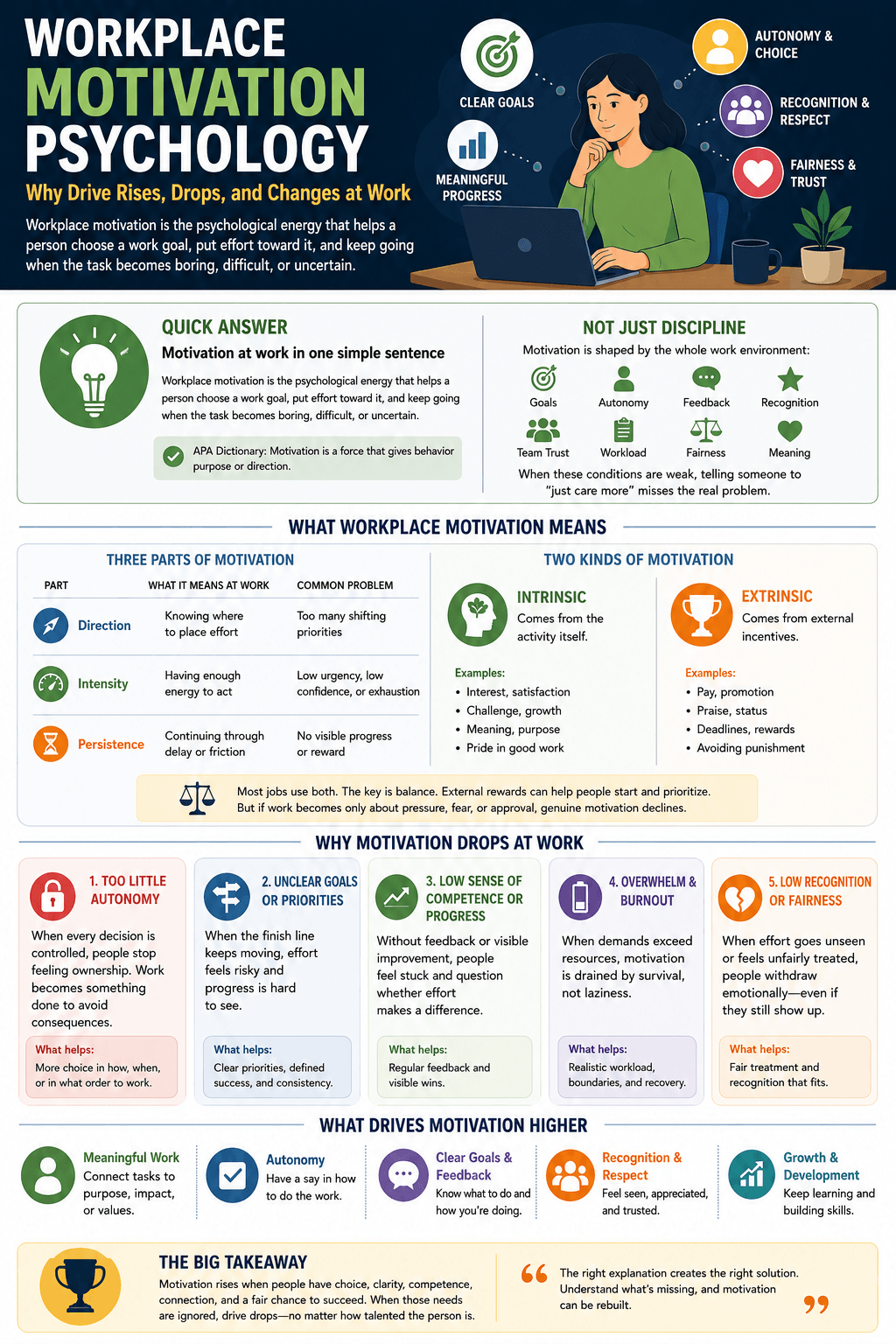
Quick Answer
Motivation at work in one simple sentence
Workplace motivation is the psychological energy that helps a person choose a work goal, put effort toward it, and keep going when the task becomes boring, difficult, or uncertain. The APA Dictionary of Psychology defines motivation as a force that gives behavior purpose or direction, which is why motivation at work is about more than mood.
Why motivation is not just discipline
Discipline helps people act when they do not feel excited. Motivation, however, is shaped by the whole work environment: goals, autonomy, feedback, recognition, team trust, workload, fairness, and meaning. When those conditions are weak, telling someone to “just care more” usually misses the real psychological problem.
A more useful question is not, “Why am I not motivated?” It is, “What part of the motivation system is not being fed right now?”
What Workplace Motivation Means

Direction, intensity, and persistence of effort
Motivation has three practical parts. Direction is where effort goes. Intensity is how much effort is invested. Persistence is how long effort continues when progress is slow or the task is unpleasant.
At work, these three parts can separate. You may know what you should do but have low intensity. You may start with energy but stop after one unclear response from a manager. You may put huge intensity into low-value tasks because they give quick approval while avoiding deeper work that would matter more.
| Part of motivation | What it means at work | Common problem |
|---|---|---|
| Direction | Knowing where to place effort | Too many shifting priorities |
| Intensity | Having enough energy to act | Low urgency, low confidence, or exhaustion |
| Persistence | Continuing through delay or friction | No visible progress or reward |
Intrinsic and extrinsic motivation
Intrinsic motivation comes from interest, satisfaction, challenge, growth, or meaning inside the task. The APA Dictionary describes intrinsic motivation as incentive that comes from the activity itself. At work, this might look like enjoying problem-solving, learning a skill, creating something useful, or feeling proud of craftsmanship.
Extrinsic motivation comes from outside the task, such as pay, promotion, praise, status, deadlines, punishment avoidance, or job security. The APA Dictionary describes extrinsic motivation as motivation linked to external incentives. Most jobs use both kinds, and that is not automatically bad.
The issue is balance. External rewards can help people start and prioritize. But if work becomes only about pressure, fear, approval, or avoiding punishment, effort may continue while genuine motivation declines.
Why the work environment shapes motivation
Motivation does not live only inside a person. A capable employee can lose drive in a confusing system. A quiet employee can become engaged when expectations become clearer and feedback becomes safer. A team can work hard for a while under pressure, then lose energy when pressure becomes the normal climate.
Workplace motivation psychology therefore looks at both the person and the setting. Personal values matter, but so do role design, leadership habits, recognition, workload, culture, and whether people believe effort has a fair chance of producing results.
Why Motivation Drops at Work

Too little autonomy
Autonomy means having some meaningful choice in how work is done. It does not mean doing whatever you want. It means you are not treated like a machine that only follows instructions.
Motivation often drops when every decision is controlled, every method is dictated, and every small move requires approval. People may still comply, but they stop feeling ownership. The work becomes something done to avoid consequences instead of something they can shape.
A small amount of choice can help: choosing task order, selecting a method, proposing a timeline, or having room to solve a problem without constant monitoring.
Unclear goals or shifting priorities
Motivation suffers when the finish line keeps moving. If yesterday’s priority becomes irrelevant today, the brain learns that effort may be wasted. This can create hesitation that looks like procrastination but is actually uncertainty.
Unclear goals also make it hard to judge progress. People need to know what “done,” “good enough,” and “high priority” mean. Without those signals, work can feel like pushing energy into fog.
Low sense of competence or progress
People are more motivated when they can see that their effort improves something. This does not require constant praise. It requires evidence of growth: a task becomes easier, a customer response improves, a manager gives useful feedback, or a project moves forward.
When competence feels low, motivation can drop for two reasons. First, the work feels threatening because failure seems likely. Second, the person may stop believing effort will change the outcome. That is why vague criticism is so draining. It tells the person something is wrong without showing a path to mastery.
Weak connection between effort and reward
Motivation becomes fragile when people cannot see a fair connection between contribution and outcome. This happens when strong work is ignored, poor work has no consequence, promotions feel political, or the most visible person gets more credit than the most useful person.
The reward does not always have to be money. It can be trust, influence, learning, visibility, flexibility, appreciation, or a clearer growth path. But when effort repeatedly disappears into silence, people protect themselves by giving less.
Lack of belonging or respect
Motivation is social. People work differently when they feel included, respected, and taken seriously. A person who feels dismissed may stop sharing ideas. A person who feels invisible may do only what is required. A person who expects mockery may avoid the exact risk-taking that innovation requires.
Belonging does not mean everyone must be close friends. It means people can participate without feeling like an outsider every time they speak, ask questions, or need help.
Burnout and chronic stress
Low motivation can also be a sign that the body and mind have been under too much pressure for too long. When stress becomes chronic, people may lose energy, patience, focus, and emotional range. Workplace well-being is shaped by the way work is designed, supported, and managed.
This is where motivation advice needs caution. A person who is depleted may not need a sharper goal. They may need recovery, workload adjustment, support, or a serious conversation about expectations.
A Simple Motivation Framework for Work

Autonomy: having meaningful choice
Autonomy is the difference between “I have some agency here” and “I am only reacting to demands.” It can exist even in structured jobs. A nurse, teacher, analyst, designer, cashier, or manager may all have rules, but motivation improves when they have some voice in how to do the work well.
Ask: Where do I have room to choose? Where do I need to request more clarity or flexibility? Where am I waiting for permission when a small decision is already mine?
Competence: feeling capable and improving
Competence is not the same as perfection. It is the belief that effort can lead to skill, improvement, and better results. People often feel more motivated when tasks are challenging enough to matter but not so vague or impossible that they feel set up to fail.
One practical way to support competence is to define the next visible outcome. Instead of “be better at this role,” try “write a cleaner first draft,” “respond to customer issues within the agreed window,” or “reduce rework on this process by Friday.”
Relatedness: feeling connected and respected
Relatedness is the sense that you are not working in emotional isolation. You do not need constant encouragement, but you do need enough trust and respect to keep investing effort.
Research on self-determination theory often highlights autonomy, competence, and relatedness as core psychological needs. One open-access review on work motivation and basic psychological needs discusses how competence, autonomy, and social relatedness are connected with work motivation across contexts.
Purpose: understanding why the work matters
Purpose does not always mean a grand mission. It can be simple: this report helps someone decide, this code prevents errors, this call reduces confusion, this shift keeps the service running, this meeting prevents rework.
Work feels meaningless when tasks seem disconnected from any human or practical result. To rebuild purpose, trace the task to its usefulness. Who uses it? What does it prevent? What becomes easier because this gets done?
Fairness: believing effort is recognized appropriately
Fairness is a quiet but powerful part of motivation. People can work hard through stress if they believe the system is honest enough. Motivation erodes when rules change depending on status, feedback is uneven, credit is taken by others, or extra effort becomes the new unpaid baseline.
Fairness does not mean every outcome will feel perfect. It means people can understand the rules, trust that contribution matters, and raise concerns without being punished for doing so.
Intrinsic vs Extrinsic Motivation at Work

When external rewards help
External rewards can be useful when a task is necessary but not naturally enjoyable. Pay, deadlines, bonuses, public recognition, promotions, and accountability systems all help direct attention. Without them, many important tasks would be delayed.
External rewards work best when they are clear, fair, and connected to meaningful contribution. They are less helpful when they reward performative busyness, constant availability, or political visibility more than actual value.
When external pressure backfires
External pressure backfires when people feel controlled, threatened, or reduced to output. A tight deadline may create temporary action, but if every week is framed as an emergency, people stop trusting urgency. Fear can produce movement, but it often damages curiosity, learning, honesty, and long-term effort.
Pressure also backfires when it punishes the behaviors that improve quality. If people are punished for asking questions, they hide confusion. If they are rewarded only for speed, they may stop noticing risk. If they are praised only for sacrifice, rest starts to feel like disloyalty.
How meaning and mastery sustain effort
Meaning helps effort feel connected to something bigger than task completion. Mastery helps effort feel like it is building capability. Together, they make motivation more stable than excitement alone.
| Motivation driver | Helpful when | Risk when overused |
|---|---|---|
| Pay or bonus | Compensation is fair and tied to real contribution | People chase metrics and ignore quality |
| Praise | It is specific and sincere | People become dependent on approval |
| Deadline | It clarifies priority | Everything becomes urgent |
| Meaning | The task connects to a useful result | Meaning is used to justify overload |
| Mastery | People can see progress | Standards become perfectionistic |
Motivation vs Burnout
Low motivation can be a signal of depletion
Sometimes low motivation is not a goal problem. It is a capacity problem. A person may care deeply and still feel unable to start because their attention, patience, and energy have been drained by constant demand.
Burnout-related low motivation often feels heavier than boredom. You may feel cynical, emotionally flat, easily irritated, or physically tired before the workday begins. You may avoid tasks not because they are meaningless, but because even simple demands feel expensive.
Burnout needs recovery and workload change, not just inspiration
If the core issue is burnout, motivational quotes, new planners, or stricter routines may create a short burst and then a deeper crash. The system needs recovery. That may include reducing overload, clarifying expectations, taking breaks, using time off where possible, talking with a manager, or seeking professional support.
This distinction matters for self-respect. Calling depletion “laziness” can make a person push harder at the exact moment they need to repair capacity.
Questions that help separate the two
| Question | May point toward motivation issue | May point toward burnout or strain |
|---|---|---|
| Do I feel better after rest? | Yes, energy returns when the task is clearer | No, tiredness stays even after breaks |
| Do I care about the outcome? | Yes, but I need a better plan | I used to care, but now feel numb or cynical |
| Is the work too vague? | The next step is unclear | Even clear steps feel overwhelming |
| What happens when pressure increases? | I focus for a while | I shut down, get sick, or feel trapped |
Motivation vs Imposter Syndrome
Fear can create motion without real motivation
Not all high effort is healthy motivation. Sometimes people work intensely because they are afraid of being exposed, criticized, or seen as not good enough. From the outside, this can look like ambition. From the inside, it feels like threat management.
Fear-driven work often has a tense quality. You may over-prepare for low-risk tasks, avoid asking questions, or feel unable to enjoy success because each win only raises the pressure to keep proving yourself.
Overwork may look like drive but feel like threat
When imposter feelings drive effort, rest can feel dangerous. You may think, “If I slow down, they will realize I am not as capable as they think.” This kind of effort is not the same as engaged motivation. It is a protective response.
A useful sign is what happens after achievement. Healthy motivation often allows some satisfaction or learning. Imposter-driven effort may quickly move the goalpost: “That did not count,” “They were just being nice,” or “Next time I will fail.”
How competence evidence supports healthier effort
Competence evidence means collecting realistic proof of what you can do, where you are improving, and what skills still need support. It is not empty self-praise. It is a more accurate record than fear provides.
Try keeping a simple evidence log for two weeks: tasks completed, problems solved, feedback received, questions asked, and skills practiced. The point is not to inflate confidence. It is to stop letting anxiety be the only narrator of your performance.
How to Rebuild Motivation Practically

Clarify the next visible outcome
Motivation often improves when the next outcome is visible. “Do better at work” is too broad. “Send the revised outline by 3 p.m.” gives the brain a target.
Choose outcomes that are small enough to finish and meaningful enough to matter. A visible outcome might be a sent email, a cleaned data set, a decision draft, a first version, a scheduled conversation, or a list of blockers.
Reduce friction before increasing pressure
When motivation is low, many people add pressure first. They criticize themselves, make stricter promises, or try to force a dramatic reset. Sometimes the better move is to reduce friction.
Friction can be practical: unclear files, too many tabs, no template, messy handoff, vague instructions, or a task that is too large. It can also be emotional: fear of criticism, resentment, boredom, or uncertainty about whether effort matters.
Ask: What makes starting harder than it needs to be? Remove one obstacle before demanding more energy from yourself.
Create feedback loops that show progress
People stay more motivated when effort creates visible feedback. That feedback can be external, such as a manager response, customer result, team update, or performance metric. It can also be internal, such as noticing a task takes less time than before.
A good feedback loop answers three questions: What changed because I acted? What did I learn? What is the next adjustment?
Restore autonomy where possible
You may not control your entire job, but you may control more than it first appears. Look for choice in sequence, method, preparation, environment, communication, or timing. Even small autonomy can change the emotional tone of a task.
If you manage others, do not assume autonomy means abandoning standards. Set the outcome clearly, then give people room to choose a responsible method. That combination often supports both accountability and motivation.
Connect tasks to values without forcing positivity
Not every task will feel inspiring. Some work is repetitive, administrative, or simply necessary. Forcing positivity can make people feel dishonest.
A more grounded approach is value connection. Ask what value the task serves: reliability, service, learning, stability, craftsmanship, teamwork, financial security, customer care, or future freedom. The task does not have to be exciting to be connected to something that matters.
What Managers Often Get Wrong About Motivation
Confusing pressure with engagement
Pressure can make people move, but movement is not the same as engagement. A team may answer messages instantly because they are afraid, not because they are committed. A person may work late because silence would be punished, not because the work feels meaningful.
Managers who rely only on pressure may get short-term output and long-term withdrawal. People stop volunteering ideas, hide problems, and save their best thinking for environments where it feels safer to care.
Rewarding availability instead of contribution
Some workplaces accidentally reward being visible more than being effective. The person who replies fastest, stays latest, or talks most in meetings may look more motivated than the person doing deep work quietly.
This can train people to perform busyness. A healthier motivation system recognizes contribution, quality, learning, collaboration, and responsible follow-through, not just constant presence.
Ignoring psychological safety and fairness
Motivation suffers when people believe honesty is risky. If asking a question leads to embarrassment, employees learn to pretend. If raising a concern leads to retaliation, people protect themselves by disengaging.
Job stress is not only an individual issue. The CDC NIOSH overview of job stress explains that stress can arise when job demands do not fit a worker’s needs, capabilities, or resources. Motivation is harder to sustain when the work system keeps creating strain and then blames the person for losing drive.
What Work Motivation Depends On
Why psychological safety supports motivation
Psychological safety supports motivation because it lowers the cost of learning. People are more willing to ask questions, admit uncertainty, offer ideas, and recover from mistakes when the team response is respectful.
Without psychological safety, motivation may narrow into self-protection. The person does not ask, “How can I contribute?” They ask, “How do I avoid looking foolish?”
How office politics can make effort feel pointless
Office politics damages motivation when people believe outcomes depend more on alliances, visibility, or favoritism than on contribution. This does not mean all influence is bad. Every workplace has informal networks.
The motivational problem appears when people conclude that doing good work is not enough to be heard, credited, or considered. At that point, effort may shift away from quality and toward survival.
Why criticism affects motivation differently in different teams
Criticism can strengthen motivation when it is specific, fair, and connected to improvement. It can weaken motivation when it is vague, humiliating, personal, or unpredictable.
The same feedback sentence can land differently depending on the team climate. In a respectful team, criticism may feel like information. In a punishing team, it may feel like evidence that one mistake will define you.
When to Get Support
If low motivation comes with persistent exhaustion, depression-like symptoms, anxiety, sleep problems, or health changes
Low motivation is common, but it deserves more attention when it comes with persistent exhaustion, loss of interest in many areas of life, sleep changes, appetite changes, anxiety, hopelessness, or difficulty functioning. The National Institute of Mental Health explains depression as more than temporary sadness and notes that it can affect how people sleep, eat, think, feel, and handle daily activities.
No written guide can tell you whether you have a mental health condition. If low motivation is spreading beyond work or affecting your health, it may be worth talking with a qualified professional, a primary care doctor, a counselor, or an employee assistance program if one is available.
If workplace conditions include coercion, threats, humiliation, harassment, or retaliation
If low motivation is tied to fear, threats, humiliation, harassment, discrimination, stalking, retaliation, or coercive control, treat safety and documentation as more important than motivational techniques. In those situations, the problem is not that you need a better mindset. The environment may be unsafe or harmful.
Consider reaching out to a trusted person, HR where appropriate, a union representative if relevant, legal or workplace rights guidance, or a safety-focused support service. Do not put yourself at more risk by confronting someone alone if retaliation is likely.
FAQ About Workplace Motivation Psychology
Why am I motivated some days and not others at work?
Motivation changes because your energy, clarity, stress level, sense of progress, and emotional connection to the work change. Some days have clearer goals, better feedback, and more capacity. Other days include friction, uncertainty, overload, or a sense that effort will not matter.
Instead of judging the fluctuation immediately, look for the missing condition. Did you lose autonomy, progress, respect, rest, or a clear next step?
Is low motivation a sign of burnout?
It can be, but not always. Low motivation may come from boredom, unclear goals, weak feedback, unfair rewards, low belonging, or a poor fit between task and values. Burnout becomes more likely when low motivation comes with exhaustion, cynicism, emotional numbness, health changes, or feeling depleted before work even begins.
If rest does not restore energy and the work feels constantly draining, treat burnout as a serious possibility rather than a discipline problem.
Can rewards make motivation worse?
Rewards can help when they are fair, specific, and connected to meaningful contribution. They can hurt motivation when they make people feel controlled, reward the wrong behavior, or replace the internal satisfaction of doing good work.
For example, rewarding only speed may reduce care. Rewarding constant availability may reduce boundaries. Rewarding visible confidence may discourage thoughtful questions.
How do managers motivate employees without pressure?
Managers can support motivation by clarifying outcomes, giving useful autonomy, offering specific feedback, recognizing real contribution, removing unnecessary friction, and creating a team climate where questions and mistakes are handled respectfully. This does not remove accountability. It makes accountability easier to act on.
Pressure may still exist in any serious job, but it should not be the only fuel. Sustainable effort usually needs clarity, fairness, competence, and trust.
What is the first step when work feels meaningless?
Start by tracing one task to a real result. Ask who uses the work, what it prevents, what it makes easier, or what value it supports. If you cannot find any connection, ask for context from a manager or colleague.
If the work continues to feel empty even after clarifying its purpose, the issue may be role fit, burnout, values mismatch, or workplace culture. That calls for reflection, not self-criticism.
Key Takeaways
- Workplace motivation is about direction, intensity, and persistence of effort, not just discipline or mood.
- Motivation often drops when autonomy, competence, relatedness, purpose, or fairness are weak.
- Intrinsic and extrinsic motivation can both help, but pressure and rewards can backfire when they feel controlling or unfair.
- Low motivation is not always burnout, but burnout should be considered when low drive comes with exhaustion, cynicism, sleep problems, or health changes.
- Fear-driven overwork can look like motivation from the outside while feeling like threat from the inside.
- The first practical step is usually to clarify the next visible outcome, reduce friction, and create a feedback loop that shows progress.

Michael Reed is the Founder and Lead Writer at Psychology Exposed. He writes about human behavior, relationships, emotional patterns, self-awareness, and practical psychology topics using research-informed, easy-to-understand content.
Read More About Michael Reed: https://psychologyexposed.com/michael-reed/