

The inner critic is the part of your mind that turns mistakes, uncertainty, or vulnerability into harsh self-judgment. It may sound like a voice, a feeling, a sentence that repeats in your head, or a quick emotional punch after you do something imperfect. For many people, it does not feel like ordinary reflection. It feels like being watched by an internal evaluator that is waiting for proof that you are not enough. The inner critic becomes more powerful when every mistake feels like a threat to your worth. This is why the difference between self-esteem and self-worth matters when self-judgment gets loud.
In inner critic psychology, the important question is not only “How do I stop negative thoughts?” A more useful question is: what is this critical voice trying to prevent, and why has it become so cruel? Sometimes the inner critic tries to protect you from rejection, embarrassment, failure, or disappointment. The problem is that it often protects by attacking. It may push you to improve in the short term, but over time it can shrink your confidence, distort your self-perception, and make self-awareness feel unsafe. Becoming aware of the inner critic is part of self-awareness because it helps you separate your observing mind from the voice that attacks you.
This guide explains what the inner critic is, why it develops, how it differs from healthy self-reflection, and how to respond without pretending everything is fine. It is educational, not a diagnosis or a substitute for mental health care. If your self-critical thoughts include self-harm, severe hopelessness, or a sense that you might not be safe, support should come before self-help exercises. If reflection quickly turns into self-attack, slow the process down. A more useful way to understand yourself is to name what happened, what you felt, what you need, and what one fair next step might be.
Quick Answer

A simple definition of the inner critic
The inner critic is a harsh internal voice or mental habit that judges you in global, identity-based terms. Instead of saying, “I made a mistake and can correct it,” it says, “I am a failure,” “I always ruin things,” or “I should not even try.” It turns feedback into self-attack and often makes accountability feel like punishment. The inner critic also affects self-perception. It can make one awkward moment feel like proof of your whole identity instead of one piece of information.
Why the inner critic can feel protective and punishing at the same time
The inner critic can feel protective because it tries to prevent pain before it happens. It may warn you not to look foolish, not to need too much, not to disappoint anyone, or not to repeat an old mistake. But its method is often punishing. Instead of helping you learn, it uses fear, shame, comparison, and mental threats. That is why people can feel both dependent on it and exhausted by it.
What the Inner Critic Is

Harsh self-talk as an internalized evaluation system
Harsh self-talk is not just a random negative thought. It can become an internalized evaluation system, meaning your mind automatically measures your worth, safety, and acceptability through criticism. A small mistake at work becomes “I am incompetent.” A delayed reply from someone becomes “I am annoying.” A quiet moment at a gathering becomes “Everyone can see I am awkward.”
The inner critic often speaks with speed and certainty. It does not wait for evidence. It grabs the most painful interpretation and presents it as truth. A review of self-criticism in PubMed Central describes self-criticism as involving hostile self-dialogue and negative inner voices, which is close to how many readers experience a harsh inner critic in everyday life.
Inner critic vs conscience vs accountability
The inner critic is not the same as conscience. Conscience helps you notice when your actions do not match your values. Accountability helps you repair, learn, and act differently next time. The inner critic attacks your identity and often leaves you frozen, ashamed, or defensive.
| Inner experience | What it sounds like | What it usually leads to |
|---|---|---|
| Conscience | “That was not aligned with my values.” | Repair and clearer choices |
| Accountability | “I need to own my part and change the next step.” | Learning and responsibility |
| Inner critic | “I am terrible. I always mess things up.” | Shame, hiding, overexplaining, or giving up |
Why the inner critic often sounds certain even when it is not accurate
Certainty is not the same as accuracy. The inner critic can sound convincing because it uses absolute words: always, never, everyone, no one, should, failure. These words feel final. They remove nuance, which makes the criticism feel like a verdict instead of a thought.
When your nervous system is stressed, embarrassed, or afraid, the mind often wants a quick explanation. The inner critic offers one. It says the problem is you. That explanation is painful, but it can feel familiar, which is why people sometimes believe it before they question it.
Why the Inner Critic Develops

Early criticism, pressure, or conditional approval
An inner critic can grow from repeated experiences where approval felt conditional. A child who was praised only for grades may learn that performance equals safety. A person who was mocked for emotion may learn that needs are dangerous. Someone who was corrected more than encouraged may learn to scan for flaws before anyone else can point them out.
This does not mean every harsh inner voice comes from a dramatic past. It can also develop in competitive schools, perfectionistic families, high-pressure workplaces, comparison-heavy social media environments, or relationships where mistakes are treated as character defects.
Shame and the fear of being rejected
Shame says, “Something is wrong with me,” while guilt is more likely to say, “I did something wrong.” That difference matters. The inner critic often uses shame because shame feels like a warning system for rejection. If you can criticize yourself first, maybe you can avoid being criticized by others.
This is one reason the inner critic may become loud after social moments. You replay what you said, how you looked, whether you were too quiet, too eager, too needy, too direct, or too much. The mind tries to prevent future rejection by replaying the past until it finds a flaw to control.
Perfectionism and impossible standards
Perfectionism gives the inner critic an endless supply of material. If the standard is “never make mistakes,” any human moment becomes evidence against you. If the standard is “always be impressive,” ordinary learning feels humiliating. If the standard is “never disappoint anyone,” healthy boundaries feel selfish.
Research on self-criticism, perfectionism, and self-compassion continues to explore how harsh self-evaluation relates to distress and coping. One PubMed Central study examined self-compassion training alongside self-criticism, perfectionism, and psychological health, which fits the idea that a kinder inner response is not the same as avoiding responsibility.
Trying to prevent future mistakes through control
The inner critic often believes control is safety. If it can make you rehearse every possible mistake, maybe you will not fail. If it can make you expect rejection, maybe rejection will hurt less. If it can keep you from trying, maybe you will not be exposed.
The problem is that control does not always create wisdom. Sometimes it creates avoidance. You may delay decisions, overprepare, apologize too much, reject compliments, or stop sharing ideas. The critic claims it is helping you improve, but its version of improvement often removes courage from the process.
Common Inner Critic Messages
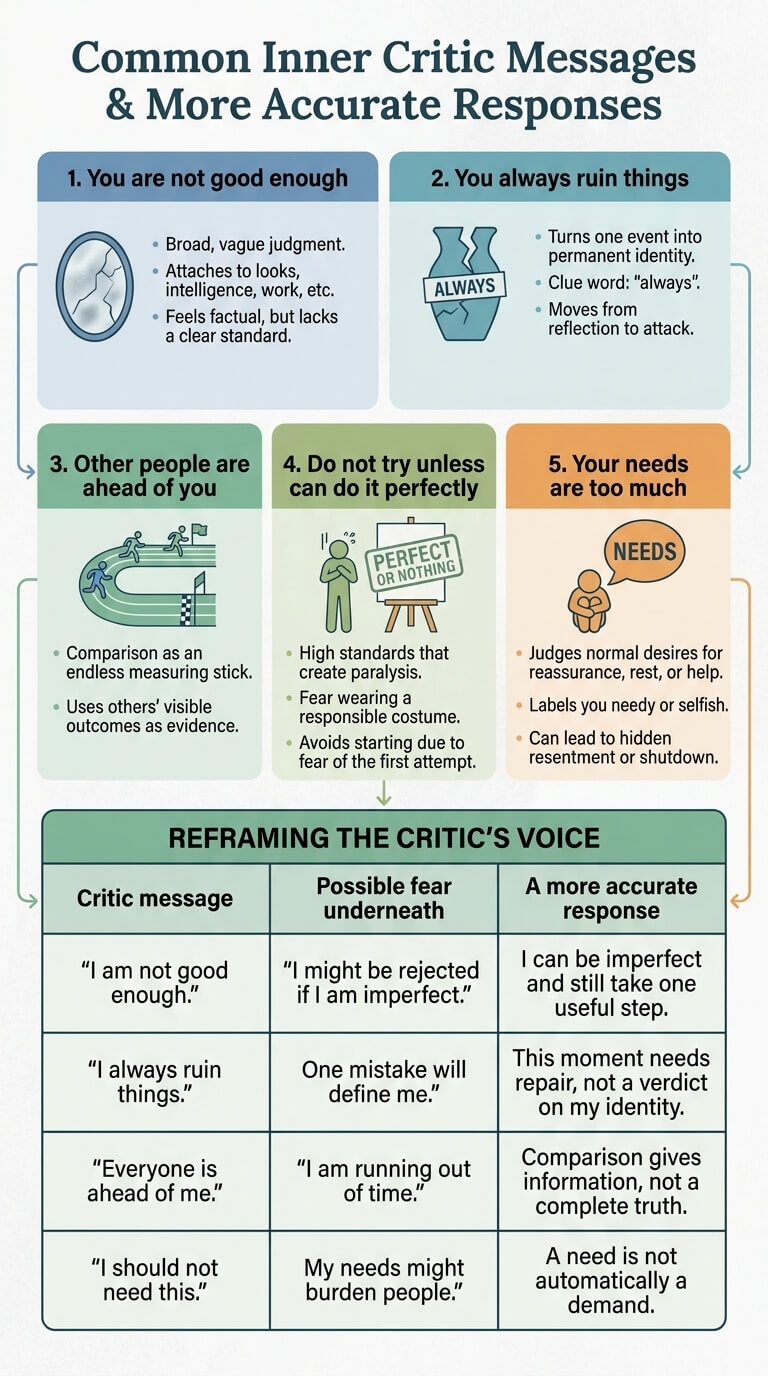
You are not good enough
This message is broad, vague, and hard to answer because it does not name a real next step. “Not good enough” can attach itself to appearance, intelligence, social skills, work, parenting, creativity, or relationships. It feels like a fact, but it is usually a judgment without a clear standard.
You always ruin things
This message turns one event into a permanent identity. You miss a deadline, say the wrong thing, forget a detail, or react emotionally, and the inner critic turns it into “This is who I am.” The word “always” is a clue that the critic has left reflection and moved into attack.
Other people are ahead of you
Comparison gives the inner critic a measuring stick that never runs out. Someone is more confident, further along, more attractive, more disciplined, calmer, richer, more loved, or more successful. The critic then uses their visible outcome as evidence that you are behind in life.
Do not try unless you can do it perfectly
This message looks like high standards, but it often creates paralysis. You might avoid applying for something, posting your work, starting a conversation, or learning a new skill because the first attempt will not match the final version in your head. The inner critic calls this preparation. Often, it is fear wearing a responsible costume.
Your needs are too much
Some inner critics are loudest around needs. You may judge yourself for wanting reassurance, rest, affection, space, help, recognition, or clarity. The critic may say you are needy, dramatic, weak, selfish, or difficult. This can make you hide normal human needs until they come out as resentment, shutdown, or overgiving.
| Critic message | Possible fear underneath | A more accurate response |
|---|---|---|
| “I am not good enough.” | “I might be rejected if I am imperfect.” | “I can be imperfect and still take one useful step.” |
| “I always ruin things.” | “One mistake will define me.” | “This moment needs repair, not a verdict on my identity.” |
| “Everyone is ahead of me.” | “I am running out of time.” | “Comparison gives information, not a complete truth.” |
| “I should not need this.” | “My needs might burden people.” | “A need is not automatically a demand.” |
Inner Critic vs Healthy Self-Reflection

Reflection is specific and useful
Healthy self-reflection names what happened and what can be changed. It is specific: “I interrupted twice in that meeting.” It is useful: “Next time, I can pause before responding.” It keeps your identity intact while still asking you to act with honesty.
Reflection also allows mixed truths. You can care about your impact and still understand your intention. You can make a mistake and still be a decent person. You can feel embarrassed and still learn. The inner critic usually cannot hold this kind of complexity.
The inner critic is global and identity-based
The inner critic makes the problem bigger than the moment. It says, “I am awkward,” instead of “That conversation felt awkward.” It says, “I am lazy,” instead of “I avoided a task because I felt overwhelmed.” It says, “I am unlovable,” instead of “This rejection hurt.”
This global language matters because identity-based criticism is harder to use. If the problem is your whole self, there is no clear next step. If the problem is a behavior, skill, habit, fear, or boundary, you can work with it.
Accountability can be firm without being cruel
Many people fear that if they soften their inner critic, they will become careless. That fear makes sense if harshness has been their main motivator. But cruelty is not the same as standards. You can say, “I need to apologize,” without saying, “I am a terrible person.” You can say, “I need to prepare better,” without saying, “I am useless.”
The Mayo Clinic discusses negative self-talk in the context of stress management and more helpful thinking patterns. The practical point is not forced positivity. It is learning to speak to yourself in a way that keeps you capable of action.
How the Inner Critic Affects Identity and Behavior
It narrows self-concept around flaws
Your self-concept is the story your mind carries about who you are. The inner critic narrows that story until flaws take up too much space. Instead of seeing yourself as a whole person with strengths, limits, needs, values, and history, you begin to organize your identity around what you think is wrong with you.
This can make praise feel suspicious. If someone compliments you, the critic may search for why they are mistaken. If you succeed, it may say the success does not count. If you improve, it may move the standard. Over time, the mind learns to reject evidence that does not match the criticism.
It makes self-worth feel conditional
Self-worth becomes fragile when the inner critic ties it to performance, approval, attractiveness, emotional control, or usefulness. On good days, you may feel acceptable. On hard days, you may feel like you have lost your right to be treated with kindness.
The APA Dictionary of Psychology defines self-esteem in terms of a person’s view of themselves, including perceived accomplishments and values. The inner critic often distorts this evaluation by making worth depend on flawless performance rather than a balanced view of the whole person.
It can trigger self-sabotage before risk or closeness
Self-sabotage often begins before the visible behavior. Before you procrastinate, withdraw, overexplain, reject an opportunity, or push someone away, the inner critic may already be telling you that failure or rejection is inevitable. The behavior then becomes an attempt to escape the critic’s predicted pain.
For example, you might avoid submitting your work because the critic says it will be judged. You might end a conversation early because the critic says you are too much. You might delay an honest apology because the critic says admitting fault proves you are bad. In each case, the inner voice makes protection look like retreat.
It distorts self-perception after mistakes
After a mistake, self-perception can become temporarily warped. You may remember only the awkward sentence, not the rest of the conversation. You may focus only on the one person who seemed unimpressed, not the people who were engaged. You may treat discomfort as proof that something terrible happened.
The inner critic uses emotional intensity as evidence. Because you feel ashamed, it says the mistake must be huge. Because you feel exposed, it says people must be judging you. Because you feel regret, it says you cannot trust yourself. A more balanced response asks what actually happened, what can be repaired, and what story the critic added.
How to Respond to the Inner Critic

Label the voice instead of merging with it
The first step is not to argue with every critical thought. That can become exhausting. Start by labeling it: “This is my inner critic speaking.” This small distance matters. It changes the thought from an unquestioned truth into something you can observe.
You can use plain language: “That is the fear voice,” “That is the perfectionism voice,” or “That is the old standard talking.” The label should not be another insult. The purpose is to separate your awareness from the attack.
Translate the criticism into a fear or need
Most critic messages have a fear underneath them. “You are going to embarrass yourself” may mean “I want to be accepted.” “You are lazy” may mean “I am scared I will fall behind.” “Do not ask for help” may mean “I do not want to be rejected or seen as a burden.”
Try this three-part translation: criticism, fear, need. For example: “I am too needy” becomes “I am afraid my needs will push people away, and I need reassurance that asking clearly is allowed.” Once you find the fear or need, the next step becomes kinder and more practical.
Answer with accurate, respectful language
You do not have to answer the inner critic with fake positivity. If you missed a deadline, “I am amazing and nothing is wrong” will not feel honest. A better answer is accurate and respectful: “I missed the deadline, and I need to communicate clearly. This does not make me worthless.”
Useful self-talk is usually specific, grounded, and doable. It does not deny the problem. It refuses to turn the problem into an identity sentence.
| Inner critic says | Respectful answer | Next action |
|---|---|---|
| “I sounded stupid.” | “I felt awkward, but one sentence does not define the whole conversation.” | Notice one thing that went fine. |
| “I ruined everything.” | “Something went wrong, and I need to identify the repair.” | Write the one repair step. |
| “I am behind everyone.” | “I am comparing my inside view to their outside view.” | Name your next personal milestone. |
| “I should not need help.” | “Needing help does not make me incapable.” | Ask one clear, reasonable question. |
Choose one corrective action without self-punishment
The inner critic often demands a dramatic emotional sentence: “I need to change everything.” A healthier response chooses one corrective action. Apologize. Clarify. Rest. Prepare. Ask. Practice. Set a boundary. Review the mistake. Make a smaller plan.
One action keeps you in reality. Self-punishment keeps you in the loop. If the action is clear and proportional, you are probably in accountability. If the action is vague, extreme, or humiliating, the critic may still be driving.
How the Inner Critic Connects to Self-Worth and Self-Awareness
How self-worth softens harsh self-judgment
Self-worth gives you a steadier place to stand when you notice something you want to change. Without it, every flaw feels like evidence that you are less valuable. With it, you can say, “This part needs work,” without turning that into “I am not worth care.”
This is why self-worth is not indulgence. It is a stabilizer. It helps you stay present long enough to learn instead of collapsing into shame or defending against every piece of feedback.
How personal values create better standards
The inner critic often uses borrowed standards: be impressive, be perfect, never disappoint, never need, never fail. Personal values help you replace those standards with something more honest. A value-based standard might be “I want to be reliable,” “I want to be honest,” or “I want to keep learning.”
Values are easier to use because they guide behavior without demanding perfection. They help you ask, “What would respect, courage, patience, or responsibility look like here?” That question is more useful than “How do I make sure nobody can criticize me?”
How understanding yourself prevents insight from becoming attack
Self-awareness can become painful when every insight becomes another reason to judge yourself. You notice avoidance and call yourself weak. You notice jealousy and call yourself bad. You notice fear and call yourself broken. That is not understanding. That is observation mixed with punishment. Harsh self-talk can also feed self-sabotage. If your mind attacks you before you even begin, avoiding the task may feel like relief rather than resistance.
Understanding yourself means looking for context, pattern, meaning, and choice. It asks, “What is happening inside me, and what would help me respond more honestly?” The inner critic asks, “What is wrong with me?” The difference changes everything.
When to Get Support
When self-criticism becomes relentless, humiliating, or linked to self-harm thoughts
Self-critical thoughts deserve extra care when they become relentless, humiliating, or connected to thoughts of self-harm. If your inner voice says you do not deserve to live, that people would be better off without you, or that you might hurt yourself, this is not a moment to handle alone. The National Institute of Mental Health explains warning signs of suicide and emphasizes getting help when risk signs appear.
If you are in immediate danger, contact local emergency services or a crisis line in your area. If you are not in immediate danger but the thoughts keep returning, consider reaching out to a mental health professional, a trusted person, or a support service. You do not need to prove that your pain is “bad enough” before you deserve help.
When the inner voice echoes abuse, trauma, or coercive control
Sometimes the inner critic sounds like someone from the outside: a parent, partner, teacher, boss, bully, or former relationship. If the voice repeats humiliating messages you heard from someone else, it may be connected to earlier experiences of criticism, control, or emotional harm.
If current relationships involve fear, threats, stalking, coercion, isolation, humiliation, or retaliation, communication tips are not the first priority. Safety, support, and trusted outside help matter more than finding the perfect way to explain your feelings.
FAQ About Inner Critic Psychology
Why is my inner critic so harsh?
Your inner critic may be harsh because it learned that criticism prevents rejection, failure, or embarrassment. It may have developed from pressure, conditional approval, perfectionism, social comparison, or repeated experiences of being judged. Harshness can feel familiar even when it is not helpful. The goal is not to shame yourself for having an inner critic, but to notice when it stops guiding you and starts attacking you.
Is the inner critic trying to protect me?
Sometimes, yes. The inner critic may try to protect you from pain by warning you before others can judge you. It may push you to prepare, improve, stay alert, or avoid risk. The problem is its method. Protection through humiliation often creates more fear, not more wisdom. A better inner response can still protect your values without using cruelty.
How is inner critic different from guilt?
Guilt is usually connected to a specific action: “I did something that affected someone.” The inner critic often turns that action into a global identity judgment: “I am a bad person.” Guilt can lead to repair when it stays specific and proportional. The inner critic often leads to shame, hiding, defensiveness, or self-punishment because it makes the whole self feel defective.
Can I be accountable without criticizing myself?
Yes. Accountability means seeing your part clearly and taking a responsible next step. Self-criticism means attacking your worth or identity. You can apologize, correct behavior, set a better standard, or ask for feedback without calling yourself names. In fact, many people become more accountable when they are not overwhelmed by shame.
What should I say back to my inner critic?
Answer with language that is honest, specific, and respectful. Try: “There is something to learn here, but I do not need to attack myself to learn it.” Or: “I made a mistake, and I can choose one repair step.” The best response is not always positive. It is accurate enough to believe and kind enough to keep you engaged.
Key Takeaways
- The inner critic is a harsh internal evaluation system that turns mistakes, needs, or uncertainty into identity-based self-judgment.
- It may try to protect you from rejection or failure, but it often uses shame, comparison, and fear in ways that make growth harder.
- Healthy self-reflection is specific and useful, while the inner critic is global, absolute, and often cruel.
- Common inner critic messages include “I am not good enough,” “I always ruin things,” “Everyone is ahead of me,” and “My needs are too much.”
- A practical response is to label the critic, translate the criticism into a fear or need, answer with accurate language, and choose one corrective action.
- If self-criticism becomes relentless, humiliating, or linked to self-harm thoughts, outside support matters more than trying to manage it alone.
Final Thoughts
The next time your inner critic speaks, do not make your first job winning an argument with it. Make your first job noticing it. Ask, “Is this helping me see clearly, or is it turning pain into a verdict about who I am?” If there is something to repair, choose one grounded action. If there is a fear underneath the criticism, name it without letting it run your identity.
You do not need to become endlessly positive to have a healthier inner life. You need a way of speaking to yourself that is honest enough to guide you and respectful enough to keep you from disappearing under shame.

Michael Reed is the Founder and Lead Writer at Psychology Exposed. He writes about human behavior, relationships, emotional patterns, self-awareness, and practical psychology topics using research-informed, easy-to-understand content.
Read More About Michael Reed: https://psychologyexposed.com/michael-reed/