

You do not only learn who you are by looking inward. You also watch what you do, notice how other people respond, remember old moments, feel emotions in your body, and turn all of that into a story about yourself. That story may contain useful information, but it is not always complete. Self perception psychology helps explain why the way you see yourself can feel convincing even when it is partly shaped by stress, comparison, feedback, memory, or one painful moment.
This matters because people often treat self-perception as if it were direct truth. You feel awkward, so you assume everyone noticed. You make one mistake, so you decide you are not capable. You receive criticism, so you start questioning your whole identity. The mind is trying to make meaning quickly, but quick meaning is not always fair meaning. A useful next step is to separate the facts from the meaning you attached to them. That simple habit can make it easier to understand yourself without turning every reaction into a fixed identity.
A more balanced view does not mean ignoring real behavior or rejecting all feedback. It means learning how to read yourself with more context. You are allowed to notice what happened, learn from it, and still refuse to reduce yourself to one interpretation.

Quick Answer

A simple definition of self-perception
Self-perception is the way you interpret yourself based on your behavior, emotions, memories, body signals, and feedback from other people. The APA Dictionary of Psychology describes self-perception theory as the idea that people sometimes infer their own attitudes, beliefs, traits, or internal states by observing themselves, especially when inner cues are unclear.
Why self-perception is useful but not always accurate
Self-perception is useful because your behavior can teach you something. If you keep avoiding a task, that may reveal fear, low interest, overwhelm, or a missing skill. But self-perception becomes inaccurate when you turn limited evidence into a fixed identity. “I avoided this” is an observation. “I am weak” is an interpretation. The first can help you respond. The second may trap you.
A fair reading of yourself usually includes three pieces at once: what happened, what was happening around you, and what you tend to conclude when you feel exposed. Without context, the mind may confuse a single response with a stable trait. With context, the same moment becomes information you can use without turning it into a sentence against yourself.
What Self-Perception Means in Psychology

Perception is not just passive seeing. The APA Dictionary of Psychology defines perception as becoming aware of objects, relationships, and events through processes such as recognizing, observing, and interpreting. Self-perception applies that same idea inward. You notice information about yourself, then your mind organizes it into meaning.
The key word is interpreting. Your mind does not simply record your life like a camera. It selects, compares, filters, and explains. A small social pause might be read as “they are bored with me” if you already feel insecure. The same pause might be read as “they are thinking” if you feel safe. The event is the same, but the self-meaning changes.
How people infer traits from behavior
One of the central ideas behind self-perception theory is that people may infer what they believe, feel, or value by looking at what they do. If you volunteer to help a friend, you may conclude that you are generous. If you keep saying yes to requests, you may conclude that you are easygoing. If you avoid conflict, you may conclude that you are peaceful or, depending on your interpretation, that you are cowardly.
Daryl Bem’s classic work on self-perception theory helped explain how people may infer inner states from external behavior when internal cues are weak, unclear, or hard to read. In everyday life, this means your actions can become evidence, but they are not always the whole case.
How emotions become evidence about identity
People also use emotions as evidence. Feeling nervous before speaking may become “I am bad at presenting.” Feeling jealous may become “I am insecure.” Feeling tired around people may become “I am antisocial.” Sometimes the emotion does point toward something important. Other times it points toward sleep loss, stress, unfamiliarity, pressure, or a need for better boundaries.
The risk is emotional over-reading. A feeling is real, but the story you attach to it may need checking. Anxiety can tell you that something feels uncertain. It does not automatically prove that danger is present or that you are incapable. Shame can tell you that something touched a sensitive self-belief. It does not automatically prove that you are defective.
How social feedback shapes the mirror you use
Other people become part of your self-mirror. Compliments, criticism, exclusion, praise, silence, comparison, and approval can all shape what you notice about yourself. Research on reflected appraisals, published through PubMed Central, describes how people form perceptions of how they are seen by others. That perceived mirror can influence self-understanding, even when the mirror is partial.
This is why feedback needs context. One person’s criticism may contain useful information. It may also reflect their mood, standards, bias, control, misunderstanding, or lack of care. Letting feedback inform you is different from letting feedback own your identity.
The Self-Perception Loop

Self-perception often works like a loop. One moment leads to an interpretation, the interpretation becomes a belief, and the belief influences the next moment. Seeing the loop gives you a place to interrupt it.
| Step | What happens | Example |
|---|---|---|
| Notice behavior | You observe something you did or did not do. | You stayed quiet in a meeting. |
| Interpret meaning | You decide what that behavior says about you. | “I am not confident enough to contribute.” |
| Store belief | The interpretation becomes part of your self-view. | “I am not a person who speaks up.” |
| Act from belief | The belief shapes future behavior. | You prepare less, withdraw more, and speak even less next time. |
Notice behavior
The loop begins with something observable. You procrastinated, helped someone, avoided a message, snapped at a friend, performed well, forgot something, changed your mind, or stayed silent. At this stage, the fairest language is descriptive. “I did not reply for two days” is more useful than “I am unreliable.”
Interpret what the behavior means
Next, your mind explains the behavior. This is where self-perception becomes powerful. The same behavior can have several meanings. Not replying for two days might mean avoidance, overload, lack of interest, fear of conflict, unclear boundaries, or simple forgetfulness. A fair interpretation looks at context before turning behavior into identity.
Store a belief about yourself
If an interpretation repeats, it may become stored. You may stop saying, “I avoided that conversation,” and start saying, “I am someone who cannot handle difficult conversations.” The belief now feels like a trait rather than a reading of a situation. This is where self-perception begins feeding self-concept.
Act from that belief next time
Stored beliefs influence future behavior. If you think you are bad at hard conversations, you may delay them, over-explain, apologize too quickly, or avoid them completely. That behavior then becomes more evidence for the same belief. The loop continues until you create a new interpretation, a new action, or both.
Why Self-Perception Gets Distorted

Distorted self-perception does not mean you are lying to yourself. It means your mind is using incomplete information to create a fast explanation. The explanation may be understandable, but still too narrow.
One strong emotion can feel like proof
A strong emotion can make one interpretation feel obvious. Embarrassment says, “Everyone saw that.” Fear says, “This will go badly.” Shame says, “This means something is wrong with me.” The stronger the feeling, the more certain the story may seem. But intensity is not the same as accuracy.
Negative feedback can become overgeneralized
Feedback is easiest to overgeneralize when it touches an old insecurity. One critical comment may become “I am not good at this.” One rejection may become “People do not choose me.” One awkward conversation may become “I always make things weird.” Fair self-perception asks whether the feedback points to a specific behavior, a pattern, or an old wound getting activated. If every piece of feedback changes how valuable you feel, the issue may not be perception alone. It may also involve the difference between self-esteem and self-worth.
Comparison changes what you notice
Comparison narrows attention. When you compare yourself to someone who seems more confident, attractive, skilled, successful, calm, or socially liked, your mind may start scanning only for evidence that you are behind. A comparative model of self-perception in PubMed Central explains how comparison standards can shape how people represent and evaluate themselves. The standard you choose changes the conclusion you reach.
Stress narrows the story you tell about yourself
Stress reduces mental space. When you are tired, pressured, lonely, overstimulated, or afraid, your self-reading may become harsher and less flexible. You may ignore context and jump to character labels. “I am struggling today” becomes “I cannot handle life.” “I need support” becomes “I am a burden.” Stress makes the story feel urgent, but urgency is not always wisdom. Self-perception becomes less reliable when the inner critic takes over the interpretation. The issue is not only what happened, but how quickly your mind turns it into an attack on your character.
Self-Perception vs Self-Concept
Self-perception and self-concept are closely connected, but they are not the same. Confusing them can make temporary moments feel permanent.
| Question | Self-perception | Self-concept |
|---|---|---|
| What is it? | The active process of reading yourself. | The more stored story of who you believe you are. |
| Time frame | Moment to moment, often shaped by recent events. | More stable, built from repeated interpretations. |
| Example | “I felt nervous and stayed quiet today.” | “I am a quiet person who does not speak up.” |
| Risk | Reading one moment too strongly. | Turning repeated readings into a fixed identity. |
Self-perception as the active reading of yourself
Self-perception is what happens as you interpret yourself in real time. You ask, often without realizing it, “What does my reaction mean?” “What does their response say about me?” “What kind of person acts this way?” This process is constantly updating, especially during emotionally charged moments.
Self-concept as the identity story that gets stored
Self-concept is what gets saved after many self-perception cycles. It contains repeated beliefs such as “I am responsible,” “I am difficult,” “I am independent,” “I am not creative,” or “I am someone people leave.” Some beliefs are accurate. Some are outdated. Some began as survival explanations but became identity labels. If the same interpretation repeats for years, it may start becoming part of your self-concept. A momentary thought such as ?I handled that badly? can slowly become a larger identity label like ?I am bad at everything.?
How the two reinforce each other
Self-perception feeds self-concept, and self-concept influences self-perception. If your self-concept says you are socially awkward, you may interpret neutral social moments as proof. If you start interpreting more fairly, your self-concept may slowly become more flexible. The loop works both ways.
Examples of Self-Perception in Everyday Life
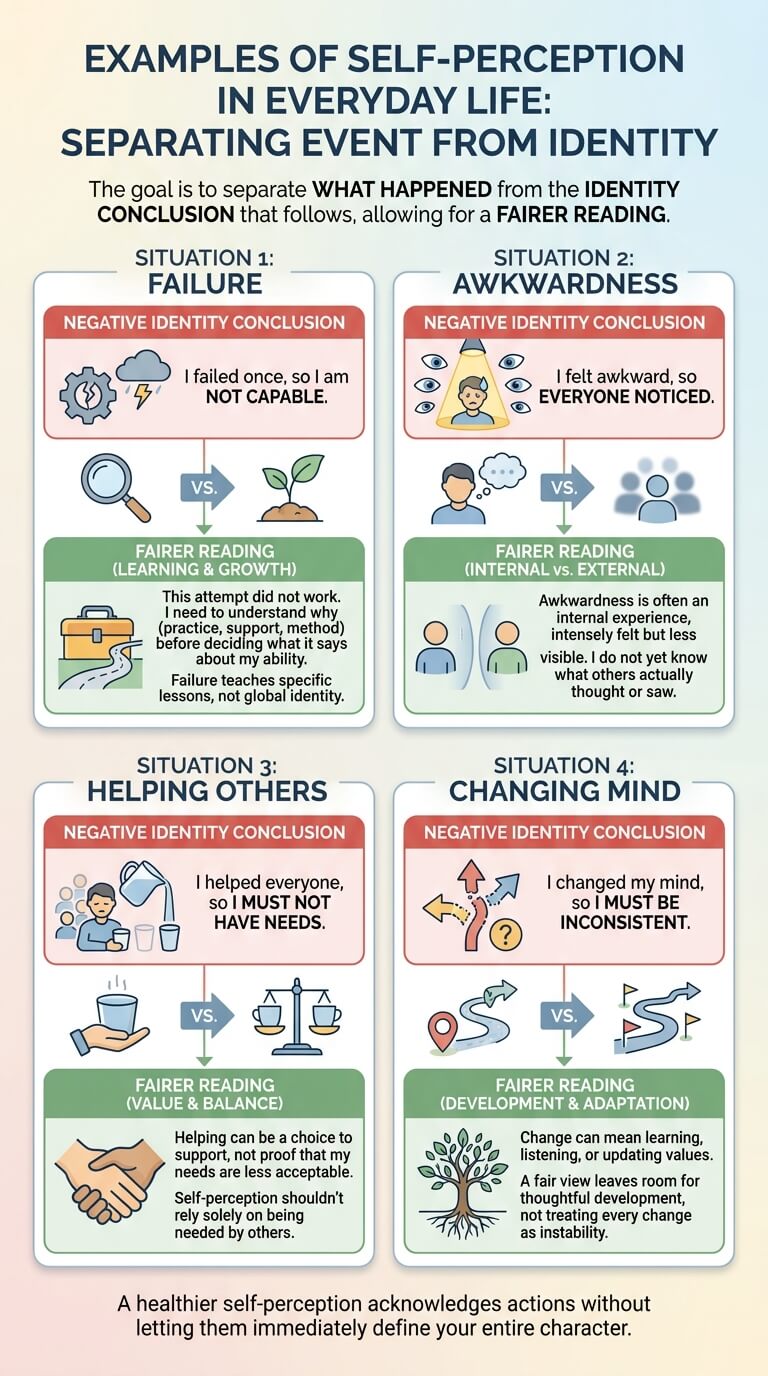
Self-perception becomes easier to understand when you look at ordinary situations. The point is not to excuse behavior. The point is to separate what happened from the identity conclusion that follows. Self-perception is one layer of self-awareness. It helps you notice not only what you did, but also how quickly your mind turns that behavior into a conclusion about who you are.
I failed once, so I am not capable
Failure can teach you something specific, such as where you need practice, support, rest, better timing, or a different method. But one failure does not prove a global identity. A fairer reading might be: “This attempt did not work, and I need to understand why before I decide what it says about my ability.”
I felt awkward, so everyone noticed
Awkwardness is an internal experience, not always an external fact. You may feel every pause, facial expression, and sentence mistake intensely because you are inside your own body. Other people may notice far less than you imagine. A fairer reading might be: “I felt awkward, but I do not yet know how visible it was or what others thought.”
I helped everyone, so I must not have needs
Helping can feel like proof that you are strong, useful, or caring. It may also hide the belief that your needs are less acceptable than other people’s needs. If you repeatedly help while ignoring yourself, self-perception may shift from “I choose to support others” to “I am only valuable when I am needed.”
I changed my mind, so I must be inconsistent
Changing your mind may mean you are unreliable, but it may also mean you learned more, listened carefully, or updated your values. The question is whether the change is impulsive, avoidant, thoughtful, or growth-based. A fair self-perception leaves room for development instead of treating every change as proof of instability.
How to Check Your Self-Perception More Fairly

You do not need to argue yourself into positivity. A better aim is accuracy with kindness. Accuracy without kindness becomes self-attack. Kindness without accuracy becomes avoidance. Fair self-perception tries to hold both.
Ask what else could explain the behavior
Before turning behavior into identity, ask for alternative explanations. Did you avoid the task because you are lazy, or because it was unclear? Did you withdraw because you do not care, or because you felt overwhelmed? Did you speak sharply because you are cruel, or because you were exhausted and handled it badly? The answer may still require accountability, but it will be more specific.
Look for patterns, not single moments
One moment deserves attention. A repeated pattern deserves a plan. If you yelled once, repair the moment. If you keep yelling when stressed, learn what happens before the reaction and what support or change is needed. Patterns give better information than isolated events because they show what repeats across contexts.
Separate feeling, fact, and interpretation
Try writing three short lines. Feeling: “I feel embarrassed.” Fact: “I stumbled over my words in the meeting.” Interpretation: “Everyone thinks I am incompetent.” This separation does not dismiss the feeling. It helps you see where certainty has entered too early.
| Layer | Question to ask | Example |
|---|---|---|
| Feeling | What am I experiencing inside? | “I feel anxious and exposed.” |
| Fact | What actually happened? | “I paused and lost my place once.” |
| Interpretation | What story am I adding? | “I am not professional enough.” |
| Fairer reading | What else could be true? | “I had a difficult moment and can prepare differently next time.” |
Use feedback without handing over your identity
Feedback can be valuable, but it should not become a total verdict on who you are. Ask: Is this person responding to a specific behavior? Do they know the full context? Is the feedback respectful? Is there a pattern across multiple trusted people? Does the feedback give me something actionable, or only shame? Good feedback helps you see more clearly. Harmful feedback makes you feel smaller without helping you act better.
One practical rule is to accept feedback at the level it is given. If someone says your message sounded abrupt, you can look at that message, your timing, and your wording. You do not have to jump to “I am a bad friend.” Specific feedback deserves a specific response. Global self-attack usually makes repair harder, not easier.
How Self-Perception Connects to Self-Awareness
Self-perception sits between daily experience and deeper identity. It influences your inner critic, your values, your self-worth, and the broader work of understanding yourself. This is why small interpretation habits matter. The way you read a meeting, a text reply, a mistake, or a compliment can quietly become part of how you move through the next week.
How self-perception can feed the inner critic
The inner critic often grows from harsh self-perception. It takes one behavior and turns it into a character attack. “I forgot” becomes “I am useless.” “I felt nervous” becomes “I am weak.” When you slow the perception process, you give the inner critic less material to exaggerate.
How values help correct distorted interpretations
Values provide a steadier reference point than mood or comparison. If you value honesty, one awkward honest conversation does not mean you are bad at relationships. It may mean you are practicing a value in an imperfect way. If you value growth, confusion does not mean failure. It may mean you are updating your understanding.
Why self-worth should not depend on one perception cycle
Self-worth becomes fragile when one moment is allowed to define your value. A bad performance, rejected message, critical comment, or emotional reaction may deserve reflection, but it should not decide whether you deserve respect. A fair self-perception says, “This is information.” A harsh one says, “This is my worth.” Those are not the same.
When to Get Support
Most people misread themselves sometimes. Support becomes more important when self-perception turns into constant self-monitoring, severe shame, fear, or distress that interferes with daily life.
When self-perception becomes obsessive, harsh, or distressing
If you spend long periods replaying conversations, checking whether you are a bad person, seeking reassurance, or feeling unable to stop analyzing yourself, outside support may help. The National Institute of Mental Health explains that recurring unwanted thoughts and repetitive behaviors can become time-consuming and distressing for some people. This does not mean your self-analysis is automatically a disorder. It means persistent distress deserves care rather than more self-punishment.
When feedback is manipulative, humiliating, coercive, or unsafe
If someone repeatedly uses criticism, humiliation, threats, control, isolation, or retaliation to shape how you see yourself, the issue is not only self-perception. It may be a safety concern. In that situation, do not focus only on becoming more open to feedback. Consider support from a trusted person, counselor, local service, or safety resource that understands coercive or controlling dynamics.
FAQ About Self Perception Psychology
What is self-perception in psychology?
Self-perception in psychology refers to how people interpret themselves by observing their own behavior, emotions, reactions, memories, and social feedback. It is not only what you think about yourself. It is the process of deciding what your actions and experiences mean about who you are.
Why do I see myself more negatively than others do?
You may see yourself more negatively because you have more access to your own doubts, body sensations, awkward feelings, and private mistakes than anyone else does. You may also be filtering yourself through old criticism, comparison, stress, or shame. Other people may see your whole behavior while you are focused on your worst internal moment.
Is self-perception the same as self-awareness?
No. Self-awareness is the broader ability to notice your thoughts, feelings, behavior, motives, and impact. Self-perception is one part of that process. It is the way you interpret what you notice. Self-awareness asks, “What is happening in me?” Self-perception asks, “What does this say about me?”
Can other people change how I see myself?
Other people can influence how you see yourself, especially when their feedback is repeated, emotionally important, or tied to belonging. But influence is not the same as truth. A trustworthy mirror is specific, respectful, and connected to real behavior. A distorted mirror uses shame, control, or global labels.
How do I know whether my self-perception is accurate?
Look for evidence across time, not only one emotional moment. Ask whether your interpretation separates facts from feelings, whether trusted feedback agrees with it, whether it leaves room for context, and whether it helps you respond constructively. Accurate self-perception is usually specific, flexible, and useful. Harsh self-perception often feels global, final, and punishing.
Key Takeaways
- Self-perception is the process of interpreting yourself from behavior, emotions, memories, and feedback.
- A self-perception can be useful without being complete, especially when emotion or stress makes one story feel certain.
- Self-perception is different from self-concept: perception is the active reading, while concept is the stored self-story.
- One mistake, awkward feeling, or criticism should not become a total identity statement.
- Fair self-perception separates feeling, fact, and interpretation before deciding what a moment means.
- Support may help when self-evaluation becomes obsessive, severely harsh, or shaped by manipulative or unsafe feedback.

Michael Reed is the Founder and Lead Writer at Psychology Exposed. He writes about human behavior, relationships, emotional patterns, self-awareness, and practical psychology topics using research-informed, easy-to-understand content.
Read More About Michael Reed: https://psychologyexposed.com/michael-reed/