

You can change jobs, meet new people, move to a new place, or outgrow an old role, yet still feel pulled by an older version of yourself. Maybe you still think of yourself as the quiet one, the difficult one, the reliable one, the failure, the outsider, or the person who always has to keep things together. That is where self concept psychology becomes useful.
Your self-concept is not just a mood or a passing opinion. It is the mental picture you carry about who you are. It includes the labels you use, the roles you identify with, the abilities you trust, the weaknesses you expect, and the stories you repeat when life challenges you. A self-concept can help you feel stable, but it can also become too narrow when old labels stop matching your current life. Self-concept is one part of the broader self-awareness process. It focuses less on one mood or one reaction and more on the identity story you have learned to carry over time.
Quick Answer
A simple definition of self-concept
Self-concept is the organized picture you hold of yourself, including your traits, roles, abilities, values, social identities, and repeated beliefs about who you are. The APA Dictionary of Psychology defines it as a person’s description and evaluation of the self. In everyday language, it is the answer you carry when life asks, “Who am I?”
Why self-concept feels true even when it is incomplete
Your self-concept feels true because it is built from repeated experience. If you were praised for being responsible, criticized for being sensitive, ignored when you spoke up, or rewarded only when you performed well, your mind may have turned those patterns into identity statements. The problem is not that every old label is false. The problem is that a label can become too small for the person you are now.
What Self-Concept Means in Psychology

Self-concept is often described as a cognitive structure, which means it helps organize information about the self. A research review in PubMed Central describes the self-concept as an organized system that shapes how people feel about themselves, others, and social relationships. That matters because you rarely meet the world as a blank slate. You meet it through expectations about yourself.
If your self-concept includes “I am dependable,” you may notice every moment when people need you. If it includes “I am awkward,” you may replay small social mistakes long after everyone else has moved on. If it includes “I am not the kind of person who succeeds,” you may treat opportunity as a setup for embarrassment rather than a real opening.
The difference between self-concept, identity, self-esteem, and self-worth
These terms overlap, but they do not mean the same thing. Keeping them separate helps you avoid turning every self-question into a confidence problem.
| Term | Simple meaning | Everyday example |
|---|---|---|
| Self-concept | The picture and belief system you have about yourself | “I am the responsible one in my family.” |
| Identity | The broader sense of who you are across roles, history, values, and belonging | “I am a parent, artist, friend, immigrant, and lifelong learner.” |
| Self-esteem | How positively or negatively you evaluate yourself | “I feel proud of myself today,” or “I feel like I am not good enough.” |
| Self-worth | The sense that your value is not fully dependent on performance or approval | “I made a mistake, but I still deserve respect.” |
The parts of self-concept: traits, roles, abilities, values, and social identity
Your self-concept usually has several layers. Some layers are personal: “I am curious,” “I am private,” “I am anxious in groups,” or “I am good with details.” Some are role-based: sibling, friend, parent, partner, worker, caretaker, leader, student. Some are ability-based: creative, practical, athletic, analytical, persuasive, organized, or emotionally perceptive.
There are also value-based parts, such as honesty, loyalty, independence, kindness, stability, faith, ambition, or freedom. Social identity can become part of the picture too, including culture, language, community, generation, profession, or group belonging. A healthy self-concept can hold many layers at once. A narrow one reduces you to one role, one wound, one failure, or one strength.
How self-concept becomes a filter for experience
A self-concept is not passive. It filters what you notice, what you ignore, and what you think new events mean. If you believe you are “bad at relationships,” a delayed text may feel like confirmation. If you believe you are “always the strong one,” needing help may feel like identity failure rather than a normal human moment. Self-concept is different from self-perception. Self-concept is the bigger story you carry about yourself, while self-perception is how you interpret your behavior, emotions, and feedback in the moment.
This filter can protect you from uncertainty. It gives your mind a familiar explanation. But it can also keep you from seeing evidence that you have changed. One kind comment may be dismissed as politeness. One mistake may be treated as proof. That is how self-concept can become more convincing than reality.
How Your Self-Concept Forms
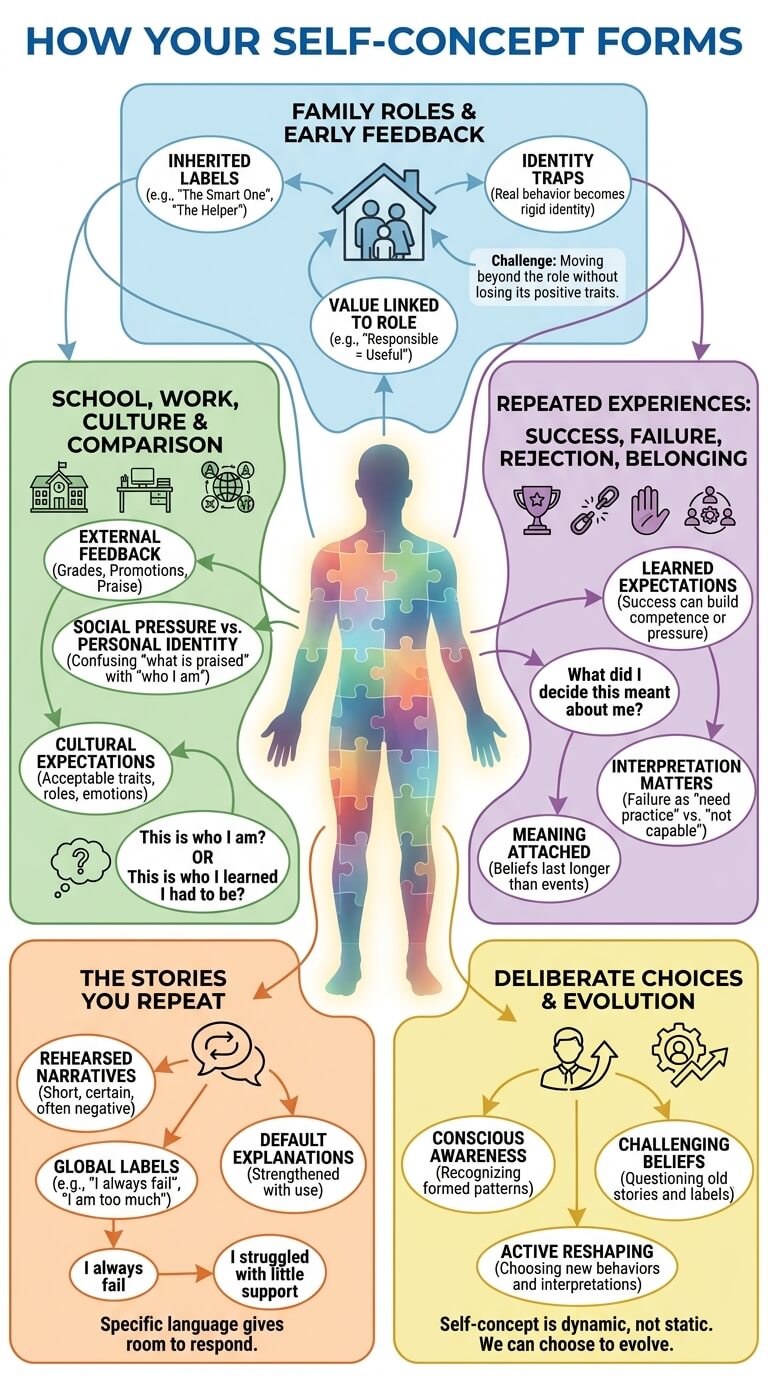
No one creates a self-concept from nothing. It develops through feedback, relationships, comparison, culture, roles, and repeated choices. Some parts are chosen deliberately. Other parts are absorbed so early that they feel like facts.
Family roles and early feedback
Many people inherit their first self-labels inside the family system. A child may become “the smart one,” “the emotional one,” “the helper,” “the troublemaker,” “the invisible one,” or “the one who never complains.” These roles may begin as descriptions of real behavior, but they can become identity traps when the person grows.
For example, being the responsible child may bring praise and trust. Later, it may become hard to rest, ask for support, or let others be disappointed. The old role says, “If I am not useful, I am failing.” A person can be responsible without being responsible for everyone.
School, work, culture, and comparison
Self-concept is also shaped by school and work feedback. A student who struggles in one subject may decide, “I am not smart,” even if the real issue was teaching style, stress, language, attention, or lack of support. An employee who is overlooked may decide, “I am not leadership material,” even if the workplace never gave them a fair path to be seen.
Culture and comparison add another layer. People learn what traits are praised, what emotions are acceptable, what achievements count, and which roles are expected of them. Over time, a person may confuse social pressure with personal identity. “This is who I am” may sometimes mean, “This is who I learned I had to be.”
Repeated success, failure, rejection, and belonging
Repeated experiences are powerful because they teach the mind what to expect. Success can build a self-concept around competence, but it can also create pressure to never struggle. Failure can teach humility and adaptation, but repeated failure without support may become a global label. Rejection can teach discernment, but repeated rejection may become a belief that belonging is not available.
The important question is not only “What happened?” It is also “What did I decide this meant about me?” Two people can experience the same setback and form different self-beliefs. One may think, “I need more practice.” Another may think, “This proves I am not capable.” The event matters, but the meaning you attach to it can last longer than the event itself.
The stories you repeat about yourself
Your self-concept is reinforced by the stories you rehearse. These stories often sound short and certain: “I always mess things up.” “People like me do not get chosen.” “I am too much.” “I am not creative.” “I am only valuable when I achieve.” “I am easy to replace.”
A story becomes stronger each time it is used as the default explanation. That does not mean you can simply replace it with a positive slogan. A more useful first step is to make the story more specific. “I always fail” becomes “I struggled in situations where I had little support and high pressure.” Specific language gives you room to respond. Global labels leave very little room to move.
Signs Your Self-Concept May Be Too Narrow

A narrow self-concept does not always feel negative. Sometimes it is built around a strength. The issue is not whether the label is good or bad. The issue is whether the label gives you room to be fully human.
You use old labels as proof
Old labels become limiting when you use them to end the conversation with yourself. “I am shy” may describe a familiar pattern, but it does not prove you can never build social confidence. “I am not a leader” may describe past experience, but it does not prove you cannot lead in a quieter or more thoughtful way.
Notice the word “proof.” A label becomes rigid when it stops being a description and starts becoming a verdict.
You reject evidence that does not match your self-story
When a self-concept is rigid, contradictory evidence feels suspicious. If someone compliments your insight, you may say they are just being nice. If you handle a difficult situation well, you may call it luck. If someone enjoys your company, you may assume they do not know the real you yet.
This is one reason a negative self-concept can survive positive experiences. The experience is not allowed to count.
You confuse a past role with your whole identity
Roles matter, but they are not the whole self. You may have been the caretaker in your family, the quiet child in class, the person who failed publicly once, the one who moved away, the one who stayed, or the one who had to grow up early. Those roles may explain part of you. They do not define all of you.
A role becomes too large when every choice has to protect it. The capable person cannot admit confusion. The easygoing person cannot say no. The achiever cannot slow down. The independent person cannot receive care. The self becomes organized around maintaining the role instead of living honestly.
You feel threatened when people see a different side of you
Sometimes growth feels uncomfortable not because it is wrong, but because it challenges the old picture. If people see you as more confident, softer, more skilled, more assertive, or more uncertain than before, part of you may feel exposed. You might even pull back into the old role because it feels safer.
This does not mean growth is fake. It may mean your self-concept is updating more slowly than your behavior.
| Sign | What it may sound like | A more flexible question |
|---|---|---|
| Old label as proof | “I am just not that kind of person.” | “Was that always true, or mostly true in certain settings?” |
| Rejecting new evidence | “That success does not count.” | “What part of this evidence am I not letting in?” |
| Past role as identity | “Everyone expects me to be the strong one.” | “Who am I allowed to be when I am not performing this role?” |
| Threatened by change | “This new version of me feels strange.” | “Can something feel unfamiliar and still be real?” |
Self-Concept Examples in Everyday Life

Self-concept becomes easier to understand when you see how it operates in daily decisions. It does not only appear in deep reflection. It appears when you reply to a message, accept an opportunity, avoid a room, apologize too quickly, or refuse help you actually need.
The capable person who cannot ask for help
This person may be skilled, reliable, and trusted. Their self-concept says, “I am the one who handles things.” That belief can support competence, but it may also make normal dependence feel shameful. Asking for help may feel like losing the identity that made them valuable.
The update is not “I am helpless.” The update is “I can be capable and supported at the same time.”
The shy person who avoids every social risk
A shy self-concept may come from temperament, past embarrassment, social comparison, or years of being described as quiet. The person may avoid speaking up because the label predicts discomfort before the situation even begins.
The update is not “I must become extroverted.” The update is “I can be quiet and still participate in selected ways.” A flexible self-concept allows small experiments without forcing a personality performance.
The high achiever who feels valuable only when performing
Achievement can be meaningful. The problem begins when achievement becomes the only permission to feel worthwhile. This person may feel calm only after proving themselves, then anxious again when the next standard appears. The self-concept says, “I am what I produce.”
Mayo Clinic notes that thoughts and beliefs influence self-esteem and that long-held beliefs can feel factual even when they are opinions, a useful reminder when performance-based self-judgment feels automatic in daily life. Their self-esteem guidance also emphasizes noticing and adjusting thoughts that erode self-regard.
The outsider who stops expecting belonging
If someone has felt excluded often enough, the self-concept may become “I do not belong anywhere.” This belief can protect against disappointment by lowering hope. It can also block connection before others have a chance to respond.
The update is not “Everyone will accept me.” That would be too simple. The update is “Some spaces may not fit me, and some spaces may be worth testing slowly.”
Self-Concept vs Self-Perception
Self-concept and self-perception are closely related, but they answer different questions. Self-concept is the stored belief system. Self-perception is the ongoing process of interpreting your behavior, feelings, and feedback.
Self-concept as the stored belief system
Think of self-concept as the personal file your mind keeps about you. It contains old conclusions, repeated roles, strengths, fears, social identity, and expectations. Because it is stored, it can feel stable even when your life changes.
This stability can be helpful. You do not want to rebuild your identity every morning. But if the file has not been updated in years, it may keep using outdated information.
Self-perception as the ongoing interpretation process
Self-perception is more active. It is what happens when you watch yourself do something and decide what it means. You notice that you avoided a difficult call and think, “I am cowardly,” or “I was overwhelmed,” or “I need a better plan.” The same behavior can create different self-beliefs depending on how you interpret it.
This is why self-perception can gradually change self-concept. When you interpret new behavior in a fairer way, the stored picture may begin to update.
Why both shape self-awareness differently
Self-concept tells you what you already believe about yourself. Self-perception tells you how you are making meaning from what you do now. The first gives you continuity. The second gives you new information.
If you only look at self-concept, you may stay loyal to an old identity. If you only look at self-perception, you may overreact to every recent mood or mistake. Self-awareness improves when you can hold both: “This is the story I have carried, and this is what my current behavior may be showing me.”
How to Update an Outdated Self-Concept

Updating self-concept does not mean inventing a fantasy version of yourself. It means making the story more accurate, flexible, and humane. One useful framework is Label, Location, Evidence, Experiment.
| Step | Question | Purpose |
|---|---|---|
| Label | “What identity label am I using?” | Brings the self-story into view. |
| Location | “Where did this label become familiar?” | Separates origin from absolute truth. |
| Evidence | “What evidence supports it, and what evidence complicates it?” | Makes the story more balanced. |
| Experiment | “What small behavior would test a wider version of me?” | Creates new experience without forcing a dramatic identity shift. |
Separate description from identity
A description names something specific. An identity label turns it into the whole self. “I avoided that conversation” is a description. “I am weak” is an identity label. “I struggled with that project” is a description. “I am incompetent” is an identity label.
This distinction matters because descriptions allow learning. Global identity labels often create shame or resignation. When you catch a harsh label, ask, “What is the most accurate description of what happened?”
Look for evidence of flexibility
Rigid self-concepts survive by ignoring exceptions. If you believe you are always passive, look for moments when you expressed a preference. If you believe you are never disciplined, look for areas where you already show consistency. If you believe you are impossible to love, look for people, animals, communities, or moments where care has existed, even imperfectly.
Evidence of flexibility does not erase pain. It simply proves that the old story is not the entire story.
Replace global labels with specific patterns
Specific patterns are easier to work with than global labels. “I am bad with people” can become “I freeze in large groups when I do not know what role I have.” “I am a failure” can become “I lost confidence after several setbacks and have been avoiding situations where I might be evaluated.”
Specific wording points toward support, practice, boundaries, or new choices. Global labels point toward a fixed identity. Research on self-image, self-concept, and self-identity also shows why clear language matters, since these terms are often used loosely even though they shape different parts of self-understanding.
Test one small new behavior safely
Self-concept updates through experience, not only analysis. Choose one small behavior that gently challenges the old label without overwhelming your nervous system or your life. A quiet person might ask one question in a meeting. A caretaker might let someone else handle one task. A high achiever might share an unfinished draft with a trusted person.
The point is not to prove a brand-new identity immediately. The point is to collect honest evidence. Afterward, ask: What did I predict would happen? What actually happened? What did this show me about the range of who I can be?
How Self-Concept Connects to Identity, Worth, and Self-Awareness
Self-concept sits close to several other self-awareness topics. The difference is that self-concept focuses on the stored picture of who you believe you are. Other topics explore how that picture is evaluated, disrupted, criticized, or reorganized.
How self-concept influences self-worth
If your self-concept says, “I am only valuable when I am useful,” self-worth may feel conditional. If it says, “I am lovable only when I am easy,” conflict may feel dangerous. If it says, “I am a burden,” receiving care may feel uncomfortable even from people who want to offer it.
This is where self-concept and self-worth meet. Self-worth asks whether your value can remain steady even when a role, achievement, relationship, or label changes.
Why identity crisis can happen when self-concept changes
An identity crisis can happen when an old self-concept no longer fits, but a new one has not fully formed. This can occur after career change, parenthood, breakup, grief, migration, illness, aging, faith change, success, failure, or leaving a long-held role. When your old self-concept no longer fits your life, the change can feel disorienting. In some seasons, that shift may feel closer to an identity crisis than a simple change in preference.
The discomfort does not always mean you are lost forever. Sometimes it means the old map has stopped matching the territory. Research on self-concept clarity connects a coherent sense of self with meaning and identity, which helps explain why unclear self-beliefs can feel so unsettling.
How personal values help organize a healthier self-story
Values can help when labels become too loud. Instead of asking only “Who have I always been?” you can ask “What do I want to stand for now?” A values-based self-story is often more flexible than a label-based one because values can guide many versions of you.
For example, the label “I am the quiet one” may become limiting. The value “I want to be thoughtful and honest” leaves more room. You can be thoughtful in silence, honest in conversation, and still grow into new forms of expression.
When to Get Support
Self-reflection is useful, but some self-beliefs are painful enough that support matters. This is especially true when negative self-concept is tied to long-term shame, bullying, trauma, abuse, discrimination, humiliation, or repeated rejection.
When negative self-beliefs create persistent shame or hopelessness
Consider reaching out to a qualified mental health professional if your self-image is dominated by hopelessness, worthlessness, intense shame, or the belief that you cannot change. Support can help you examine self-beliefs without being alone inside them.
If thoughts of self-harm appear, or if you feel at risk of hurting yourself, seek immediate support from local emergency services, a crisis line, or a trusted person near you. A self-concept article is not a substitute for urgent care.
When self-image is tied to trauma, bullying, abuse, or severe distress
If your self-concept was shaped by threats, coercion, violence, chronic humiliation, or controlling relationships, be careful about treating the issue as simple confidence work. The priority may be safety, stabilization, and professional support, not debating yourself into a more positive mindset.
You do not have to prove that your pain is severe enough before you deserve help. If the self-story you carry makes daily life, relationships, sleep, work, or basic care feel consistently difficult, support is worth considering. The labels inside your self-concept can also influence what you believe you deserve. This is why self-concept often connects with self-worth, especially when old labels make respect or care feel unfamiliar.
FAQ About Self Concept Psychology
What is an example of self-concept?
An example of self-concept is “I am a dependable person who is good at solving practical problems but not comfortable asking for help.” This statement includes traits, abilities, and a role. Another example is “I am the outsider,” which may include social identity, belonging expectations, and past experiences of exclusion.
Can self-concept change?
Yes, self-concept can change, but it usually changes through repeated new experiences, reflection, relationships, and different interpretations of old stories. It may not change instantly because familiar self-beliefs often feel safe, even when they are painful. Small experiments and more accurate language can help the self-story become more flexible.
Is self-concept the same as self-esteem?
No. Self-concept is the picture you have of who you are. Self-esteem is how you evaluate yourself. For example, “I am a quiet person” is part of self-concept. Feeling ashamed of being quiet or feeling comfortable with it involves self-esteem. The same self-concept can be evaluated in different ways depending on context and belief.
Why do I still believe old labels about myself?
Old labels often remain because they were repeated during emotionally important periods of life. They may have come from family roles, school experiences, rejection, comparison, or survival strategies. The mind tends to keep familiar explanations because they reduce uncertainty. Updating them requires both new evidence and permission to let your identity become more accurate.
How do I know if my self-concept is unhealthy?
A self-concept may be unhealthy or too narrow if it traps you in shame, blocks healthy relationships, makes growth feel impossible, rejects positive evidence, or reduces your whole identity to one role or wound. The question is not whether every self-belief is positive. The question is whether your self-concept is accurate, flexible, and spacious enough for real life.
Key Takeaways
- Self-concept is the organized self-image you carry, including traits, roles, abilities, values, social identity, and repeated beliefs.
- A self-concept can provide stability, but it can also become too narrow when old labels are treated as permanent truth.
- Self-concept is different from self-perception, self-esteem, and self-worth, even though all four influence self-awareness.
- Family roles, school feedback, work, culture, belonging, rejection, success, and repeated stories can all shape the way you see yourself.
- Updating self-concept works best when you replace global identity labels with specific patterns and test small new behaviors safely.
- Support is worth considering when negative self-beliefs are tied to severe shame, hopelessness, trauma, abuse, or persistent distress.

Michael Reed is the Founder and Lead Writer at Psychology Exposed. He writes about human behavior, relationships, emotional patterns, self-awareness, and practical psychology topics using research-informed, easy-to-understand content.
Read More About Michael Reed: https://psychologyexposed.com/michael-reed/