
Office politics can feel confusing because the official chart rarely explains everything that happens at work. The chart may show who reports to whom, but it may not show who influences decisions, who controls information, who protects certain projects, who gets credit, or why a simple request becomes complicated after it passes through the wrong person.
That does not mean every workplace is toxic or every coworker is manipulative. Much of office politics is informal influence: reputation, belonging, security, alliances, risk, and decision-making under limited resources. Some is normal. Some is annoying but manageable. Some crosses into repeated harm, retaliation, exclusion, or fear.
Office politics psychology does not have to become a playbook for manipulation. A healthier approach is to notice what is happening, protect your credibility, act ethically, and know when the issue needs stronger support.

Quick Answer
Office politics in one simple sentence
Office politics is the informal way people use relationships, reputation, information, timing, and influence to shape decisions at work. It exists because workplaces are social systems, not only task systems. People are not only doing jobs. They are also managing risk, status, trust, belonging, and access to opportunity.
Why office politics is not always bad
Office politics becomes harmful when it involves manipulation, exclusion, blame shifting, retaliation, or fear. But not all political behavior is unethical. Advocating for a project, understanding decision makers, building trust across teams, clarifying ownership, and sharing useful information can be healthy forms of influence when they are transparent and fair.

What Office Politics Means Psychologically

Informal influence beyond the org chart
The org chart tells you formal authority. Office politics shows informal influence. A senior leader may have the title, but a long-term employee may know how decisions actually move. A project manager may not rank highest, but they may control timing, context, and who gets included early.
Psychologically, this matters because people respond to perceived influence as much as formal authority. If someone has access to decision makers, controls important information, or shapes the story around a person or project, others may treat that person as powerful even without a leadership title. The APA Dictionary of Psychology describes social influence as changes in thoughts, feelings, or behavior caused by others, including when their presence is only implied or expected. That is a useful way to understand why one person’s approval, silence, or framing can change a whole meeting.
Status, belonging, and reputation management
At work, people want more than a paycheck. They often want respect, security, inclusion, autonomy, growth, and proof that their effort matters. Office politics appears when those needs interact with hierarchy and uncertainty. A person may protect a project because it represents their competence. A manager may resist a new idea because it threatens their status. A coworker may attach themselves to a powerful person because belonging feels safer than standing alone.
Reputation also becomes workplace currency. If people see you as reliable, fair, discreet, and prepared, they may include you earlier. If they see you as careless with information or quick to blame, they may quietly route around you. Reputation can be unfair or biased, but it still shapes access.
Information as social power
Information is one of the most common forms of informal power. People who know what is changing, who supports what, which deadlines are flexible, and which concerns matter most can influence decisions before a formal meeting begins. This is why being excluded from information flow can feel so disorienting. You may be asked to deliver results while missing the context that others already have.
Responsible information sharing helps people coordinate and avoid surprises. Irresponsible information control creates confusion, dependency, gossip, or unfair advantage. Notice whether information helps the work move forward or mainly helps one person control the room.
Why Office Politics Exists

Scarce resources and competing priorities
Politics grows when resources are limited. Budgets, headcount, leadership attention, promotions, bonuses, project priority, and public recognition cannot always go to everyone at the same time. When people believe a decision will affect their security or status, they often become more strategic about how they present information and who they involve.
Advocacy is not automatically bad. A team lead may be protecting capacity, and a product owner may believe their project has the highest value. Trouble begins when advocacy becomes distortion: hiding risks, exaggerating wins, undermining other teams, or framing disagreement as disloyalty.
Unclear decision rules
Office politics often becomes stronger when nobody knows how decisions are made. If promotion criteria are vague, people may focus on visibility rather than contribution. If project approval depends on personal preference, people may try to please the most powerful person instead of building the strongest case. If ownership is unclear, credit and blame become easier to manipulate.
Clear rules do not remove all politics, but they lower guessing. When people know who decides, what evidence matters, and how tradeoffs are handled, hidden influence has less room to replace transparent judgment.
Human need for status, security, and belonging
Workplaces activate old social needs in modern form. People want to know whether they are valued, whether they are safe, whether they belong, and whether they will be protected if something goes wrong. When those needs feel threatened, behavior can become more political.
A person who fears losing relevance may resist a skilled new hire. A manager who feels judged may defend a weak process. A coworker who feels overlooked may gather allies before raising a concern. The behavior may still be unhelpful, but the status need underneath it matters.
Trust gaps between teams or leaders
Politics also grows in trust gaps. If two departments believe the other side will take credit, hide mistakes, or ignore constraints, they may stop sharing early information. If employees believe leaders only reward good news, bad news may travel through whispers before it reaches the right room. If managers believe staff will use openness against them, they may hold back context until decisions are already made.
Trust gaps create extra social labor. People spend more energy reading motives and protecting themselves, even when no single event looks dramatic.
Healthy, Neutral, and Harmful Office Politics
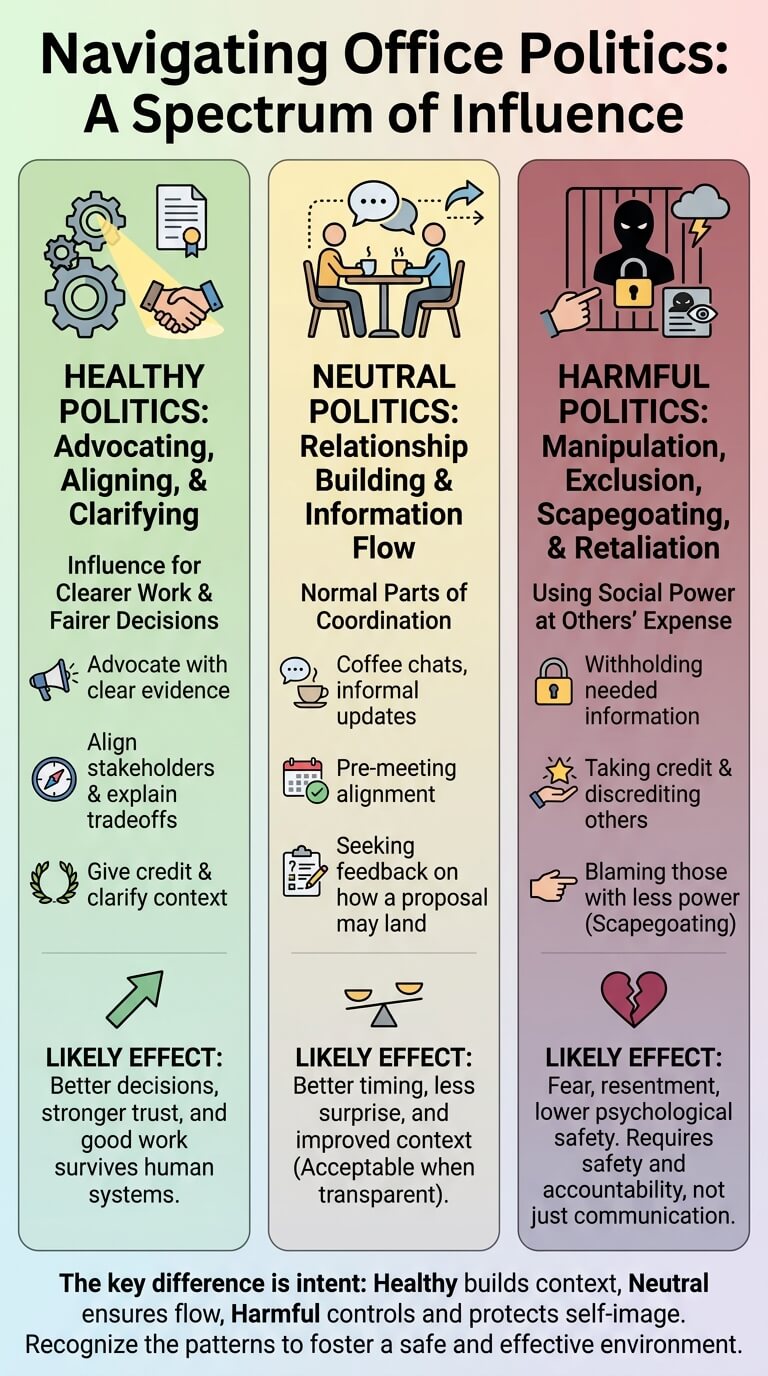
Healthy influence: advocating, aligning, and clarifying
Healthy office politics is influence used in service of clearer work, fairer decisions, and better coordination. It includes explaining why a project matters, inviting the right stakeholders early, naming risks respectfully, giving others credit, and making sure decision makers understand tradeoffs before they choose.
This kind of influence is not fake. A strong idea can still fail if it reaches the wrong person too late or surprises people who needed context. Healthy influence helps good work survive human systems.
Neutral politics: relationship building and information flow
Some politics is neutral. Coffee chats, informal updates, pre-meeting alignment, and asking trusted colleagues how a proposal may land can be normal parts of coordination. These behaviors become suspicious only when they are used to exclude, deceive, pressure, or punish.
A practical test is whether the behavior would still feel acceptable if described plainly. “I asked two stakeholders for feedback before the meeting” is usually normal. “I made sure the person who disagrees with me was not invited” is different. The first builds context. The second controls the room.
Harmful politics: manipulation, exclusion, scapegoating, and retaliation
Harmful politics uses social power to protect image at someone else’s expense. It may include discrediting a coworker, taking credit, withholding needed information, blaming someone with less power, excluding people from decisions, or punishing a valid concern.
When politics repeatedly creates fear, humiliation, coercion, or retaliation, it is no longer just a social dynamic to navigate. It may require documentation, support from a trusted manager, HR guidance, or outside advice depending on the situation. Good communication skills are not a substitute for safety or accountability.
| Type of politics | What it may look like | Likely effect |
|---|---|---|
| Healthy | Advocating for a project with clear evidence and giving credit to contributors | Better decisions and stronger trust |
| Neutral | Checking how a proposal may land before a meeting | Better timing and less surprise |
| Harmful | Withholding context, spreading doubt, or blaming someone who lacks power | Fear, confusion, resentment, and lower psychological safety |
Common Office Politics Patterns

The informal gatekeeper
An informal gatekeeper controls access without always having formal authority. They may know which leader needs to be convinced first, which projects are truly supported, or which concerns will quietly block approval. In a healthy version, this person helps others understand the system. In a harmful version, they make people dependent on them, filter information unfairly, or reward loyalty over quality.
With an informal gatekeeper, ask specific questions before assuming motive: “Who should be included?” “What concern will matter most?” “Is there context I am missing?” Their answers often reveal whether they are coordinating or controlling.
The meeting-after-the-meeting
The meeting-after-the-meeting happens when the formal meeting looks settled, but the real interpretation happens later in smaller conversations. Sometimes this is harmless processing. People need to clarify details or think out loud. Other times, it becomes a place where decisions are quietly reversed, objections are raised without accountability, or people who were not present shape the final story.
To reduce damage, summarize decisions in writing when stakes are high: “My understanding is that we agreed on these next steps.” The point is to reduce ambiguity before private interpretations become competing realities.
Credit claiming and blame shifting
Credit and blame are highly political because they affect reputation. Credit claiming may look like someone presenting group work as their own, repeating your idea in a higher-status room, or highlighting their contribution while leaving out the people who made it possible. Blame shifting may appear when problems are reframed as one person’s failure instead of a shared process issue.
Protecting credit does not require aggression. Clarify ownership early: “I will draft the analysis, Jordan will handle the data, and Priya will present the risks.” If someone takes credit, respond calmly: “I want to add that the original analysis came from our team’s work on Monday, and I can share the details.”
Strategic silence
Strategic silence is when people withhold their real view because speaking feels risky. Sometimes silence is thoughtful. People may need time, privacy, or more information. In political environments, silence may mean people fear being punished, do not trust the decision process, or are waiting to see which side becomes safer.
Leaders may mistake silence for agreement. Ask for input in low-pressure ways, invite written concerns, and respond well when someone names a risk. People speak more honestly when disagreement is not treated as betrayal.
Coalition building and quiet resistance
Coalition building means people gather support before making a move. It can be ethical when people align around a shared concern, gather evidence, and bring a stronger proposal forward. It becomes unhealthy when the coalition’s main purpose is to isolate, pressure, punish, or defeat a person rather than solve a problem.
Quiet resistance can appear when people feel a decision was forced on them. They may comply in public but slow the work privately. Hidden resistance often signals that the official conversation skipped a real concern.
Office Politics vs Toxic Workplace Signs

Politics can exist in healthy workplaces
A healthy workplace still has influence, disagreement, relationships, and competing priorities. People will still advocate for resources, protect their team’s time, and think about how their work is perceived. That is not automatically toxic. In fact, completely ignoring politics can leave you naive about how decisions actually happen.
A psychologically healthier workplace makes politics more transparent. People know how decisions are made, how concerns can be raised, and how credit is shared. APA’s resources on healthy workplaces emphasize employee well-being, organizational performance, and two-way communication.
Toxic patterns involve repeated harm, fear, or retaliation
Toxicity is more than discomfort. A workplace may be stressful, imperfect, or politically complex without being toxic. The concern rises when harmful behavior is repeated, protected, or used to make people afraid. Examples include retaliation after someone raises a concern, public humiliation, threats, discriminatory treatment, harassment, intimidation, or exclusion that blocks someone from doing their job.
In those situations, the question is not “How do I play the politics better?” The question becomes “What support and protection do I need?” Communication may still matter, but safety, documentation, and appropriate reporting channels may matter more.
How to tell discomfort from danger
Discomfort often sounds like, “I do not like this dynamic, but I can still ask questions, clarify expectations, and disagree without serious punishment.” Danger sounds more like, “If I speak honestly, I may be humiliated, isolated, threatened, fired in retaliation, or targeted.”
Use this distinction carefully. Not every uncomfortable conversation is unsafe. But if people who speak up are repeatedly harmed, treat the situation as more serious than ordinary office politics.
Office Politics vs Conflict at Work
Conflict is the visible disagreement
Conflict at work is usually easier to see. Two people disagree about a deadline, a decision, a behavior, a role, or a priority. The tension may happen in a meeting, email thread, performance conversation, or project review. Conflict can be uncomfortable, but it is not automatically political.
Healthy conflict can clarify what matters. It may reveal a risk that others missed or force a better decision. The problem is not disagreement itself. The problem is how disagreement is handled and whether people can raise concerns without being punished socially.
Politics is often the hidden incentive layer
Politics is the layer underneath the visible disagreement. A team may argue about timeline, but the hidden issue is who will be blamed if the launch fails. A manager may reject an idea, but the hidden issue is that the idea threatens a project they sponsored. A coworker may criticize your work, but the hidden issue is competition for visibility.
Seeing this layer does not mean becoming paranoid. It means asking, “What is at stake for each person?” The answer may be budget, reputation, workload, status, autonomy, or fear of being exposed.
Why solving conflict requires understanding both
If you only address the visible disagreement, the same tension may return in a different form. You may solve the deadline issue but not the blame issue. You may agree on a process but not address the status threat. You may calm the meeting but leave the informal story unchanged.
A better response includes both layers. Name the task issue, then check the human stakes: “We need to decide the timeline, and I want to make sure nobody carries blame for constraints they did not create.”
How to Navigate Office Politics Ethically
Map incentives before reacting
Before you respond to a confusing political moment, slow down and map the incentives. Who gains if this decision moves forward? Who loses time, status, budget, or control? Who has information others do not have? Who feels exposed? Who may be trying to avoid blame?
This is not about judging character. It is about understanding pressure so you can respond more cleanly, ask for clearer criteria, or move the conversation back to evidence.
Build trust before you need it
Trust is easier to build before a crisis. Small behaviors matter: follow through, give accurate updates, avoid careless gossip, ask for other teams’ constraints, and admit what you do not know. People are more likely to interpret you fairly during tension if your usual behavior is reliable.
Political skill, used ethically, includes social awareness and the ability to work through human systems without losing integrity. Research indexed in PubMed has examined political skill and career-related outcomes, reminding us that influence is a real workplace factor.
Keep communication clear and documented when stakes are high
When stakes are high, clarity protects everyone. After important conversations, write brief summaries of decisions, owners, timelines, and open risks. Keep the tone neutral and practical. Documentation should not sound threatening unless the situation already requires formal escalation.
For example: “Thanks for the discussion. Ana owns the client update, Marco will confirm the data by Thursday, and I will send the revised timeline.” This reduces later confusion.
Give credit publicly and clarify ownership early
Giving credit is one of the simplest ways to reduce destructive politics. When people trust that their work will be named fairly, they are less likely to hoard information or fight for visibility in indirect ways. Public credit also makes it harder for one person to quietly rewrite the story later.
Clarify ownership early, especially in cross-functional work: “Let’s make sure we are clear on owners and contributors before we present this.”
Avoid gossip disguised as strategy
Gossip often feels like information, but it can damage judgment. A useful conversation helps you understand context, risks, and next steps. Gossip mainly gives you a feeling of insider status while making someone else look smaller.
A simple boundary is: do not say things in private that would embarrass you if repeated with your name attached. If you must discuss a sensitive pattern, keep it behavior-based.
What Not to Do
Do not assume every relationship is manipulation
Once people notice office politics, some start seeing manipulation everywhere. A coworker having lunch with a leader may be networking, or they may simply have a working relationship. A manager asking for alignment may be coordinating, not plotting.
Stay observant without becoming suspicious by default. Look for patterns over time, not one-off moments. Ask what evidence you have, what alternative explanation is possible, and whether the behavior helps the work or unfairly harms someone.
Do not share sensitive information to gain approval
When people feel excluded from informal power, they may be tempted to buy belonging with information. That is risky. Sharing confidential details, private complaints, or someone else’s vulnerability may create short-term closeness but long-term distrust.
If someone pressures you for sensitive information, you can be warm without giving it away: “I am not comfortable discussing that part, but I can talk about the timeline we are responsible for.” Protecting boundaries is part of credibility.
Do not fight hidden politics with hidden attacks
It may feel satisfying to counter manipulation with manipulation, but that usually makes the system worse. Quietly undermining someone, building revenge alliances, or spreading selective information may protect you briefly while damaging your reputation and increasing mistrust.
When possible, move the issue toward clarity: name the work problem, ask for criteria, document agreements, and involve the right people. If the behavior is harmful or retaliatory, get support.
How Office Politics Shows Up in Daily Work
How psychological safety reduces destructive politics
When people can raise concerns without fear of embarrassment or punishment, fewer issues need to travel through whispers. Psychological safety does not mean everyone agrees or every comment feels comfortable. It means people believe honest input, questions, and mistakes can be handled with respect.
Teams with low psychological safety often develop more backchannel behavior because the formal channel feels risky. If concerns cannot be named in the meeting, they usually move somewhere less useful.
Why criticism can become political when status is threatened
Criticism becomes political when feedback is not only about improvement but also about status. A person may receive useful feedback as an attack if they feel their position is insecure. A manager may frame criticism harshly to protect authority. A peer may criticize publicly to gain visibility rather than improve the work.
To keep criticism cleaner, focus on behavior, standards, and next steps. The more feedback becomes a public ranking of worth, the more political it becomes.
How motivation drops when effort and recognition feel unfair
Office politics affects motivation when people believe effort and recognition are disconnected. If the same people always get visibility, if credit is not shared, or if decisions seem based on alliances more than contribution, people may stop giving discretionary effort.
Work stress can also rise when social dynamics make work feel harder to control. NIOSH describes job stress as harmful physical and emotional responses when job requirements do not match a worker’s resources, capabilities, or needs on its page about stress at work. Political confusion can become one of those demands when it adds uncertainty, vigilance, and extra emotional labor.
When to Get Support
If politics includes threats, coercion, retaliation, discrimination, harassment, or humiliation
Some situations should not be handled only with social skill. If office politics includes threats, coercion, repeated humiliation, discriminatory treatment, harassment, stalking, intimidation, or retaliation for speaking up, treat it as a safety and accountability issue. You do not need to prove that every detail was intentional before you take your own concern seriously.
Keep factual notes: dates, times, what happened, who was present, what was said, what work impact followed, and what steps you took. Behavior-based documentation is easier to use than emotional summaries.
When to involve HR, documentation, a trusted manager, or external support
Consider support when the pattern repeats, when the person has power over your job, when your health is affected, when you are blocked from working, or when informal attempts make things worse. Support may include a trusted manager, HR, an employee assistance program, a mentor, a union representative, legal advice, or another qualified resource.
If the situation involves harassment or discrimination, government and workplace rights resources may also matter. The U.S. Equal Employment Opportunity Commission provides information on workplace harassment, including conduct related to protected characteristics. Use resources that fit your country, workplace, and risk level.
FAQ About Office Politics Psychology
Is office politics always toxic?
No. Office politics can include normal influence, relationship building, stakeholder awareness, and advocacy. It becomes a bigger concern when influence turns into manipulation, exclusion, retaliation, fear, blame shifting, or repeated unfairness.
How do I know if someone is being political or just strategic?
Look at transparency, fairness, and impact. Strategy helps people coordinate around a goal. Harmful political behavior hides context, controls access unfairly, damages reputations, or protects one person’s image by making another person carry the cost.
Should I avoid office politics completely?
Avoiding manipulation is wise. Avoiding all workplace influence is usually not realistic. If you ignore informal dynamics, you may miss how decisions are made and what concerns must be addressed. Aim for ethical awareness, not social withdrawal.
How can I protect my reputation without being fake?
Protect your reputation through consistency. Follow through, communicate early when problems appear, give credit, avoid careless gossip, clarify ownership, and ask questions before assuming motives. Intentional behavior is not fake when it matches your values.
What should I do if a coworker takes credit for my work?
Start by clarifying the record calmly. Name the work, the contribution, and the next step without attacking character. For example: “I want to clarify that the analysis came from the model I built last week, and I am happy to walk through the assumptions.” If it repeats, document examples and consider involving a manager or trusted leader.
Key Takeaways
- Office politics is the informal psychology of influence, reputation, information, status, and decision-making at work.
- Not all politics is harmful. Advocacy, alignment, stakeholder awareness, and clear information flow can be healthy when they are transparent and fair.
- Politics becomes more concerning when it involves manipulation, exclusion, blame shifting, retaliation, humiliation, or fear.
- Conflict is the visible disagreement, while politics is often the hidden incentive layer underneath the disagreement.
- Ethical navigation means mapping incentives, building trust, documenting high-stakes decisions, giving credit, and avoiding gossip.
- If the dynamic includes threats, harassment, discrimination, or retaliation, prioritize support and documentation over trying to handle it alone.
Office politics is easier to navigate when you do not treat it as either harmless or evil by default. Ask what kind of influence is happening, who is affected, whether the process is fair, and what response protects both your integrity and your work. Start with clarity, notice incentives, keep records when stakes are high, and get support when behavior crosses into fear, retaliation, or harassment.

Michael Reed is the Founder and Lead Writer at Psychology Exposed. He writes about human behavior, relationships, emotional patterns, self-awareness, and practical psychology topics using research-informed, easy-to-understand content.
Read More About Michael Reed: https://psychologyexposed.com/michael-reed/