

Personal values are the quiet standards that shape what you protect, what you choose, what you regret, and what feels meaningful when nobody is grading you. They are not the same as goals, habits, rules, or personality traits. A goal can be completed. A rule can be obeyed. A value points toward the kind of person you want to be and the kind of life you want your choices to support. If you are unsure which values are truly yours, it may help to understand yourself through repeated choices, emotional signals, and the moments that feel meaningful rather than simply impressive.
In personal values psychology, values matter because they connect identity with action. When your choices match your values, life may still be difficult, but it often feels more coherent. When your choices repeatedly ignore your values, you may feel successful on paper and still feel uneasy, resentful, divided, or strangely disconnected from yourself.
This is not about branding yourself with a perfect list of impressive words. It is not about turning your life into a productivity plan. Values are more practical than that. They help you notice what feels alive, what feels costly, where guilt is steering you, where comparison has taken over, and where your choices may be asking for a more honest direction.
Quick Answer

A simple definition of personal values
Personal values are guiding principles that describe what matters deeply to you and how you want to live, choose, relate, and respond. They can include honesty, freedom, family, growth, compassion, courage, stability, creativity, faith, fairness, learning, service, or responsibility. In everyday life, values help turn self-awareness into choices that feel more aligned.
Why values are different from goals, rules, and preferences
A goal is an outcome you want to reach. A rule tells you what you should or should not do. A preference is something you like. A value is a direction. For example, “build a business” is a goal, “work every morning” is a rule, “quiet spaces” may be a preference, and “independence” or “creativity” may be the value underneath.
What Personal Values Mean in Psychology

Values as guiding principles for attention and action
Values guide what you notice and what you are willing to act on. If fairness is important to you, you may notice unequal treatment quickly. If stability matters, you may pay attention to risk, structure, and reliability. If growth matters, you may feel pulled toward learning even when it is uncomfortable.
The APA Dictionary of Psychology describes values clarification as a process that helps people become more aware of moral principles and ethical priorities. That definition is useful because values are not only abstract ideals. They influence real choices, especially when two options both have a cost.
Values as part of identity and self-concept
Your values are part of how you answer the question, “Who am I trying to be?” They do not describe every detail of your identity, but they help organize it. A person who values loyalty may see themselves as someone who shows up. A person who values curiosity may see themselves as someone who keeps learning. A person who values peace may notice when constant conflict pulls them away from themselves.
Values also interact with self-concept. If you believe you are “the responsible one,” responsibility may be a true value, but it may also be an old role. The difference matters. A value feels chosen, even when it is demanding. A role often feels like a job you are not allowed to resign from.
Why values can change across life stages
Values can become clearer or change in priority as your life changes. Someone who valued adventure in their twenties may still value it later, but stability, caregiving, health, or community may move higher. Someone who spent years chasing approval may later discover that freedom and honesty matter more than being agreeable. Values-based choices become harder when your worth depends on approval. Separating self-esteem from self-worth can make it easier to choose what you respect, not only what wins praise.
This does not make your earlier values fake. It means values are alive inside a changing life. They are stable enough to guide you, but flexible enough to mature with experience.
Why Personal Values Matter

Values reduce decision noise
Decision noise happens when every option feels equally loud. You may ask, “What will people think?” “What if I fail?” “What is the smartest choice?” “What would make me look successful?” “What would avoid conflict?” These questions can matter, but they are not all equal.
Values give you a filtering question: “Which option lets me live closer to what matters?” That does not make hard decisions easy. It does make them less chaotic. A values-based choice may still disappoint someone, cost money, require courage, or create temporary discomfort. But it is less likely to leave you feeling like a stranger to yourself.
Values help you set boundaries without constant guilt
Boundaries are easier to understand when they protect something important. Without values, a boundary may feel like selfishness. With values, it becomes clearer: “I am protecting rest because health matters,” “I am protecting honesty because resentment grows when I pretend,” or “I am protecting family time because presence matters to me.”
This is different from using values to control other people. A value does not give you the right to demand that everyone live your way. It gives you a clearer reason for your own choices, limits, and tradeoffs.
Values make self-awareness practical
Self-awareness can become circular if it never reaches action. You can know you are unhappy, know you are overcommitted, know you are people-pleasing, and still repeat the same pattern. Values help you ask, “What does this awareness ask me to protect or practice?”
For example, noticing resentment may reveal that fairness or rest is being ignored. Noticing envy may reveal a value you have not given yourself permission to pursue. Noticing regret may show that a choice protected comfort but ignored courage.
Values protect against living from comparison only
Comparison asks, “Am I ahead or behind?” Values ask, “Am I moving in a direction that matters to me?” Those questions create very different lives. Comparison may push you toward choices that look impressive but feel empty. Values may lead you toward choices that are quieter but more coherent.
Research on identity-based motivation suggests that people often prefer actions that feel congruent with an active identity and interpret difficulty through that identity lens. A PubMed Central article on identity-based motivation gives useful background for understanding why values and identity can shape what feels possible, natural, or worth pursuing.
Personal Values vs Goals, Needs, and Beliefs

Goals are outcomes; values are directions
A goal can be checked off. A value keeps guiding you after the goal is complete. “Run a marathon” is a goal. “Vitality” or “discipline” may be values. “Get promoted” is a goal. “Mastery,” “contribution,” or “security” may be values. “Move to a new city” is a goal. “Freedom,” “adventure,” or “belonging” may be underneath.
This distinction protects you from confusing achievement with alignment. You can reach a goal that does not match your values. You can also live a value before the big goal is achieved.
Needs are human requirements; values are chosen priorities
Needs are not optional in the same way values are. People need safety, rest, connection, food, autonomy, dignity, and care. Values are the priorities that guide how you want to meet needs and organize life around them.
For example, rest may be a need. Simplicity may be a value that helps you protect rest. Connection may be a need. Loyalty, warmth, or honesty may be values that shape how you build connection.
Beliefs describe what you think is true; values describe what matters
A belief says, “This is how the world works.” A value says, “This is what matters to me.” You might believe conflict is risky, but still value honesty. You might believe success requires constant availability, but value family, health, or freedom. You might believe people will judge you, but value courage enough to speak anyway.
| Concept | Simple meaning | Example |
|---|---|---|
| Value | A direction that matters | Honesty, creativity, compassion, stability |
| Goal | A specific outcome | Finish a degree, save money, start a project |
| Need | A human requirement | Sleep, safety, connection, dignity |
| Belief | An idea you hold as true | “If I say no, people will be upset.” |
| Preference | Something you like or favor | Quiet mornings, small groups, flexible schedules |
Signs You Are Disconnected From Your Values
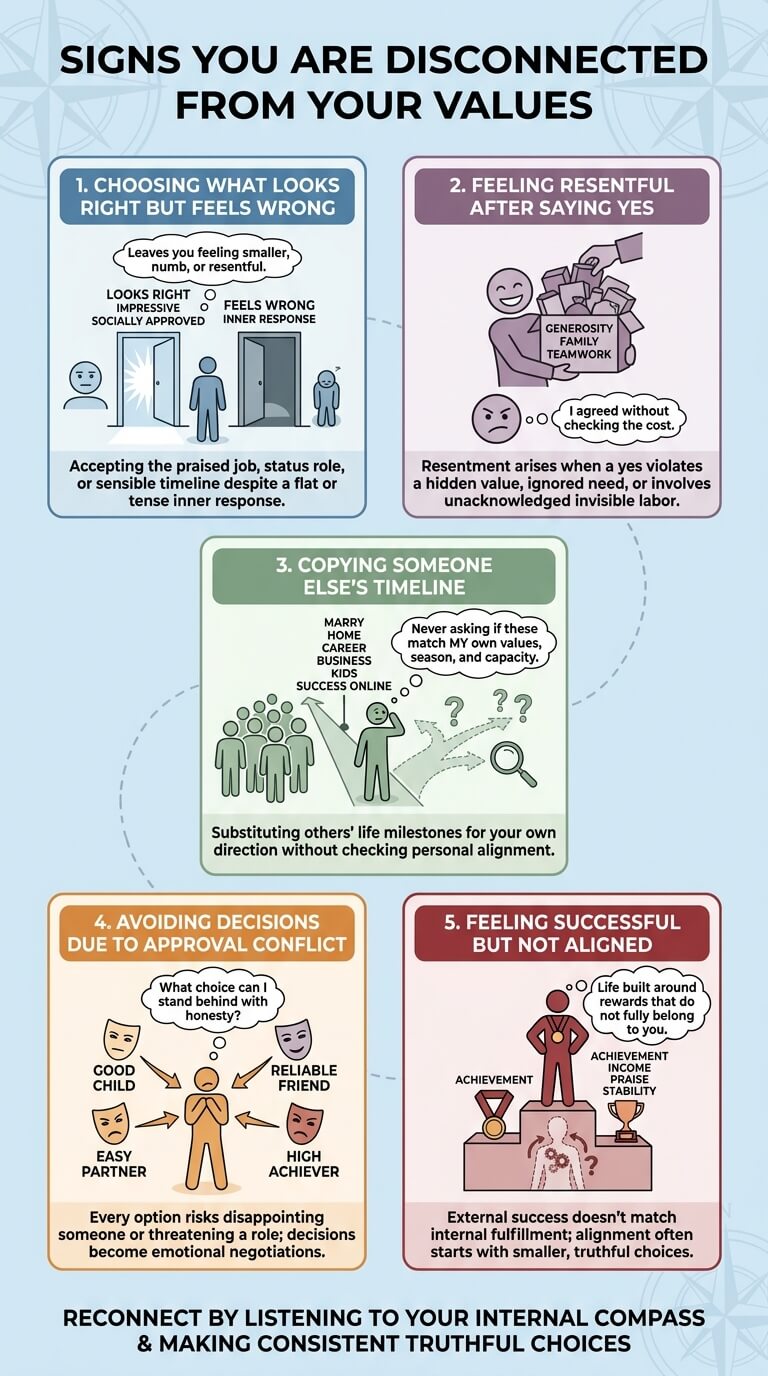
You keep choosing what looks right but feels wrong
A choice can look sensible, impressive, or socially approved and still feel wrong for your life. You may accept the job everyone praises, stay in the role that gives you status, or follow a timeline that makes sense to others, while your inner response stays flat or tense.
This does not always mean the choice is bad. Sometimes responsible choices feel heavy. But if the same “right” choices repeatedly leave you feeling smaller, numb, or resentful, your values may be asking for attention.
You feel resentful after saying yes
Resentment often appears when a yes violates a hidden value or ignored need. You may value generosity, but not endless availability. You may value family, but not being assigned every emotional responsibility. You may value teamwork, but not doing invisible labor that nobody acknowledges.
Resentment is not always proof someone else is wrong. Sometimes it is information: “I agreed without checking what this would cost me.”
You copy someone else’s timeline
When values are unclear, other people’s timelines can become substitutes for direction. You may copy when others marry, buy a home, change careers, start a business, have children, move cities, or display success online. The problem is not wanting similar things. The problem is never asking whether those things match your own values, season, and capacity.
You avoid decisions because every option threatens approval
Some people call themselves indecisive when the deeper issue is approval conflict. Every option risks disappointing someone. Every choice seems to threaten a role: the good child, the reliable friend, the easy partner, the high achiever, the strong one.
When approval is the main compass, decisions become emotional negotiations with imagined reactions. Values help return the question to your life: “What choice can I stand behind with honesty?”
You feel successful but not aligned
Misalignment can be confusing because from the outside nothing looks wrong. You may have achievement, income, praise, stability, or a respectable path. Yet internally, you feel like your life is built around rewards that do not fully belong to you.
This is one reason values work should be gentle, not dramatic. You do not have to burn down your life to listen to misalignment. Often, you begin by making smaller choices that tell the truth more consistently.
How to Identify Your Personal Values
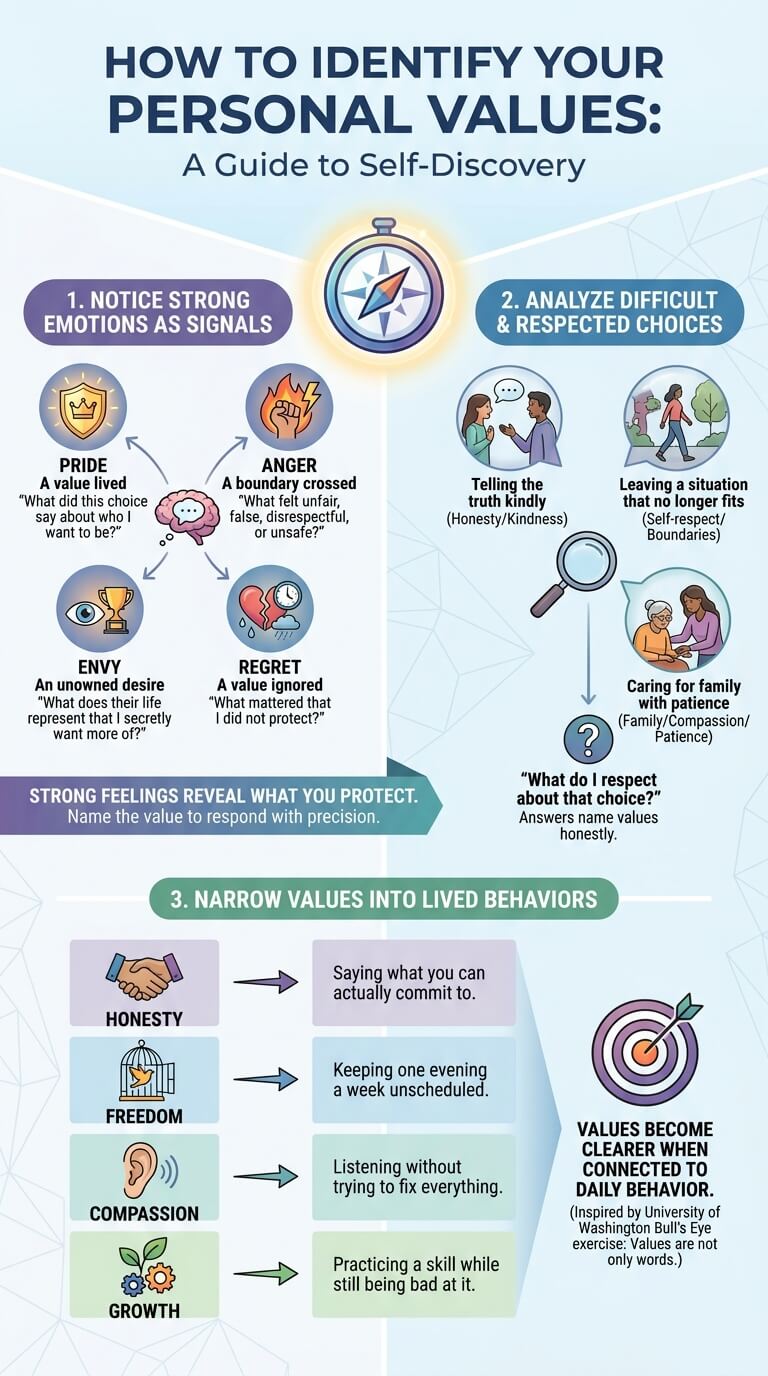
Notice moments of pride, anger, envy, and regret
Strong emotions often point toward values. Pride may show you what you respect in yourself. Anger may show you what feels violated. Envy may reveal a desire or value you have not allowed yourself to claim. Regret may show where comfort, fear, or approval overruled something important. Sometimes people know their values but still act against them when fear takes over. That does not always mean the values are fake; it may mean self-sabotage is interrupting the follow-through.
| Emotion | Possible value signal | Question to ask |
|---|---|---|
| Pride | A value you lived | “What did this choice say about who I want to be?” |
| Anger | A boundary or principle may have been crossed | “What felt unfair, false, disrespectful, or unsafe?” |
| Envy | A value or desire may be unowned | “What does their life represent that I secretly want more of?” |
| Regret | A value may have been ignored | “What mattered that I did not protect?” |
Ask what you are protecting when you feel strongly
When you feel unusually strong about something, ask what you are protecting. If you are upset about a broken promise, you may be protecting trust. If you feel tense when plans keep changing, you may be protecting stability. If you feel alive around creative work, you may be protecting expression.
The point is not to overanalyze every feeling. It is to notice the value underneath the reaction. Once you can name the value, you can respond with more precision.
Look at choices you respect even when they are difficult
Values often appear in the choices you respect, even when they are not easy. You may respect someone who tells the truth kindly, leaves a situation that no longer fits, cares for family with patience, admits a mistake, learns a craft slowly, protects their health, or refuses to win by humiliating others.
Ask yourself: “What do I respect about that choice?” The answer may name a value more honestly than a generic list ever could.
Narrow values into lived behaviors
A value becomes useful when it is translated into behavior. “Honesty” might mean saying what you can actually commit to. “Freedom” might mean keeping one evening a week unscheduled. “Compassion” might mean listening without trying to fix everything. “Growth” might mean practicing a skill while still being bad at it.
The University of Washington Bull’s Eye exercise is a values-clarification tool that asks people to identify valued life domains, notice barriers, and create a values action plan. Its most useful lesson is simple: values are not only words. They become clearer when you connect them to daily behavior.
How to Use Values Without Becoming Rigid
Values are directions, not perfection tests
A value is not a weapon to use against yourself. If you value health and miss a workout, you have not failed your identity. If you value honesty and avoid one difficult conversation, you are not a fraud. Values point you back toward a direction after ordinary human inconsistency. Values can be especially useful during an identity crisis. Even when you do not know exactly who you are becoming, values can show what kind of direction still feels honest.
This matters because people with a strong inner critic can turn values into another standard to fail. The question is not “Did I live this value perfectly?” A kinder and more useful question is, “What is one next choice that moves me a little closer?”
One value can conflict with another
Values conflict is normal. You may value loyalty and honesty, but telling the truth may disappoint someone you love. You may value security and freedom, but a choice that offers freedom may include uncertainty. You may value achievement and rest, but your schedule may force a tradeoff.
Values do not remove tradeoffs. They help you make tradeoffs consciously. Instead of pretending there is one perfect answer, you can say, “In this season, which value needs priority, and what value do I need to protect in a smaller way?”
Values-based choices still require flexibility
A values-based life is not rigid. If your value is family, flexibility may mean showing up in different ways when work, distance, health, or capacity change. If your value is creativity, flexibility may mean creating in short blocks rather than waiting for perfect conditions. If your value is service, flexibility may mean helping without rescuing.
Acceptance and Commitment Therapy often uses values as part of committed action, which means choosing behavior linked to what matters even when discomfort is present. A PubMed Central paper on the valuing process in ACT discusses how experts define and measure valuing, which supports the idea that values are lived through ongoing choices rather than one final declaration.
How Personal Values Help You Understand Who You Are
How values clarify identity during an identity crisis
During an identity crisis, old roles may stop fitting before a new identity is clear. Values can create a bridge during that uncertain period. You may not know the exact job, relationship structure, city, or future you want, but you may know you want more honesty, freedom, stability, creativity, learning, faith, community, or peace.
That is why values are helpful during transition. They do not require a final life answer. They help you choose the next honest experiment.
How values counter the inner critic’s impossible standards
The inner critic often speaks in impossible standards: never fail, never need help, never disappoint, never be behind. Values give you a more human standard. If your value is courage, the question is not whether you felt fear. It is whether you took a meaningful step with fear present. If your value is kindness, the question is not whether everyone approved. It is whether you acted with care and honesty.
Values can soften self-criticism because they move your attention from identity verdicts to chosen direction.
How values reveal self-sabotage patterns
Self-sabotage often protects you from discomfort, exposure, responsibility, or possible disappointment. Values can reveal the cost. If you value connection but avoid every honest conversation, the avoidance is protecting comfort while costing closeness. If you value growth but only act when success is guaranteed, the avoidance is protecting pride while costing learning.
Seeing the value cost does not mean shaming yourself. It means asking whether the protection is still worth the price.
When to Get Support
When values conflict is tied to coercion, fear, threats, or unsafe pressure
Values work is not enough when someone is using fear, threats, humiliation, isolation, surveillance, financial pressure, or retaliation to control your choices. In those situations, the priority is safety and support, not perfect communication or private reflection. You do not have to prove that your values are valid before you deserve help.
If relationship or family pressure feels unsafe, resources such as the National Domestic Violence Hotline can help explain emotional abuse and controlling behavior. If there is immediate danger, contact local emergency services or a trusted local support option.
When decision paralysis comes with severe anxiety or distress
Values can help with direction, but they are not a substitute for mental health care. If decision-making comes with panic, hopelessness, intense shame, intrusive thoughts, self-harm thoughts, or severe distress, it may be time to talk with a qualified professional. The National Institute of Mental Health offers general guidance on caring for mental health and recognizing when support may be needed.
Getting support does not mean you failed at self-awareness. It means the situation deserves more care than a private exercise can provide.
FAQ About Personal Values Psychology
What are examples of personal values?
Examples of personal values include honesty, loyalty, freedom, creativity, compassion, courage, stability, learning, fairness, family, faith, health, independence, service, curiosity, responsibility, peace, and excellence. The most important question is not whether a value sounds impressive. It is whether it actually guides choices you respect and want to practice.
How do I know if a value is really mine?
A value is more likely to be yours if it still matters when nobody is rewarding you, if you respect it in action, and if ignoring it repeatedly leaves you feeling misaligned. A copied value usually feels more like pressure, image management, fear, or obligation. Some values are inherited from family or culture and still genuinely yours, but they should feel chosen, not only enforced.
Can personal values change?
Yes. Some values remain stable for a long time, while others change in priority as your life stage, responsibilities, relationships, health, culture, or experiences change. A shift in values does not mean you were fake before. It may mean you are updating your life around what now matters more clearly.
What if my values conflict with my family or culture?
Values conflict with family or culture can be emotionally difficult because it may involve belonging, loyalty, identity, faith, safety, and approval. Move carefully. You may need to separate private clarity from immediate action. If disagreement could lead to threats, retaliation, violence, severe isolation, or financial control, prioritize safety and outside support before confrontation.
How many core values should I choose?
For practical self-awareness, three to five core values is often easier to use than a long list. A long list can become too vague. A shorter list forces you to ask what truly guides your decisions in this season. You can still care about many things, but your core values should help you choose when tradeoffs appear.
Key Takeaways
- Personal values are guiding directions, not goals, rules, preferences, or perfection tests.
- Values help connect self-awareness with action, especially when decisions feel noisy or approval-driven.
- Strong emotions such as pride, anger, envy, and regret can reveal values that need attention.
- Values can conflict with each other, so aligned choices still require tradeoffs and flexibility.
- Values are most useful when translated into lived behavior, not kept as impressive words.
- If values conflict involves coercion, threats, unsafe pressure, or severe distress, support and safety come first.
Final Thoughts
Personal values are not meant to trap you inside a perfect identity. They are meant to help you come back to yourself when guilt, comparison, fear, approval, or old roles get too loud. Start with one value that feels real in this season, then ask what small behavior would express it this week. The answer does not need to be dramatic. It only needs to be honest enough to move your life one step closer to alignment. Values are part of self-awareness because they reveal what you want your choices to be guided by, especially when approval, fear, guilt, or comparison is loud.

Michael Reed is the Founder and Lead Writer at Psychology Exposed. He writes about human behavior, relationships, emotional patterns, self-awareness, and practical psychology topics using research-informed, easy-to-understand content.
Read More About Michael Reed: https://psychologyexposed.com/michael-reed/