

Self-awareness can sound simple until you try to use it in real life. You may notice that you overexplain when you feel judged, avoid decisions when you feel uncertain, or chase approval even when you know it leaves you drained. The question is not only “Why do I do that?” It is also “What belief about myself is guiding that reaction?”
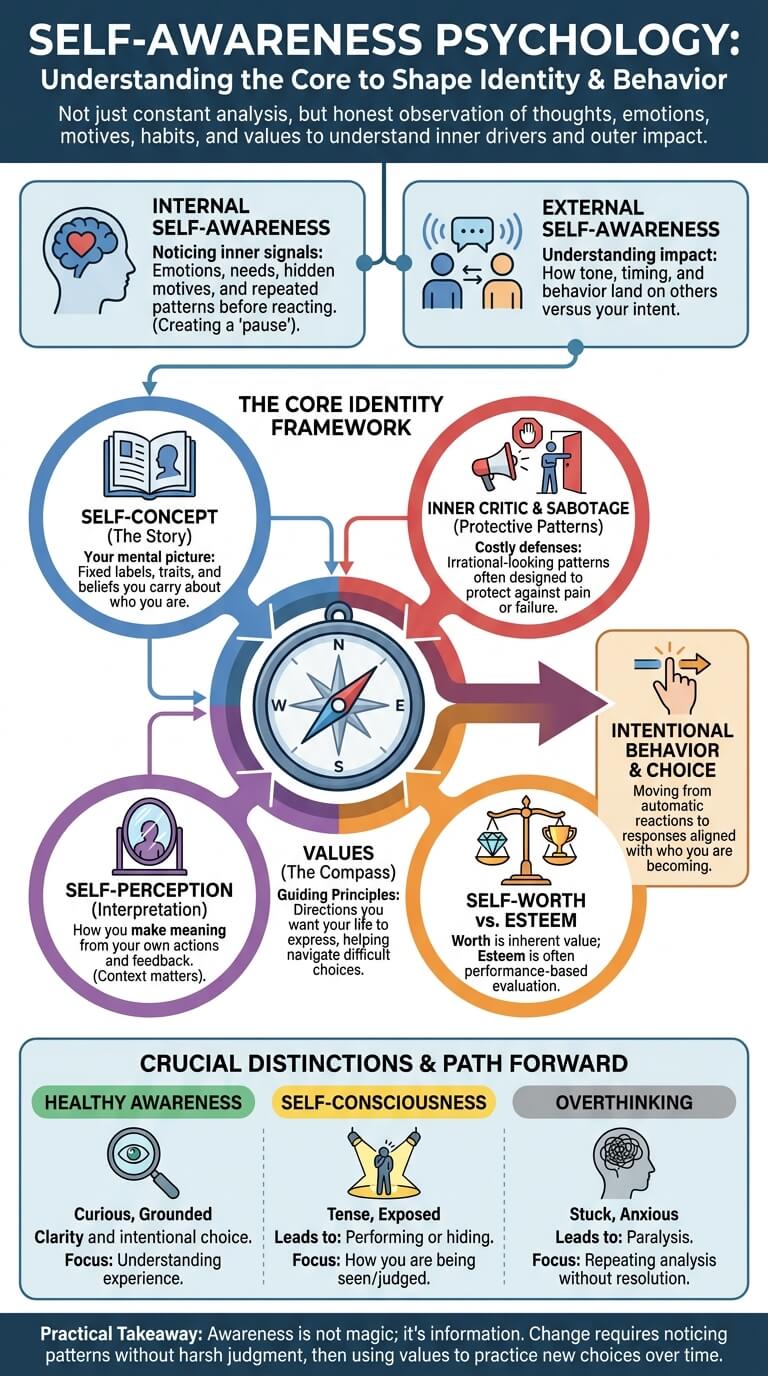
In psychology, self-awareness is not the same as constant self-analysis. It is the ability to notice your thoughts, emotions, motives, habits, values, and impact with enough honesty to understand yourself more clearly. It can help you see the difference between a real need, an old fear, a repeated story, and a choice that no longer fits who you are becoming.
This overview gives you the big map: self-concept, self-perception, identity confusion, self-esteem, self-worth, self-sabotage, inner criticism, personal values, and self-understanding. It does not replace therapy, and it is not meant to diagnose you. It is a practical starting point for making sense of the self-beliefs that shape everyday behavior.
Quick Answer
A simple definition of self-awareness in psychology
Self-awareness in psychology means paying attention to yourself as a person with thoughts, feelings, motives, habits, values, strengths, limits, and social impact. The APA Dictionary of Psychology defines self-awareness as self-focused attention or knowledge. In everyday life, that means you can observe what is happening inside you without automatically believing every thought or obeying every impulse.
What self-awareness helps you notice and what it cannot solve by itself
Self-awareness helps you notice patterns before they run your life. You might recognize that criticism makes you defensive, loneliness makes you chase unavailable people, or unclear values make every option feel equally wrong. But awareness is not magic. Knowing a pattern exists does not always change it immediately. Change usually needs practice, support, safer environments, repeated choices, and sometimes professional help.
What Self-Awareness Means in Psychology

Internal self-awareness: noticing thoughts, emotions, needs, and patterns
Internal self-awareness is the ability to notice what is happening inside you. This includes your emotions, body signals, thoughts, needs, motives, assumptions, and repeated reactions. For example, you might notice that you are not only angry, but embarrassed. You might realize that you are not only procrastinating, but afraid of being seen as mediocre.
This type of awareness is useful because many people react before they understand what is driving the reaction. A person may say yes to avoid guilt, then feel resentful. Another person may criticize themselves before anyone else can, then call it “being realistic.” Internal awareness creates a small pause between experience and response. In that pause, you can ask: “What am I feeling, what story am I telling, and what do I actually need?”
External self-awareness: understanding how you may come across to others
External self-awareness is the ability to consider how your behavior may affect other people. It does not mean obsessing over whether everyone likes you. It means being able to recognize that your tone, timing, facial expression, withdrawal, or repeated habits may land differently from your intention.
For instance, you may intend to be helpful, but your advice may sound impatient. You may intend to protect your peace, but your silence may feel punishing to someone else. External awareness helps you hold both sides at once: “I know what I meant, and I can still care about how it affected someone.” That balance matters in relationships, leadership, parenting, friendship, and conflict repair.
Self-awareness vs self-consciousness vs overthinking
| Concept | What it focuses on | How it feels | Useful direction |
|---|---|---|---|
| Self-awareness | Understanding your inner experience and impact | Clearer, grounded, curious | Notice patterns and make more intentional choices |
| Self-consciousness | How you are being seen or judged | Tense, exposed, monitored | Separate real feedback from imagined scrutiny |
| Overthinking | Repeating analysis without resolution | Stuck, anxious, mentally crowded | Return to facts, needs, values, and one next step |
Self-awareness gives you information. Self-consciousness often makes you feel watched. Overthinking circles around the same question without helping you act. The difference matters because people sometimes mistake self-awareness for being hard on themselves. A more useful version of self-awareness is curious, specific, and humane.
Why Self-Awareness Matters for Identity
How self-beliefs influence choices and relationships
Your self-beliefs quietly shape what you allow, avoid, pursue, and repeat. If you believe you are only lovable when useful, you may overgive. If you believe your needs are too much, you may hide them until resentment builds. If you believe failure proves something permanent about you, you may avoid risks that would help you grow.
Self-awareness makes these beliefs visible. Once they are visible, they become easier to question. You can ask whether a belief is accurate, inherited, outdated, protective, or based on a narrow season of life. This is not about forcing yourself to think positively. It is about seeing the rulebook you have been living by, then deciding which rules still deserve authority.
Why unclear identity can make decisions feel unstable
Identity gives decisions a center. When your sense of self is unclear, even small choices can feel loaded. You may choose based on who is watching, what avoids conflict, what earns approval, or what feels safest in the moment. That can create a life that looks functional from the outside but feels disconnected on the inside.
Research on identity development often describes identity as something that forms through exploration, commitment, relationships, and life transitions. A review in PubMed Central on identity development notes that identity development involves both maturation and stability across adolescence and early adulthood. Adults continue to refine identity as roles, relationships, losses, cultures, work, and values change.
When self-awareness becomes harsh self-monitoring
Self-awareness becomes less helpful when it turns into constant surveillance. Instead of “What am I noticing?” the question becomes “What is wrong with me now?” This can happen when a person uses introspection as a way to prevent rejection, avoid mistakes, or stay ahead of criticism.
A good test is whether your reflection leaves you with more clarity or more shame. Helpful awareness sounds like: “I can see why I reacted that way, and I can choose differently next time.” Harsh self-monitoring sounds like: “I always ruin everything.” The first creates responsibility. The second creates fear. Responsibility can support change; fear often makes patterns more rigid. A pattern can be especially confusing when part of you wants change while another part keeps interrupting it. In those moments, self-sabotage may be less about laziness and more about protection that has become too costly.
The Core Framework: Beliefs, Perception, Identity, Worth, and Direction

Self-concept as the story you carry about who you are
Self-concept is the mental picture you have of yourself. It includes your traits, roles, abilities, body image, social identity, personal history, and the way you describe yourself in your own mind. The APA Dictionary of Psychology entry on self-concept describes it as a person’s description and evaluation of the self, including qualities, skills, roles, and characteristics.
When self-concept is flexible, you can update your view of yourself with new evidence. When it is rigid, one mistake may feel like proof of your whole identity. A flexible self-concept might say, “I handled that poorly today.” A rigid one might say, “I am bad at relationships.” Self-awareness helps you catch when a temporary behavior becomes a permanent label.
Self-perception as how you interpret your behavior and feedback
Self-perception is how you make meaning from what you do and what others reflect back to you. You may infer that you are “lazy” because you avoid a project, when the deeper issue is fear, boredom, lack of support, or unclear priorities. You may infer that you are “too sensitive” because someone dismissed your reaction, when your feeling may contain useful information.
The APA Dictionary of Psychology describes self-perception theory as the idea that people may infer attitudes, beliefs, traits, or states by observing their own behavior. That is useful, but it has a limitation: behavior needs context. One action rarely tells the whole truth about who you are.
Values as the compass behind decisions
Personal values are the qualities, principles, or directions you want your life to express. They can include honesty, stability, creativity, kindness, learning, independence, family, courage, fairness, spirituality, service, or adventure. Values are not the same as goals. A goal is something you finish. A value is a direction you keep returning to.
Self-awareness becomes practical when values enter the picture. Instead of asking only “What do I feel like doing?” you can ask “What choice is closer to the kind of person I want to practice being?” Values do not remove discomfort, but they reduce confusion. They give you a reason to tolerate temporary discomfort for a decision that fits your deeper direction.
Inner critic and self-sabotage as protective but costly patterns
The inner critic and self-sabotage often look irrational from the outside, but they may have protective logic. The inner critic may try to keep you from rejection by criticizing you first. Self-sabotage may try to keep you from disappointment by making failure feel controlled. These patterns can be costly because they protect you from pain by limiting your life.
Self-awareness does not require you to hate these parts of yourself. A better first step is to ask what they are trying to prevent. Are they trying to prevent embarrassment, abandonment, failure, guilt, envy, conflict, or vulnerability? Once the protective motive is clearer, you can look for a less costly way to meet the same need.
Key Areas of Self-Awareness Psychology

Self Concept Psychology: the mental model you have of yourself
Self-concept psychology looks at the story you carry about who you are. It asks how you describe yourself, what labels feel fixed, which roles define you, and how your past experiences shape your current identity. This topic is useful when you keep saying things like “I am just not that kind of person” or “I have always been this way.” One useful part of self-awareness is noticing the story you already carry about who you are. That story is your self-concept, and it can shape what feels possible, familiar, or not like you.
A deeper self-concept guide can explore how people form self-beliefs, how labels become limits, and how a person can update their self-image without pretending the past never happened. In this overview, the key question is simple: “What story about myself am I treating as permanent?”
Self Perception Psychology: how you infer who you are from actions and feedback
Self-perception psychology focuses on how you interpret your own behavior. You may assume that your action reveals your true character, but behavior can come from stress, environment, habit, fear, social pressure, unmet needs, or limited options. This topic matters when you judge yourself quickly after a single reaction, mistake, or choice. Self-awareness also depends on how fairly you interpret your own behavior. Your self-perception can make the same mistake feel like useful feedback or proof that something is wrong with you.
A deeper self-perception guide can explore how people draw conclusions from feedback and behavior, including why those conclusions may be incomplete. For now, the key distinction is this: self-perception is one lens inside self-awareness, not the whole picture of identity.
Identity Crisis Psychology: why transitions can make the self feel uncertain
An identity crisis does not always look dramatic. It can look like waking up one day and realizing that your life fits an older version of you. It can appear after a breakup, job change, relocation, loss, health shift, parenthood, graduation, aging milestone, cultural transition, or long period of people-pleasing.
A deeper identity crisis guide can explore why transitions disrupt the self, how uncertainty differs from failure, and what signs suggest a person is in a meaningful identity reorganization rather than simply having a bad week. Here, identity confusion is one important reason people often seek self-awareness. Sometimes self-awareness becomes more urgent during a life transition, when old roles no longer feel true but a new identity has not fully formed. That experience can feel like an identity crisis rather than simple indecision.
Self Esteem vs Self Worth: performance-based confidence vs inherent value
Self-esteem and self-worth are often used together, but they are not identical. Self-esteem usually relates to how positively you evaluate yourself, often including competence, approval, achievement, or social comparison. The APA Dictionary of Psychology definition of self-esteem connects it to how positively qualities in the self-concept are perceived. This is also where it helps to separate confidence from deeper value. The difference between self-esteem and self-worth can explain why praise feels good for a moment but does not always create inner steadiness.
Self-worth points to a deeper question: “Do I believe I have value even when I fail, disappoint someone, change roles, or cannot perform?” A deeper comparison can explore that difference in detail. The boundary matters because confidence and inherent human value are not the same thing.
Self Sabotage Psychology: why people block what they consciously want
Self-sabotage psychology examines why people sometimes work against their stated goals, relationships, health, or opportunities. It may involve avoidance, procrastination, choosing unavailable people, provoking conflict, quitting before being evaluated, or staying loyal to an identity built around struggle.
This topic should not be reduced to laziness or lack of discipline. In this cluster, self-sabotage belongs to identity and self-beliefs, not productivity. A deeper self-sabotage guide can ask what the behavior protects, what fear it avoids, and what belief makes success feel unsafe, unfamiliar, undeserved, or socially risky.
Inner Critic Psychology: how self-criticism becomes an inner voice
The inner critic is the internal voice that attacks, warns, compares, shames, or predicts failure. Sometimes it sounds like your own thoughts. Sometimes it echoes family, school, culture, past rejection, or high-pressure environments. It may claim to protect you by keeping you prepared, humble, or alert.
A deeper inner critic guide can explore the difference between useful self-correction and harsh self-attack. It can give readers language for noticing the critic without automatically obeying it. At the map level, inner criticism matters because it shapes self-awareness, but it is only one part of the identity system.
Personal Values Psychology: how values clarify decisions
Personal values psychology helps explain why some choices feel right on paper but wrong in the body. You may have the opportunity, the approval, and the logic, yet still feel misaligned because the choice violates a value you have not named. Values help turn self-awareness into direction. When self-awareness feels too abstract, values can make it more practical. Your personal values help you see what you want to move toward, not only what you want to avoid.
A deeper values guide can show how to identify values, separate chosen values from inherited expectations, and use values during decisions. In the larger self-awareness framework, values function as the compass that helps turn insight into direction.
How to Understand Yourself Psychology: a practical self-inquiry guide
Understanding yourself is not only about thinking harder. It involves noticing patterns, asking better questions, observing choices over time, listening to emotional signals, reviewing feedback carefully, and testing small changes. It is both reflective and behavioral.
A practical self-understanding guide can give readers a structured way to examine themselves without spiraling into self-blame. It can include questions, journaling prompts, pattern tracking, and first steps. The larger principle is that self-understanding works best when you can connect thoughts, feelings, values, self-beliefs, and behavior. If you want a more practical next step, it can help to slow the process down into questions about facts, feelings, meanings, needs, and choices. That is often a better way to understand yourself than trying to solve your whole identity at once.
Decision Guide: Which Self-Awareness Article Should You Read Next?

If you feel confused about who you are
Start with identity and self-concept. Ask whether your confusion is about roles, values, relationships, work, culture, life stage, or a version of yourself that no longer fits. If the confusion began after a major transition, the identity crisis topic may be the most useful next step. If the confusion is more about labels you have carried for years, self-concept may be the better doorway.
If you keep judging yourself harshly
Start with inner critic, self-esteem, and self-worth. The central question is not only “How do I stop negative thoughts?” It is “What standard am I using to decide whether I am acceptable?” If your self-evaluation rises and falls with performance, approval, appearance, productivity, or comparison, the self-esteem vs self-worth article will likely clarify the difference.
If you repeat patterns you do not understand
Start with self-perception and self-sabotage. Repeated patterns usually carry information, but the first interpretation is not always the most accurate one. Instead of labeling yourself as lazy, broken, dramatic, avoidant, or difficult, look at the pattern’s function. What does it help you avoid? What does it help you control? What does it cost later?
If you need clearer values or direction
Start with personal values and the practical self-understanding guide. Values are especially helpful when there is no perfect choice. They help you choose based on direction rather than pressure, fear, guilt, or short-term approval. If you feel pulled by everyone else’s expectations, values work can help you hear your own priorities more clearly.
Common Misunderstandings About Self-Awareness
Self-awareness is not the same as fixing yourself
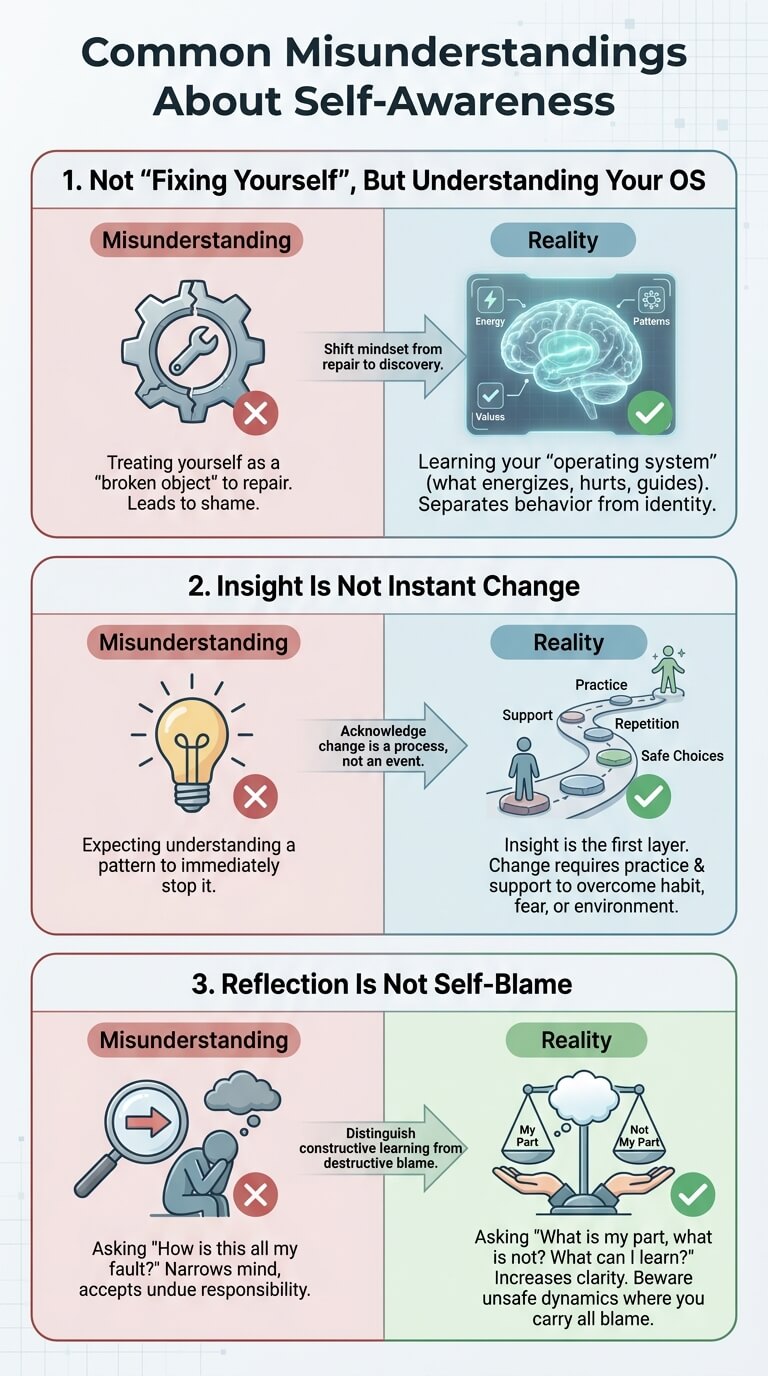
Many people approach self-awareness as if they are a broken object that needs repair. That mindset can create shame before the work even begins. Self-awareness is better understood as learning your own operating system: what energizes you, what hurts you, what protects you, what patterns repeat, and what matters enough to guide your choices.
You can take responsibility for a behavior without treating your whole self as defective. You can admit that a reaction caused harm without turning the moment into a permanent identity. This distinction is crucial. Shame tends to collapse the self. Awareness helps you separate the behavior, the feeling, the belief, and the next choice.
Insight does not always create instant behavior change
It is common to understand a pattern and still repeat it. That does not mean the insight was fake. It means the pattern may be tied to habit, nervous system activation, social environment, fear, reward, identity, or relationships that keep reinforcing it.
For example, you may realize you say yes to avoid disappointing people, but still feel panic the next time you say no. You may understand that your inner critic is harsh, but still hear it when you try something new. Awareness is often the first layer. Repetition, practice, support, and safer choices turn insight into change.
Being reflective is not the same as blaming yourself
Reflection asks, “What is my part, what is not my part, and what can I learn?” Self-blame asks, “How is this all my fault?” These questions lead to different outcomes. Reflection increases clarity. Self-blame narrows the mind and often makes people accept responsibility for things outside their control.
This matters especially in relationships and families. Self-awareness should not be used to excuse someone else’s cruelty, control, humiliation, or threats. If reflection always ends with you carrying all the blame, the issue may not be a lack of self-awareness. It may be an unsafe or unfair dynamic that requires support, boundaries, or protection.
When to Get Support
Persistent distress, shame, hopelessness, or identity confusion
Self-awareness can bring up uncomfortable material. It may reveal grief, regret, anger, shame, loneliness, or confusion that has been pushed aside for a long time. If these feelings become persistent, interfere with daily life, or make you feel hopeless, support from a qualified mental health professional may be appropriate. Mental health includes emotional, psychological, and social well-being, not only the absence of a diagnosed condition.
When self-criticism includes self-harm thoughts or severe anxiety
If self-criticism includes thoughts of self-harm, feeling like others would be better off without you, or urges to hurt yourself, treat that as a serious signal. You deserve immediate support. Contact local emergency services, a crisis hotline in your country, or a trusted person who can stay with you while you get help. NIMH provides education on warning signs that someone may be thinking about suicide, including changes in behavior and expressions of unbearable pain.
When relationships involve fear, coercion, threats, or humiliation
Self-awareness is valuable, but it should not be used to make you tolerate mistreatment. If a relationship includes fear, coercion, threats, stalking, humiliation, isolation, retaliation, or pressure to doubt your reality, prioritize safety and outside support over communication techniques. The National Domestic Violence Hotline describes abuse as patterns involving power and control, which can include nonphysical tactics as well as physical violence.
FAQ About Self Awareness Psychology
What is self-awareness in psychology?
Self-awareness in psychology is the ability to notice and understand yourself as the subject of your own experience. It includes awareness of thoughts, emotions, motives, behavior, values, self-beliefs, and how you may affect others. It is not only introspection. It also includes checking whether your self-view matches your behavior, feedback, and real-life patterns.
Can you be too self-aware?
You can become overfocused on yourself in a way that feels tense, ashamed, or mentally stuck. That is usually closer to self-consciousness, rumination, or harsh self-monitoring than balanced self-awareness. Helpful self-awareness creates clearer choices. Unhelpful self-focus makes you feel trapped in analysis and afraid of every reaction. Self-awareness is harder when your inner voice turns every mistake into a character verdict. If that happens often, the inner critic may be shaping what you notice about yourself.
How is self-awareness different from self-esteem?
Self-awareness is about noticing and understanding yourself. Self-esteem is about how positively you evaluate yourself. A person can have high self-awareness and still struggle with low self-esteem, especially if they notice their flaws more easily than their strengths. A person can also appear confident but lack awareness of their impact on others.
Does self-awareness change personality?
Self-awareness does not instantly change personality, but it can influence behavior, choices, relationships, and identity over time. When you understand your patterns, you may respond differently, choose different environments, practice new skills, and stop treating old labels as permanent. Personality is not a switch, but self-awareness can support gradual, intentional change.
What is the first step to understanding yourself better?
Start by observing one repeated pattern without judging it too quickly. Choose something specific, such as saying yes when you mean no, avoiding feedback, comparing yourself to others, or feeling unsettled after certain conversations. Ask what happened, what you felt, what you believed it meant, and what you needed. Specific observation is usually more useful than a broad question like “Who am I?”
Key Takeaways
- Self-awareness is the ability to notice your inner experience, behavior, values, self-beliefs, and impact with honesty and curiosity.
- Self-awareness is different from self-consciousness and overthinking because it should lead to clearer understanding, not constant self-surveillance.
- Your self-concept, self-perception, values, inner critic, and self-worth all shape how you interpret yourself and make decisions.
- Identity confusion often becomes stronger during transitions because old roles, values, and self-beliefs may no longer fit your current life.
- Insight is useful, but change usually requires practice, supportive environments, safer choices, and sometimes professional help.
- If self-reflection turns into hopelessness, self-harm thoughts, or pressure to tolerate coercion or humiliation, support and safety matter more than self-analysis.
Final Thoughts
A useful first step is to choose one area of your life where your behavior feels confusing and observe it for a week. Do not start with the biggest wound or the harshest label. Start with one pattern you can watch clearly. Write down what happened, what you felt, what story you told yourself, what you needed, and what choice moved you closer to your values.
Self-awareness is not about becoming perfectly analyzed. It is about becoming more honest, more grounded, and less ruled by automatic beliefs. When you understand the story you carry about yourself, you are better able to decide which parts still protect you, which parts limit you, and which parts are ready to be rewritten through action.

Michael Reed is the Founder and Lead Writer at Psychology Exposed. He writes about human behavior, relationships, emotional patterns, self-awareness, and practical psychology topics using research-informed, easy-to-understand content.
Read More About Michael Reed: https://psychologyexposed.com/michael-reed/